
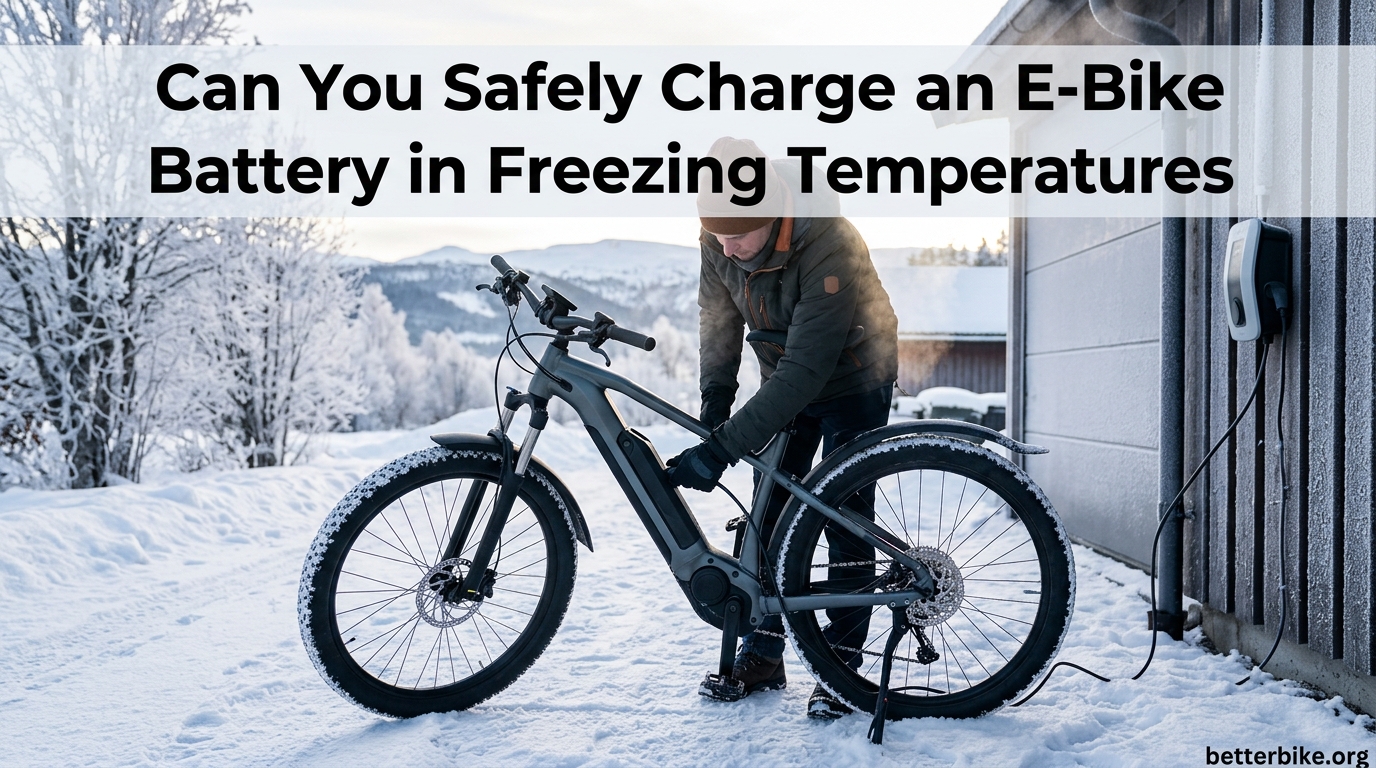
It is a question that crosses every winter commuter’s mind at some point: you get home from a freezing ride, your battery is nearly dead, and you just want to plug it in and get ready for tomorrow. But can you safely charge an e-bike battery in freezing temperatures? The short answer is no, and getting this wrong can permanently damage a battery that costs hundreds or even thousands of dollars to replace.
Our team has spent years researching lithium-ion battery behavior, testing cold-weather commuting strategies, and digging through hundreds of forum threads from real e-bike riders who have dealt with winter battery problems firsthand. What we found is that most riders know cold weather reduces range, but far fewer understand the specific danger of charging a cold battery.
The confusion is understandable. Your charger might show a green or red light. The battery might accept some charge. Everything looks like it is working fine. But inside the cells, irreversible damage may already be happening.
This guide covers everything you need to know about charging e-bike batteries in cold weather. We explain the science behind lithium plating, provide a step-by-step safe charging procedure, show you how to tell if your battery has already been damaged, and walk through real commuter scenarios like charging at work or dealing with an unheated garage.
If you take away one thing from this article, let it be this: never charge an e-bike battery that is below 32 degrees Fahrenheit (0 degrees Celsius). Wait for it to warm up first. Everything else in this guide explains why that rule exists and how to follow it in the real world.
Table of Contents
Quick Answer
No. Never charge an e-bike battery below 32 degrees Fahrenheit (0 degrees Celsius). Charging a cold lithium-ion battery causes lithium plating, which permanently reduces capacity, increases internal resistance, and in severe cases can lead to dendrite growth that creates a thermal runaway risk. Always bring the battery to room temperature (ideally above 50 degrees Fahrenheit or 10 degrees Celsius) and wait 2 to 3 hours before plugging in the charger.
The Short Answer: Why 32 Degrees Fahrenheit Is the Hard Line
Every major battery manufacturer and e-bike brand sets the same threshold: do not charge below 32 degrees Fahrenheit (0 degrees Celsius). This is not a conservative suggestion or a guideline with wiggle room. It is a hard physical limit based on how lithium-ion chemistry works.
Below freezing, the electrolyte inside the battery becomes thicker and more viscous. Lithium ions that normally slide smoothly into the graphite anode during charging cannot move fast enough. Instead of inserting themselves into the anode structure through a process called intercalation, they pile up on the surface and form metallic lithium deposits. This is lithium plating, and it is permanent.
Once lithium plates onto the anode, that lithium is no longer available to store energy. Your battery loses capacity, and there is no way to reverse it. Some of the plated lithium can slowly dissolve back during discharge, but a significant portion becomes permanent capacity loss.
The plating also creates a secondary problem. Over time, those metallic deposits can grow into needle-like structures called dendrites. If a dendrite grows long enough to pierce the separator between the anode and cathode, it creates an internal short circuit. That short circuit can trigger thermal runaway, an uncontrolled heat event that can lead to a battery fire.
This is why every reputable source draws the line at 32 degrees Fahrenheit. Not because the battery will immediately explode, but because every cold charge increases the risk of permanent damage and safety hazards. The damage may be invisible at first, but it accumulates over time.
Why Cold Charging Destroys E-Bike Batteries: The Science
To understand why cold charging is so destructive, we need to look at what happens inside a lithium-ion battery at the chemical level. You do not need an engineering degree to follow this, but understanding the basics will make you a much smarter e-bike owner.
Lithium Plating Explained
During normal charging, lithium ions travel from the positive electrode (cathode) through the electrolyte and insert themselves into layers of graphite on the negative electrode (anode). This process is called intercalation, and it is what stores energy in your battery.
Think of it like parking cars in a parking garage. Lithium ions are the cars, and the graphite anode is the garage with designated parking spots. At normal temperatures, the ions flow smoothly into their spots.
When the battery is cold, two things go wrong. First, the electrolyte thickens, so the ions move more slowly through it. Second, the chemical reactions at the anode surface slow down. The ions arrive at the anode but cannot insert themselves into the graphite fast enough.
Instead of parking inside the garage, the ions pile up outside. They convert from ions into metallic lithium on the surface of the anode. This metallic lithium is not supposed to be there. It is dead weight that does not contribute to energy storage.
The colder the battery and the higher the charging current, the worse the plating. This is why fast charging a cold battery is especially destructive. Even a standard 2-amp charger can cause significant plating at freezing temperatures.
Electrolyte Viscosity and Ion Flow
The electrolyte is the liquid medium inside the battery that allows lithium ions to move between electrodes. At room temperature, it flows easily, like water. Ions move through it quickly and efficiently.
As temperature drops, the electrolyte becomes thicker and more viscous. Imagine trying to run through waist-deep water instead of air. That is essentially what the lithium ions experience when the electrolyte thickens in the cold.
This increased viscosity has two effects that compound each other. The ions travel more slowly, which means they arrive at the anode surface later than expected. And the anode surface reactions slow down too, so even the ions that do arrive cannot insert quickly enough.
The result is a traffic jam at the anode surface. Ions pile up, and plating begins. At 14 degrees Fahrenheit (-10 degrees Celsius), the electrolyte viscosity is so high that charging becomes almost entirely plating rather than intercalation.
This is also why cold batteries show reduced capacity during discharge. The thick electrolyte slows ion movement in both directions, reducing the effective capacity and causing voltage sag under load. Forum riders often report their battery percentage dropping suddenly during cold rides. That is voltage sag in action.
Dendrite Growth and Safety Risks
Lithium plating is bad enough because it permanently reduces capacity. But the more dangerous consequence is dendrite growth.
Dendrites are microscopic fingers of metallic lithium that grow from the plated deposits on the anode surface. They grow slowly over time, but each cold charging event adds more metallic lithium for them to build from. Think of them like icicles forming on a roof edge, growing longer and sharper with each freeze cycle.
The battery contains a thin separator between the anode and cathode. This separator is only about 20 to 25 microns thick, less than a human hair. If a dendrite grows long enough to pierce this separator, it creates a direct electrical connection between the anode and cathode.
This internal short circuit can trigger thermal runaway. The battery rapidly self-heats, potentially reaching temperatures above 1,000 degrees Fahrenheit. The cells vent flammable gases, and once ignition occurs, the fire is extremely difficult to extinguish because the battery generates its own oxygen.
Now, a single cold charge is unlikely to grow a dendrite long enough to pierce the separator. The real danger comes from repeated cold charging over weeks or months. Each event adds more metallic lithium to the anode surface, giving dendrites more material to grow from. This is why consistent cold charging is far more dangerous than a single accidental incident.
Forum users who report their battery BMS shut down in extreme cold as a protective measure are actually experiencing a good thing. That shutdown is the BMS trying to protect the battery from exactly this kind of damage. But not all BMS units are equally effective, which we will cover shortly.
E-Bike Battery Temperature Thresholds: Complete Guide
Different temperature ranges affect your battery in different ways. Understanding these ranges helps you make smart decisions about when to charge, when to store, and when to ride.
Below is a comprehensive breakdown of temperature ranges and what they mean for your e-bike battery. Use this as your reference guide throughout the winter season.
Below 14 Degrees Fahrenheit (-10 Degrees Celsius): Extreme Cold
At these temperatures, your battery is essentially in survival mode. Do not charge under any circumstances. Do not ride if you can avoid it. If you must ride, expect range reduction of 50 percent or more.
Store the battery indoors at room temperature. If the battery is on the bike in an unheated space at these temperatures, remove it immediately and bring it inside.
The electrolyte is so thick that ion movement is severely restricted. Even discharging causes stress on the cells. Some BMS units will shut down entirely to protect the battery, which riders on forums have reported as a sudden power cut during rides.
14 to 32 Degrees Fahrenheit (-10 to 0 Degrees Celsius): Cold
This is the danger zone for charging. Never plug in your charger when the battery is in this range. Lithium plating will occur, and the colder the temperature, the faster it happens.
You can ride in this temperature range, but expect 30 to 50 percent range reduction. The battery can discharge safely in the cold, but it will deliver less total energy and show voltage sag under heavy load.
If you ride in this temperature, bring the battery indoors immediately after your ride and let it warm up before charging. Wait at least 2 to 3 hours at room temperature.
32 to 50 Degrees Fahrenheit (0 to 10 Degrees Celsius): Cool
This is a gray area for charging. The official threshold is 32 degrees Fahrenheit, but many battery engineers recommend warming the battery above 50 degrees Fahrenheit before charging for maximum safety.
At 35 or 40 degrees Fahrenheit, plating risk is reduced compared to below-freezing temperatures, but it is not zero. If you want to maximize battery lifespan, wait until the battery reaches 50 degrees Fahrenheit or warmer before plugging in.
Riding in this range is generally fine, with a modest range reduction of 10 to 25 percent. This is typical spring and fall riding weather in many climates.
50 to 77 Degrees Fahrenheit (10 to 25 Degrees Celsius): Ideal
This is the sweet spot for charging, discharging, and storing your e-bike battery. All chemical processes operate at optimal efficiency in this range.
Charge your battery at these temperatures whenever possible. Store your battery long-term in this range at 50 to 60 percent charge for maximum cycle life.
Expect full rated range with no temperature-related losses. This is the temperature range where your battery performs exactly as the manufacturer intended.
Above 77 Degrees Fahrenheit (25 Degrees Celsius): Warm
Charging at higher temperatures is generally safe, but avoid charging above 113 degrees Fahrenheit (45 degrees Celsius). Heat accelerates battery aging, so try to charge in the cooler part of this range when possible.
Do not leave your battery in direct sunlight on a hot day, especially in a closed vehicle. High heat degrades lithium-ion cells almost as effectively as freezing cold, just through a different mechanism.
Safe Charging Procedure: Step by Step
Now that you understand why cold charging is dangerous, here is the exact procedure to follow every time you charge your e-bike battery during winter. Following these steps will protect your investment and extend your battery’s cycle life.
Step 1: Bring the Battery Indoors
After a cold ride, the first thing you should do is remove the battery from the bike and bring it indoors. If your battery is integrated and not easily removable, bring the entire bike indoors if possible.
Place the battery in a room-temperature environment, ideally between 50 and 77 degrees Fahrenheit. Avoid placing it near heat sources like radiators, space heaters, or fireplaces. Rapid heating can cause condensation inside the battery casing, which creates its own set of problems.
Step 2: Wait 2 to 3 Hours
This is the step most riders skip, and it is the one that causes the most damage. A battery that has been sitting in 20 degree Fahrenheit weather for 8 hours is cold to the core. The outside may feel warm to the touch after 30 minutes indoors, but the internal cells take much longer to reach room temperature.
Wait at least 2 hours for a battery that was in moderately cold conditions (32 to 45 degrees Fahrenheit). Wait 3 hours or more for a battery that was in extreme cold (below 32 degrees Fahrenheit) for an extended period.
If you want to be precise, some Bluetooth-enabled BMS units can tell you the internal battery temperature. Use that feature if your battery has it. Otherwise, err on the side of waiting longer.
Step 3: Use the Original Matching Charger
Always use the charger that came with your e-bike or a manufacturer-approved replacement. Third-party chargers may have different voltage profiles, charging currents, and temperature compensation features.
A matching charger is calibrated for your specific battery’s cell chemistry, capacity, and BMS communication protocol. Using the wrong charger can cause overcharging, undercharging, or charging current that is too high for safe operation.
This is especially important in cold weather. Some premium chargers have temperature sensing built in and will refuse to charge if the battery is too cold. A cheap third-party charger will happily pump current into a freezing battery without any protection.
Step 4: Charge to 80 to 90 Percent for Daily Use
For day-to-day commuting, you do not need to charge to 100 percent. Lithium-ion batteries experience less stress when charged to 80 to 90 percent rather than fully charged.
Some chargers and BMS units have an 80 percent charge mode specifically for this purpose. If yours does, use it for daily riding. Save the 100 percent charge for when you need maximum range for a long ride.
This practice extends cycle life significantly. Over hundreds of charge cycles, the difference between charging to 80 percent versus 100 percent can add dozens of additional cycles to your battery’s lifespan.
Step 5: Disconnect When Full
Do not leave your battery connected to the charger for extended periods after it reaches full charge. While most modern BMS units stop charging when full and switch to a trickle maintenance mode, it is still best practice to disconnect.
Leaving the battery plugged in also creates a small parasitic drain through the BMS circuitry. Over days or weeks, this can slowly discharge the battery, which then triggers the charger to top it up again. Each top-up cycle adds wear to the cells.
Unplug the charger as soon as the charge indicator shows full. If you charge overnight, make a habit of unplugging first thing in the morning.
The “My Charger Says It’s Charging” Misconception
This is one of the most common and dangerous misconceptions we see in e-bike forums. Riders assume that if their charger shows a charging indicator (usually a red light), the battery must be at a safe temperature for charging.
Unfortunately, this is not true for most e-bike chargers. The charger indicator tells you that current is flowing into the battery. It does not tell you whether that current is being stored properly or causing lithium plating.
Most standard e-bike chargers have no temperature sensing at all. They will pump current into a battery at 20 degrees Fahrenheit just as readily as one at 70 degrees Fahrenheit. The charger has no way of knowing the battery is too cold.
Some premium batteries have a BMS that monitors internal temperature and blocks charging below 32 degrees Fahrenheit. This is a valuable safety feature. But forum users report that not all BMS units work this way. Some will allow charging even when the battery is cold, which means you cannot rely on the BMS to protect you.
The bottom line: never assume that because the charger light is on, everything is fine. The charger does not know the battery temperature. You need to verify the battery is warm before plugging in.
What If You Have No Indoor Charging Option?
Some riders live in apartments without easy indoor bike access. Others commute to workplaces where bringing a battery inside is not practical. If you have no way to charge your e-bike battery indoors, you need a different strategy.
Option one: buy a second battery. Charge one indoors while you ride with the other. Swap them when you get home. This is the most reliable solution, though it requires an upfront investment.
Option two: remove the battery and bring just the battery indoors, even if the bike stays outside or in a cold garage. Most e-bike batteries are removable and weigh only 5 to 10 pounds. You can charge it in your apartment, office, or any indoor space.
Option three: use a battery warmer or insulated charging box. These are containers with built-in heating elements that warm the battery to a safe charging temperature. They are not as reliable as indoor charging, but they are better than charging cold. Forum users report mixed results, so research specific products carefully.
Option four: if you absolutely must charge in a cold garage, at minimum use a space heater to warm the immediate area around the battery for an hour before and during charging. This is far from ideal, but it reduces plating risk compared to charging at ambient cold temperature.
What to Do After a Cold Ride: Decision Tree
One of the biggest sources of anxiety we see in forums is riders not knowing what to do after their battery has been exposed to cold. Should they charge it? Should they wait? How long should they wait? What if they already plugged it in while it was cold?
Here is a simple decision tree you can follow every time you finish a winter ride.
Step 1: Check the battery temperature. If the battery feels cold to the touch or you know it has been in freezing temperatures, assume it needs warming. Do not plug in the charger.
Step 2: Bring the battery indoors. Remove it from the bike and bring it into a heated space. If the battery is not removable, bring the whole bike inside.
Step 3: Wait 2 to 3 hours. Let the battery sit at room temperature. Do not rush this step. The internal cells need time to warm, not just the outer casing.
Step 4: Verify temperature. If you have a Bluetooth BMS, check the internal temperature reading. It should be above 50 degrees Fahrenheit. If not, use your judgment based on how long it has been indoors.
Step 5: Charge normally. Once the battery is warm, follow the standard charging procedure outlined above.
If you accidentally plugged in a cold battery for a short time, do not panic. A 5-minute accidental charge is unlikely to cause significant damage. But if you charged a cold battery for hours, the risk of plating is real. Monitor the battery’s performance over the next few weeks for signs of capacity loss.
One Accidental Cold Charge vs. Cumulative Damage
This is a question that comes up constantly in forums and one that no competitor has properly addressed. The short answer is: a single accidental cold charge is unlikely to ruin your battery, but repeated cold charging absolutely will.
Lithium plating from a single cold charge event typically deposits a small amount of metallic lithium on the anode. This may reduce capacity by a fraction of a percent. You probably will not even notice the loss in daily riding.
Some of that plated lithium will slowly dissolve back into the electrolyte during subsequent discharge cycles. This is called spontaneous recovery, and it means a single cold charge is partially self-correcting over time.
However, repeated cold charging compounds the problem. Each event adds more metallic lithium faster than the recovery process can dissolve it. The deposits grow thicker, dendrites have more material to build from, and the damage becomes permanent.
Think of it like sunburn. One sunburn is not going to give you skin cancer. But repeated sunburns over years significantly increase your risk. The same principle applies to cold charging.
If you have charged your battery cold once by accident, do not stress. Learn from it and do not do it again. If you have been charging cold regularly, expect accelerated capacity loss and consider having the battery professionally inspected.
Signs of Cold Damage: How to Diagnose It
This is one of the most requested topics in e-bike forums, and almost no competitor covers it. Riders want to know: how can I tell if cold charging has damaged my battery? The answer involves looking for specific symptoms and understanding the difference between temporary and permanent damage.
Cold Damage Self-Check
Here is a self-check checklist you can use to assess whether your battery has suffered cold damage. Go through each item and note any symptoms you have observed.
Symptom 1: Noticeable range reduction at normal temperatures. If your battery used to deliver 40 miles of range in warm weather and now only delivers 30 miles after the same charge, that is a sign of permanent capacity loss. Measure this in consistent conditions (same route, same rider weight, same assist level) for an accurate comparison.
Symptom 2: Battery percentage drops suddenly during rides. If the charge indicator shows 70 percent, then suddenly jumps to 40 percent or lower, the battery has high internal resistance. This is a classic sign of lithium plating damage. The cells cannot deliver consistent voltage under load.
Symptom 3: Battery takes longer to charge than it used to. If a charge that used to take 4 hours now takes 6 hours, some cells may have higher internal resistance due to plating. The charger has to work harder and longer to push the same amount of energy into the cells.
Symptom 4: Battery feels warmer than usual during charging or riding. Increased internal resistance generates more heat. If your battery is noticeably hotter than it used to be under similar conditions, that excess heat is a warning sign.
Symptom 5: Battery will not hold a charge during storage. If you store your battery at 60 percent and come back a week later to find it at 30 percent, the cells may have internal damage causing excessive self-discharge. A healthy battery should lose only 2 to 5 percent per month in storage.
Symptom 6: Swelling or physical deformation. This is the most serious symptom. If the battery casing is bulging, swollen, or shows any physical deformation, stop using it immediately. This indicates gas generation inside the cells, which is a precursor to thermal runaway. Take it to a professional for disposal.
If you notice symptoms 1 through 5, your battery has likely suffered some capacity loss but may still be usable. Track the symptoms over time to see if they worsen. If you notice symptom 6, stop using the battery immediately and contact the manufacturer or a battery professional.
Temporary Range Loss vs. Permanent Damage
One of the biggest sources of confusion is distinguishing between temporary cold-weather range loss and permanent battery damage. They feel similar from the rider’s perspective, but they are completely different issues.
Temporary range loss occurs because cold electrolyte is thicker, slowing ion movement during discharge. This reduces effective capacity and increases voltage sag. The battery delivers less energy simply because the chemistry is sluggish in the cold.
This type of range loss is completely reversible. Once the battery warms up, it returns to full capacity. Forum commuters report that range often stabilizes after the first 5 to 10 minutes of riding as the battery warms from motor heat and current flow.
Permanent damage, on the other hand, means the battery has lost actual lithium capacity due to plating. This loss does not recover when the battery warms up. It persists across all temperature conditions.
To distinguish between the two, test your battery’s range in warm conditions. If you ride at 65 degrees Fahrenheit and still get your normal range, the cold-weather reduction was temporary. If you ride at 65 degrees Fahrenheit and get noticeably less range than you used to, the battery has permanent capacity loss.
Forum riders in Ireland and other cold-climate regions report seeing the same winter range drop year after year without permanent degradation, as long as they follow safe charging practices. The riders who report permanent damage are almost always those who charged their batteries cold, even occasionally.
Winter Storage Best Practices for E-Bike Batteries
How you store your battery during winter is just as important as how you charge it. Improper storage can cause damage even if you never charge the battery during the cold months. Here is what you need to know.
Storage Charge Level and Location
If you are storing your e-bike battery for more than a few weeks without riding, charge it to 50 to 60 percent before storage. This is the ideal charge level for lithium-ion cells during long-term storage.
Storing at 100 percent charge puts stress on the cells and accelerates degradation. Storing at 0 percent charge risks deep discharge, which can permanently damage the cells. The 50 to 60 percent range minimizes both types of stress.
Store the battery at room temperature, ideally between 50 and 77 degrees Fahrenheit. A spare room, closet, or climate-controlled garage works well. Avoid uninsulated garages, sheds, or outdoor storage during winter.
Store the battery away from direct sunlight, heat sources, and flammable materials. While the risk of thermal runaway from a properly stored battery is very low, it is good practice to keep batteries away from anything that could fuel a fire.
Removable vs. Integrated Batteries
Removable batteries are far easier to care for in winter. You can simply unlock the battery, slide it off the bike, and carry it indoors for charging and storage. This is a significant advantage for winter riders.
Integrated batteries, which are built into the bike frame, present a bigger challenge. You cannot easily remove them for indoor charging. If your battery is integrated, you have a few options.
First, check whether the battery is truly non-removable or just requires tools to remove. Some integrated batteries can be removed with an Allen key after removing a frame cover. Check your bike’s manual or contact the manufacturer.
Second, if the battery truly cannot be removed, you will need to bring the entire bike indoors for charging. This may require a ground-floor access point or a ramp if you live in an apartment.
Third, if bringing the bike indoors is not possible, you will need to find a way to warm the battery before charging. A battery warmer or heated charging enclosure is your best option. This is not ideal, but it is far safer than charging cold.
Different battery form factors also have different cold tolerance characteristics. Downtube batteries and rack batteries are more exposed to airflow and cold than triangle batteries, which benefit from being partially enclosed by the frame. External battery covers can help all form factors retain some warmth.
Monthly Maintenance During Storage
If you store your battery for the entire winter, do not just set it and forget it. Check on it monthly to ensure it stays in good condition.
Check the charge level every 4 weeks. If it has dropped below 40 percent, charge it back up to 50 to 60 percent. All lithium-ion batteries slowly self-discharge over time, and the BMS draws a small parasitic current even when the battery is not in use.
Inspect the battery casing for any signs of damage, swelling, or corrosion on the contacts. Clean the contacts with a dry cloth if you see any oxidation.
If your battery has a Bluetooth BMS, check the cell voltages through the app. All cells should read within a narrow range of each other. Significant cell imbalance is a sign of cell degradation.
This monthly check takes about 5 minutes and can catch problems before they become serious. It is especially important for batteries that are several years old, as older cells are more prone to self-discharge and imbalance.
Real Commuter Scenarios: What Actually Happens
Theory is important, but what matters most is how these guidelines play out in real-world commuting situations. Here are three common scenarios that e-bike riders face every winter, along with practical advice for each.
Charging at Work
Many winter commuters ride to work in the morning, leave their e-bike parked all day, and ride home in the evening. The question is whether they should charge the battery at the office during the day.
If your office is heated and you can bring the battery indoors, charging at work is perfectly safe. In fact, it is ideal because the battery will warm up during the morning ride, cool slightly during the day, and be at a safe indoor temperature by lunchtime when you plug it in.
If your bike is parked outside or in an unheated garage at work, do not charge the battery there. Even if the afternoon sun warms the bike, the battery’s internal temperature may still be below safe charging levels. Remove the battery and bring it inside to charge.
One forum commuter reported a perfect system: they ride to work with one battery, swap it for a charged spare that they brought inside the previous day, and charge the spent battery indoors during the workday. This eliminates all cold-charging risk entirely.
Be considerate of workplace safety when charging at the office. Charge on a non-flammable surface, do not leave the battery unattended for the entire day, and check with your employer if you are unsure about their policy on charging lithium-ion batteries in the workplace.
The Unheated Garage Dilemma
This is probably the most common winter battery problem. Your e-bike lives in an unheated garage. The garage gets down to 20 or 30 degrees Fahrenheit overnight. You want to charge the battery, but the garage is too cold.
The solution is simple but requires a habit change. Remove the battery from the bike and bring it inside your home to charge. Even if the bike stays in the cold garage, the battery comes inside.
One rider on a forum described a problem we hear often. They stored their bike with the battery on it in an unheated garage overnight. In the morning, the battery showed 60 to 70 percent charge but would not take additional charge. This is likely the BMS blocking charging due to low temperature. While the BMS protected the battery in this case, the rider had no way to charge before their commute.
The fix is to always bring the battery inside overnight. Charge it in the evening after it has warmed up, then either leave it indoors overnight or put it back on the bike just before your morning ride. This ensures you always start the day with a warm, fully charged battery.
One rider described their battery plummeting from full charge by mile 6 of a 15-mile winter commute after being stored in an unheated garage. The battery was cold-soaked and delivering reduced capacity due to voltage sag. If they had stored the battery indoors, they would have started the ride with a warm battery and full range.
Long-Term Winter Storage
If you stop riding for the winter entirely, proper storage is critical to preserving your battery’s health. A battery that is poorly stored for 3 to 4 months can emerge with significant capacity loss.
Start by charging the battery to 50 to 60 percent. Do not store it fully charged or fully discharged. Both extremes cause cell stress during long idle periods.
Bring the battery indoors to a climate-controlled space. A spare room, closet, or basement that stays between 50 and 70 degrees Fahrenheit is ideal.
Check the battery monthly as described in the maintenance section above. Top it up to 50 to 60 percent if it has dropped below 40 percent.
Before resuming riding in the spring, charge the battery to 100 percent and take it on a short test ride. Monitor range and performance. If everything looks normal, you are good to go for the season.
Users in very cold climates, below 0 degrees Fahrenheit, report needing backup transportation options for the deepest part of winter. Even with perfect battery care, riding an e-bike in extreme cold is uncomfortable and reduces range so dramatically that commuting may not be practical. Having a backup plan for the coldest weeks is smart planning.
Battery Covers and Insulation: Do They Help?
Neoprene battery covers are a popular winter accessory, and for good reason. They provide measurable benefits for winter riding, though they are not a solution for cold charging.
A neoprene cover wraps around the battery and provides thermal insulation. It slows heat loss from the battery during rides, which helps maintain a more consistent internal temperature. Forum riders and manufacturer testing suggest a 10 to 15 percent range improvement when using a cover in cold weather.
The cover works by trapping the heat that the battery generates naturally during discharge. As you ride, current flowing through the cells generates waste heat. Without a cover, that heat dissipates quickly in cold airflow. With a cover, it stays trapped around the battery, keeping the cells warmer.
Covers are most effective at moderate cold temperatures (25 to 40 degrees Fahrenheit). In extreme cold, the insulating effect is not enough to overcome the temperature differential, and the battery will still get cold eventually.
It is important to understand that a battery cover does not make cold charging safe. A cover will not warm a cold battery to a safe charging temperature. You still need to bring the battery indoors and let it warm up before charging, regardless of whether you use a cover.
Covers are also useful during short stops. If you ride to a store and leave your bike outside for 30 minutes, a cover will slow the rate at which the battery cools. This can make a real difference in maintaining range for the ride home.
Make sure to use the right size cover for your battery. A cover that is too loose will not insulate effectively. A cover that is too tight may interfere with the battery’s mounting mechanism or ventilation. Check compatibility with your specific battery model before purchasing.
Cold Charging Myths Busted
There is a lot of misinformation about cold-weather battery charging circulating in forums, Facebook groups, and even some manufacturer documentation. Let us clear up the most common myths.
Myth 1: “My charger shows a red light, so the battery must be warm enough to charge.” Reality: The charger indicator only shows that current is flowing. It does not indicate battery temperature. Most chargers have no temperature sensing at all. Never use the charger indicator as proof that charging is safe.
Myth 2: “My BMS will protect the battery if it is too cold to charge.” Reality: Some BMS units do block charging below 32 degrees Fahrenheit, but many do not. Forum users report widely varying BMS behavior across different brands and models. Do not assume your BMS has this feature unless the manufacturer specifically confirms it.
Myth 3: “Slow charging a cold battery is safe.” Reality: Slower charging reduces the rate of lithium plating but does not eliminate it. Plating occurs whenever the battery temperature is below freezing, regardless of charge rate. Even a 0.5-amp trickle charger will cause plating at 30 degrees Fahrenheit.
Myth 4: “If I start charging at room temperature, the charging process will keep the battery warm.” Reality: Charging does generate some heat, but not enough to counteract a cold environment. If you move a warm battery to a cold garage and start charging, it will cool down during the charge cycle. Always charge in a temperature-controlled environment.
Myth 5: “One cold charge destroyed my battery.” Reality: A single accidental cold charge is unlikely to cause noticeable damage. Some of the plated lithium will dissolve back during subsequent use. The real danger comes from repeated cold charging over time.
Myth 6: “Cold weather permanently reduces my battery capacity.” Reality: Cold weather temporarily reduces range due to electrolyte thickening. This is reversible. Permanent damage only occurs from cold charging, not from cold discharge or cold storage (within reasonable limits).
Myth 7: “I should charge my battery to 100 percent before winter storage to prevent deep discharge.” Reality: Storing at 100 percent causes more cell stress than storing at 50 to 60 percent. The risk of deep discharge during a few months of storage is minimal if you check the charge level monthly.
NMC vs LFP Batteries: Does Cell Chemistry Matter?
Most e-bike batteries use one of two lithium-ion chemistries: NMC (Nickel Manganese Cobalt) or LFP (Lithium Iron Phosphate). Both have the same cold-charging limitation, but there are some differences worth understanding.
NMC is the most common chemistry in e-bike batteries. It offers high energy density, meaning more range per pound of battery. NMC cells are typically rated for charging above 32 degrees Fahrenheit and will suffer lithium plating below that threshold.
LFP is less common in e-bikes but is gaining popularity due to its superior safety characteristics. LFP cells are more tolerant of abuse and less prone to thermal runaway. However, they still should not be charged below 32 degrees Fahrenheit.
Interestingly, LFP cells may actually be more susceptible to lithium plating at low temperatures than NMC cells. Their lower operating voltage means less driving force for ion intercalation, so plating begins at relatively higher temperatures compared to NMC.
The bottom line is that regardless of your battery’s chemistry, the 32 degree Fahrenheit charging threshold applies. Do not assume your LFP battery is more cold-tolerant for charging purposes.
Specific cell types mentioned frequently in forums include Samsung 25R, Samsung 30Q, LG MJ1, Panasonic NCR18650B, Molicel P42A, and Molicel P45B. These are all high-quality cells, but none of them are rated for charging below freezing. The cell quality matters for overall longevity, but no cell chemistry eliminates the cold-charging risk.
Winter Riding Tips to Preserve Battery Life
While charging practices are the most critical factor, how you ride in cold weather also affects your battery’s health and longevity. Here are practical tips for winter riding.
Start your ride with a warm battery whenever possible. A battery that starts at 65 degrees Fahrenheit will perform better and stay warmer throughout the ride than one that starts at 30 degrees Fahrenheit. Store the battery indoors until just before you leave.
Use pedal assist wisely in cold weather. Higher assist levels draw more current, which increases voltage sag and generates more heat in the cells. A moderate assist level balances range preservation with battery warmth.
Expect range reduction of 10 to 30 percent at temperatures between 32 and 50 degrees Fahrenheit, and 30 to 50 percent at temperatures below freezing. Plan your routes accordingly or carry a spare battery for longer rides.
Keep your battery dry. Water ingress is a year-round concern but can be worse in winter when snow and slush are present. Most e-bike batteries have some water resistance, typically rated to IPX4 or similar. Still, wipe down the battery and contacts after wet rides.
Avoid sudden full-throttle starts in very cold weather. High current draw from a cold battery causes maximum voltage sag and stress on the cells. Start gently for the first few minutes to let the battery warm up gradually through current flow.
Forum commuters report that range often stabilizes after the first 5 to 10 minutes of riding. The battery generates internal heat from current flow, which partially offsets the cold environment. This is why a long winter ride may show more consistent performance after the initial range drop at the start.
How to Warm Up a Cold E-Bike Battery Quickly and Safely
If you need to charge your battery and it is cold, you need to warm it up first. Here are the safest and most effective methods.
The safest method is simply bringing the battery indoors and waiting. At room temperature (65 to 70 degrees Fahrenheit), a cold battery will warm to safe charging temperature in 2 to 3 hours. This requires no equipment and carries zero risk.
You can speed up the process slightly by placing the battery in a warmer room. A laundry room or utility room that runs a few degrees warmer than the rest of the house can cut the warm-up time by 30 to 60 minutes.
Avoid using external heat sources like hair dryers, heat guns, or space heaters pointed directly at the battery. Rapid surface heating can cause thermal gradients within the battery, where the outside is hot but the inside is still cold. This creates condensation risk and can stress the cells unevenly.
Do not use an oven, microwave, or any direct heating appliance. These are extremely dangerous and can easily trigger thermal runaway.
Battery warmers designed specifically for e-bike batteries are available. These use gentle, controlled heat that warms the battery evenly. They typically take 1 to 2 hours to bring a cold battery to safe charging temperature. This is a good investment if you frequently need to charge cold batteries.
If you have a Bluetooth BMS, use the temperature monitoring feature to determine when the battery is warm enough. The internal temperature should be above 50 degrees Fahrenheit before you start charging.
Battery Warranty and Cold Damage Coverage
One topic that forum users frequently ask about is whether battery warranties cover cold damage. The answer depends on your specific warranty terms, but here is what you should know.
Most e-bike battery warranties cover manufacturing defects for a period of 1 to 2 years. They typically do not cover damage caused by improper use, including charging below the specified temperature range.
If your battery has suffered capacity loss and you send it in for warranty replacement, the manufacturer may test the cells for signs of lithium plating. If they find plating damage, they may determine that the damage was caused by cold charging rather than a manufacturing defect, which would void the warranty.
Some premium battery brands have internal data logging in the BMS that records temperature and charging events. If present, this data can show whether the battery was charged below 32 degrees Fahrenheit at any point. This information could be used to support or deny a warranty claim.
To protect your warranty coverage, always follow the manufacturer’s charging temperature guidelines. Keep your battery in temperature-controlled conditions, and document your charging practices if you are concerned about a future warranty claim.
If your battery is already showing signs of capacity loss and you are considering a warranty claim, be honest about your charging history. Attempting to hide cold-charging damage is unlikely to succeed if the manufacturer performs cell analysis, and it could result in a denied claim and lost trust.
Seasonal Transition Checklist: Fall to Winter
Preparing your e-bike battery for winter before the cold weather arrives can prevent problems later. Here is a checklist to follow in late fall as temperatures start to drop.
Check that your charger is working properly and is the correct model for your battery. If you have been using a third-party charger, consider switching back to the original manufacturer charger for winter.
Inspect your battery casing for any cracks, swelling, or damage that could allow moisture ingress. Winter riding involves more wet conditions, and any existing damage is likely to worsen.
Clean the battery contacts and apply a thin layer of dielectric grease to prevent corrosion. Cold, damp conditions can accelerate contact oxidation.
If you have a Bluetooth BMS, connect to the app and check for any firmware updates. Updated firmware may include improved cold-weather protection algorithms.
Purchase a neoprene battery cover if you plan to ride through the winter. Install it now so you are ready for the first cold ride.
Establish your indoor charging routine before the weather gets cold. If you need to clear a space in your home for battery charging, do it now rather than scrambling on the first freezing morning.
Consider buying a second battery if you are a daily commuter. Having a spare means you can always have one charged and ready indoors while the other is in use.
Review this article and bookmark it for quick reference. The temperature thresholds and charging procedure are things you will want to check repeatedly throughout the winter season.
What to Do If You Suspect Cold Damage
If you have been charging your battery in cold conditions and are concerned about damage, here is what you should do.
Stop cold charging immediately. Every additional cold charge adds more plating damage. From this point forward, follow the safe charging procedure outlined in this guide.
Establish a baseline by measuring your current range under controlled conditions. Ride a known route at a moderate assist level in mild weather and note the distance you achieve. Compare this to the range you got when the battery was new.
Monitor the battery over the next few weeks. If the range stabilizes and does not continue to decrease, the damage was likely limited. Some of the plated lithium may dissolve back into the cells during normal use, partially recovering capacity.
If range continues to decrease despite following safe charging practices, the damage is ongoing. The battery may have significant internal damage that will continue to worsen. In this case, consider having the battery professionally tested.
Professional battery testing involves cell-level voltage and capacity analysis. Some e-bike shops and battery rebuilders offer this service. They can tell you which cells, if any, are degraded and whether a rebuild or replacement is worthwhile.
If the battery shows any signs of swelling, excessive heat, or unusual behavior, stop using it immediately. These are safety hazards that indicate serious cell damage. Contact the manufacturer or a professional for proper disposal and replacement.
Frequently Asked Questions
Can an ebike battery be too cold to charge?
Yes. An e-bike battery is too cold to charge below 32 degrees Fahrenheit (0 degrees Celsius). Charging below this threshold causes lithium plating, which permanently reduces battery capacity and creates safety risks. Always warm the battery to above 50 degrees Fahrenheit before plugging in the charger.
What temperature is too cold to charge a battery?
32 degrees Fahrenheit (0 degrees Celsius) is the hard limit for charging lithium-ion e-bike batteries. Below this temperature, lithium ions cannot intercalate properly into the graphite anode and instead form damaging metallic lithium deposits. For maximum safety, charge at temperatures above 50 degrees Fahrenheit (10 degrees Celsius).
What happens if an ebike battery freezes?
If an e-bike battery is stored or discharged in freezing temperatures, it experiences temporary range reduction of 30 to 50 percent due to electrolyte thickening. This is reversible when the battery warms up. However, if you charge a frozen battery, lithium plating causes permanent capacity loss, increased internal resistance, and potential dendrite growth that can lead to thermal runaway.
What temperature is too cold for lithium-ion batteries?
For charging, anything below 32 degrees Fahrenheit (0 degrees Celsius) is too cold for lithium-ion batteries. For discharging (riding), lithium-ion batteries can operate down to approximately 14 degrees Fahrenheit (-10 degrees Celsius) with significant range reduction. For long-term storage, keep lithium-ion batteries between 50 and 77 degrees Fahrenheit at 50 to 60 percent charge.
How long should I wait to charge a cold e-bike battery?
Wait at least 2 to 3 hours after bringing a cold e-bike battery indoors before charging. The battery’s internal cells take much longer to warm than the outer casing. For a battery that was in extreme cold (below 14 degrees Fahrenheit) for an extended period, wait 4 hours or more. If you have a Bluetooth BMS, verify the internal temperature is above 50 degrees Fahrenheit before charging.
Can one cold charge ruin my e-bike battery?
A single accidental cold charge is unlikely to ruin your e-bike battery. Some of the plated lithium will dissolve back during subsequent use. However, repeated cold charging compounds the damage over time. Think of it like sunburn: one occurrence is unlikely to cause serious harm, but repeated exposure significantly increases the risk of permanent damage.
Should I remove my e-bike battery in winter?
Yes, removing your e-bike battery and storing it indoors during winter is the best practice. If your battery is removable, take it inside to a climate-controlled space at 50 to 60 percent charge. This protects it from extreme cold, reduces parasitic drain, and makes safe charging convenient. If your battery is integrated, bring the entire bike indoors when possible.
How much range do I lose in cold weather?
Expect 10 to 30 percent range reduction at temperatures between 32 and 50 degrees Fahrenheit, and 30 to 50 percent reduction below freezing. This temporary loss is caused by electrolyte thickening and is fully reversible when the battery warms up. A neoprene battery cover can recover 10 to 15 percent of lost range by trapping heat generated during riding.
Conclusion: Protecting Your Investment This Winter
The rule for whether you can safely charge an e-bike battery in freezing temperatures is simple: never charge below 32 degrees Fahrenheit (0 degrees Celsius). Doing so causes irreversible lithium plating that permanently reduces capacity and creates safety risks through dendrite growth.
The practical application of this rule requires building good habits. Bring your battery indoors after every cold ride. Wait 2 to 3 hours for it to warm up before charging. Use the original matching charger. Store at 50 to 60 percent charge in a temperature-controlled space. Check on stored batteries monthly.
If you accidentally charge your battery cold once, do not panic. A single event is unlikely to cause noticeable damage. But do not make it a habit. Repeated cold charging compounds the damage and will significantly shorten your battery’s lifespan.
The difference between a battery that lasts 500 charge cycles and one that lasts 200 often comes down to cold-weather care. A few minutes of patience, waiting for your battery to warm up, can add years of useful life to one of the most expensive components on your e-bike.
Bookmark this guide, share it with your riding group, and make safe winter charging a habit. Your battery, your wallet, and your safety will all benefit from following these practices through every cold season.