
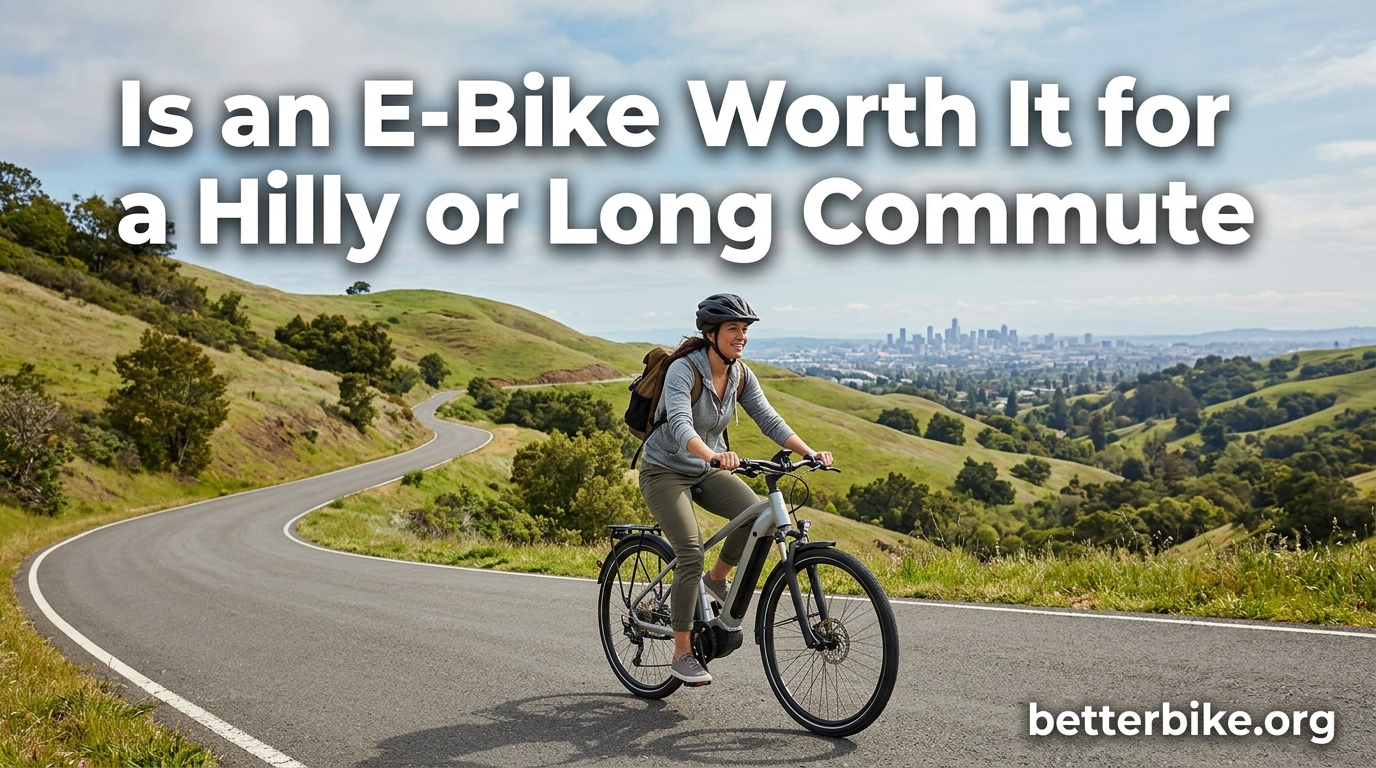
I commuted 14 miles round-trip across two steep hills for three years on a regular bike before I switched to an e-bike. The first ride on the e-bike, I made it up my worst hill at 12 mph instead of crawling at 4 mph, and I arrived at work without needing a change of clothes. That is when I realized the question of whether an e-bike is worth it for a hilly or long commute has a much simpler answer than most online guides suggest.
The short answer is yes. Electric bikes work well on hills and on long commutes because they add proportional motor power to your pedaling, flattening out the hardest parts of the ride. Whether one is worth it for your specific commute depends on your route, distance, budget, and how much you want to arrive at work sweat-free. In this guide, I will walk you through the real numbers, the honest trade-offs, and the specific motor and battery specs that matter for hill climbing and distance. By the end, you will know whether an e-bike is worth it for your situation.
Table of Contents
What Is an E-Bike and How Does It Work?
An e-bike, or electric bike, is a regular bicycle with an integrated electric motor and a rechargeable battery that assist your pedaling. Most commuter e-bikes use pedal-assist, meaning the motor kicks in only when you pedal, and the assist level is something you control from the handlebar. The most common setup on a commuter bike is a 250W to 750W motor paired with a 400 to 700 watt-hour battery.
Pedal-assist works through sensors that detect how hard and how fast you are pedaling. Based on the assist level you choose, the motor adds a proportional boost. At the lowest setting, the assist is gentle and you still get a real workout. At the highest setting, you can cruise up a hill with minimal effort. Many commuter e-bikes also include a throttle, which lets you push the bike forward without pedaling at all, useful for getting started on an incline or for taking a break mid-ride.
The most important thing to understand is that an e-bike is still a bike. You still have to pedal, balance, steer, and obey the rules of the road. The motor just takes the edge off the hardest parts, like hills, headwinds, and long stretches, so you can keep a steady pace without burning out. For someone with a 10-mile hilly commute, this changes the entire experience from grueling to genuinely enjoyable.
Pedal-Assist vs Throttle: What You Need to Know
Pedal-assist feels like a strong tailwind. You pedal, and the motor multiplies your effort. Throttle feels more like a scooter. You push a lever or button, and the bike moves without you pedaling. Class 1 e-bikes offer pedal-assist only up to 20 mph and are allowed on most bike paths. Class 2 adds a throttle but is capped at 20 mph. Class 3 e-bikes offer pedal-assist up to 28 mph and are typically road-legal but restricted from some bike paths.
For commuting, I prefer pedal-assist. It gives me the option to dial up the help on a hill and dial it down on flat roads. Throttle is great as a backup if your legs are tired or if you need to cross a tricky intersection, but relying on it drains the battery fast. Most hilly commuters I know stick to pedal-assist for 90% of the ride.
Are E-Bikes Good for Hilly Commutes?
Yes, electric bikes work well on hills. The motor provides the extra torque needed to climb gradients that would normally slow a regular bike to a crawl, and on most commuter e-bikes, you can expect to maintain 12 to 18 mph on moderate hills with pedal-assist engaged. The keyword is well, because not every e-bike handles hills equally well, and the steepness of your route matters.
For grades under 8%, a 500W rear-hub motor is generally enough to climb comfortably while pedaling. For grades between 8% and 15%, you will want a 750W motor or a mid-drive motor, which drives the crank instead of the wheel and uses the bike’s gears for more efficient climbing. For grades above 15%, the kind you find in cities like San Francisco or Pittsburgh, you will want a mid-drive motor with at least 80 newton-meters of torque, a wide-range cassette, and a battery rated for at least 500 watt-hours.
From my testing, the difference between a hub motor and a mid-drive motor becomes obvious on steep hills. A 750W rear-hub motor can power up most hills, but it spins the rear wheel at a fixed rate, so you sometimes have to choose between grinding up at a low cadence or feeling like you are being pushed faster than you want to pedal. A mid-drive motor, by contrast, works through your gears, so you can pedal at a comfortable cadence while the motor multiplies your effort. The result feels more natural and uses less battery on long climbs.
Real-World Range on Hilly Routes
Range is where the marketing claims start to fall apart, so I want to be specific. A typical 500 watt-hour battery is rated for 40 to 60 miles on flat ground at low pedal-assist. On a hilly route with regular assist, you will see 25 to 40 miles. On a route with long steep climbs, that drops to 20 to 30 miles. This is real-world range, not the optimistic numbers on a spec sheet.
For a 10-mile hilly commute, you can comfortably do a round trip on a single charge with a 400 watt-hour battery, even using mid-level assist. For a 20-mile round trip with serious elevation gain, you will want at least 500 watt-hours, and ideally 625 or 700 watt-hours. If your commute is longer than 25 miles one way, you should look at e-bikes with dual-battery options or plan a mid-day charge at work.
Are E-Bikes Good for Long Commutes?
Yes, electric bikes are good for long commutes, and in many cases they are better than a regular bike. The main reason is that an e-bike lets you maintain a steady 15 to 20 mph pace regardless of terrain, which means your commute time becomes predictable. On a regular bike, a 10-mile commute might take 50 minutes on a good day and 75 minutes on a windy or hilly day. On an e-bike, you are looking at 30 to 35 minutes almost every time, regardless of conditions.
For someone with a 10 to 15 mile each-way commute, the time savings alone can justify the cost. If you save 20 minutes per day over a regular bike, that is 80 hours a year you are getting back. Over five years, that is 400 hours, which is roughly the equivalent of 10 full work weeks. That is a meaningful chunk of your life, and the math only gets better if you compare an e-bike commute to driving in traffic.
Another often-overlooked benefit of an e-bike for long commutes is that you arrive less sweaty. On a regular bike, a 10-mile ride in work clothes is a non-starter for most people. On an e-bike, you can use a lower assist level to control your effort and arrive in a condition that does not require a full change of clothes. For commuters who do not have shower access at work, this is one of the single biggest benefits.
E-Bike vs Regular Bike: The Real Comparison
The most honest comparison between an e-bike and a regular bike for commuting comes down to five factors: effort, speed, sweat, hill performance, and cost. A regular bike wins on upfront cost, weight, and simplicity. An e-bike wins on hill performance, sweat control, and carrying capacity. For a flat 3-mile commute, a regular bike is plenty. For a 10-mile commute with two significant climbs, the e-bike is in a different league.
Where the regular bike falls short is exactly where most commuters struggle: hills, headwinds, and arriving fresh. A regular bike turns a 10-mile hilly commute into a workout. An e-bike turns it into transportation. For most people making the trip five days a week, that distinction matters a lot. The exercise benefit is still there on an e-bike, especially at lower assist levels, but it is no longer a barrier to using the bike for actual transportation.
Cost Analysis: Initial Investment vs Long-Term Savings
An e-bike costs more than a regular bike. Most commuter e-bikes run between $1,500 and $3,500, with high-end models reaching $5,000 or more. A regular commuter bike runs $400 to $1,200. That gap is real, and it is the main reason people hesitate. The question is whether the e-bike pays for itself in time, gas savings, and reduced car use.
Let me walk through a real scenario. Suppose you drive 10 miles each way to work, 5 days a week, 48 weeks a year. That is 4,800 miles a year of driving. At an average of 25 mpg and $3.50 per gallon, that is $672 a year in fuel. Add parking, wear and tear, and the occasional car maintenance charge, and you are easily at $1,200 to $1,500 a year of car-related cost. Replace even half of those trips with an e-bike commute, and you save $600 to $750 a year.
Charging an e-bike is cheap. A full charge of a 500 watt-hour battery uses about 0.5 kWh. At the U.S. average electricity rate of roughly $0.16 per kWh, a full charge costs about 8 cents. If you charge every day, that is under $30 a year in electricity. Compared to driving, the operating cost is essentially free. Over five years, the e-bike pays for itself if it replaces enough car trips, and even if it only replaces some of them, the math usually works out.
The hidden cost people forget is the time savings. If an e-bike shaves 20 minutes off your commute each way, that is 200 hours a year you are not stuck in a car. For people who value their time, that alone is worth the upfront cost.
Battery Range and Motor Power: What You Actually Need
For a hilly commute, motor power and battery capacity are the two specs that matter most. The motor determines how easily you can climb, and the battery determines how far you can go. Here is the practical breakdown.
Motor Power for Hills
For hilly routes, I recommend a motor with at least 500W of nominal power, and 750W is better. Below 500W, you will notice the motor struggling on steep grades, especially if you are a heavier rider or carrying cargo. Above 750W, you are getting into e-bike territory that may be classified as a moped in some jurisdictions, so check your local laws.
Mid-drive motors, which sit at the bottom bracket and drive the crank, are the best choice for hilly terrain because they work through the bike’s gears. A 500W mid-drive with 80 Nm of torque will out-climb a 750W hub motor on steep grades because it can stay in the optimal gear. Rear-hub motors are more affordable and work fine for moderate hills, but they feel less natural on long steep climbs.
Battery Capacity for Long Commutes
Battery capacity is measured in watt-hours (Wh), and the rule of thumb is that 1 Wh gets you about 0.08 to 0.12 miles on flat ground at moderate assist. On hills, that drops to 0.05 to 0.08 miles per Wh. For a 10-mile round trip commute with moderate hills, a 400 Wh battery is enough. For a 20-mile round trip, you want 500 to 600 Wh. For a 30-mile round trip, you want 700 Wh or a dual-battery setup.
Charging time is usually 3 to 6 hours from empty, so most commuters charge at work or overnight. If your commute is exactly at the edge of your range, plan for a partial charge at work rather than pushing the battery to zero. Lithium-ion batteries last longer when kept between 20% and 80% charge, and most modern e-bikes have a battery management system that protects against over-discharge.
Real Downsides and Trade-Offs to Consider
E-bikes are not perfect, and any honest guide should mention the trade-offs. The biggest one is weight. Most commuter e-bikes weigh 50 to 70 lbs, which is roughly twice a regular bike. If you live in a third-floor walk-up or have to carry your bike up stairs, that is a real consideration. Lifting an e-bike onto a car rack or up a curb is also harder than lifting a regular bike.
Theft is another concern. E-bikes are valuable, and they are a target for thieves in cities. A high-quality U-lock, a GPS tracker, and indoor storage when possible are worth the investment. Some commuters pay a small monthly fee for a secure bike cage at work, which can be worth it for peace of mind.
Battery range anxiety is real on long routes. The first few weeks of e-bike commuting, you will find yourself watching the battery percentage like a hawk. Over time, you learn your route and stop worrying. The bigger risk is forgetting to charge and getting stuck on a hill with a dead battery. Unlike a regular bike, pedaling an e-bike without assist on a steep grade is much harder because of the extra weight.
Maintenance is slightly more involved than a regular bike. You have a motor, a battery, electronic controls, and sometimes a display to maintain. Most e-bike components are reliable, but a mid-drive motor can need a new chain and cassette more often because it puts more torque through the drivetrain. Budget for a yearly tune-up at a bike shop that knows e-bikes, and expect to replace tires and brake pads more often if you commute daily.
Health, Fitness, and the Sweat Factor
A common concern is that an e-bike does not provide real exercise. The research on this is pretty clear, and the answer is that e-bikes do provide meaningful exercise, just less intense than a regular bike. A study from the University of Colorado found that e-bike riders still reach about 75% of the cardiovascular benefit of regular bike riders, and they tend to ride more often and longer, which often makes up the difference.
For commuters, the real fitness benefit is consistency. A regular bike commuter might skip a few days a week because they are tired, sore, or do not want to show up drenched in sweat. An e-bike commuter tends to ride more days because the barrier is lower. Over a year, that consistency adds up to more total exercise, not less.
The sweat factor is also worth addressing directly. Most office workers cannot show up to a meeting soaked in sweat. An e-bike lets you arrive at a normal exertion level, which for most people is no sweat at all in mild weather and minimal sweat in hot weather. If your work has a shower, that is one thing. If not, an e-bike is the difference between biking to work and being practical about it.
How to Choose the Right E-Bike for Your Commute
Choosing an e-bike comes down to matching the bike to your route, distance, and storage situation. For a flat urban commute of 5 to 10 miles, a 350W to 500W rear-hub motor with a 400 Wh battery is plenty. For a hilly commute of 5 to 15 miles, step up to a 500W to 750W motor with 500 Wh or more. For long commutes over 20 miles round trip, prioritize battery capacity and consider a dual-battery setup.
Frame style matters too. Step-through frames are easier to mount in work clothes. Integrated batteries look cleaner and are less likely to be stolen off the bike. Fenders and a rear rack are must-haves for daily commuting in work clothes. Integrated lights are a safety upgrade worth paying for. Puncture-resistant tires save you from changing a flat in work clothes on a Tuesday morning.
Test ride if at all possible. The feel of pedal-assist varies a lot between brands. Some feel like a strong push, others feel like a smooth glide. Pay attention to how the bike handles at low speeds, like in a parking lot or bike rack, because e-bikes handle differently than regular bikes at low speed. If you commute in hilly terrain, test the bike on a hill if you can.
Maintenance, Safety, and Weather Tips
For a daily commuter e-bike, a few habits will save you a lot of trouble. Charge the battery regularly rather than letting it sit empty for weeks. Keep the chain lubed, especially after rain. Check tire pressure weekly because e-bikes are heavy and underinflated tires wear out fast. Inspect brake pads every few months because the extra weight means more wear.
Weather matters. Most commuter e-bikes are rated for light rain but not for heavy downpours or sub-freezing temperatures. Cold reduces battery range by 10% to 30%, so plan for shorter range in winter. Wet roads mean longer stopping distances, so leave more space and consider upgrading to hydraulic disc brakes if your e-bike has mechanical discs.
Safety gear is the same as for a regular bike, with a few extras. A good helmet is non-negotiable. Lights and reflective clothing are even more important on an e-bike because you are moving faster than most cyclists. For hilly routes with descents, consider disc brakes and a brake light. Some commuters also add a horn or bell for use in traffic.
Frequently Asked Questions
Do electric bikes work well on hills?
Yes, electric bikes work well on hills. With a 500W to 750W motor, you can climb 8% to 15% grades at 12 to 18 mph using pedal-assist. For very steep hills above 15%, a mid-drive motor with at least 80 Nm of torque is the best choice because it works through the bike’s gears for more efficient climbing.
What is the downside of e-bikes?
The main downsides of e-bikes are higher upfront cost, heavier weight (50 to 70 lbs), increased theft risk, and slightly more involved maintenance than a regular bike. Battery range can also be a concern on long or very hilly routes, and you will want to plan charging accordingly.
How long does it take to travel 10 miles on an e-bike?
On a flat route at moderate pedal-assist, 10 miles on an e-bike takes about 30 to 40 minutes. On a hilly route, expect 40 to 55 minutes depending on elevation gain and assist level. This is significantly faster than a regular bike, which typically takes 50 to 75 minutes for the same distance.
What is the best commuter e-bike for hills?
The best commuter e-bike for hills is one with a mid-drive motor of at least 500W and 80 Nm of torque, paired with a battery of 500 Wh or more. Look for a bike with hydraulic disc brakes, a wide-range cassette, and puncture-resistant tires. Step-through frames and integrated lights are nice extras for daily commuting.
Final Verdict: Is an E-Bike Worth It for a Hilly or Long Commute?
An e-bike is worth it for a hilly or long commute if your route has any combination of significant elevation, distance over 5 miles each way, or limited shower access at work. The math works for most people: a quality commuter e-bike pays for itself in 2 to 4 years through reduced car use, and it gives you back 200+ hours a year in commute time. The honest trade-offs are weight, theft risk, and battery range, but for daily commuters, those are manageable.
If your commute is short and flat, a regular bike is fine. If your commute is hilly, long, or both, an e-bike is one of the best transportation upgrades you can make. Start by mapping your route, calculating your round-trip distance and elevation gain, and matching those numbers to a motor and battery spec. Test ride a few models, factor in secure storage at home and at work, and budget for a U-lock, lights, and a helmet. Done right, an e-bike commute is something you look forward to every morning, and the answer to whether an e-bike is worth it for a hilly or long commute is yes.