
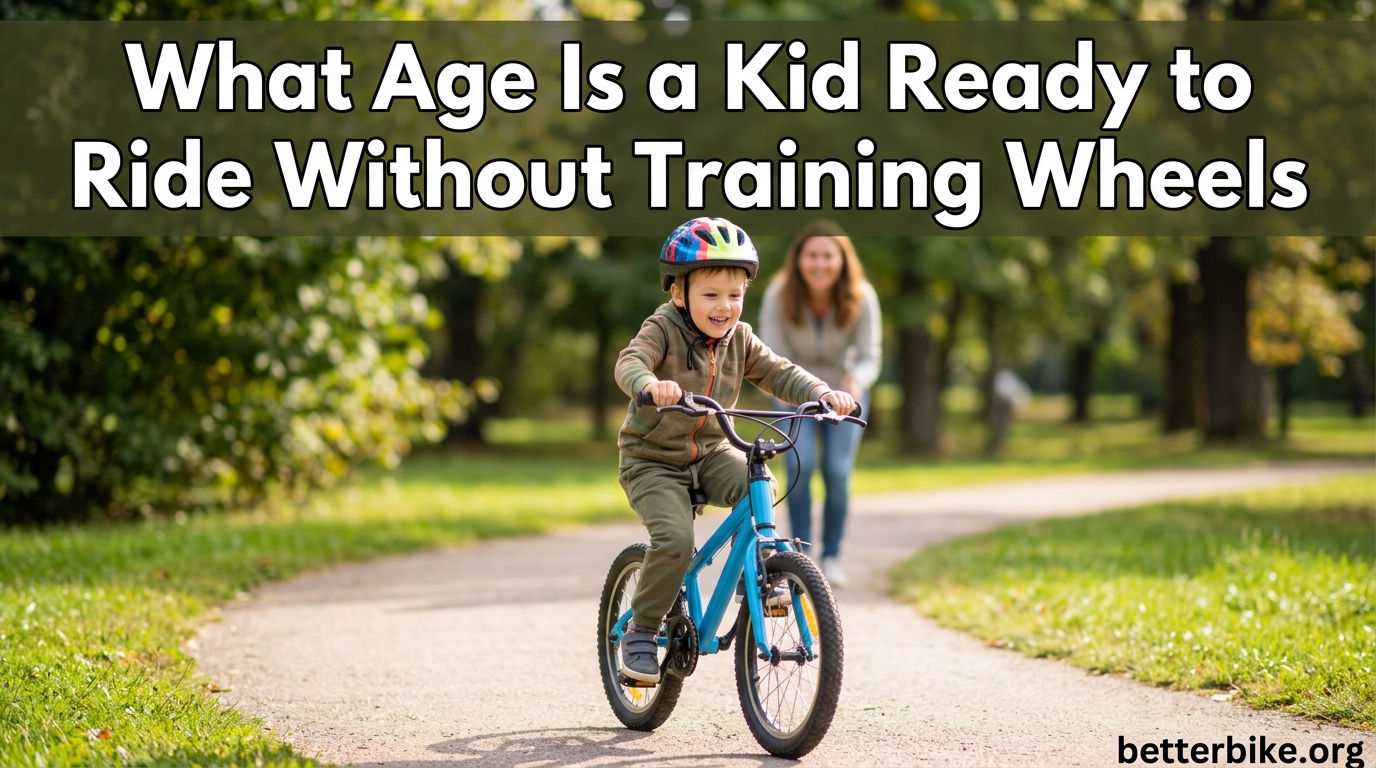
Most children are ready to ride a bike without training wheels somewhere between ages 4 and 6, with a wider normal range of 3 to 8 years old. That is the short answer to what age is a kid ready to ride a bike without training wheels, but the longer answer is that age is the wrong question to focus on first. Readiness is about skills, not birthdays.
If you are reading this, you are probably a parent standing in a garage, staring at a small bike, wondering whether today is the day the training wheels come off. I have been there, and so have millions of other parents who later shared their stories on Reddit parenting forums. Some of those kids took off the same afternoon. Others needed weeks, and a few needed months.
In this guide, I will walk you through the real readiness signs, the typical age ranges backed by pediatric and cycling experts, the balance bike versus training wheels debate, a step-by-step teaching method you can use this weekend, and what to do if your child is scared, resistant, or older than the “expected” age. Everything here is pulled from a mix of expert sources like Stanford Children’s Health and the International Bicycle Fund, plus real parent experiences that match what most families actually go through.
Table of Contents
The Quick Answer: What Age Is a Kid Ready to Ride Without Training Wheels?
Most kids develop the balance, coordination, and physical strength to ride a two-wheeled bike without training wheels between ages 4 and 8, with ages 5 to 7 being the most common window for independent riding. Stanford Children’s Health specifically notes that between ages 4 and 8, most children develop enough coordination, agility, and a sense of balance to ride without training wheels. The International Bicycle Fund, which Stanford cites, places the typical transition age right in that same 4 to 8 range.
If you want a single number to anchor on, age 5 is a reasonable midpoint. But I want to be very clear: that number is an average, not a deadline. The range is 3 to 8 for a reason, and plenty of perfectly normal, athletic, coordinated kids are on the later end of that window.
Readiness is really about three things working together: physical coordination (balance, steering, pedaling or gliding), mental willingness (confidence, excitement, ability to follow directions), and developmental maturity (gross motor skills that come with age). When all three line up, the actual learning often happens surprisingly fast.
The Typical Age Range for Riding Without Training Wheels
Let me break the age question down more carefully, because the 3-to-8 range is wide and parents need context to know where their own child likely falls.
Ages 3 to 4: Early Learners (Usually Balance Bike Kids)
Is it normal for a 3 year old to ride a bike without training wheels? It is unusual but not impossible. Children riding independently at age 3 almost always learned on a balance bike starting around 18 to 24 months. By the time they hit 3, they have already mastered balancing and gliding, and the transition to pedals is small.
Reddit parents who skipped training wheels entirely report this pattern often. One parent shared that all of their kids started on balance bikes, with the earliest riding at 2.5 years and the rest by 3. This is the exception, not the norm, but it shows what is possible when balance comes first.
For most typically-developing 3 year olds, the right next step is a balance bike, not a pedal bike. They are building the foundation.
Ages 4 to 5: The Most Common Starting Window
This is where most kids who used a balance bike make the jump to a pedal bike without ever touching training wheels. They already know how to balance and steer. The only new skill is pedaling, and many kids pick that up in a single session.
For kids who did not use a balance bike, ages 4 to 5 are often when they are physically ready to start learning, but it usually takes longer. The pedaling is easy. The balancing is the hard part, and that is what takes the weeks of practice.
Ages 5 to 7: The Sweet Spot for Independent Riding
Lifespan Kids, KTL Therapy, and most pediatric experts point to ages 5 to 7 as the most reliable window. KTL Therapy, a pediatric occupational therapy source, says children should have the appropriate gross motor skill development to learn between 5 and 6 years old. This is the age range where the brain, body, and confidence all sync up for most kids.
If your child is 5, 6, or 7 and still on training wheels or a balance bike, you are not behind. You are right in the middle of normal.
Ages 7 to 8 and Beyond: It Is Never Too Late
Is 9 too old to learn to ride a bike? Absolutely not. Neither is 10, 11, or older. Forum posts from parents of 7 and 8 year olds who cannot yet ride are common, and the response from other parents is almost universal reassurance. Kids learn at different rates, and there is no developmental harm in learning later.
What often happens with older beginners is that they learn very quickly once they are ready. An 8 year old has more strength, better coordination, and a longer attention span than a 4 year old. Once the fear is handled, the skill comes fast.
If your older child feels embarrassed, address it directly. Tell them the truth: plenty of kids their age are still learning, and most adults who ride learned at all different ages. Then focus on making the learning low-pressure and fun rather than a race against younger siblings or neighbors.
Siblings Learn at Wildly Different Ages (And That Is Normal)
One of the most reassuring patterns I found in parent forums is how differently siblings learn. One Reddit parent described their first child learning at 6, the second at 4, and the third later still. Same parents, same bikes, same teaching approach, completely different timelines.
If your oldest learned at 4 and your youngest is 6 and still not riding, that is not a sign anything is wrong. It is just how kids work.
Signs Your Child Is Ready to Ride Without Training Wheels
This is the section that matters more than any age range. Readiness signs are observable, testable, and far more reliable than a birthday on the calendar. Here is a checklist you can use today.
Physical Readiness Signs
1. They can balance on one foot for 5 to 10 seconds. Balance is the core skill for riding a two-wheeler. If your child can stand on one foot, hop, and walk along a curb or low beam without falling, their balance system is ready.
2. They can coordinate two different movements at once. Riding requires pedaling (or pushing off) while balancing and steering. Watch how they do with other two-task activities: climbing playground equipment, skipping, or using a scooter. If those come easily, biking will too.
3. They have enough leg strength to push a balance bike up to a glide. A child who can run and stride on a balance bike with both feet off the ground for a few seconds has the strength needed for pedaling.
4. They can start and stop a scooter or balance bike on their own. Stopping is actually the more important skill. A child who can brake a balance bike with their feet, or a scooter with a hand brake, understands the concept of controlling speed.
5. They have the stamina for 15 to 30 minutes of physical practice. Bike learning is tiring. If your child tires out after 5 minutes of running around, build general stamina first.
Mental and Emotional Readiness Signs
6. They are excited about riding a two-wheeled bike. Desire matters more than gear. A child who wants to ride will push through frustration. A child who does not want to will fight you every pedal of the way.
7. They can follow multi-step instructions. “Pedal forward, look ahead, keep your feet on the pedals” is a three-step direction. If your child can follow instructions like that in other contexts, they can follow them on a bike.
8. They recover from falls without melting down. Every new rider falls. A child who falls, gets up, dusts off, and wants to try again is mentally ready. A child who falls once and refuses to get back on is not ready that day, and that is okay.
9. They ask for the training wheels to come off. This is the strongest possible signal. When your child is the one asking to ride without training wheels, they have made the mental leap. Say yes and get to work.
10. They can focus on a single task for 15 to 20 minutes. Attention span is part of readiness. Short, focused practice blocks beat long, scattered sessions every time.
Signs Your Child Is NOT Ready Yet
Just as important as knowing when to start is knowing when to wait. Pushing a child who is not ready usually backfires and creates fear that takes longer to undo.
Wait if your child actively resists or cries when you suggest removing the training wheels. Wait if they cannot yet ride a balance bike with confidence. Wait if they fall frequently during normal play. Wait if they cannot yet pedal a tricycle smoothly. And wait if you, the parent, are stressed about the timeline, because your child will pick up on that stress.
Waiting a few months is not falling behind. It is letting your child develop at their own pace, which almost always leads to faster, happier learning when the time is right.
Balance Bike vs Training Wheels: Why It Matters
This is one of the most debated topics among parents, and the research and expert consensus actually points fairly clearly in one direction: balance bikes are better for most kids. Here is why, and also when training wheels still make sense.
Why Balance Bikes Work Better Neurologically
A balance bike is a small bike without pedals. The child sits on the seat, walks with their feet, and gradually learns to lift their feet and glide. The neurological reason this works so well is that it isolates the hardest skill, balancing, and lets the child master it before adding the easier skill, pedaling.
Training wheels do the opposite. They take balancing out of the equation entirely, so the child learns to pedal first. The problem is that when the training wheels come off, the child now has to learn balancing from scratch while unlearning the bad habits training wheels taught them, like leaning toward the grounded wheel in turns.
Polygon Bikes, in their detailed piece on whether children need training wheels, makes the point sharply: training wheels create false confidence and limited effectiveness on real terrain. The child feels like they are riding, but they have not actually learned the core skill.
The data backs this up. Kids who start on balance bikes typically transition to pedal bikes 1 to 2 years earlier than kids who start on training wheels. Many balance bike kids never use training wheels at all.
How to Use a Balance Bike Effectively
Start your child on a balance bike as early as 18 months to 2 years old if they are interested. The bike should be small enough that they can sit on the seat with both feet flat on the ground and their knees slightly bent.
Do not push them to glide before they are ready. Early sessions are just walking the bike around. Over weeks and months, they will naturally start lifting their feet for longer stretches. That is when the magic happens.
Once they can glide for 10 seconds or more with both feet up, they are ready for a pedal bike. Most kids who reach this milestone transition to pedaling in a single afternoon.
When Training Wheels Still Make Sense
I want to give a balanced view here, because training wheels are not evil and they work fine for many kids. Some situations where they still make sense:
For very hesitant or fearful children who are scared to try balancing, training wheels can provide a confidence bridge. They let the child get comfortable on a bike, learn pedaling and steering, and build willingness to try without support.
For kids with delayed motor development or coordination challenges, training wheels can offer a gentler on-ramp. A pediatric occupational therapist can help you decide if this is the right path for your child.
For parents who prefer a gradual method and do not want to invest in a separate balance bike, training wheels are a reasonable option. They are not the fastest path, but they are a workable one.
One Reddit parent made a point worth repeating: balance bikes can feel overhyped, and parents who use training wheels are not doing it wrong. The goal is a child who learns to ride, not a child who learns via the “right” method. Use what works for your family.
Step-by-Step: How to Teach a Kid to Ride Without Training Wheels
This is the practical section. If your child is showing readiness signs and you have a bike ready, here is a teaching method that combines the best techniques from expert sources and real parent experiences. Plan on doing this over several short sessions, not one marathon afternoon.
Step 1: Get the Right Bike, Properly Fitted
The bike must be small enough that your child can sit on the seat with both feet flat on the ground. This is non-negotiable for learning. If they are on tiptoes, the bike is too big and they will not be able to catch themselves, which means more falls and more fear.
Kids Activities Blog makes this point strongly: use as small a bike as possible during the learning phase. A bike they can outgrow in six months is fine. The priority is confidence, not longevity.
Remove the pedals for the first few sessions if your child is learning to balance on a pedal bike rather than transitioning from a balance bike. Most kids bikes have pedals that unscrew easily with a wrench. This turns the pedal bike into a makeshift balance bike so they can learn balance first.
Step 2: Find the Right Location
You want a flat, open, paved surface with no traffic. An empty parking lot, a quiet basketball court, or a long, flat sidewalk all work. Avoid grass, because it is harder to balance on, harder to pedal through, and surprisingly painful to fall on.
Some parents swear by a slight grassy hill for the very first balancing attempts. The child coasts down with feet up, learning the feeling of balance without having to pedal. This works for some kids but adds fall risk, so only try it if your child is physically confident.
Step 3: Teach Balance First (If They Skipped the Balance Bike)
Have your child sit on the bike with pedals removed (or on a balance bike). Have them walk the bike forward, then push off and try to glide with both feet up. The goal is short glides, even just 2 to 3 seconds at first.
Cheer every glide, no matter how short. The point is to wire the feeling of balancing without falling into their nervous system. Most kids get to a 5 to 10 second glide within one or two sessions.
Do not move to pedaling until they can glide confidently with feet up for at least 5 seconds. This is the foundation, and skipping it is the number one mistake parents make.
Step 4: Put the Pedals Back On and Teach the Start
Once balance is solid, reinstall the pedals. Teach your child the “2 oclock pedal position.” That means the pedal on their dominant side should be at the 2 oclock position, slightly forward of straight up. From there, one strong push downward gets the bike moving with momentum.
Have them practice this start without you holding the bike. The first few attempts will be wobbly. Stay close, but let them feel the start for themselves.
Step 5: Hold Them the Right Way
This is where most parents create problems. Do not hold the handlebars. Do not hold the seat. Both of those prevent the child from feeling and correcting balance themselves.
Instead, hold your child under the armpits or by the back of their shirt, just below the neck. This is the technique multiple Reddit parents recommended. You stabilize the child, not the bike. The bike wobbles, the child learns to correct the wobble, and you are only there to catch them if they actually fall.
This is also the technique that saves your back. Running while bent over holding a bike seat is brutal. Holding a child upright from the armpits or shirt lets you run more naturally.
Step 6: The Towel Trick
If you have seen the towel trick mentioned in forums or YouTube videos, it is real and it works. Take a bath towel, loop it under your childs arms and across their chest, and hold the two ends behind them like reins.
As they pedal, you walk or jog behind them holding the towel ends. You can gently steady them when they wobble and release tension when they are balanced. The advantage over armpit-holding is that you can be further back, which gives them more independence and saves your back even more.
This is one of the most-shared parent tips online, and for good reason. It works for kids who need a little extra stabilization but are ready to do most of the work themselves.
Step 7: Practice Steering and Turning
Once your child can ride in a straight line for 20 to 30 feet, start teaching turns. Begin with very wide, gentle turns and work toward tighter ones over multiple sessions.
Teach them to look where they want to go, not at the ground or at the obstacle they are trying to avoid. The bike follows the eyes. This is a skill even adult riders forget, and it is one of the most important things a new rider can learn.
Step 8: Teach Braking First, Always
Before your child pedals independently, make sure they know how to stop. If the bike has a coaster brake (pedal backward to stop), have them practice braking from a push-start before they ever pedal forward. If it has hand brakes, have them squeeze the brake while walking the bike.
The reason braking comes first is simple: a child who can stop is a confident child. A child who cannot stop is a scared child. Fear kills learning.
Step 9: Let Go (Yes, Really)
This is the hardest step for parents. Once your child is balancing, steering, and braking, you have to actually let go. Many parents, without meaning to, keep a hand on or near the bike long after the child is ready to ride solo.
Set up a clear signal. Tell your child: “I am going to let go when you say go.” Or, if they are not ready to know you are letting go, do it without telling them and stay close enough to catch a fall. Most kids who are actually ready ride fine the moment you let go, and the surprise on their face when they realize they are doing it alone is one of the great parenting moments.
Step 10: Normalize Falling
Falling is part of the process. Tell your child this before the first session and remind them after every fall. “Falling means you are learning. Get up and try again.”
Most falls during learning are slow-motion tumbles, not crashes. Keep them in a helmet and on a soft surface if possible, and they will be fine. The kids who learn fastest are usually the ones who fall, laugh, and get back on.
How Long Does It Take to Learn?
Real timelines from parents vary widely, and I want to give you realistic expectations rather than the “learned in one afternoon” claims you sometimes see.
For kids coming off a balance bike with solid gliding skills, the transition to pedaling usually takes one or two sessions, sometimes a single afternoon. They already have the hard skill.
For kids starting from training wheels or no bike experience at all, expect two to six weeks of regular short practice sessions. One Reddit parent taught their 4 year old in about 3 weeks of daily 15-minute sessions. That is a typical timeline.
Some kids take longer, and a few take months. None of these timelines are wrong. The biggest predictor of speed is not age or natural talent, it is frequency of practice. Short, consistent sessions beat long, sporadic ones every time.
Bike Sizing and Safety Gear
Having the right size bike and proper safety gear makes a bigger difference than most parents expect. Here is what you need to know.
Bike Sizing by Wheel Diameter
Kids bikes are sized by wheel diameter, not frame size. The standard progression looks like this, based on Stanford Children’s Health guidance:
12-inch wheels: Ages 2 to 4, balance bikes and very small pedal bikes. Child should be able to sit with both feet flat on the ground.
14-inch wheels: Ages 3 to 5, first pedal bikes for many kids. Still small enough for easy balance learning.
16-inch wheels: Ages 4 to 7, the most common size for learning to ride without training wheels. Usually come with coaster brakes (pedal backward to stop).
20-inch wheels: Ages 6 to 9, the next size up. Many of these introduce hand brakes and even gears for the first time.
24-inch wheels: Ages 8 to 11, approaching adult bike proportions. Hand brakes and multiple gears are standard.
The most important sizing rule: your child should be able to stand over the top tube with both feet flat on the ground and have at least an inch of clearance. For learning, prioritize being able to put feet down quickly over growing room.
Helmets Are Non-Negotiable
Stanford Children’s Health cites sobering statistics on head injuries in young cyclists, particularly boys ages 10 to 14. A properly fitted helmet reduces the risk of serious head injury by 85 percent or more. There is no good reason to skip one.
The helmet should sit level on your childs head, about two finger widths above the eyebrows. The side straps should form a V under each ear. The chin strap should be snug enough that you can fit only one finger between strap and chin. Replace any helmet that has been in a crash, even if it looks fine.
Start the helmet habit from the very first balance bike ride at age 2. If a helmet is just part of biking, like shoes are part of running, your child will never argue about it. If you introduce it later, expect resistance.
Coaster Brakes vs Hand Brakes
Most 16-inch kids bikes come with coaster brakes, which engage when the child pedals backward. These are easier for small children to use because they require less hand strength.
By 20-inch bikes, most have hand brakes, and some have both. Hand brakes give your child more control and prepare them for adult bikes, but they require enough grip strength to operate. If your child cannot comfortably squeeze a hand brake, stick with coaster brakes for now.
Common Parent Concerns and How to Handle Them
“My child is terrified of falling.”
Fear of falling is the number one barrier parents report, and it is entirely normal. The way to handle it is not to dismiss it but to address it directly. Acknowledge that falling is scary. Tell your child you will not let go until they are ready. Start with very short glides on a balance bike where feet can touch the ground instantly. Build tiny wins before pushing for longer rides.
One thing that helps: have your child watch other kids their age learning and falling and getting back up. Seeing peers do it normalizes the process. Another tactic: let them watch themselves on video riding successfully. The visual proof that they can do it builds confidence faster than any words.
“My 7 year old still cannot ride and feels embarrassed.”
This is more common than you think, and the embarrassment is the bigger problem. Tell your child the truth: many kids their age are still learning, and plenty of adults never learned as kids and picked it up later. Then remove the audience. Practice in a private spot where they will not run into neighbors or schoolmates.
For older beginners, the balance bike method often works fastest. Even if they are “too old” for a balance bike in their mind, take the pedals off their pedal bike and have them glide. They will pick up balance quickly because they have the strength and coordination, and the fear drops away once balancing clicks.
“Should I push or wait?”
If your child is resistant, wait. Pushing a child who is not mentally ready creates fear that is much harder to undo than a few extra months of waiting. Drop the topic for a month, then bring it up casually. Sometimes all it takes is a friend getting a new bike for the willingness to come back.
That said, gentle nudges are different from pressure. You can offer opportunities without demanding outcomes. “Want to try the balance bike at the park today?” is fine. “You need to learn to ride this summer or you will be the only one who cannot” is not.
Frequently Asked Questions
Is it normal for a 3 year old to ride a bike without training wheels?
It is unusual but possible. Most 3 year olds who ride without training wheels learned on a balance bike starting around 18 to 24 months. For typically developing 3 year olds, a balance bike is the more appropriate next step rather than a pedal bike.
What age to take training wheels off a bike?
Most children are ready to have training wheels removed between ages 5 and 7. Look for readiness signs like the ability to balance on one foot, coordination on a scooter or balance bike, and genuine excitement about riding without support. Age matters less than these skills.
Is 9 too old to learn to ride a bike?
No, 9 is not too old. Neither is 10, 11, or older. Kids and even adults learn to ride at all ages. Older beginners often learn faster because they have more strength, better coordination, and longer attention spans than younger children.
Can I teach my kid to ride a bike without training wheels?
Yes, you can teach your own child. Use the balance-first method, get a properly fitted bike, practice in short frequent sessions, and hold your child under the arms rather than the bike so they learn to balance themselves. Most parents successfully teach their kids in 2 to 6 weeks of regular practice.
How old are most kids when they learn to ride a bike without training wheels?
Most kids learn between ages 4 and 8, with ages 5 to 7 being the most common window. Kids who start on a balance bike often transition to a pedal bike between ages 3 and 5, while kids who start on training wheels typically make the switch between ages 5 and 7.
How to teach a kid to ride a bike without training wheels using a towel?
The towel trick involves looping a bath towel under your childs arms and across their chest, then holding the two ends behind them like reins. As they pedal, you walk or jog behind, gently steadying them when they wobble and releasing tension when they balance. It saves your back and gives the child a sense of independence while still providing support.
Is 5 years old too late to learn to ride a bike?
No, 5 is not too late at all. In fact, 5 is right in the middle of the most common learning window of ages 4 to 8. Many kids do not even start learning until age 5 or 6 and do just fine.
The Bottom Line on Bike Readiness
So, what age is a kid ready to ride a bike without training wheels? For most children, the answer falls between ages 4 and 8, with 5 to 7 being the sweet spot. But the better question is whether your child is showing the readiness signs: balance, coordination, excitement, and the ability to follow directions and bounce back from falls.
Start with a balance bike if you can. Use the towel trick and the under-armpits hold when teaching. Keep sessions short, frequent, and fun. And remember that your childs timeline is their own, not a race against siblings, neighbors, or some average number.
The day they take off on two wheels for the first time, you will both remember it forever. Take a deep breath, grab the helmet, and enjoy the process.