
Choosing between mid-drive vs hub motor e-bikes is the single most important decision you will make when buying an electric bike. The motor type affects everything from hill climbing ability and battery range to ride feel and long-term maintenance costs. Pick the wrong one, and you could end up with a bike that struggles on your daily route or costs far more than necessary.
I have spent years researching e-bike motor systems, reading through hundreds of owner experiences on forums like Reddit’s r/ebikes, and comparing the two dominant motor designs side by side. The truth is that neither motor type is universally better. Each one serves specific riding styles, terrain types, and budgets.
This guide breaks down exactly how each motor works, compares them across every category that matters, and helps you match the right motor to how you actually ride. Whether you commute on flat city streets, tackle steep mountain trails, or haul groceries up neighborhood hills, you will have a clear answer by the end.
Table of Contents
What Is a Hub Motor E-Bike?
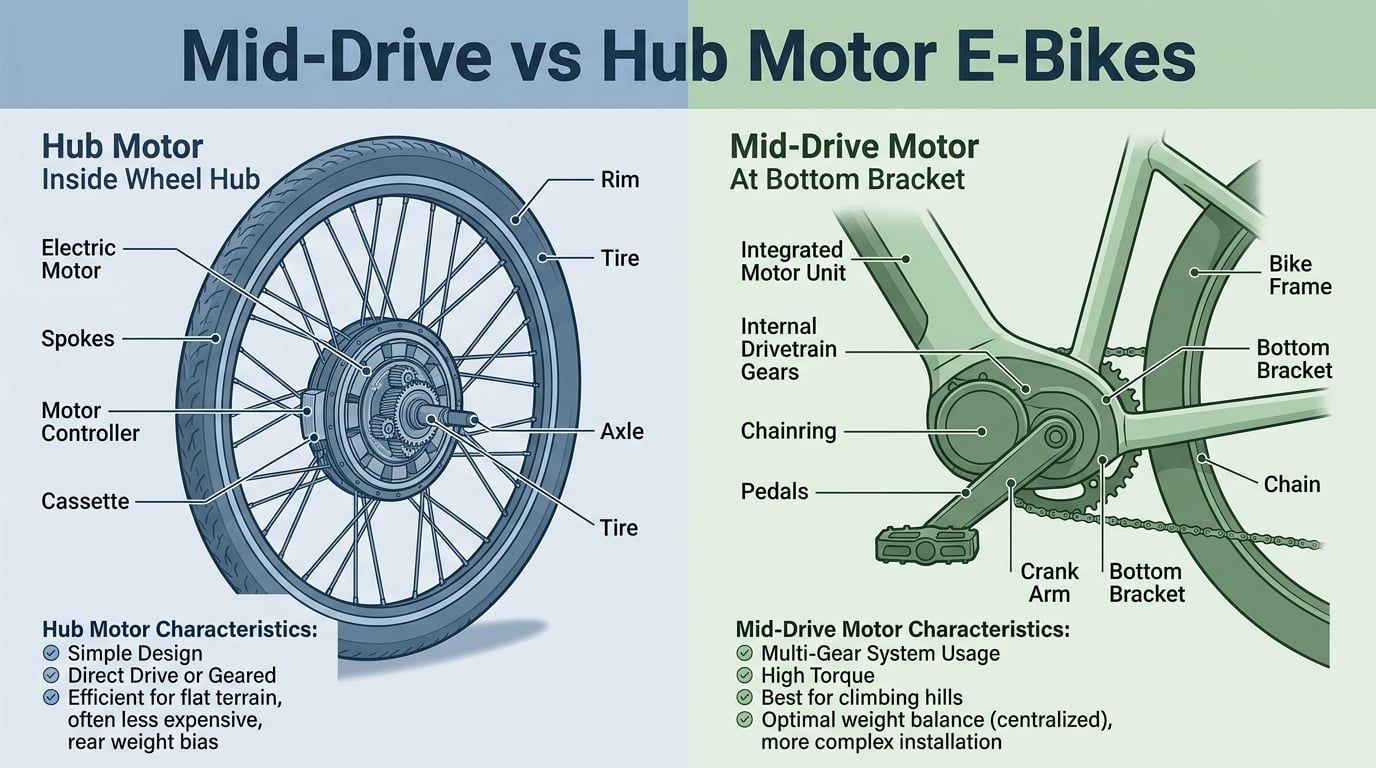
A hub motor e-bike has its electric motor built directly into the hub of either the front or rear wheel. The motor sits inside the wheel assembly and spins the wheel independently of the bike’s chain, gears, and pedals. This means the motor drives the wheel directly rather than working through the drivetrain.
Rear hub motors are the most common configuration on production e-bikes. They provide traction for acceleration and keep the motor weight over the drive wheel. Front hub motors appear mainly on budget models and conversion kits, essentially turning the bike into an all-wheel-drive setup when combined with pedaling.
Hub motors typically range from 250W to 750W, with some high-performance models pushing well beyond that. Most are brushless DC motors sealed inside the hub shell, which protects internal components from water and road debris. The motor connects to a controller and battery, often offering both pedal assist and throttle modes.
Because the motor operates independently of the bike’s gears, it always applies power at a single fixed gear ratio. This is simple and reliable but creates some limitations on steep hills, which we will cover in detail later.
What Is a Mid-Drive Motor E-Bike?
A mid-drive motor e-bike has its motor mounted at the bottom bracket, right where the cranks and pedals connect to the frame. Instead of spinning a wheel directly, the motor drives the chain and powers the bike through the same gears your legs use. This is the fundamental difference that shapes every performance characteristic of a mid-drive system.
Because the motor works through the bike’s gearing, it can take advantage of every gear ratio. When you shift to a low gear for climbing, the motor also benefits from that mechanical advantage. When you shift up for speed on flat ground, the motor spins more freely. This gear-ratio leverage is why mid-drive motors are rated at lower wattages but often outperform higher-wattage hub motors on hills.
Mid-drive motors are standard on premium e-bikes, electric mountain bikes, and cargo bikes. Brands like Bosch, Shimano, Brose, and Bafang dominate this space, with torque outputs typically ranging from 50 Nm to 90 Nm. The motor sits low and centered on the frame, which creates a balanced weight distribution that riders immediately notice.
The trade-off is complexity. Because the motor sends torque through the chain and cassette, those drivetrain components wear faster than on a traditional bike or a hub motor e-bike. This is the core of the chain-vs-spoke debate that pops up constantly in e-bike forums.
Mid-Drive vs Hub Motor E-Bikes: Side-by-Side Comparison
Here is how the two motor types compare across the categories that matter most. This comparison draws from manufacturer specifications, independent testing data, and real-world owner reports.
| Feature | Hub Motor | Mid-Drive Motor |
|---|---|---|
| Motor Location | Inside front or rear wheel hub | At bottom bracket, between pedals |
| Power Delivery | Direct to wheel, single gear ratio | Through chain and gears, multi-ratio |
| Hill Climbing | Moderate, can overheat on long climbs | Excellent, uses gear ratios for torque |
| Efficiency | Good on flat terrain | Higher on varied and hilly terrain |
| Weight Distribution | Concentrated at wheel (front or rear) | Centered and low on frame |
| Ride Feel | Pushed or pulled sensation | Natural, proportional to pedaling |
| Maintenance | Spoke breakage risk, wheel repairs costly | Chain and cassette wear faster |
| Typical Cost | More affordable | More expensive |
The table tells most of the story, but the nuances behind each category matter. A hub motor is not simply a worse choice. It is a different tool for a different job. Let us dig into the specifics.
Hub Motor Pros and Cons
Hub motors dominate the entry-level and mid-range e-bike market for good reasons. They are affordable, simple, and genuinely excellent for the right rider. Here is the full breakdown.
Hub Motor Advantages
Affordability: Hub motors cost significantly less to manufacture and install. You can find quality hub motor e-bikes at price points where mid-drive options simply do not exist. For budget-conscious buyers, this is often the deciding factor.
Simplicity and reliability: With fewer moving parts connecting to the drivetrain, hub motors are largely sealed and maintenance-free. There is no extra chain wear, no motor-induced cassette degradation, and no complex gear-shifting under power. Many hub motor owners ride for years with nothing more than basic brake and tire service.
Throttle-ready: Most hub motor e-bikes come with a throttle mode that lets you ride without pedaling at all. This is hugely popular for commuters who want to arrive sweat-free. In the US, Class 2 e-bikes with throttle are legal in most states.
Easy motor replacement: If a hub motor fails, you can often swap the entire motor-equipped wheel without touching the rest of the bike. The repair is straightforward compared to replacing a frame-integrated mid-drive system.
Hub Motor Disadvantages
Poor hill climbing: Because the motor operates at a single fixed gear ratio, it cannot adapt to steep inclines the way a mid-drive can. On long, steep climbs, hub motors can overheat and reduce power output to protect themselves.
Spoke breakage risk: Hub motors add significant weight to the wheel and apply torque directly to the spokes. Heavier riders or those carrying cargo frequently report broken spokes, especially on rear hub motors. Wheel repairs involving hub motors are more expensive because the motor complicates wheel building.
Less natural ride feel: Hub motor riders on Reddit frequently describe a “pushed” sensation (rear hub) or “pulled” sensation (front hub). The power feels separate from your pedaling rather than working with it. This is not necessarily bad, but it feels different from riding a regular bike.
Heavy, unbalanced wheels: A hub motor adds 8 to 15 pounds to a single wheel. This makes the bike feel unbalanced when you lift it, and it affects handling, especially when maneuvering at low speeds or carrying the bike up stairs.
Mid-Drive Motor Pros and Cons
Mid-drive motors are the premium choice for serious e-bike riders, and for good reason. But they come with trade-offs that are worth understanding before you spend the extra money.
Mid-Drive Advantages
Superior hill climbing: This is the single biggest advantage of a mid-drive motor. Because it powers through the bike’s gears, shifting to a low climbing gear gives the motor mechanical advantage. A 250W mid-drive can out-climb a 750W hub motor on steep grades. If you live in a hilly area, this alone justifies the cost.
Natural ride feel: Mid-drive motors typically use torque sensors that measure how hard you are pedaling and provide proportional assistance. The power feels like an extension of your own effort rather than a separate push. Riders who have owned both types almost universally prefer the mid-drive feel for this reason.
Balanced weight distribution: The motor sits at the bottom bracket, keeping weight low and centered between the wheels. This makes the bike handle more like a traditional bicycle and improves stability at speed and on technical terrain.
Higher efficiency on varied terrain: By using the bike’s gears, the motor always operates in its optimal RPM range. On routes with mixed terrain including hills, flats, and stops, a mid-drive e-bike will typically travel farther per charge than an equivalent hub motor setup.
Better for mountain biking: Electric mountain bikes almost exclusively use mid-drive motors. The natural power delivery, balanced handling, and gear-ratio advantage are essential for technical terrain. A hub motor on a mountain trail is a recipe for overheating and poor control.
Mid-Drive Disadvantages
Higher cost: Mid-drive systems are more expensive to manufacture and install. The motor, frame integration, and torque sensor all add to the price. If your riding is mostly flat and casual, the extra cost may not deliver proportional value.
Faster drivetrain wear: The motor sends torque through the chain and cassette, which accelerates wear on these components. Chains may need replacement every 1,000 to 2,000 miles compared to 2,000 to 3,000 miles on a traditional bike. This is an ongoing cost that hub motor owners do not face.
More complex maintenance: Mid-drive systems have more components that can fail or need adjustment. The motor is integrated into the frame, making replacement more involved. Not every bike shop is equipped to service every mid-drive system, especially less common brands.
Frame stress: The concentrated torque at the bottom bracket puts stress on the frame. Quality frames handle this fine, but cheap mid-drive conversions on frames not designed for the torque can develop cracks over time.
Hill Climbing: Which Motor Handles Steep Terrain Better?
Mid-drive motors win the hill climbing contest decisively. The reason comes down to basic physics and how each motor type applies power.
When you encounter an 8% grade on a mid-drive e-bike, you shift to a lower gear. The motor benefits from the same gear reduction, multiplying its torque at the rear wheel. A 70 Nm mid-drive motor in a low climbing gear can deliver massive torque to the ground, making steep climbs feel nearly effortless.
A hub motor has no such advantage. It spins the wheel at a fixed ratio regardless of what gear you have selected. On steep hills, the motor must work harder and draw more current to maintain speed. On long climbs, this sustained high-current draw generates heat, and most hub motors have thermal protection that reduces power output to prevent damage. Riders on forums regularly report their hub motor e-bikes slowing to a crawl on extended climbs.
For short, gentle hills in the 3% to 5% range, a quality hub motor handles the job fine. For anything steeper or longer, the mid-drive advantage becomes dramatic. If your daily route includes serious climbs, a mid-drive is not just better. It may be the only option that works reliably.
Efficiency and Battery Range: Does Motor Type Matter?
Motor type has a measurable impact on battery range, but the effect depends heavily on terrain. The efficiency difference between mid-drive and hub motors is not constant across all riding conditions.
On flat terrain at a steady speed, hub motors are quite efficient. The motor spins at a consistent RPM without the friction losses of running power through a chain and gears. For flat-ground commuters who maintain a steady pace, a hub motor e-bike may deliver equal or even better range than a mid-drive on the same battery.
On varied and hilly terrain, the picture flips. Mid-drive motors use the bike’s gears to stay in their optimal efficiency range, even when climbing. A mid-drive e-bike on a hilly route can deliver 10% to 15% more range than a comparable hub motor setup. Over the life of the bike, that extra range means fewer charge cycles and potentially longer battery life.
Battery voltage also plays a role. Most e-bikes use 36V or 48V systems, with some high-performance models running 52V. Higher voltage systems deliver power more efficiently, which can partially offset the inherent efficiency differences between motor types. But given the same battery, a mid-drive will go farther on hills and a hub motor will hold its own on flats.
Weight Distribution and Handling Differences
Where the motor sits on the bike changes how it feels to ride, carry, and maneuver. This is one of the most immediately noticeable differences when you switch between motor types.
A rear hub motor concentrates 8 to 15 pounds of motor weight at the back of the bike. This makes the rear end feel heavy and can affect handling, especially at low speeds or when navigating tight turns. Lifting a hub motor e-bike onto a bike rack or carrying it up stairs feels unbalanced because one end is significantly heavier than the other.
A mid-drive motor sits at the bottom bracket, the lowest and most central point on the frame. This keeps the weight between the wheels and low to the ground, which improves stability and makes the bike feel more like a traditional bicycle. The handling difference is particularly noticeable on technical trails, during tight urban maneuvering, and when stopping and starting at intersections.
For cargo bikes, the centered weight of a mid-drive is especially valuable. When you add panniers, child seats, or heavy loads to a rear-rack-equipped bike, having the motor weight at the center rather than the rear prevents the bike from feeling tail-heavy and difficult to control.
Maintenance and Durability: Chain Wear vs Spoke Breakage
The maintenance debate between hub and mid-drive owners comes down to one recurring theme from forums: mid-drive bikes break chains, and hub-drive bikes break spokes. This is not a myth. It is a direct consequence of how each motor type applies power.
Mid-drive motors send torque through the chain and cassette. This means your chain experiences forces from both your legs and the motor. Chains stretch and wear faster, cassettes wear unevenly, and chainrings take extra abuse. A mid-drive owner on Reddit put it bluntly: “Expect to replace your chain every 1,500 miles instead of every 3,000.” The good news is that chain and cassette replacements are relatively affordable and can be done at home with basic tools.
Hub motors apply torque directly to the wheel, bypassing the chain entirely. Your drivetrain wears at a normal rate. However, the motor weight and torque stress the wheel spokes. Heavier riders, cargo haulers, and those who regularly ride on rough roads report broken spokes on rear hub motor wheels. Fixing a hub motor wheel is more complicated and expensive because the motor complicates the wheel truing and rebuilding process. Not every wheel builder wants to work on a motorized hub.
In terms of motor longevity, both types are generally reliable when properly maintained. Quality hub motors from manufacturers like Bafang, Shengyi, and BMZ regularly last 10,000 or more miles. Mid-drive systems from Bosch, Shimano, and Brose are similarly durable, with many exceeding 15,000 miles before motor service is needed. The deciding factor for longevity is usually the quality of the motor and how well the bike is maintained, not the motor type itself.
Rear hub motor wheel repairs tend to be the most expensive single maintenance issue. If you break multiple spokes or damage the rim, rebuilding a hub motor wheel can cost significantly more than a standard wheel because of the labor involved. Budget for this if you choose a hub motor and ride hard or carry heavy loads.
Ride Feel: Why Mid-Drive E-Bikes Feel More Natural
Ride feel is subjective, but the consensus among riders who have owned both motor types is strong. Mid-drive e-bikes feel more like riding a regular bike with superhuman legs. Hub motor e-bikes feel more like riding a bike with an invisible hand pushing or pulling you.
The difference comes down to sensor technology. Most mid-drive systems use torque sensors that measure how hard you press on the pedals and deliver power proportional to your effort. Pedal harder and the motor works harder. Ease off and the motor eases off. This creates a seamless, natural sensation that many riders describe as feeling like their own legs are simply much stronger.
Many hub motor e-bikes use cadence sensors instead. A cadence sensor simply detects whether the pedals are turning and activates the motor at a preset power level. This creates a less refined power delivery that can feel jerky or delayed. The motor engages when you start pedaling and disengages when you stop, but it does not respond to how hard you are working.
Higher-end hub motor e-bikes do use torque sensors, narrowing the ride-feel gap. But the fundamental difference remains: a hub motor pushes the wheel, while a mid-drive pushes the cranks. The sensation of motor power flowing through the pedals rather than from behind you is what riders notice most.
A Reddit user who owned both types described it perfectly: “The difference in ride quality is huge. The response is much better, the assist is more appropriate, it is smoother, it feels more natural.” This is the most common sentiment among riders who have experienced both systems.
Which Motor Type Is Right for How You Ride?
Now for the question that brought you here. The answer depends entirely on your terrain, budget, and riding style. Here is a straightforward guide to matching motor type to real-world use cases.
Flat terrain commuters: If your daily route is mostly flat with only gentle rollers, a hub motor e-bike is an excellent choice. You get reliable power, throttle mode for sweat-free arrivals, simple maintenance, and a lower purchase price. The hill-climbing and efficiency advantages of a mid-drive will rarely come into play on flat ground.
Hilly area riders: If your routes include regular climbs of 5% grade or steeper, a mid-drive motor is worth every penny. The gear-ratio advantage means you will climb hills that a hub motor would struggle with, and you will do it without overheating the motor or draining the battery.
Cargo and heavy-load riders: Mid-drive is the clear winner here. The extra torque through the gears, combined with the balanced weight distribution, makes carrying cargo or pulling a child trailer far more manageable. Cargo e-bikes almost universally use mid-drive motors for these reasons.
Mountain bikers: Mid-drive is the only real option for off-road and mountain biking. The natural power delivery, gear-ratio advantage, and balanced handling are essential on technical terrain. Hub motors on mountain trails will overheat, handle poorly, and frustrate you on climbs.
Budget-conscious buyers: Hub motor e-bikes offer tremendous value. You can get a reliable, capable hub motor e-bike for far less than any mid-drive option. If your riding is casual and your terrain is forgiving, spending extra on a mid-drive may not be worth it.
Long-distance tourers: If you ride long distances on varied terrain, the efficiency advantage of a mid-drive motor translates to more miles per charge and fewer charging stops. The natural ride feel also reduces fatigue on long days in the saddle.
Quick Decision Checklist
Ask yourself these five questions to narrow down your choice:
1. Is my terrain mostly flat, or do I regularly face hills over 5% grade? Flat favors hub; hilly favors mid-drive.
2. Do I want a throttle mode for riding without pedaling? If yes, hub motor is typically the easier path.
3. Will I carry heavy cargo or pull a trailer? If yes, strongly consider mid-drive.
4. Is my budget flexible, or am I looking for the best value? Hub motors win on raw value.
5. Do I plan to ride off-road or on mountain trails? If yes, mid-drive is essential.
Common Myths About Hub and Mid-Drive Motors
Plenty of misinformation circulates in e-bike forums and even in some manufacturer marketing. Let us clear up the most common misconceptions.
Myth: Hub motors are low quality and not worth buying. This is false. Hub motors from reputable manufacturers are reliable, efficient, and perfectly suited for flat-terrain riding, commuting, and casual use. They dominate the entry-level market because they deliver genuine value, not because they are inferior. For the right rider, a hub motor is the smarter choice.
Myth: Mid-drive motors always destroy chains. Chains do wear faster on mid-drive e-bikes, but proper maintenance dramatically reduces the problem. Regular chain lubrication, timely chain replacement before it damages the cassette, and using good-quality chains designed for e-bike torque all extend drivetrain life. Many mid-drive owners get acceptable chain life with proper care.
Myth: More watts always means more power and better performance. Wattage is only part of the equation. A 250W mid-drive motor with 80 Nm of torque, running through a low gear, will out-climb a 750W hub motor on steep hills. Torque, gearing, and motor placement matter more than raw wattage for real-world performance. Do not compare motors by watts alone.
Myth: You cannot feel the difference between motor types. Riders who have spent meaningful time on both types almost always report a noticeable difference in ride feel, handling, and hill performance. The difference is real and significant, especially on varied terrain.
FAQ’s
What is the difference between hub motor and mid-drive e-bike?
A hub motor e-bike has the motor built into the wheel hub (front or rear), powering the wheel directly and independently of the bike’s gears. A mid-drive e-bike has the motor mounted at the bottom bracket between the pedals, powering the drivetrain through the chain and gears. This means mid-drive motors use the bike’s gear ratios for efficient power delivery, while hub motors spin at a single fixed ratio.
Which is better for hills, mid-drive or hub motor?
Mid-drive motors are significantly better for hills. Because they power through the bike’s gears, shifting to a low gear gives the motor mechanical advantage and multiplies torque at the rear wheel. Hub motors operate at a fixed gear ratio and can overheat on long or steep climbs, reducing power output. For any route with regular climbs over 5% grade, a mid-drive motor is the recommended choice.
Are mid-drive e-bikes more efficient than hub motors?
Mid-drive e-bikes are more efficient on varied and hilly terrain, typically delivering 10% to 15% more range per charge than comparable hub motor setups. On flat terrain at steady speeds, hub motors are quite efficient and may match mid-drive range. The efficiency advantage of mid-drive motors comes from their ability to use the bike’s gears to stay in an optimal operating range.
Do hub motors break spokes more often than mid-drive?
Yes, hub motors can cause more spoke breakage, especially on rear wheels. The motor adds weight to the wheel and applies torque directly through the spokes. Heavier riders and cargo haulers are most affected. Mid-drive motors power through the chain instead, avoiding direct spoke stress, but they accelerate chain and cassette wear as a trade-off.
How does motor placement affect e-bike handling and balance?
Hub motor placement concentrates motor weight at one wheel, making the bike feel unbalanced when lifted or maneuvered at low speeds. Mid-drive motors sit at the bottom bracket, keeping weight low and centered between the wheels for more natural, stable handling. The difference is most noticeable on technical terrain, during tight turns, and when carrying the bike.
Which motor type lasts longer: hub or mid-drive?
Both motor types are generally long-lasting when properly maintained. Quality hub motors and mid-drive systems from reputable brands regularly exceed 10,000 to 15,000 miles before needing motor service. Motor longevity depends more on build quality, riding conditions, and maintenance than on motor type. However, mid-drive drivetrain components (chains, cassettes) wear faster, while hub motor wheels face more spoke stress.
Conclusion: Making Your Decision
The mid-drive vs hub motor e-bikes debate comes down to matching motor technology to your real-world riding. Hub motors offer unbeatable value for flat-terrain commuters who want throttle mode and simple maintenance. Mid-drive motors deliver superior hill climbing, natural ride feel, and balanced handling for riders facing varied terrain, heavy loads, or technical trails.
Neither motor type is objectively better. The right choice is the one that fits your terrain, budget, and riding style. If possible, test ride both types before buying. The ride-feel difference is something you need to experience firsthand, and a 15-minute test ride on each motor type will tell you more than any spec sheet ever could.
Once you know which motor type suits you, focus on motor quality, battery capacity, and frame design from a reputable manufacturer. A well-built hub motor e-bike from a trusted brand will serve you far better than a poorly built mid-drive from a company that cuts corners. The motor type is your starting point, but build quality determines whether you enjoy your e-bike for years to come.
1 thought on “Mid-Drive vs Hub Motor E-Bikes: Which Is Right for How You Ride 2026 Guide”