
Most e-bike batteries last between 3 and 5 years, or roughly 500 to 1,000 full charge cycles before they start showing serious wear. But they rarely fail overnight. Instead, they send a series of warning signs that riders can spot early if they know what to look for. Knowing how to tell if an e-bike battery is dying and needs replacing can save you from getting stranded mid-commute, prevent damage to your motor and controller, and help you avoid a costly surprise replacement.
I have spent the last several years working with e-bike owners across commuter, cargo, and off-road categories. The pattern is always the same: riders notice a small change, brush it off, and weeks later the battery quits entirely. This guide walks through the seven clearest signs of a failing battery, how to test your battery health at home with a multimeter, when repair makes sense, and when replacement is the only safe option.
If your e-bike is over two years old or has been ridden hard in cold, hot, or hilly conditions, pay close attention. The earlier you catch battery degradation, the more options you have.
Table of Contents
How to Tell If an E-Bike Battery Is Dying: 7 Warning Signs
The clearest warning signs of a dying e-bike battery show up in everyday riding behavior, not on a diagnostic screen. If you notice one or more of these symptoms together, your battery is likely approaching the end of its useful life.
1. Reduced Range on a Full Charge
Range loss is the single most common sign riders report when an e-bike battery is dying and needs replacing. A healthy 48V battery that once delivered 40 miles may suddenly max out at 25 or 30 miles on the same route, same load, and same assist level. This happens because individual lithium-ion cells inside the pack lose their ability to hold a full charge over time.
Track your range over a few rides under identical conditions before you panic. Temperature, tire pressure, wind, and rider weight all affect range. But if your real-world distance has dropped by 20 percent or more and you cannot explain it by external factors, capacity degradation is the most likely cause.
Forum riders on r/ebikes frequently describe the same scenario: a battery that showed full capacity suddenly dies at 30 percent. That gap between displayed charge and actual charge is one of the strongest indicators the cells are degrading unevenly.
2. Longer Charging Times
When an e-bike battery takes noticeably longer to charge than it used to, the cells are losing efficiency. A pack that filled in four hours may now take six or seven, or it may never reach a true 100 percent. This happens because degraded cells resist charging and the BMS (Battery Management System) slows current to protect them.
You might also notice the charger light behaves oddly. Some riders report the charger shows green (indicating a full charge) when the battery is clearly not full. That mismatch between the charger and the actual cell state points to internal resistance building up inside the pack.
If your charger used to switch from red to green at a predictable time and now lingers on red for hours, treat it as a warning. Pair this symptom with reduced range, and you almost certainly have a fading battery.
3. Sudden Power Drops During Rides
One of the more dangerous signs is sudden power loss while you are riding. The motor may cut out briefly, jerk, or drop from full assist to almost nothing without warning. This is particularly hazardous in traffic or on steep hills where you depend on the motor to maintain speed.
Power drops happen when individual cells in the pack fall out of balance. The BMS shuts off power to protect the weaker cells from damage. As more cells degrade, the drops become more frequent and more severe.
Reddit users describe this exact pattern: the battery indicator shows full, then the bike suddenly stalls and jerks before recovering. If you experience this regularly, stop riding and get the pack tested. Continuing to ride with a pack that drops voltage can damage the controller and motor.
4. Physical Damage, Swelling, or Bulging
Any visible swelling, bulging, or deformation of the battery case is a serious red flag. Lithium-ion cells expand when they degrade internally or when gas builds up from chemical breakdown. A swollen battery is unsafe to use, charge, or even keep in your home.
Check the battery casing regularly for cracks, dents, corrosion around the contacts, or heat discoloration. A battery that smells like it is off-gassing, or one that feels warm to the touch while sitting idle, needs immediate attention.
Forum users on r/eBikeBuilding are blunt about this: at the first sign of swelling, the pack should be removed, isolated, and taken to a battery recycler or e-bike shop. Do not attempt to ride, charge, or open a swollen pack. Lithium-ion thermal events are rare but extremely dangerous.
5. Overheating During Use or Charging
A small amount of warmth during charging or heavy riding is normal. Excessive heat is not. If your battery becomes hot enough to be uncomfortable to hold, or if the heat persists long after charging stops, the cells are degrading and the internal resistance is climbing.
Overheating tends to get worse over time. A pack that runs slightly warm today may run hot next month. Heat accelerates degradation, creating a feedback loop that shortens remaining life fast.
Pay attention to where the heat is concentrated. If one section of the pack is noticeably hotter than the rest, a specific cell group may be failing. The BMS may not catch this until the damage spreads to neighboring cells.
6. Battery Indicator Showing Incorrect Levels
When the charge indicator jumps erratically or shows a full battery that drains in minutes, the BMS can no longer accurately read cell voltage. This is different from a slow decline. The indicator may swing from 100 percent to 40 percent in a single ride, then climb back up after a short rest.
This behavior means the cells are badly out of balance. The BMS averages readings across the pack, and when some cells are far weaker than others, the reported percentage is essentially fiction.
You can sometimes reset the BMS to get a temporary improvement (more on that below). But if the erratic readings return within a few rides, the cells themselves are degraded and a BMS reset will not bring them back.
7. Error Codes or Warning Lights
Many modern e-bikes display error codes on the handlebar display when the battery or BMS detects a problem. Common codes reference battery voltage faults, cell imbalance, over-temperature, or communication errors between the battery and controller.
Codes vary by brand, so check your owner’s manual for specifics. Bosch, Shimano, Bafang, and other systems all use different numbering. The pattern to watch for is the same code returning after you clear it, especially if it relates to voltage or temperature.
Recurring error codes that point to battery faults are one of the strongest signals that a replacement is in your near future. A single code may just be a sensor glitch; the same code three rides in a row is a real problem.
How Long Does an E-Bike Battery Last?
Most quality lithium-ion e-bike batteries are rated for 500 to 1,000 full charge cycles. In real-world use, that translates to roughly 3 to 5 years for a regular commuter, or longer for a light rider. Heavy daily commuters who drain and recharge the pack every day may see noticeable degradation within 2 to 3 years.
A charge cycle is one full discharge and recharge, not one plug-in. If you use 50 percent of your battery and recharge it, that counts as half a cycle. This is why partial charging actually extends total lifespan compared to running the pack from full to empty every time.
Other factors that shorten lifespan include storing the battery fully charged or fully depleted for long periods, exposure to extreme heat or freezing temperatures, and using a charger that is not matched to the pack’s voltage. A 48V battery charged with a 52V charger, for example, will degrade faster and may become unsafe.
If your battery is older than 3 years and showing any of the warning signs above, it is reasonable to start planning for replacement rather than hoping it recovers.
How to Test Your E-Bike Battery Health
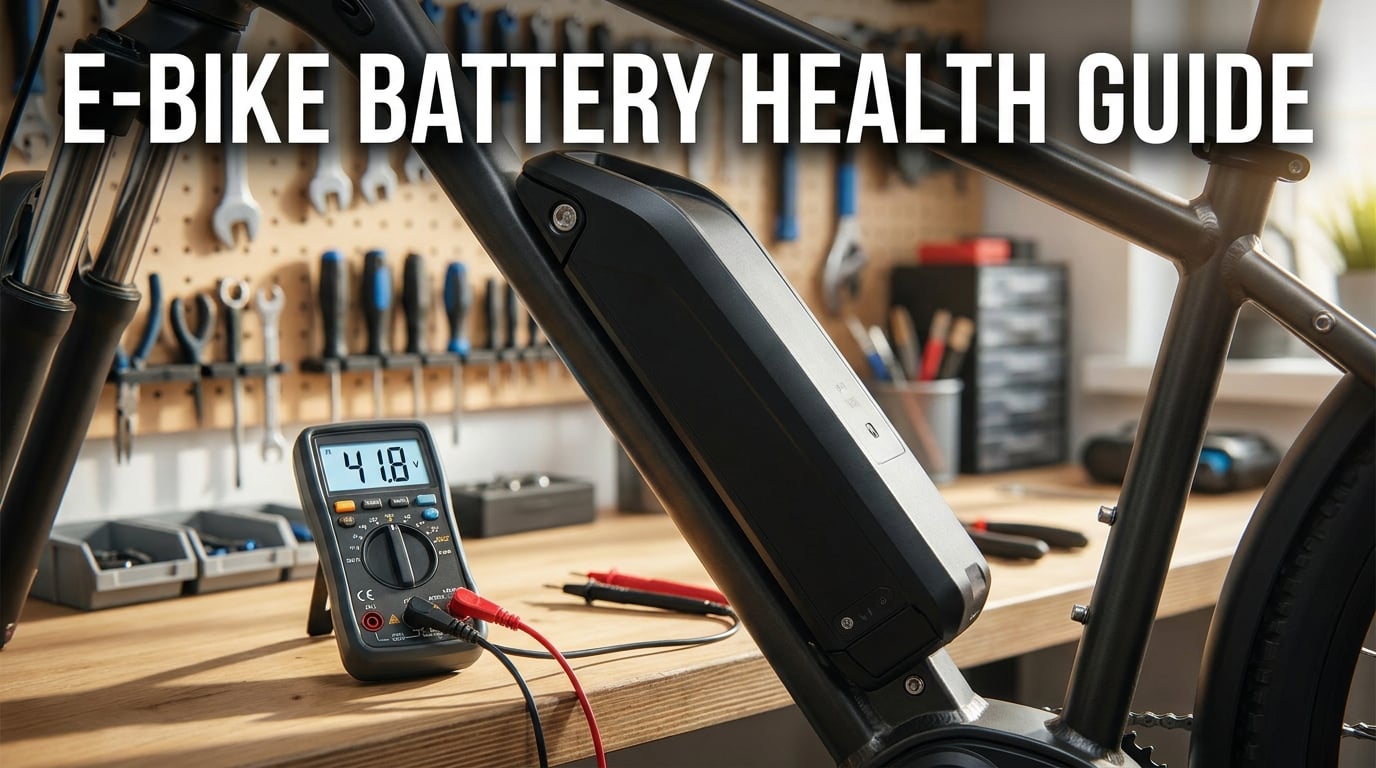
You do not need a dealer visit to get a basic read on your battery health. A multimeter, a fully charged battery, and about fifteen minutes will tell you a lot.
Testing Voltage With a Multimeter
Step 1: Fully charge your battery until the charger light turns green, then let it rest for at least 30 minutes. Resting matters because voltage spikes right after charging and gives a falsely high reading.
Step 2: Set your multimeter to DC voltage in a range that covers your battery. For a 36V pack, use the 60V or 200V setting. For a 48V or 52V pack, use the 200V setting.
Step 3: Place the red probe on the positive terminal and the black probe on the negative terminal of the battery’s output connector. Read the voltage.
For a 36V battery, a fully charged healthy pack reads around 42V. A 48V pack reads around 54.6V. A 52V pack reads around 58.8V. If your reading is more than 2 to 3 volts below the expected full-charge voltage, cells are weak or the BMS is not balancing correctly.
Step 4: Take the battery for a short ride, then measure again. If voltage collapses quickly under load, the pack has high internal resistance and is approaching end of life.
Checking the BMS (Battery Management System)
The BMS is the small circuit board inside the pack that balances cells, prevents overcharge and over-discharge, and reports status to the bike’s display. When a battery behaves erratically but the cells are still healthy, the BMS may be the culprit.
A BMS reset can sometimes restore normal behavior. Disconnect the battery from the bike, then use a paperclip or wire to bridge the BMS reset pins if your pack exposes them. Some packs require holding the power button for 10 to 15 seconds. Check your manufacturer’s instructions because the procedure varies.
If the erratic behavior disappears after a reset and stays gone for several rides, the BMS needed recalibration. If the symptoms return within a week, the cells are the problem and the BMS is doing its job by reporting the degradation.
What Causes E-Bike Batteries to Die Early?
Batteries do not usually fail on a predictable schedule. Four factors accelerate degradation more than any others.
Heat is the biggest killer. Leaving your e-bike in a hot car, charging in direct sunlight, or storing the battery next to a heater all age the cells faster. Ideal charging and storage temperature is room temperature, around 60 to 70 degrees Fahrenheit.
Deep discharges are the second biggest factor. Running the battery down to zero stresses the cells far more than stopping at 20 percent. Try to recharge when you hit 20 to 30 percent remaining, not when the bike dies.
Long-term storage at the wrong charge level is the third. If you store your e-bike for winter with the battery at 100 percent or completely dead, you will lose capacity before spring. Store at roughly 40 to 60 percent charge in a cool, dry place.
The fourth factor is using the wrong charger or charging while the pack is hot from riding. Always let the battery cool for 15 to 20 minutes before plugging it in, and only use the charger that came with the bike or a manufacturer-approved replacement.
Repair vs Replace: Which Makes Sense?
This is the question every e-bike owner faces once the signs pile up. The right answer depends on the age of the pack, the type of failure, and your budget.
When Repair Is Worth It
If your battery is under 2 years old and the issue is a faulty BMS, a broken connector, or a single bad cell group, repair is usually the smarter call. Specialized e-bike battery repair services like FTH Power or Cycle Satiator can diagnose and fix these issues for significantly less than a new pack.
A BMS replacement typically runs a fraction of a new battery cost and can add years to a pack that still has healthy cells. Connector replacements and cell rebalancing are also affordable if you catch the problem early.
Repair is also worth considering if you have a hard-to-source battery for an older or custom e-bike. If a replacement pack is not readily available, rebuilding the existing one may be your only realistic option.
When Replacement Is the Better Choice
If your battery is over 3 years old, shows visible swelling, has multiple failing cell groups, or keeps triggering the same error code after a BMS reset, replacement is the safer and more economical path. Pouring repair money into a pack that is near the end of its rated cycle life rarely pays off.
Replacement is also the right call if you have noticed heating issues, sudden power drops, or erratic charge indicator behavior that does not respond to troubleshooting. These symptoms point to widespread cell degradation that no repair can fully reverse.
Forum riders who have been through both options almost universally recommend replacing rather than repairing once multiple symptoms stack up. The safety and reliability of a fresh pack outweighs the upfront savings on a repair that may only buy you another few months.
Safety Warnings for Damaged Batteries
If your battery is swollen, leaking, or has a burned smell, stop using it immediately. Do not attempt to charge it. Remove it from the bike, place it on a non-flammable surface away from anything combustible, and take it to a battery recycler or e-bike shop as soon as possible. Damaged lithium-ion packs can catch fire without warning.
5 Tips to Extend Your E-Bike Battery Life
Once you have a healthy pack, a few habits will help you get the full 500 to 1,000 cycles the manufacturer rated it for.
First, charge to 80 percent for daily use and only charge to 100 percent before a long ride. Lithium-ion cells degrade faster when held at maximum voltage, so saving the full charge for when you actually need it extends total lifespan.
Second, never store the battery fully charged or fully depleted. If you are parking the e-bike for more than a week, drop the charge to around 50 percent and store the pack in a cool, dry location.
Third, avoid charging immediately after a ride. Let the pack cool for at least 15 minutes before plugging in. Charging a hot battery accelerates cell wear.
Fourth, keep the battery dry and the contacts clean. Corrosion on the connector causes voltage drops that the BMS reads as cell imbalance, triggering protection modes that limit your power output.
Fifth, use only the charger that came with your e-bike or a manufacturer-approved replacement with the correct voltage and current rating. Mismatched chargers are a leading cause of premature battery failure and a serious safety risk.
FAQ’s
What’s the average lifespan of an e-bike battery?
Most quality e-bike batteries last 3 to 5 years or 500 to 1,000 full charge cycles. Heavy daily commuters may see degradation sooner, while light riders can extend life well beyond 5 years with proper charging and storage habits.
What are the symptoms of a bad ebike battery?
The most common symptoms are reduced range on a full charge, longer charging times, sudden power drops during rides, physical swelling or damage, overheating, erratic charge indicator readings, and recurring error codes. If you notice two or more of these together, the battery is likely failing.
Is it worth replacing an ebike battery?
Yes, if the bike itself is in good shape and the battery is over 3 years old or showing multiple failure signs. A new pack typically restores full performance for a fraction of the cost of a new e-bike. Repair may be worth it for packs under 2 years old with a faulty BMS or connector issue.
What happens when an e-bike battery dies?
When an e-bike battery dies completely, the motor stops providing assistance and the bike becomes a regular bicycle. You can still pedal, but without power assist. Sudden death while riding can be dangerous in traffic or on hills, which is why early warning signs matter.
How to bring an ebike battery back to life?
Try a BMS reset first by disconnecting the battery and holding the power button for 10 to 15 seconds. If the pack sat fully depleted for weeks, a slow charge with the original charger may wake it. If neither works after two attempts, the cells are degraded beyond recovery and replacement is the only safe option.
Conclusion
Learning how to tell if an e-bike battery is dying and needs replacing comes down to watching for seven clear signs: range loss, longer charges, power drops, swelling, overheating, erratic indicators, and recurring error codes. Most riders see at least two of these long before the battery quits entirely.
If your pack is over 3 years old, take an hour to test it with a multimeter and try a BMS reset. If the symptoms persist, weigh repair versus replacement based on the age and condition of the cells. And if you see swelling, leaking, or burning smells, stop using the battery immediately and get it to a professional.
Catching battery degradation early gives you time to shop for a replacement on your schedule, rather than scrambling after a sudden failure on the road. Start tracking your range today, and you will know exactly when the time comes.