
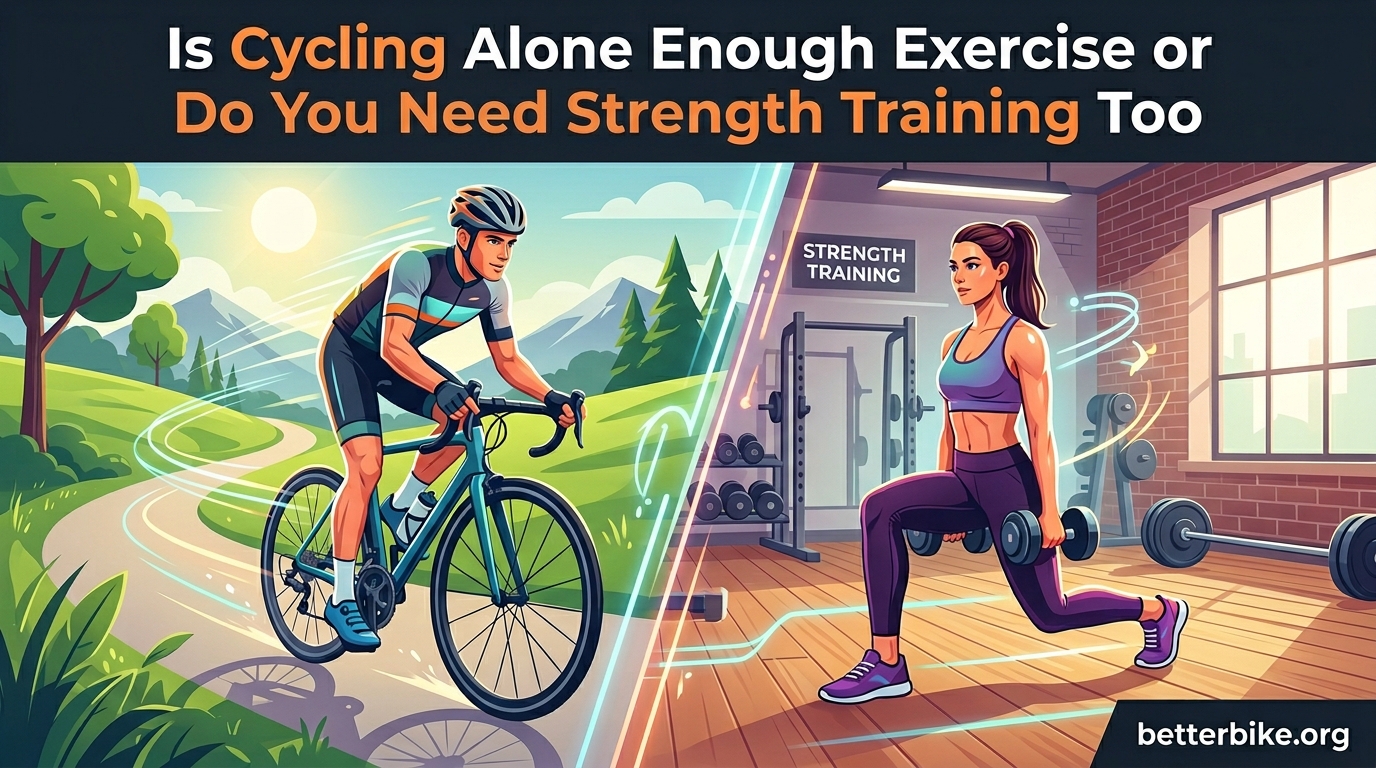
If you have ever finished a long ride feeling like you conquered the world and then wondered whether you really need to lift weights too, you are asking the right question. The short answer is no, cycling alone is not enough exercise if you want to stay healthy, strong, and injury-free for the long haul. Cycling delivers world-class cardiovascular fitness and powerful legs, but it leaves major gaps in bone density, upper body strength, core stability, and muscle balance that only strength training can fill.
Our team has spent years digging into exercise science, coaching forums, and real-world cyclist experiences to figure out what happens when riders rely on the bike alone. What we keep finding is something sports scientists call the cyclist’s paradox. You can have the aerobic engine of an elite athlete and the bone density of someone who never exercises at all.
In this guide, we break down exactly what cycling does for your body, where it falls short, and why adding even two short strength sessions per week can change the trajectory of your health, especially as you age. Whether you are a casual commuter, a weekend warrior, or a masters racer, this is the complete picture of how to combine cycling and strength training the right way.
Table of Contents
What Cycling Actually Does for Your Body
Cycling is one of the most effective cardiovascular exercises on the planet. It builds a massive aerobic engine, strengthens your heart, lowers resting blood pressure, and torches calories without pounding your joints. When you ride consistently, your quadriceps, hamstrings, glutes, and calves develop impressive endurance, and your capillary network expands to deliver oxygen more efficiently.
But here is where the story gets complicated. Cycling is a non-weight bearing exercise, which means your skeleton never has to fight against gravity in the way it does when you run, jump, or lift something heavy. The motion is also highly repetitive and seated, so it works a limited range of muscles through a limited range of motion.
Pushing down on the pedals does create some muscle tension, and studies show cyclists do build more leg strength than sedentary people. The issue is that the resistance is fixed by your gears and bodyweight, not progressively overloaded the way a barbell or dumbbell can be. Translation: cycling takes your leg endurance to incredible heights but plateaus quickly when it comes to raw strength and muscle mass.
The Cyclist’s Paradox Explained
The cyclist’s paradox is a well-documented phenomenon in sports medicine. Studies of competitive cyclists, including research on elite Tour de France-level riders, have found that they can have below-average bone mineral density despite having extraordinary cardiovascular fitness. One frequently cited study of professional cyclists found that a significant portion had T-scores low enough to classify as osteopenia or even osteoporosis, conditions most people associate with frailty and aging.
The reason is straightforward. Bone is living tissue that responds to mechanical stress. When you load it through impact or heavy resistance, it gets denser and stronger. When you do not, it slowly weakens, no matter how fit your heart and lungs are. Cycling keeps you in the saddle, supported by the bike, moving through a smooth circular motion that never asks your bones to adapt.
This is the paradox. You can ride 200 miles a week, look incredibly lean and athletic, and still be at elevated risk for stress fractures and brittle bones. Adding strength training, especially weighted squats, deadlifts, lunges, and overhead presses, gives your skeleton the load it needs to stay dense and resilient. Without that stimulus, your bones age faster than your cardio fitness would suggest.
Why Strength Training Matters for Cyclists
Strength training fills the gaps that cycling cannot touch. Here is what the research and decades of coaching experience consistently show when cyclists add resistance work to their routine:
- Bone density protection. Resistance training is the only reliable way to increase bone mineral density. Cycling, no matter how hard or how often, does not meaningfully load your bones.
- Muscle mass preservation. Adults lose 3 to 8 percent of their muscle mass per decade after age 30, and the rate accelerates after 60. Strength training is the single most effective intervention to slow and reverse that loss.
- Core stability. Cycling works your legs hard but barely challenges your core. A strong core translates to better power transfer, less lower back pain, and improved bike handling.
- Injury prevention. Cycling is repetitive, which creates muscle imbalances, especially weak glutes, tight hip flexors, and underdeveloped hamstrings. Strength work corrects those imbalances before they become chronic injuries.
- Improved power output. Multiple peer-reviewed studies show that heavy resistance training improves cycling economy and peak power output, even in highly trained cyclists.
- Better coordination and balance. Lifting weights, especially compound movements, trains proprioception and neural pathways that cycling alone never touches.
- Cognitive benefits. Emerging research links resistance training to improved executive function, memory, and neuroplasticity, particularly in older adults.
- Functional fitness for life. Cycling does not train you to lift groceries, climb stairs with a child, or get up off the floor. Strength training does.
None of these benefits require becoming a bodybuilder. Two focused sessions per week, roughly 30 to 45 minutes each, covers all of them when programmed correctly.
Bone Density: The Hidden Risk of Cycling Alone
If there is one reason to stop skipping strength work, this is it. Bone mineral density is not something you can feel declining. There is no soreness, no warning sign, no performance drop on the bike. The first symptom is often a fracture, and by then the problem has been developing for years.
Because cycling is non-weight bearing, dedicated cyclists often end up with bone density significantly lower than runners, swimmers who also do dryland training, or people who lift weights. Masters cyclists are especially vulnerable. If you have ridden for decades without ever touching a barbell, you are carrying a hidden risk that a simple DEXA scan would reveal.
The good news is that bones respond to loading at any age. Research shows that even adults in their 60s, 70s, and beyond can increase bone mineral density through progressive resistance training. Heavy squats, deadlifts, standing overhead presses, and loaded carries are particularly effective because they load the spine, hips, and shoulders, the exact sites where cyclists tend to lose density fastest.
For cyclists who cannot or do not want to use a barbell, bodyweight squats, resistance bands, and plyometric movements like jumping and bounding still provide more bone stimulus than cycling ever will. Something is always better than nothing when it comes to skeletal loading.
Muscle Loss and Aging Cyclists
Sarcopenia, the age-related loss of muscle mass, is not a problem you can out-ride. Cycling preserves Type I, slow-twitch muscle fibers beautifully because those are the fibers responsible for endurance work. But Type II, fast-twitch fibers, the ones that generate raw power and protect you from falls, fade quickly without specific training.
Research on aging athletes consistently shows that endurance exercise alone is not enough to preserve muscle mass and functional strength. Older cyclists who ride a lot but never lift weights often end up with strong cardiovascular systems but weak grips, poor balance, and difficulty with everyday tasks like standing from a low chair or catching themselves when they stumble.
Here is how we think about age-specific recommendations:
Cyclists in their 40s. This is when muscle loss quietly begins. Two strength sessions per week focused on compound lifts will preserve what you have and set you up for the decades ahead. Think of it as a retirement account for your body.
Cyclists in their 50s. Hormonal changes start to accelerate muscle loss. Strength training becomes non-negotiable. Heavy lifting, appropriately progressed, is your best tool. Many riders in this bracket report noticeable improvements in climbing power within a few months of starting.
Cyclists 60 and older. The forum discussions on this are powerful. Riders in their 70s and 80s who have lifted consistently for years describe bone density scores comparable to people decades younger, plus the strength to keep riding hard. One cyclist in a popular training forum mentioned having bone density equal to a 25-year-old at 84, attributed to decades of consistent resistance work. That is not an outlier, it is what consistent training produces.
Does Strength Training Make You Faster on the Bike?
For years, the cycling world was split on whether lifting weights actually improved performance. The myth was that strength training made you bulky and slow, and that any time in the gym was time stolen from riding.
The modern research tells a different story. Multiple peer-reviewed studies, including well-controlled trials on trained cyclists, have shown that adding heavy resistance training two to three times per week improves cycling economy, increases peak power output, and boosts sprint performance, without adding meaningful body mass. One frequently cited study found that cyclists who added heavy strength training improved their time to exhaustion at maximal aerobic power by double-digit percentages.
The mechanism is efficiency. When your legs are stronger, each pedal stroke costs you relatively less effort. Your fast-twitch fibers, which cycling underuses, become available for surges, attacks, and steep climbs. You also delay fatigue because your muscles can recruit more fibers before exhausting the ones you rely on.
The key is programming. Heavy, low-rep compound lifts, think squats, deadlifts, and leg presses in the 3 to 6 rep range, build strength without size. High-rep, low-weight circuits do not deliver the same neurological adaptations and tend to add fatigue without payoff. If you want to get faster on the bike, lift heavy and lift infrequently.
How to Combine Cycling and Strength Training
Now we get to the part most guides skip. Knowing you should lift is one thing. Actually fitting it into a life already full of riding, work, and family is another. Here is the practical blueprint our team recommends.
How Often Should Cyclists Lift Weights?
Two sessions per week is the sweet spot for nearly every cyclist. Research and coaching experience consistently show that two focused sessions deliver the vast majority of the benefits. A third session adds marginal gains and significantly more fatigue, which is rarely worth it unless you are in a dedicated off-season block.
During the racing season or when you are riding hard, you can drop to one maintenance session per week and still preserve strength. During the off-season, two to three sessions of heavier, progressive loading is ideal for building a strength base you can carry into the next season.
The Best Strength Exercises for Cyclists
Focus on compound movements that load the muscles cycling underuses. Here is the short list that covers the essentials:
- Squats (goblet, front, or back) for quads, glutes, and core
- Deadlifts (conventional or Romanian) for hamstrings, glutes, and posterior chain
- Lunges or split squats for single-leg strength and balance
- Hip thrusts or glute bridges for power on the pedals
- Standing overhead press for shoulders, upper back, and core
- Rows or pull-ups for upper back and posture correction
- Planks, dead bugs, and Pallof presses for core stability
- Loaded carries (farmer’s walks) for grip, core, and full-body coordination
Avoid exercise machines that lock you into a single plane of motion. Free weights, bodyweight movements, and kettlebells build the kind of functional strength that transfers to riding and to life off the bike.
Scheduling Strength Work Around Your Rides
The biggest mistake cyclists make is stacking a heavy leg day right before a hard ride. Your legs end up trashed and you blame the lifting for ruining your cycling. The fix is sequencing.
Do your strength sessions on the same day as a hard ride, after the ride, or on a rest day with at least 24 hours before your next hard effort. Never lift heavy the day before an interval session, a race, or a long group ride. A sample weekly schedule might look like this: hard ride and lift on Tuesday, easy ride Wednesday, hard ride Thursday, lift Friday, long ride Saturday, rest Sunday.
If you can only manage one session per week, do it on a day when you have no riding planned or after an easy recovery ride. Consistency beats perfection. One session every week for a year beats three sessions for a month followed by three months of nothing.
Time-Efficient Workouts for Busy Cyclists
This is the gap no competitor in the cycling space fills well. Most cyclists are not professional athletes. You have a job, a family, and limited hours. Here is how to get strength work done when time is tight.
Keep sessions to 30 minutes. Pick three or four compound movements and do them as a circuit with minimal rest. A squat, a hinge, a push, and a pull covers the entire body in four exercises. Warm up for five minutes, work for 20, cool down for five. That is a complete session.
Use supersets to combine exercises and cut rest time. Pair a squat with a row, or a deadlift with an overhead press. You will get more work done in less time and your heart rate stays elevated, which doubles as cardio conditioning.
Embrace minimum viable workouts. On brutal weeks, even 15 minutes of goblet squats, push-ups, and planks is better than skipping entirely. The goal is consistent skeletal loading and muscle stimulus, not perfection.
At-Home Alternatives When You Cannot Get to a Gym
Not every cyclist wants a gym membership, and that is fine. You can build effective strength at home with minimal equipment. A set of dumbbells, a kettlebell, and a set of resistance bands covers the vast majority of what you need.
Bodyweight movements also work if you keep them challenging. Bulgarian split squats, single-leg deadlifts, push-up variations, and plank progressions all build real strength without any equipment. Add a loaded backpack for squats and lunges to increase resistance over time.
Resistance bands, frequently mentioned in cycling forums as a practical alternative, are excellent for posterior chain work, shoulder health, and travel. They cost a fraction of what a dumbbell set does and pack into a jersey pocket or suitcase. If you skip the gym entirely, bands plus bodyweight plus a single heavy dumbbell or kettlebell is a complete home setup.
Cognitive and Mental Benefits You Probably Haven’t Heard About
Here is something most guides skip entirely. Strength training changes your brain, not just your body. Multiple studies have linked regular resistance training to improved executive function, better memory, and increased gray matter volume in adults over 50.
The mechanism appears to involve increased production of brain-derived neurotrophic factor, or BDNF, a protein that supports the growth and survival of neurons. Heavy lifting also challenges your nervous system to coordinate complex movements, which builds new neural pathways and improves proprioception, your body’s awareness of where it is in space.
For older cyclists especially, this matters. Cognitive decline and physical decline often go hand in hand, and resistance training is one of the few interventions that appears to slow both. If you want to stay sharp on the bike and off it well into your 70s and beyond, lifting weights is one of the highest-leverage things you can do.
Common Myths About Strength Training and Cycling
Let us clear up the objections that keep cyclists out of the weight room.
Myth: Lifting makes you bulky and slow. Reality: Heavy, low-rep strength training builds neurological strength without significant muscle mass. Cyclists who get bulky are eating in a calorie surplus and doing high-volume bodybuilding work, not heavy compound lifts.
Myth: I do not have time to lift. Reality: Two 30-minute sessions per week is enough. That is one hour total, less time than most cyclists spend on a single easy ride.
Myth: Cycling works my legs enough. Reality: Cycling builds endurance in a limited range of motion. It does not build raw strength, fast-twitch fiber capacity, or bone density.
Myth: Strength training will trash my legs for riding. Reality: Only if you schedule it badly. Lift after hard rides or on rest days and the fatigue is minimal. Your legs adapt within a few weeks.
Is cycling alone enough exercise?
No. Cycling delivers excellent cardiovascular fitness and leg endurance, but it is non-weight bearing and does not build bone density, upper body strength, or balanced muscle development. For long-term health, especially as you age, you need strength training in addition to riding.
Does cycling affect the prostate?
Prolonged cycling can put pressure on the perineum and may temporarily affect prostate health or urinary function in some men. Using a properly fitted saddle, taking standing breaks, and adjusting bike fit significantly reduces risk. If you experience numbness or urinary symptoms, consult a urologist and revisit your saddle choice.
What is the 75% rule in cycling?
The 75% rule suggests that 75% of your training volume should be done at or below your aerobic threshold, meaning easy, conversational effort. Only about 25% of your riding should be hard intervals or high-intensity work. This balance maximizes aerobic development while leaving room for recovery and strength training.
Can cycling reduce blood pressure?
Yes. Regular aerobic exercise like cycling is one of the most effective lifestyle interventions for lowering resting blood pressure. Most studies show meaningful reductions within a few weeks of consistent riding, with the best results coming from a mix of moderate-intensity and higher-intensity sessions.
Does cycling lower cortisol?
Moderate cycling can help reduce baseline cortisol levels over time by improving overall stress management and cardiovascular fitness. However, chronic high-volume or high-intensity training without adequate recovery can actually elevate cortisol. Balance your riding with sleep, nutrition, and strength work for the best hormonal outcomes.
How often should cyclists do strength training?
Two sessions per week is the sweet spot for most cyclists. Each session should last 30 to 45 minutes and focus on compound lifts like squats, deadlifts, presses, and rows. During race season you can drop to one maintenance session weekly.
Will strength training make me bulky on the bike?
No. Heavy, low-rep lifting builds strength through neurological adaptation, not muscle size. Cyclists who add mass are usually eating in a large calorie surplus and doing high-volume bodybuilding work. Properly programmed strength training for cyclists adds power without weight.
Does cycling count as cardio or strength training?
Cycling is primarily cardiovascular exercise. It does build some muscular endurance in the legs, but the resistance is not progressive enough to qualify as true strength training. Cycling should be paired with dedicated resistance work for complete fitness.
Conclusion: Is Cycling Alone Enough Exercise?
So, is cycling alone enough exercise? For pure cardiovascular health and leg endurance, it is genuinely world-class. For complete fitness that protects your bones, preserves your muscle, sharpens your mind, and keeps you riding strong into your 70s and 80s, it is not even close to enough.
The cyclist’s paradox is real, and it catches up with everyone who ignores it. The fix is simple. Two short strength sessions per week, focused on compound lifts, scheduled around your rides. That is one hour of your week to dramatically change the trajectory of your health and your cycling.
If you are not lifting yet, start this week. Pick three exercises, grab a dumbbell or a set of bands, and do one set of each. Build from there. Your future self, the one still climbing hard at 75 with bones like a 25-year-old, will thank you.