
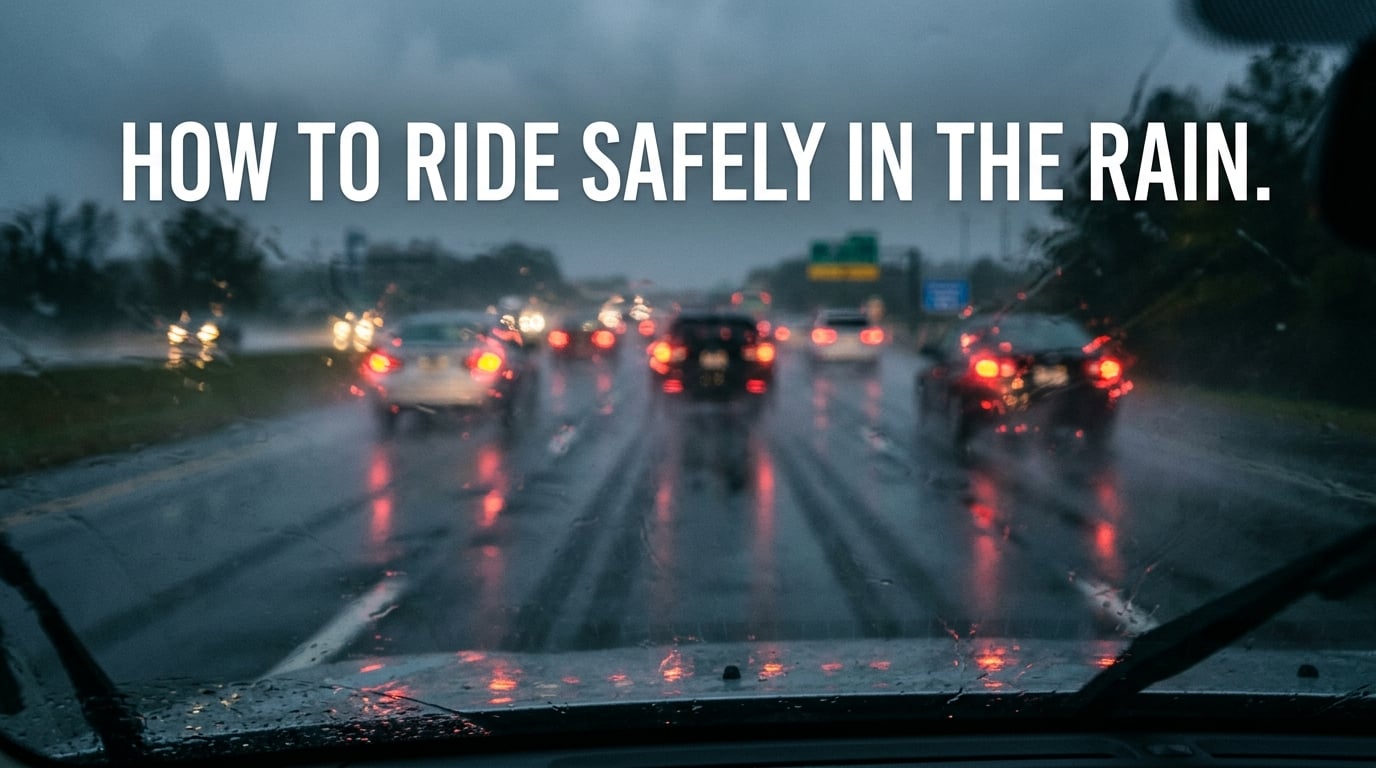
Wet pavement contributes to over 860,000 crashes every year in the United States alone, according to data cited by AAA and fire safety officials. When rain mixes with road surfaces, conditions change fast and the margin for error shrinks dramatically. Learning how to ride safely in the rain can mean the difference between arriving at your destination and ending up in a ditch.
Whether you drive a car, ride a motorcycle, or commute on a bicycle, slick roads demand a completely different approach than dry conditions. In this guide, our team breaks down everything from the science of why roads get slippery to step-by-step techniques for preventing and recovering from dangerous situations like hydroplaning and skids.
We pulled advice from official sources like UCLA Transportation, the City of San Jose, and AAA, plus real-world experience from motorcycle and cycling communities on Reddit. The result is a practical, no-fluff guide you can apply the next time the forecast calls for rain.
Table of Contents
Why Roads Become Slick When It Rains
Roads do not get slick just because water makes surfaces slippery. The real danger comes from what the water stirs up. Oil, grease, vehicle fluids, and dust accumulate on road surfaces during dry periods. When the first rain hits, that layer of grime lifts to the surface and creates a surprisingly slick film.
This is why the first rainfall after a dry spell is the most dangerous. Regions like Southern California, where rain may not fall for months, see particularly hazardous conditions because oil buildup is extreme. UCLA Transportation specifically warns drivers about this oil slick effect, which can make roads feel like ice for the first 30 to 60 minutes of rainfall.
Beyond the oil slick, water itself reduces the friction between your tires and the road. Even after the initial oil washes away, wet pavement cuts your available traction significantly. Your tires cannot grip as firmly, which means every input you make, braking, accelerating, or steering, has less effect than on dry roads.
Yes, roads absolutely get slick when it rains, and the first rain after a dry period is the worst of all. Understanding this helps you take the threat seriously rather than treating rain like a minor inconvenience.
How to Ride Safely in the Rain: Core Techniques
The single most important thing you can do when roads are wet is slow down. Speed limits are designed for dry, clear conditions. On wet pavement, you should reduce your speed by at least 5 to 10 mph below the posted limit, and even more in heavy rain. Reducing speed directly increases your available traction and gives you more time to react.
Every movement you make should be smooth and deliberate. Sudden throttle application, hard braking, or jerky steering inputs are exactly what cause loss of control on slick roads. The UCLA guide puts it well: do things one at a time. Brake first, then steer. Accelerate out of a turn only after you have straightened the wheel. Mixing inputs overwhelms whatever grip your tires still have.
If you are on a motorcycle or scooter, this principle becomes even more critical. Experienced riders on Reddit emphasize that smooth is safe. One rider put it plainly: gentle throttle control, smooth brake operation, try to keep off the back brake, and leave plenty of room. Another added that if your tires are good, you will have more grip than you think most of the time, so confidence built on smooth technique goes a long way.
When someone asks what you should do when the roads are wet and slippery, the answer comes down to a handful of core habits: slow down, increase your following distance, use headlights, make smooth inputs, and never use cruise control. Do all of those things consistently and you eliminate the vast majority of wet weather risk.
Increase Your Following Distance
On dry roads, the standard following distance rule is 3 seconds behind the vehicle in front of you. In rain, that rule changes. You need at least 6 seconds of following distance when roads are wet, and even more in heavy rain or low visibility.
This is what safety instructors call the 3-6 second rule. In dry conditions, stay 3 seconds back. In wet conditions, extend to 6 seconds or more. To measure this, pick a fixed point on the road like a sign or overpass. When the vehicle ahead passes it, start counting. If you reach that same point before your target count, you are too close.
The reason is simple physics. Wet pavement can double your braking distance compared to dry roads. If the car in front of you stops suddenly and you only have 3 seconds of gap, you will not have enough room to come to a safe stop. Doubling your following distance gives you the buffer you need to react and brake gradually instead of slamming the pedal.
Maintain Traction on Wet Roads
Traction is everything when conditions are slick. Your tires are the only contact points between your vehicle and the road, and on wet surfaces, those contact patches are working harder than ever. To avoid losing traction in the rain, start with your tires.
Check your tread depth regularly. Tires with worn tread cannot channel water away effectively, which dramatically increases the risk of hydroplaning. The penny test is a quick way to check: insert a penny into the tread groove with Lincoln’s head facing down. If you can see the top of his head, your tread is too worn for safe wet weather driving. Replace those tires before riding in rain.
Tire pressure matters too. Underinflated tires reduce your contact patch and increase rolling resistance, while overinflated tires reduce grip. Check your pressure monthly and follow the manufacturer’s recommended range. For motorcycles, proper pressure is even more important since you only have two wheels keeping you upright.
When braking on wet roads, apply pressure gradually rather than stabbing the pedal. If your vehicle has anti-lock brakes, trust the system and maintain firm, steady pressure. The ABS will pulse the brakes for you and prevent lockup. For motorcyclists without ABS, practice modulating both brakes gently and avoid grabbing the front brake hard in slippery conditions.
Visibility: Headlights, Wipers, and Defogging
Turning on your headlights in the rain is not just common sense, in most states it is the law. California Vehicle Code 24400, for example, requires headlights whenever weather conditions require the use of windshield wipers. Even in daylight, headlights make you visible to other drivers and help you see the road ahead more clearly.
Use your low beams, not your high beams. High beams reflect off rain and create a wall of glare that actually reduces visibility. If your vehicle has fog lights, those can help illuminate the road surface without adding upward glare.
Your windshield wipers should be in good condition before the rainy season starts. Worn, cracked, or streaking blades smear water across the glass instead of clearing it. Replace them at least once a year, or sooner if you notice performance dropping. Pair good wipers with a quality windshield treatment that beads water for clearer vision.
Defogging is another critical visibility factor. When warm, moist air hits cold glass, fog forms on the inside of your windows faster than you might expect. Use your defroster and air conditioning together to clear condensation quickly. For motorcyclists, helmet visor fogging is a major pain point that comes up repeatedly in forums. Riders recommend anti-fog sprays, pinlock inserts, or even cracking the visor slightly to improve airflow and reduce condensation buildup.
Never Use Cruise Control in the Rain
This one surprises people, but it is one of the most dangerous things you can do in wet conditions. Cruise control is designed to maintain a set speed regardless of what the road throws at you. If your tires begin to lose traction or you start to hydroplane, cruise control will actually try to accelerate to maintain speed, making the situation dramatically worse.
If you need to reduce speed quickly while cruise control is active, you have to cancel it first, then brake. That extra fraction of a second can be the difference between avoiding a collision and causing one. Both UCLA and the City of San Jose list canceling cruise control as a top safety priority for wet weather driving.
The fix is simple: turn cruise control off the moment rain starts. Maintain manual control of your speed so you can react instantly to changing conditions. Your right foot should always be ready to ease off the accelerator or apply the brakes as needed.
Watch for Painted Lane Markings and Metal Surfaces
Here is a hazard that almost no safety guide mentions, but riders talk about constantly in forums. Painted lane markings, crosswalks, and directional arrows become incredibly slippery when wet. The paint and thermoplastic materials used for road markings have almost no grip in rainy conditions compared to bare asphalt.
Multiple riders on Reddit flagged this as a major concern. One put it bluntly: be aware of painted lane markings as they will be quite slick. Another noted that you cannot always avoid them, especially at intersections, so the best strategy is to minimize lean angle and avoid braking or accelerating hard while crossing painted surfaces.
Metal surfaces are equally dangerous. Manhole covers, metal expansion joints on bridges, and railroad tracks become slick as ice when wet. If you cannot avoid them, cross them in a straight line with steady, gentle throttle. For cyclists and motorcyclists, railroad tracks should be crossed at as close to a perpendicular angle as possible to prevent the tires from sliding along the rail.
How to Handle Hydroplaning
Hydroplaning happens when a layer of water builds up between your tires and the road surface, lifting your vehicle so it essentially rides on top of the water. At that point, you have zero steering control and zero braking ability. It is one of the scariest experiences a driver can have.
Hydroplaning can occur at speeds as low as 35 mph if the water is deep enough, though the risk increases significantly above 50 mph. Worn tires, underinflation, and even tire width all affect your susceptibility. The wider the tire and the shallower the tread, the more likely you are to hydroplane.
If you feel the steering go light or the rear end start to drift, you are likely hydroplaning. Here is what to do, step by step. First, ease off the accelerator gradually. Do not slam the brakes. Second, keep the steering wheel straight and avoid sudden corrections. Third, let the vehicle slow down naturally until the tires regain contact with the road. Once you feel grip return, you can resume gentle steering and braking inputs.
Prevention is far easier than recovery. Reduce speed in heavy rain, avoid driving through puddles, and keep your tires in good condition with adequate tread depth. If the rain is so heavy that water is pooling on the road, it is time to slow way down or pull over entirely.
Standing Water and Flooded Roads
Never attempt to drive or ride through standing water. It only takes 6 inches of water to reach the bottom of most passenger cars, and 12 inches can float many vehicles entirely. What looks like a shallow puddle could be hiding a washed-out section of road, a deep pothole, or debris that could damage your vehicle or throw you off a bike.
The City of San Jose guide specifically warns against driving through flooded areas, citing that even experienced drivers underestimate the force of moving water. If you encounter water covering the road, turn around and find an alternate route. The few minutes you save are not worth the risk of losing your vehicle or your life.
Even shallow puddles deserve caution. They can hide slick spots, loose gravel, or sharp debris. Slow down before entering any puddle and maintain a straight line through it. Avoid braking while in the water, as wet brakes are less effective immediately after.
Skid Recovery on Slick Roads
If despite your best efforts your vehicle or bike begins to skid, knowing what to do can save you from a crash. The recovery technique depends on which wheels lose traction, but the first rule is always the same: stay calm and do not panic.
For a front-wheel skid, where the vehicle plows straight ahead despite your steering input, ease off the accelerator and gently steer in the direction you want to go. Do not brake hard, as that will only make the skid worse. Wait for the tires to regain grip before applying more steering input.
For a rear-wheel skid, where the back end slides out, steer into the skid. That means turning the steering wheel in the same direction the rear is sliding. If the back end swings right, steer right. This countersteering technique realigns the vehicle and helps you regain control.
If your vehicle is equipped with anti-lock brakes, the ABS will handle brake modulation for you during a panic stop. Maintain firm, steady pressure on the pedal and trust the system. You may feel the pedal pulse or vibrate, which is normal. For motorcyclists, ABS has become standard on many models and is highly recommended for wet weather riding.
When to Pull Over and Wait
Sometimes the safest decision is to stop riding entirely. If visibility drops so low that you cannot see the vehicle ahead clearly, if rain is coming down so hard that your wipers cannot keep up, or if you feel yourself losing focus from the stress of the conditions, find a safe place to pull over.
Pull into a rest area, gas station, or parking lot well off the roadway. Avoid stopping on the shoulder of a highway unless absolutely necessary, as reduced visibility increases the risk of being struck by another vehicle. Use your hazard lights if you must stop near traffic.
Rain intensity often changes quickly. Waiting 20 to 30 minutes can be enough for the heaviest bands to pass. There is no shame in waiting out a storm. Arriving late is always better than not arriving at all.
Vehicle Preparation Checklist Before Riding in Rain
Before you head out in wet conditions, run through this quick checklist to make sure your vehicle is ready. Taking five minutes before you leave can prevent problems that would be impossible to fix on the road.
- Tires: Check tread depth and pressure. Replace worn tires before the rainy season.
- Brakes: Ensure brake pads have adequate material and that your brake system responds firmly.
- Headlights and taillights: Test all lights, including turn signals and brake lights, to confirm they are working and visible.
- Windshield wipers: Replace blades if they streak or leave gaps. Fill your washer fluid reservoir.
- Defroster and climate control: Confirm the defroster works and that your AC can help clear interior fog quickly.
- Helmet visor (motorcyclists): Apply anti-fog treatment or install a pinlock insert before the ride.
- Tire pressure monitoring: Check that your TPMS is functioning and no warning lights are active.
For motorcyclists and cyclists, add rain-specific gear to your checklist. Waterproof gloves, a rain suit, and waterproof boots keep you comfortable and focused. Cold, wet hands are a real safety hazard because they reduce your grip strength and reaction time.
FAQ’s
How to not lose traction in rain?
To avoid losing traction in the rain, reduce your speed, check your tire tread depth and pressure regularly, and make all inputs smooth and gradual. Avoid hard braking, sharp steering, and sudden acceleration. If your vehicle has ABS, trust the system during emergency stops by maintaining firm steady pressure on the brake pedal. For motorcycles, keep off the rear brake in slick conditions and use gentle throttle control.
What is the 3 6 second rule?
The 3-6 second rule is a following distance guideline. In dry conditions, maintain at least 3 seconds of distance behind the vehicle in front of you. In wet or rainy conditions, extend that to 6 seconds or more. To measure it, pick a fixed point on the road and count the seconds between the vehicle ahead passing it and you reaching the same point.
Do roads get slick when it rains?
Yes, roads become slick when it rains because water lifts oil, grease, and debris that have accumulated on the surface during dry periods. The first rainfall after a dry spell is especially dangerous because the oil layer has not yet washed away, creating a film that can make roads feel as slick as ice for the first 30 to 60 minutes.
What should you do when the roads are wet and slippery?
When roads are wet and slippery you should slow down by at least 5 to 10 mph, increase your following distance to 6 seconds or more, turn on your headlights, make smooth and deliberate inputs for braking and steering, turn off cruise control, and avoid standing water. If conditions become too dangerous, pull over to a safe area and wait for the rain to ease.
Key Takeaways for Riding Safely in the Rain
Riding safely in the rain comes down to respecting the conditions and adjusting your approach. Slow down, double your following distance, use your headlights, and make every input smooth and deliberate. Never use cruise control, avoid standing water, and pull over if visibility drops too low.
Remember that the first rainfall after a dry period is the most dangerous moment on the road. Watch out for painted lane markings and metal surfaces, which are far slicker than surrounding asphalt. Keep your tires in good condition and know how to recover from hydroplaning and skids before you ever need those skills.
Practice these techniques before you need them. The next time the forecast calls for rain, you will be ready to ride with confidence instead of fear. Stay safe out there.