
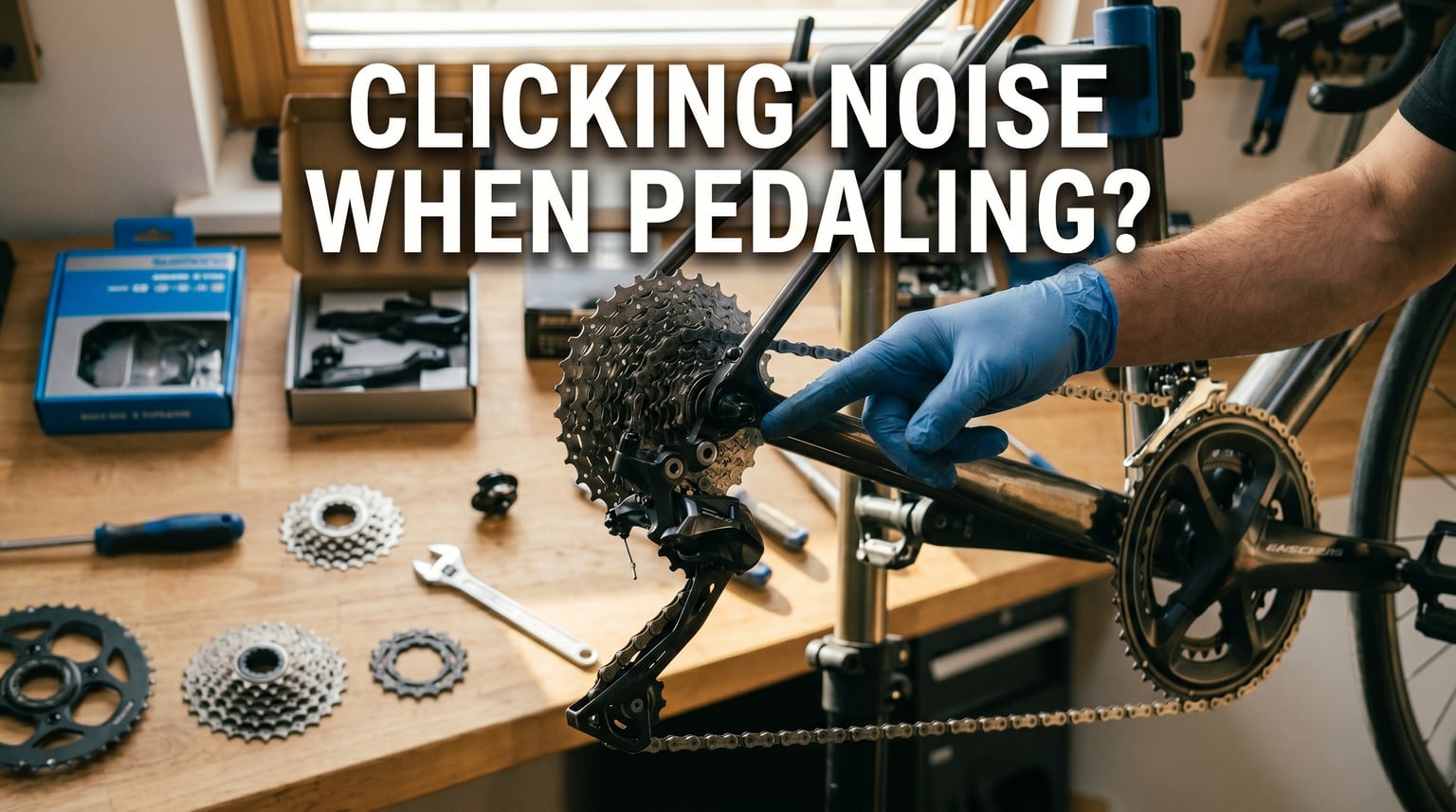
A clicking noise when pedaling that goes away when you coast is one of the most common complaints I hear from fellow cyclists. I have chased this exact rattle on my own road bike for years, and I have helped friends diagnose it on everything from budget commuters to carbon race machines.
The good news: this kind of noise is almost always fixable. The pattern you describe – click under power, silence when coasting – points to a specific set of components that only move when you apply force to the pedals. In this guide, I will walk you through what causes it, how to narrow down the source, and how to fix each part step by step.
Table of Contents
Why the Clicking Noise Stops When You Coast
The reason your bike clicks while pedaling but stays quiet when coasting comes down to a single mechanism: the freehub. The freehub is the ratcheting unit inside your rear hub that lets the wheel spin freely without turning the cassette when you stop pedaling.
When you pedal, the chain pulls the cassette, which engages the freehub and drives the rear wheel. Every bolt, spline, and bearing along that power path experiences load. Any tiny movement between two parts under load – even a few thousandths of an inch – produces a click.
When you coast, the chain still spins, but it no longer drives the cassette. The freehub disengages, the rear hub freewheels, and the load on the drivetrain drops to zero. That is why the click vanishes. The components only “talk” to each other when power is being applied.
Knowing this narrows the suspects immediately. Anything that moves under pedaling force – pedals, crank arms, bottom bracket, chainring, cassette, lockring – is on the list. Your brakes, tires, and spokes generally are not, unless they are rubbing.
Quick Diagnostic Questions to Narrow Down the Source
Before you start pulling things apart, spend two minutes answering these questions. I use this exact flow when a friend asks me to listen to their bike.
- Does the click happen once per pedal stroke or many times? One click per revolution almost always points to the crank arm, pedal, or bottom bracket. A fast tick-tick-tick usually means chain or cassette.
- Does it happen under heavy load only, or any pedaling? If it only appears when standing or climbing, suspect the chainring bolts, bottom bracket, or pedal body. If it appears during easy spinning, suspect a dry chain or worn cassette.
- Does the click speed up when you pedal faster, or stay synced to the wheel? Cadence-synced = drivetrain. Wheel-synced = hub, freehub body, or spokes.
- Can you reproduce it on a work stand? If not, you are dealing with a load-only issue. Mechanics miss these constantly because stands remove the rider’s weight.
- Did the noise start after a specific event? A crash, a bike wash, a new cleat install, or a recent service are all big clues.
How to Fix Clicking Noise in Bike Pedals
Pedals are the number one cause of a single click per pedal stroke. I have seen clipless pedals, flat pedals, and even high-end road pedals all do this.
Start with the pedal threads. Pedal threads are made of soft steel, and they loosen over time from vibration. Grab each pedal arm and try to wobble it side to side. Any play means the bearings or the spindle are worn. No play? Tighten the pedal against the crank arm with an 8mm Allen key. Remember: the right pedal is normal thread, the left pedal is reverse thread.
Check pedal bearings. If the pedal body itself has play or roughness when you spin it, the bearings are shot. Many pedals use a cartridge bearing that can be replaced. Cheaper pedals often use a loose-ball bearing that you can re-grease after pulling the dust cap.
Inspect the cleats. On clipless pedals, worn or loose cleats cause a click that only happens when you apply power. Pop the cleats off the shoes, clean the mounting holes, add a tiny bit of thread locker, and reinstall them. If the cleats are worn down to the indicator lines, replace them.
A quick tip I learned the hard way: always grease the pedal threads before installing pedals. Dry threads creak. Greased threads last longer and stay quiet.
Crank Arms and Bottom Bracket Clicking
Loose crank arms are the second most common culprit, and they are a close cousin of pedal issues. The crank arm slides onto a tapered spindle and locks in place with a single bolt (or a self-extracting system on some models).
Check crank arm bolts. Use a torque wrench and tighten each crank arm bolt to the manufacturer spec – usually 30 to 50 Nm. If you do not have a torque wrench, tighten firmly and check for play. I have found FSA and other OEM cranks especially prone to loosening. Forum mechanics often recommend removing the bolt, cleaning the threads, and applying a drop of red (permanent) thread locker before reinstalling.
Look for play at the crank-to-bottom-bracket interface. Hold the crank arm and rock it toward and away from the frame. Any movement means the taper fit is degrading. The taper is a precision-machined cone that relies on metal-to-metal contact. If it loosens, the contact surfaces fret and wear. Continued riding in this state can ruin the crank arm and the spindle.
Test the bottom bracket bearings. Spin the cranks backward and listen for grinding or roughness. A healthy bottom bracket spins freely and silently. If you feel catching, clicking from inside the frame, or visible play, the bottom bracket needs service or replacement. Press-fit units can creak as they shift in the frame under load – a thin smear of assembly compound on the cups before installation fixes this.
Chain, Chainring, and Cassette Issues
Drivetrain noise that speeds up with cadence almost always lives in the chain, chainring, or cassette.
Clean and lube the chain. A dry or dirty chain is the simplest fix. Wipe the chain down with a rag, apply a quality chain lube designed for your conditions (wet lube for rain, dry lube for summer), and wipe off the excess. A properly lubed chain is silent; a neglected chain ticks like a clock.
Check chainring bolts. Grab each chainring and try to wiggle it relative to the crank arm. If it moves, the chainring bolts are loose. Tighten them in a star pattern with a Torx or hex driver. Many riders have permanently solved their clicking by going over every chainring bolt once a year.
Inspect the cassette lockring. The cassette lockring holds the cassette cogs onto the freehub. If it loosens, the whole cassette can rock slightly under power. Use a cassette lockring tool and tighten the ring securely. This is one of the easiest fixes and one of the most commonly missed.
Look for chain wear and stiff links. A chain stretched beyond 0.75% should be replaced. A stiff link – one segment that does not flex freely – clicks on every revolution. Flex the chain in a U-shape to find stiff links and work them back and forth until they move freely.
Other Sources of Clicking: Seatpost, Saddle, and Spokes
When the obvious fixes do not solve the problem, it is time to look at the less common suspects. I have personally been fooled by each of these at least once.
Seatpost and saddle. A dry or under-greased seatpost can creak under load, but a loose saddle clamp or saddle rails can produce a distinct click. Drop the seatpost, clean it, grease it (or use carbon paste on a carbon post), and reinstall. Tighten the saddle clamp bolts to spec – usually 4 to 6 Nm.
Spokes and wheel tension. A loose spoke can ping or click as the wheel flexes under your weight. Squeeze pairs of spokes to feel for tension differences. A loose spoke usually needs a single quarter-turn to bring it back in line with its neighbors.
Quick release and thru-axle. A rear wheel that is not properly secured can shift in the dropouts, causing a rhythmic click. Make sure your quick release is fully closed, or your thru-axle is torqued to spec.
When to Take Your Bike to a Mechanic
Some problems deserve a professional. If you have worked through the steps above and the click is still there, or if you see visible damage on the crank arm, chainring, or cassette, stop riding and book a service.
A mechanic with a work stand and a stethoscope-style tool can isolate noises that are nearly impossible to find at home. Bottom bracket replacement, cassette service, and freehub body replacement are all jobs where the cost of a shop visit is much less than the cost of damaging an expensive crankset.
If your bike is new and the click appeared within the first few rides, contact the shop where you bought it. Most bike shops will diagnose warranty-related noises for free.
Preventing Clicking Noises in the Future
Once you have solved the noise, a little maintenance keeps it from coming back.
- Wipe and lube your chain every 100 to 150 miles.
- Check crank arm and pedal torque at the start of every season.
- Re-grease pedal threads every time you remove and reinstall pedals.
- Inspect cleats every 6 months, replace when worn.
- Use assembly compound on press-fit bottom bracket cups.
- Listen to your bike – new noises are easier to fix than old ones.
A quiet bike is a well-maintained bike. Five minutes of attention a month will save you hours of diagnosis later.
FAQ’s
Why is my bike making a clicking noise when I stop pedaling?
A clicking noise when you stop pedaling usually comes from the freehub ratcheting in the rear hub, which is normal. If the click only happens while pedaling and stops when coasting, the cause is almost always a loose drivetrain component like the crank arm, pedal, or chainring bolts.
Why does my bike make a clicking sound when coasting?
A click that only happens when coasting usually comes from the freehub body inside the rear hub. Light ticking from the freehub is normal. Loud or new clicking can indicate worn pawls, a dirty freehub, or a loose cassette lockring that needs inspection.
Why does my road bike make a clicking sound when I pedal?
On a road bike, the most common causes of a pedaling click are loose crank arm bolts, worn pedal bearings, dry chain links, and loose chainring bolts. The noise disappears when coasting because the freehub disengages and removes load from these components.
Why does my pedal make a clicking sound?
A click from the pedal area usually means loose pedal threads, worn pedal bearings, or a worn clipless cleat. Remove the pedal, clean and grease the threads, and tighten it back to spec. If the click continues, the internal bearings likely need service or replacement.
Final Thoughts on Fixing a Clicking Noise When Pedaling
A clicking noise when pedaling that goes away when you coast is almost always caused by something loose, dry, or worn in the drivetrain. The freehub mechanism is the reason the noise only appears under power – it disengages the moment you stop pedaling, removing load from every suspect component.
Start with the cheapest and easiest fixes: lube the chain, tighten the pedals, check the crank bolts. Work your way through the pedals, crank arms, bottom bracket, chainring, and cassette. If you have tried everything and the click is still there, a good mechanic with a work stand will find it.
Keep your bike quiet, keep it safe, and keep riding. If you want to sharpen your bike handling skills while you are in the workshop mood, check out our guide to mountain bike handling techniques for descending steep terrain.