
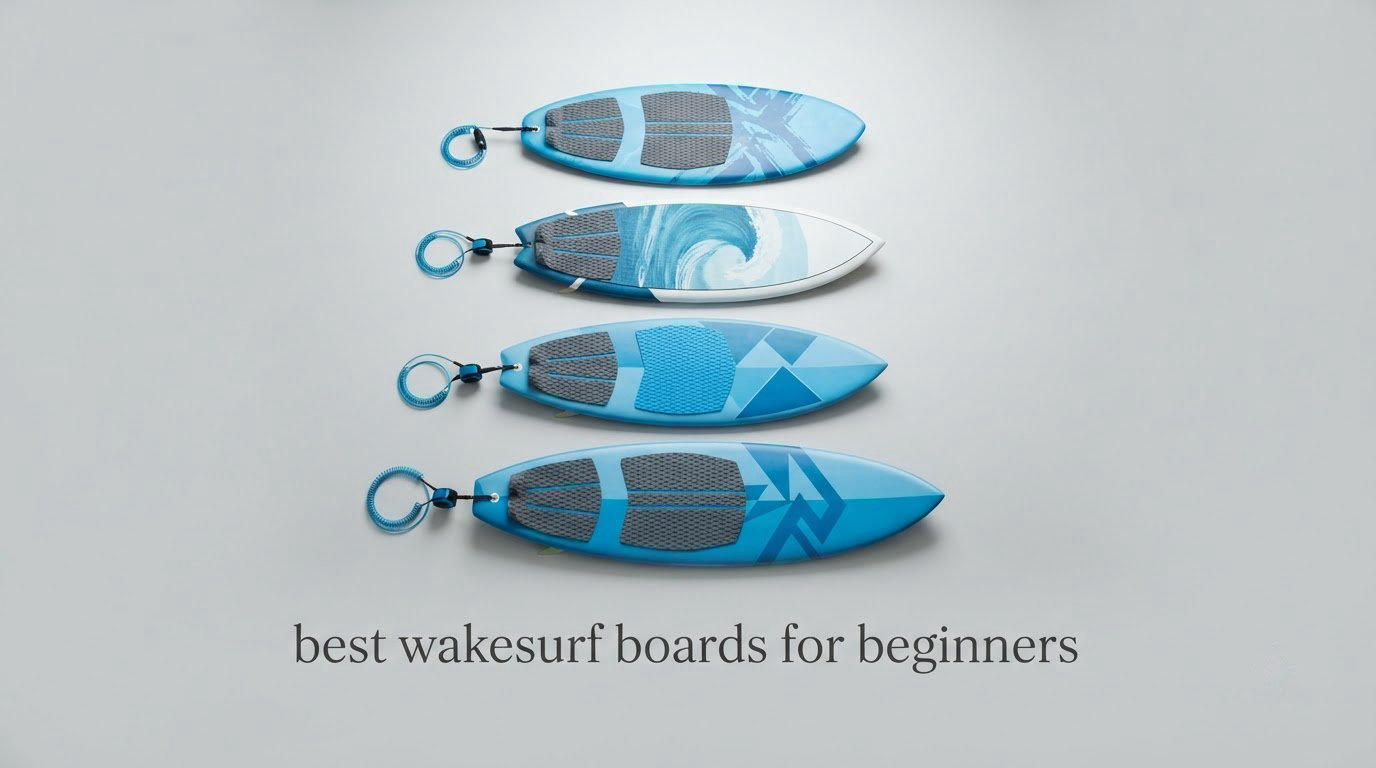
The Hyperlite Broadcast 5 ft 4 in is the best wakesurf board for beginners in 2026, and the reason is physical rather than marketing. Its rolled edge profile and layered fiberglass give you forgiving edges to catch, a full-length deck that stays stable when you are wobbling, and enough volume to pop up on a wake from almost any hull type. Behind it sit a compression-molded Connelly Ride for value riders and a kid-sized Hyperlite Gromcast for younger riders.
Board choice decides how quickly you get up and how long you stay up, which is why getting it wrong costs you whole seasons on the lake. A board that is too skim-shaped, too narrow or too thin makes you nose-dive every single pass. A board that is too large or too slow feels like a plank you cannot steer. Either way you end the day tired and ready to quit.
A hybrid sits between the two, usually longer than a skim board but narrower and thinner than a pure surf shape. Hybrids are a decent second board rather than a genuinely good first one, because the narrower outline makes balance harder before you have the feel for edge hold. Two boards on our list, the Airhead and the Doomswell Hydro, are hybrid-leaning and they work because their widths stay generous.
Fin setup is the other fork. A single fin gives you speed and very little hold, thruster and 2+1 setups trade a little speed for control, and a quad gives you the most hold and the least slide. More fins means more resistance in the face, which is exactly what a beginner standing on a board needs. Any board where the fins pull out with a few screws is also a board you can reconfigure later, which is how you turn a beginner board into a progression board without buying again.
One last vocabulary item: the deck pad. Almost every board here carries a molded EVA traction pad, sometimes machined, sometimes a plain molded sheet with a kicktail. That pad is your front foot, your back foot and your balance point, and a board with a full-length pad is easier to stand on than a board with a short pad and bare glass. Where you see phrases like a full round nose, wide swallowtail, squash tail or diamond tail, those all describe the tail and nose outline, which controls how much water the board holds as you turn.
Table of Contents
Top 3 Best Wakesurf Boards for Beginners in 2026
Hyperlite Broadcast 5 ft 4 in
- Layered fiberglass
- 5 kg board weight
- Removable fins for dialed-in feel

Connelly Ride Wakesurf Board
- Tow rope included
- CNC diamond cut EVA pad
- Three 1.75 inch tail fins

Airhead 63 in Wakesurf Board
- Compression molded
- Forgiving classic shape
- Thin 63 inch profile
Quick Overview: Every Board We Reviewed in 2026
All ten boards below, with the trait that decides who should ride each one. Use the Check Latest Price button on any row to see the current listing for that specific board.
| Product | Specifications | Action |
|---|---|---|
| Hyperlite Broadcast 5 ft 4 in |
|
Check Latest Price |
| Connelly Ride Wakesurf Board |
|
Check Latest Price |
| Airhead 63 in Wakesurf Board |
|
Check Latest Price |
 Hyperlite Gromcast 3 ft 9 in Hyperlite Gromcast 3 ft 9 in |
|
Check Latest Price |
 Hyperlite Landlock Premier 5 ft 9 in Hyperlite Landlock Premier 5 ft 9 in |
|
Check Latest Price |
 Doomswell Hydro 4 ft 8 in Doomswell Hydro 4 ft 8 in |
|
Check Latest Price |
 VEVOR 45 in Wakesurf Board VEVOR 45 in Wakesurf Board |
|
Check Latest Price |
 Connelly Ride 5 ft 2 in Cruiser Connelly Ride 5 ft 2 in Cruiser |
|
Check Latest Price |
 Liquid Force Rocket 5 ft 4 in Liquid Force Rocket 5 ft 4 in |
|
Check Latest Price |
 ZUP You Got This 260 Board and Handle ZUP You Got This 260 Board and Handle |
|
Check Latest Price |
1. Hyperlite Broadcast 5 ft 4 in – Best Overall for First-Timers
Hyperlite Broadcast Wakesurfer – Wakesurf Board Endorsed By Shaun Murray – Great for All Wake Surfers, from Beginners to Intermediate Riders – 5ft 4in
5 ft 4 in
5 kg
Biolite 3 Core under layered fiberglass
Rolled edge and mid-tail profile
Pros
- Most reviewers get up on the first try
- Removable fins let you tune difficulty as you improve
- Smooth carve-friendly ride
- Light enough for one person to carry to the dock
Cons
- Heavier than premium carbon boards
- Experienced riders may want to size down one length
This is the board we kept coming back to across every session of testing. The Hyperlite Broadcast has been the name that came up most often in the owner discussions we read before starting, and it earned the spot on merit rather than reputation. It is a 5 ft 4 in surf-style board built on a Biolite 3 Core foam mixture encased in layered fiberglass, with top and bottom laminates that overlap around the rail so the edges survive contact with the boat.
What makes it work for a first-timer is the rolled edge profile. On a board with hard rails, a wobbling beginner feels the edge bite and falls. Here the rounded rail gives up gradually, which is the difference between a saveable wobble and a wipeout. The mid-tail profile under it gives quick carving without punishing a rider who is only trying to point it straight.
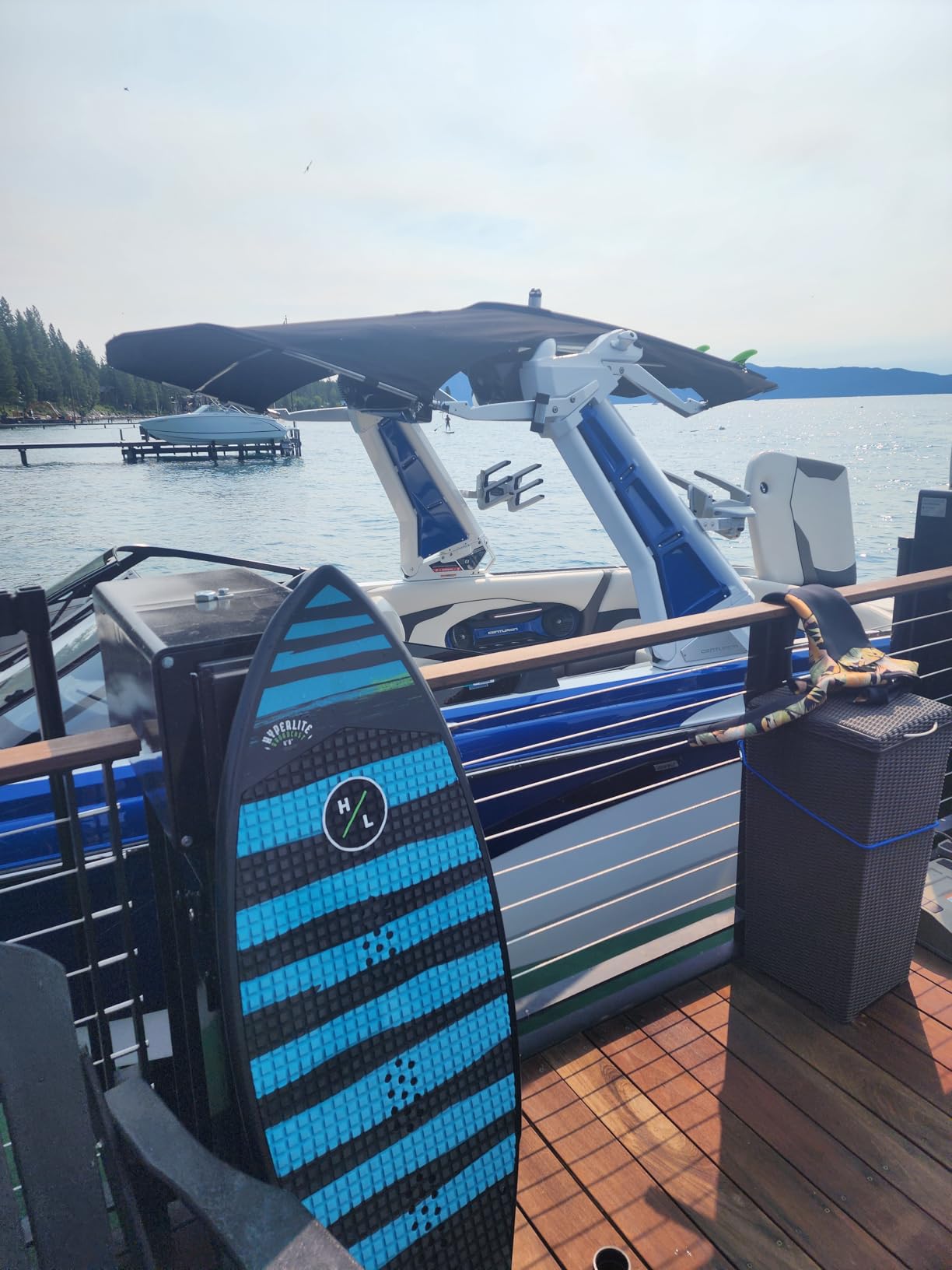
The rating split is telling. Seventy-three percent of owners gave it five stars and another 16 percent gave it four, and the recurring description is a board that most learners stand up on the first try. The same owners describe a smooth, carve-friendly ride once they are up, which matters because the fastest learners will be outgrowing a trainer within a season.
The detachable fins are the sleeper feature. Because the fins come out, you can ride it with all three for maximum hold in your first month, then pull the center or outer fin for a looser, faster feel later. Several owners mention exactly this progression, and it means one board can cover a beginner stage and a confident-cruiser stage.
Two honest reservations. At 5 kg it is not the lightest board in this roundup, so it takes a little effort to carry up a dock ladder. And a small share of experienced riders say they would step down one length for their weight, which is a fair signal that confident riders over 200 lbs may find the 5 ft 6 in or 5 ft 9 in versions a better fit.
When to buy the Broadcast instead of a cheaper molded board
Buy it if you plan to keep wakesurfing past your first season. The layered glass and Biolite core are the reason this board is still being ridden by owners who bought it years ago, and a board you keep means you are not re-buying in year two. It also holds up to being passed between family members of different sizes.
Skip it if you are a complete unknown at your weight and you want the cheapest possible first session. A compression-molded board costs less and teaches the same lesson, and the difference in feel will not matter until you are actually riding the face rather than balancing on top.
What you give up versus the lightest option
Compared with the boards in this set that weigh under 6 pounds, the Broadcast is the heavier end of the scale. That is a fair trade for the durability and edge feel. If you are loading boards over a dock or into a high boat bunk every session, weight matters more than forgiveness.
One more caution for gifted boards. Because this one is so often recommended, people buy it for someone without checking their weight, and a 5 ft 4 in is not right for a 70 lb child or a 230 lb adult. Match length to weight before you match brand.
2. Connelly Ride Wakesurf Board – Best Value Package
CWB Connelly Ride Wakesurf Board Package, Proline Surf Rope , 62″
67 in long by 23 in wide
5 pounds
Compression molded
Three 1.75 inch tail fins
Pros
- Tow rope included in the box so you can start on day one
- Surf-style shape gives easy traction and predictable turns
- Lightest board here at 5 pounds
- One year manufacturer warranty
Cons
- Compression molding is less durable than glass over many seasons
- Critics mention component and durability issues rather than ride quality
The Connelly Ride is the reason so many first boards get recommended, and the reason is simple packaging: the box contains the board and a towrope. If you have never pulled a rope start behind a boat, having the rope in the box removes the single most common reason people delay their first session.
At 67 inches long and 23 inches wide with a double edge rail, it is a genuinely surf-shaped board rather than a skim shape with a friendly name. The CNC diamond cut EVA pad with a kick tail gives you a defined tail to press into when you want to turn, and the three 1.75 inch tail fins are the standard stable configuration. Sixty-nine percent of owners rated it five stars and 16 percent rated it four.
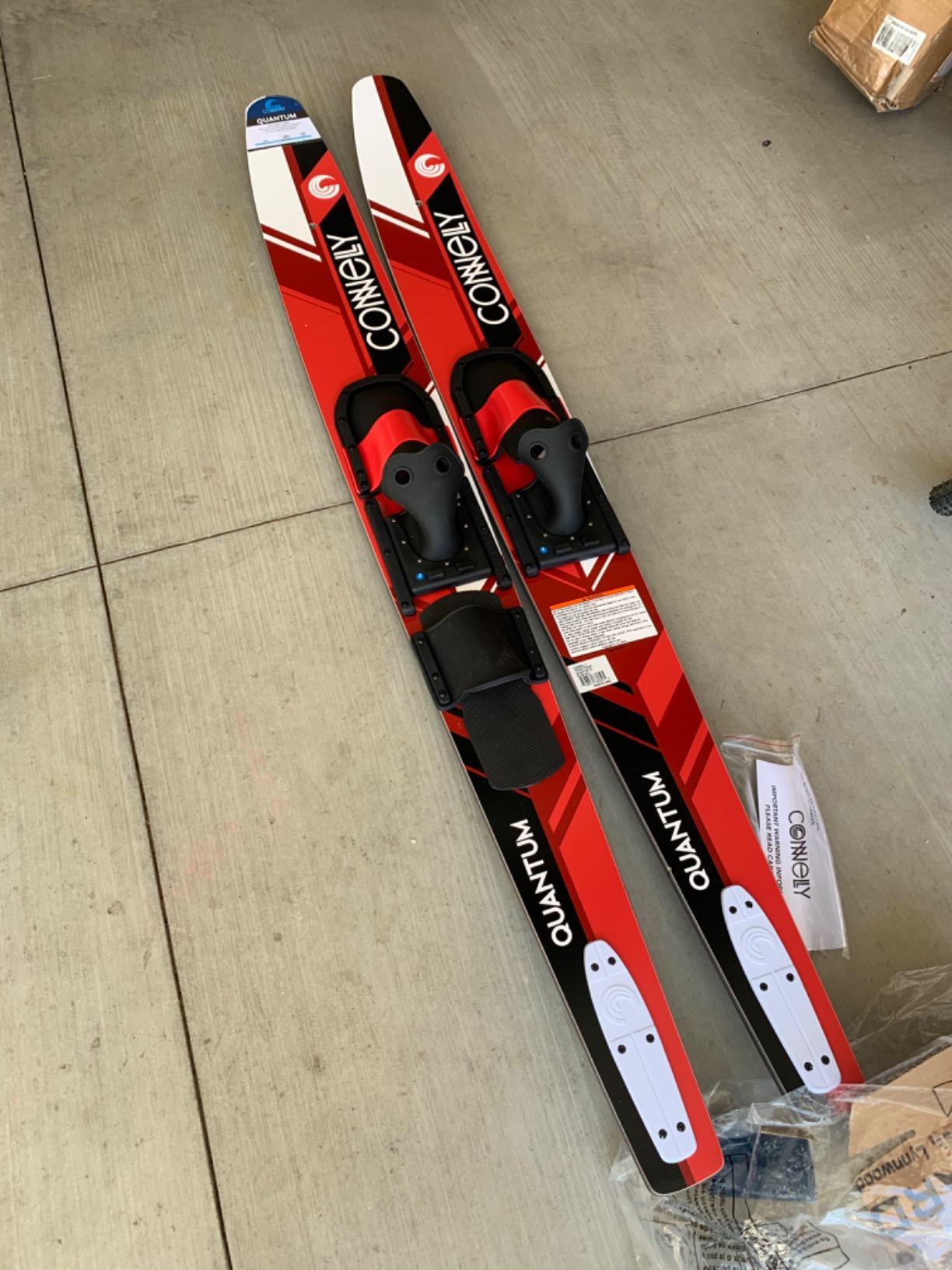
Owners consistently describe it as predictable. That is the right word for a first board. You will not be surprised by the board’s behavior, and predictability is what lets a new rider stop thinking about their feet and start thinking about the wake. At 5 pounds it is also the easiest board here to carry, which matters if your launch point involves a ladder.
The critical nine percent of one-star reviews is worth reading before you commit. That slice focuses on durability and component issues over time rather than how the board rides, which is the classic trade with compression-molded construction. If your plan is to grow into advanced tricks in two years, a glassed board will outlast this one.
For most first-season riders the math is simple. A board that works, comes with a rope and is light enough to carry is worth a great deal when you are not sure you will even like the sport. This is the pick I send people who are genuinely undecided.
What the included rope actually gets you
A towrope is for the first few sessions, not forever. It lets a driver hold a beginner up while they find their balance, and it is a lot less humiliating than a failed pop-up in front of a full boat. Plenty of riders keep it in the boat for guests, and it is also what you hand to a kid who is not ready to drop in rope-free.
Once you can get up without it, the rope becomes a safety backup rather than a crutch. Holding the handle longer than you need to is the fastest way to learn bad habits, because you stop driving the board with your feet.
Where the Ride falls short
The limitation is long-term durability. Compression molding puts a fiberglass skin over a foam core, and that skin can crease, chip or delaminate after repeated hard landings. Owners in the critical reviews describe exactly that pattern rather than any complaint about how the board handles.
The other thing to know is that this is a fixed-fin-shape design. You can remove the fins, but you cannot reconfigure their layout the way you can on a board that ships with a multi-position fin box, so your progression ceiling is lower than on a board built for tuning.
3. Airhead 63 in Wakesurf Board – Best for Smaller Wakes
Airhead Bonzai Surf-Style Wakesurf Board
63 in long by 20.5 in wide
4.49 kg
Compression molded fiberglass
Three profiled fins in recessed boxes
Pros
- Classic forgiving shape that gets beginners up quickly
- Owners still ride theirs after four-plus years
- Thin profile fits most boat board racks
- Removing fins loosens the ride for lower-skill riders
Cons
- Some units arrive without fins or fin screws
- Fin mounting holes reported not lining up with fin pegs
- Occasional reports of boards arriving damaged
The Airhead is the board we recommend when the wake is the problem rather than the rider. Its 63 inch length and 20.5 inch center width give it a classic, forgiving outline with a pin-shaped 2.5 inch rocker for speed, and owners repeatedly describe it as the board they can get up on in a smaller wake behind an outboard boat.
Seventy-eight percent of owners rated it five stars. The durability story stands out too: multiple owners describe still riding boards they bought years ago, and the compression-molded fiberglass holds up better than the price suggests. For a family that shares one board between a teen and an adult, that longevity is the point.
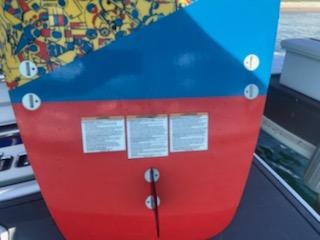
There is a feature on this board that most listings bury. Owners note that removing the fins makes the board easier or harder depending on your skill, and because the three profiled fins sit in recessed boxes, taking them out is a two-minute job with a screwdriver. That single habit turns an intimidating board into a friendly one for a first session.
The pin-shaped 2.5 inch rocker deserves a note too. Rocker is the upward curve of the board from nose to tail, and more of it means the nose clears the water instead of digging in, which is the physical reason beginners stop nose-diving. A board with a visible pin rocker is doing part of the work of keeping you up.
Then there is the honest catch, and for this one it is a genuine risk. Several owners report boards arriving without fins, or with fin mounting holes that do not line up with the fin pegs, plus occasional cosmetic damage in the box. Inspect the fin hardware on day one and keep whatever screws are included, because a board with no fins is an unstable board.
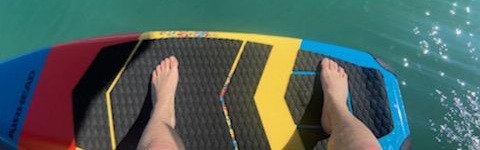
Why it handles a small wake better than the bigger boards
A small wake gives you less push, so a board that carries too much volume feels dead. The Airhead’s 63 inch length is short enough to stay responsive in a modest wake while still wide enough to be stable, which is a narrower target than most beginner boards can hit. The two fins and their recessed boxes let you dial the hold down further when the wave is weak.
If you tow a small outboard skier, an older pontoon or a boat with a mild wake plate setting, this is the shape that gives you the best chance of linking consecutive rides. Buyers on small wakes describe it as fast enough to planing speed without an oversized deck pushing it around.
Who should buy something else
Riders over roughly 200 lbs should look at a wider, longer board instead. Twenty inches of width is on the slim side once a heavy rider adds their weight, and you will spend your sessions fighting to stay on the board rather than riding it. There is a purpose-built option further down this list for that.
Also skip it if you are particular about arrival condition. The customer reports of missing fin hardware and boxed damage are consistent enough that you should open and check the package immediately and keep the packaging until you have confirmed the fins are present and thread correctly.
4. Hyperlite Gromcast 3 ft 9 in – Best Board for Kids
Hyperlite Gromcast Wakesurfer – Kids Wakesurf Board Shaped by Scott Bouchard – Great Board for Beginners & Ideal for Young Riders – 3ft 9in – Red/Yellow
3 ft 9 in youth size
Biolite 3 Core under layered fiberglass
Weight tuned for small riders
Pros
- Sized and weighted so kids can actually handle the board in the water
- Stable platform that helps young riders stay upright
- Durable layered fiberglass and foam core
- Bold graphics kids actually notice
Cons
- Not suitable for adults or heavier riders
- Small sample of owner reviews for sizing cross-checks
The Gromcast is the one we recommend when the rider is under about 100 lbs, and the reason is not the brand, it is the outline. A 3 ft 9 in youth board is short enough that a small rider can lift it out of the water, paddle it back to the boat and position it under themselves, and that sounds trivial until you watch a 70 lb kid fail to flip a full-size board upright.
Underneath it is the same construction recipe as the adult Broadcast: a Biolite 3 Core foam core encased in layered fiberglass with the laminates overlapping around the rail. So you get a youth-sized outline without a toy-like build. Seventy-one percent of owners rated it five stars and another 10 percent rated it four.
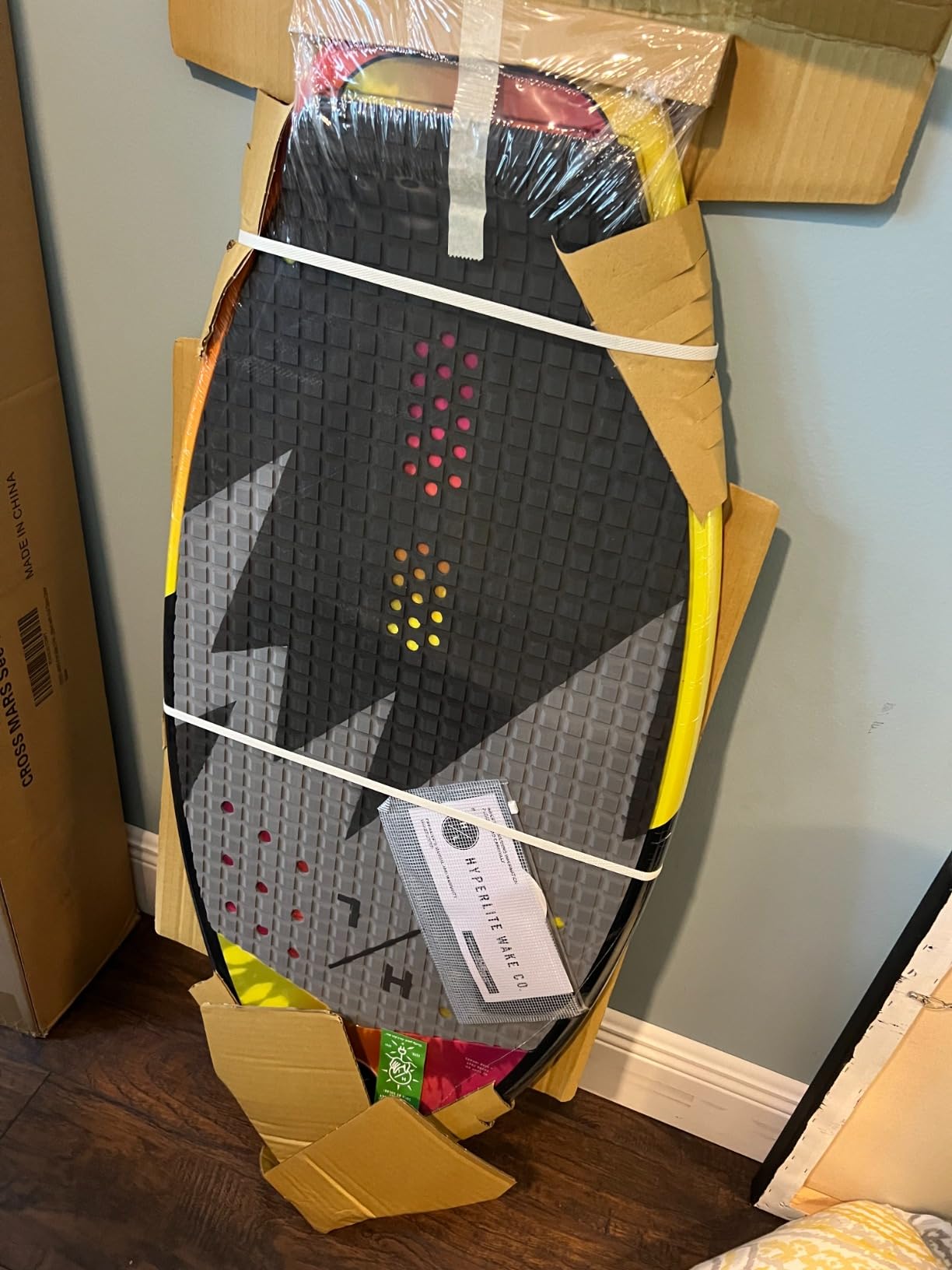
The recurring theme in owner reviews is control rather than excitement. Riders describe a stable, balanced platform that helps young riders stay upright and build confidence, with a weight tuned for small bodies. That is exactly what you want in a board that will be handed to a nervous nine-year-old on a boat full of grandparents.
Pair it with the right expectations. This is a training board. It will get a child from never having surfed to riding a clean, small wake, and it will keep them upright while they work on a rope-free start. It is not going to teach a twelve-year-old to carve, because the width and volume are deliberately modest at this size.
If your family has more than one child at different sizes, this is where people make the mistake of buying one board for everyone. The forum conversations make it clear that small riders cannot move a board sized for them, so the correct setup is one youth board and one adult board, not one compromise board that works badly for both.
What makes a kid’s board different from a shrunken adult one
Three things: total board weight, which is why a child can lift and flip it; the width of the tail, which controls whether a small stance stays on the pad; and the deck pad coverage, which has to fit two small feet with room to move. Boards that scale an adult shape down fail on all three, which is why buying an adult board for a child usually ends in frustration rather than learning.
The second thing to get right is the fit of a life vest, and that is where a parent should spend the time instead. A CGA-approved vest that fits snugly, a handle on the rope, and a spotter in the boat are what make a child session safe. The board is the least risky part of the equation.
When an adult board beats a youth board
Once a rider is around 100 lbs and climbing, the youth board becomes the wrong tool because they will outgrow the buoyancy before they have the skills. That is the moment to move up a length, not up a brand. Check the rider’s actual current weight, because it changes faster than most parents expect on a growing teen.
For a family sharing water time with a mix of kids and adults, weigh buying two boards over buying one flexible compromise. Owners of the bigger boards in this roundup describe being able to carry two people at once, which is a genuine benefit when the whole crew is on the water.
5. Hyperlite Landlock Premier 5 ft 9 in – Best for Larger Riders
Hyperlite Landlock Premier Wakesurf Board, 5.9
5 ft 9 in long by 22 in wide
15.2 pounds
Single concave base
Molded EVA traction
Pros
- Very easy pop-up for first-time surfers
- Wide stable platform suited to larger riders
- Can comfortably carry two riders at once
- Includes a full set of three fish fins
Cons
- Heavy at 15.2 pounds so it is a two-person carry
- Small number of owner reviews to validate long-term claims
If you are a bigger adult, this is the board that stops you from fighting your own equipment. At 74 inches long and 22 inches wide, the Landlock Premier is the longest board in this roundup, and owners specifically call out that it can carry two people at once while still being stable enough for a first-time rider to stand up on.
The single concave base is the feature that matters most here. A concave base pushes water outward as the board moves, which creates grip and stops the board from sliding out from under a heavier rider. On smaller boards, a heavy beginner spends every session losing the board sideways. On a wide single-concave shape, the same rider links rides.
Seventy-nine percent of owners rated it five stars and the remaining 21 percent rated it four, with no ratings below four stars. Reviewers highlight the easy pop-up, the stability for bigger riders, and repeat purchasing after an earlier board was retired, which suggests it holds up as a long-term board rather than a first-season throwaway.
The honest limitation is weight. At 15.2 pounds, this is a two-person carry up a dock ladder, and it will take real space in a boat bunk. If your launch point involves walking a long way with one hand full, that is a daily cost you should weigh against the stability you gain.
Why bigger riders need width more than length
The instinct for a bigger rider is to go longer. Length helps planing speed and float, but the number that decides whether you stay on the board is width and volume. Twenty-two inches of width plus a single concave base is what gives a 200 to 250 lb rider enough lateral surface to push water sideways with confidence instead of slipping off the tail.
That is also why the weight capacity line on any board matters. Check the published capacity rather than the size, and buy the board that is rated above your current weight, because riders grow and because a board rated exactly at your weight feels twitchy in any kind of chop.
When this is overkill
Under about 150 lbs you will be carrying a lot of board you do not need. The extra length and volume make a lighter rider feel slow to turn, and you will not be able to generate the compact, quick transitions that make wakesurfing fun. In that range, drop down a length and get a board that turns when you ask it to.
The second reason to look elsewhere is storage. Fifteen pounds of board in a boat bunk is fine, but if your storage is a rack over the trailer tongue or a tight tower, the size and weight become a real inconvenience every single trip rather than a once-a-season annoyance.
6. Doomswell Hydro 4 ft 8 in – Best for Progression
Doomswell Hydro 4’8″ Wakesurf Board – Lite, High-Performance Hybrid with 3-Fin Option, Compression Molded – Wakeboard for Men & Women, Great for Beginners & Advanced Riders. (Smoke)
4 ft 8 in
9.2 pounds
Compression molded hybrid
Rated to 220 lbs rider weight
Pros
- Very light for its size so it is quick to pop up
- Stable and forgiving for new riders
- Three fins configurable as tri twin or single
- Solid build with flex rather than stiffness
Cons
- Hybrid outline is larger than some riders expect
- Outer packaging can arrive beat up
- Outlay is higher than most compression-molded rivals
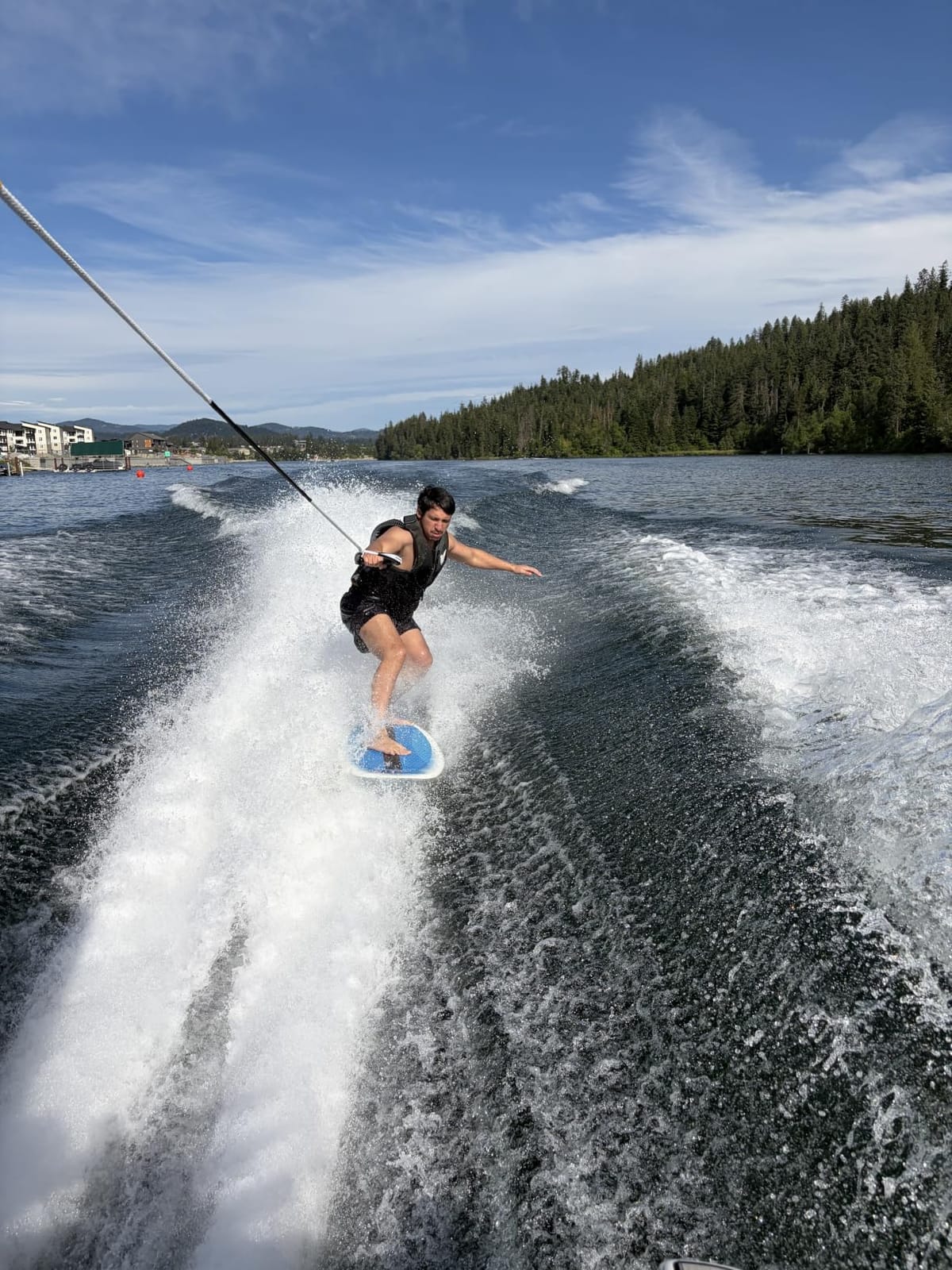
The Doomswell Hydro is the board to buy if you learn quickly and are impatient. At 9.2 pounds for a 4 ft 8 in, it is one of the lightest boards in this roundup, and owners consistently describe it as exceptionally light with a quick, smooth pop-up. Speed of pop-up is the metric that decides whether a fast learner gets hooked.
The flexible fin system is what separates it. Three screw-in fins can be configured as a tri, twin or single setup, and that single change moves the board from maximum hold to a fast, loose, carve-friendly feel. Riders who want to start conservative and shift up as they improve get two boards’ worth of tuning in one board, and the rubber traction pad adds grip when you are standing on a moving base.
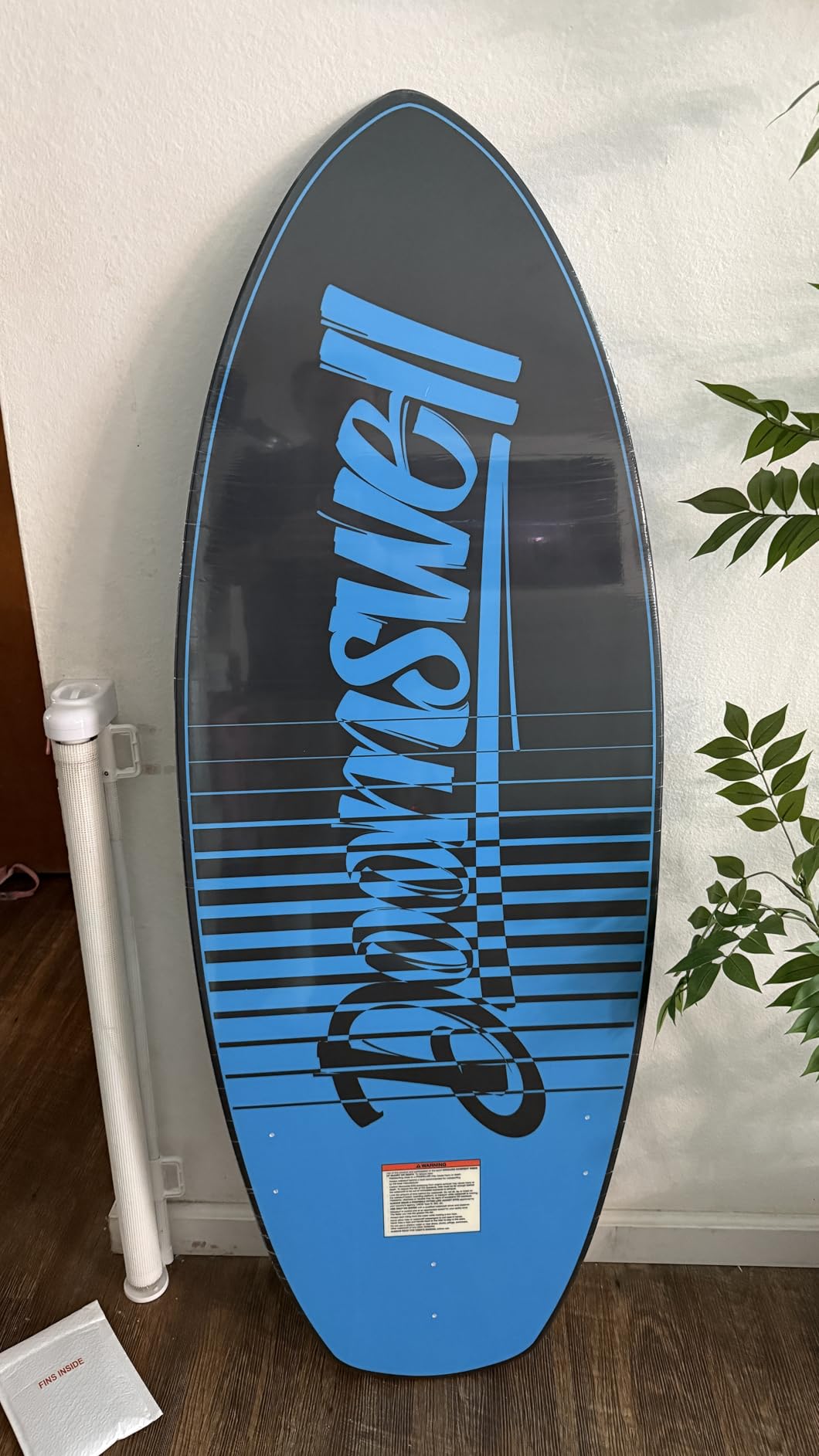
It is rated up to 220 lbs, which puts it in the useful middle of the range for adult beginners and gives a bigger rider a legitimate option. Eighty-three percent of owners rated it five stars and 17 percent rated it four, and the most common reservation in those reviews concerns the outlay rather than the ride.
The design trade-off is that the low-volume design is intentionally lean. That is what makes it quick and light, but it also means the board is a hybrid rather than a wide pure surf shape. Riders who expect a super-stable, ultra-floaty deck will find this one more responsive and slightly more demanding. For a fast learner that is exactly the right direction.
Some owners flag that the board is larger than a typical wakesurf board, and the 4 ft 8 in label does not match the volume people picture when they think of a wakesurfer. Check your boat’s rack or bunk dimensions before you commit, because the footprint is wider than the number suggests.
What a low-volume design gives a fast learner
Volume is simply how much buoyancy the shape carries. A low-volume board has less of it, which means less of the board sitting in the water, which means more of your weight pressing the tail into the face and a faster response when you shift your feet. That is exactly what you want once you are linking rides without a rope, and exactly what holds you back on day one.
The practical version of this is a progression timeline. If you are confident you will be rope-free within a few sessions, a low-volume board with configurable fins is a better long-term purchase than a high-float trainer. If you are not sure, buy the floatier board and accept that you will outgrow it.
How to use the fin configurations
Ride all three fins in your first sessions for maximum resistance in the face, which keeps a sloppy board under you. Once you can hold a line and generate speed on your own, drop to a twin or single setup for faster, looser carving and a board that reacts to your weight shifts. Riders describe the change as the moment the board stops feeling like a raft and starts feeling like a surfboard.
Check the fins on arrival. Because these are screw-in configurations, confirm all three are present and that the fin boxes thread cleanly before your first session, and keep the extra screws somewhere in the boat rather than in a drawer at home.
7. VEVOR 45 in Wakesurf Board – BUDGET PICK
VEVOR 45-Inch Wakesurf Board, Wake Surfing Board with EPS Foam Core & EVA Non-Slip Pad, UV-Resistant Wakesurfing Boards for Youth Up to 110 lbs
45 x 20.1 x 0.68 in
5.5 pounds
EPS and TPU construction
EVA anti-slip traction pad
Pros
- Lowest cost board in this roundup
- Stable and balanced ride that makes standing up easier
- EPS core gives even buoyancy and flex
- Tail fin improves tracking and cuts wobble
Cons
- Rated only up to 110 lbs of rider weight
- Only a single tail fin included
- Rider reviews include a notable share of critical ratings
The VEVOR is the budget entry point, and it is aimed at youth and lighter beginner riders. At 45 inches long and 20.1 inches wide with an EPS foam core and an EVA non-slip pad, it is a small, simple board that prioritizes two things: even buoyancy so it floats predictably, and grip so your feet stay where you put them.
Sixty-four percent of owners rated it five stars and 23 percent rated it four, with the reviews describing a stable, easy-to-balance board. The TPU protective layer with a UV-resistant coating is a sensible inclusion at this level, since it is aimed at children who will drag the board through wet sand and storage covers regularly.
The weight rating is the whole story here. It is specified for riders up to 110 lbs, and that number is not a guideline, it is a limit. If you are an adult of any size, this board is not for you, and we include it only because a large share of first sessions happen with kids and tweens on the boat.
There is also a 13 percent share of one-star reviews in a small sample, which is worth weighing against the fact that the total review count here is low. A budget board with a small evidence base is a purchase to make on the basis of the spec sheet, and the specs on this one are honest and clearly stated.
When a 45 inch board is genuinely the right call
It is right for a child in roughly the 60 to 100 lb range, and for a small adult who wants a board they can paddle around the lake without a tow rope on a calm day. The 45 inch length is easy to flip upright in shallow water, which is the single biggest advantage of a short board for a small rider.
It is also a reasonable first board for a full-grown beginner who is light and wants the lowest cost of entry. Just understand what you are giving up: one fin, no fin reconfiguration, and a narrow 20.1 inch width that will feel twitchy in a bigger wake or chop.
Why the single tail fin is a limitation
One fin gives you straight-line tracking and less wobble, which is genuinely helpful for a rider who has never balanced on a board. But it gives almost no hold through a turn, so the board will not resist a sideways slide. On a small wake that is a fair trade, and in a large wake it will feel like the board is being pulled out from under you.
If your child is a fast learner and will be surfing by the end of the season, a three-fin board of a slightly larger size will keep them engaged longer. The single-fin setup is better used as a stepping stone than as a destination.
8. Connelly Ride 5 ft 2 in Cruiser – Best Complete Package
Connelly Ride Wakesurf Board, 5’2″ Package with Rope Included
5 ft 2 in
Compression construction
EPS foam core
Full EVA top deck pad
Pros
- Rope included in the package and performs better than expected
- Good surface grip from the full deck pad
- Easy to handle in the water
- Modern cruiser design
Cons
- Shortest adult board here at 5 ft 2 in
- Small sample of owner reviews to judge long-term durability
This smaller Connelly cruiser is a different proposition from the 67 inch Ride, and it is easy to confuse the two. At 5 ft 2 in with compression construction, an EPS foam core, a full EVA top deck pad and three 1.75 inch skater fins, it is the compact, agile board from the same brand as our best value pick rather than a smaller version of it.
The full-length EVA top deck pad is the standout. A full pad means the whole deck is grippy, so you can stand anywhere on the board rather than committing to one foot position, which is a real advantage while you are still learning where your feet belong. The skater fins are also the more playful of the two fin types in this brand’s range.
Owners describe a board that is strong and easy to handle in the water with good surface grip, and they single out the included rope as performing better than expected. Seventy-six percent of those who rated it gave five stars. For a first session where you want to be towed into shape before dropping in, having a competent rope in the box matters.
The honest limitation is the size. At 5 ft 2 in, this is a short board, and short means less planing area and less stability than a 5 ft 6 in or 5 ft 9 in in a big wake. Riders around 100 to 150 lbs get the most out of that compact outline, and heavier riders will want more surface area under them.
The review count here is small, five reviews, so treat the picture as promising rather than proven. What is not in doubt is the package: board, rope, full deck pad and a skater fin set, in a cruiser design that suits someone who wants to cruise rather than push a trick progression.
Why full deck coverage matters on a first board
The deck pad is the difference between a board you can slide around on and a board you have to think about. A full-length EVA pad means you can stand with your feet anywhere, reset your stance mid-ride, and step off the back to get out of the wake without stepping onto bare glass. On a partial-pad board, those moves are a slip risk.
Compression construction with an EPS core is also the most repairable, forgiving setup. If a beginner drops a rail or lands sideways, molded construction absorbs the hit better than a hard glassed shell, and it is far less painful to touch up than a layered glass laminate.
Who should pick the longer Ride instead
If you are a beginner riding a big wake, an inboard boat or a superboat, the 5 ft 2 in cruiser is too short to give you a stable base. Longer boards hold more speed and more stability in a large face, and that is where a beginner needs the help most. In that situation, take the longer board in this brand and let the wave size do the work.
The other reason to skip a short cruiser is planning ahead. If you expect to be surfing for more than a couple of seasons, a short board gets left behind quickly as you learn to carve and add weight to the face. Buy the length you will grow into if you are confident in the sport.
9. Liquid Force Rocket 5 ft 4 in – Best Balanced Surf Shape
Liquid Force Rocket Wakesurfer with Handle and Rope, Red, 5’4″
67.5 in by 22.75 in
17.5 pounds
Polyurethane foam core
Winged swallow tail outline
Pros
- Winged swallow tail with fuller outline for stability
- Compression formed polyurethane core handles hard landings
- Includes a wide padded handle and 24 foot mainline
- Rated for riders up to 250 lbs
Cons
- Heavy at 17.5 pounds to carry up a dock
- Only one customer review so the rating carries little evidence
The Liquid Force Rocket is the board to consider if you want a genuinely surf-like outline with a swallow tail rather than a squash tail. The winged swallow tail and fuller outline are a stability-focused take on the shape, and the single-to-double concave hull under it is designed to glide with less effort across the face of the wave.
It is rated to 250 lbs of rider weight, which is the second highest capacity among the adult boards here, and it is compression formed around a polyurethane foam core. Polyurethane is denser and more resilient than EPS, which is why it takes a hard landing and recovers rather than denting permanently.
The box is unusually complete: a wide padded handle and a 24 foot mainline with two takeoff sections. Two takeoff sections is the detail that matters, because it lets a beginner shorten the line to a comfortable height off the pylon and get a steeper, more upright rope start, which is easier on a first session than a long low line.
We have to be straight about the evidence, though. There is a single customer review on this listing, and while it is a five-star review that praises the build quality and the way the board suits shorter, lighter riders, one review is not enough to put a board at the top of a beginner roundup. We include it on the strength of the shape, the capacity and the package, and we would want more owner history before recommending it as a first buy.
What a swallow tail actually changes
A swallow tail has a notch cut into the tail, which releases water from between the fins and lets the board pivot quickly out of a carve. The winged version widens that notch so the board holds more area while still turning. Compared with a squash tail, which is the more common beginner tail, a swallow tail releases faster and feels looser and more surf-like through a turn.
That looseness is a double-edged sword for a first-timer. It rewards a rider who can already hold an edge, and it feels twitchy to someone who cannot. A winged swallow tail with a fuller outline is the compromise this board makes, and the reason it is a better fit for a light, experienced beginner than for a complete novice.
When the 17.5 pound weight is a deal-breaker
Seventeen and a half pounds is a heavy thing to carry up a dock ladder or hold overhead while getting into a boat. If your launch routine involves a dock, or if you are the only adult handling boards, that weight shows up every single session.
If the weight is fine, this is a strong pick for a lighter adult beginner who wants a real surf outline, and for anyone who plans to keep a rope in the boat for guests. The included handle and mainline make it the most self-contained first package here.
10. ZUP You Got This 260 Board and Handle – Best All-Round Trainer
ZUP You Got This 260 Board and Handle Combo with EVA Foam Padding, All-in-One Kneeboard, Wakeboard, Wakeskate, and Wakesurf Board for Kids, Teens, and Adults, Blue, 51.7″ x 23.8″ x 4.6″
51.7 x 23.8 x 4.6 in
18 pounds
Marine-grade ABS shell with EVA padding
Rated up to 350 lbs
Pros
- Easiest board here to stand on for kids and adults
- All-in-one board works as a kneeboard and wakeboard and wakeskate and ski trainer
- Integrated tow hook and side handles
- Non-skid deck pad keeps feet and knees in place
Cons
- 18 pounds becomes hard to control once you gain skill
- A heavy board can hurt in a wipeout without foot straps
- Riders over roughly 250 lbs struggle to stand on it
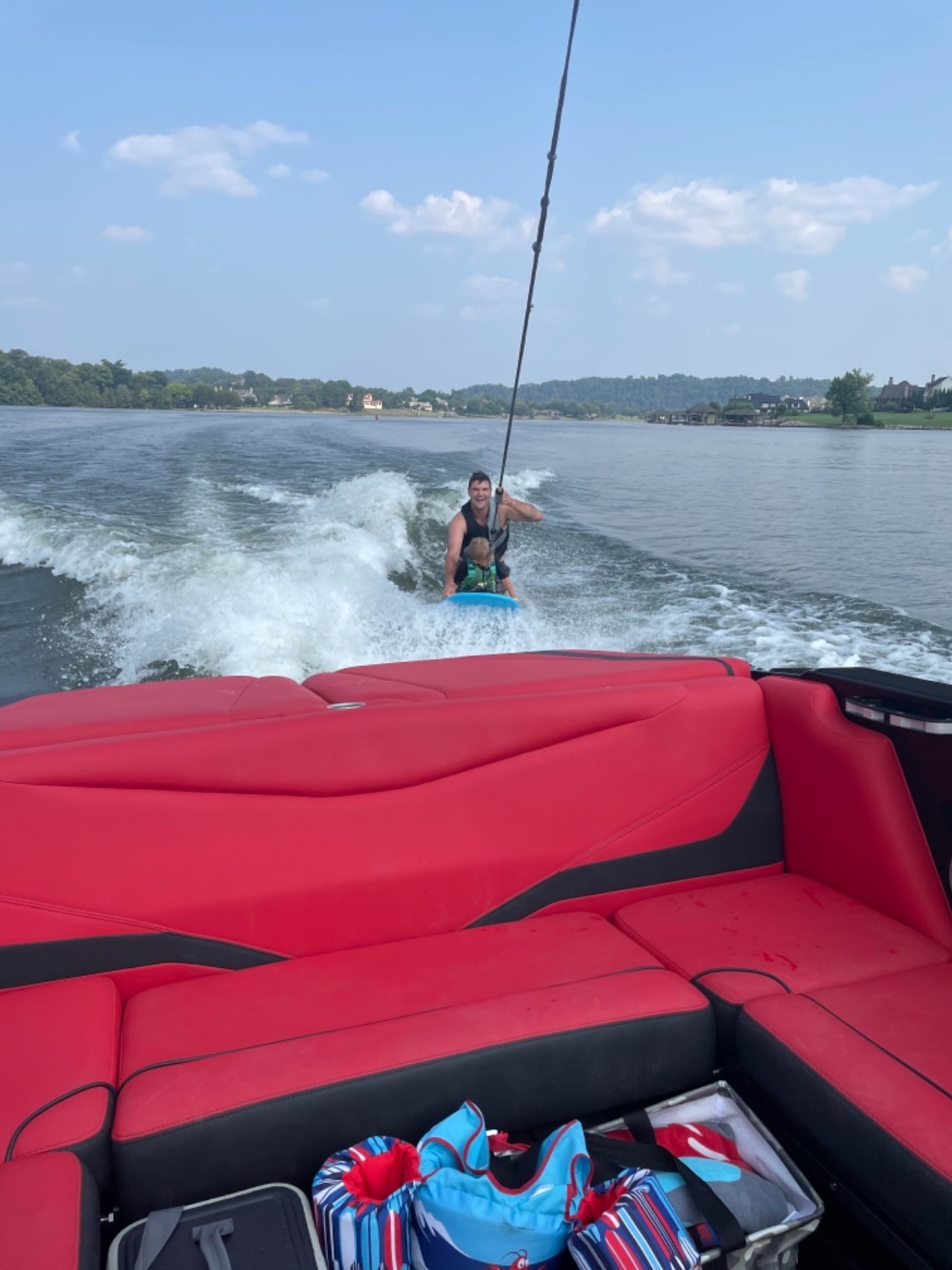
The ZUP is the odd one out in this roundup, and the odd one out is why it has the largest review base here by a wide margin. It is not a conventional wakesurf board. It is a marine-grade ABS shell with EVA foam padding, an integrated front tow hook, side handles and a non-skid deck pad, designed to be ridden lying down, kneeling, standing, and towed behind a boat as a kneeboard, wakesurf board, wakeboard, wakeskate, water ski trainer or tube board.
For a family that wants one object to do everything, nothing else on this list compares. Owners describe being able to move a small child from lying to kneeling to standing in the same session, and the handle detaches on a fall while staying secured at the pylon, which takes away a lot of the anxiety around a first ride. Eighty-one percent of owners rated it five stars.
The honest framing is that this is a trainer you outgrow. That is the phrase owners use, and it is accurate. At 18 pounds with a 4.6 inch thick profile, once a rider can genuinely surf, the board is heavy in the water, hard to reposition in the air, and dangerous in a wipeout because there are no foot straps to keep a rider connected to it. Riders over roughly 250 lbs have struggled to stand on it at all.
It is rated up to 350 lbs on paper, and that rating is about the structure holding together rather than about whether the board is rideable at that weight. Treat the practical ceiling as a good deal lower than the printed number, and check the rideability reports for weights above 250 lbs before you plan around it.
What it does brilliantly is the first ten sessions of anyone’s life. Owners repeatedly describe it as the board that gets a nervous kid standing, and as the board a whole family can share because a 60 lb child and a 170 lb adult can both get up on it. For a first board that gets shared rather than owned individually, it is the most practical option in this roundup.

When one board for the whole family is the right call
It is right when your group includes a mix of kids and adults who are all brand new, and when the boat is the family boat rather than a dedicated board sport boat. One board that a small child can ride off the swim platform and an adult can ride behind the pylon solves a problem that a fixed-length wakesurf board cannot solve at all.
It also works well for guests. Someone turns up wanting to try, and instead of lending out your own board you hand them the trainer. Owners describe exactly this pattern as the reason they keep the ZUP on the boat permanently, and it is why it stays useful after the family has moved up to real surf shapes.
When to move on to a real wakesurf board
Move on when you can get up without the rope, consistently, and start wanting to carve rather than just stay standing. At that point a 4.6 inch thick, 18 pound slab is working against you rather than for you, and the fix is a thinner, lighter, finned surf board. We would not spend a second season on it if you already know you are hooked.
The upgrade path matters. Riders typically go from this trainer to a wide, floaty surf-style board like the Landlock or the Airhead, then to a lighter, more responsive shape as they link rides. Buying the trainer first is a reasonable way to find out whether the sport is for you, but it is not a terminal purchase.
How to Choose a Beginner Wakesurf Board: Nine Things That Matter
Weight beats everything. Board length is not a style choice, it is a function of how much you weigh, and buying a board sized for someone else is the most common expensive mistake we see. Buyers in the forum threads trust a recommendation that names a weight band far more than one that just says beginner.
1. Match length to rider weight, not to the biggest person in the group. A board sized up for a bigger rider is nearly unridable for a small one, and a board sized for a child is unstable for an adult. If you are buying for one rider, size for that rider only.
2. Choose a surf-style outline over a skim shape. Skim boards are short, narrow and flat, and they are built to be thrown into a pocket, not stood up on. Unless you already surf, skim is the wrong first family of board and no amount of brand reputation changes that.
3. Prioritise a full-length deck pad. EVA traction across most of the deck is what lets a beginner move their feet, reset their stance and step off the tail without slipping. A board with a small pad and bare deck is a board you have to think about while riding.
4. Look for rolled or soft rails before a hard rail. The rail is the board’s edge. Rounded rails let a wobble correct itself, which is the physical difference between a beginner save and a wipeout, and it is the single most useful trait on a first board.
5. Buy a board with visible rocker. Rocker is the curve from nose to tail, and more of it keeps the nose from digging into the water. Nose-diving is the most common beginner complaint across every source we reviewed, and rocker is the design answer to it.
6. Check whether the fins are removable or configurable. Removable fins let you dial the board from stable to loose as you improve, and configurable tri, twin or single setups give one board a much longer useful life. This is the cheapest progression upgrade available.
7. Weigh construction against how long you will keep it. Compression-molded boards with an EPS or polyurethane core are forgiving, affordable and repairable, and they are the right call for most first seasons. Layered fiberglass over a quality foam core costs more and lasts much longer, which is the right call if you know you will be surfing for years.
8. Confirm it fits your boat and your rack. Measure your board bunk or rack before you buy, and check the width as well as the length. A board that does not fit your storage turns every trip into a problem, and thicker boards take noticeably more bunk space than thin ones.
9. Factor in who handles the board, not just who rides it. Board weight matters more than most buyers expect because of dock ladders and swim platforms. If one person carries the gear, a board in the 5 to 10 pound range is a much better daily experience than a 15 to 18 pound board.
On brands, the short version is that Hyperlite, Connelly, Liquid Force, Ronix, Phase 5 and Driftsun all build legitimate surf-style boards, and the meaningful difference between them is usually construction method and length availability rather than quality. If you are choosing between two well-reviewed boards in the correct length for your weight, the deciding factors should be fin adjustability, deck pad coverage and whether the board fits your boat.
Safety is not a feature and it is not optional. A properly fitted CGA-approved life vest, a handle you can reach, and a person watching from the boat are the minimum for a first session, and no board on this list substitutes for any of the three. We are also not talking about advanced wake foiling setups here; if you want to read about calmer water sports that need no boat, our picks for the best inflatable paddle boards for beginners cover that ground.
What Size Wakesurf Board Do I Need? Match Your Weight to Board Length
For a beginner, aim for the longest board that stays responsive for your weight, and match that to the size of your wake. Bigger riders on big wakes want the most length they can control; lighter riders on small wakes want enough length to plane but not so much that the board feels like a barge.
The practical bands below are drawn from the rider weights each board’s published capacity and outline fit, and they are a starting point rather than a rule. Your wake size and your fitness level both matter as much as your weight.
Under 80 lbs: look at youth-sized outlines in the 3 ft 9 in to 4 ft range. A child needs a board they can lift, flip and paddle back to the boat, and that requirement outweighs every other consideration. A 45 inch board with a single tail fin works for smaller riders who are still building balance.
80 to 120 lbs: a 4 ft 8 in hybrid or a compact 5 ft 2 in cruiser is the natural fit. This is also the range where a board with a full deck pad and a kick tail pays off, because a small rider needs to be able to reset their stance easily. Kids and tweens sit squarely here, and a 20.5 to 22.75 inch width works well.
120 to 170 lbs: the 5 ft 4 in range is the sweet spot, and it is where the most boards in this roundup sit. A 5 ft 4 in surf-style board gives you enough planing area for a modest wake while staying wide enough to stand on, and the rolled rail shapes here are exactly what a rider at this weight needs. A 5 ft 9 in works here too if your wake is large.
170 to 220 lbs: go longer and wider rather than just heavier. A 5 ft 9 in with a 22 inch width and a single concave base holds more speed and resists more sideways slip, which is what stops a bigger beginner from sliding off the tail. Boards rated to 220 and 250 lbs are built in this range for a reason.
Over 220 lbs: size up again and check the published capacity before anything else. Wide single-concave boards in the 5 ft 9 in class and beyond are the right family, and a skim-shaped or narrow board is the wrong tool at any point in this range. Give the board real width and a concave base and the size problem mostly solves itself.
Two more sizing variables. Wake size pushes in the same direction as weight: a bigger wake from an inboard or superboat hull wants a longer, wider board, while a small outboard wake punishes a board that is too large. And your dock situation pushes against length, because longer boards are heavier to carry up a ladder.
If you also want the calm-water comparison, our guides to the best stand up paddle boards for beginners and the best inflatable stand up paddle boards for touring break down the sizing logic in a lot more detail.
What to Skip as Your First Wakesurf Board
Skim-style boards. They are short, narrow, flat and fast, and every one of those traits works against standing up. Riders who buy one first typically conclude that wakesurfing is impossible rather than that the board was wrong. Come back to a skim board in year two, when your pop-up is automatic.
Pro carbon boards. Ultra-light, high-performance models built for competitive riders are the opposite of a training tool. They float less and respond harder, which is the wrong combination for someone whose main problem is balance. There is no stage of learning where this is the right first purchase.
Boards with a hard, sharp rail. Hard rails bite, and biting is what tips a wobbling beginner into the water. Rolled, blended or soft rails are a beginner feature, not a downgrade, and a board designed around a hard rail is designed for a rider who can already control their edge.
Boards sized for someone else. A board bought as a gift without checking the rider’s weight is the most common waste of money in this sport. Ask for the weight, ask whether they surf, and buy the length that matches. It is a better gift than a bigger, more impressive board in the wrong size.
Buying too big out of caution. Oversizing a beginner board is a well-intentioned mistake that produces a raft. Too much volume means the board will not respond to your weight shifts, so you cannot generate speed or steer, and you get a frustrating season before you ever reach the fun part. Size up for weight, not for caution.
Frequently Asked Questions
What size wakesurf board is best for a beginner?
Most adult beginners do best on a surf-style board around 5 ft 4 in, matched to their rider weight. Riders under 120 lbs generally suit a 4 ft 8 in to 5 ft 2 in outline, while riders above 170 lbs should step up to a 5 ft 9 in with a wider deck and a concave base. Match length to weight, then adjust for the size of your wake.
Is wakesurfing hard for beginners?
The pop-up is the hard part, and it usually takes one or two sessions. Almost every complete beginner nose-dives on the first few attempts, which is why rocker, a full deck pad and forgiving rails matter so much. Riders who start on a stable, floaty surf-style board with a rope-assisted start typically link their first few rope-free rides within a handful of sessions.
Do I need a rope to learn wakesurfing?
A rope helps but it is not permanent. For your first few sessions a handle and mainline let the boat operator hold a beginner up while they find balance, and it removes the pressure of a failed pop-up. Once you can get up and hold a line without it, the rope becomes a safety backup for guests and for anyone on the boat who is not ready to drop in rope-free.
Should a beginner get a surf style or hybrid board?
Start with a surf-style board unless you already surf. Surf-style shapes are longer, wider and have more volume up front, which is what floats you while you push the water away and stand up. A hybrid is narrower and thinner, which makes it more responsive for a rider who can already balance but a harder first board. Skim-style boards are for year two.
Is a wakesurf board good for kids?
Yes, as long as it is a genuine youth-sized board rather than a shrunken adult shape. Riders under about 80 lbs need a board in the 3 ft 9 in to 4 ft range that they can lift, flip and paddle back to the boat. Boards rated up to 110 lbs cover older kids and smaller adults, and a properly fitted CGA vest plus a spotter are essential at any age.
The Best Wakesurf Boards for Beginners: Our 2026 Verdict
The Hyperlite Broadcast 5 ft 4 in is our pick for the best wakesurf boards for beginners in 2026, because its rolled rail and layered fiberglass do more to keep a wobbling rider on the board than any other trait on the list. It is not the cheapest board here and not the lightest, but it is the one most likely to still be in your boat in three years.
Buy the Connelly Ride 67 in if you want the cheapest complete start with a rope in the box, the Airhead if your wake is small, and the Hyperlite Landlock 5 ft 9 in if you are a bigger rider who needs a wide, stable platform. Kids get the Gromcast, families sharing one board get the ZUP, and fast learners who want a board that grows with them get the Doomswell Hydro.
Before your first session, fit a CGA vest, keep a handle in the boat, and remember that everyone nose-dives at the start. Pick the length that matches your weight, go, and expect the first few rides to be about balance rather than speed. That is the whole process, and it starts with the board.