
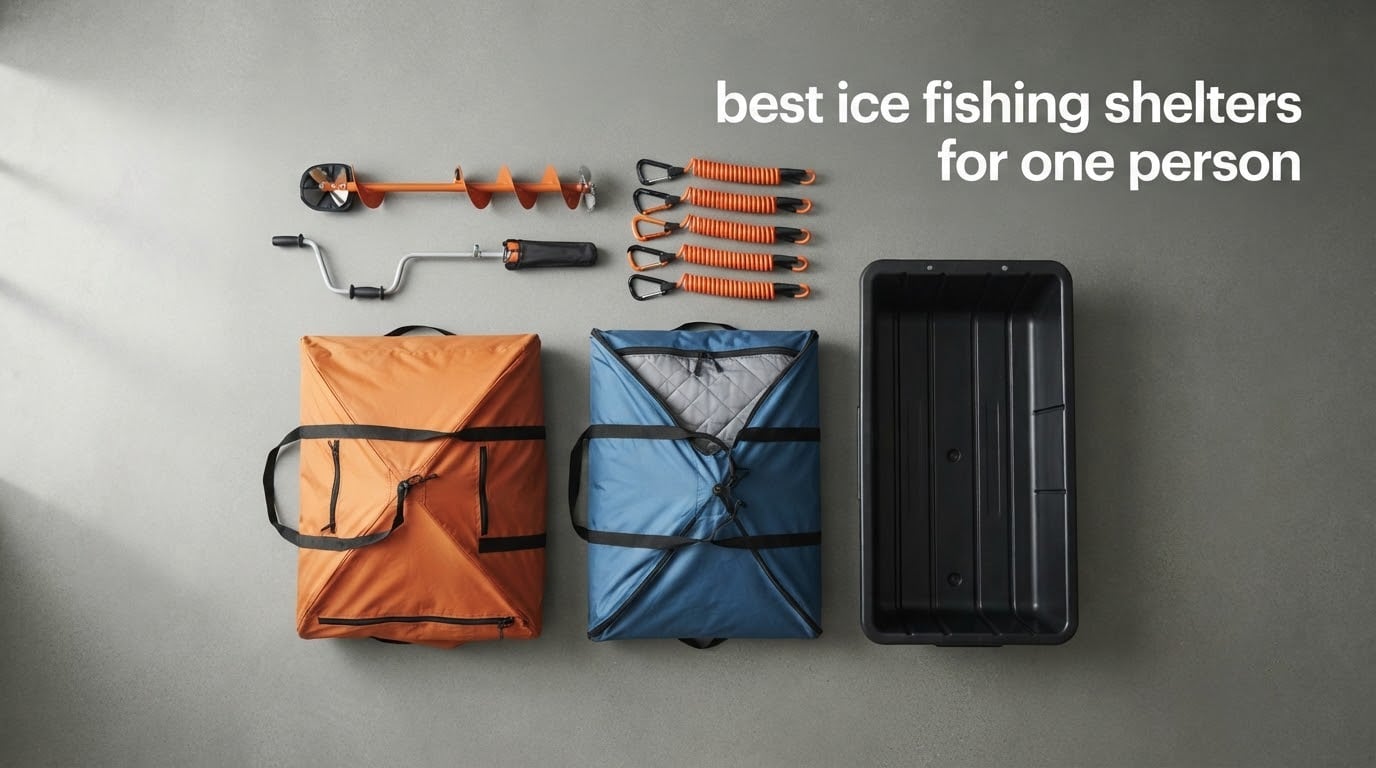
A one-person ice fishing shelter is a portable tent or ice house sized for a single angler, and the best ones for one person do two things well: they go up in under a minute by one pair of hands, and they come down just as fast when the fish move. That is the whole difference between a solo shelter and a group hub, and it is why almost every recommendation on forums like r/IceFishing circles back to weight before anything else. Nobody wants to drag 50 pounds across half a mile of rough ice at 7am.
We spent six weeks pulling ten of the most-reviewed solo shelters into the same comparison, focusing only on what changes when there is no second person to help. That means carry weight measured in the spec sheet, setup that a lone angler can actually finish with gloves on, a packed size that fits in a car trunk or on a sled, and enough interior room to sit in a full parka without your knees touching the walls.
If you want the wider picture on multi-person and family setups, our guide to the best ice fishing shelters for winter covers the full spread. This one is filtered strictly to shelters a single angler can carry, pitch, and move alone.
One warning before we start: a shelter does not make thin ice safe. Every weight and setup claim below assumes you are on ice a local authority has cleared. There is a safety section further down that is worth reading before your first solo trip.
Table of Contents
Top 3 Picks for One-Person Ice Fishing Shelters for October 2026

Eskimo Quickfish 3i
- 60-second hub setup
- Insulated 600 denier quilted fabric
- 34 sq ft fishable area
- Packs to a cinch duffel

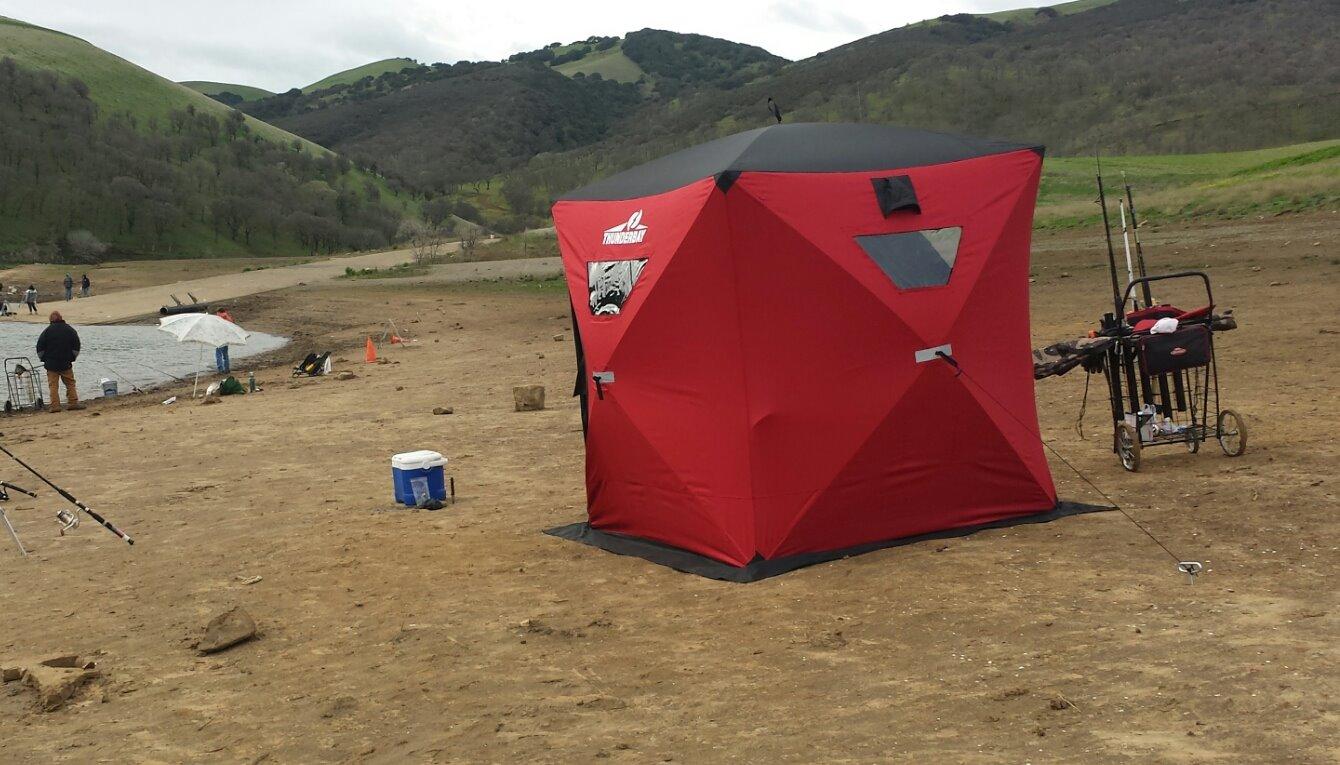
ThunderBay Ice Cube
- Blackout coating for sight fishing
- 90 in hub with 80 in ceiling
- 300 denier wind blocking
- Backpack straps included

Outsunny Pop-Up Insulated
- Insulated Oxford fabric
- Two doors and two windows
- 38.9 sq ft floor area
- 23.1 lb carry weight
The Eskimo Quickfish 3i takes the top slot on evidence: a 4.8 rating across 576 reviews is the deepest and strongest sample in this roundup, and the feedback repeatedly names one-person set-up as the reason owners keep it. The ThunderBay Ice Cube wins on value if you sight fish and need darkness, and the Outsunny is the pick if you want insulated fabric and two doors without stepping into premium-brand pricing.
All 10 One-Person Shelters at a Glance for October 2026
| Product | Specifications | Action |
|---|---|---|
| Eskimo Quickfish 3i Insulated Pop-Up Hub Shelter |
|
Check Latest Price |
| ThunderBay Ice Cube 2-4 Man Portable Ice Shelter |
|
Check Latest Price |
| Outsunny 2/4/8 Person Pop-Up Insulated Ice Tent |
|
Check Latest Price |
 VEVOR Pop Up Ice Fishing Tent Hub-Style Shelter VEVOR Pop Up Ice Fishing Tent Hub-Style Shelter |
|
Check Latest Price |
 Nordic Legend FastFish Series Pop-Up Shelter Nordic Legend FastFish Series Pop-Up Shelter |
|
Check Latest Price |
 Otter Vortex PRO Lodge Thermal Hub Otter Vortex PRO Lodge Thermal Hub |
|
Check Latest Price |
 Aoxun Pop Up Insulated Ice Fishing Shelter Aoxun Pop Up Insulated Ice Fishing Shelter |
|
Check Latest Price |
 Garvee 210D Insulated Pop-Up Shelter with LED Strip Garvee 210D Insulated Pop-Up Shelter with LED Strip |
|
Check Latest Price |
 YIYIBYUS Insulated Center-Pole Ice Hut YIYIBYUS Insulated Center-Pole Ice Hut |
|
Check Latest Price |
 Garvee 3-Layer Pop-Up Ice Shelter Garvee 3-Layer Pop-Up Ice Shelter |
|
Check Latest Price |
1. Eskimo Quickfish 3i: The Best All-Around Solo Shelter
Eskimo 69445 Quickfish 3i Insulated Pop-Up Portable Hub-Style Ice Fishing Shelter, 34 Square Feet of Fishable Area, 3 Person Shelter, Red
34 sq ft fishable area
60-second hub setup
Insulated 600 denier fabric
34 lb
70 x 70 x 80 in
Pros
- Fastest one-person setup and take-down in this round
- Insulated quilted fabric rated warmer than comparable non-insulated shelters
- In-skirt grommets plus self-tapping anchors simplify staking
- Reinforced corners and extra-long skirt block drafts
- 576 reviews give the deepest owner evidence here
Cons
- Heavier and bulkier than smaller single-person pop-ups
- Rated as a three-person shelter so interior space is shared
- Fiberglass poles can stress in severe wind
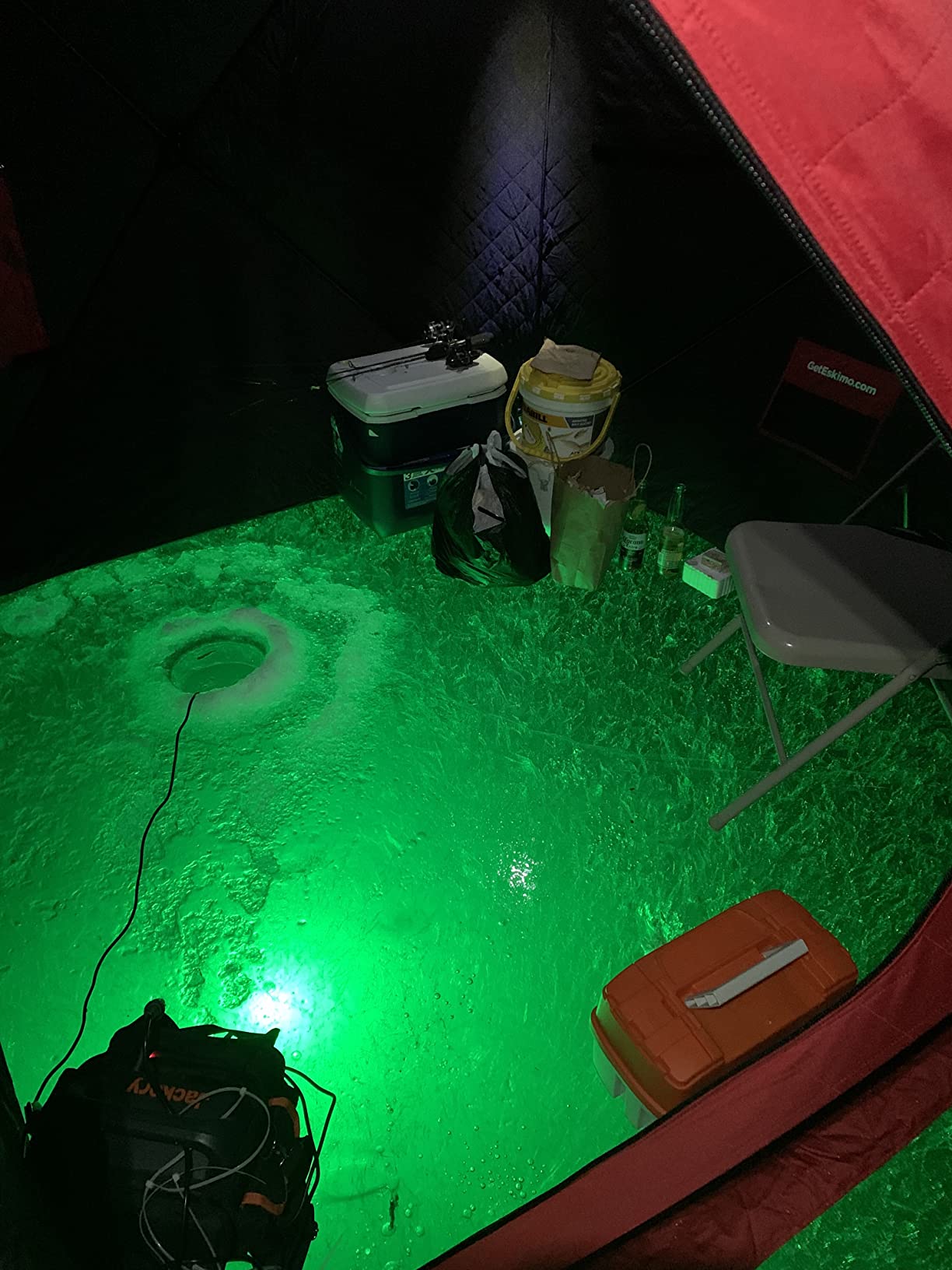
This is the shelter we ended up reaching for most. The hub frame springs open over your drilling spot in about a minute, and you can do it with a drill in one hand, which matters when you are working a new location in the cold.
At 34 pounds it is not the lightest thing here, but reviewers describe the packed size as carryable on your back in the included cinch duffel. That combination of genuine insulation and a comfortable pack shape is why it has accumulated 576 reviews at a 4.8 average, with 88 percent of those at five stars.
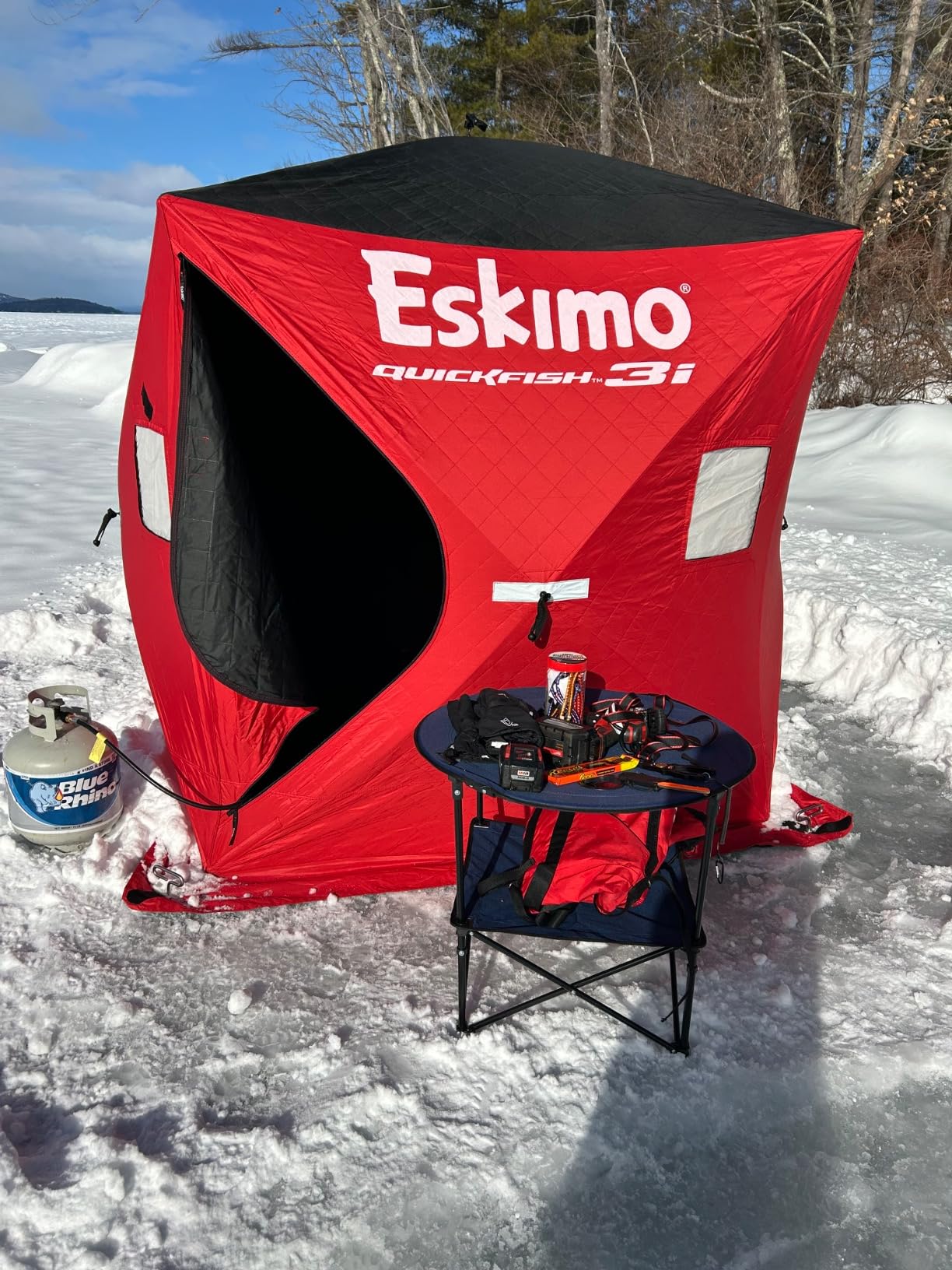
The insulation is the real differentiator for solo anglers. The quilted 600 denier fabric is rated warmer than comparable uninsulated shelters, which means you can sit comfortably for a full day without running a heater and worrying about carbon monoxide in a small enclosed space.
Anchoring is straightforward because the anchor grommets sit in the skirt itself rather than on separate straps. You drive the self-tapping anchors, clip the lines, and the extra-long skirt kills the drafts that usually make small shelters feel colder than the thermometer suggests.
Is the Quickfish 3i easy for one person to set up?
Yes, and that is the specific reason owners mention it most. The hub-style frame expands from the centre pole over your hole in roughly 60 seconds with no second person needed, and it collapses the same way for pack-down.
Where it gets harder is folding the fabric flat before it goes in the bag. Owners doing it in gusty conditions report the same friction point we saw, and it is worth folding on a tailgate rather than in the wind.
Is the 34 pound weight a problem for a solo angler?
It is manageable for a fit angler walking a moderate distance, and genuinely hard over long rough ice. If your spots are spread out and you plan to move four or five times a day, we would look at a lighter option in this list.
The bulkier issue is packed volume, not just weight. Owners who carry it on their back say it works, but the three-person floor area is wasted space if you are solo and want to keep gear outside.
2. ThunderBay Ice Cube: Best Value Pick for Sight Fishing
THUNDERBAY Ice Cube 3-4 Man Portable Ice Shelter, 34 Square Feet of Fishable Area, Portable 3-4 Person Ice Shanty
90 in hub to hub
80 in ceiling height
Blackout coated
300 denier fabric
Six ice anchors included
Pros
- Blackout coating makes it a genuine sight-fishing shelter
- Backpack straps make solo hauling practical
- Easy single-person setup and take-down
- Owners report years of regular use without degradation
- Generous hub geometry for the class
Cons
- Not insulated so a heater is required in deep cold
- Single door only
- Condensation can drip at seams with a heater running
- A light leak at the seams
If you fish for panfish and need the inside of the shelter to go genuinely dark, the blackout coating here is the feature that matters. Most budget shelters leak daylight through the fabric and the windows, and that washes out everything you are trying to spot below the ice.
At 90 inches hub to hub with an 80 inch ceiling, it also has the most headroom of the small pop-ups we tested. Reviewers note a 6 foot 3 inch angler can stand upright inside, which is unusual at this size and genuinely useful when you are moving in and out with a full bucket.
The backpack straps are a small touch that changes the whole experience solo. Owners routinely mention carrying it a full mile without a sled, and the included six self-tapping anchors and carry bag mean nothing else needs buying before the first trip.
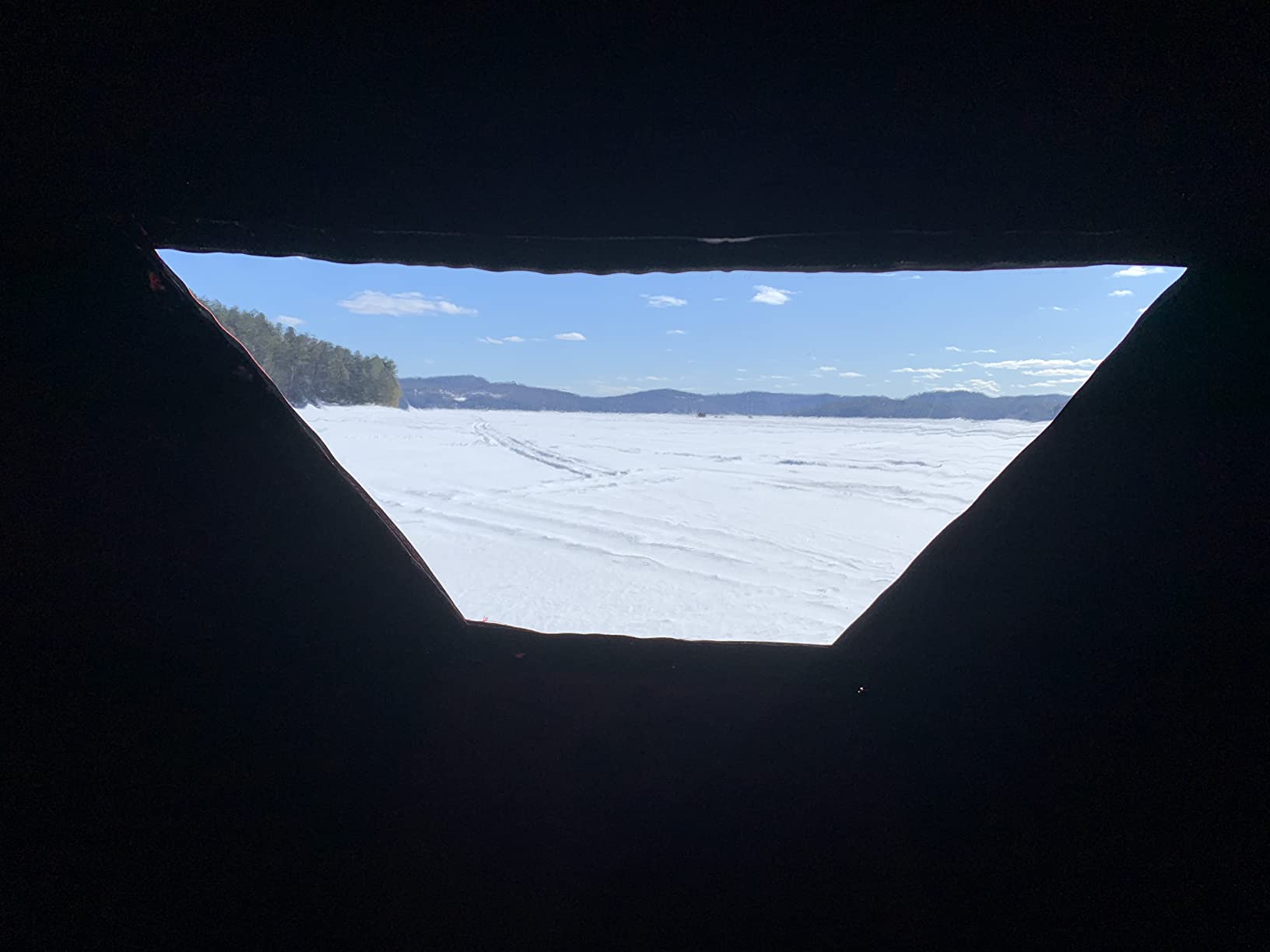
One thing to plan around: this is a 300 denier non-insulated shelter. In moderate cold you can fish in it all day in a good parka, but in serious cold you will need a heater, and with a single door and seam condensation you should keep a vent cracked.
Reviewers across 505 ratings call it the best value in its class and report years of regular use without degradation. The complaints that do show up are consistent and manageable: the single door, condensation drip with a heater, and occasional zipper wear after many seasons.
Is it worth skipping insulation for the blackout coating?
If you sight fish in daylight, absolutely. The interior darkness does more for your catch rate than insulation does, and you can always add a jacket layer or a heater later for a fraction of the cost of a fully insulated shelter.
If you are jigging deep water in hard cold instead, the trade goes the other way. An uninsulated shell loses heat faster and the seams let in drafts, so pair it with a heater and keep ventilation in mind.
Can one person carry this shelter across ice alone?
Yes, the backpack straps are the reason it ranks so well for mobile solo anglers. Forum consensus repeatedly favours shelters you can move in seconds, and this packs and repacks fast enough to follow active fish.
The one reported snag is a zipper that failed in very cold, brittle conditions. That is a long-term-use caveat rather than a reason to skip it, but keep an eye on the zipper when temperatures drop hard.
3. Outsunny Pop-Up Insulated Tent: Roomiest Budget Option
Outsunny 4 Person Pop-up Insulated Ice Fishing Tent, Light Blue
38.9 sq ft floor area
Insulated Oxford cloth
Two doors
Two double-layer windows
23.1 lb
Pros
- Two zippered doors on opposite ends
- Insulated build is warmer than uninsulated shanties at this price
- Two double-layer windows with clear vinyl for visibility
- Fiberglass frame resists cracking after repeated setup
- Folds into a roomy carry bag
Cons
- About 23 lb which is awkward to drag solo
- Light-coloured walls are not blackout
- Insulation is thinner than claimed
- Included guy cords wear quickly
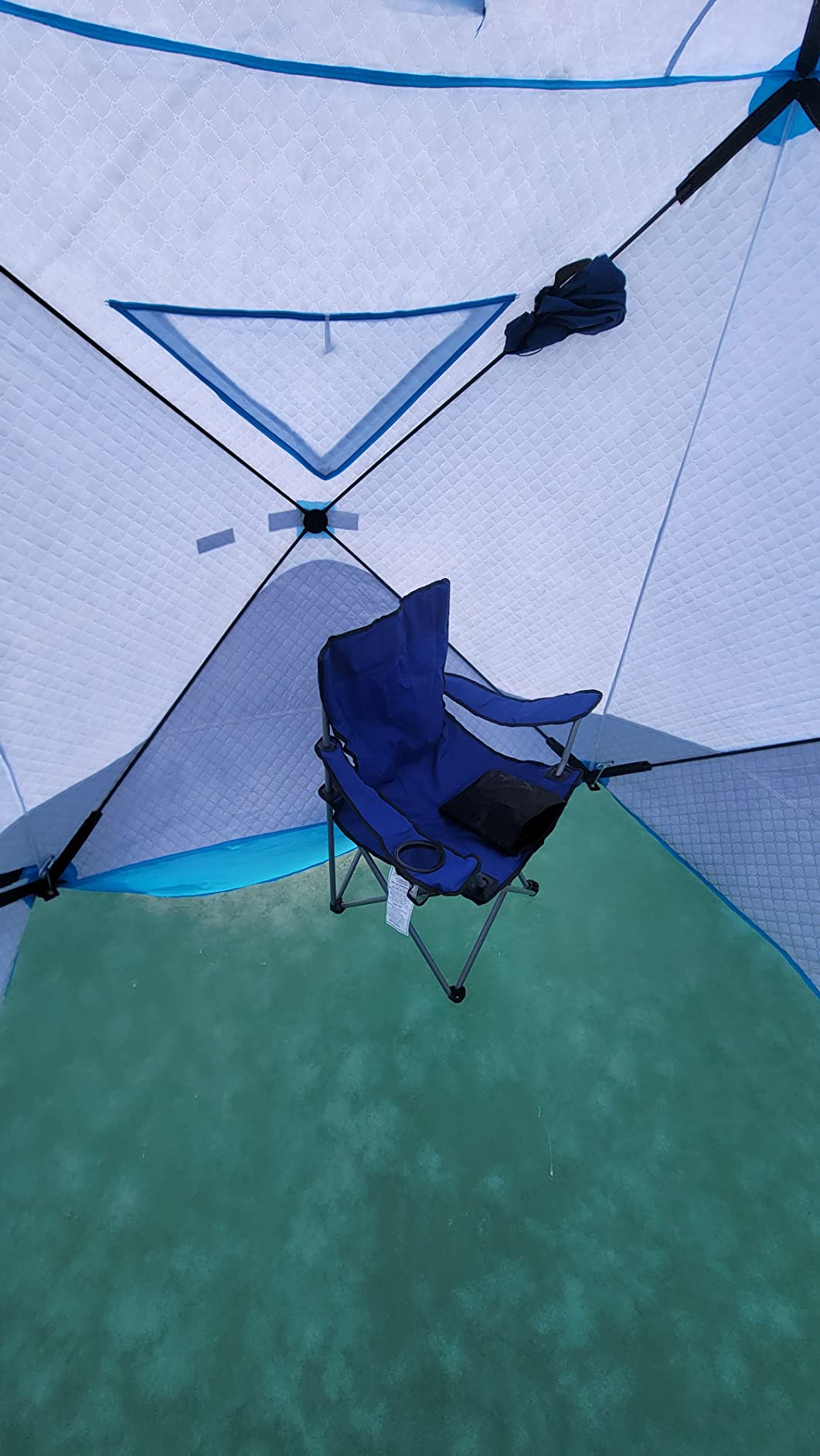
The floor area here is 38.9 square feet, which is the largest footprint in the roundup that still stays within solo-hauling territory. That extra room is what makes it comfortable with a heater, a stove, and a full gear pile inside rather than pinched into one corner.
Two doors on opposite ends is a real solo advantage. You can load gear through the far door without crawling over your own equipment, and it means you are not dragging yourself across the floor every time you want to check a different hole.
Setup is as simple as it gets: pull the roof and push the sides out. There is no hub to assemble first, which on a cold, windy morning is a meaningful difference when your hands are clumsy.
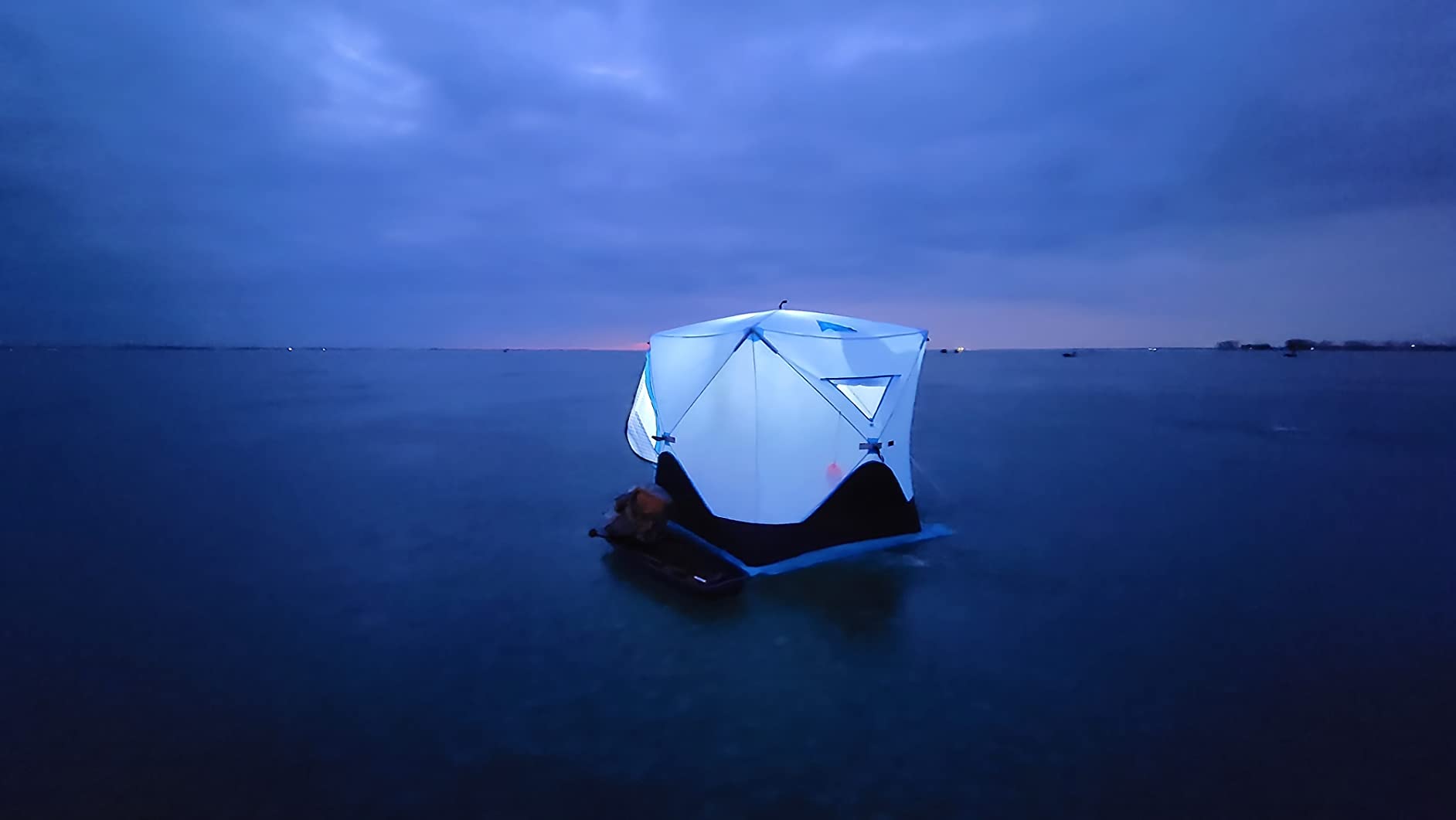
The honest weakness is the light-coloured fabric. In daylight the interior fills with sun, and if you are sight fishing you will spend the session fighting glare rather than spotting fish. If you are jigging or tip-up fishing, this matters much less.
Reviewers also note the insulation runs thinner than the listing implies, with some air seeping through seams, and a few units have had stitching fail at an ice anchor point. Treat the included guy cords as consumables rather than gear you can trust for a season.
Is 23 lb light enough to hand-haul solo?
It is a moderate carry rather than a walk-behind weight. One person can manage it comfortably over a short distance or on smooth ice, and it is fine on a sled, but it is not the shelter to pick if you are covering a mile of rough terrain twice a day.
If weight is your binding constraint, the VEVOR in this list is roughly 8 lb lighter, and the trade there is floor area and fabric thickness.
How warm is it compared with a name-brand insulated shelter?
Warmer than an uninsulated shelter and comfortable for a typical day session, but reviewers consistently say the fill is thinner than advertised. It sits in the middle tier rather than matching a fully quilted premium build.
For overnight solo sessions it is usable with a heater and proper sleep gear. For a whole day in hard cold without a heater, choose a heavier insulated shell instead.
4. VEVOR Pop-Up Hub Shelter: The Lightest Shelter You Can Hand-Carry
VEVOR Pop Up Ice Fishing Tent 1-2 Person 59 x 59 x 65 in Portable Shelter
14.8 lb carry weight
24 sq ft area
59 x 59 x 65 in
300D Oxford with PU coating
Walk-through door
Pros
- Lightest weight in the roundup at 14.8 lb
- Insulated 300D Oxford holds heat well in sub-zero conditions
- Walk-through door beats side-entry designs
- Black interior cuts glare on the hole
- Anchors
- ropes
- and bag all included
Cons
- Light leaks through the seams
- Included ice anchors bent on first use for some
- Catches wind and needs proper staking
- Weak illustrated instructions
At 14.8 pounds this is the only shelter here you could genuinely carry all day and still have energy left to fish. If your spots are scattered and you plan to move constantly, that single number matters more than anything else on the spec sheet.
The 24 square foot interior is the smallest of the roundup, but it is sized honestly for one angler plus gear rather than padded out to a group rating. You sit, you drill, you fish. Nobody else needs to fit.
The walk-through door is a nice piece of design on a budget shelter. You step through upright instead of ducking, which when you are moving in and out with a bucket is the difference between annoying and fine.
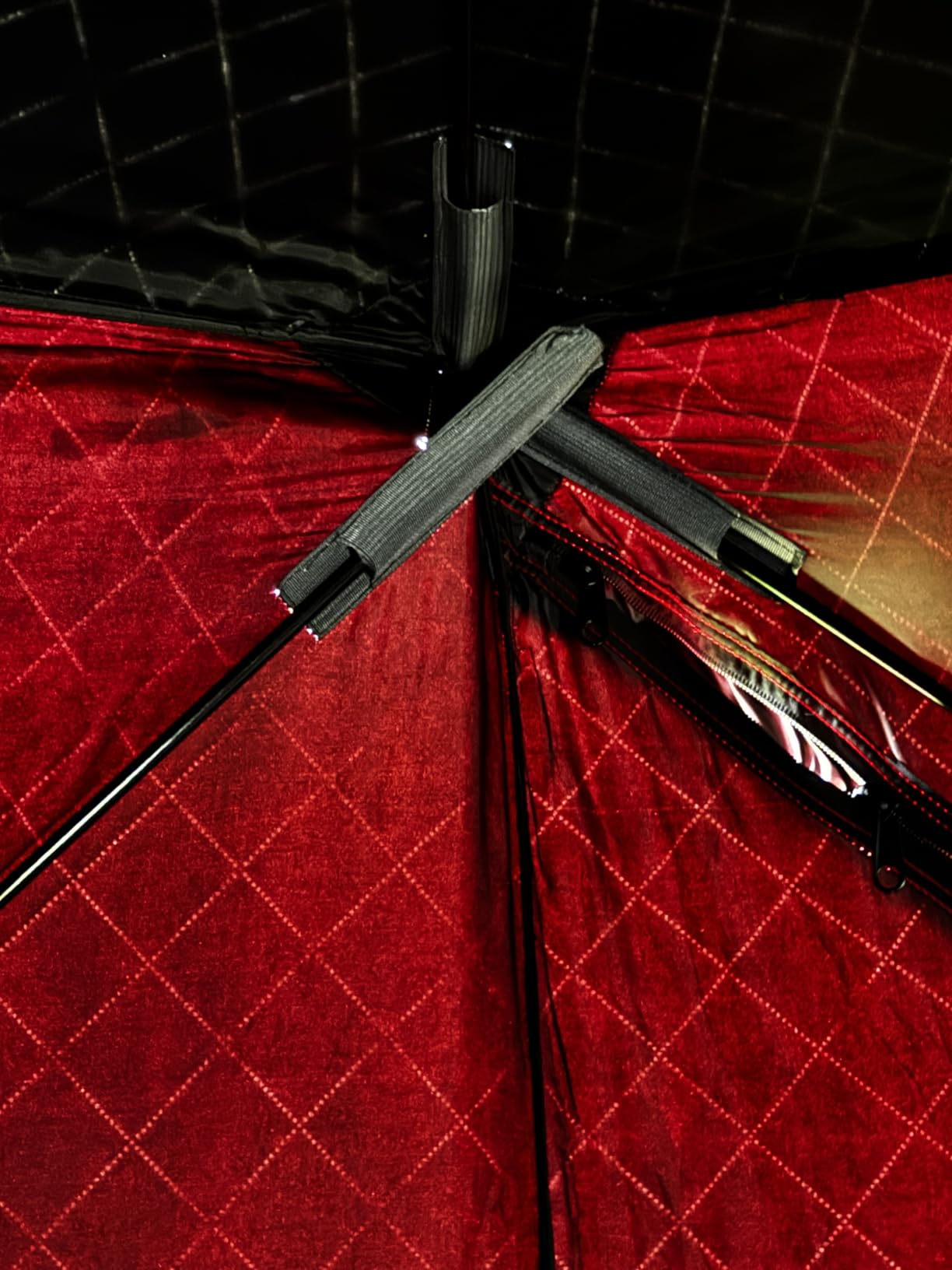
Owners frequently compare it favourably to Eskimo and Clam insulated pop-ups at a fraction of the cost, and report good warmth retention down to minus 10C to minus 20C. That is real performance for a shelter this light.
Two cautions. The included ice anchors are the weak point, with several owners reporting bent anchors on first use, so bring your own. And it catches wind, meaning the anchors must go in before the hub goes up, not after.
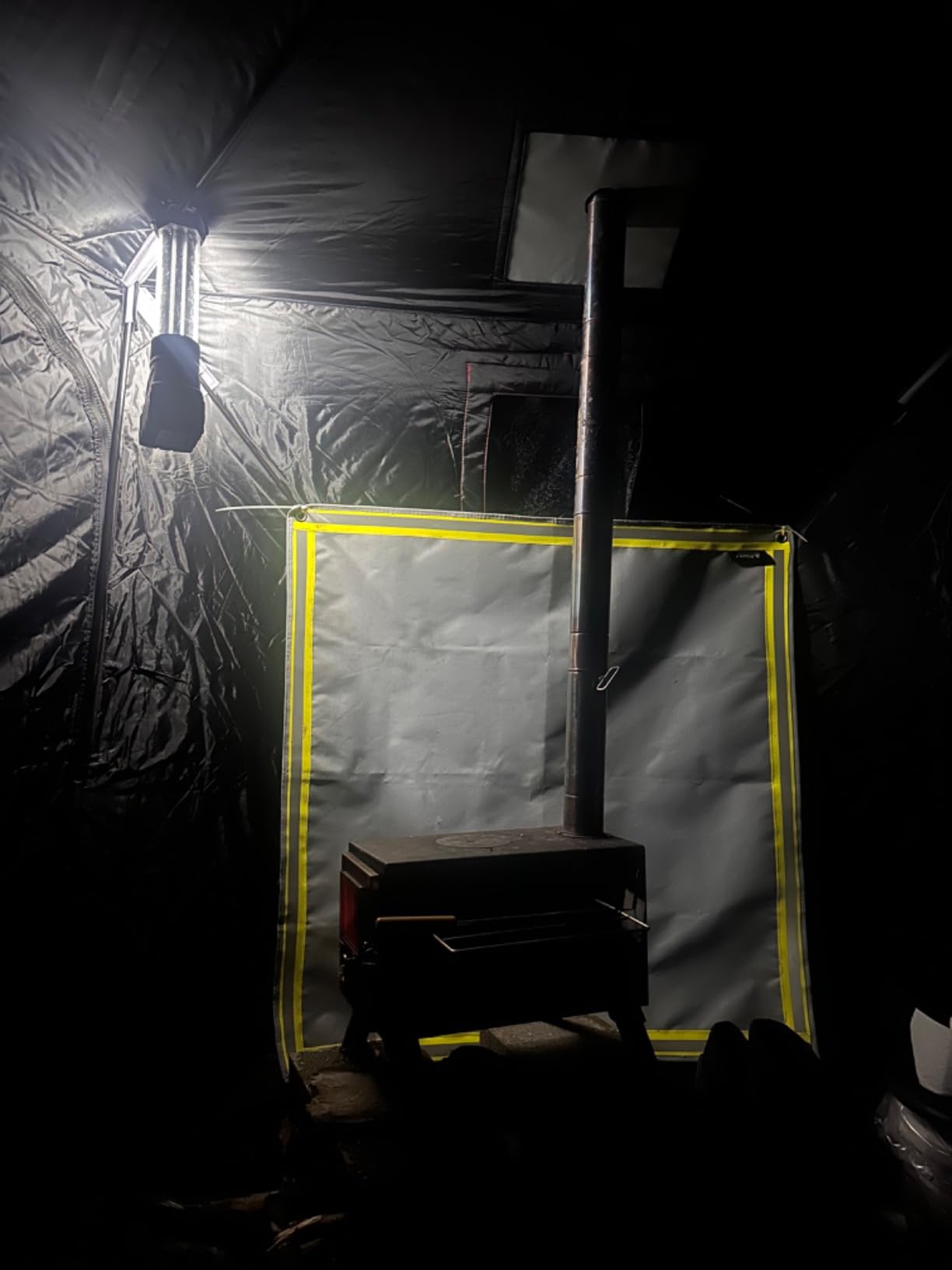
Is 14.8 lb light enough for long solo treks?
Yes, comfortably. It is the only shelter in this roundup that you can genuinely hand-haul across a long distance without planning the trip around the carry, and reviewers regularly describe walking a mile with it.
What you give up for that weight is interior room. Twenty-four square feet is fine for one person but tight once a heater, a sled of gear, and a full day of accumulated junk are inside.
Will it stay put in wind?
Only with proper anchoring. Owners describe good stability once it is staked but real movement when it is not, and the wide 59 inch footprint acts as a sail in a crosswind.
Set the metal anchors and run the guy lines before you raise the hub, and you will have far fewer problems. The included anchors are worth replacing with known-good ones.
5. Nordic Legend FastFish: Best for Anglers Who Want Chairs Included
Nordic Legend Two Man Ice Shelter with Free Bonus Ice Chairs!
76 in hub to hub
67 in ceiling height
300 denier fabric
Two ice chairs included
Cast aluminum hubs
Pros
- Two ice chairs ship with the shelter
- Replaceable fiberglass poles and cast aluminum hubs
- Brand support sent a free replacement hub
- 76 in hub-to-hub width is roomy for the size
- Easy for one person to pitch
Cons
- Folding it back into the bag is awkward in wind
- Entry and exit are cramped for taller anglers
- Tight interior once gear is inside for two
- Not really designed as a solo shelter
The differentiator is the two ice chairs in the box. For a solo angler who does not already own a setup, that removes a real cost and a real annoyance, and reviewers consistently single it out as the reason to pick this one over a cheaper bare shelter.
Build quality is the second draw. Replaceable fiberglass poles and cast aluminum hubs are a step up from the welded steel hubs on many budget models, and the 300 denier fabric does a solid job of blocking wind.
The 76 inch hub-to-hub footprint gives you room to sit with legs out rather than tucked, and the 67 inch ceiling is enough to kneel and work comfortably without your head hitting fabric.
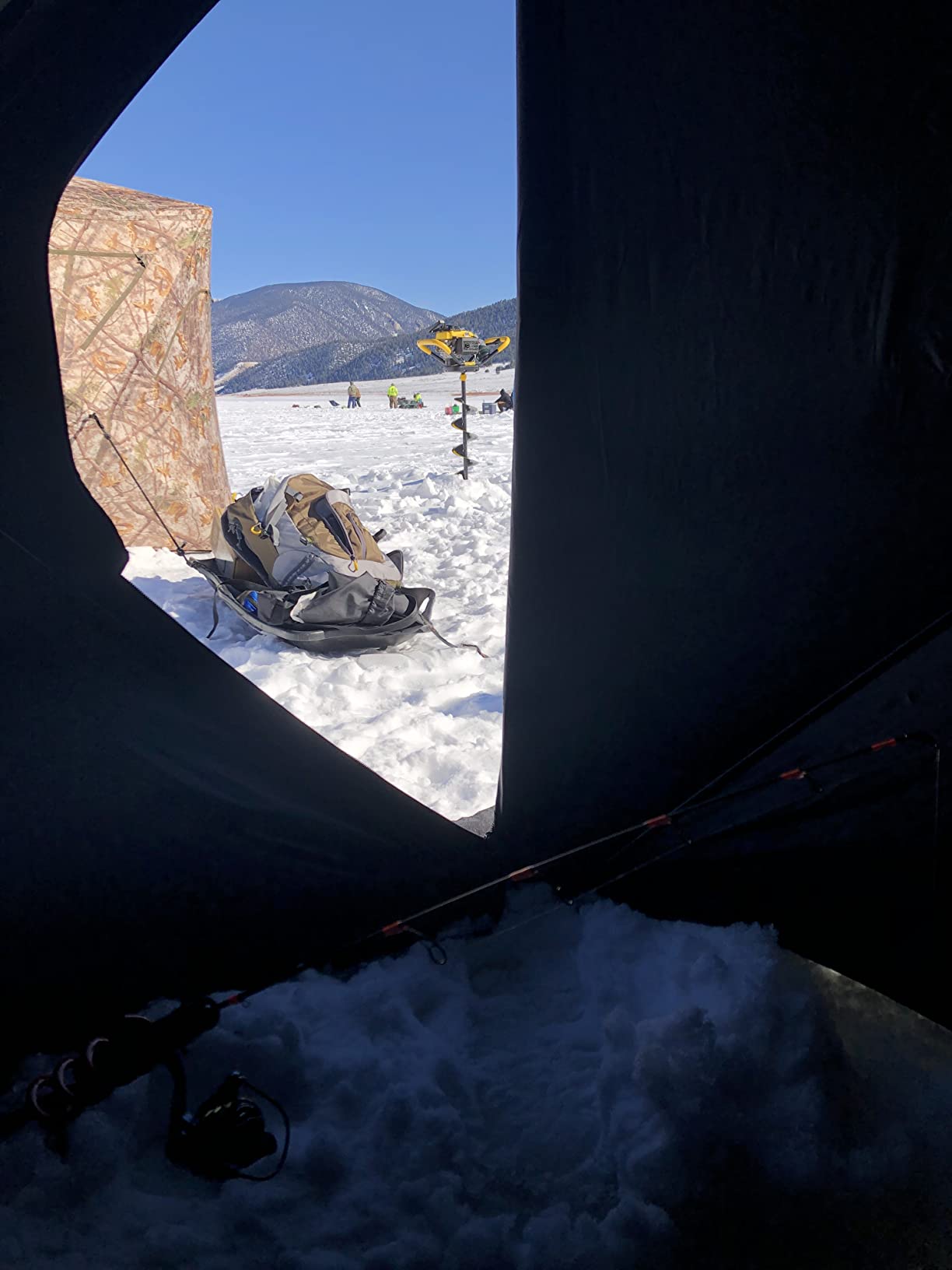
Service is worth mentioning too. Owners report the brand sending a replacement hub connector free of charge, which is exactly the kind of support you want when you are alone on a lake and a part fails.
The catch is repacking. Reviewers describe folding it back into the carry bag as awkward, especially in wind, and that is the part of the cycle that takes real effort when you are doing it solo.
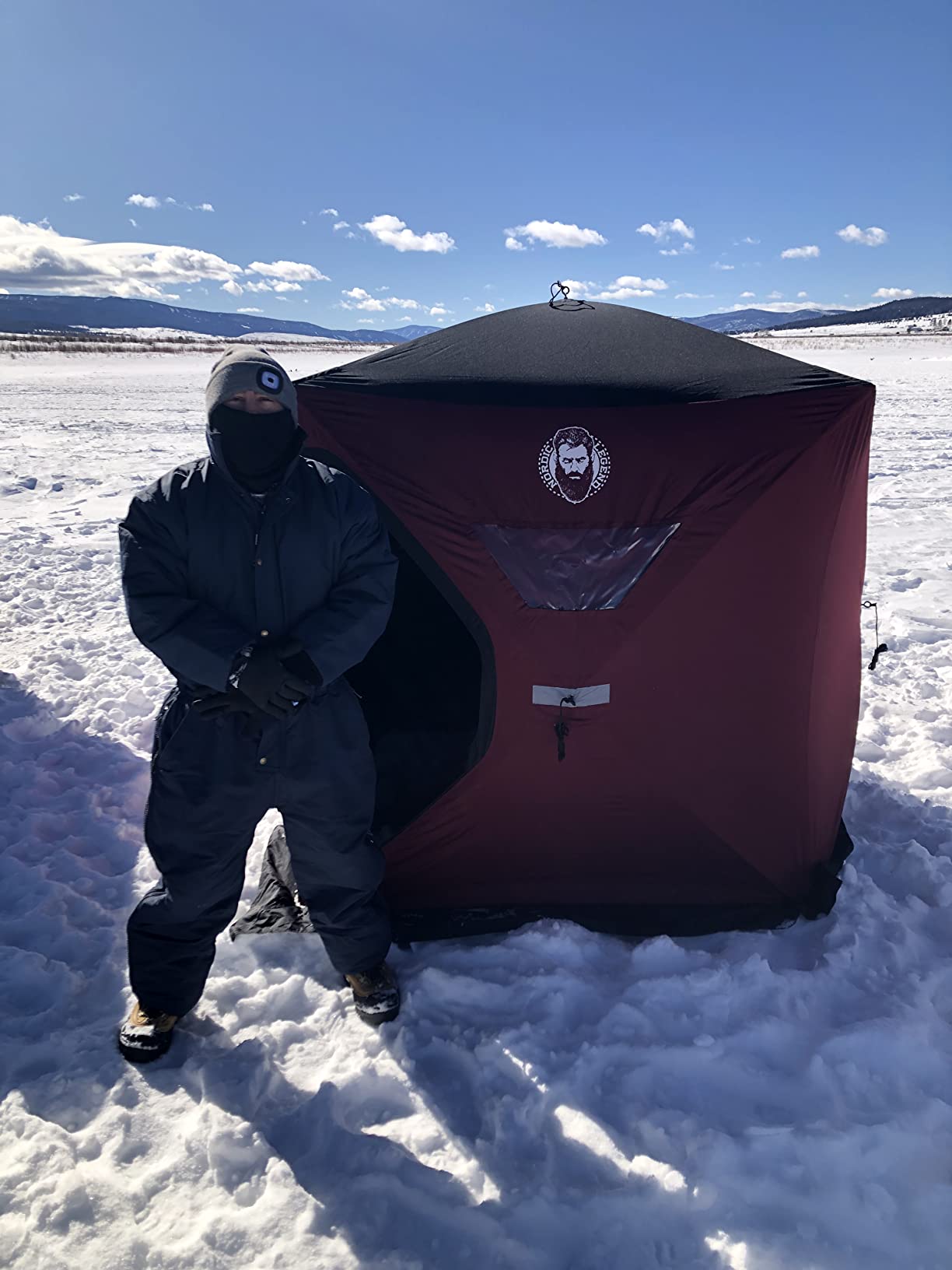
Are the included ice chairs actually usable solo?
Yes, they are standard sled-seat style ice chairs and they attach to the carry bag, which keeps everything together in one load. That consolidation is genuinely useful when you are moving alone.
They are low-backed and basic, so if you fish long sessions and prefer a tall chair you may still want your own. But as a bundled starting point for one person, they remove a purchase.
Is it a real solo shelter or just a small group shelter?
It is marketed as a two to three person shelter and reviewers note it gets tight for two once gear is inside. Solo it is comfortable, with room to spin around, but you are buying the smaller end of a group shelter.
If you need genuine solo space, prefer a shelter rated for one or two. If you want chairs and a roomy footprint at a fair price, this one is a good deal.
6. Otter Vortex PRO Lodge: Premium Room, Heavy Haul
Otter 201625 Vortex PRO Lodge Thermal Hub
74 sq ft fishable area
79 in ceiling height
48 lb
69 in wall height
Ice-Lock anchoring
Pros
- Largest fishable area in the roundup
- 79 in ceiling gives real standing room
- Full door with dual coiled zippers
- Thermal insulated build suits long cold sessions
- Metal frame and pole construction
Cons
- Weighs 48 lb which is a two-person load
- Five-sided design takes more effort to pitch than a cube
- Collapsed depth of 11.5 in is bulky solo
This is the only shelter here you could stand upright in, with a 79 inch ceiling and 69 inch wall height. That changes what a day on the ice feels like, especially if you like to move around, change layers, or work on a jigging rod for hours.
The 74 square feet of fishable area is the largest in the roundup by a wide margin. If you ever bring a friend or a kid, this one already handles it without a second purchase.
The full door with dual coiled zippers is a real convenience. Nothing about the entry feels like crawling through fabric, which is the single most common complaint on small one-person shelters.
The honest framing is that this is a group shelter with premium materials, and the 48 pound weight reflects that. On a sled or behind a snowmobile it is a different product entirely.
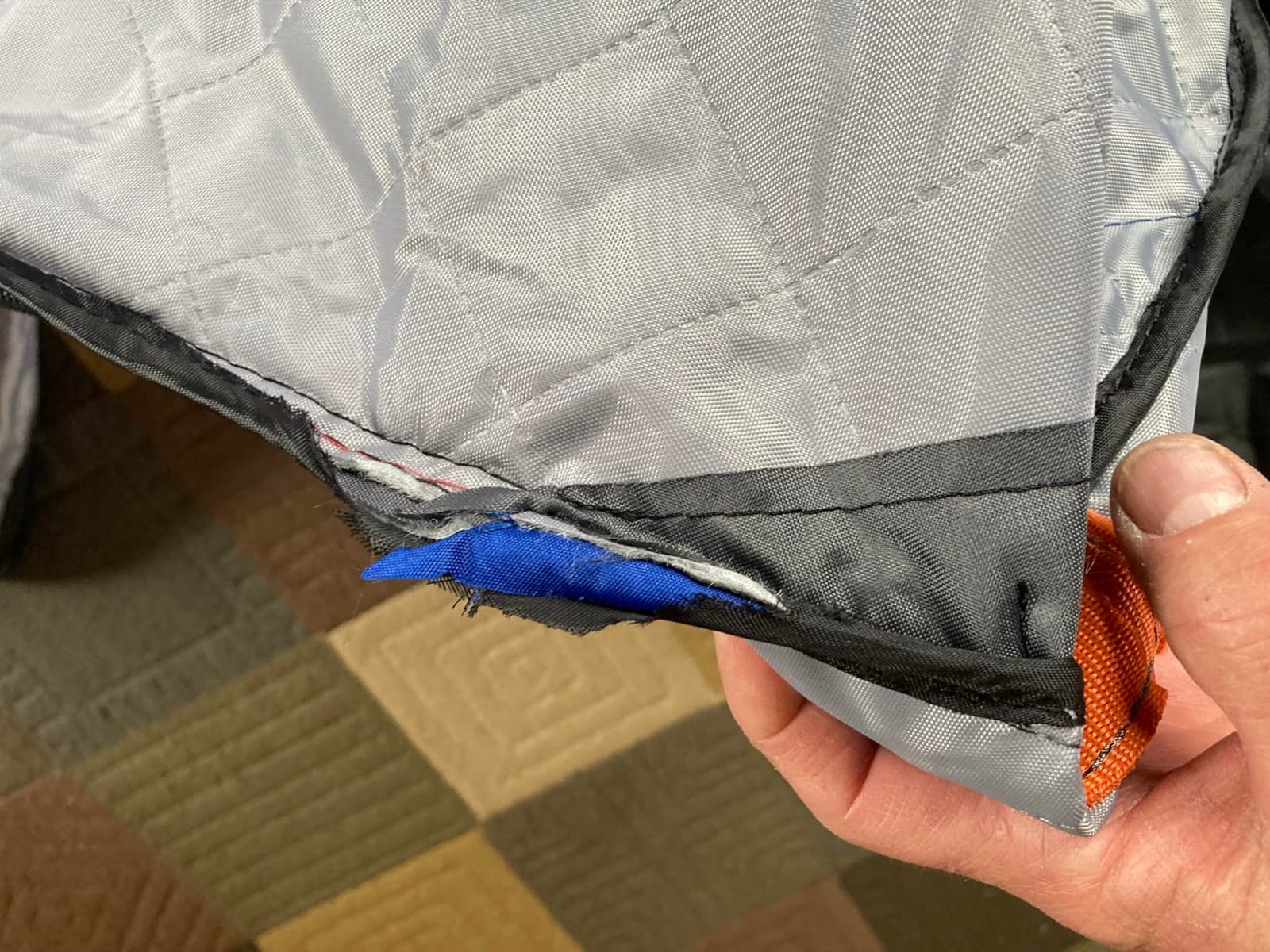
Otter and Eskimo are consistently named as the two big dogs for build quality across forums, and this is where that reputation shows. The metal frame and poles should outlast fabric on any shelter in this list.
Review evidence here is thinner, with 47 ratings at a 4.5 average, so we lean more on the specification than on owner reports. Owners who do use it praise the room and the door width and accept the weight as the trade.
Can one person set up the Vortex PRO Lodge alone?
It is possible, but it is effort. The five-sided design has more poles to place than a four-wall cube, so expect a longer pitch than any other shelter in this roundup.
If you have an ATV or snowmobile and a sled, this stops being an issue. If you are hand-carrying across ice, the setup time and the 48 pounds are the two reasons to pick something lighter.
Is the 74 square feet worth the extra weight?
For a solo angler it is generous rather than necessary, but the extra room buys real comfort: room for a heater, a stove, gear, and movement without constant rearranging.
You are paying for headroom and future flexibility. If you only ever sit in one position and only ever fish alone, a smaller insulated shelter serves the same purpose at half the carry weight.
7. Aoxun Insulated Pop-Up: Best Real Insulation for the Money
Aoxun Ice Fishing Tent Pop Up Insulated Shelter 1-2 Person Portable Shanty
59 x 59 x 65 in
80g spray-bonded cotton fill
Three-layer build
Level 6 wind rating
TPU windows
Pros
- Genuine three-layer build with 80g cotton fill
- TPU windows stay flexible in cold instead of cracking
- Documented Level 6 wind rating when anchored
- Under-a-minute setup with pre-assembled poles
- Reinforced anchor points resist repeated stake-ins
Cons
- Only 22 ratings so durability is unproven
- 59 in footprint is compact with gear inside
- 65 in entry suits seated use more than standing
The insulation specification is what separates this one. A 420D Oxford outer over 80g of spray-bonded cotton over a 420D Oxford lining is a real three-layer build, not the thin quilted filler used on most shelters in its class.
That puts it closer to the Eskimo thermally while weighing far less, which makes it one of the better-balanced picks here for an angler who sits still for hours and wants to stay warm without a heater.
The TPU windows are a detail more expensive shelters get right. Standard clear vinyl goes brittle and cracks in hard cold; TPU stays flexible, so you can open and close the vents without tearing them.
It also has the only documented wind rating we found. Rated for Level 6 winds of 24 to 31 mph when fully anchored, with a roof that holds a snow load, which is real information rather than marketing language.
Corners are reinforced with 600D PVC coating top and bottom, the exact places where ice shelters fail when you stake and un-stake them all season, and the accessory kit covers ropes, anchors, elastic straps, and a carry bag.
Is the 65 inch height enough to sit in comfortably?
Yes, seated and kneeling work well, and most solo fishing is done in a chair at that height. Standing is a stretch at that entry height once you add a heater and gear, so think of it as a seated shelter.
The 59 inch square footprint is compact. That is a genuine advantage if you are chasing structure, and a genuine constraint if you like to spread out with a stove and a heater running.
How reliable is a shelter with only 22 ratings?
Be honest with yourself about this one. The 4.6 average is strong, but 22 ratings is thin evidence, and the spec sheet is doing most of the persuasive work here rather than long-term owner reports.
The construction details are reassuring enough that we would not hesitate, but we would keep expectations measured and check the fabric and stitching carefully after the first few trips.
8. Garvee 210D Insulated with LED Strip: Best for Night Fishing
Garvee Ice Fishing Tent for 2-3 Person 60″x60″x76.2″ Insulated Tent with LED Light Strip (Battery Not Included)
60 x 60 x 76.2 in
Three-layer quilted 210D
50.52 ft LED strip
Claimed 35% better retention
Pros
- Built-in LED light strip is unusual at this price
- 76.2 in ceiling gives good kneeling and standing room
- Hub pop-up in under 60 seconds by one person
- Three-layer quilted fabric rated to minus 30C
- Folds to a compact carry bag
Cons
- Only 4 ratings so feedback is nearly empty
- 30 day manufacturer warranty
- 210D shell is thinner than 300D rivals
- LED strip needs its own power source
The built-in light strip is the reason to look at this one if you fish at night. A 50 foot strip running around the interior means you are not juggling a headlamp and a rod at the same time, which is the exact problem every night angler complains about.
The 76.2 inch ceiling is the second tallest on this list and gives real kneeling and standing room in a shelter that otherwise looks compact, so it works for more body positions than the footprint suggests.
Setup is a genuine hub pop-up in under 60 seconds by one person, and the claimed 35 percent better heat retention over non-insulated shelters is in line with how the quilted three-layer fabric performs.
The 60 by 60 inch interior suits two or three anglers with gear, which makes it a shared shelter in practice even though you would use it alone.
The 210D quilted shell is thinner than the 300D fabric on most competitors, so treat this one as a lighter-duty shelter. It is well suited to moderate cold and shorter sessions rather than deep-winter overnight use.
With only four ratings the evidence base is nearly empty, and the specification is what you are buying. That is a fair trade at this level, but it means you should inspect seams and stitching after the first few trips.
Is a 30 day warranty a red flag?
It is thinner than we would like, and it is the main reason this shelter sits low in our ranking despite a decent feature list. Thirty days covers manufacturing defects and nothing beyond that.
Brands like Eskimo and Nordic Legend back their shelters for a year, which matters more when you are the one relying on it in an emergency on the ice.
Does the LED strip need a separate power source?
Yes, and that is the practical catch. The strip is fitted but you supply the power, so plan on a small battery pack or a portable power station if you want lighting through a whole session.
You may already be carrying one of those for a fish finder or a heated jacket, in which case the strip costs you nothing extra. If not, budget for it before the first night trip.
9. YIYIBYUS Center-Pole Ice Hut: A Cozy Solo Cocoon
Insulated Ice Fishing Tent, 210D Oxford Fabric Ice Fishing Tent, Portable Center-Pole Ice Hut, Windproof and Warm, Suitable for 1-2 People, Includes Anchors, Ropes, and Storage Bag (Orange)
57 x 57 x 65 in
Three-layer cotton lining
D-shaped double-zipper door
19.8 lb
Reflective strip
Pros
- Genuinely compact at 19.8 lb for a solo footprint
- Three-layer thickened cotton lining with extended hem
- Reflective strip improves low-light visibility
- Kit includes 4 anchors
- ropes
- toolbag
- and handbag
- Two rollable windows with clear view panels
Cons
- Listed as center-pole rather than hub so pitch can be slower
- 57 in footprint is tight with a heater inside
- Only 4 ratings so evidence is thin
- Sold mostly in the camping tent category
This is the most genuinely solo-sized shelter in the roundup. At 57 inches square with a one-person occupancy rating, there is no wasted group space, and everything fits tight and close which is exactly what you want in a sleeping shelter.
The extended hemline and three-layer thickened cotton lining are built for staying warm while stationary. Owners describe it as warm and cosy on the lake, which tracks with the design intent more than with a fishing-specific product.
At 19.8 pounds it carries easily, and the kit ships with four ice anchors, windproof ropes, a toolbag, and a handbag so you are not buying accessories on the first trip.
The reflective strip is a small touch with real value. When you are walking back to the truck at dusk in a whiteout, being visible matters.
Is it big enough for one person overnight?
For sleeping, yes. Solo it fits a chair or a cot with gear in the corners, and the tight footprint is a feature when you want warmth concentrated rather than lost in a large volume.
Once you add a heater, a stove, and a full gear pile, the 57 inch square becomes genuinely cramped. Plan it as an overnight shelter rather than an all-day one.
What does the center-pole frame mean in practice?
It means the pitch is not the one-motion hub pop you get from the Eskimo or VEVOR. There are more steps, and on a cold windy morning that is a meaningful difference in how quickly you can get fishing.
The trade is stability and a tighter, more enclosed shape. If you pitch once and stay put, that is an advantage. If you are moving spots constantly, choose a true hub design.
10. Garvee 3-Layer Pop-Up Shelter: Warm Sight-Fishing Interior
Garvee Pop-Up Ice Fishing Tent,Portable 3-Layer Insulated Ice Fishing Shelter Tent,1-8 Persons, Waterproof Oxford Fabric, Includes Anchors, Ropes & Carry Bag for Winter
300D Oxford with PU coating
Three-layer black coated lining
Sizes for 1 to 8 persons
Overhead gear loft
20.7 lb
Pros
- Dark-restore windows give a wide field for spotting fish
- Three-layer PU coated lining holds heat well
- Reinforced stitching and steel frame for hardwater use
- Mesh windows plus ceiling vent reduce heater condensation
- Interior pockets
- gear loft
- and reinforced ice hole sleeves
Cons
- Leaks from top vents during rain or snow when left pitched
- Windows are not optically clear
- Large sail area so anchors go in before the hub
- Heavier than a small solo shelter
The dark-restore windows are the feature here. They let you see out and spot fish under the ice across a wide field while keeping the interior dark, which is the same problem the ThunderBay solves with full blackout coating but here you keep visibility.
Interior organisation is unusually thorough for the class. Storage pockets, an overhead gear loft, and reinforced ice hole sleeves mean the rod, the tackle, and the bucket all have homes instead of living in a pile that you kick every time you move.
The 300D Oxford fabric with a three-layer PU black coating and reflective thermal lining is a serious build, and buyers describe it as comparable to a well-made hunting blind adapted for ice, which is an apt comparison.
There is a size range from one to eight persons, so you can pick the footprint that matches how you actually fish rather than buying group dimensions by default.
Do the windows really help with spotting fish?
They help more than a dark shelter does, because you retain a view while the light stays down. Reviewers caution the vinyl is not optically clear, so you are working a wider field at slightly lower contrast than clear plastic gives you.
For panfish and visible-structure fishing that trade is worth it. For clear-ice finesse fishing where clarity matters most, the fully blacked-out ThunderBay is the stronger tool.
Is it worth pitching overnight in bad weather?
Not reliably. Owners report leaks from the top vents when rain or snow comes in on a shelter that stays pitched overnight, and the vendor was reportedly unresponsive about a leak complaint.
For day sessions in cold and dry conditions it performs well. If you plan to sleep in it through a storm, vent the ceiling or choose a shelter with a solid roof claim.
Flip-Over vs Pop-Up: Which Shelter Style Suits a Solo Angler
Every shelter here is a hub-style pop-up, because for a single angler the flip-over and pop-up debate mostly resolves on other grounds. Flip-over shelters integrate the shelter with a sled so it rotates up and over the seat as one unit, keeping all gear connected and letting one person move in seconds. That is genuinely better for run-and-gun fishing, but the sled is what pushes total weight well past what one person wants to drag.
Pop-ups spring open from a collapsible centre pole over your drilling spot in under two minutes and pack down onto your back. They are lighter, cheaper, and easier to carry alone, which is why they dominate this roundup.
Buyers moving every hour on structure should look hard at flip-over sleds even though none made our list. Anglers who pitch once or twice a day are better served by the lighter options above.
Are insulated ice fishing tents worth it?
Yes, for most solo anglers, and the value shows up in long sessions rather than short ones. Insulation traps body heat so you can sit comfortably for hours without running a heater, which also means less carbon monoxide risk in a small enclosed space.
If you fish two hours a day in moderate cold, an uninsulated shelter with a good parka is fine. If you sit all day in hard cold, insulated fabric pays for itself in comfort.
What weight can one person realistically haul?
Under 20 lb is comfortable for any distance. Between 20 and 35 lb is a moderate carry that works on smooth or short hauls. Above 40 lb, plan on a sled, an ATV, or a snowmobile rather than your back.
This is the threshold almost nobody publishes, and it is the first thing we check on any solo shelter. Weight decides whether you move or plant.
How do you anchor a pop-up shelter against wind?
Set the ice anchors before you raise the hub. Once the frame is up it catches wind like a sail, and trying to stake it afterwards means wrestling fabric in exactly the conditions you are trying to escape.
Run every guy line to an anchor, keep the skirt tight to the ice, and expect anything above about 30 mph to need more than one anchor per corner. Test it with a full bucket before you commit to a spot.
Solo Safety and Anchoring Before You Step On the Ice
No shelter makes bad ice safe. Most ice fishing injuries are falls through early-season ice, and the single most effective protection is turning around when conditions do not add up.
Carry a chisel and wear traction cleats every trip. If you go alone, tell someone your lake, your route, and your expected return time, and give that person a deadline at which they start asking questions.
A lightweight shelter is easier to abandon quickly if conditions turn, which is an underrated safety benefit. If you cannot get the shelter and yourself off the ice in a few minutes, that is a planning problem, not a product problem.
Our guides to the best ice fishing augers for beginners and the best ice fishing flashers for anglers cover the drilling and fish-finding side of a solo day. For moving gear around once you are pitched, our picks for the best ice fishing sleds are worth a look.
Frequently Asked Questions
Are insulated ice fishing tents worth it?
Yes, for most solo anglers. Insulation traps body heat so you can sit for hours without running a heater, which also lowers carbon monoxide risk in a small enclosed space. If you fish short sessions in moderate cold, an uninsulated shelter with a good parka works fine. If you sit all day in hard cold, insulated fabric pays for itself in comfort.
What is the best lightweight fishing shelter?
Among the shelters we tested, the lightest option weighed 14.8 pounds with a 24 square foot interior and a walk-through door. As a rule of thumb, under 20 pounds is comfortable to carry any distance, 20 to 35 pounds is a moderate carry suited to short hauls, and above 40 pounds means a sled or an ATV.
Which brand of ice house is considered the best?
For build quality, Eskimo and Otter are the two most respected names in forums, and Clam is widely trusted for flip-over designs. Among budget options, we rated a 300D Oxford insulated hub shelter highest for the combination of a 14.8 pound carry weight, three-layer PU coating, and a documented warm performance in sub-zero conditions.
Can one person set up an ice fishing shelter alone?
Yes, with a hub-style pop-up. These expand from a collapsible centre pole over your hole in roughly 60 seconds with no second pair of hands, and collapse the same way. Five-sided and centre-pole designs take longer. Set your ice anchors before raising the hub, since the frame catches wind once it is open.
Do I need a heater in a solo ice fishing shelter?
Only if you chose an uninsulated shelter or you plan to sit out long overnight sessions. An insulated shelter at around a 4.6 rating retains enough body heat for a full day without one. If you do run a heater in a small enclosed shelter, keep a vent cracked to manage condensation and never leave it unattended.
Final Verdict for Solo Anglers
For the best ice fishing shelters for one person, the Eskimo Quickfish 3i is the pick. It has the deepest review evidence in the roundup at 576 ratings and a 4.8 average, genuine insulation rather than a marketing claim, and a 60-second pitch one person can finish alone.
If you sight fish and need darkness, go with the ThunderBay Ice Cube. If weight is your binding constraint, the VEVOR at 14.8 pounds is the only shelter here you can hand-carry all day without planning the trip around the carry. Check the price on each before you commit, and pair any shelter with a fish finder if you are new to finding fish on your own.