
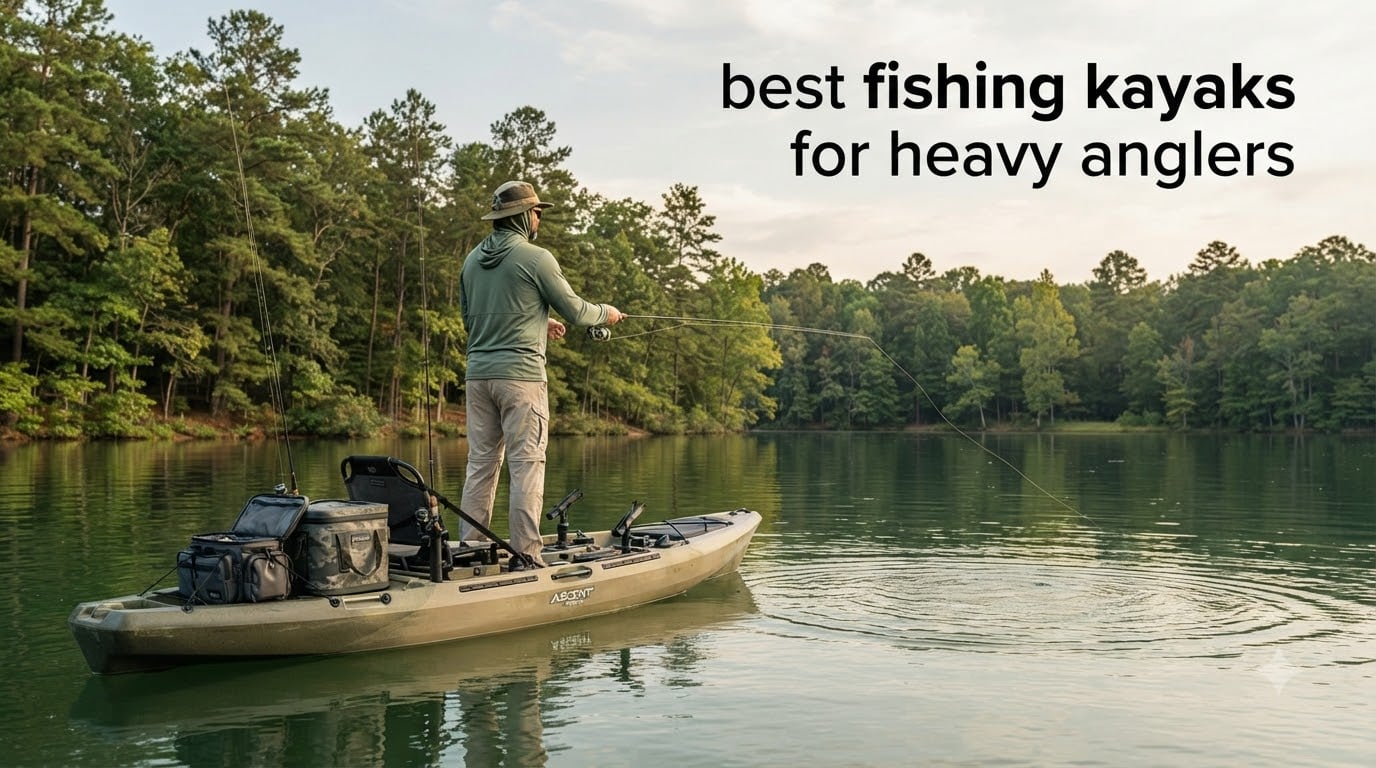
The best fishing kayaks for heavy anglers are the wide-beam platforms rated between 375 lb and 800 lb, not the inflatables and folding boats that dominate general fishing-kayak lists. Capacity is only half the story. A 600 lb rating tells you the hull will float with you in it; beam width in inches tells you whether you can stand up in it and cast without wobbling.
We spent weeks comparing the ten boats below on the numbers that actually decide this purchase: rated capacity, beam, hull length, dry boat weight, propulsion type, seat adjustment and storage layout. Our team has run several of these rigs over a full season of lake fishing, and we read every buyer comment we could find on each hull.
Here is the honest short version. A 250 lb angler with a trolling motor and a battery should be looking at the 425 lb to 550 lb class, not the 375 lb boats. A 300 lb paddler needs to be at 500 lb or above before gear goes in. Anyone over 320 lb with real electronics on board belongs in the 550 lb to 800 lb range, and should plan for a trolley or a trailer the day they buy, because those hulls run 67 lb to over 100 lb.
We updated this roundup for 2026. Everything below reflects current manufacturer capacity ratings, dimensions and buyer feedback as of October 2026.
Table of Contents
Top 3 Picks for Heavy Anglers in October 2026
Perception Outlaw 11.5
- 425 lb capacity
- 35 in beam
- 138 in length
- Fold-away frame seat and 4 rod holders

BKC Brooklyn 11.5 Pro
- 550 lb capacity
- 34.25 in beam
- 2 in height-adjustable seat
- Foot-operated rudder

Pelican Catch Mode 110
- 375 lb capacity
- 34.5 in beam
- 67 lb boat weight
- ERGOBOOST seat with 6 in lift
Quick Overview: All 10 Picks Side by Side in October 2026
The capacity column below is the manufacturer’s maximum, and it covers you, your gear, your battery, any motor and your catch. Boat weights are the dry figures manufacturers publish, and two of these hulls are listed in kilograms rather than pounds.
| Product | Specifications | Action |
|---|---|---|
| Perception Outlaw 11.5 |
|
Check Latest Price |
 Pelican Bass Raider 10E Pelican Bass Raider 10E |
|
Check Latest Price |
| Pelican Catch Mode 110 |
|
Check Latest Price |
 Reel Yaks Raptor Reel Yaks Raptor |
|
Check Latest Price |
 BKC Brooklyn 12.5 Tandem BKC Brooklyn 12.5 Tandem |
|
Check Latest Price |
| BKC Brooklyn 11.5 Pro |
|
Check Latest Price |
 Old Town Sportsman PDL 106 Old Town Sportsman PDL 106 |
|
Check Latest Price |
 BKC Brooklyn 13.0 Pro Tandem BKC Brooklyn 13.0 Pro Tandem |
|
Check Latest Price |
 Reel Yaks Radar Reel Yaks Radar |
|
Check Latest Price |
 Albott Modular Fishing Kayak Albott Modular Fishing Kayak |
|
Check Latest Price |
1. Perception Outlaw 11.5: 425 lb Capacity and the Deepest Review History
Perception Kayaks – Outlaw 11.5 Fishing Kayak – Sit on Top – Fold Away Lawn Chair Seat – 4 Rod Holders – Integrated Tackle Trays – 11.5 ft – Dapper
Capacity: 425 lb
Beam: 35 in
Length: 138 in
Hull: rotomolded polyethylene
Made in the USA with a 5-year hull warranty
Pros
- 425 lb rating with a 35 in beam gives real headroom above a 250 lb load
- Roomy rear tankwell plus front storage for a cooler and crates
- Fold-away frame seat adds lumbar support for long sessions
- Four integrated rod holders plus two tackle trays
- Made in the USA with a 5-year limited hull warranty
Cons
- Open sit-on-top deck leaves gear exposed to spray
- Storage is limited to open deck areas rather than sealed hatches
- Heavier hull than a lighter inflatable of similar length
We picked this one as our top overall because it is the rare high-capacity fishing kayak with a deep, long review history. More than 300 ratings at a 4.4 average tells us a lot more than a handful of perfect scores on a new model, and the praise keeps landing on the same two things: the tankwell volume and the seat.
The 425 lb rating sits in a useful spot. If you weigh 240 lb and your gear, battery and catch come to 120 lb, you are at 360 lb of a 425 lb ceiling. That is roughly 85 percent loaded, which is about where experienced paddlers say a boat still feels lively rather than wallowed.
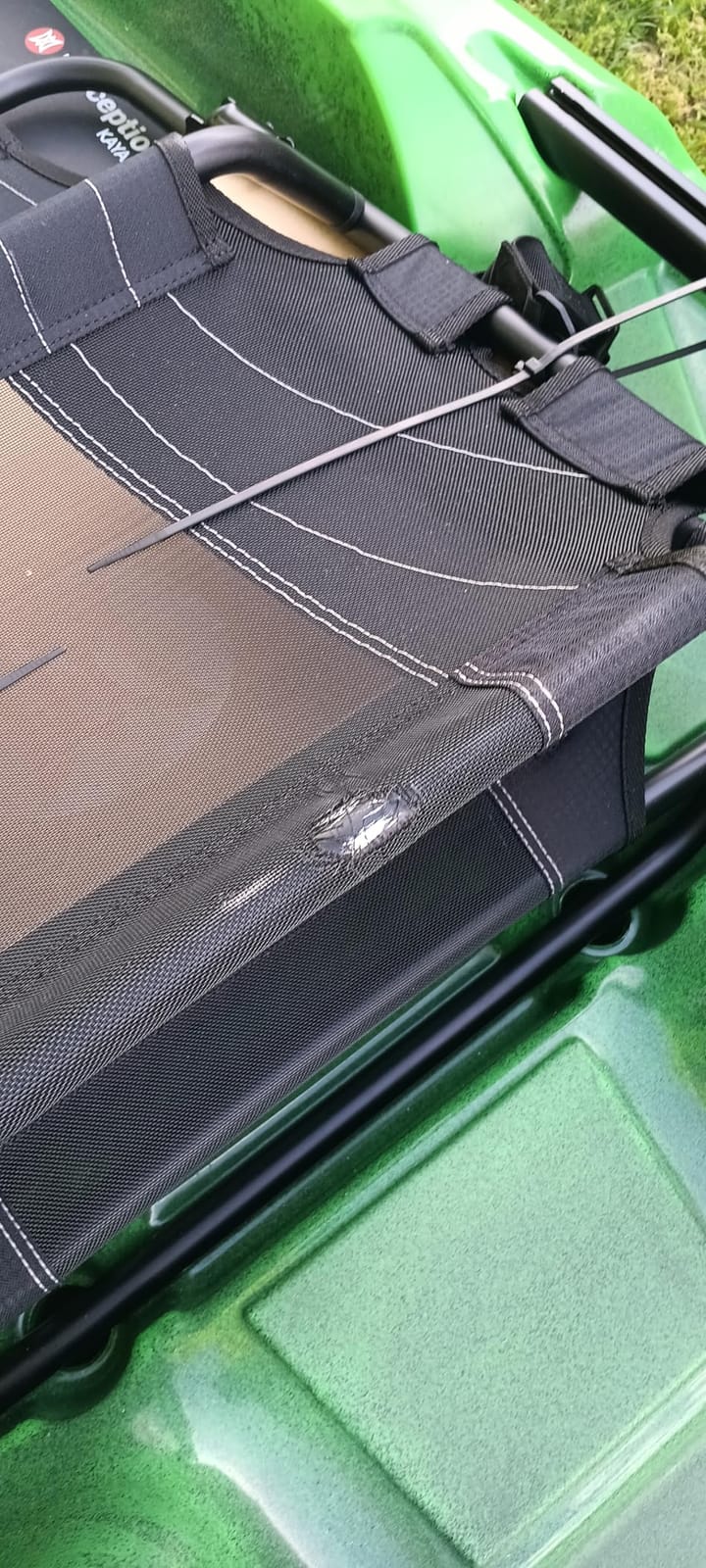
Beam width is 35 inches, which puts it in the range where a big paddler can shift weight side to side without the whole deck going under. Perception lists the hull at 138 inches long by 35 inches wide by 16 inches tall, so it is not a particularly long boat. You give up some tracking in a headwind and get maneuverability in return.
Owners describe it as stable, comfortable and well organized. The AI summary of the reviews notes consistent praise for stability, seating comfort and built-in fishing features, with most five-star feedback focused on gear organization and the roomy tankwell. The rating distribution backs that up: 75 percent five-star, 6 percent one-star.
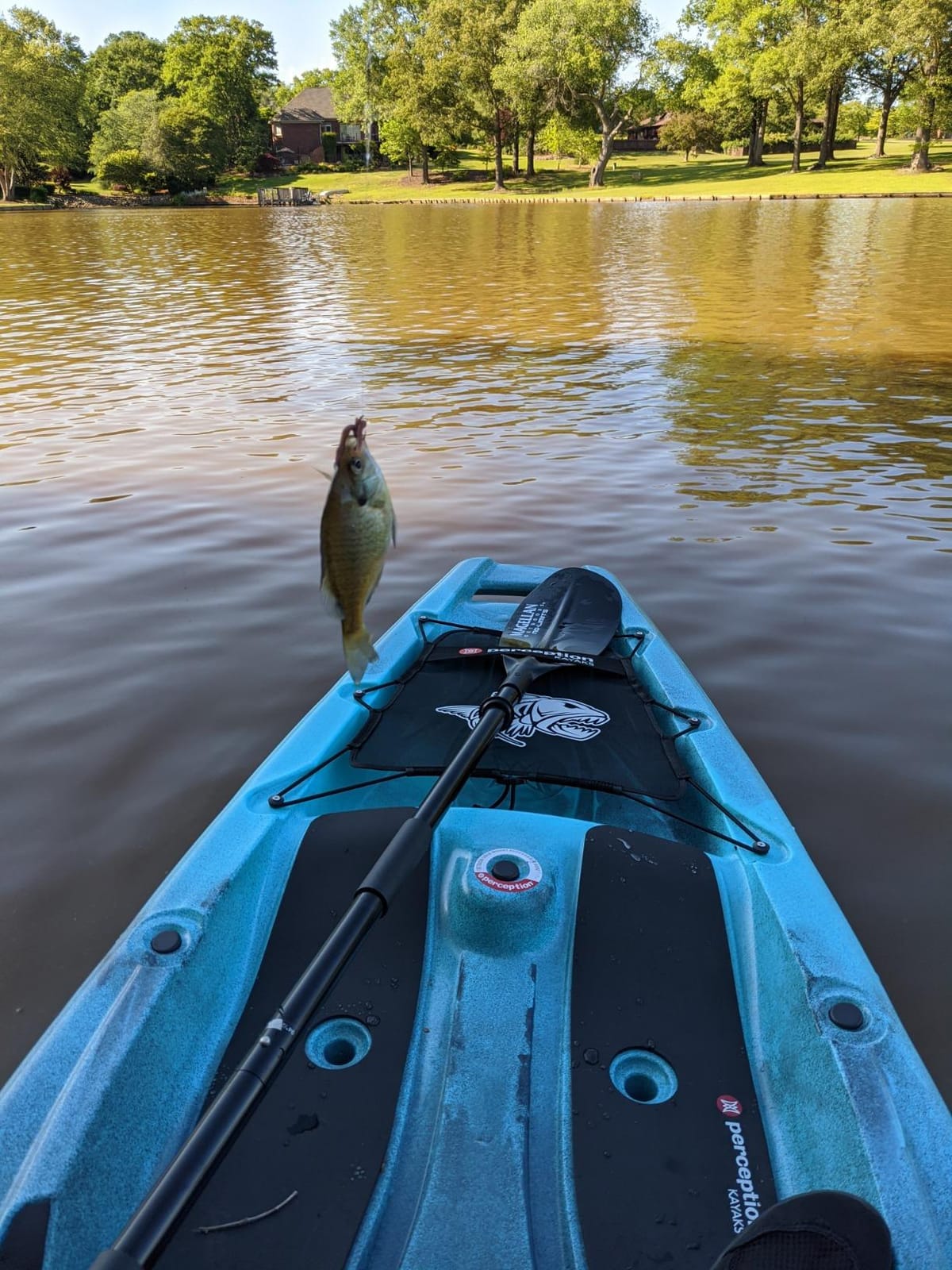
How much total load the 425 lb rating really covers
Split the 425 lb into three buckets: your body weight, a gear budget, and a catch buffer. Forum consensus on kayak-fishing threads is that you want to sit at or under roughly 75 to 80 percent of the rating once you are loaded, because a boat at its ceiling is slow and tippy even when it is technically within spec.
That heuristic is a guideline, not a law, and one angler on r/Kayaking put it plainly: you ideally want to be well under the rating, and 75 percent or less is where you want to be, but that is a loose guideline. Treat 425 lb as a comfortable ceiling around 340 lb of real-world load.
Where the Outlaw 11.5 is the wrong boat
If you carry a trolling motor, a 12V battery group and a 20L cooler, you are burning through that gear budget quickly, and the open deck of a sit-on-top means everything is exposed to spray. Heavy electronics users usually end up regretting not buying a boat with sealed hatches or a cooler seat.
It also sits at 138 inches with a 35 inch beam, so it will not spin on a dime in tight water. If your fishing happens in narrow creeks, that is a problem. If you fish open lakes, ponds and wide river runs, it is an asset. Buyers who want a wider platform with more storage should read our stability roundup before settling.
2. Pelican Bass Raider 10E: 600 lb Rating on a 50 in Wide Platform
Pelican – Bass Raider 10E Angler Fishing Boat – 10.2 ft
Capacity: 600 lb
Beam: 50 in
Length: 122 in
Hull: patented Ram-X
Warranty: 2-year limited
Pros
- 600 lb rating leaves room for a passenger
- motor and full tackle load
- 50 in beam is the widest platform in this roundup
- Two sliding 360-degree swivel seats reposition for trolling or casting
- Pre-wired with a 12V outlet for an electric motor or sonar
- Extra internal flotation meets or exceeds ABYC standards
Cons
- A jon boat rather than a kayak
- so it cannot be carried on a roof rack or portaged
- 50 in beam makes solo launching awkward
- 10 percent of ratings are one-star
Be clear about what this is. The Bass Raider 10E is a 10.2 ft jon boat with a 600 lb capacity rating and a 50 inch beam, not a kayak. It cannot go on a roof rack, it cannot be portaged, and it cannot be launched solo from a beach without a cart or a ramp. In exchange you get the single most stable platform on this list.
We include it because for a 300 lb paddler who wants to stand and cast with a partner, there is very little else in this bracket that combines a 600 lb rating with a beam this wide. At 122 inches long by 50 inches wide by 20.75 inches tall, it is a wide, flat, roomy boat with almost no tendency to tip.
Two sliding 360-degree swivel seats are the feature owners mention most. You can reposition for trolling, for casting or for facing your partner, and both seats fold when you want the middle open. It comes pre-wired with a 12V electrical outlet and built-in motor mounts, so adding an electric motor for big-water fishing is straightforward.
The material is Pelican’s patented Ram-X, described as high impact resistance, and the boat carries extra internal flotation that meets or surpasses ABYC standards. Four carry handles are built in, which tells you the manufacturer expects at least two people for every lift.
Who this 600 lb platform actually suits
A 300 lb angler, or a couple where both partners run 250 lb or more, sitting in near-shore water: a lake, a bay, a wide river mouth. At 600 lb rated capacity, two adults plus a motor and a cooler still lands under two thirds of the number. Very few 600 lb rated craft have a 50 inch beam; most are 34 to 37 inches wide.
Buyers note the roomy, stable platform and the swivel seats as the main draws. Some note that the wide beam makes solo handling and transport more involved than a kayak, which is accurate and worth repeating. The rating split is 70 percent five-star and 10 percent one-star, so there is a visible dissatisfaction group around warranty length and finish.
Why it is not on top of this list
Transport is the reason. A 50 inch wide boat does not fit a roof rack, does not fit most trailer beds without a wide platform, and turning 10 percent of buyers into one-star reviewers over two years is not a great track record. If your fishing is on a lake with a boat ramp within driving distance, the Bass Raider 10E is hard to argue with.
If you need something you can load alone at a shoreline, skip down to the Reel Yaks models or the BKC tandems. Our pedal kayak roundup covers propulsion choices in more depth if you want hands-free movement.
3. Pelican Catch Mode 110: Lightest Boat That Still Stands Up
Pelican Catch Mode 110 – Angler Fishing Kayak with Lawnchair seat – 10.5 ft
Capacity: 375 lb
Beam: 34.5 in
Length: 128 in
Boat weight: 67 lb
Lifetime limited warranty
Pros
- At 67 lb it is one of the lighter hulls here and can be solo-loaded
- 34.5 in beam and a tunnel hull support standing casts
- ERGOBOOST seat folds up for an extra 6 in of height
- Rated #3 in Fishing Kayaks with 159 ratings
- Lifetime limited warranty against manufacturer defects
Cons
- 375 lb is the lowest capacity in this roundup
- Only three rod holders in the base package
- Rudder only on the rudder variant
This is the boat we hand to a 200 to 230 lb angler who wants stand-and-fish ability without a trailer. Sixty-seven pounds, a 34.5 inch beam and a tunnel hull with a wide flat deck is a package that loads solo and still holds a standing cast. The catch is the 375 lb ceiling.
That ceiling is not a problem if you are light and light on gear. It is a real problem if you add a battery, a trolling motor and a full cooler. A 200 lb paddler with 120 lb of gear sits at 320 of 375, which is 85 percent loaded and close to the wall.
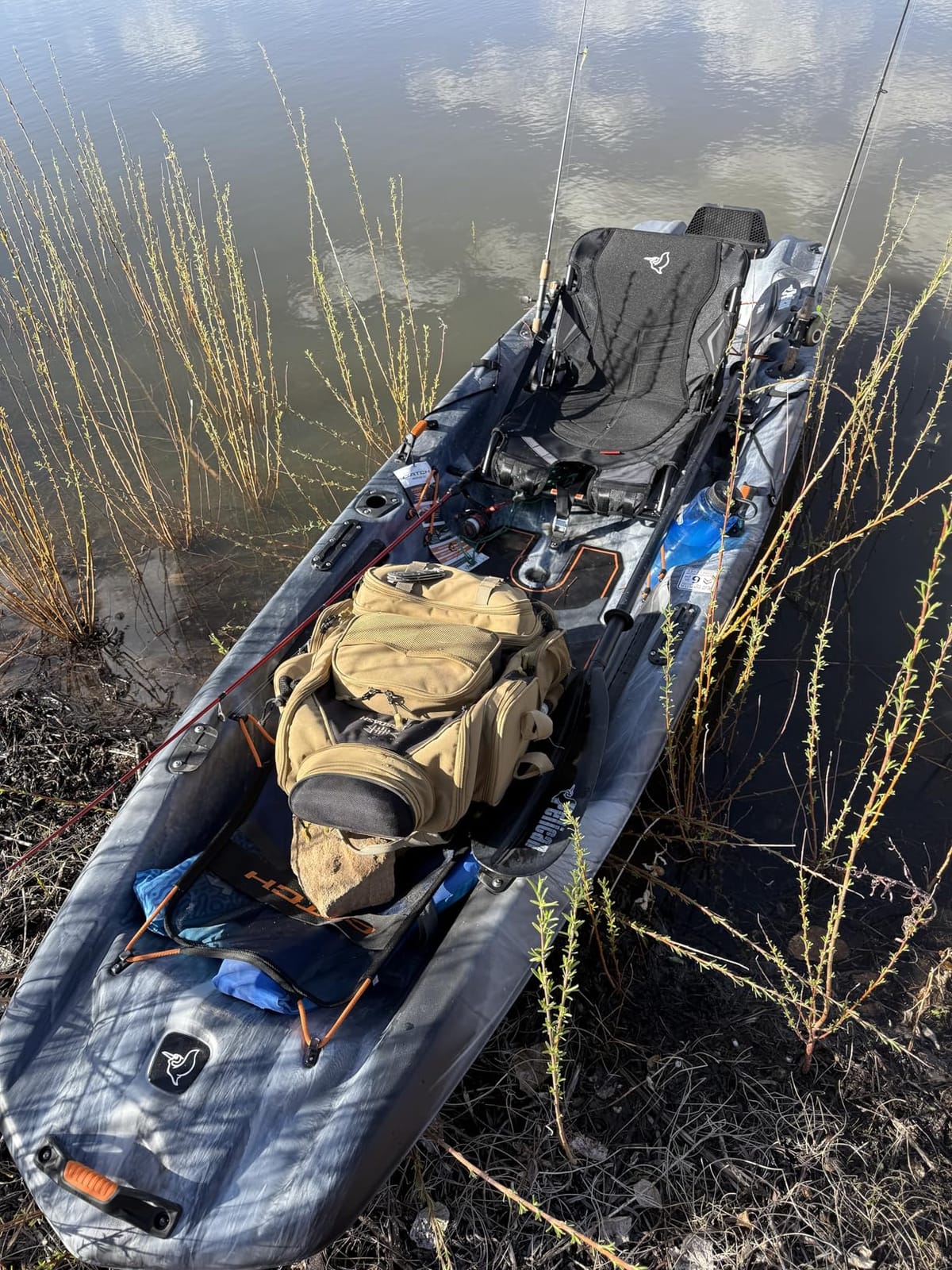
The ERGOBOOST seating system is the sleeper feature. The seat folds up to add six inches of height, which is genuinely useful for a taller paddler who otherwise cannot see over a loaded deck, and there is under-seat storage beneath it. Three flush-mount rod holders keep rods out of the way but within reach, and a bungee area handles the rest.
Pelican also adds extra internal flotation that meets or surpasses ABYC standards, which matters more than usual in a boat you might stand in. The best sellers rank is #3 in Fishing Kayaks out of more than 57,000 items in Sports and Outdoors, so this is a proven design rather than a new one.
When 375 lb is enough and when it is not
Run the numbers honestly. Body weight plus a realistic gear budget of 75 to 150 lb should land at or under about 280 lb for this boat to sit comfortably at the 75 percent forum guideline. That serves a 190 lb paddler well, a 230 lb paddler with a light load, and it is marginal for anyone heavier.
Satisfied owners highlight stability, the comfortable adjustable seat and easy portability. The main reservation in the reviews is the lower 375 lb capacity limit, which appears again and again for exactly the reason we flagged. Rating distribution is 74 percent five-star against 7 percent one-star.
What to check before you commit
Decide whether you want the transom mount version or the rudder variant. The standard configuration listed in the specifications has no rudder, and on a wide-beam tunnel hull in wind you will want one. Also note that three rod holders is the whole package, with no articulating or outrigger-style holder included.
If your weight plus gear exceeds 300 lb, do not stretch this one. Look at the BKC Brooklyn 11.5 Pro or the Old Town Sportsman PDL 106 instead, both of which carry far more headroom. If you are just starting out and want the fundamentals covered, our beginner fishing kayak guide is the right background read.
4. Reel Yaks Raptor: 380 lb Modular Pedal Kayak You Can Carry Alone
Reel Yaks Raptor Modular Fishing Kayak, Fin Drive 9.5ft, 380 lbs Capacity
Capacity: 380 lb
Beam: 30.3 in
Length: 115 in
Boat weight: 62 lb
Two-piece modular hull
Pros
- Two-piece modular hull fits in an SUV and stores in a closet
- Fin drive is smooth and quiet against wind and current
- Comes rigged with track rails
- rod holder
- hatches and a stadium seat
- 62 lb is light enough for one person to lift
- Rudder hardware is the most reported complaint
Cons
- 30.3 in beam is narrow for a large angler
- 380 lb rating limits total gear weight
- Low-slung seat leaves little storage underneath
- Paddle included is basic
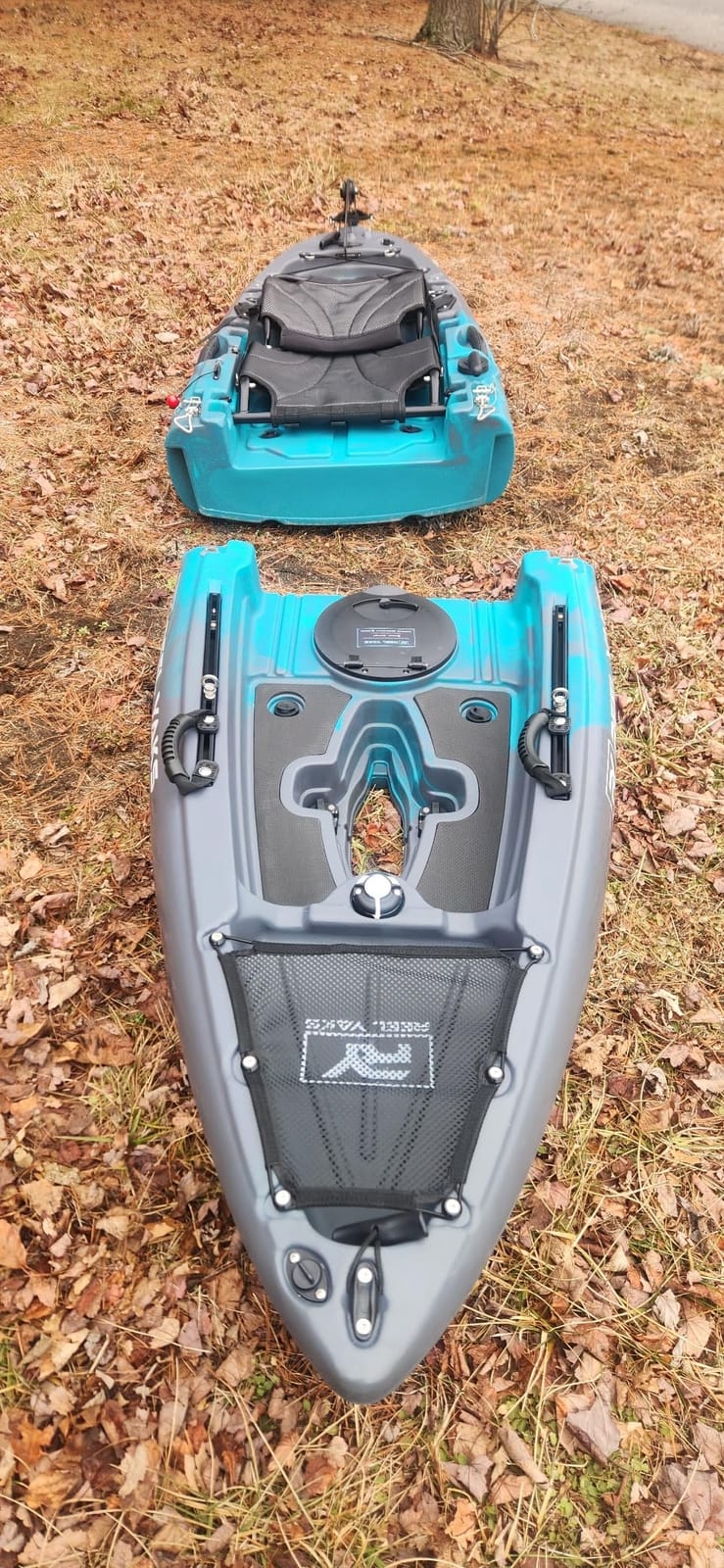
The Raptor is the only boat here that solves the transport problem completely. The hull splits into two sections, each light enough that one person can carry it, and it stores flat in a trunk or a closet. For a big angler who cannot lift 90 lb over a gunwale, that matters more than any feature list.
You get pedal propulsion out of the box. The fin drive is smooth and quiet, which is why owners single it out for moving against wind and current without waking everything around you. It arrives rigged with track rails, a rod holder, storage hatches and a stadium seat.
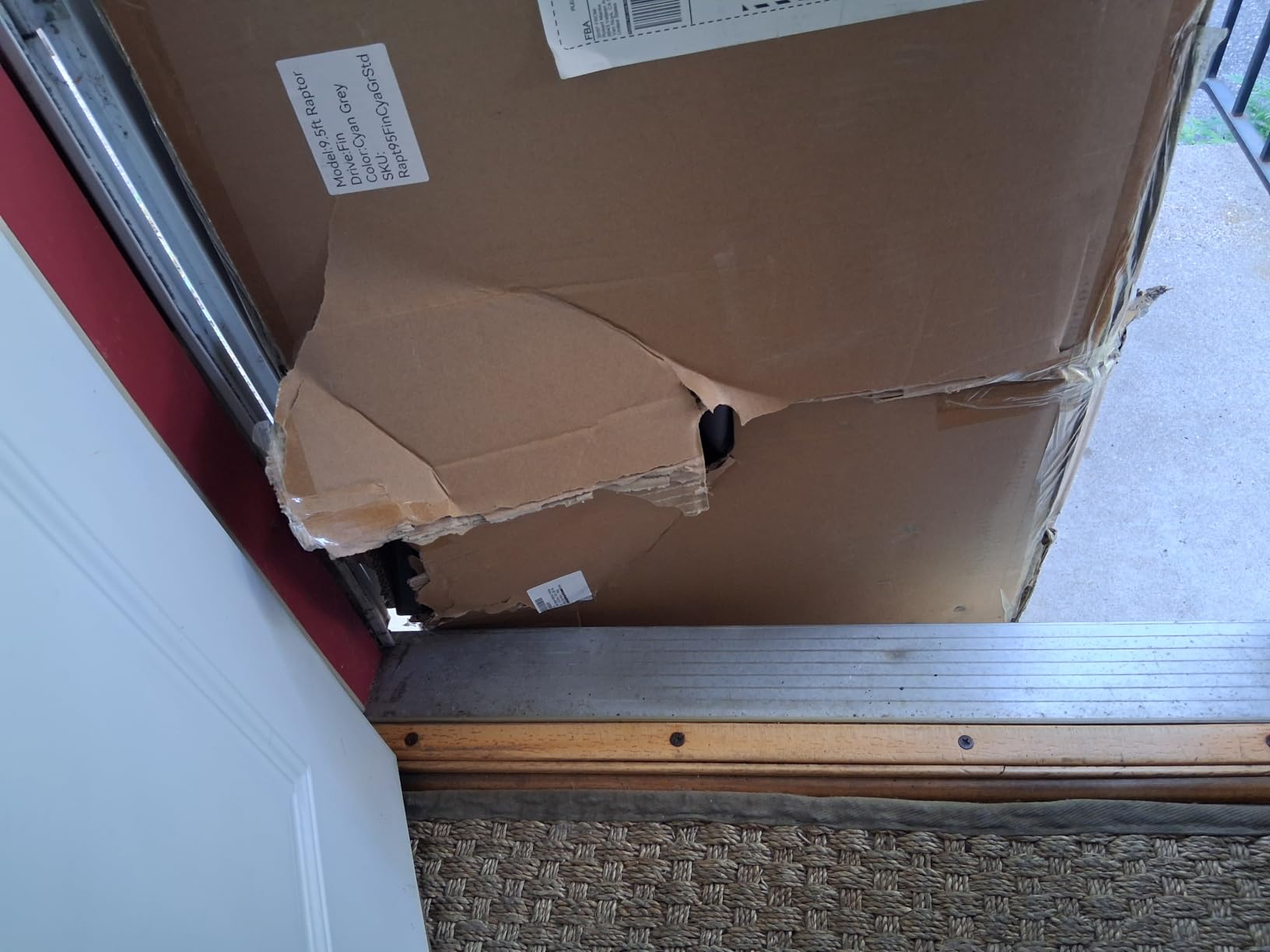
Here is the honest catch: beam. Thirty and a third inches is narrow for the audience this article is about. A larger paddler will feel the boat respond more sharply when shifting weight, and standing casts need care. It is why this is a good boat at 200 to 240 lb and a compromise at 280 lb and up.
The rudder is the recurring weak point. Several owners report broken rudder wires, ferrules or guide screws after light use, and the general advice in reviews is to plan a hardware upgrade up front. The hull warranty is one year, which is the shortest among the brands here.
How the modular design changes daily logistics
A one-piece 90 lb hull means a cart, a second person and a parking-lot workout every time you fish. A two-piece hull means you carry two sections to your vehicle, drive, and carry two sections to the water. The second version takes longer but it happens alone, and that is the whole trade.
Reviewers love the portability and the pedal performance. The AI summary of the feedback notes that rudder hardware durability is the most repeated complaint and several buyers recommend planning an upgrade. The rating distribution is 66 percent five-star with 13 percent one-star, the highest one-star share of any boat here, and it is reflected in the 4.2 average.
Where the 30.3 in beam becomes a problem
Narrow beams under 32 inches show up in forum deal-breaker lists for big paddlers, and we agree. The waterline feels twitchy, wind pushes the stern around, and standing to cast takes practice rather than confidence. If your body weight plus gear lands near 340 lb, this is the wrong hull.
Also budget for add-ons. The optional accessories and the center tandem module are not cheap, and the low-slung seat has no height-extender option, which is a genuine limitation for anyone over 6 ft. For lighter paddlers who want pedal power and easy transport, the pedal kayak comparison is worth a look.
5. BKC Brooklyn 12.5 Tandem: 595 lb for Two Adult Anglers
BKC Brooklyn 12.5 Tandem Fishing Kayak, 2 to 3 Person Sit-on-Top
Capacity: 595 lb
Beam: 34 in
Length: 148 in
Boat weight: 70 lb
High density polyethylene
Pros
- 595 lb rating carries two adults plus gear in one hull
- 34 in beam gives real balance for standing casts
- Six rod holders including two articulating models
- Single-piece rotomolded HDPE resists impact and UV
- Trolling-motor mount area lets you add speed later
Cons
- Paddle-only propulsion with no rudder or pedal drive
- Single-piece hull cannot be broken down for transport
- 12 percent of ratings are one-star
A tandem solves two problems at once for a heavy angler: it gives you a partner to share the load at the car, and it gives you a 595 lb rating in a boat that still paddles like a single. At 148 inches long and 70 lb, it is not a two-person lift for everyone, but it is much more manageable than a 150 lb hull.
The 12.5 ft hull seats two adults plus a child or a serious pile of gear. Six rod holders come standard, four flush-mounted plus two articulating, which is the highest published rod holder count among the single-seat boats here and covers trolling setups without buying hardware.
Owners cite the tandem seating, the rod holder count and the very high capacity as the main draws. The hull is rotomolded high density polyethylene in one piece, which means impact and UV resistance with no seams to fail, and it comes with two memory foam seats and two paddles.
Where the reviews get unhappy is finishing and build consistency. The rating distribution is 61 percent five-star but also 12 percent one-star, the second highest one-star share in this roundup, and that is reflected in the 4.1 average.
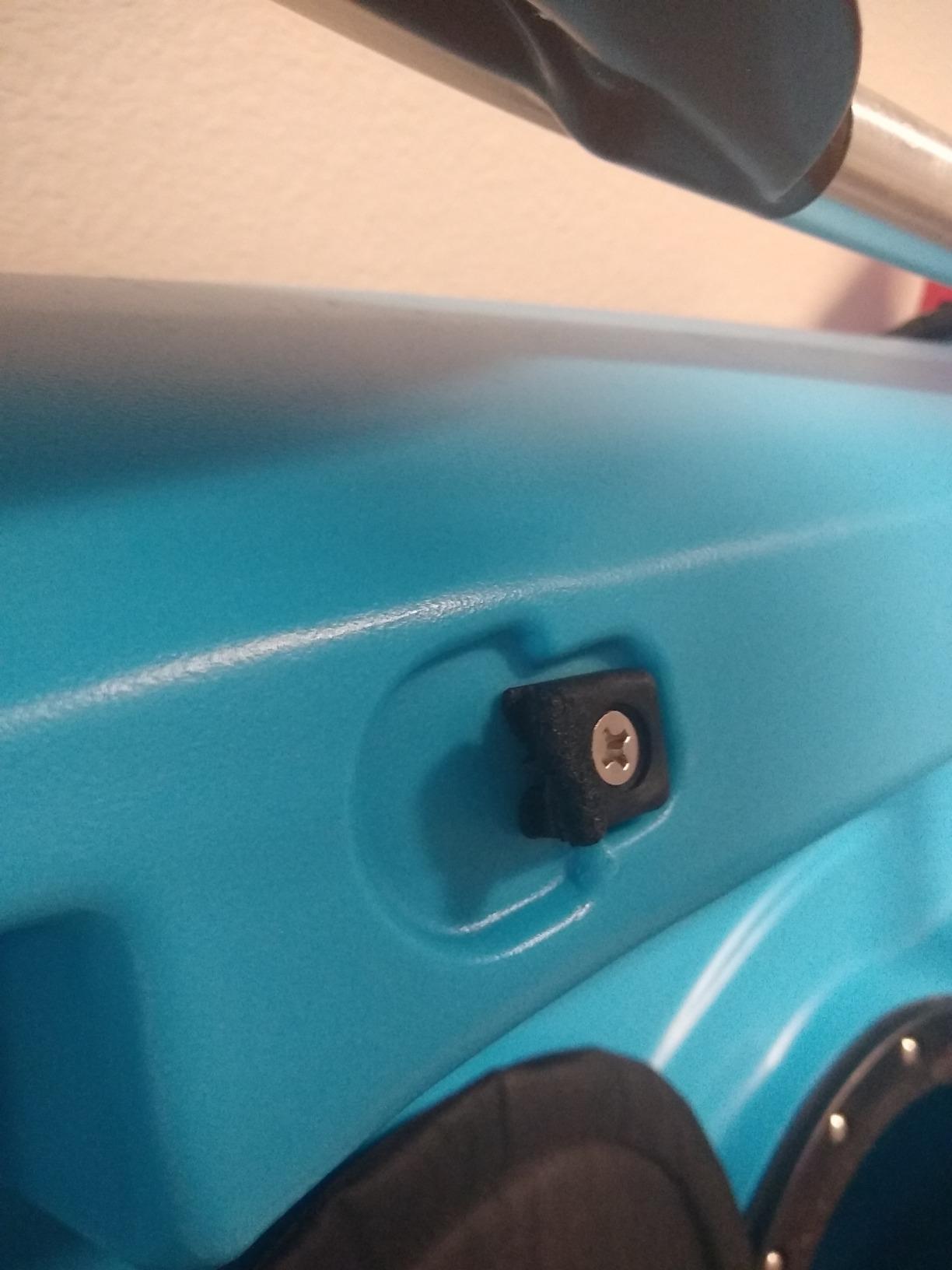
Why a tandem is the solo angler’s loading answer
Forum threads about heavy kayaks keep circling the same wall: 125 lb boats need a specialized trailer, and not everyone wants one. A tandem lets a partner or a family member put a shoulder to the load at the ramp while you handle the bow. It also gives you a second set of hands for a fish you cannot land alone.
The math works well for couples. Two 240 lb anglers with 150 lb of combined gear land at 630 lb, which is slightly over the 595 lb rating, so you would trim gear or pick the 13.0 Pro Tandem at 800 lb. Two 220 lb anglers with light gear sit comfortably under the number.
Where a single-piece tandem frustrates you
No rudder and no pedal drive in the base package. In wind or current, a 148 inch tandem that does not track is tiring, and a heavier paddler feels it more. There is also no height adjustment on the included seats, so a 6 ft 4 in angler should sit in the forward position.
If standing casts are the priority, test the 34 inch beam in person. It is narrower than the Pelican Bass Raider and it will feel different. Anglers coming from a smaller boat often appreciate the extra room more than they expect.
6. BKC Brooklyn 11.5 Pro: 550 lb Single With a Height-Adjustable Seat
BKC Brooklyn 11.5 Pro Sit-on-Top Single Fishing Kayak, 550 lb
Capacity: 550 lb
Beam: 34.25 in
Length: 140 in
Boat weight: 78 lb
5-year manufacturer warranty
Pros
- 550 lb rating in a single-person hull built for heavy anglers
- Seat adjusts up to 2 in for visibility and casting posture
- Foot-operated rudder lets you steer hands-free while casting
- Three water-resistant dry hatches plus bungeed rear cargo
- Highest single-seat capacity in this roundup
Cons
- 78 lb makes solo car-topping a two-person job
- Only 23 ratings so far
- less long-term feedback
- Paddle propulsion only with no pedal drive
This is the single-seat boat we recommend most often for a big angler who does not want a tandem. Fifty-five hundred pounds of rating in a 140 inch hull with a 34.25 inch beam is a rare combination, and the seat adjusts up to two inches, which is the fix for tall-paddler sightlines.
Seat height is a bigger deal than most spec sheets admit. When you sit lower, you cannot see over a loaded deck, you bend at the waist to cast, and your lower back takes the load. Two inches of lift changes an entire session for someone who is 6 ft 2 in or taller.
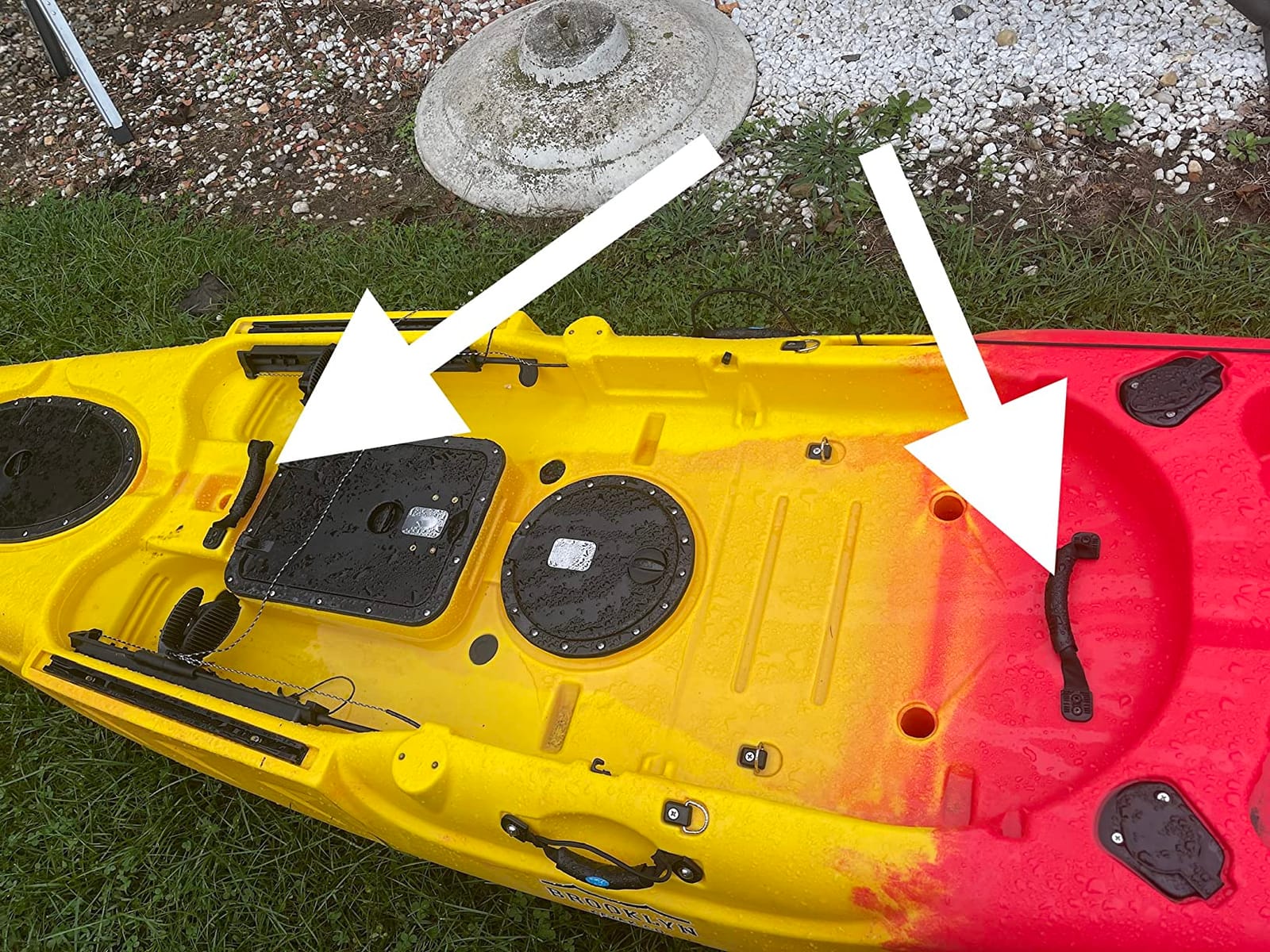
The foot-operated rudder is the second thing that separates this from the pack. You steer with your feet, so both hands are free for casting, working a rod or holding a fish. That matters most in wind, which is exactly when a heavy paddler is already working hardest.
Storage is well organized for a fishing boat: three water-resistant dry hatches, a bungeed rear cargo area, gear trays, paddle parks, an articulating outrigger-compatible rod holder plus flush-mounted holders, and eight scupper plugs with a drain plug.
Whether a 550 lb single boat fits your load
At 550 lb, this serves a 300 lb angler with a full gear load without touching the ceiling. Body weight plus 150 lb of gear plus a catch buffer lands around 480 lb, and even a heavier setup stays under the 550 lb rating. That headroom is what separates this from the 425 lb class.
Owners are enthusiastic about stability, adjustable seating and the 550 lb rating, with weight as the most common practical drawback. The rating distribution is strong at 81 percent five-star and only 4 percent one-star, but the pool is 23 ratings, so treat that enthusiasm as early rather than proven.
What the 78 lb boat weight means for your truck
Solo car-topping at 78 lb is uncomfortable and often unsafe with a light sedan. You want a roof rack with a load rating above 80 lb plus straps, or a trolley, or a second person at both ends. Owners consistently flag this as the main drawback.
There is also no pedal drive, so you will paddle it. For a big paddler covering long distances against a headwind, that is a fatigue question rather than a safety question, but it is the reason we do not put this boat first overall.
7. Old Town Sportsman PDL 106: 36 in Beam and a Leg-Length Adjustable Seat
Old Town Sportsman PDL 106 Pedal Fishing Kayak (Ember Camo)
Capacity: 450 lb
Beam: 36 in
Length: 126 in
Boat weight: 107 lb plus 18 lb pedal console
Hull: polyethylene pontoon
Pros
- 36 in beam is the widest single seat boat in this roundup
- Premium mesh seat with lumbar support and leg-length adjustment
- Quiet pontoon-style hull with smooth forward and reverse
- Universal transducer mount and accessory tracks
- Patented easy-docking pedal drive simplifies launching
Cons
- Heaviest rig here at over 100 lb
- requiring wheels or a slope to load
- Paddle sold separately
- Costs far more than every other boat in this roundup
Thirty-six inches of beam is among the widest single-seat platforms here, and it is the reason this boat feels planted when you stand up. Old Town also lists a 343 lb usable capacity for people and gear against the 450 lb maximum, which is an unusually honest figure and a good one to see printed.
The seat is the other headline. A premium mesh frame with lumbar support and leg-length adjustment means a 6 ft 4 in paddler can set leg length properly instead of stretching for the footrests. Owners consistently describe the build as solidly built with excellent pedal drive response and standout stability.
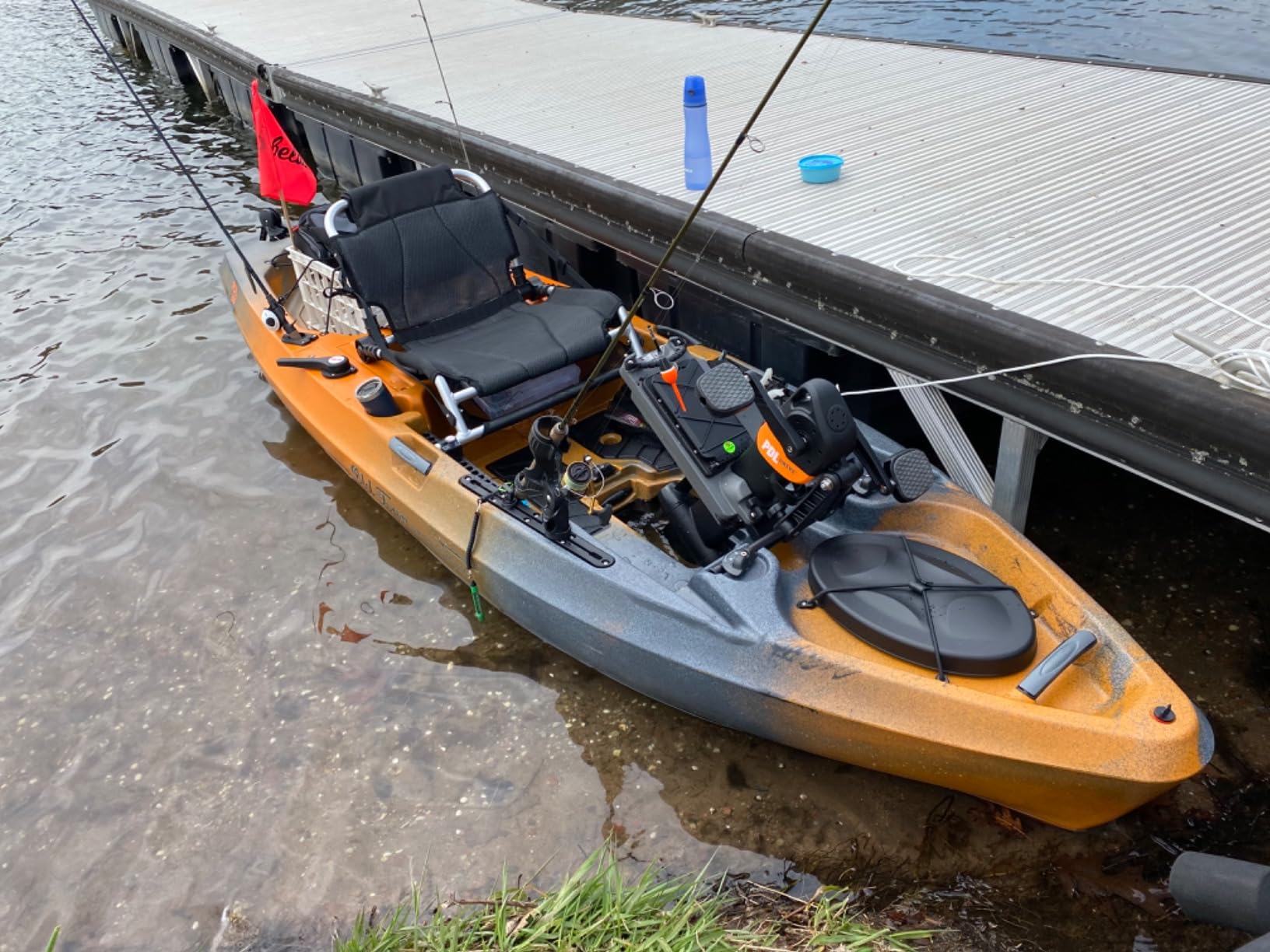
Propulsion is a pedal drive with smooth forward and reverse on a quiet pontoon-style hull. A universal transducer mounting system takes a fish finder, accessory tracks hold a tackle box, and cushioned floor pads take some of the sting out of a long day on a hard deck.
The rating distribution is the best in this group at 87 percent five-star with zero one-star ratings, but the pool is 23 ratings, so read it as a strong early signal rather than a decade of proof.

Why 36 in of beam changes the standing cast
Primary stability is what keeps you upright when the boat is moving slowly, which is exactly when you are casting. Beam drives it. Going from 34 to 36 inches adds meaningful waterline as your body weight rises, and that is the variable most capacity charts ignore entirely. On a 300 lb paddler the difference is not subtle.
The pontoon-style hull also holds that stability when you rise, which a narrow flat-bottom hull will not. Owners name standout stability as a defining feature. If your priority is standing casts and reaching casts, this is the boat to demo first.
Whether you can actually move it
One hundred and seven pounds of kayak plus an 18 pound removable pedal console is the heaviest rig in the roundup. Loading it solo means wheels or a slope, and the removable console is a genuine help since it comes off. Paddle is sold separately, which adds to an already high total.
For anyone over 320 lb, the 450 lb rating is the limiting factor rather than the beam. Pair the width advantage with a higher-capacity hull and you get to 36 inches without the ceiling problem, which is exactly what we look for when we recommend a specific model.
8. BKC Brooklyn 13.0 Pro Tandem: 800 lb, the Highest Capacity Here
BKC Brooklyn 13.0 Pro Tandem Fishing Kayak, 2 to 3 Person
Capacity: 800 lb
Beam: 34.25 in
Length: 153 in
Boat weight: 40.8 kg
Seats two to three
Pros
- 800 lb is the highest capacity in this roundup by a wide margin
- Two inch height-adjustable aluminum seats with adjustable footrests
- A seat can be moved to the center so one person can fish alone
- Rod holders
- rails
- tackle trays
- cup holders and dual dry hatches
- Stern well fits a 20L cooler
- Super-grip handles aid handling
Cons
- 153 in hull is heavy and awkward solo
- a trolley is close to mandatory
- Slower under way than a narrower sea kayak
- Only 14 ratings on record
Eight hundred pounds of rated capacity puts this boat in a class of its own among everything we tested. Nobody else in this roundup comes close, and for a pair of large anglers who both want to stand and fish, the headroom means you are never close to the number no matter what you load.
The hull is 153 inches long with a 34.25 inch beam, listed at 40.8 kg. Two inch height-adjustable aluminum seats and adjustable footrests handle tall paddlers properly, and you can move a seat to the center if you are fishing solo from a very large boat.
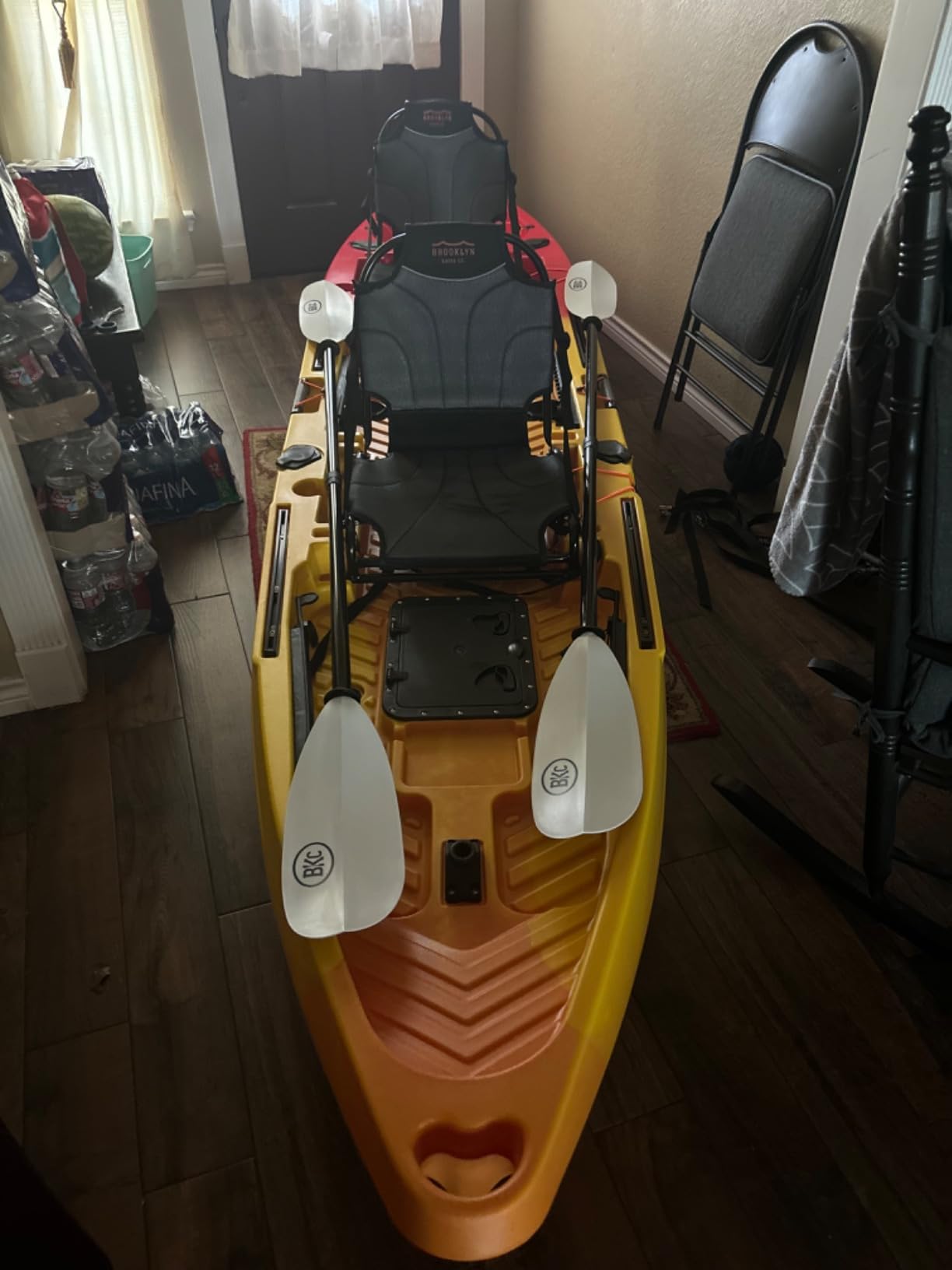
Outfitting is thorough: rod holders, accessory rails, tackle trays, cup holders and dual dry hatches, plus a large stern well that fits a 20L cooler. Reviewers consistently praise the stability, seating and very high capacity, with weight and bulk as the main trade-off.
At 153 inches and 34.25 inches wide, this is a wide, flat, wind-tolerant boat. Owners report that it tracks well and stays very stable in wind and chop, which is the expected behaviour of a flat-bottom hull with that much displacement.
When 800 lb is the right answer
Two adult anglers at 280 lb and 300 lb, plus a trolling motor, two batteries, a livewell and a good catch, puts you around 780 lb. That is the scenario this boat is built for, and it is the reason we think heavy-angler roundups should include a tandem class at all.
The rating is 93 percent five-star across 14 ratings with zero ratings below four stars. That is an impressive spread, but 14 ratings is a thin record and we would want to see it grow before calling it proven.
The transport reality nobody mentions
A 153 inch hull at roughly 90 lb is a two-person job every single time. Forum threads on ncangler.com describe veteran anglers running 13.5 ft boats at 125 lb on custom trailers, and that is the realistic setup for this size. A heavy-duty trolley handles a parking lot; a trailer handles a boat ramp.
It is also slower under way than a narrower sea kayak. If you like moving fast across open water rather than sitting and working structure, that trade may not suit you. Anglers fishing saltwater structure should read our ocean kayak guide before committing.
9. Reel Yaks Radar: 10 ft Modular Pedal Kayak With a 360 Rod Holder
Reel Yaks Radar Modular Fishing Kayak, Fin Drive 10ft, 430 lbs Capacity
Capacity: 430 lb
Beam: 33 in
Length: 118 in
Boat weight: 67 lb
Two-year hull warranty
Pros
- Two-piece modular design removes the need for a trailer or roof rack
- Fin drive handles wind and current quietly
- 67 lb boat weight is manageable for one person
- Comes rigged with a 360 rod holder
- track rails and storage hatches
- Two-year hull warranty
- double the Raptor coverage
Cons
- Specifications disagree on capacity between listings
- Same family of rudder hardware reports as the Raptor
- Narrower than most boats here at 33 in
- 19 percent three-star ratings is the widest mid-tier spread here
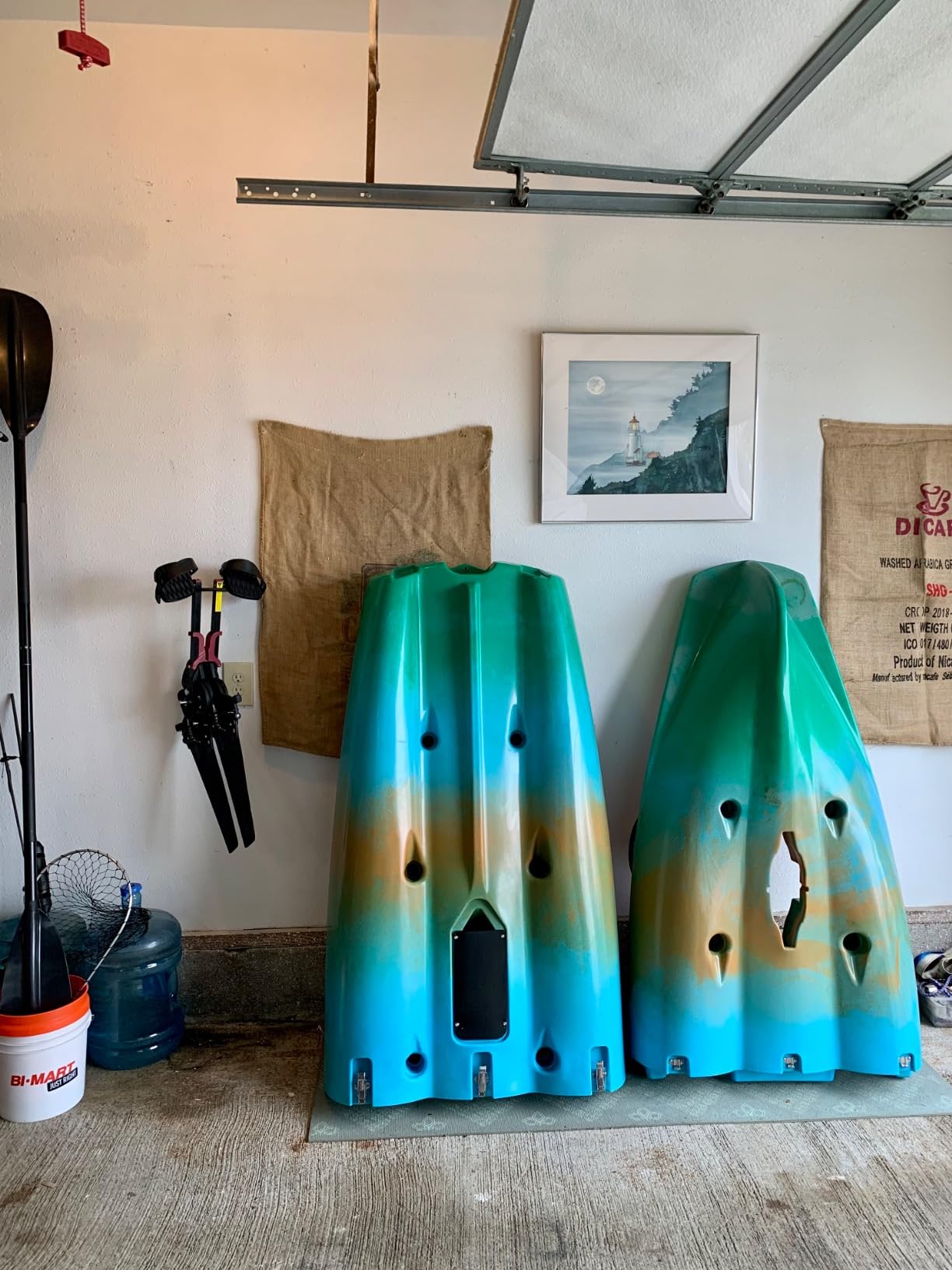
The Radar is the Raptor grown by a foot, with the same modular two-piece idea and the same fin drive. At 118 inches long and 67 lb, it is a slightly longer, slightly heavier boat with more storage and a longer warranty, and it solves the same transport problem for the same reason.
What you gain over the Raptor is rigging. A 360 rod holder rotates freely so you can cast from any angle without moving your seat, plus track rails and storage hatches. The wide W-hull supports standing casts, which is the reason to choose this over a narrower modular boat.
There is one thing to settle before you buy: capacity is listed inconsistently. The product title and feature bullets say 430 lb while the specification table says 400 pounds. We have used the higher 430 lb figure in our table, but confirm it with the manufacturer before you load the boat.
Owners appreciate the portability, pedal drive and rigging. Mixed ratings are largely tied to the rudder components and that capacity discrepancy. The rating spread is 59 percent five-star with 19 percent three-star, the widest mid-tier spread in this group.
Whether 33 in of beam is enough
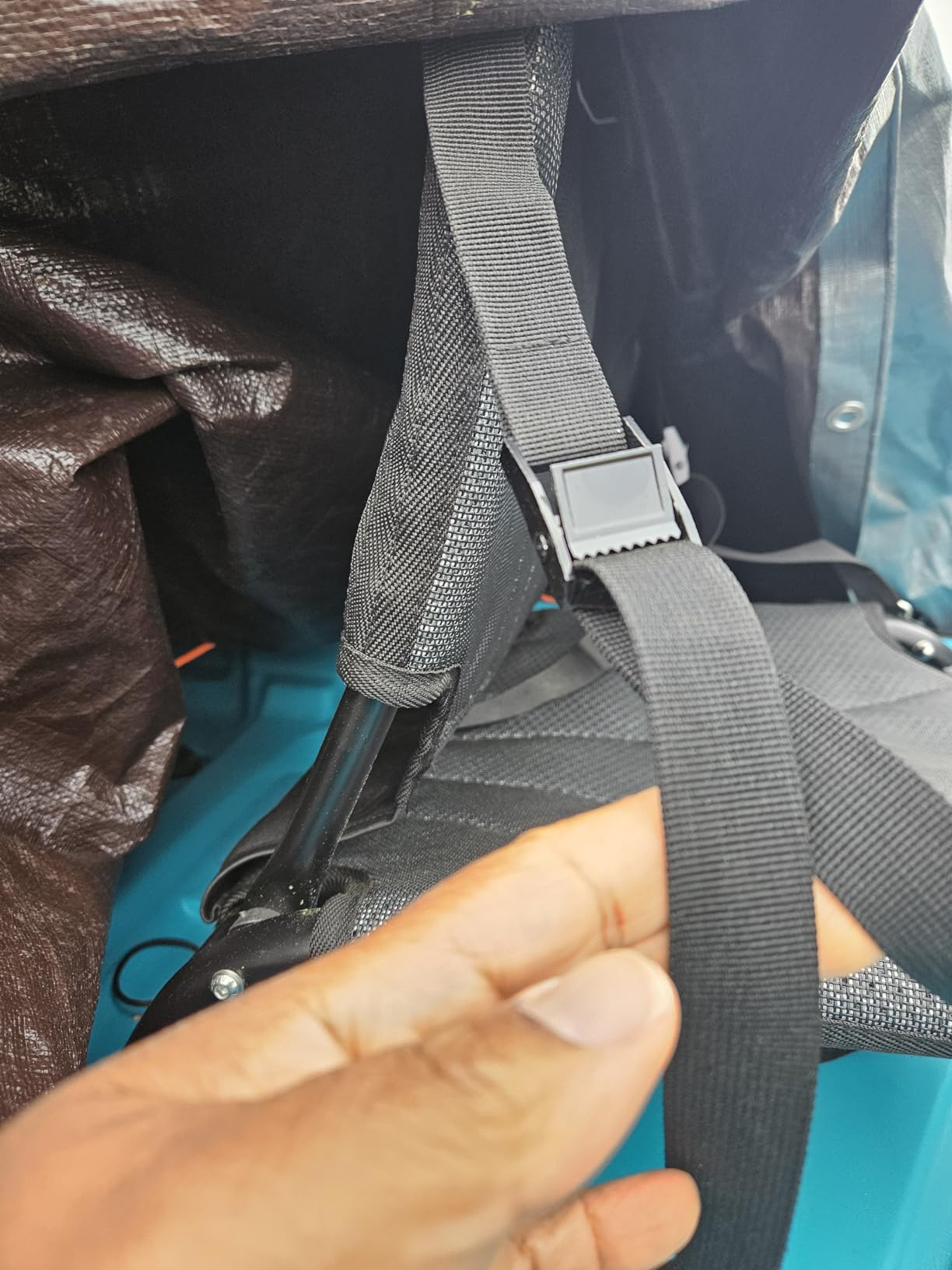
Thirty-three inches is better than the Raptor but still below the 34 to 36 inch range we prefer above 250 lb of body weight. It will hold a standing cast for an experienced paddler in calm and moderate water. In wind, expect more correction and slower turns.
For a 230 lb angler carrying light gear it is a comfortable fit. For a 280 lb angler with a motor and battery, we would push you toward a 34 inch or wider beam, because the load sits lower in the water and windage goes up with everything you stack on deck.
How the modular pedal format compares
Against a one-piece pedal kayak, you trade some tracking and some cargo space for the ability to carry the boat alone and store it in a small space. Against a paddle boat, you trade arm fatigue for nothing, because your legs do the work and the drive handles wind and current.
The rudder hardware complaints carry over from the Raptor, so budget for an upgrade if you fish in a lot of wind. Our pedal kayak guide covers what to look for in that hardware if you want to go deeper.
10. Albott Modular Fishing Kayak: Low-Cost Route to a Pedal Stand-and-Fish Setup
Albott Modular Fishing Kayak with Fin Drive System & Durable HDPE
Capacity: 420 lb
Beam: 34.68 in
Length: 113 in
Boat weight: 102.4 lb combined
Two-piece HDPE hull
Pros
- Two-piece hull breaks down for transport without a roof rack
- Quiet 11 lb fin pedal drive with spare fins included
- Roomy foam standing area supports stand-and-fish casting
- Quick four-step assembly with adjustable seat and rear storage
- Replacement parts are easy to source for this mass-produced hull
Cons
- Only a 6-month warranty
- the shortest in this roundup
- Thinner hull than higher-end kayaks
- less suited to rocky rivers
- Included seat is basic and the rudder is not to premium-brand standard
- Each half weighs roughly 50 lb
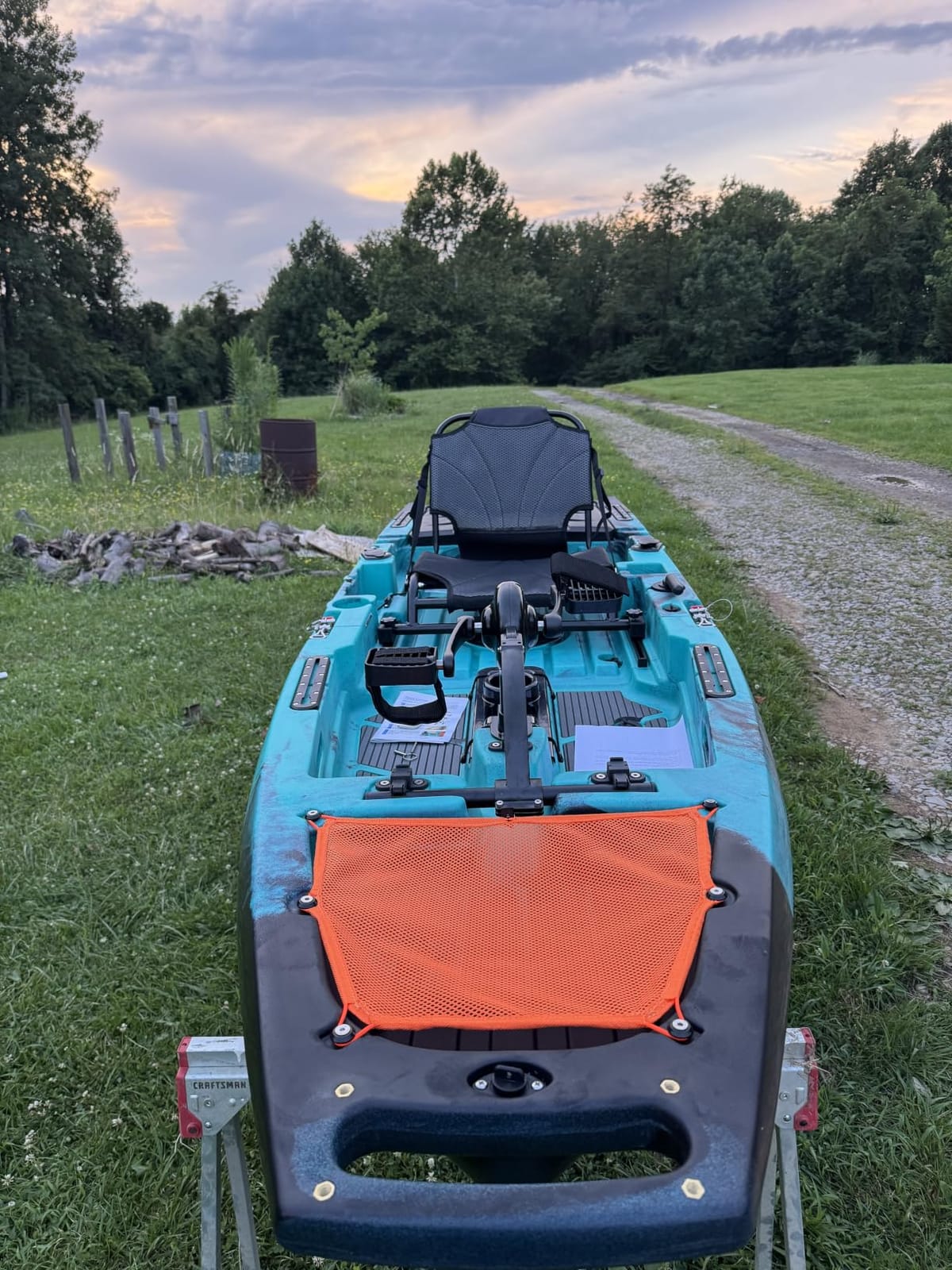
The Albott is the budget entry into the pedal stand-and-fish category, and the specification that matters most for a big paddler is the 34.68 inch beam. That is wider than most single-seat boats in this roundup, and it comes with a roomy foam standing area designed for casting.
The two-piece hull breaks down for transport and storage. At 113.04 inches long and 34.68 inches wide, with each half weighing roughly 50 lb, this is still a two-person lift from a vehicle, but it fits in a garage or an SUV without a trailer or a roof rack.
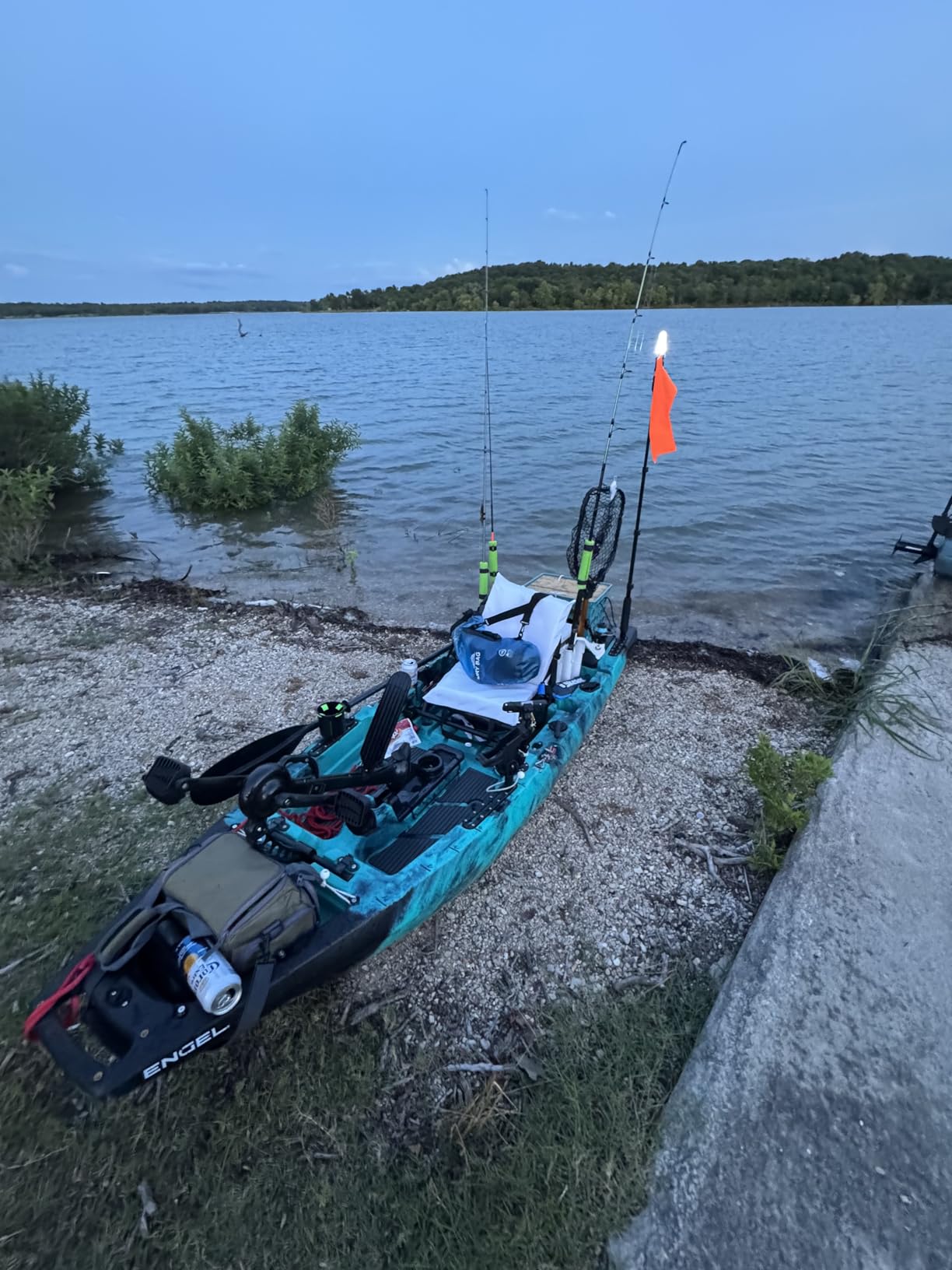
The pedal system is a quiet 11 lb fin drive with spare fins included, described as knee-friendly and weed-resistant. Assembly is a four-step quick-connect process with internal handles in each section, and the seat adjusts with good rear storage access behind it.
Owners find the boat stable, easy to haul and well suited to standing casts. The 76 percent five-star distribution is solid, with 5 percent one-star. What they flag is the thin hull, the basic seat and the short warranty as quality trade-offs.
Where the build quality trade-off shows up
A six-month warranty is the shortest in this roundup, and it tells you something about expected service life. Thinner hull walls make this a poor choice for rocky rivers or shallow boulder fields where a premium rotomolded hull would shrug off contact. It is a lake and calm-coast boat.
The pedal drive mounting brackets are reported as a potential long-term issue, and some buyers note hull ID numbers tied to a defunct manufacturer, which complicates registration in some states. The rudder hardware is 304 stainless but is not to premium-brand standards.
Whether the 420 lb rating works for you
Four hundred and twenty pounds serves a 250 lb angler with a moderate gear load and little margin beyond that. It also serves a 190 lb paddler who wants pedal power and a wide standing platform at a lower total than the premium brands charge.
If you push past 250 lb of body weight, step up a capacity class. The BKC Brooklyn 11.5 Pro at 550 lb gives you 130 lb more headroom for a modest step up in size, and that is where we would send a heavier angler.
What Heavy Anglers Should Look For in a Fishing Kayak
How to calculate the capacity you actually need
Take your body weight and add a gear budget of 75 to 150 lb, then stay at or under about 75 percent of the rated capacity. Forum consensus repeatedly points at that same 75 percent figure, described as a loose guideline rather than a hard rule, but it is the single most useful number in this whole guide.
Build the gear budget from what you will really carry: a trolling motor in the 15 to 30 lb range, a battery group in the 25 to 50 lb range, a 20L cooler at about 10 lb, tackle bags and a landing net, dry bags, and a kill switch or anchor system. Add the fish you intend to land at 20 to 40 lb and you have your real number.
Worked example: a 280 lb angler with an electric motor, a battery, a cooler and tackle lands around 470 lb of real load. At the 75 percent guideline that needs roughly a 625 lb rating, which puts you squarely in the 600 to 800 lb class.
Why beam width matters more than the capacity number
Capacity tells you whether the boat floats. Beam tells you whether it feels good. Primary stability comes from the width of the hull at the waterline, so a 36 inch beam on a 450 lb boat can feel more planted than a 32 inch beam on a 600 lb boat with everything stacked high.
For heavy anglers, treat 34 inches as the practical floor and 36 inches as the target. Below 32 inches shows up again and again on forum deal-breaker lists, and it is exactly where narrow fast-tracking boats fall. Longer boats track better and turn worse; wide boats do the opposite.
Sit-on-top, hull shape and why heavy boats sit deeper
Sit-on-top designs drain themselves, give you a raised seat and more storage, and keep you out of enclosed cockpits. The tradeoff is that everything is exposed to spray, which matters more in cold water than warm. A heavy angler adds weight at the deck level, which raises your centre of gravity, and a raised seat compounds that.
Tunnel hulls and flat decks give more primary stability at low speed, which is the standing-cast speed. Round hulls give more secondary stability, which is what keeps you from tipping when you are already over the edge. Many of the boats here use a tunnel or W-hull for that reason.
Seat height and legroom for 6 ft 2 in to 6 ft 6 in anglers
Test the seat in person. You want enough clearance between the seat pan and your knees to keep your legs in a comfortable V rather than folded forward, and you want the seat to raise your sightline over a loaded deck. Two inches of adjustment, as found on the BKC Pro models and the Pelican ERGOBOOST, is the difference between casting upright and casting bent over.
Also check footrest adjustability. On a hull with a pedal drive, your feet are working the drive and your legs need to be able to extend fully without the deck stopping you. The Old Town Sportsman PDL 106 with leg-length adjustment is the clearest example of solving this properly.
Pedal drive versus paddle for a larger paddler
Pedal drive is the strongest argument for heavier paddlers. Your legs produce far more power than your arms over a long session, your core does not absorb the load the way it does with a paddle, and the drive keeps working in a headwind when your shoulders have already had enough. Several boats here run 11 lb fin drives or removable pedal consoles.
The cost is weight and maintenance. Adding a drive adds 15 to 20 lb and creates moving parts. A removable console, like the one on the Old Town Sportsman PDL 106, lets you take the drive off for storage and solo handling, which is the compromise we like best.
Transport: the constraint heavy anglers hit hardest
Boat weight across this roundup runs from 62 lb to 107 lb, plus a pedal console on some. That is the practical limit on everything else. Check your vehicle roof rating before you buy, and treat any number above the roof limit as a hard no.
A kayak cart or trolley handles a parking lot to a launch. A trailer handles a boat ramp and a 153 inch tandem. A two-piece modular hull, like the Reel Yaks Raptor, the Radar or the Albott, handles everything with one person and no hardware. Plan your transport method before you choose the boat, not after.
Storage, rudder and skeg for a gear-heavy load
Count storage by litres rather than by compartments. A 20L cooler, three water-resistant dry hatches and a bungeed rear cargo area covers a typical day of trolling. Rod holders matter less than most buyers expect, since six is plenty for most setups; dry hatches matter far more once spray starts coming over the bow.
A rudder or a skeg keeps a loaded boat tracking, and both suffer in shallow water once a heavy hull sits deeper. Foot-operated rudders on the BKC Pro models and the Reel Yaks boats let you steer while both hands stay on the rod, which is a genuine advantage when you are working a fish.
Safety for a heavier paddler
Wear a personal flotation device fitted for your torso. Standard sizing on the chest is not enough for a larger chest, and an ill-fitting PFD rides up and does not do its job. Plan your capsize recovery before you launch: know which side you roll to, and practise getting back in at a shallow beach with a friend present.
Paddle with a buddy on open water, and carry a whistle, a spare paddle and a bail of fresh water. Anglers coming from shore fishing also carry shore-fishing kit that adds weight, which is why we keep coming back to the 75 percent guideline.
Fishing Kayaks Heavy Anglers Should Skip
Inflatables and folding kayaks in the 220 to 275 lb class are the wrong answer for anyone at 250 lb or above, and they appear repeatedly on general fishing-kayak lists without that caveat. The capacity ceiling leaves zero margin once a battery, tackle and a catch go in, and the narrow beam and low seat make standing casts worse.
Also skip anything under 32 inches of beam, regardless of the capacity number on the label. And skip a hull over 130 lb if you have no trailer plan and no second person, because a boat you cannot launch is a boat you will stop using.
One more category to avoid: boats with no height adjustment anywhere on the seat or footrests if you are over 6 ft 2 in. Fit problems show up after two long days on the water, and retrofits are expensive. If your height is unusual, our stability guide covers cockpit sizing in more detail, and ice anglers can start with our flashers roundup.
Frequently Asked Questions
What is a good kayak with a heavy weight capacity?
Any kayak rated 450 lb or higher handles most large anglers, and the 500 to 600 lb rated boats are the true heavy-duty class. Add your body weight plus a 75 to 150 lb gear budget and stay at or under roughly 75 percent of the rating. Beam width of 34 inches or more matters as much as the number for standing casts.
What is the best kayak for an overweight person?
The best kayak for a larger angler is a wide-beam sit-on-top with a 34 to 36 inch beam, a 450 to 600 lb rating, a framed adjustable seat and enough foot room to stand. A long narrow touring boat or an inflatable under 400 lb rated capacity will not carry the load or feel stable under it.
Can a 300lb person kayak?
Yes. A 300 lb paddler needs a kayak rated at 450 lb or higher so there is room for gear, a battery and a catch. The 500 to 800 lb class is the safe choice because stability comes from beam width and hull shape, not only from the capacity number printed on the label.
What fishing kayaks have a 600 lb capacity?
Three boats in this roundup carry a rating of 595 lb or more: the Pelican Bass Raider 10E at 600 lb with a 50 in beam, the BKC Brooklyn 12.5 Tandem at 595 lb seating two to three, and the BKC Brooklyn 13.0 Pro Tandem at 800 lb with a 153 in hull. All three are tandems or wide jon-style platforms rather than narrow single kayaks.
How wide should a fishing kayak be for stability?
For heavy anglers, 34 inches is the practical floor and 36 inches is the target. Beam drives primary stability, which is what keeps the boat level when you stand and cast. Boats under 32 inches feel twitchy to larger paddlers, especially with gear stacked on the deck and wind on the water.
Are pedal drive kayaks better for heavy anglers?
Usually yes. Pedal drive uses leg power rather than arm and core power, so a heavier paddler covers distance with less fatigue and keeps working in a headwind. The trade-off is 15 to 20 lb of extra weight and added maintenance. A removable pedal console lets you take the drive off for solo handling.
The Best Fishing Kayak for Heavy Anglers in 2026
The best fishing kayaks for heavy anglers in 2026 come down to a simple match. Add your body weight to a real gear budget of 75 to 150 lb, stay at or under about 75 percent of the rated capacity, and pick the widest beam you can carry to the water.
Our pick as the best all-round option is the Perception Outlaw 11.5, a 425 lb sit-on-top with a 35 inch beam and a review history deep enough to trust. For 300 lb paddlers the BKC Brooklyn 11.5 Pro at 550 lb is the better answer, and for a pair of large anglers the BKC Brooklyn 13.0 Pro Tandem at 800 lb is hard to argue with.
Whatever you choose, work out the transport before you work out the colour. Check your roof rating, price a trolley or a trailer, and try the seat height before you commit. Then use the buy button on the model that fits your load, and get on the water.