
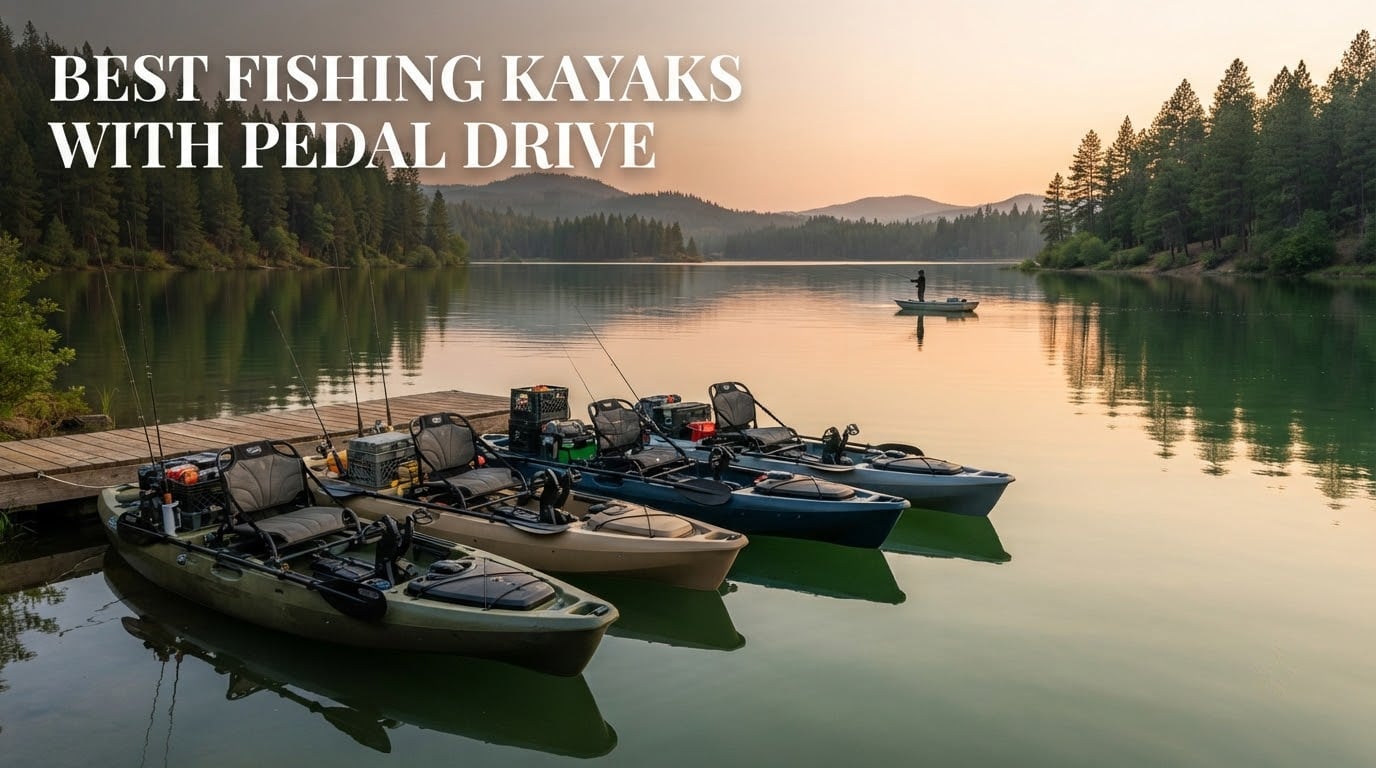
The best fishing kayaks with pedal drive solve a problem paddlers have complained about for years: fishing is a two-handed job, and a paddle is a third pair of hands you keep having to stow. A pedal drive puts thrust under your feet, leaves your hands on the rod, and turns a slow paddle-around into a trip across the lake at a steady clip. That is why this category has grown so fast, and why the 2026 buying decision now comes down to hull, rigging, and the type of drive underneath you.
We spent weeks reading owner reviews, spec sheets and forum threads on pedal kayaks, then narrowed twelve hulls down to the ones worth your attention right now. The list covers rigid polyethylene boats and one inflatable, single-piece and modular builds, fin drives and propeller drives, and price points from four figures up to serious money. Nothing here is padded out for volume; if a boat earned a slot, there is a reason.
One thing to clear up before the picks: a pedal drive does not make the kayak paddle-free. Anglers on kayakfishing forums almost universally carry a paddle anyway, and most use the pedals for the long transit between spots rather than for every stroke. The drive earns its keep when you are covering water hands-free, fishing from the bow or stern, or casting while moving. If your entire game is walking a marsh edge at walking pace, a paddle-only boat is a legitimate choice.
Table of Contents
Top 3 Pedal Drive Fishing Kayaks for October 2026
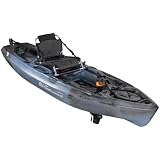
Old Town Sportsman PDL 106
- 450 lb capacity
- 343 lb usable
- 107 lb hull
- Pontoon-style hull with forward and reverse drive
- 5-year drive warranty

Reel Yaks Raider
- 66 lb split into two sections
- 380 lb capacity
- Lightweight propeller drive
- W-hull sit-on-top design
- 2-year hull warranty

Albott Modular Fishing Kayak
- 400 lb capacity
- Three-step modular assembly
- Propeller drive with easy reverse
- 304 stainless hardware
- Cable-operated stern rudder
All 12 Pedal Kayaks at a Glance for October 2026
Every boat below is a fishing kayak with a foot-powered drive. Scan the list for capacity and drive type first, then read the full review for the one that fits your water and your body.
| Product | Specifications | Action |
|---|---|---|
| Old Town Sportsman PDL 106 |
|
Check Latest Price |
| Reel Yaks Raider Modular 9.5 ft |
|
Check Latest Price |
| Albott Modular Fishing Kayak |
|
Check Latest Price |
 Reel Yaks Radar Modular 10 ft Reel Yaks Radar Modular 10 ft |
|
Check Latest Price |
 LIFETIME Renegade 116 LIFETIME Renegade 116 |
|
Check Latest Price |
 BKC Brooklyn 10.5 Pro Pedal BKC Brooklyn 10.5 Pro Pedal |
|
Check Latest Price |
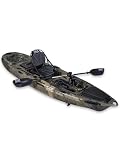 Rotocraft 10 ft Single Pedal Kayak Rotocraft 10 ft Single Pedal Kayak |
|
Check Latest Price |
 Spatium Pedal Fishing Inflatable Spatium Pedal Fishing Inflatable |
|
Check Latest Price |
 BKC Brooklyn 10.0 Single Pedal BKC Brooklyn 10.0 Single Pedal |
|
Check Latest Price |
 Old Town Sportsman BigWater PDL 132 Old Town Sportsman BigWater PDL 132 |
|
Check Latest Price |
 Old Town Malibu Pedal Solo 12 ft Old Town Malibu Pedal Solo 12 ft |
|
Check Latest Price |
 Pelican Catch Kicker 110 HDII Pelican Catch Kicker 110 HDII |
|
Check Latest Price |
1. Old Town Sportsman PDL 106 – The Best All-Rounder
Old Town Sportsman PDL 106 Sit-on-Top Fishing Kayak, Steel Camo
450 lb capacity
343 lb usable
107 lb hull
10 ft 6 in length
5-year drive warranty
Pros
- Stands and bounces without flipping
- Pontoon hull with instant reverse
- Quick rudder response and good tracking
- Lumbar-support mesh seat adjusts to leg length
- Light enough to cartop for its size
Cons
- Heavy to load so a cart or slope helps
- Paddle sold separately
- Less tracking than 12 and 13 ft hulls
Out of everything we looked at, the Sportsman PDL 106 is the one we kept coming back to. It is a 10 foot 6 inch polyethylene sit-on-top with a 36 inch beam and a 450 pound capacity rating, which puts it in the range where a large angler can sit comfortably with a full day of gear and still feel stable. Owners describe standing up and shifting weight in it without any sense of tipping, and that is the single most useful trait when you are casting to structure from a seated position.
The drive is Old Town’s PDL unit with a removable console that weighs 18 pounds, and it runs forward and reverse. In practice that means you can back into a spot to line up a shot without dragging a paddle across your lap. The rudder picks up quickly, and the wide pontoon-style hull holds a straight line better than the length alone would suggest.
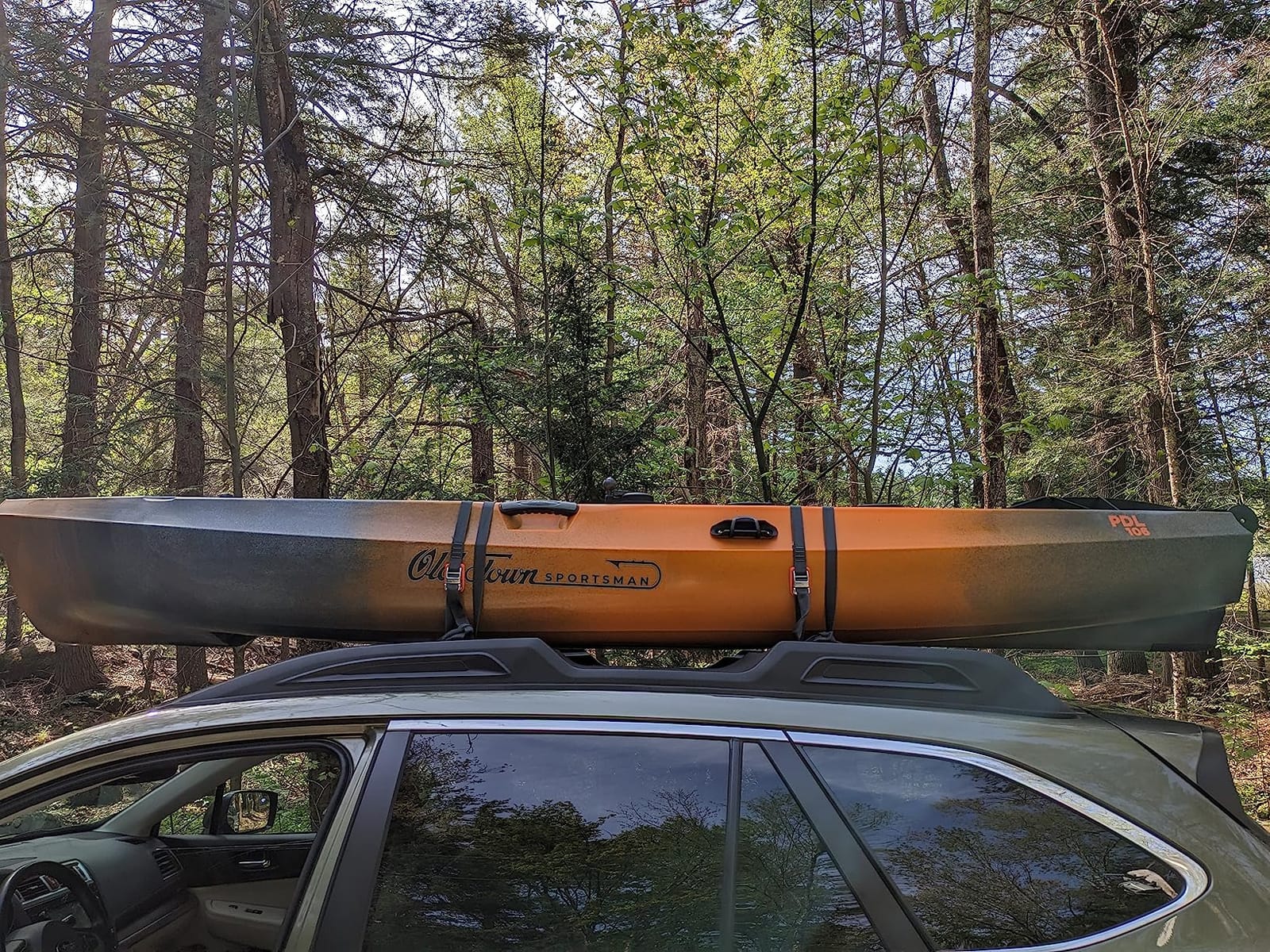
Where the honesty matters: this is a 107 pound boat. That is genuinely light for a pedal kayak of this class, and owners still say a kayak cart or a gentle slope is the difference between a good launch and a bad one. The paddle is not included, which catches first-time buyers out more than anything else on this list.
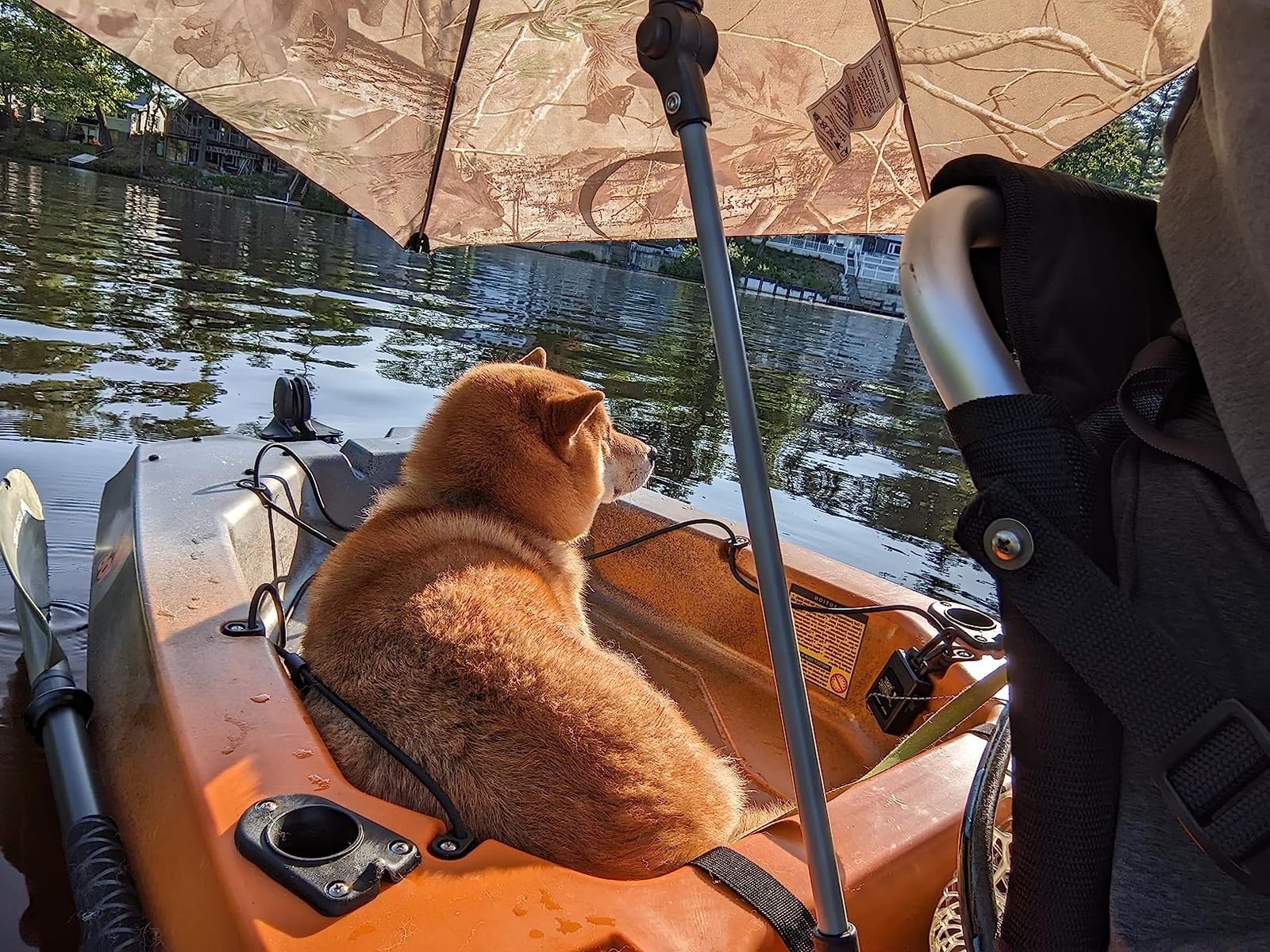
Rigging is where Old Town spends its money. You get customizable accessory tracks, cushioned floor pads for grip when you stand, a tackle box, multiple rod holders and a universal transducer mounting system. The premium mesh seat has real lumbar support and adjusts for leg length, which matters on a boat this width because your knees sit further forward than in a narrow hull.
Why we made it the top pick
It is the most complete package without being the heaviest or longest. Capacity of 450 pounds covers bigger anglers who feel cramped in the 350 pound boats, and the removable console means you can leave 18 pounds at home when cartopping to a small lake. The 5-year drive warranty is longer than most of the drives in this group.
It also does not ask you to compromise on water. A propeller drive is not the right tool for a weed-choked creek, but on a lake, reservoir or bay this hull is calm, quiet and predictable. If your fishing spans open water and the occasional paddle-access pond, this is the boat we would put in the truck.
Where it falls short
Owners who want to run long open-water distances report less tracking than they get from 12 and 13 foot hulls. If you are crossing a wide lake into a headwind every morning, the extra length of the longer boats in our pedal kayak picks will hold a line better.
The other limitation is simply the weight. At 107 pounds plus console, this is a two-person launch unless you own a cart. Anglers who fish alone and walk a long shoreline path should read our beginner kayak guide before committing.
2. Reel Yaks Raider – Best Value Modular Pedal Kayak
Reel Yaks Raider Modular Fishing Kayak – 9.5ft, 380 lbs Capacity, Red White Black – Pedal Fishing Kayaks for Adults & Youth, Sit on Top, Compact Storage, Lightweight, Easy Transport
380 lb capacity
66 lb hull
9.5 ft length
Splits into two 31 lb sections
2-year hull warranty
Pros
- Fits in a small SUV or apartment closet
- Four-step tool-free assembly
- Very stable standing platform
- Prop drive handles current well
- Locking section latches feel solid
Cons
- Drive unit is awkward to fit once afloat
- Prop tangles in weeds
- Some gear wear reported in the pedal unit
- Sections are heavier than expected to lift
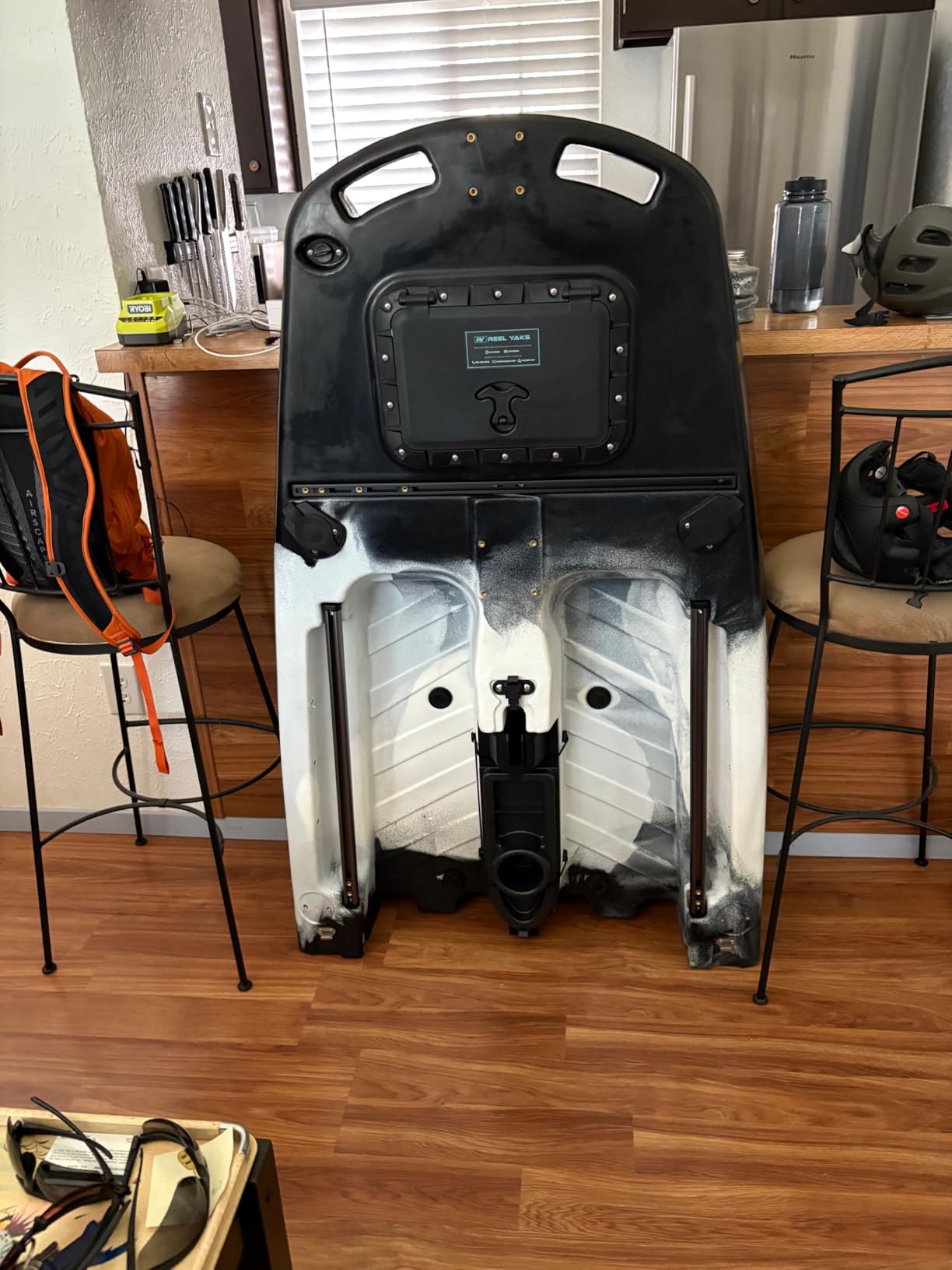
The Reel Yaks Raider’s entire argument is one idea: this is a full pedal fishing kayak that breaks into two pieces. Each section weighs 31 pounds and has integrated carry handles, so the whole boat becomes two manageable loads instead of one 66 pound awkward one. For anglers with a small garage, a rental car, or no roof rack, that is the feature that ends the search.
Assembly takes four steps and no tools. Owners who live with the boat report that the W-hull sit-on-top design is stable enough to stand and cast from, and the package includes a 360 degree rod holder, a paddle, the propeller drive and a stadium seat. You are not buying a bare hull and hunting for fittings afterward.
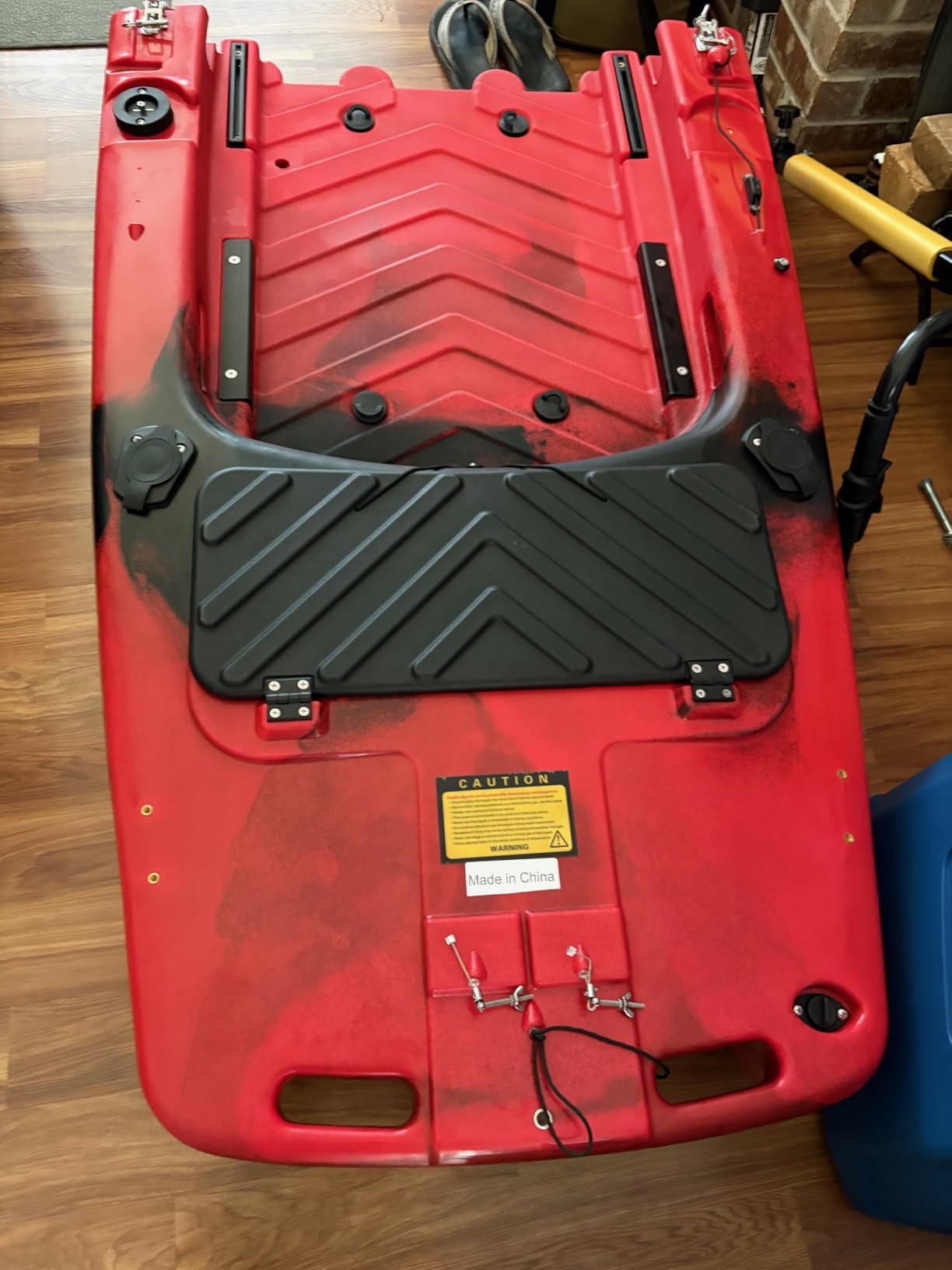
The criticism we kept seeing was about the drive unit rather than the boat. Fitting the pedal assembly on once you are already in the water is awkward, and the propeller snags weeds and aquatic vegetation badly enough that one owner described pedalling as hard work in a marsh. That is the standard propeller drive trade-off, not a defect specific to this model.
There are also reports of gear wear in the pedal drive, including loose pedals after roughly two months of use, and rudder tension that needs adjusting after the first outing. Front storage is not reachable while seated, so the practical gear capacity is lower than the hull suggests.
Who this modular design suits
Apartment anglers, anyone without a trailer, and solo fishers who move between lakes without a truck bed. The two-piece format is the reason this boat exists, and if you have ever wrestled a 100 pound hull down a boat ramp alone, you will understand the appeal immediately.
It is also a sensible first pedal kayak. The capacity rating of 380 pounds is honest for a small-to-medium angler and the fit-out covers the essentials, so you are not spending your budget on accessories you could have skipped.
When to buy a different boat
If you are a heavy angler or carry serious tackle, 380 pounds is tight and the step-up sibling adds length and capacity. If your water is mostly shallow and weedy, a fin drive such as the Pelican Catch Kicker listed below handles vegetation far better.
Long-term owners who want more drive support should know that parts for these units are brand-specific, so it is worth asking your dealer about service before you commit.
3. Albott Modular Fishing Kayak – The Budget Pedal Entry
Albott Modular Fishing Kayak with Propeller Drive System & Durable HDPE
400 lb capacity
109.7 lb hull
9.5 ft length
Three-step modular build
6-month warranty
Pros
- Sits in the top tier of the category sales rank
- Three-step assembly with internal handles
- Reinforced HDPE with stainless hardware
- Adjustable seat and generous storage
- Easy reverse for docks and mangroves
Cons
- Six-month warranty is short for the category
- Newer brand with limited long-term history
- 109.7 lb hull is heavy to lift
The Albott is the value entry here: a 400 pound capacity pedal kayak with a propeller drive, a reinforced HDPE hull and 304 stainless hardware, held together by a three-step modular assembly with internal section handles. At 34 reviews averaging 4.5 stars, it has the strongest sales rank of any pedal kayak in the group, which tells you a lot about how many people are actually buying it.
The drive is straightforward and good at what prop drives do well: quiet acceleration and easy reverse. Reversing matters more than new buyers expect, because backing out of a dock, a mangrove edge or a tight boat ramp channel without paddling is the everyday benefit.
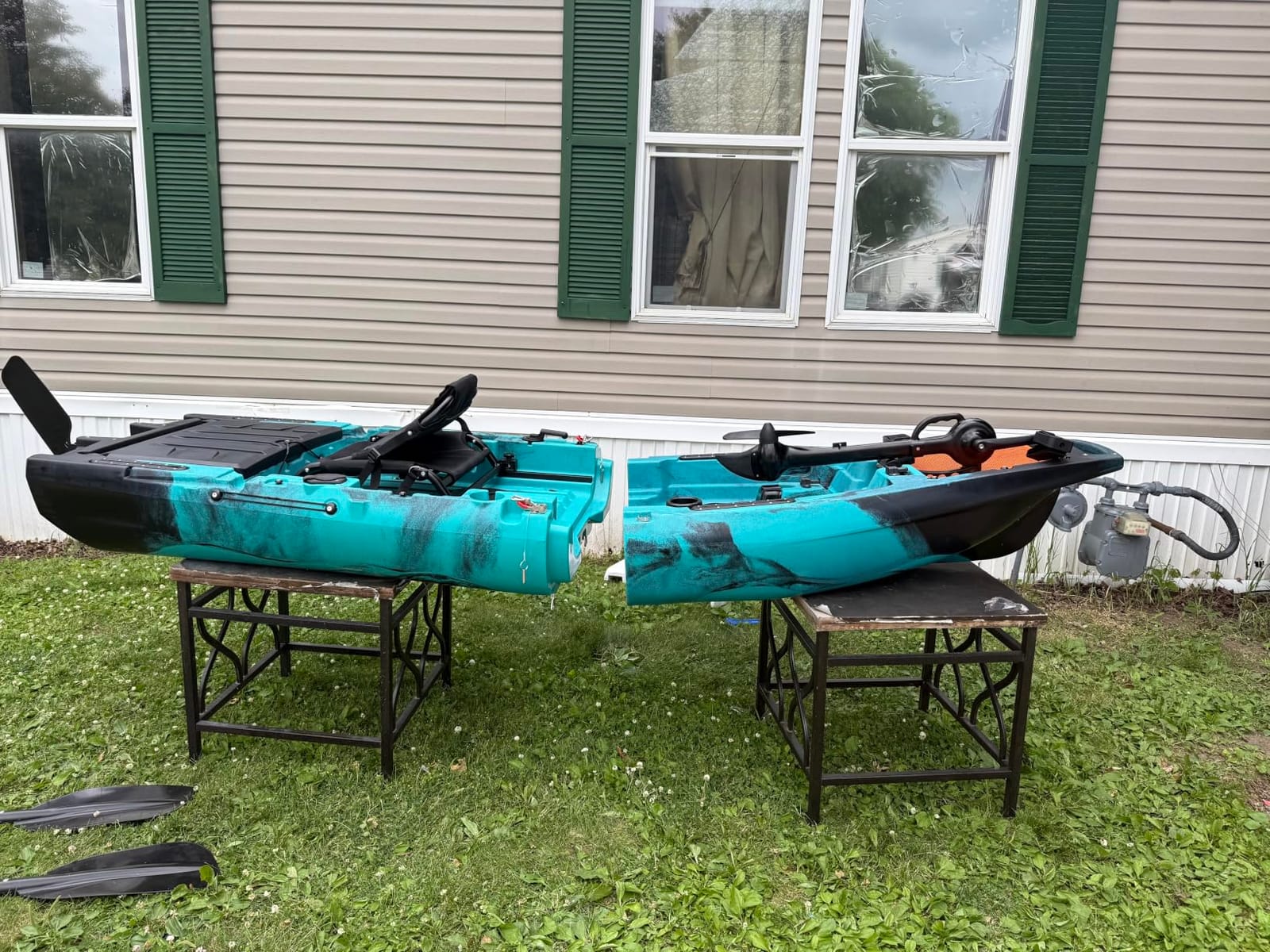
The seat adjusts and there is ample storage, and the modular layout works solo, as a tandem, or as a rental fleet unit. That last point is why the stainless hardware matters: this boat is being used commercially, which is a durability signal you rarely see described for a value model.
The honest caveat is the warranty. Six months is dramatically shorter than the two-year terms offered by Reel Yaks and the lifetime hull terms offered by some larger paddlesport brands. For a boat that will live on a trailer or a rack, that shorter coverage is a real risk, and it is the reason we did not rank this first despite the strong rating.
Why it earns the budget badge
Nothing else at this level gives you a 400 pound capacity, stainless hardware and a prop drive with reverse in a boat you can carry in sections. If your budget stretches to a quality paddle kayak instead, our stability picks are worth a look, but for pure value per feature this is hard to argue with.
It is also a sensible commercial or family boat. Two seating positions, modular sections and heavy-duty hardware mean one purchase can serve several anglers.
Where the risk sits
Short warranty coverage and a newer brand name mean less owner history to draw on. Buy it from a dealer who will stand behind assembly problems, and keep an eye on the drive hardware through the first season.
If you need a longer hull for open water, keep reading, because there are stronger tracking characteristics later in this list.
4. Reel Yaks Radar – More Room, Same Two-Piece Idea
Reel Yaks Radar Modular Fishing Kayak, 10ft, 430 lbs Capacity
430 lb capacity
88 lb hull
10 ft length
Two-piece modular hull
Fin and prop options
Pros
- Higher capacity than the smaller sibling
- Two-piece storage in a vehicle trunk
- Stable W-hull for standing casts
- Rod holders tracks and hatches fitted as standard
- Precise maneuvering in tight water
Cons
- Drive and rudder need adjustment after assembly
- Prop configuration tangles in weeds
- Lighter duty feel than a single-piece hull
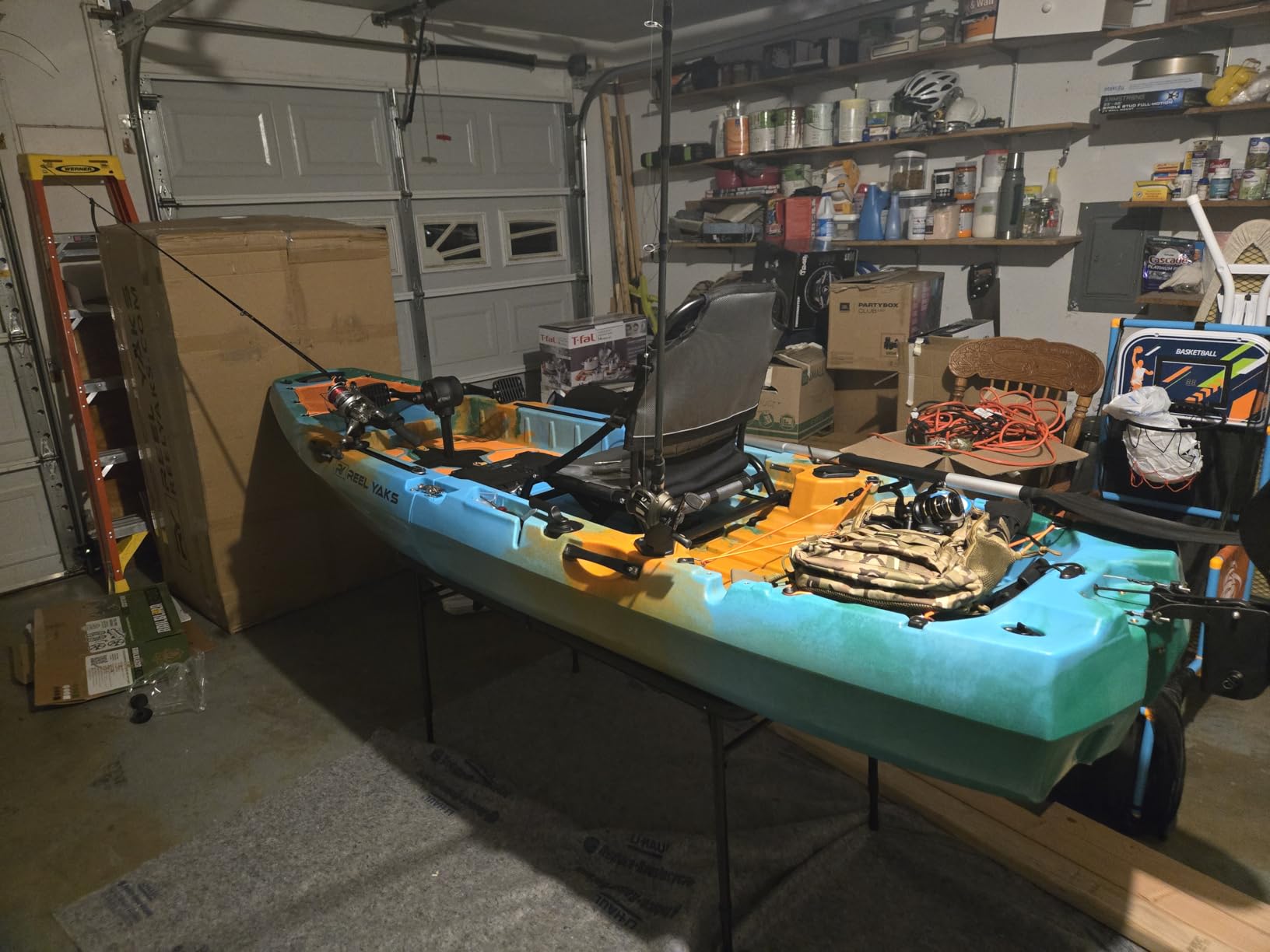
The Radar is the step-up version of the modular idea: 10 feet long instead of 9.5, 430 pounds of capacity instead of 380, and about 22 pounds more hull weight. That extra capacity is the reason to step up. Anglers who run heavy tackle, a large crate and an electric setup need somewhere to put the weight, and this boat has it.
Everything an angler actually needs is already fitted. Flush-mount rod holders, track rails and storage hatches come as standard, which removes a real chunk of the accessory budget. The wide W-hull is stable while standing, and the propeller drive gives instant forward and reverse for precise positioning.
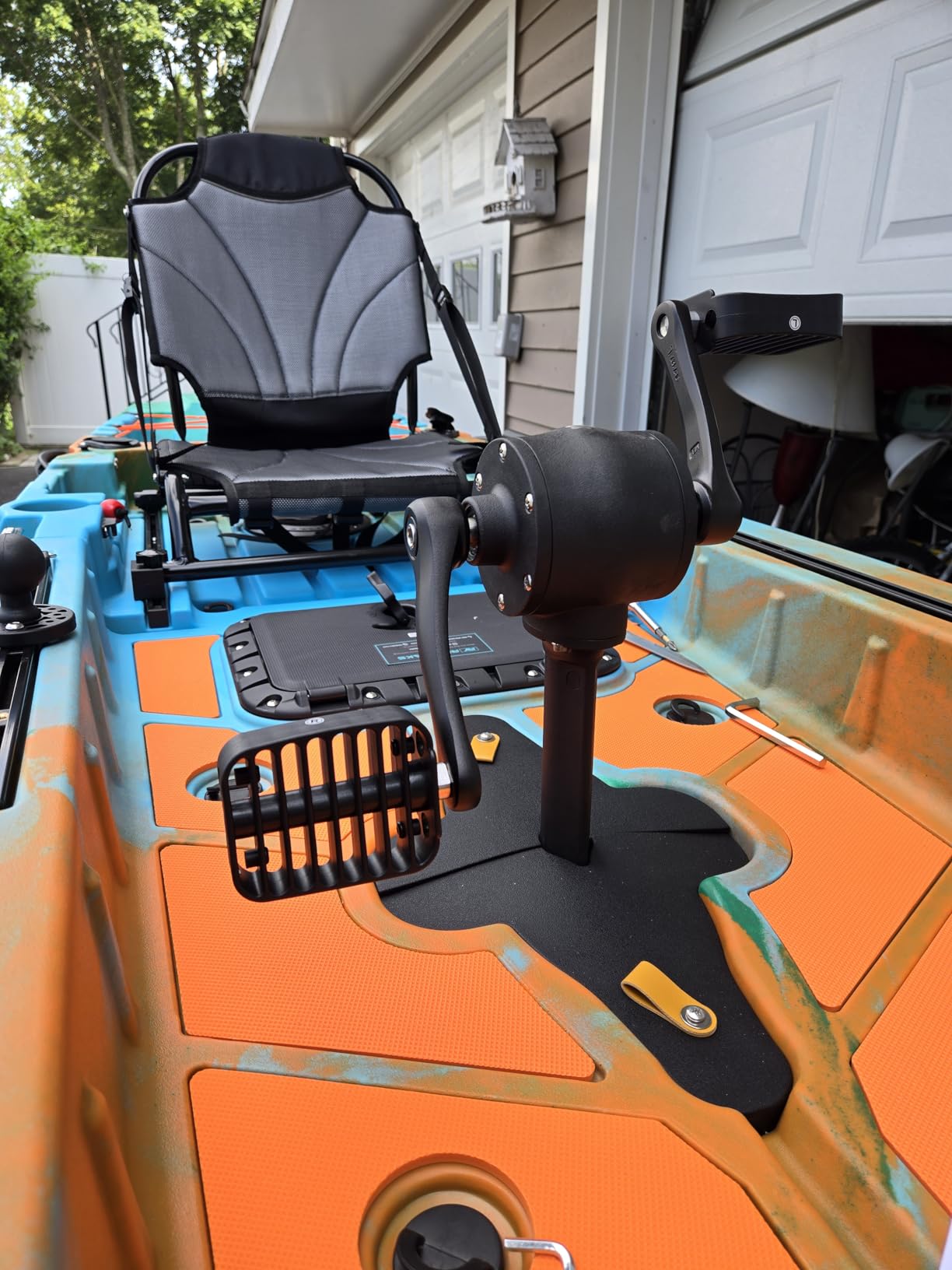
Notably, this hull is also offered in a fin drive configuration, which matters if you fish a lot of shallow structure. That choice alone moves it from a general-purpose boat to something more flexible than most competitors at this size.
The recurring notes from owners: expect to spend time adjusting the drive and rudder after the first assembly, and expect the propeller version to collect weeds in shallow water. Once assembled, the modular sections feel lighter duty than a single-piece moulded hull, which is the honest cost of the storage benefit.
Why capacity is the deciding factor
Every pound of capacity is really a statement about how you fish. If you carry a bait tank, a tackle crate, an electric motor and a full tackle selection, a 380 pound rating becomes the limiting factor rather than the hull length. At 430 pounds with a wide W-hull, this boat stops fighting you on long days.
For bigger anglers who want more room still, we cover the 500 pound option further down.
When a rigid hull beats a modular one
If you have a proper garage and a trailer, the advantage of splitting the boat shrinks considerably. Rigid polyethylene hulls flex less and feel more solid once you are moving through chop, and the seam between two-piece models is where water eventually finds its way.
Buyers who fish lakes with a truck bed rather than a storage problem should weight our stability rankings more heavily.
5. LIFETIME Renegade 116 – Comfort First
Lifetime Renegade 116 Pedal Drive Fishing Kayak
350 lb capacity
102.5 lb hull
11.5 ft length
Sliding framed seat
5-year limited warranty
Pros
- Pedal drive frees both hands completely
- Sliding framed seat raises sight line
- Multiple storage bays and accessory tracks
- Paddle included and stows on the hull
- 5-year limited warranty
Cons
- 102.5 lb hull needs a planned launch
- Very little owner review history on this listing
The Renegade 116 is built around a single idea: sit comfortably for a whole day. The framed seat slides forward and back on a track, has back support and raises the sitter above the deck, which improves your sight line over surface chop. On an 11.5 foot hull with a 32 inch beam, that elevated seating is the feature anglers notice most.
The drive deploys easily and runs a propeller, and the rudder is integrated rather than tacked on. Flush-mount rod holders, universal accessory tracks and storage at both ends are all standard, and the self-draining scupper holes keep standing water out of the boat after rain.
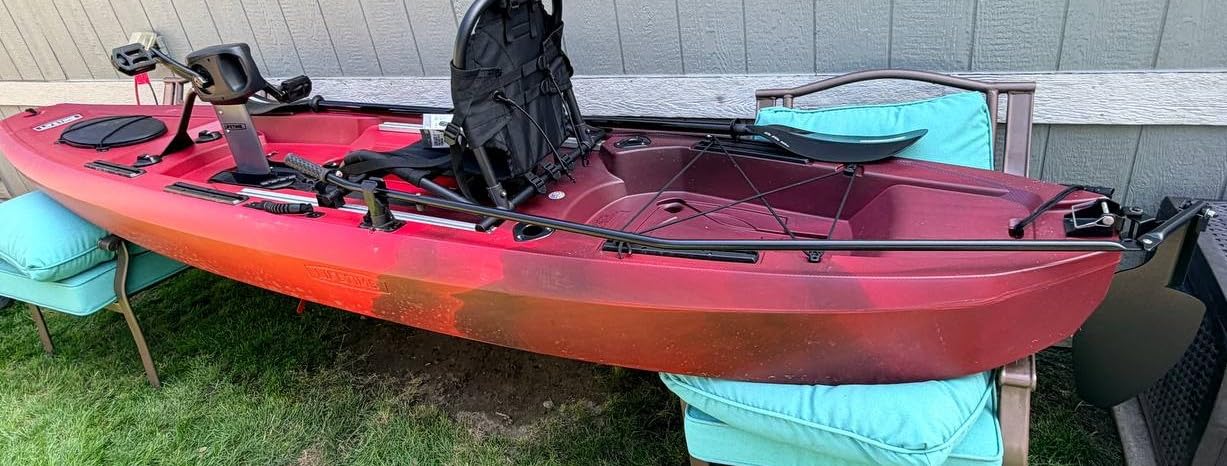
Owners also like that a full-size paddle is included and stows on the hull. That is a bigger deal than it sounds: a pedal kayak without a paddle aboard is a boat you paddle one-handed in a hurry, and several forum regulars insist on always carrying one.
We want to be straight about the evidence here. This listing has a single owner review behind it, so we can tell you what the boat is specified to do but not how it performs after three seasons. Treat it as a well-equipped option with an unproven service history rather than a proven workhorse.

What you gain from the seating
An elevated seat changes how you fish. Higher eye lines help you read structure and see weed edges, and back support through a long day is worth more to most anglers than an extra pound of capacity. If you are over 50 or have lower back issues, this is the boat to look at first.
The 350 pound capacity is the trade. Pair it with the seat height and it suits mid-weight anglers who want comfort over load capacity.
What to verify before buying
Ask the dealer about drive service and parts turnaround. A drive unit is a mechanical assembly that will eventually need a bearing, a belt or a cable, and support matters more than any single spec on the page.
The weight is real. At 102.5 pounds, budget for a cart and plan your launch route before the first trip.
6. BKC Brooklyn 10.5 Pro – The Lightweight Big-Capacity Option
BKC Brooklyn 10.5 Pro Pedal Fishing Kayak, Propeller Drive
440 lb capacity
65 lb hull
10.5 ft length
Propeller bicycle-style drive
Motor-ready layout
Pros
- High 440 lb rating on a light hull
- Bicycle-style pedals with adjustable foot straps
- Responsive hand-operated rudder
- Rod holders sealed hatches and rear bungees
- Aluminum frame seat keeps you elevated
Cons
- No battery compartment for a trolling motor
- Small hardware failures reported early
- Rudder and hatch quality issues on earlier models
- Inconsistent parts service
Put a 440 pound capacity rating on a 65 pound hull and you get something unusual: a boat rated for a large angler and a full tackle load that most people can move with one hand on the handle. That is the Brooklyn 10.5 Pro’s headline, and it is why it lands high on this list despite a middling star rating.
The drive is an upgraded bicycle-style propeller unit with adjustable foot straps, which is more refined than most budget pedal systems and makes a real difference over a long day. The hand-operated rudder gives precise tracking and tighter turns than a foot rudder, and the aluminum frame seat keeps you high and dry.
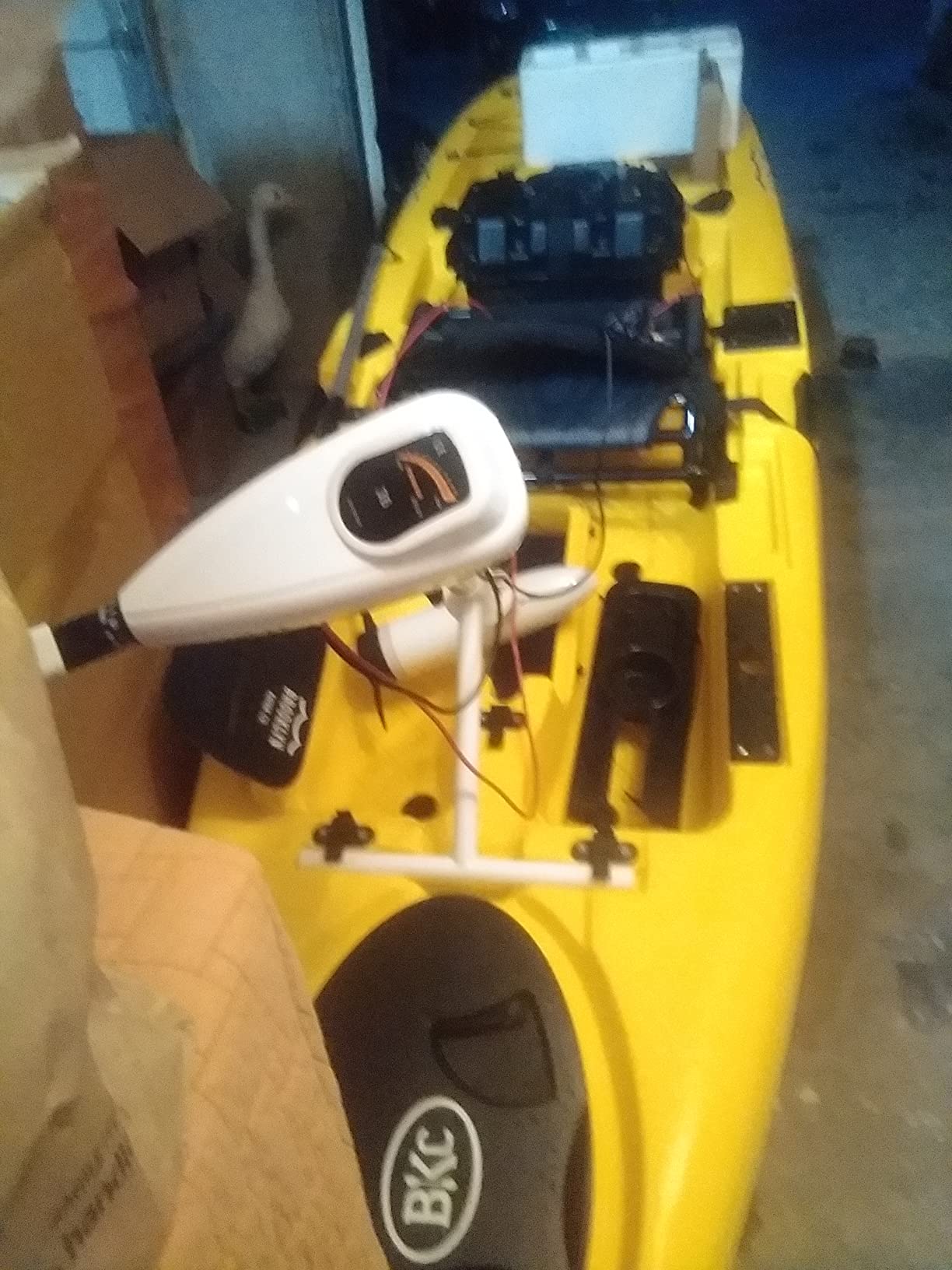
It is rigged from the factory with flush-mounted rod holders, sealed storage hatches and expanded rear bungee cargo. Owners who use it as intended like the hands-free propulsion and the responsive rudder in wind and current.
The criticism is about fittings rather than function. Several reviewers report clips and small parts breaking within the first month, and one detailed review documents a stripping rudder system and hatches that never sealed properly. Parts service has also been described as inconsistent, which you should weigh before a purchase this size.
The hybrid-motor angle
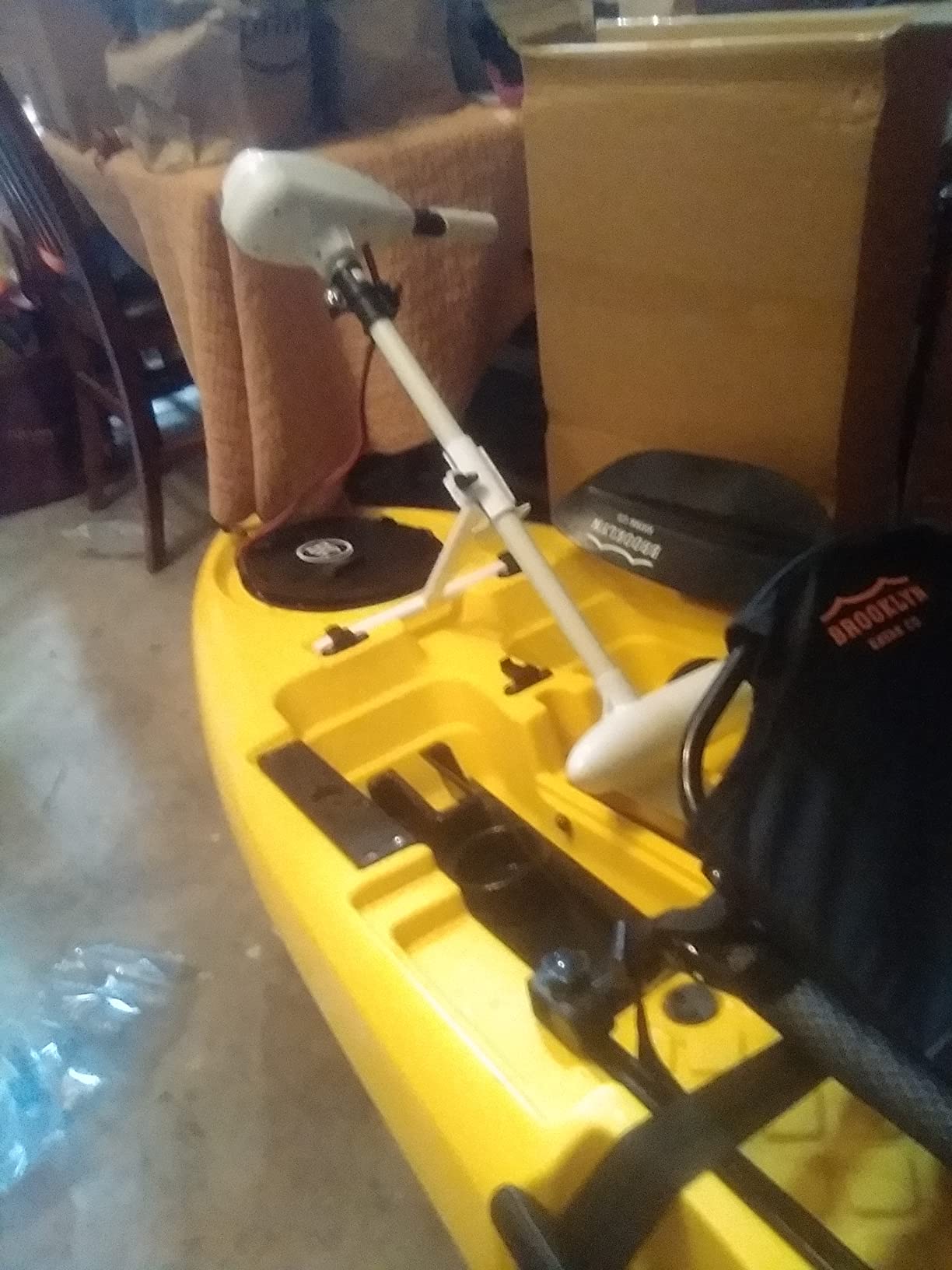
This hull is laid out for a trolling motor later on. It is explicitly motor-ready, which means you can add electric propulsion if your fishing moves to open water or you want silent running at dawn. Plenty of kayak anglers run exactly this hybrid, using the pedal drive in shallow water and the motor in the channel.
Be aware there is no battery compartment provided. Several owners retrofit one themselves, so factor that into your build if a motor is part of the plan.
Who should look elsewhere
If you are someone who fishes constantly from a river or a marsh where branches are common, a propeller drive will collect them. Fin drives tolerate that environment far better, and there is a lighter-weight fin-drive boat later in this list.
Warranty terms are not stated on this listing, which is worth confirming in writing at the point of purchase.
7. Rotocraft 10 ft Single Pedal Kayak – Storage and Warranty Focused
RC 10′ Single Pedal Kayak – Propeller Drive (Green Camo)
310 lb capacity
67 lb HDPE hull
10 ft 4 in length
Three storage hatches
7-year warranty
Pros
- Stable platform with accessory rails for gear
- Three hatches for organized day-trip storage
- Adjustable aluminum frame seat
- Light 67 lb hull
- 7-year warranty listed
Cons
- 310 lb rating limits gear loads
- Very few owner reviews to judge reliability
Storage is the story with this boat. Three separate hatches, a large bow hatch, a rectangular compartment behind the seat and a circular under-seat hatch, give you somewhere to separate wet gear from dry gear, tackle from lunch, and a fish from a ruler. For an angler who fishes all day and stays organized, that layout is genuinely useful.
The propeller pedal drive provides hands-free speed and consistent thrust, and the rudder handles rougher water. The aluminum frame sit-on-top seat adjusts for both support and sight line, and the accessory rails let you bolt on whatever your rig needs.
At 67 pounds it is one of the lighter hulls we covered, and the 7-year warranty is longer than most drive terms in this group. If you keep a boat for a decade, warranty length is a genuine factor.
What the numbers mean for you
The 310 pound capacity is the most restrictive among these boats. It suits an angler and a light load, which means the tackle crate stays at home and the cooler is small. Anglers carrying electronics and multiple rod setups need one of the 430 or 440 pound hulls instead.
The saving grace is that with a low total weight, this is one of the easiest boats here to solo carry to a shoreline launch.
What we cannot tell you yet
Only two reviews exist, both five stars, so the long-term picture is genuinely unknown. The written feedback highlights on-water stability, rail provision and responsive seller communication after the sale, which is encouraging but thin.
Our advice: buy this one from a dealer who will handle a warranty claim locally, because the value of a long warranty depends entirely on who honours it.
8. Spatium Pedal Fishing Inflatable – The Only Packable Option
Spatium Pedal Fishing Inflatable Kayak Pedal Sit on Top Pedal Drive Fishing Kayak with 360° Rotatable Seat Pedal Kayak for Adults One Person Suitable for Rivers,Oceans,Lakes-Fish Bone Model
330 lb capacity
Double-layer PVC hull
11 to 12 PSI pressure
360-degree swivel seat
1-year warranty
Pros
- Converts between three modes with one swap
- Swivel seat on a rail makes casting easy anywhere
- Built-in camera mount and nav light point
- Side measurement scales for catch sizing
- Wheeled backpack and pump included
Cons
- Accessory brackets do not fit standard transducer mounts
- No extra air connector for an electric pump
- Assembly takes about an hour
- Only 1-year warranty
This is the odd one out in the list, and it is worth understanding why it exists. The hull is inflatable PVC rather than moulded polyethylene, and it converts between three configurations: a pedal kayak, a standard pedal board, and a motorized fishing board. If your storage is a studio apartment or you fly to fish, nothing else here solves that problem.
The build is more convincing than most inflatables. Owners describe a rigid, stable feel once inflated, with a double-layer hull, 0.9 inch PVC pipes at 7 to 8 PSI and a hull pressure of 11 to 12 PSI, plus stabilizing bottom fins. The 360 degree rotatable seat rides an 80 cm rail with forward and backward adjustment, so you can cast from any position without twisting.
There are nice touches that show someone actually fishes. Built-in camera mount base, a navigation light attachment point, and measurement scales printed along both sides of the hull for sizing a catch. Top speed is quoted at 6 to 8 km/h, which is fast for a pedal boat.
The rigging is the weak point. The Starport bracket mounts sit too far apart to accept a standard fish finder transducer without fabricating a custom platform, and no extra air connector is supplied for an electric inflator. Assembly takes roughly an hour.
Who this genuinely suits
Travelers, apartment dwellers, and anyone who fishes a different water every weekend and cannot justify a 100 pound hull in a hallway. The wheeled backpack makes the packed boat genuinely movable rather than a theoretical convenience.
If you fly with gear regularly, this is the only pedal fishing kayak on the list that makes that realistic.
Why most anglers should skip it
Rigid polyethylene hulls are cheaper per pound, tougher against abrasion, and far easier to repair. A puncture in an inflatable ends your trip, and the 330 pound capacity is well short of what big anglers need.
With only three reviews and a one-year warranty, treat it as an interesting specialist tool rather than the safe choice for a first pedal kayak.
9. BKC Brooklyn 10.0 – The Fin-Drive Entry Point
BKC Brooklyn 10.0 Single Pedal Fishing Kayak, Sit-on-Top
350 lb capacity
58 lb class hull
10 ft rotomolded HDPE
Flipper-style pedal drive
5-year warranty
Pros
- Flipper drive handles shallows and plants
- Quick acceleration and hands-free thrust
- Rudder steers sharply over long stretches
- Rod holders hatch and bungees included
- 5-year warranty and a full-size paddle
Cons
- 350 lb capacity limits gear loads
- Longer learning curve than a propeller drive
- Basic accessory rail for heavy rigging
Among the hard-shell pedal kayaks we covered, this is the more affordable of the fin-drive designs. That choice changes where you can fish. Underwater fins lift, flex and pass over vegetation instead of cutting through it, which makes this the boat to shortlist if you fish shallow reservoirs, flooded timber or a marsh.
The rest of the package is a sensible entry-level fit. A 10 foot rotomolded HDPE hull in the 58 pound class, rated to 350 pounds, with two built-in rod holders, a watertight front hatch and bungee-secured rear cargo. The aluminum-frame seat is adjustable, scupper holes drain the deck, and a full-size paddle is included.
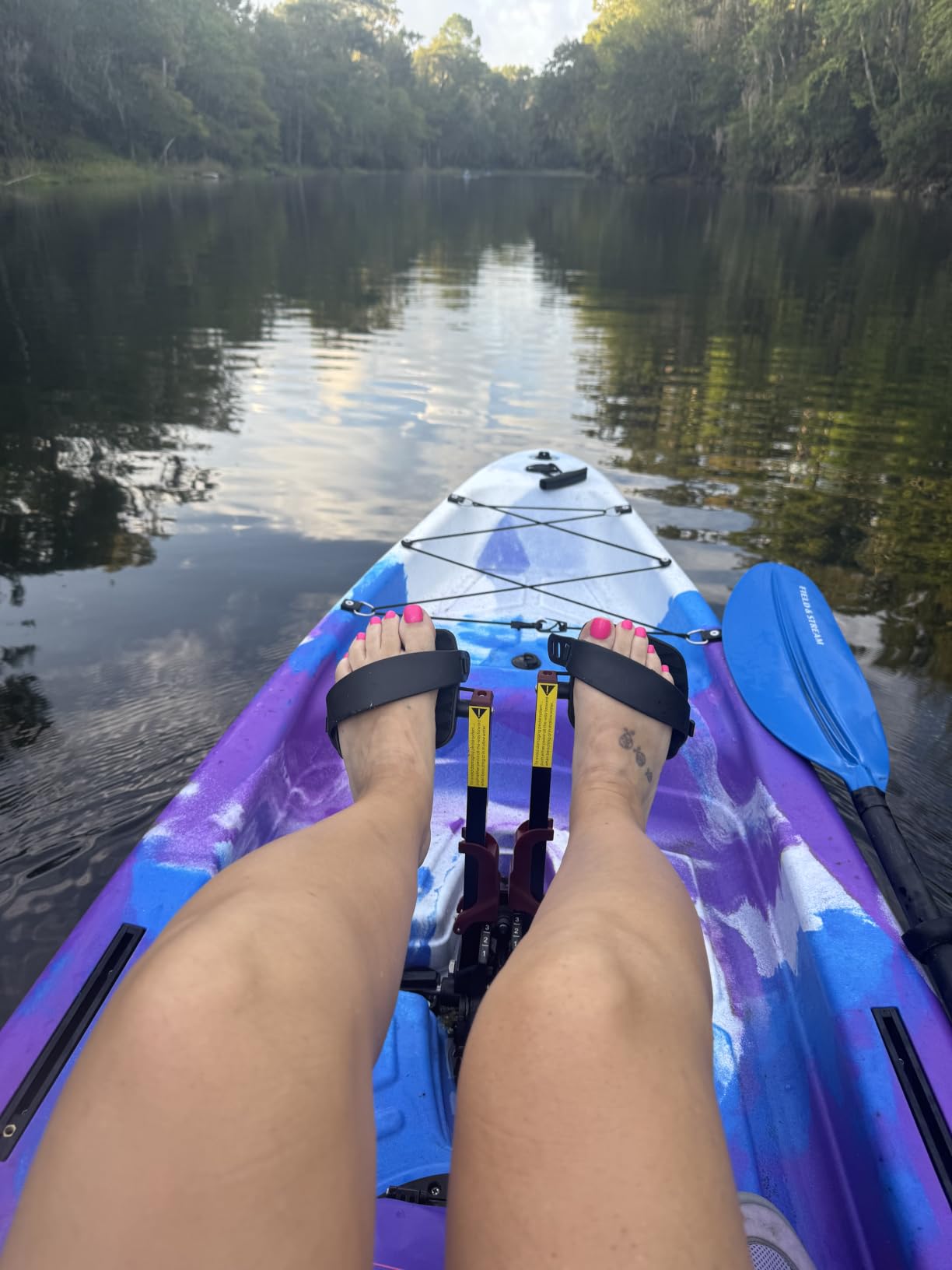
Owners like the quick acceleration and the sharp, responsive hand-operated rudder, and the 5-year warranty is longer than most drives in this group offer. The 4.2-star average reflects a modest platform more than any functional complaint.
The 350 pound rating is tight among the hard-shell boats on this list, so heavy anglers should look further up the roundup. And the flipper drive has a steeper learning curve than a propeller, so expect a few sessions before the stroke feels natural.
Where a flipper drive beats a prop drive
Shallow water with weeds, submerged branches and grass beds. Fin drives are far less likely to snag and far less likely to kill your forward momentum on a strike. Several owners who switched from propeller boats cite exactly this as the reason for the change.
The trade is efficiency. A propeller pushes water efficiently and holds speed better in open water, so for long lake crossings the fin drive asks more of your legs.
Who should buy something else
Anglers carrying heavy gear or carrying themselves will find 350 pounds restrictive. And if your accessory plans are ambitious, the basic rail may need supplementing with track hardware.
For comparison on fin-drive alternatives with more capacity, the last boat in this list is worth reading.
10. Old Town Sportsman BigWater PDL 132 – The Open-Water Pick
Old Town Sportsman BigWater PDL 132 Pedal Fishing Kayak (Ember Camo)
500 lb max
378 lb usable
122 lb hull plus 21 lb console
13 ft 2 in hull
Removable drive
Pros
- Built for open water and tournament fishing
- Removable drive cuts transport weight sharply
- Highest capacity in the group at 500 lb
- Premium mesh seat with lumbar support
- Transducer mounting and paddle clip included
Cons
- Heaviest hull here at 122 lb before the console
- Largest footprint and worst for tight spaces
- Paddle sold separately
At 13 feet 2 inches long and 36 inches wide, the BigWater PDL 132 is the boat for anglers who fish big water seriously. Capacity is 500 pounds with 378 usable for rider and gear, which leaves real room for a tournament setup, multiple rod tubes and a full battery bank without trimming anything.
The hull tracks well, which matters most in exactly the conditions this boat is built for. Owners point to open-water stability and the ability to hold a line in a chop as the decisive advantages over shorter pedal hulls.
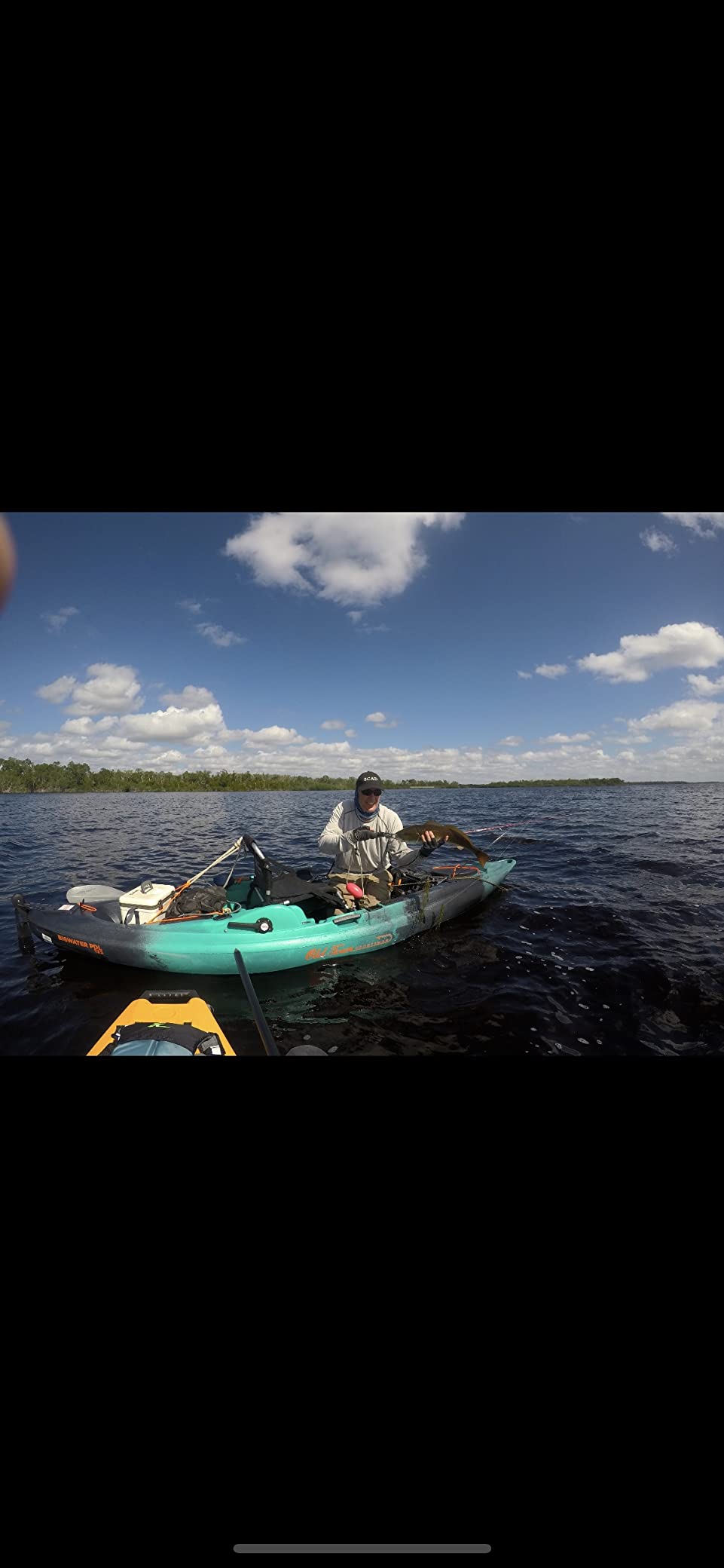
The smart design decision is the removable pedal console. It weighs 21 pounds, and taking it off leaves a 122 pound hull that two people can carry comfortably. That single removable component is what makes a boat this size remotely practical for one angler with a friend along for the launch.
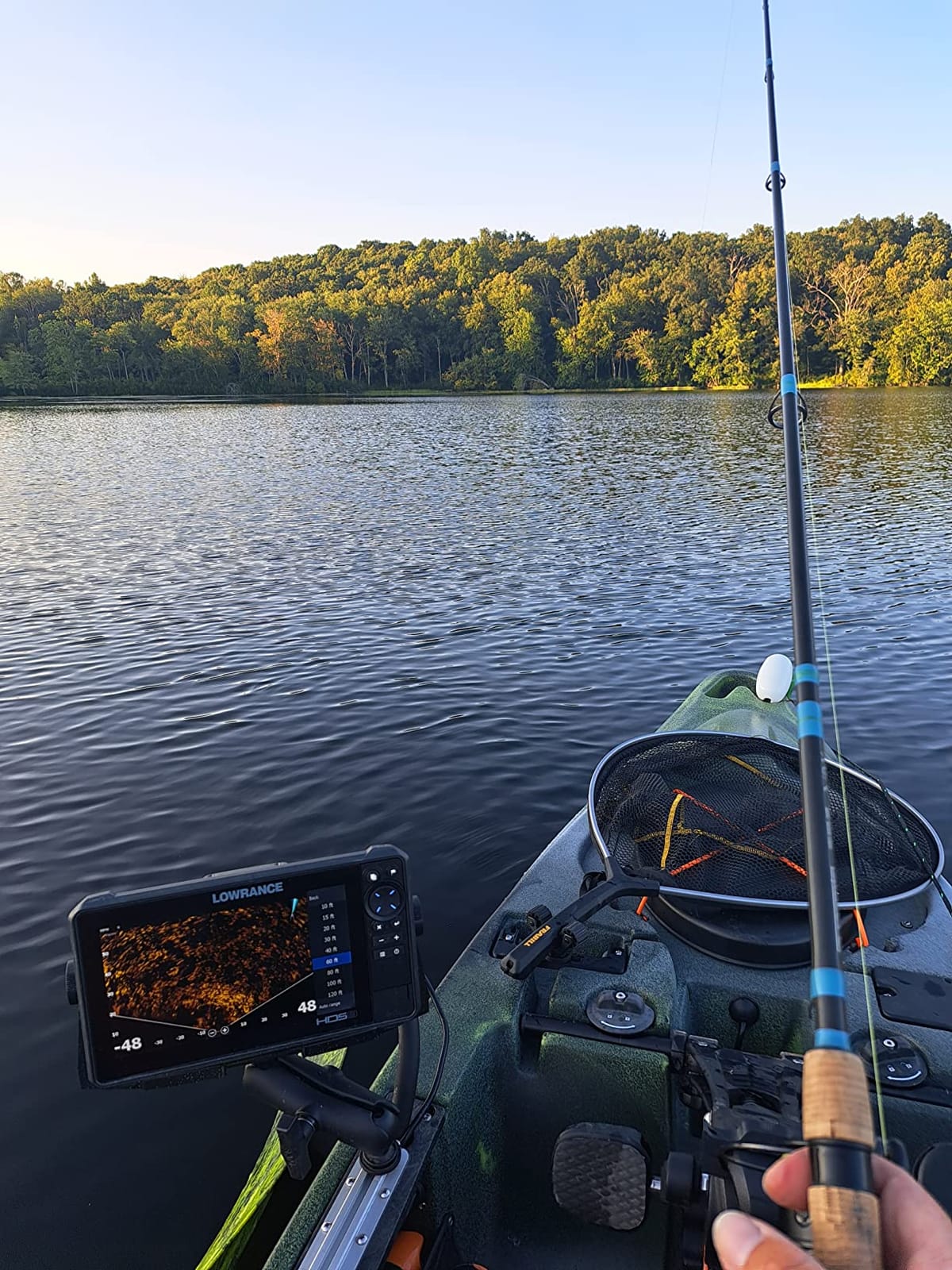
Rigging matches the Sportsman platform: customizable accessory tracks, cushioned floor pads, a custom tackle box, multiple rod holders, universal transducer mounting and a side-mounted hull paddle clip. The premium mesh seat adjusts for leg length and supports the lower back.
Why big water demands this length
Tracking and speed are length functions. A 13 foot hull holds a line in wind and moves across a lake with fewer strokes than a 10 foot hull, and on long runs that difference is the difference between arriving with energy left and arriving tired. If your season is spent crossing open water to reach fish, length pays for itself.
The width also gives a genuinely stable standing platform, which is the difference between casting accurately from the deck and casting from a seated seat.
Where it stops being practical
This is the least suitable boat here for skinny water, small storage spaces and solo carrying. The footprint alone rules out a closet, a small garage and tight creek fishing. A paddle is sold separately.
If you want offshore capability with a smaller footprint, our ocean kayak picks cover boats that travel further on less water.
11. Old Town Malibu Pedal Solo – Comfortable Cruising With Fishing Ability
Old Town Ocean Kayak Malibu Pedal Sit-on-Top Kayak, Lava
12 ft sit-on-top hull
Large stern tankwell
Three flush rod holders
Twin 18-inch tracks
5-year drive warranty
Pros
- Stable and fast in choppy water
- Adjustable seat suits taller paddlers
- Large stern tankwell for coolers and gear
- Easy to add a stern-drive trolling motor
- 5-year PDL drive warranty
Cons
- Recreational hull with angler features added
- Limited hull warranty terms
The Malibu is a 12 foot sit-on-top recreational pedal kayak that owners have quietly turned into a fishing platform, and it works. The owner record is a consistent five stars, with the most common themes being stability, speed and comfort, particularly for taller paddlers who struggle to fit in shorter cockpits.
The seating is the Element Beach seat, adjustable on a slide track with a storage pocket and a ventilated mesh cover. Owners report that the fit for taller bodies is noticeably better than the competition.
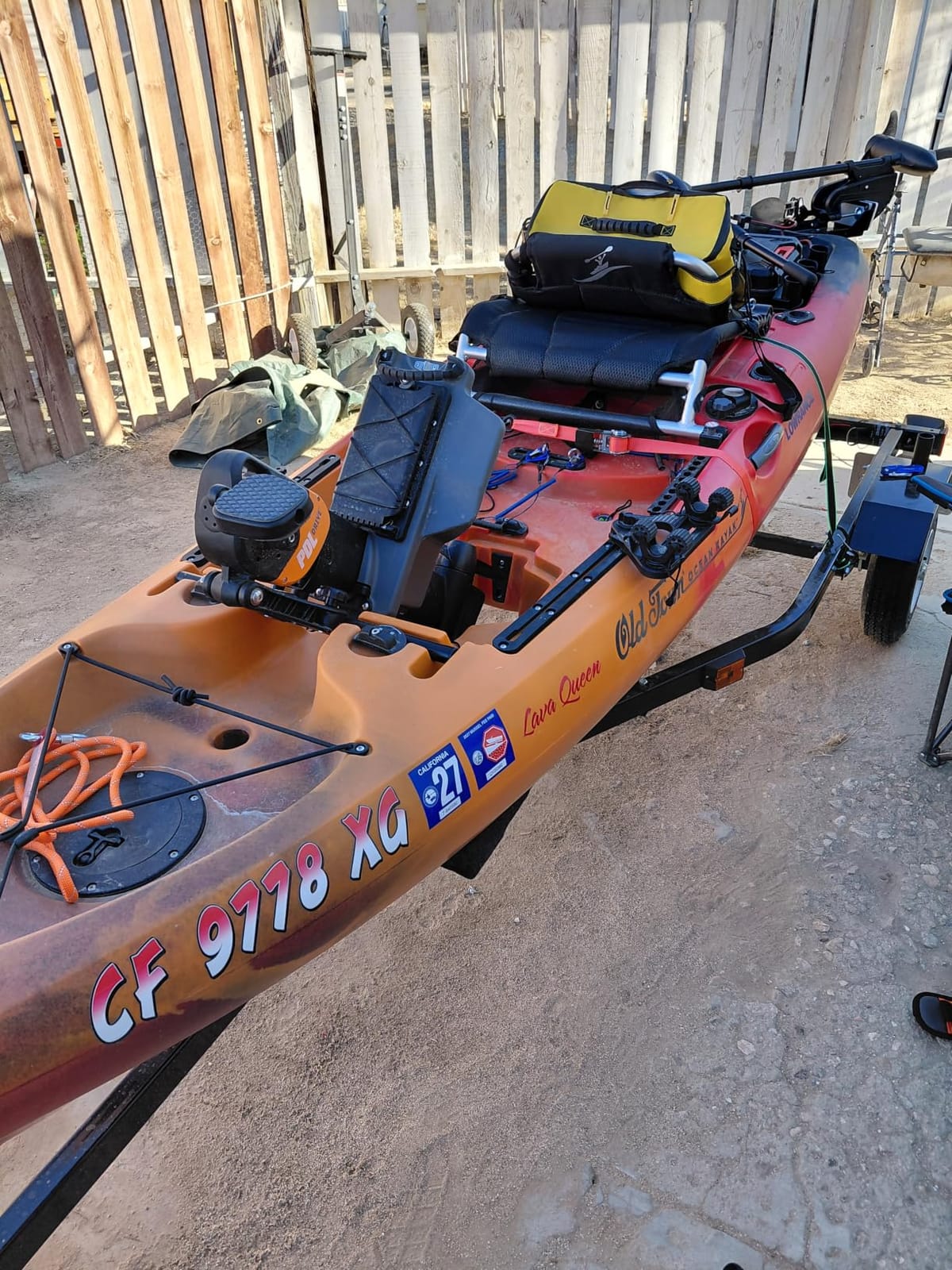
The redesigned stern tankwell is large and takes a cooler plus bulky gear, and the three flush-mount rod holders, two behind the seat and one forward-facing, let you fish facing either direction. Two 18-inch accessory tracks flank the cockpit for electronics and rod holders. Adding a stern-drive trolling motor with an extended tiller is straightforward.
Several owners note it is a reworked successor to the Old Town Salty PDL, which they rate as one of the best fishing kayaks for the money. That lineage matters: the platform is proven even though the angler features are newer.
What the recreational base gives you
Because the hull is designed for efficient travel rather than angling, you get more speed and a smoother ride than a fishing-specific hull of the same length. If you paddle to spots rather than fishing from where you launch, that efficiency pays off every trip.
The trade is purpose-built rigging. There is no transducer shield, no live well and fewer fishing-specific fittings than the Sportsman models.
Who should skip it
Anglers who rig a serious electronics setup or need tankwell space for live bait should look at the Sportsman platform instead. This is the comfort and versatility option, not the tournament option.
Given the 5-year PDL drive warranty and limited hull terms, confirm the hull coverage in writing when you buy.
12. Pelican Catch Kicker 110 HDII – Light and Built for Weeds
Pelican Catch Kicker 110 HDII – Sit on top Fishing Angler Pedal Kayak – Amazonia – HyDryve II Pedal System – Stable – 11 ft
300 lb capacity
59 lb hull
11 ft length
HyDryve II fin pedal system
Lifetime hull warranty
Pros
- Very light 59 lb hull with built-in rigging tracks
- Fin drive handles plants and shallows
- Pedal position adjusts for different users
- Ergoboost seat raises your sight line
- Lifetime limited hull warranty
Cons
- Lowest rating in the group at 3.7 stars
- 300 lb capacity limits gear loads
- Rudder assists rather than steers
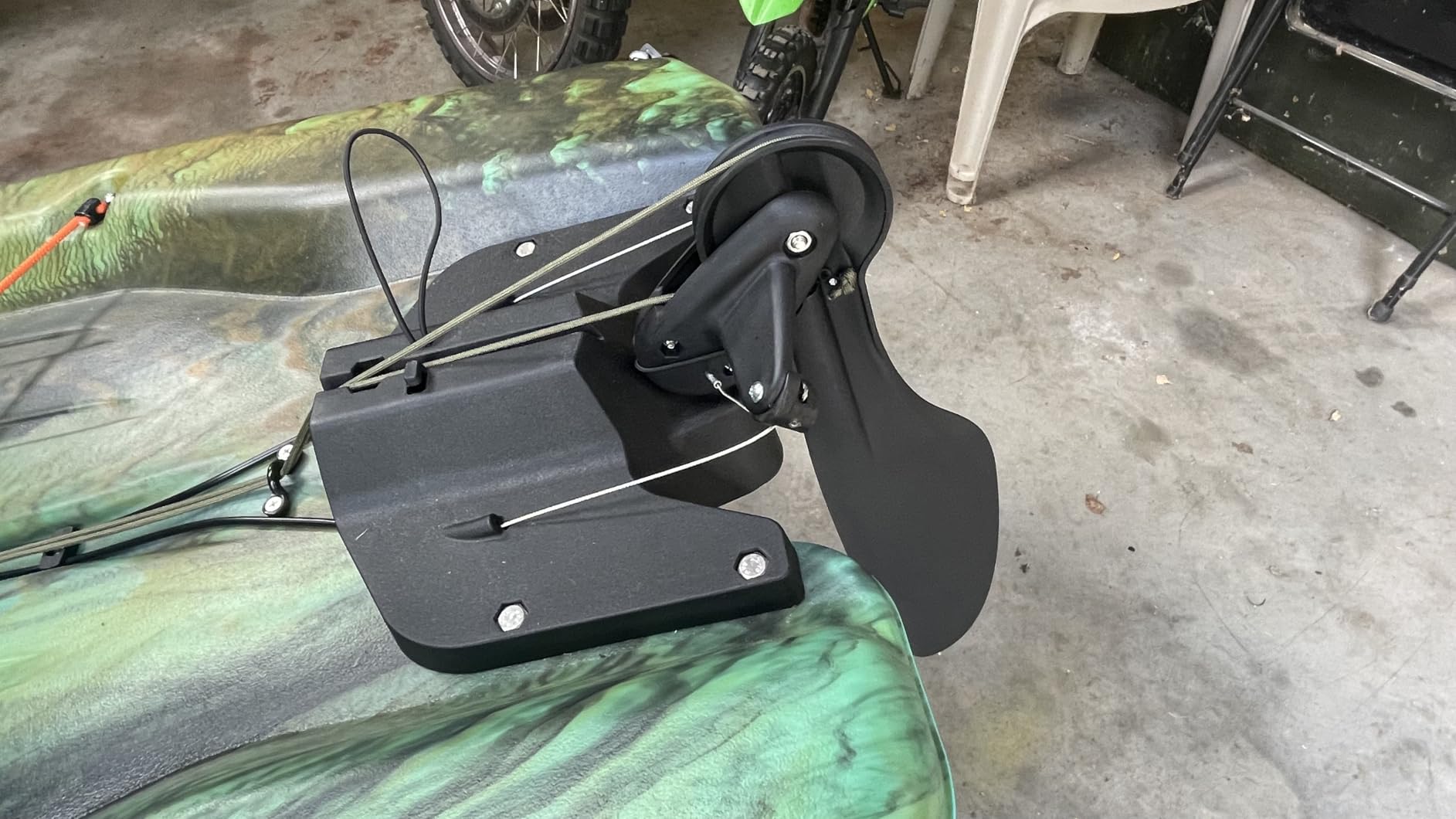
The Catch Kicker 110 pairs a 59 pound hull with a fin drive. That combination makes it one of the lightest boats here to solo carry and the best suited to shallow, plant-choked water, and for those two reasons it deserves serious consideration despite the lowest rating on this list.
The HyDryve II fin system is efficient over distance and handles aquatic plants far better than a propeller. Pedal position adjusts to fit different paddlers, so a household with two different sized anglers can share one boat, and the Ergoboost seat raises you for a better field of view.
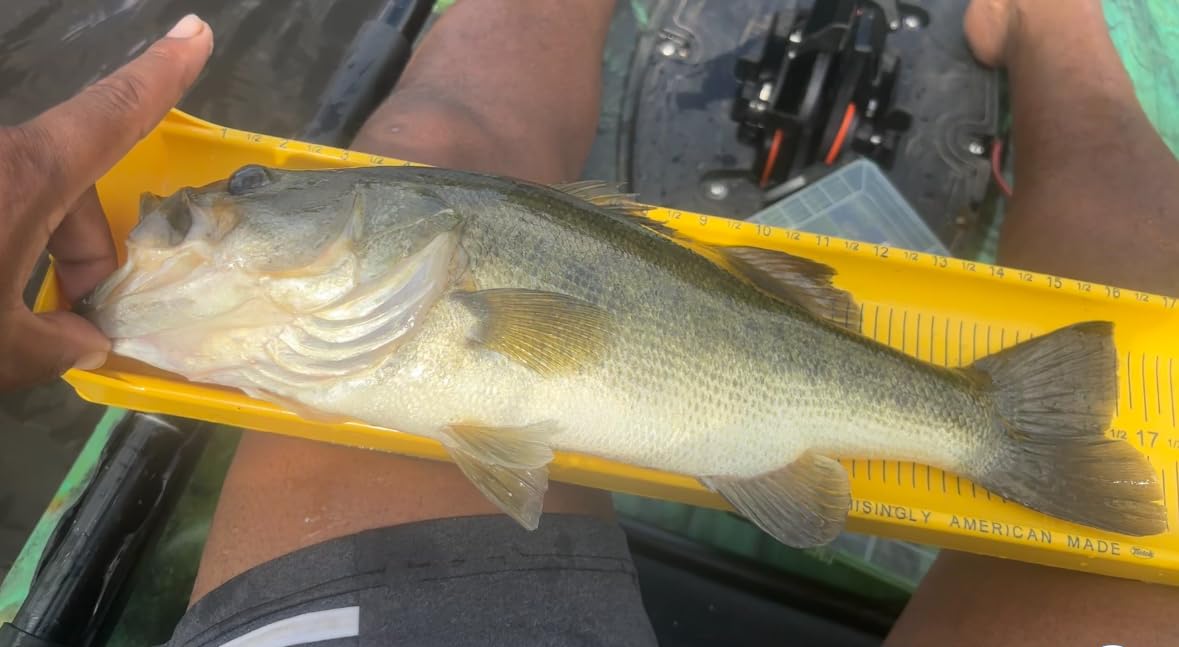
Clever detail: the moulded handles contain metal accessory track grooves, so rigging is built into the carry points rather than added later. The rudder handle is reachable from either side of the seat.
Now the honest part. This listing has the widest rating spread of anything we covered, with 16 percent one-star reviews alongside strong five-star reports. Positive feedback clusters on the light carry weight, the rigging tracks and the plant-friendly drive. Negative feedback concentrates on the pedal drive and rudder, with owners describing a steep learning curve and mixed durability.
The lifetime limited hull warranty from an established paddlesport manufacturer is a meaningful offset to that risk. The 300 pound rating is tight, so pack light.
Where this fin drive shines
Grass beds, flooded vegetation, shallow bays and anywhere a propeller would stall. Owners who fish weedy water specifically praise how the fins lift over plants rather than tangling in them, and several forum regulars with fin-drive kayaks say they would not go back to a propeller in that environment.
At 59 pounds, this is also the boat to buy if you fish a shoreline you have to walk to, or if you want to keep a pedal kayak inside a garage without a rack or trailer.
Why the rating gives us pause
A 3.7-star average across 30 reviews means real owners are unhappy. The complaints concentrate in the drive and steering hardware, and the rudder is described as an assist rather than a primary control, so it will not replace a paddle in close quarters.
Buy it if you need the two things it does better than anything else here, and if the lifetime hull warranty matters to you. Otherwise the safer fin-drive option is the BKC Brooklyn 10.0.
Pedal Drive Systems Explained
Every boat on this list is propelled by feet, but the mechanisms differ in ways that dictate what water you can fish. Understanding the five drive types is the fastest way to narrow twelve hulls down to two or three candidates.
Propeller drive (prop drive)
A propeller drive uses a chain, belt or gear train to spin a small propeller through the hull. It is the most efficient type, holds speed well and reverses, which makes it the standard choice on lakes, bays and open water. The weakness is debris: weeds, branches and submerged grass wrap around the prop and kill your momentum until you clear them.
Push-pedal and flipper fin drives
Flipper drives use large underwater fins that flex on the power stroke and fold back on recovery, so they push water without a spinning shaft. Because the fins lift rather than cut, they pass over vegetation and branches. That makes them the right drive for shallow marsh, grassy flats and flooded timber, at the cost of some open-water efficiency.
Rotating and gear-driven systems
Rotating pedal systems spin a shaft directly, while gear-driven units route your leg motion through a reduction gear to multiply torque. Lower gear ratios give more thrust per stroke and better balance in current, at the cost of top speed. Anglers moving up a river or fighting a tide will feel the difference immediately.
Hybrid pedal-motor systems
A hybrid gives you foot power plus a mounting point for an electric motor, letting you pedal in the shallows and motor in the channel. Several owners of the boats here run exactly that setup, and one of them on this list is explicitly designed to accept a trolling motor later.
Choosing by water type
For deep open water, cold lakes and long crossings, choose a propeller drive for speed and efficiency. For shallow, weedy or snag-filled water, choose a fin drive. For rivers and current, prioritise torque and steering response over top speed. Our general rule: if you are ever uncertain, buy the hull that is sold in both drive configurations and pick the drive last.
How to Choose a Pedal Drive Fishing Kayak
Start with your own numbers before you fall for a hull. Sit down with your typical gear load and your body weight, add them together, then compare against the usable capacity rather than the maximum rating. Marketing capacity is measured with a minimal load; the usable figure is the one that describes a real fishing day.
Beam width matters more than length for most anglers. A wider hull gives primary stability, which is what lets you stand and cast. Below about 33 inches, standing becomes a commitment; above 35 inches, it becomes normal. Length gives tracking and speed, which is what you need on open water. Decide which one your water asks for.
Rigged weight is the number people forget. The hull weight on a spec sheet is not what you lift. Add the seat, the drive unit, the pedal console, tracks and hardware, and a 107 pound hull can become a 130 pound carry. If you launch solo, factor in a kayak cart in your budget.
Seat type sets your endurance. A framed mesh seat with back support and an adjustable slide track is worth paying for if you fish full days. A stadium seat suits shorter trips. Elevated seating improves your sight line over chop and helps you read structure.
Rigging should be standard, not an accessory project. Look for flush-mount rod holders, accessory tracks or in-handle rigging grooves, a watertight bow hatch, a stern tankwell or cargo bungees, and a transducer shield or universal mount. Boats that ship these fitted save both money and drilling.
The rudder deserves as much attention as the drive. A hand-operated rudder gives noticeably better control in wind and current than a foot-operated one. On a propeller boat you may still want a paddle for close quarters, since some rudders assist rather than steer.
Check warranty length and parts availability before anything else. A drive unit is a mechanical assembly that will need maintenance. Warranty terms on these boats range from six months to seven years, and parts are brand-specific. Ask your dealer directly who services a drive claim in your area.
Finally, ask whether you should buy a pedal kayak at all. If your budget would otherwise buy a much better paddle boat, and your fishing is mostly close-range work in shallow water, the paddle kayak is the smarter purchase. If you cover real distances, fish hands-free, or fish from bow and stern, pedal drive earns its cost.
Pedal Drive vs Paddle vs Trolling Motor
These three propulsion types get compared constantly, and the honest answer is that each wins in a different scenario.
Pedal drive is quiet, requires no battery, needs no registration in most states, and keeps both hands free indefinitely. It costs more at purchase, adds weight, and needs regular cleaning of the drive. It cannot run silently past a wary fish at a distance the way an electric motor can, though it is far quieter than a small outboard.
Paddle is the lightest, cheapest, simplest and most repairable option. It is also the most physically demanding over distance and it occupies your hands and your lap when you are fishing. For short distances and shallow water it remains hard to beat.
Trolling motor delivers silent, remote-control movement and is the only option that handles heavy current without effort. The costs are a battery you must charge and keep dry, added hull weight, a mount that consumes deck space, and in saltwater most states require registration or a licence because it is considered a motorized vessel.
Our practical recommendation: pedal drive as the primary system, paddle always aboard, and a trolling motor only if you fish tidal water, heavy current or very long distances where silence matters.
Safety, Maintenance and Running Costs
Wear a properly fitted personal flotation device on every trip. Anglers in pedal kayaks face a specific hazard that paddlers do not: the drive unit and console add hard edges and mass around your legs, and getting back in after a capsize is harder from a higher, heavier seat. Practise a remount in shallow water before you ever need one in real conditions.
Shovel water out after capsizing rather than trying to remount while swimming. A drive unit full of water weighs far more than the console does dry, and freeing a propeller from a wrapped weed in a current is not a task to attempt while floating.
Prop drive maintenance is simple and mostly ignored. After every trip on weedy or debris-filled water, pull the weed off the prop and drive shaft, rinse with fresh water, especially after any saltwater session, and check that the prop spins freely with no bent blades. Keep the drive chain or belt tensioned according to the manufacturer’s guidance and never operate it dry.
Rinse the hull and rigging tracks after saltwater use, since corrosion around stainless fittings still happens faster than most owners expect. Store the boat out of direct sunlight to protect the polyethylene from UV and any electronics from heat.
On running costs, pedal drive keeps most of the money in your pocket after the purchase. There is no battery to replace, no fuel and no annual registration in the large majority of states. Budget instead for a spare prop or fin assembly, a replacement pedal or drive cable when the years add up, and a kayak cart for solo anglers, since those are the three expenses nearly every owner eventually faces.
Frequently Asked Questions
What is the best fishing kayak?
For most anglers fishing from a pedal boat, the Old Town Sportsman PDL 106 is the strongest all-round choice, with a 450 pound capacity, a 36 inch beam for standing casts and a removable 18 pound pedal console that makes it easier to transport. Big-water anglers should step up to the 13 foot Sportsman BigWater PDL 132, while anglers who need the lightest boat should look at the 59 pound Pelican Catch Kicker 110.
Can I add pedals to my kayak?
You can add a pedal drive to some kayaks, but it depends entirely on the hull. Rotary pedal drives bolt to a flat transom area and a propeller drive needs a well beneath the hull, so only certain hulls are compatible. Frames, inflatable kayaks and sit-on-tops without a transom are usually not candidates. Before buying a drive kit, confirm the manufacturer lists your exact hull as compatible.
Which kayak is best for the sea?
For open ocean and bay fishing, length and tracking matter most, which is why the 13 foot Old Town Sportsman BigWater PDL 132 and the 12 foot Old Town Malibu Pedal Solo are the right shapes for the job. Both handle chop and hold a line better than shorter pedal hulls. Note that a pedal drive system adds hard hardware and weight around the cockpit, which makes remounting after a capsize harder in breaking surf than it would be in a paddle boat.
How fast do pedal drive kayaks go?
Most anglers paddle at roughly 3 mph and sustain around 4 to 5 mph on a pedal drive in calm water. Actual speed depends on hull length, prop pitch, gear ratio and current. The convertible pedal board on this list quotes 6 to 8 km/h, which is at the fast end of what foot propulsion delivers. In practice you rarely ride at full speed because you are fishing, not racing.
Are pedal drive kayaks worth it?
They are worth it if you cover real distances, fish hands-free, cast from a standing position or fish from the bow and stern. They are less worth it if your fishing is mostly short paddles in shallow water, because a paddle kayak at the same budget is lighter, cheaper to maintain and easier to carry. Many owners estimate they use the pedals for around half of their time and still carry a paddle for everything else.
What is the difference between prop drive and fin drive kayaks?
A propeller drive spins a shaft-driven prop that pushes water efficiently and holds speed, but it snags weeds, branches and submerged grass. A fin drive uses large underwater fins that flex on the power stroke and fold on recovery, so they lift over vegetation instead of cutting through it. Prop drives suit open water and long crossings; fin drives suit shallow marsh, grassy flats and flooded timber.
Do pedal drive kayaks work in shallow water?
They do, but the drive type decides how comfortably. Propeller drives work but collect weeds and lose thrust quickly in vegetation, so you will spend the trip clearing the prop. Fin drives such as the HyDryve II system on the Pelican Catch Kicker 110 and the flipper drive on the BKC Brooklyn 10.0 are the right choice for shallow, plant-heavy water.
Do pedal drive kayaks need to be registered?
In most states, a human-powered pedal drive kayak does not require registration or a licence. The situation changes if you add a trolling motor or any electric propulsion, because most states then treat the craft as a motorized vessel with registration, licensing and safety equipment requirements. Rules vary by state, so check your local boating authority if you plan to add a motor.
Final Verdict
The best fishing kayaks with pedal drive in 2026 come down to what your water asks of you. The Old Town Sportsman PDL 106 is our Editor’s Choice because it balances capacity, a stable 36 inch beam, a removable drive console and a five-year drive warranty better than anything else on this list, and it does it at 107 pounds rather than 122.
Big-water and tournament anglers should go straight to the Sportsman BigWater PDL 132 for its 500 pound rating and open-water tracking. Weedy shallows call for a fin drive, and the Pelican Catch Kicker 110 or the BKC Brooklyn 10.0 both fill that role. And if your real constraint is storage, not fishing, the modular Reel Yaks Raider and Radar split into two pieces that live in a closet.
Before you buy anything, add up your body weight and your real gear load, and check the usable capacity rather than the headline number. Then pick the drive type that matches your water. That single decision will do more for your fishing than any other feature on the spec sheet.