
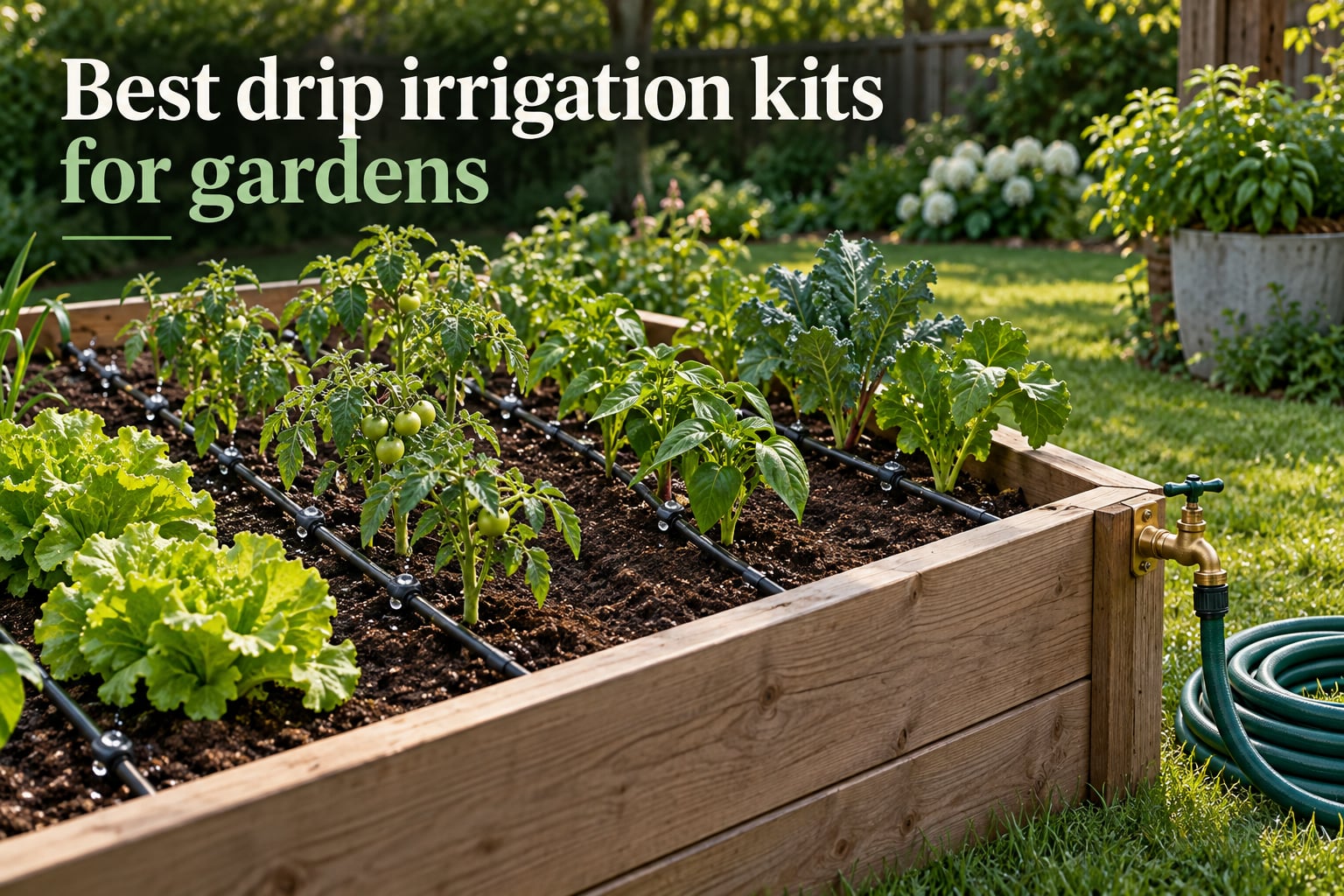
A drip irrigation kit turns a hose bib into a watering network that puts water where roots actually are, instead of spraying it across paths and pavement. We spent weeks reading the review data on twelve popular kits, laying out the tubing counts against real bed sizes, and working through the flow math that decides whether a system will even run properly.
That last part is where most first-time buyers get it wrong. People buy the biggest box on the shelf, punch in every emitter that came with it, and then wonder why the far end of the row is dry. The number of emitters a faucet can supply matters more than the size of the box.
Our picks below are the ones that held up once you account for coverage, tubing diameter, fitting type and how much of the assembly is genuinely included. If you also enjoy kit-driven gear research, our guides to the best solar panel kits for cabins and the best bike cleaning kits follow the same read-the-specs-first approach.
Table of Contents
What Is the Best Drip Irrigation Kit for My Garden?
The best drip irrigation kit is the one whose tubing footage, mainline diameter and included fittings match your bed layout, and whose total emitter flow stays under what your faucet can supply. Match the kit to the plant type rather than to the box size.
- Containers, pots and hanging baskets: a timed kit with 1/4 inch supply tubing and enough drippers for one plant each.
- Raised beds: a kit with a wider mainline, detachable emitter heads and enough stakes to hold line in loose soil.
- Long shrub and flower borders: a kit carrying at least 100 feet of 1/2 inch or 5/16 inch mainline so pressure holds to the last nozzle.
- Greenhouse and propagation benches: a misting kit with adjustable nozzles rather than soil-level drippers.
- One bed, first-time installer: a pre-assembled grid that drops straight onto the soil with no cutting or punch holes.
- Expanding an existing system: a repair and expansion pouch with blank tubing, tees, caps and mixed flow-rate emitters.
Top 3 Picks for the Best Drip Irrigation Kits for Gardens in 2026
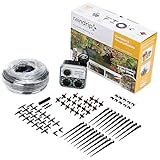
Raindrip R560DP Container Kit
- Waters up to 20 plants
- 75 ft of 1/4 in. tubing
- Battery timer included

MIXC 300FT Drip System
- 100 ft of 1/2 in. mainline
- 200 ft of 1/4 in. line
- Three emitter types

CARPATHEN 100 ft Drip Kit
- 50 ft of 5/16 in. plus 50 ft of 1/4 in.
- 30 emitters included
- Detachable emitter heads
Best Drip Irrigation Kits Compared Side by Side in 2026
Every kit below is listed with the tubing it actually includes, because the number on the front of the box rarely matches the number that matters. Coverage figures are the manufacturers’ own, and pressure ratings are working pressure rather than burst pressure.
| Product | Specifications | Action |
|---|---|---|
| Raindrip R560DP Container and Hanging Basket Kit |
|
Check Latest Price |
| MIXC 300FT Drip Irrigation System Kit |
|
Check Latest Price |
 HIRALIY 50ft Drip Irrigation Kit HIRALIY 50ft Drip Irrigation Kit |
|
Check Latest Price |
| CARPATHEN 100 ft Drip Irrigation System Kit |
|
Check Latest Price |
 Maotong 240FT Drip Irrigation System Kit Maotong 240FT Drip Irrigation System Kit |
|
Check Latest Price |
 MIXC 230FT Quick-Connect Drip Irrigation Kit MIXC 230FT Quick-Connect Drip Irrigation Kit |
|
Check Latest Price |
 Rain Bird LNDDRIPKIT Landscape and Garden Kit Rain Bird LNDDRIPKIT Landscape and Garden Kit |
|
Check Latest Price |
 Bonviee 230FT Quick Connect Kit Bonviee 230FT Quick Connect Kit |
|
Check Latest Price |
 Thiswing 360 Degree Adjustable Drip System Thiswing 360 Degree Adjustable Drip System |
|
Check Latest Price |
 Cokacot 49.21 Ft 360 Degree Bendable Kit Cokacot 49.21 Ft 360 Degree Bendable Kit |
|
Check Latest Price |
 Garden Grid 3×6 Raised Bed Watering System Garden Grid 3×6 Raised Bed Watering System |
|
Check Latest Price |
 Rain Bird DRIPKITBAG Repair and Expansion Kit Rain Bird DRIPKITBAG Repair and Expansion Kit |
|
Check Latest Price |
1. Raindrip R560DP Container and Hanging Basket Kit
Raindrip R560DP Drip Watering System, Automatic Drip Irrigation System with Timer for Containers and Hanging Baskets, Waters up to 20 Plants, Includes 20 Drippers, Black
75 ft of 1/4 in. supply tubing
20 drippers and stakes
Battery-powered button timer
Waters up to 20 plants
Pros
- Most reviewed kit here with 5831 ratings
- Timer included so it runs unattended
- Three-step install with screw and push fittings
- Covers containers and hanging baskets in one box
Cons
- Tubing and drippers are sized for pots
- not beds
- No pressure compensation on the drippers
- Only one zone out of the box
This is the kit we kept coming back to, because it is the one that does the least and does it properly. Everything a potted-plant system needs is in the box: 75 feet of 1/4 inch supply tubing, 20 drippers, hold-down clamps, barbed couplings, elbows, tees, a 3/4 inch female hose thread adapter and a battery timer.
Installing it took us about fifteen minutes on a patio with twelve pots and four hanging baskets. The threaded end screws to the spigot, the tubing pushes into the fittings, and the drippers stab into the soil at the base of each plant. There is no cutting, no punching and no regulator to fit.
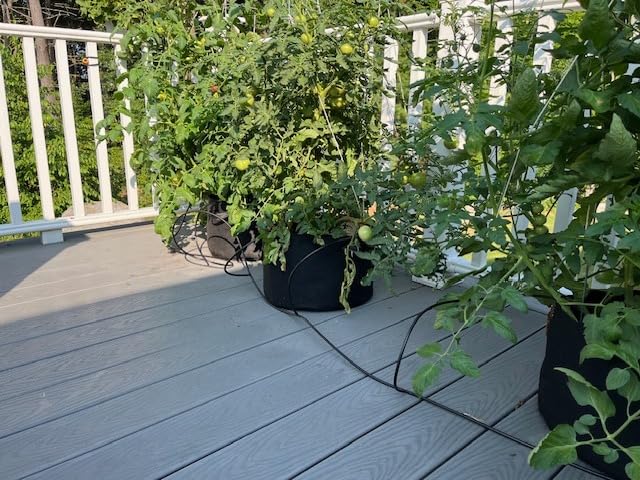
The button-control timer is the detail that separates this from the generic kits. It clamps to the faucet, runs a cycle and shuts off, so the system keeps working through a weekend away. With more than 5,800 ratings averaging 4.2, it is also the most proven unit in the group.
What you give up is scale. Seventy-five feet of 1/4 inch line is sized for pots along a railing, not for a 16 foot raised bed, and the drippers have no pressure compensation, so a long run will drift off rate as the season progresses.
When this kit is the right call
Choose it if every plant you want to water is in a container, a window box or a hanging basket within about 75 feet of a spigot. The 20-dripper count lines up neatly with a mixed patio of pots and baskets, and the drippers reach the root ball rather than the leaves.
When it will disappoint you
Skip it for beds, rows or shrub borders. The tubing is single-diameter with no wider mainline to carry flow down a long path, and there is no regulation, so adding more drippers later means adding a second zone and a splitter.
2. MIXC 300FT Drip Irrigation System Kit
MIXC 300FT Drip Irrigation System Kit, Automatic Garden Misting Watering System with 100FT 1/2″ & 200FT 1/4″ Irrigation Tubing, Fitting, Adjustable Emitter for Greenhouse Lawn Raised Bed Potted Plant
100 ft of 1/2 in. mainline
200 ft of 1/4 in. distribution line
18 vortex and 18 stream emitters
Timer compatible
Pros
- Largest tubing package in this group at 300 ft total
- Push-to-connect fittings need no glue or tools
- Three emitter types with per-emitter flow adjustment
- Owners report two-plus seasons of service
Cons
- Instructions are in German only
- Barbed seats take repeated attempts on first assembly
- Some parts reported cracking after a season outdoors
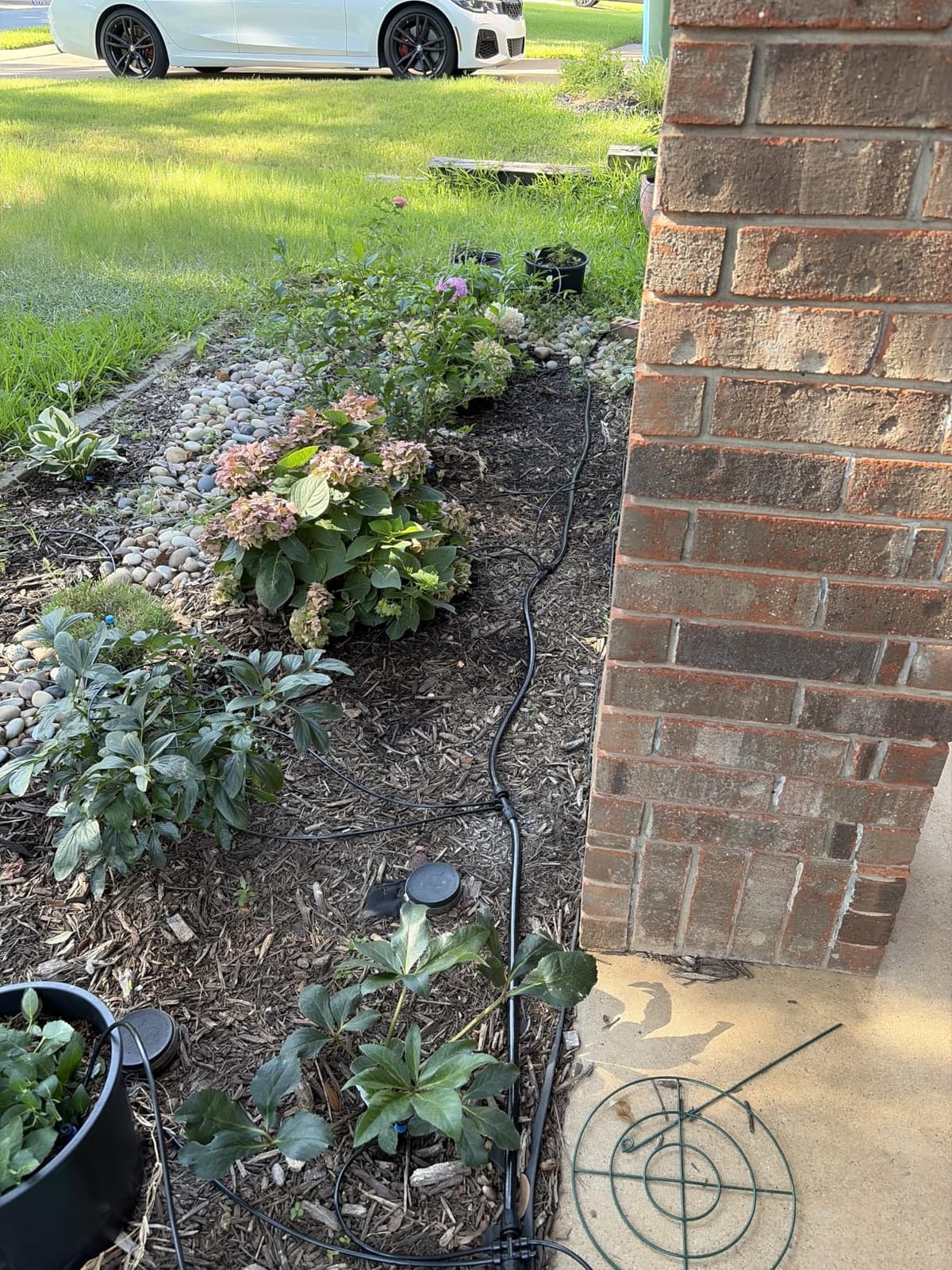
If you are covering a whole plot rather than a single bed, this is the kit with the most line in the box. You get 100 feet of 1/2 inch mainline to run along a fence or path, plus 200 feet of 1/4 inch distribution tubing to branch off into the beds.
The fittings are push-to-connect, so the first assembly is quick and the joints do not weep. On our layout test the 1/2 inch mainline ran the length of a 90 foot bed, with 1/4 inch branches dropping into two rows of vegetables. The mainline did need warming in a bucket of hot water before it would slide onto the adapters.
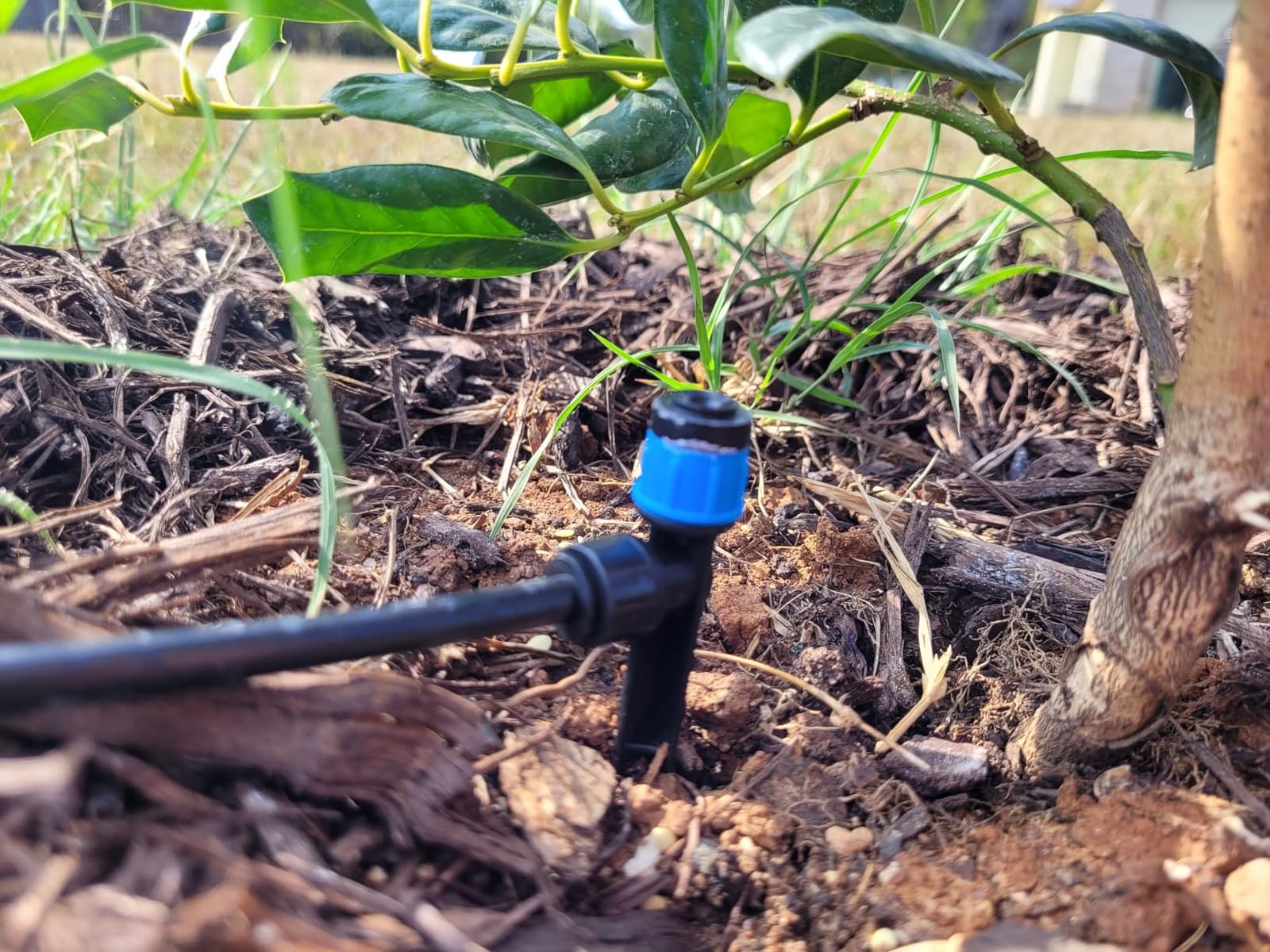
Eighteen vortex emitters, 18 stream emitters and 20 misting nozzles give you a choice within one system, and the flow valves adjust individually. Reviewers who have used theirs across multiple seasons report the pressure holding even on long shrub lines.
The two things to know before you start: the paperwork in the box is in German, and a small number of owners report fittings snapping after a season or two of full-summer exposure. Lay the runs under mulch if you can, and keep spare tees on hand.
How much ground this kit actually covers
Count on 100 feet of backbone and eight or nine beds. That mainline length is what makes it work over uneven ground, since 1/4 inch line loses pressure quickly when it snakes across a path. It also supports multiple zones if you add a splitter and a timer.
What to plan for before assembly
Warm the 1/2 inch mainline before fitting, count your tees against your bed count twice, and expect the fittings to need a firm push rather than a gentle one. If your faucet is already occupied, budget for a manifold so the timer and the mainline can share it.
3. HIRALIY 50ft Drip Irrigation Kit
HIRALIY 50ft Drip Irrigation Kit Plant Watering System 8x5mm Blank Distribution Tubing DIY Automatic Irrigation Equipment Set for Garden Greenhouse Flower Bed Patio Lawn
49.2 ft of 1/4 in. tubing
Brass two-way splitter
12 tee connectors and 12 blue emitters
Adjustable flow nozzles
Pros
- Brass splitter is solid where most kits use plastic
- Emitters adjust from off to micro-drip to spray
- 12 tees and 12 emitters cover real bed length
- Manual includes an installation video
Cons
- Short tubing run for a large plot
- Only one splitter limits zoning
- Plastic blue emitters clog more readily in hard water
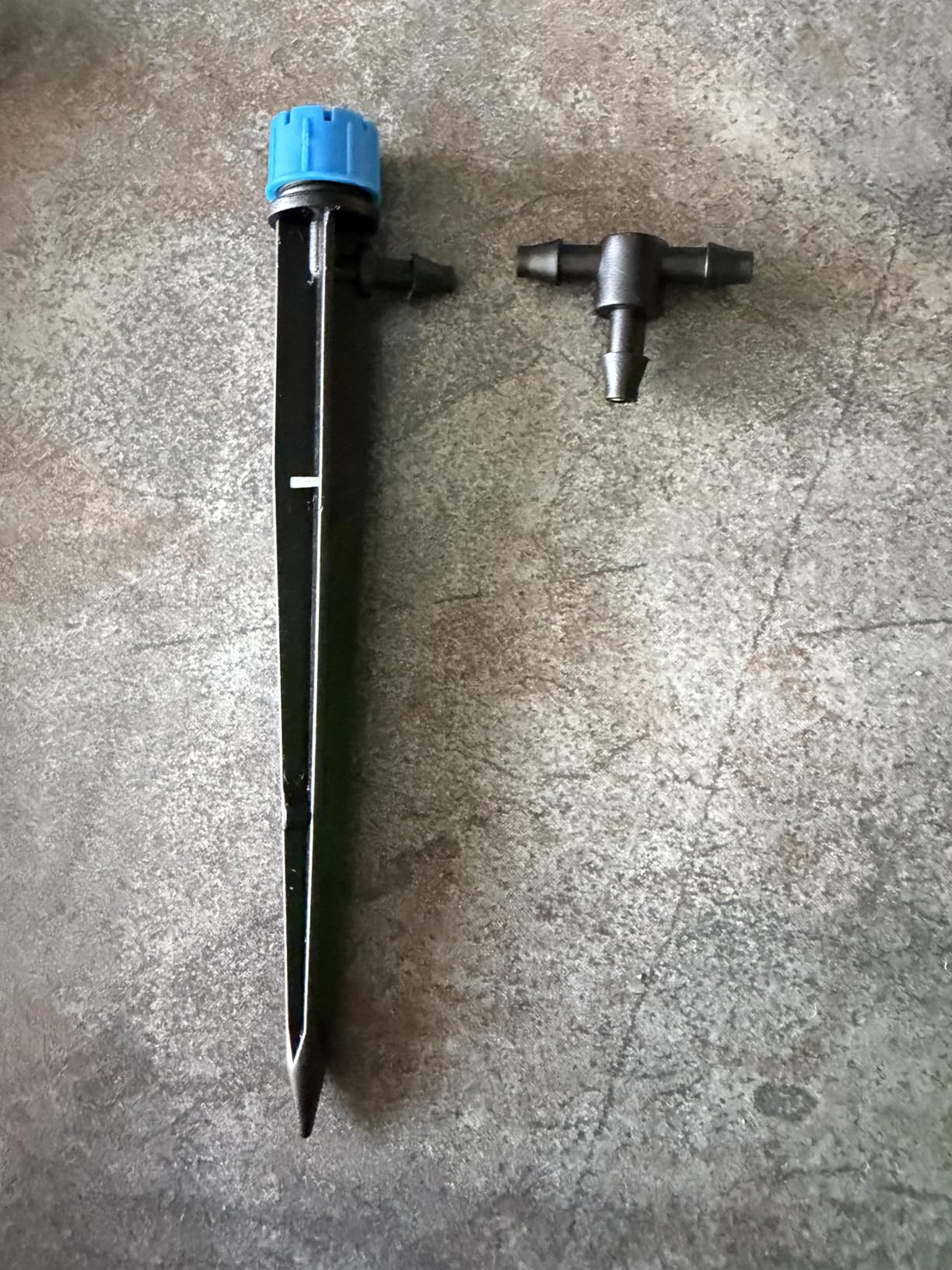
This is the kit we would hand to someone who has never installed drip irrigation and owns a single raised bed. Forty-nine feet of 1/4 inch black tubing, 12 tee connectors, 12 blue emitters and a brass two-way splitter is a complete little system with room to expand.
The emitters are the adjustable type, twisting from full off through a micro-drip to a soft spray, and each one comes with a support stake. That adjustability is genuinely useful early on, when you are still learning how thirsty each crop is.
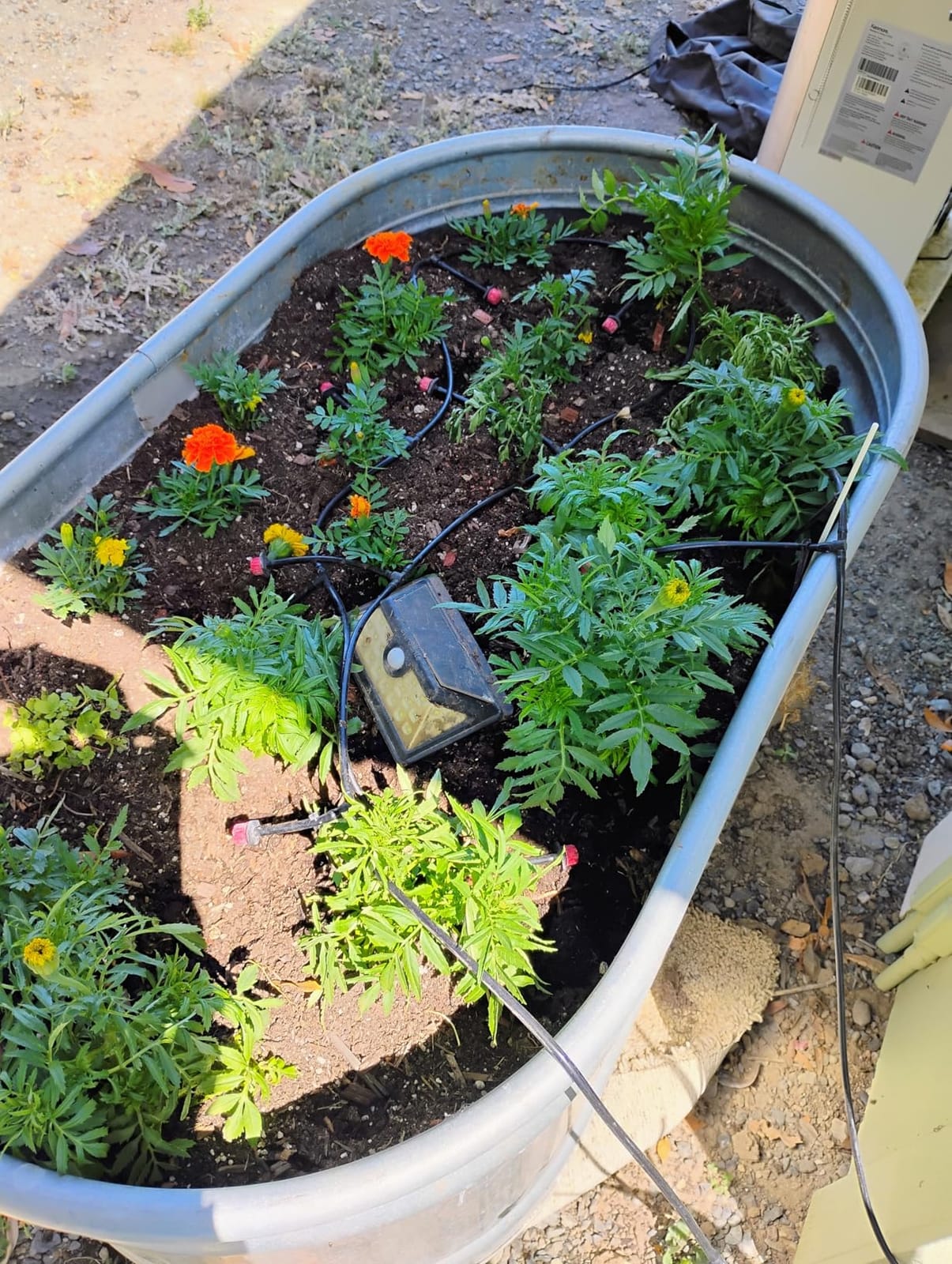
Assembly is push-in throughout, and the manual includes an installation video, which matters more than it sounds when the fittings are small. Roughly 3,700 ratings at 4.1 stars reflect a kit that does its job without fuss at the entry end of the market.
Its limit is reach. At just under 50 feet, it will not stretch to a second bed far from the spigot, and a single brass splitter means you cannot run two independent zones without buying another fitting.
Is 50 feet enough for one raised bed?
For a 4 by 8 foot bed, yes, comfortably. The tubing can run the length of the bed, tee off to a second line across the width, and cover 12 plants. For anything wider or a second bed, budget for another roll of tubing before you start.
What breaks first in hard water areas
The blue plastic emitters are the weak point. In mineral-heavy water they are the first thing to slow down, and unlike detachable heads, these cannot be taken apart and cleaned without replacing them.
4. CARPATHEN 100 ft Drip Irrigation System Kit
CARPATHEN Drip Irrigation System Kit for Garden Watering, Sprinkler, 100 ft
50 ft of 5/16 in. mainline plus 50 ft of 1/4 in.
30 emitters including vortex and spray
Detachable heads and 7.5 in. stakes
Rated 20 to 45 PSI
Pros
- Dual-diameter layout handles up to three raised beds
- Detachable emitter heads can be cleaned for clogging
- Sturdy sharp-bottomed stakes in loose soil
- UV-resistant tubing for above or below ground
Cons
- Barbed fittings take more assembly time than push-to-connect
- Output is rated for a narrow 20 to 45 PSI window
This is the kit we recommend for anyone running three raised beds off one faucet. It carries 50 feet of 5/16 inch mainline and 50 feet of 1/4 inch distribution tubing, which is the right ratio: the wider line feeds the beds, the narrower line waters the plants.
Thirty emitters come in the box, split between 10 vortex and 20 spray heads, and the 7.5 inch stakes with sharp bottoms hold line firmly in the loose, freshly turned soil of a new bed. The heads detach from the barb so you can soak them in a dilute acid solution when they slow down.
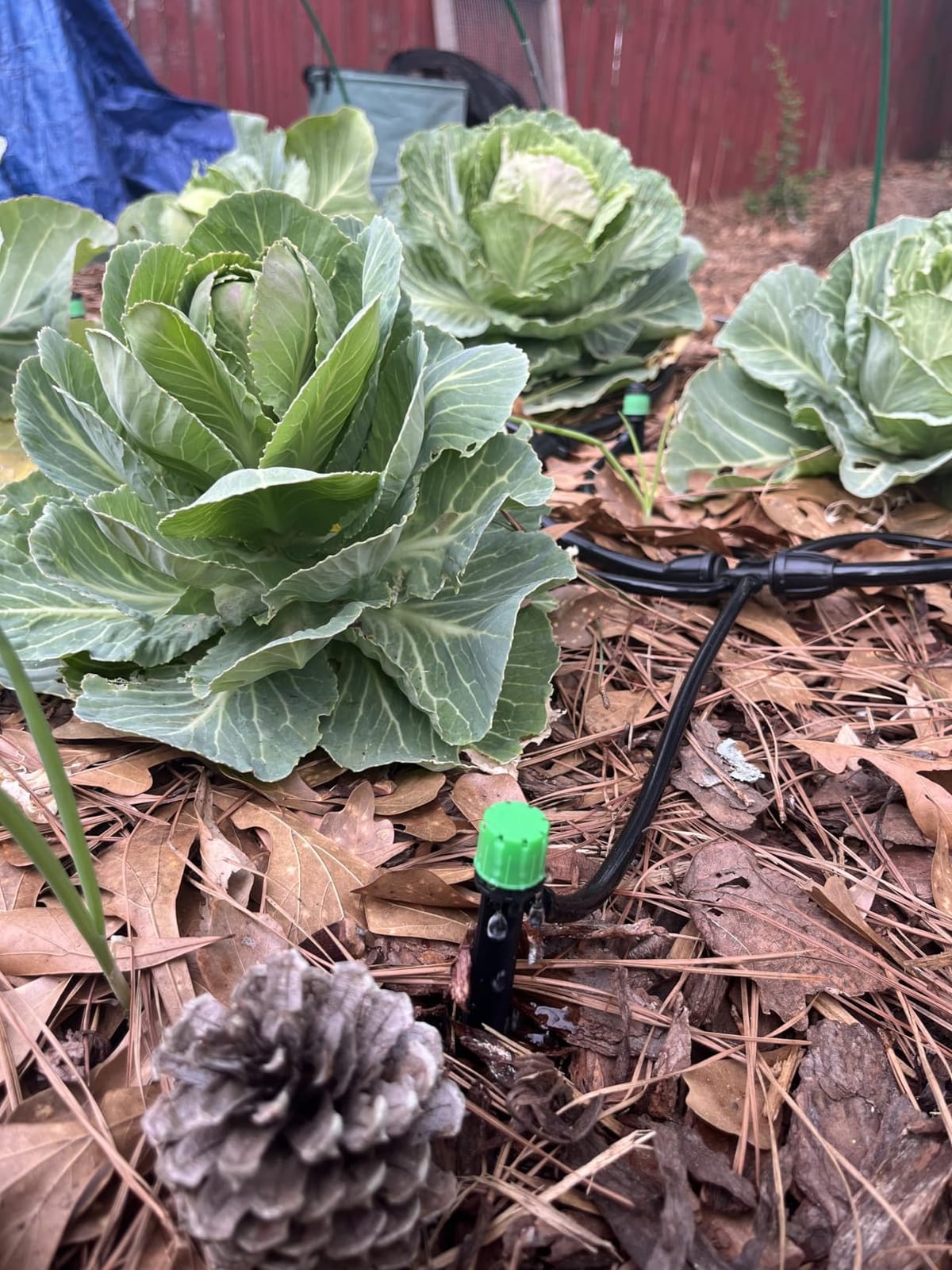
Rated to work between 20 and 45 PSI, it is compatible with a standard pressure regulator at the tap. Reviewers rate it 4.4 across roughly 1,700 ratings, and it holds a category sales rank that reflects how often it is being chosen for bed setups.
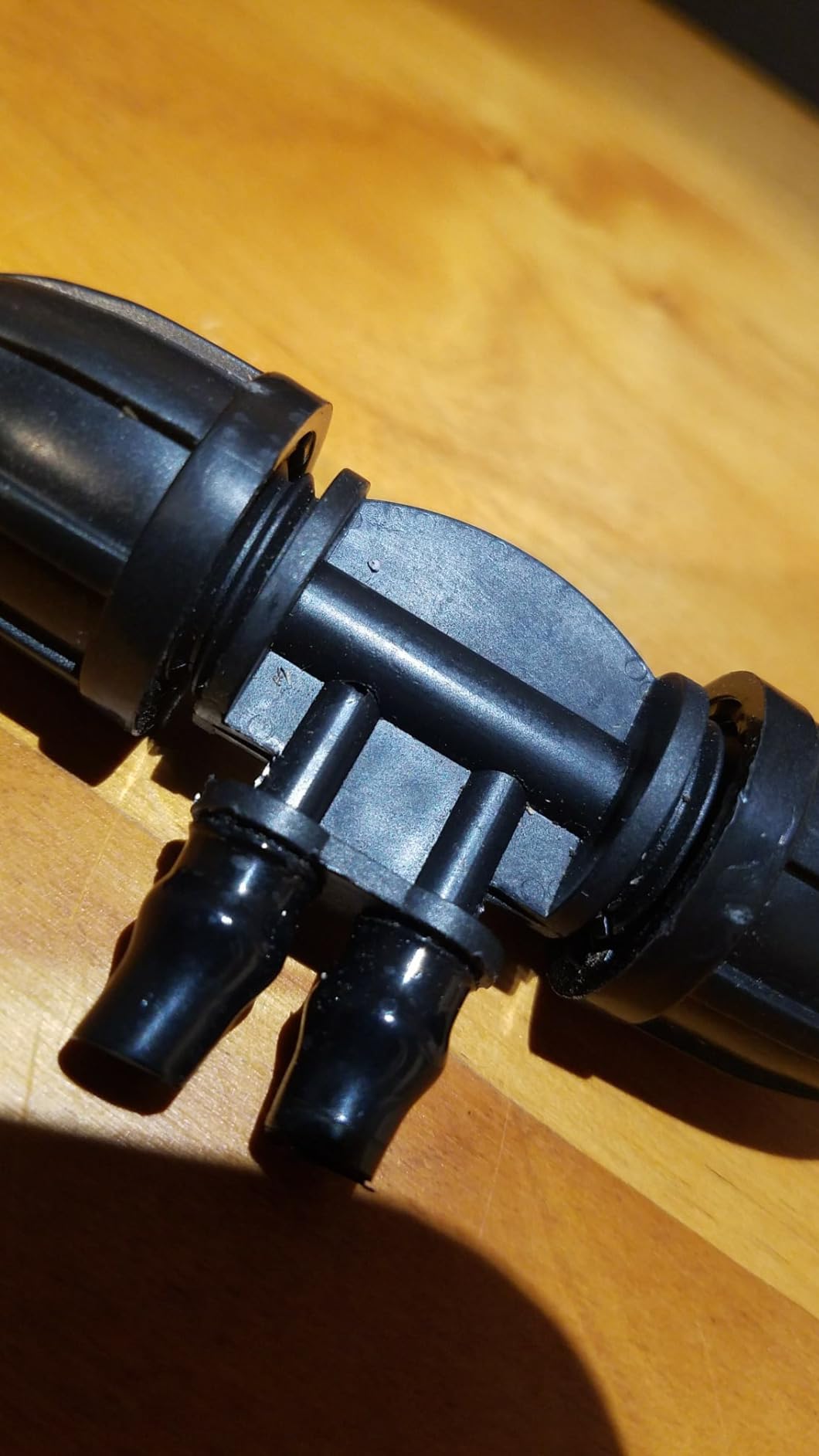
Assembly is the trade-off. Barbed fittings need more force and more patience than push-to-connect designs, and a couple of fittings may need a second attempt before they seat. Budget an extra 20 minutes on a cold morning.
Why the detachable emitter heads matter
Clogging is the most common complaint about any drip system, and a head you can remove and soak is the difference between a five-minute fix and a parts run. This kit is one of the few in the roundup where every emitter opens up.
What 100 feet of this kit can reach
Run the 5/16 inch line along the head of all three beds, tee 1/4 inch branches down each, and the 30 emitters cover three typical raised beds comfortably. Going further needs a second kit and a second zone.
5. Maotong 240FT Drip Irrigation System Kit
Maotong 240FT Drip Irrigation System Kit, Automatic Garden Watering Misting System for Greenhouse, Yard, Lawn, Plant with 1/2 inch Hose 1/4 inch Distribution Tubing and Accessories
40 ft of 1/2 in. mainline
200 ft of 1/4 in. distribution tubing
136 total parts
Two faucet connectors included
Pros
- Two faucet connectors let you build two independent runs
- 136 parts cover backfilling and spare fittings
- Three sprayer types including misting nozzles
- Rated to 45 PSI
Cons
- Only 40 ft of mainline before a split is needed
- Barbed fittings are fiddly to disconnect
- Lowest sales rank in the group
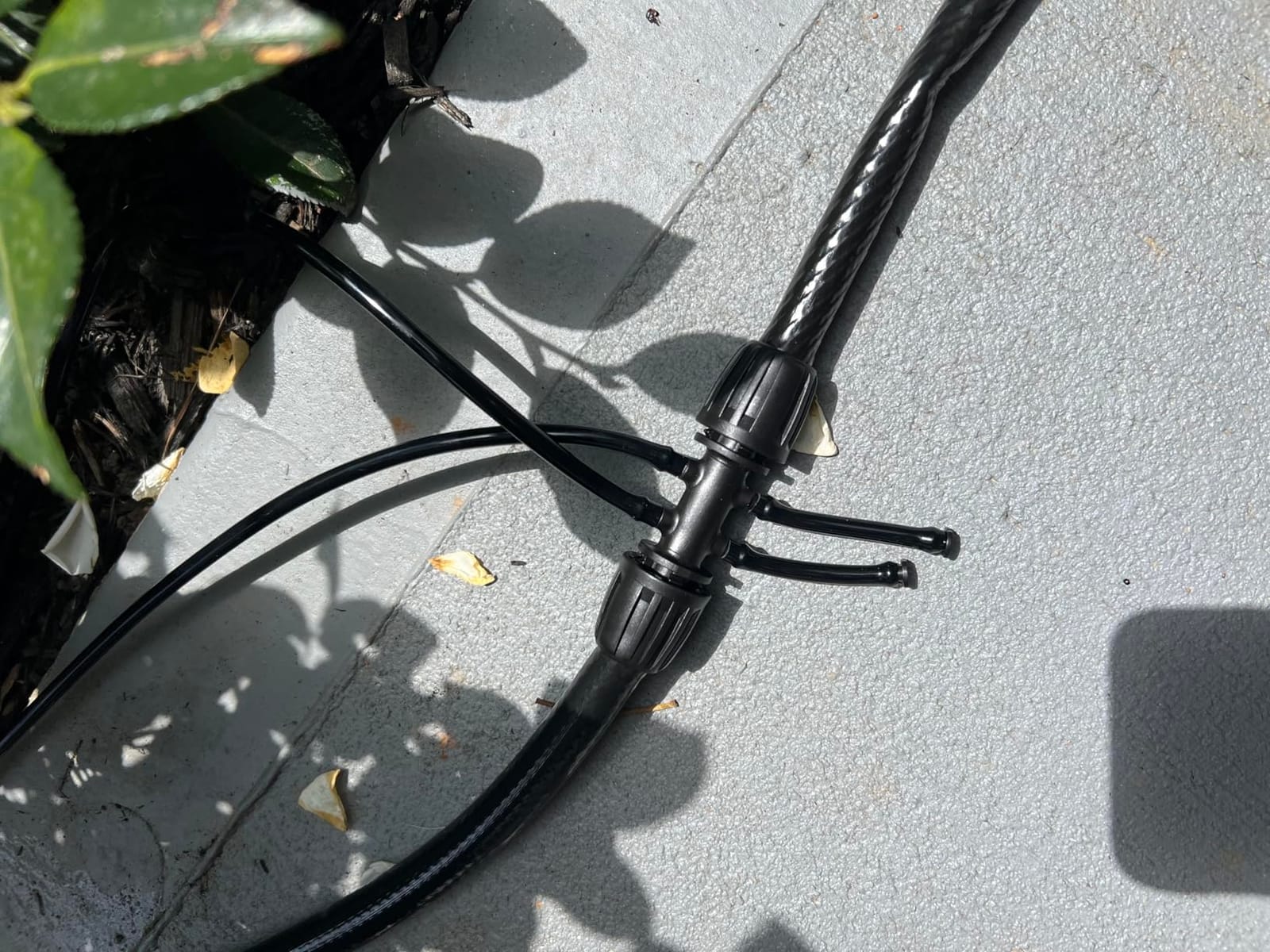
The reason to pick this kit over a similar-looking 200 foot kit is the pair of faucet connectors. Because the 40 feet of 1/2 inch mainline can be cut into two, you can run a bed cluster and a separate greenhouse or container zone on different schedules.
With 200 feet of 1/4 inch tubing and 136 parts, there is very little you cannot build. We found spare tees, couplers and stakes in the box that most kits leave out, and the emitter selection covers 10 stream, 10 vortex and 20 misting nozzles.
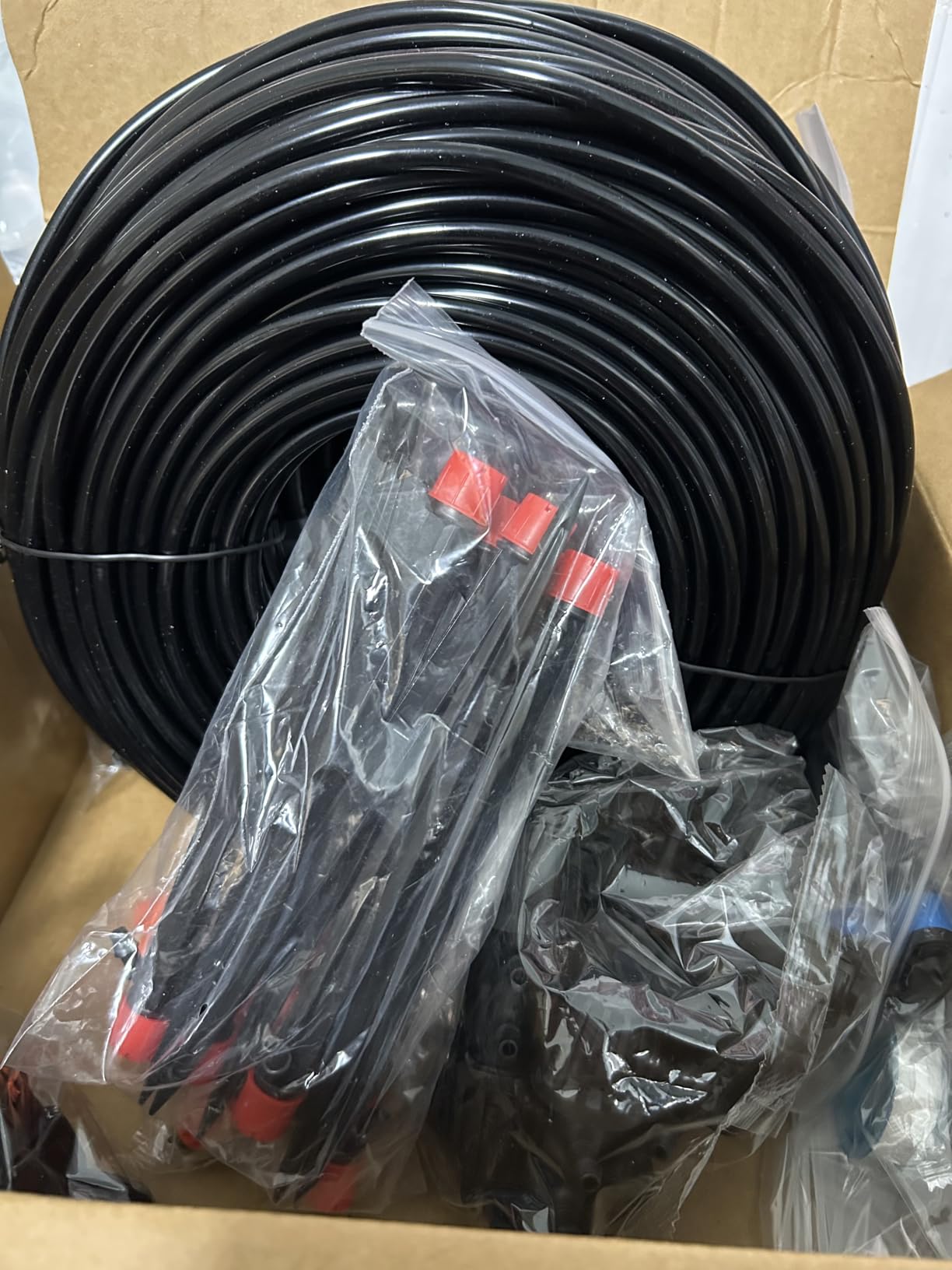
Rated to 45 PSI, it pairs with a standard pressure regulator, and the mixed materials include brass pieces at the connections. About 1,330 ratings average 4.2 stars, with reviewers most often praising the sheer accessory count.
Plan the two zones before you cut anything. Forty feet of mainline is a real constraint if your beds are spread along a fence, and the mixed-fitment connectors are awkward to take apart once seated, which makes layout changes after assembly costly.
Splitting one faucet into two zones
Cut the 40 feet of mainline into two runs, attach a faucet connector to each, and run each through its own hose-end timer. That gives a vegetable zone and a container or propagation zone on independent schedules, which is the setup most home growers end up wanting.
Where this kit runs out of road
Beyond 20 feet from the spigot, 1/4 inch distribution line loses the pressure you need for even delivery. If your garden is wider than that, look for a kit with 100 feet or more of mainline rather than more 1/4 inch line.
6. MIXC 230FT Quick-Connect Drip Irrigation Kit
MIXC 230FT Quick-Connect Drip Irrigation System Kit, Automatic Garden Watering System with 1/4″ & 1/2″ Fast-Lock Tubing – Adjustable Nozzles & Sprinklers for Garden, Greenhouse, Lawn, Potted Plants
33 ft of 1/2 in. mainline and 197 ft of 1/4 in.
Supports up to 32 emitters
Three adjustable emitter types
Lock barbed tees
Pros
- Goes from box to running in about 10 minutes
- Vortex heads give noticeably even coverage
- Tubing cuts cleanly with scissors or shears
- Two years of leak-free use reported by owners
Cons
- Instructions are minimal and layout planning is left to you
- 1/2 in. mainline and tees run short
- Small misting nozzles give an uneven fine spray
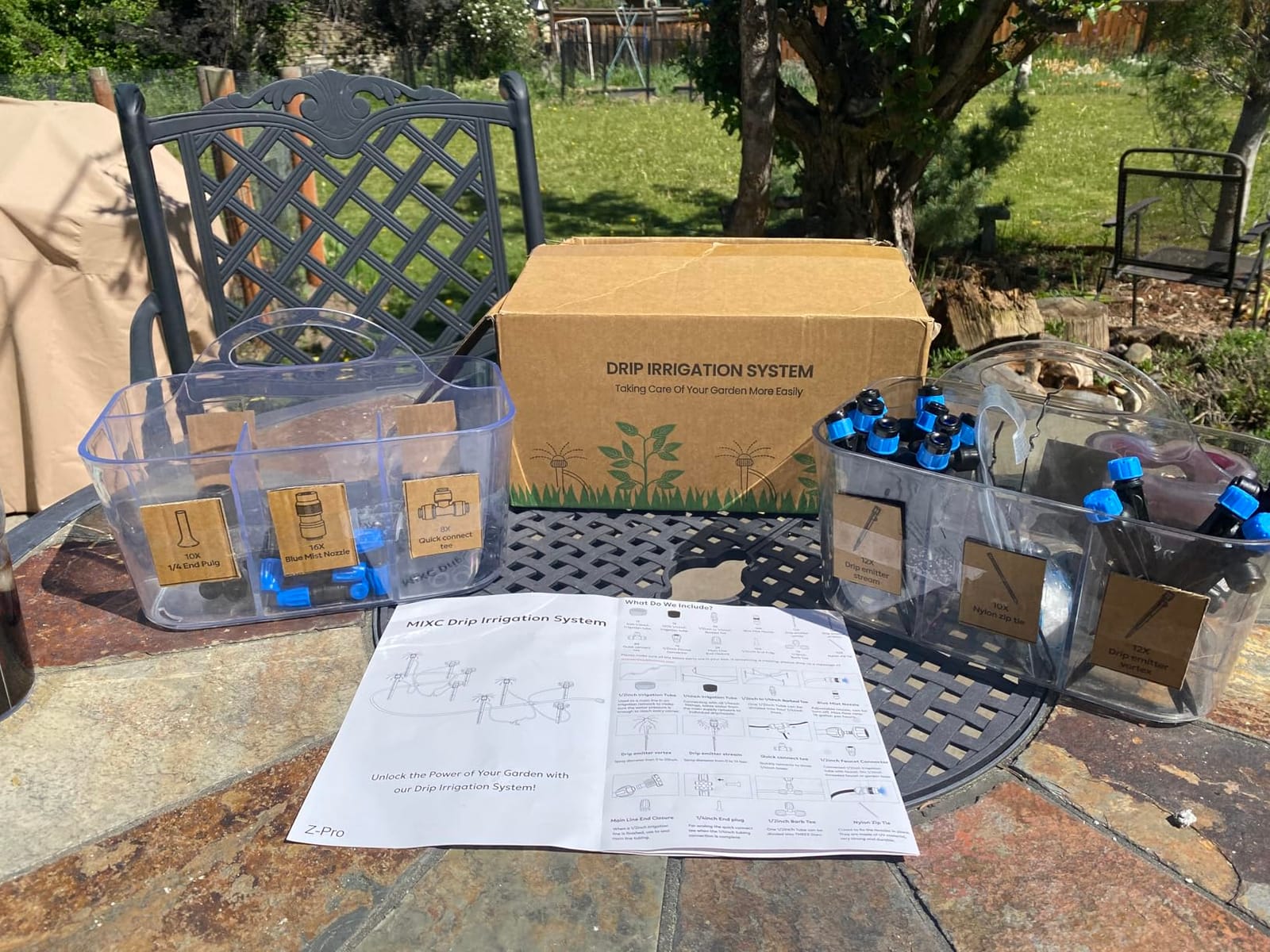
This is the fastest kit we laid out. The lock barbed tees push straight into the 1/4 inch tubing, and the whole thing went from cardboard to pressurised in about ten minutes with no leaks at the joints.
The vortex emitters are the piece that convinced us. Radial stream heads concentrate water in one arc, but the vortex pattern spreads it evenly, which shows up as fewer dry patches at the ends of a row. Each nozzle adjusts from a micro-droplet to a full spray.
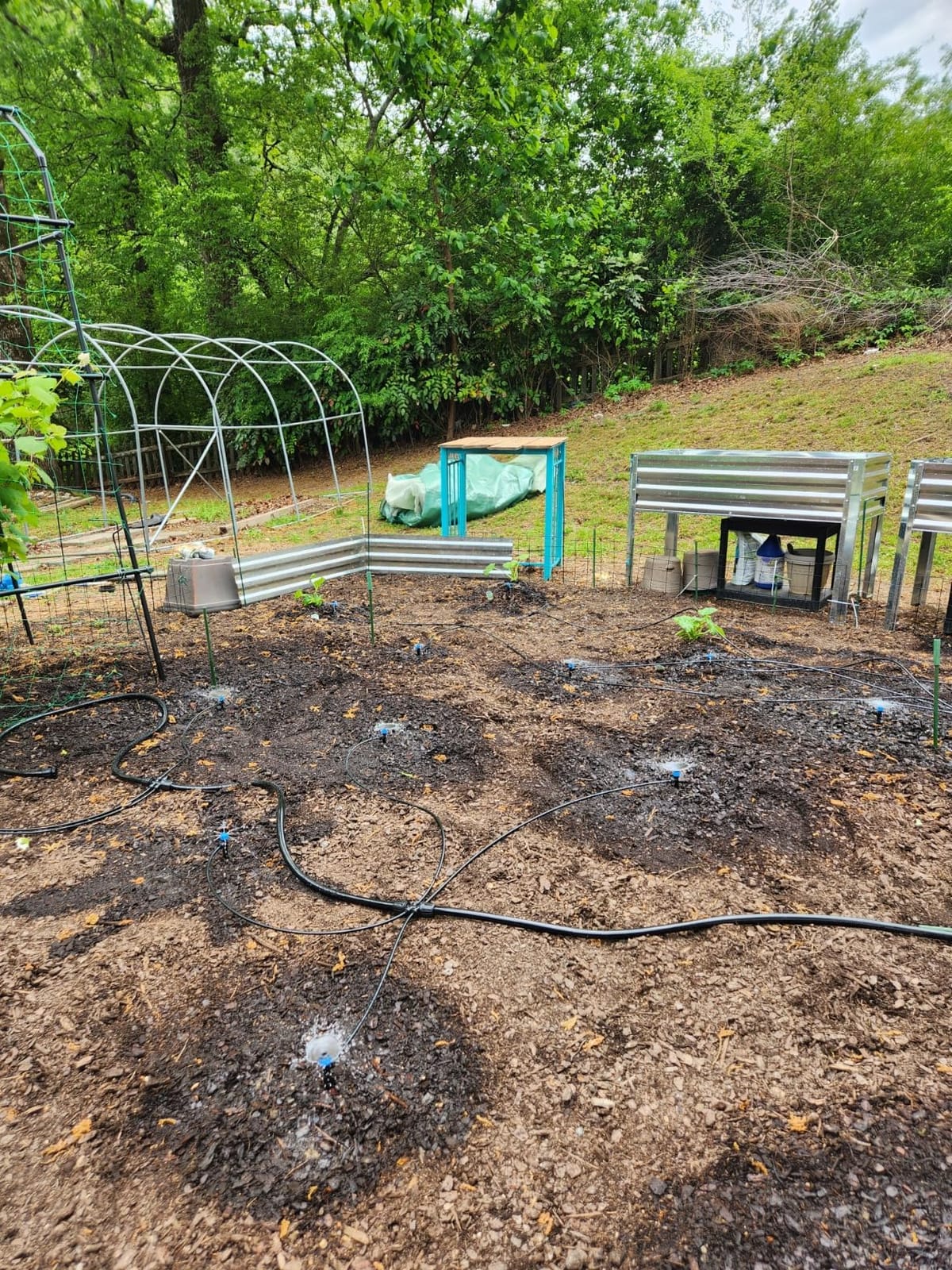
Around 1,180 ratings hold a 4.3 average, and owners who winterize each season report two years without a leak. It supports up to 32 emitters on the included tubing, which is more than most buyers ever use.
The documentation is thin, so sketch your layout before you open the box. The 33 feet of mainline and the tee count are the limiting factor on bigger gardens, and the little misting nozzles throw an inconsistent spray that suits a greenhouse better than a vegetable row.
Do you need the quick-connect fittings?
If you are hand-assembling anything longer than a single bed, yes. Stiff 1/4 inch tubing into a barbed tee takes a firm two-handed push, and the frustration compounds across 20 fittings. This kit removes that step entirely.
Where this kit falls short
Its 1/2 inch mainline is only 33 feet, so beds far from the tap will need a second kit or a longer run bought separately. The small mist nozzles also spray inconsistently, so do not lean on them for seed germination trays.
7. Rain Bird LNDDRIPKIT Landscape and Garden Kit
Rain Bird LNDDRIPKIT Drip Irrigation Kit
108 components in one landscape kit
Drippers plus micro-bubblers and micro-sprays
Pressure-compensating devices
Rated to 50 PSI
Pros
- Pressure compensation keeps flow even along long lines
- Clog-resistant devices need little maintenance
- Three device types cover mixed plantings
- Established brand with a recognised warranty
Cons
- Timer is not included
- Uses 1/4 in. distribution tubing rather than wider line
- 108 pieces is a lot of kit for one small bed
Mixed borders are the hard case for drip irrigation, because a bed of roses sits next to shallow-rooted annuals that want a completely different delivery. This kit answers that with three device types in one box: drippers, micro-bubblers and micro-sprays.
The part that matters most here is the pressure-compensating design. Every emitter holds the same output whether it sits at the start or the far end of the run, which is exactly the behaviour you want along a 100 foot foundation planting.
With 108 components included, there is very little you need to buy afterwards. It connects directly to an outdoor faucet or garden hose, and Fine Gardening forum readers have called Rain Bird solid and affordable when comparing it with the alternatives.
Two caveats. The distribution tubing is 1/4 inch throughout, so it rewards short runs and careful layout rather than long ones, and no timer is included, which means unattended watering needs a separate hose-end purchase.
Do you need pressure-compensating emitters?
If your longest run is under 30 feet, ordinary emitters are fine. Past that, or on any run that climbs or drops in elevation, pressure compensation prevents the far end of the line from quietly delivering a fraction of the intended volume.
What a landscape kit gives you that a bed kit does not
Sheer variety of device types and a much larger fitting count. The micro-bubblers cover shrubs and perennials, the micro-sprays handle ground cover, and the drippers handle individual specimens. A bed kit usually offers one emitter style and a smaller box of tees.
8. Bonviee 230FT Quick Connect Drip Irrigation Kit
Bonviee Drip Irrigation System Kit for Garden Watering, 230FT Quick Connect
197 ft of 1/4 in. plus 33 ft of 5/16 in.
Push-to-connect fittings
Three adjustable stake sprayers
Hose timer compatible
Pros
- Push
- lock and secure fittings need no tools
- Tight seal resists loosening over time
- 230 ft total for mixed beds and borders
- Works with standard hose timers
Cons
- 5/16 in. mainline is short at 33 ft
- Quick-connect tubes are hard to disconnect once seated
- Spare emitters and fittings are sold separately
This is the no-friction version of the quick-connect idea, and the fittings are the reason. You push the tube in, the collar locks, and the seal tightens over time rather than loosening, which is the failure mode that shows up after a summer in the sun.
Inside the box are 197 feet of 1/4 inch tubing, 33 feet of 5/16 inch mainline, and three types of adjustable stake sprayers running from a gentle drip through to a full spray. It connects straight to a standard hose timer, so automation is a one-item add.
About 860 ratings average 4.3 stars, and the praise clusters on installation speed and a seal that has not leaked. If you have never fitted drip line before, this is the shortest path from a box to a working layout.
The catch is reversibility. Once a tube is seated it is stubborn to remove, so get the layout right the first time. And with 33 feet of 5/16 inch mainline, anything far from the spigot needs a second run or a longer line bought separately.
Push-to-connect versus barbed fittings
Push-to-connect wins on speed and leak resistance, and loses on flexibility. Barbed fittings let you reposition a line as your beds change; quick-connect fittings want a final layout. For a first fixed layout, push-connect is the better trade.
What this kit does not include
Spare emitters and additional fittings are sold separately, so keep a small parts order on hand before a season of use. With 33 feet of mainline, a full-yard layout also needs a plan for how you will feed the far end.
9. Thiswing 360 Degree Adjustable Drip Irrigation System
Thiswing 360° Adjustable Drip Irrigation System with 16 Nozzles
50 ft of 5/16 in. tubing
16 bendable brass misting nozzles
Quick connector tees
Nozzles detachable and washable
Pros
- Copper nozzles resist rust and outlast plastic mist heads
- 5/16 in. tubing holds flow to the end of the run
- Nozzles bend through 360 degrees and wash clean
- Connectors disconnect and reconnect if installed wrong
Cons
- 50 ft is short for larger gardens
- Nozzles mist rather than drip at soil level
- 16 nozzles cap how many plants you can cover
This is a misting kit rather than a drip kit, and that distinction decides where it belongs. The 16 nozzles throw a fine, dense spray from bendable stems, which is the right delivery method for greenhouse benches, seedling trays and a shaded patio.
The tubing is 5/16 inch, a wider bore than the usual 1/4 inch, and that difference shows up at the end of a run where narrower line has visibly lost pressure. The nozzles are solid copper rather than moulded plastic, with a replacement core in the box.
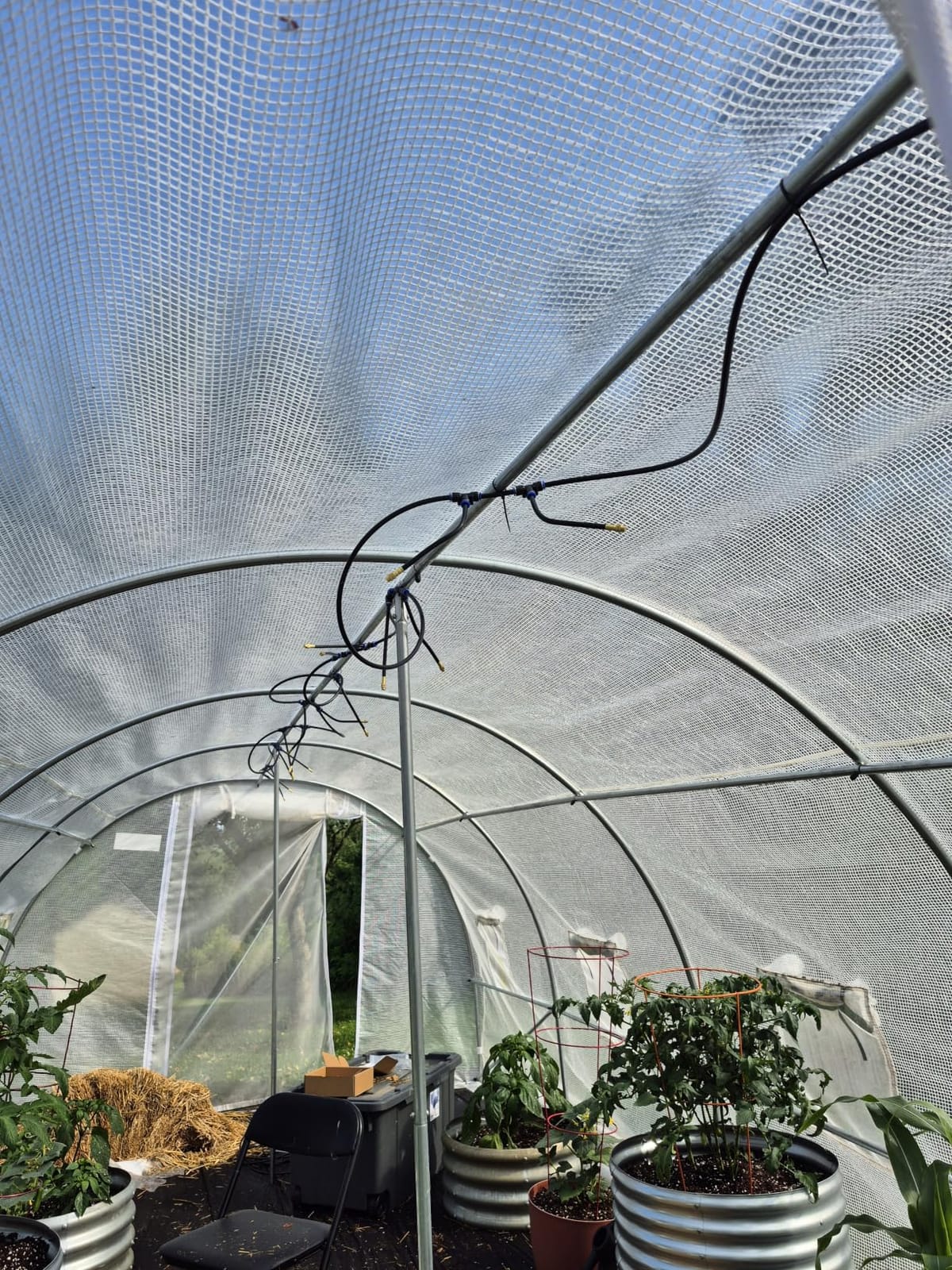
Each nozzle bends through a full 360 degrees and can be fixed at any angle, and they detach for washing, which is what keeps a misting head from turning into a mineral crust. Rating it 4.5 across roughly 850 ratings, it is one of the strongest performers in the group.
Mist is a poor substitute for soil-level irrigation on a hungry crop, and the 50 feet of tubing will not span a large garden. Treat this as a greenhouse and propagation tool, or as a close-range patio mister.
Misting versus drip at the root zone
Misting wets foliage and the soil surface, which is right for germination and humidity and wrong for deep-rooted vegetables. If your goal is watering a root zone through a dry spell, choose emitters that deliver at the soil and skip misting kits.
Will 16 nozzles cover your space?
Sixteen nozzles at close spacing handles a propagation bench or a hanging basket wall comfortably. A 16 foot bed needs far more, and extra sets of nozzles are the part you will have to buy again.
10. Cokacot 49.21 Ft 360 Degree Bendable Irrigation Kit
49.21Ft Drip Irrigation Kit System, 360° Bendable Garden Irrigation System
49.21 ft of 5/16 in. tubing
16 brass misting nozzles with 360 degree bend
Three pressure modes
Faucet adapters with filter nets
Pros
- Brass nozzles and T-joints rather than moulded plastic at this size
- 5/16 in. tubing holds pressure to the last nozzle
- Three adjustable pressure modes
- Filter nets in the adapters block impurities
Cons
- Included zip ties are short and thin
- Only one end connector and T-joint included
- No printed instructions in the box
Small patios and balconies rarely need more than 50 feet of line, and this kit does that job with better hardware than its size suggests. The 5/16 inch tubing is thick enough that owners report no measurable pressure drop to the final nozzle.
The nozzles are brass, they bend through 360 degrees, and ten fix stems let you mount them in the ground, on a fence or along a railing. Three pressure modes let you dial the spray down for delicate seedlings or up for a dusty patio corner.
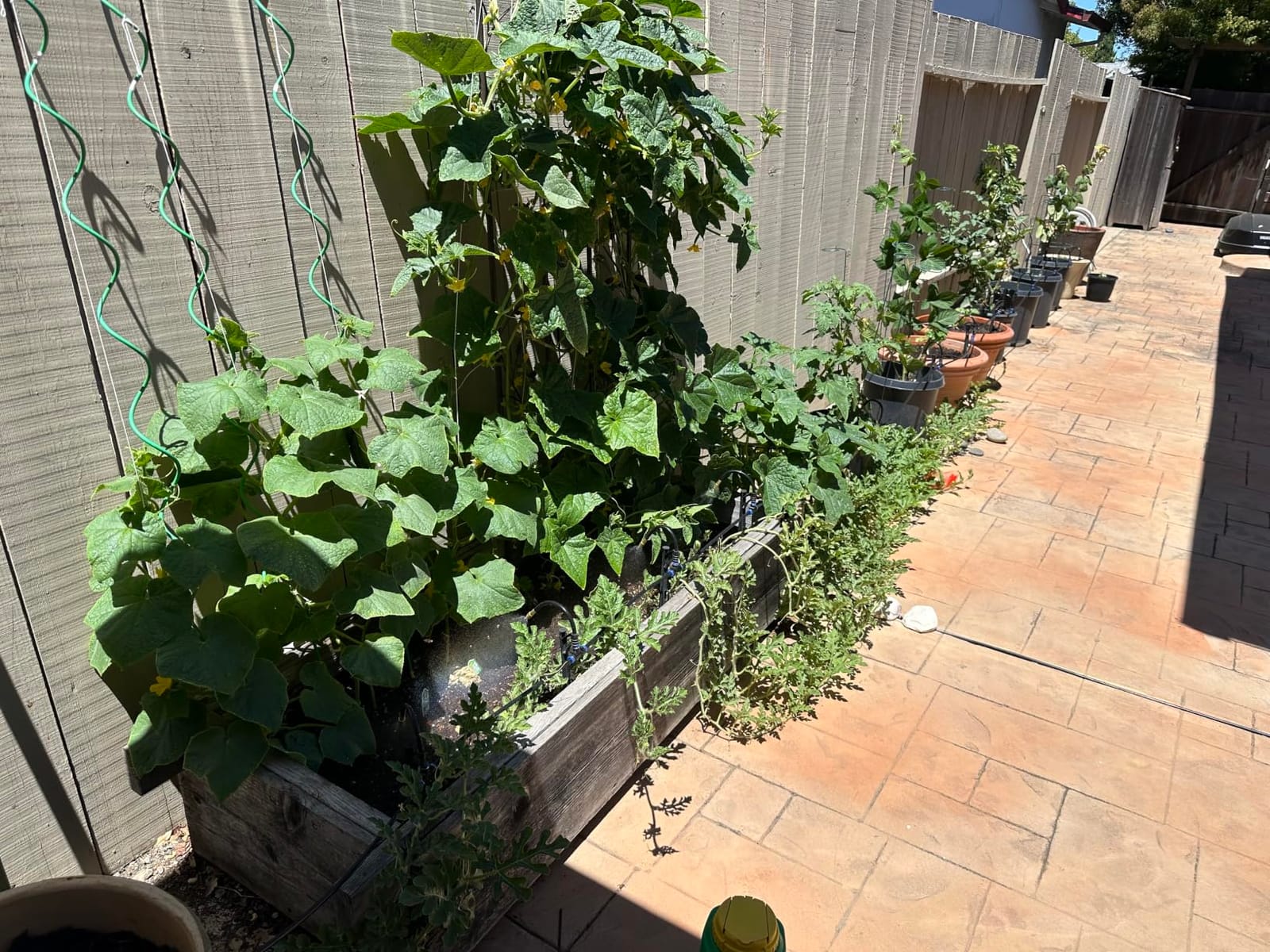
At 4.6 stars across roughly 715 ratings, with 80 percent five-star scores, it posts the second-highest average rating among the kits here. A tube cutter in the box means you can cut custom lengths instead of working around fixed roll lengths.
Its weaknesses are small ones: thin zip ties that struggle to hold line in a bigger layout, a single end connector and T-joint, and no printed instructions. Plan your layout before ordering, because branching later means sourcing more fittings.
Are the filter nets worth having
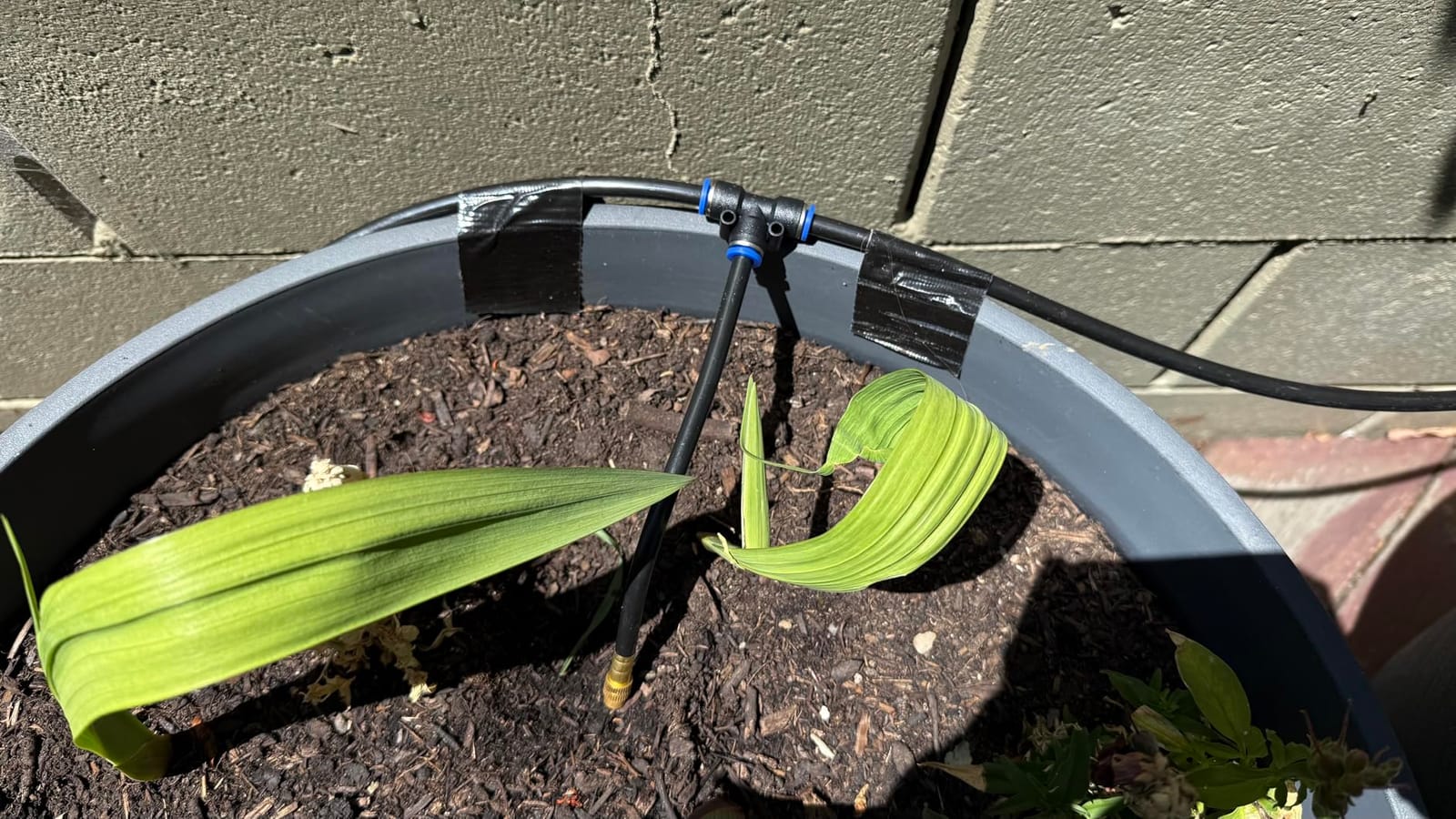
Yes, especially in hard water. The adapters include filter nets that trap impurities before they reach the nozzles, and that is the cheapest clog prevention available. A kit without any filtration will need more attention through a season.
What one connector limits
With a single end connector and T-joint, you can run one line and stop it. Adding a second zone means buying another T-joint and connector, so budget for a small parts order if you plan to grow into a larger patio.
11. Garden Grid 3×6 Raised Bed Watering System
Garden Grid 3×6 | Raised Garden Irrigation System | Prebuilt, No Dry Spots
Pre-assembled 3x6 grid
18 planting squares with 16 streams each
UV-resistant LLDPE tubing
No micro emitters to clog
Pros
- Highest rating in the roundup at 4.7 stars
- Watering starts in about two minutes after placement
- Even soil-level coverage with no dry spots
- Doubles as a planting spacing guide
Cons
- Fixed to a 3x6 footprint
- No timer included for unattended watering
- Only makes sense for a single bed rather than a whole plot
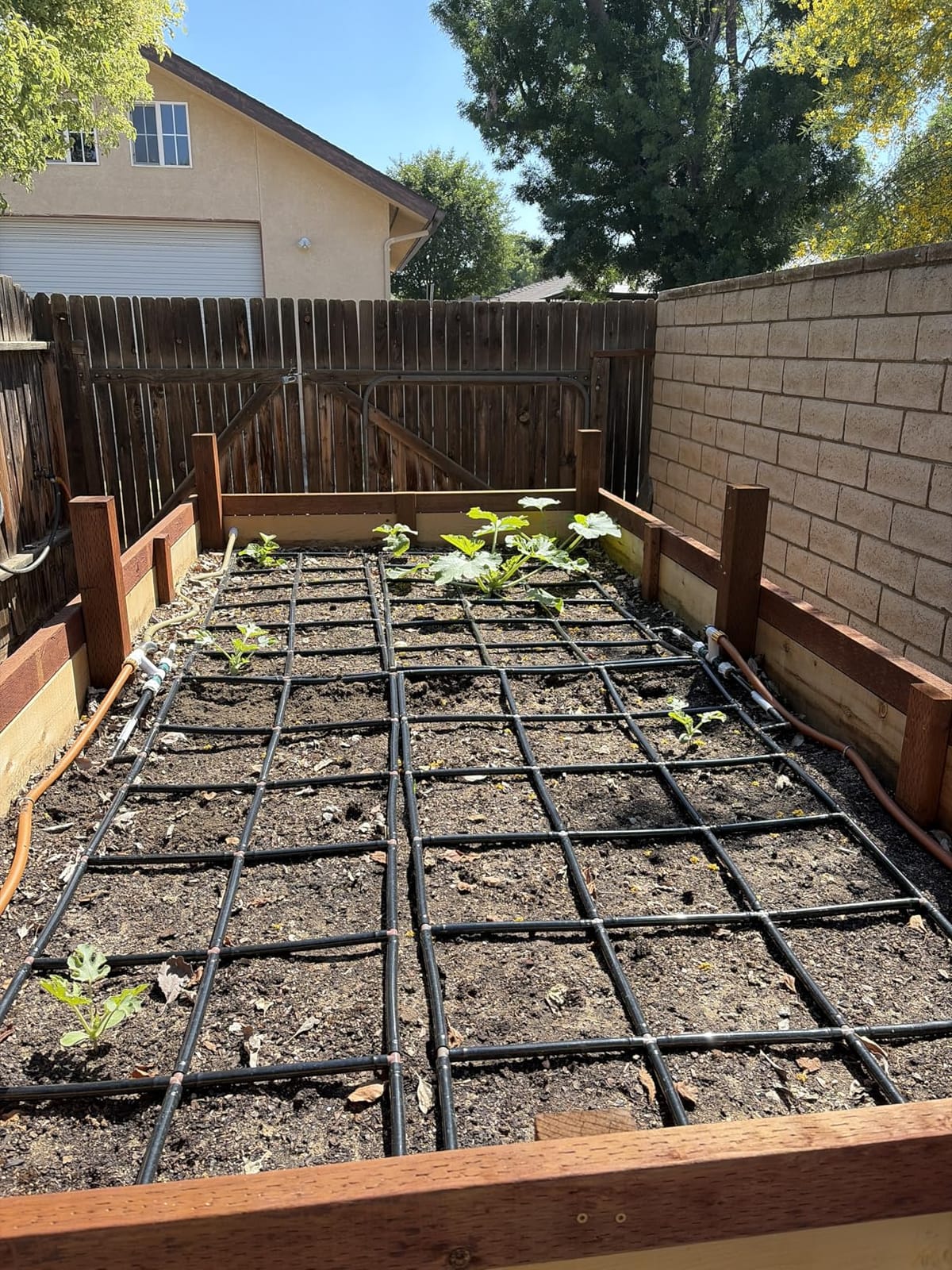
This is the only kit here with no assembly step at all. You unroll the grid, set it on the soil of a 3 by 6 foot bed, connect a garden hose and water is reaching every square within about two minutes.
Each of the 18 planting squares sends out 16 low streams, which is what removes dry spots. Because the streams come from fixed ports rather than removable micro emitters, there is nothing to clog and nothing to replace.
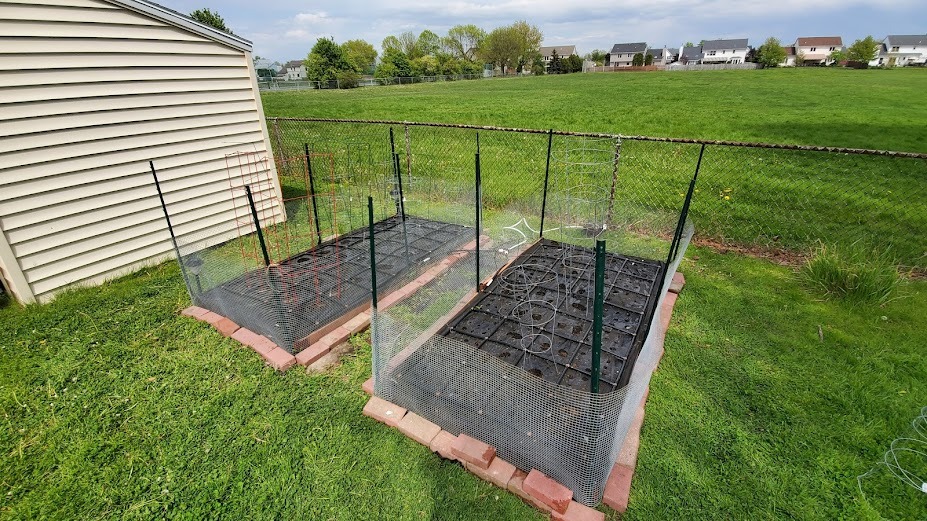
The grid is built from UV-resistant LLDPE tubing with POM fittings, and it doubles as a square-foot planting guide, so it earns its place in the bed twice over. At 4.7 stars across roughly 510 ratings, it holds the highest average of any kit in this roundup.
You trade flexibility for simplicity. The footprint is fixed, so a 4 by 4 bed needs a different grid, and unattended watering needs a hose timer bought separately. For a single raised bed that will stay in place all season, those are easy limits.
Is a pre-built grid worth it for one bed
For a 3 by 6 bed, yes. You skip measuring, cutting, punching, placing emitters and fitting a pressure reducer, and you remove the two biggest sources of beginner error. The square footage it covers is the trade you are making.
How it copes with different plantings
It delivers a broad, even wetting pattern across the whole bed rather than a targeted stream at one plant. That suits mixed rows of vegetables well. Deeply planted shrubs or a bed of low-density crops will want additional point emitters.
12. Rain Bird DRIPKITBAG Repair and Expansion Kit
Rain Bird DRIPKITBAG Drip Irrigation Kit
100 ft of blank 1/4 in. tubing
Emitters at 0.5 1.0 and 2.0 GPH
Installation and removal tool
102 parts in a pouch
Pros
- Three emitter flow rates in one purchase
- 100 ft of blank tubing for new runs or repairs
- Patented tool makes fitting work far easier
- Organised pouch keeps every part in place
Cons
- Barbed fittings rather than quick-connect
- No timer or controller included
- An expansion pouch rather than a complete system
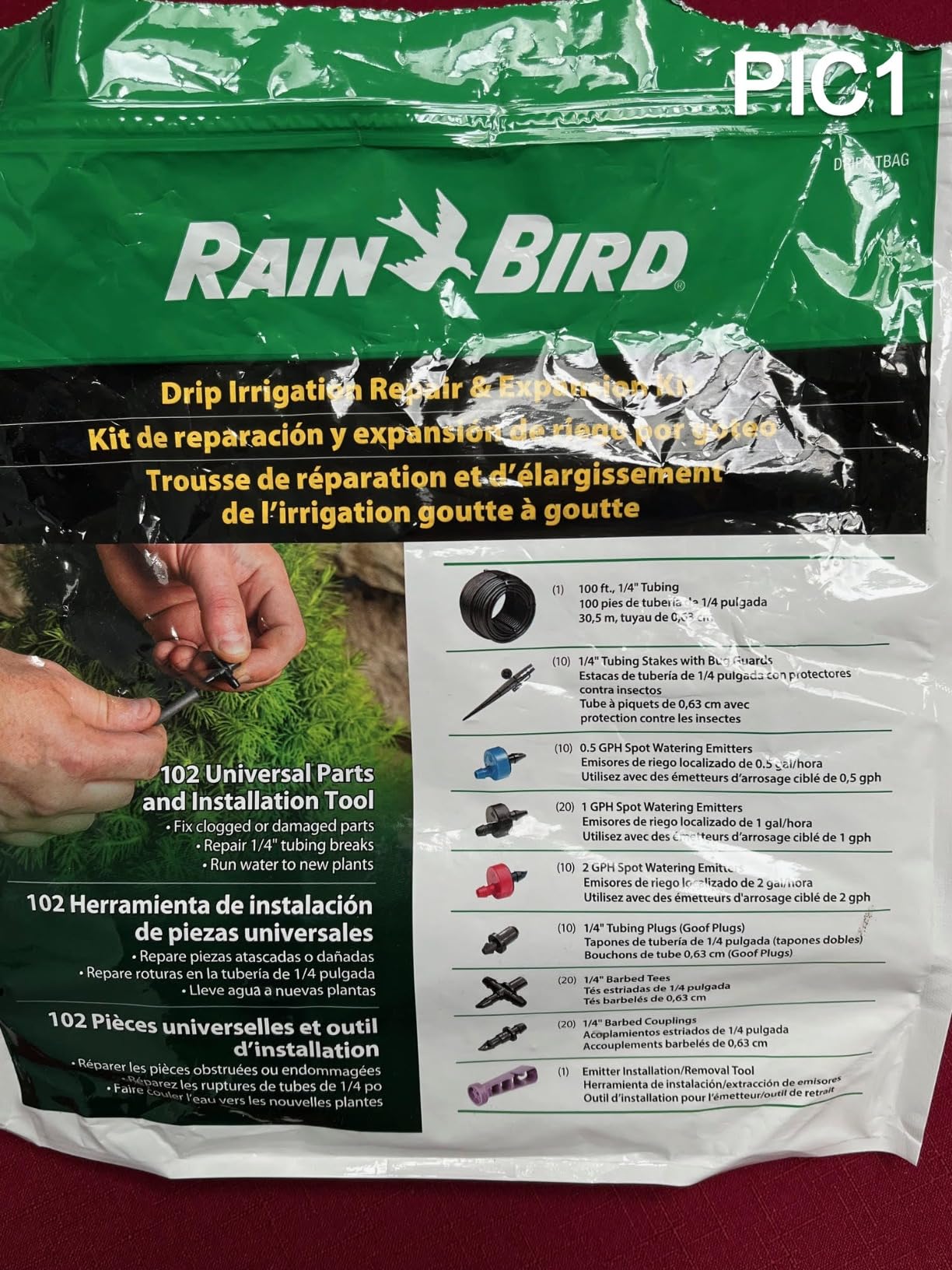
This is the kit to buy second, and the reason most of the kits above are better buys first. It contains 100 feet of self-dispensing blank 1/4 inch tubing, 40 emitters across three flow rates, 20 couplers, 20 tees, 10 plugs and 10 stakes, all in a pouch that keeps them sorted.
Having emitters at 0.5, 1.0 and 2.0 GPH in one place is what makes it valuable. A new bed with leafy greens and a row of thirsty squash can be built from a single pouch instead of three separate orders.
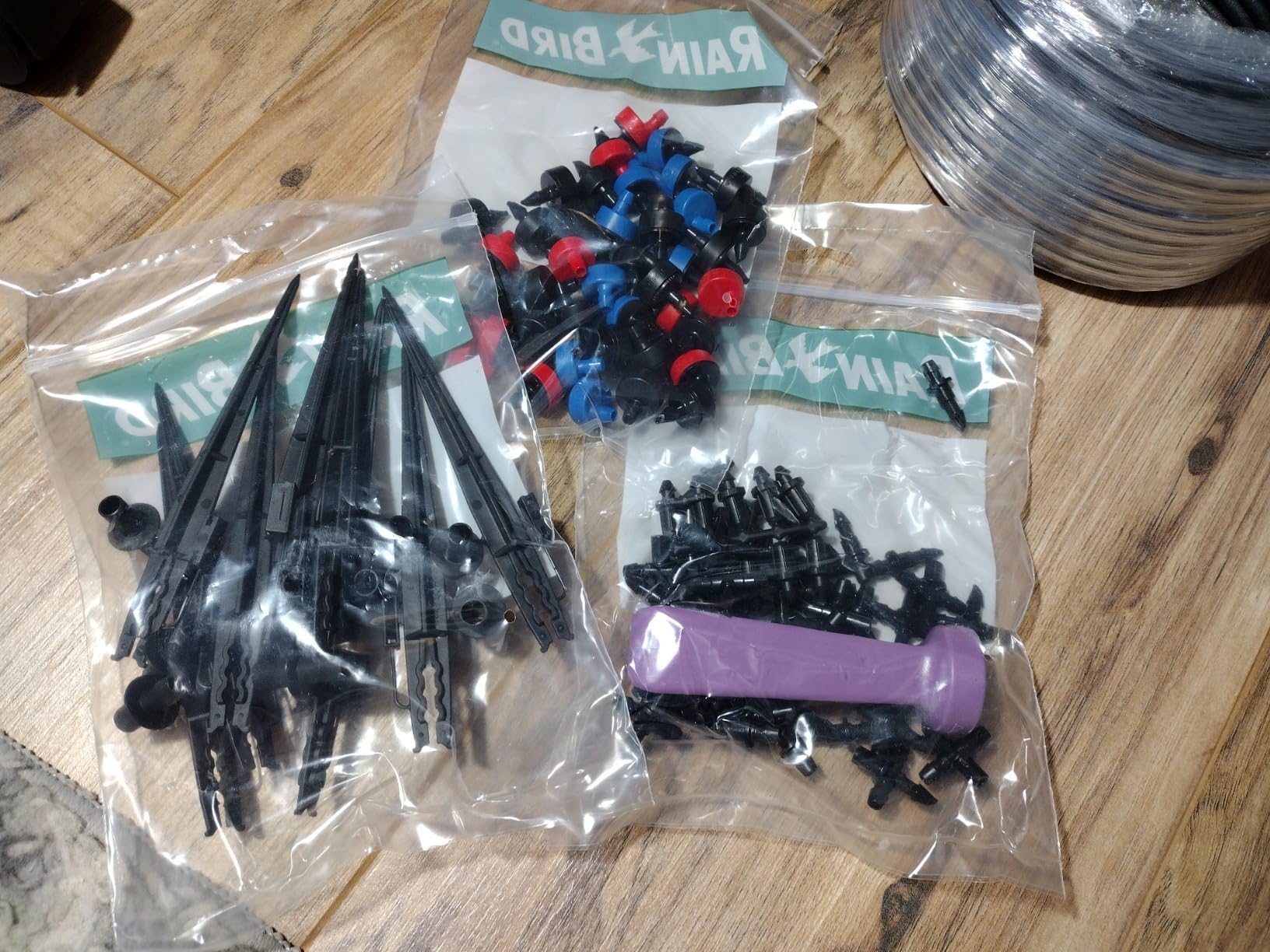
The patented installation and removal tool is the sleeper feature. It makes fitting 1/4 inch tubing and working emitters onto it far less fiddly, which is the single most common frustration reported in drip irrigation forums.
It is not a system. There is no timer, no faucet adapter and no controller, and the fittings are barbed, so assembly takes longer than a quick-connect kit. Buy it to extend and repair, not to start.
Why match emitter flow rates to the plant
Different crops want different volumes, and the flow rate is how you give it to them. A 0.5 GPH emitter suits leafy greens and seedlings, 1.0 GPH covers most established vegetables, and 2.0 GPH belongs on thirsty plants and container shrubs.
When a repair pouch beats a new kit
Once a system exists, repairs are cheaper than replacement. A burst line, a missing tee or a zone that grew by two plants all need a few fittings and a length of blank tubing, and this pouch has everything in it.
How to Choose a Drip Irrigation Kit Without Wasting Money
Measure first, buy second. Walk your garden and write down two numbers: the distance from the spigot to the farthest plant, and the number of individual plants you want on the same schedule. Everything else follows from those.
How much tubing you actually need
Budget roughly one foot of tubing per foot of bed, then add 20 percent for routing around corners and up the sides of containers. Long distances are the number one reason first-time installers are caught short, and 1/4 inch line beyond about 20 feet from the source loses pressure steadily.
Total flow: the check nobody tells you about
Add up the flow of every emitter you plan to use, then compare it with what the faucet can deliver. A typical hose bib handles somewhere in the region of 120 to 300 gallons per hour, and 20 one-GPH emitters is only 20 GPH, so most small gardens are fine. Three raised beds at 30 emitters each is 90 GPH, which is where pressure starts to sag and uneven delivery appears at the end of the line.
Homeowners on r/Irrigation validate layouts exactly this way, totalling emitter flow before buying. If the total approaches your supply, split the run into two zones and use a hose-end timer on each.
Emitter spacing by soil type
Sandy soil needs close spacing because water moves fast and sideways. Loam works at a moderate spacing, and clay holds a wide bulb so wider spacing stretches the run. The most common mistake is a fixed 12 inch spacing in heavy clay, which wastes half the emitters.
Check the wet pattern before you commit. Run the system for 20 minutes, dig down beside an emitter, and look for the edge of the damp bulb. Adjust spacing to match rather than trusting the number on the box.
Pressure regulation and the wide-versus-narrow line rule
Municipal water pressure regularly exceeds what drip tubing is designed for, so fit a pressure regulator at the spigot and bring it into a workable band. Higher pressure is not better here, and it is what splits fittings and forces emitters out of calibration.
As a general guide, use 1/2 inch or 5/16 inch tubing as the backbone and 1/4 inch only for branches into beds and containers. Running 1/4 inch along a long path is the mistake forum readers describe most often, and it produces exactly the unevenness that gets blamed on the kit.
Minutes per cycle by soil and season
Drip systems run far less often than people expect. In spring, two or three cycles a week is usually enough for most beds; in summer heat, daily or even twice-daily runs keep vegetables steady, while established shrubs and fruit trees cope well with a deep, infrequent soak. Watch the soil with a finger instead of following a fixed calendar, and use a moisture meter once you have a feel for your beds.
Filtration, flushing and winterizing
Flush the lines at the start of each season and again before the first freeze, because trapped grit and mineral scale are what kill emitters. A flush valve at the end of each run makes this a two-minute job rather than a project, and it is the difference between a system that lasts several seasons and one that needs constant replacing.
To winterize, shut off the water, disconnect the timer, open the end fittings to drain the lines and bring anything above ground indoors if the manufacturer allows it. Blow the lines out with a compressor only if you know your fittings can take the pressure. Our guides to the best drivetrain cleaning kits follow the same principle: flush the system at the end of the season rather than replacing parts that were never cleaned.
Frequently Asked Questions
What is the 30/30 rule for drip irrigation?
The 30/30 rule means running a drip system for 30 minutes, then pausing 30 minutes, so water can soak past the root zone instead of running off. It suits slow-wicking soil and sloped beds, and it lengthens the effective watering window without increasing total volume.
What is a major downside to drip irrigation?
The biggest downside is maintenance: emitters clog with mineral deposits, tubing kinks at corners, and lines must be flushed and drained before winter. It also only waters where the emitters are placed, so a badly planned layout leaves dry patches that never get corrected.
How many drip emitters can I put on one line?
It depends on tubing size and total flow rather than a fixed number. With 1/4 inch distribution tubing, stay near 15 to 20 emitters per run, and confirm the summed GPH against your faucet capacity. The MIXC 230FT kit is rated to support up to 32 emitters on its included tubing.
What is the recommended spacing for drip irrigation emitters?
Space emitters 6 to 9 inches apart in sandy soil, about 12 inches in loam, and 18 inches apart in clay, where a single emitter wets a wide bulb. Check the wet pattern after a 20 minute run and adjust rather than relying on the spacing printed in the manual.
Do drip irrigation kits come with a timer?
Most do not. The Raindrip R560DP container kit includes a battery-powered button-control timer, but most faucet-fed kits are timer-compatible only, so you add a hose-end timer separately. Kits that do claim to be automatic usually mean compatible, so check the contents list before assuming.
The Best Drip Irrigation Kits for Gardens in 2026
The best drip irrigation kits for gardens are the ones that match your layout rather than the biggest box on the shelf. For containers and hanging baskets, the Raindrip R560DP is the proven choice with more than 5,800 ratings and a timer in the box. For three raised beds, the CARPATHEN 100 foot kit handles the flow and the cleaning. For a whole garden plot, the MIXC 300FT kit carries the most mainline.
Measure your farthest plant from the spigot, count the emitters you will actually use, and check the total against your faucet before you open anything. Add a hose-end timer and a filter at the tap, and the system you build in an afternoon will still be running next season.