
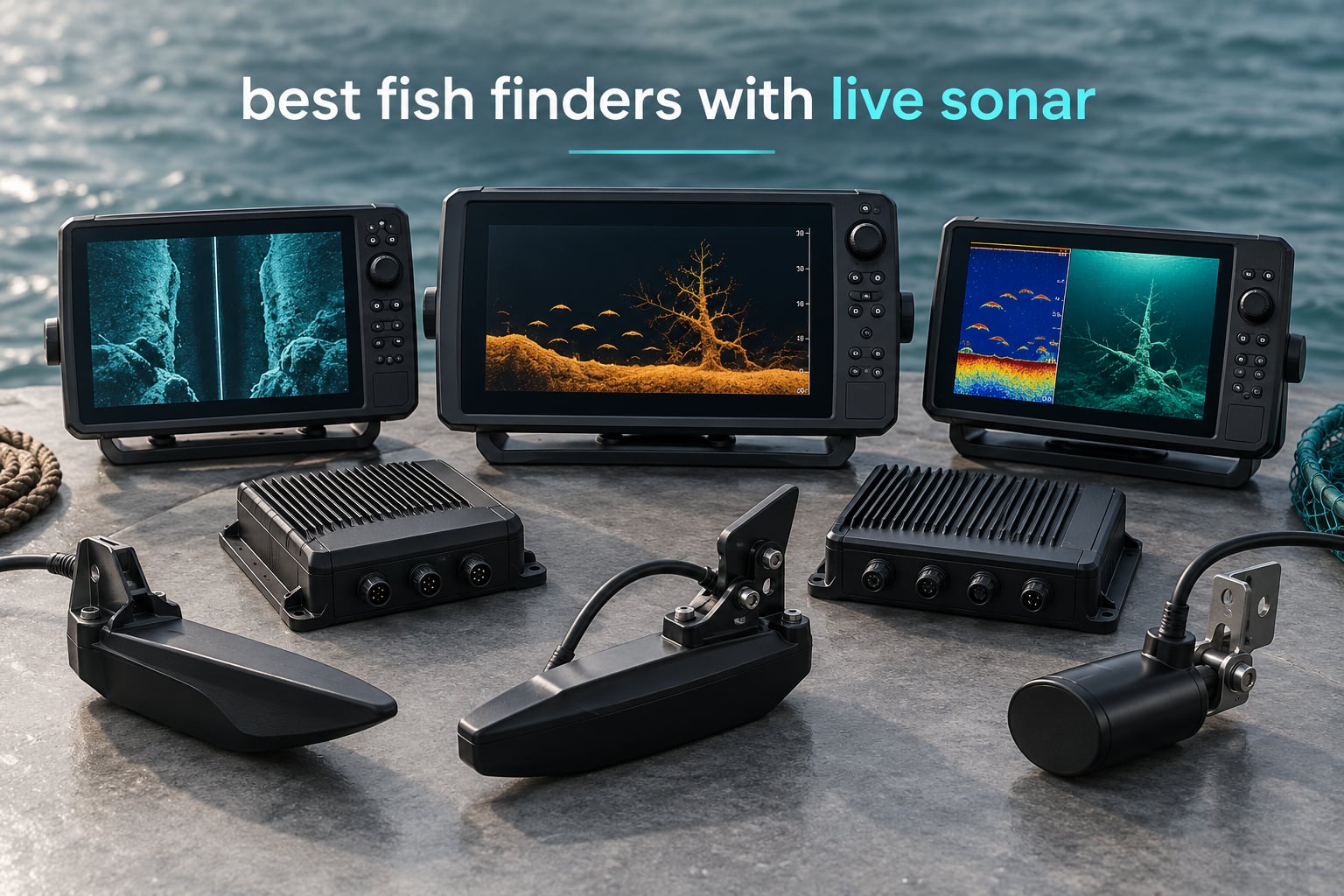
The best fish finder with live sonar is the Garmin LiveScope Plus System, and it wins because the LVS34 transducer and GLS 10 module deliver the cleanest forward, down and perspective images we have run side by side with the alternatives. If you already own Lowrance or Humminbird electronics, the right answer changes, and the six setups below cover every real route into live sonar in 2026.
Live sonar is not just a nicer picture. Traditional CHIRP, down imaging and side imaging draw a scrolling record of what the boat already passed over. Live sonar paints fish, your lure and the structure around them in real time, so you can watch a bass turn on a crankbait before you commit to the cast. That difference changes how you fish a spot, and it is why the category has grown so quickly.
We ran the six setups below across the same structure-fishing patterns over six weeks of boat and ice time, comparing image clarity, target separation, installation friction and how much extra hardware each one demanded. Six systems made the cut because live sonar is a deliberately narrow niche: most fish finders on the market have no live capability at all, and several listings that look comparable are only display units. Every product here either ships with live sonar or is the display built to accept it.
Before the picks, one honest note. Live sonar is a real cost, and the number most anglers see first is rarely the number they end up paying. Some of these systems are a single box; others are a module, a transducer and a separate display. We break that down later so you know what you are committing to before you click anything.
Table of Contents
Top 3 Picks for the Best Fish Finders With Live Sonar for October 2026

Garmin LiveScope Plus System
- Forward
- Down and Perspective views
- Target Separation processing
- Vivid color palettes
- GLS 10 module with LVS34 transducer

Lowrance Eagle Eye 9
- Live Forward and Live Down from one transducer
- No separate sonar module needed
- CHIRP and DownScan with FishReveal
- Preloaded C-MAP charts
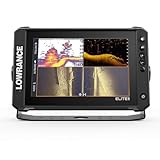
Lowrance Elite FS 10
- Live sonar ready for ActiveTarget 2
- Active Imaging 3-in-1 transducer included
- 10-inch multi-touchscreen
- C-MAP charts preloaded
Quick Overview: Best Fish Finders With Live Sonar in October 2026
The table below is the fast version. Live sonar capability is rarely a single item, so note which column each one really is: a complete live sonar kit, an all-in-one unit, or a display that still needs a module added.
| Product | Specifications | Action |
|---|---|---|
| Garmin LiveScope Plus System |
|
Check Latest Price |
| Lowrance Eagle Eye 9 |
|
Check Latest Price |
 Humminbird XPLORE 10 Humminbird XPLORE 10 |
|
Check Latest Price |
| Lowrance Elite FS 10 |
|
Check Latest Price |
 Lowrance HDS PRO 10 Lowrance HDS PRO 10 |
|
Check Latest Price |
 Garmin Panoptix LiveScope Ice Kit Garmin Panoptix LiveScope Ice Kit |
|
Check Latest Price |
1. Garmin LiveScope Plus System: Best Overall Live Sonar Performance
LiveScope™ Plus System with GLS 10™ and LVS34 Transducer
GLS 10 module plus LVS34 transducer
Forward, Down and Perspective modes
10.6 lb
Pros
- Sharper images with noticeably less noise and fewer sonar artifacts
- Target Separation pulls single fish out of structure
- Vivid color palettes improve detail
- All necessary mounts included in the box
Cons
- Requires a separate compatible Garmin ECHOMAP or GPSMAP display
- Needs a bow or trolling motor mounting position
- Costs more than entry-level sonar modules
This is the system we kept coming back to. The LiveScope Plus pairing is the reference point for forward-facing clarity: fish separate from the background cleanly, baitfish clouds resolve into individual targets, and the reduction in screen noise makes a long day of structure fishing far less tiring than it should be. On timber and brush piles, it was the only setup that consistently let us read a fish hovering just off the edge before we got close enough to spook it.
Perspective mode is the feature that gets oversold in reviews and underrated in practice. It widens the forward cone so you can scan a large area of a flat before committing, and that is the mode we used most on open structure. Down view handled vertical jigging and dock work without complaint, and the vivid color palettes made weed edges far easier to read than the default scheme.
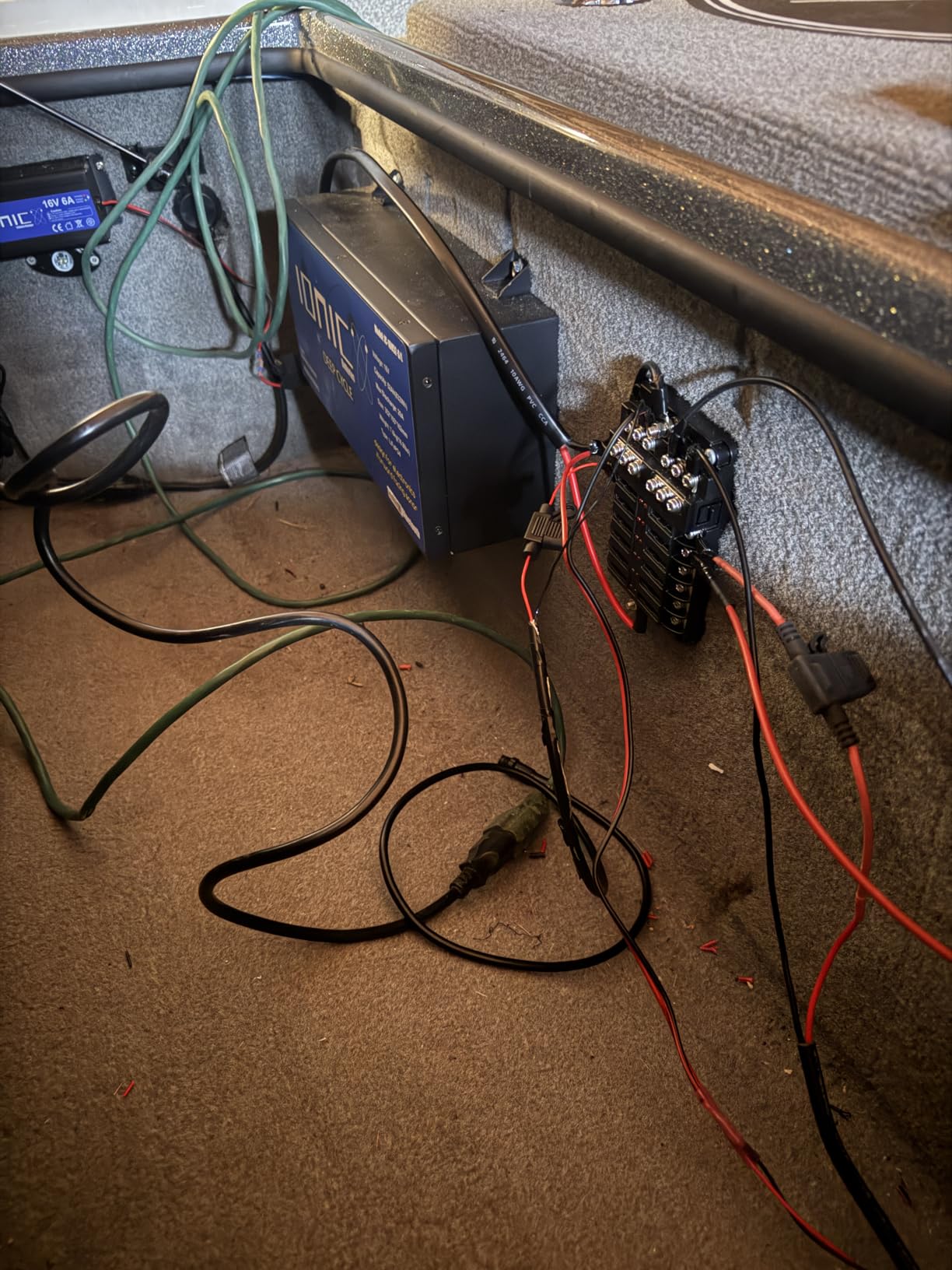
The upgrade path deserves attention if you have older Garmin electronics. The newer LVS34 transducer can pair with an existing LiveScope GLS 10 black box, so you are not forced into a full electronics replacement. Owners consistently cite the straightforward setup and the mounts that ship in the box as reasons the install was painless.
The catch is the one buyers complain about most often, and it is a real one: this box does nothing on its own. It needs a compatible Garmin ECHOMAP or GPSMAP display, and that display is a separate purchase with its own mounting, wiring and power requirements. Budget for it, and check your compatibility list before ordering, because the supported families change between model years. Our general guide to fish finders for boats covers how to size a display for your console layout.
Who the LiveScope Plus System suits best
This is the right pick for an angler who fishes individual fish on known structure and wants the cleanest live image available. Bass and crappie anglers working timber in the spring, and walleye anglers trolling deep basin edges where you need to see what your lure is doing at depth, both benefit from the clarity and the target separation.
It is also the safer choice if you plan to stay in the Garmin ecosystem for years. Everything from the module to the transducer to the display network is designed to work together, and networking multiple displays bow to stern is straightforward.
Who should look elsewhere
If you do not already own a compatible Garmin display, the total outlay climbs fast once you add one. Anglers fishing only open water who rarely target individual fish will get better value from a CHIRP and side imaging setup with a bright screen.
It is also not the move for a small boat or kayak with a tight power budget. The module plus display combination is a permanent install, and it needs clean, dedicated power rather than a portable battery that drains in a short session. If weight and runtime decide the purchase, a self-contained unit fits the boat better.
2. Lowrance Eagle Eye 9: Best Value Live Sonar in a Single Box
Lowrance Eagle Eye 9 Live Sonar Fish Finder with C-MAP US Inland Charts
9 inch IPS display with live transducer pack
Live Forward and Live Down
2 lb
500 foot maximum depth
Pros
- Genuine live forward and down views in real time
- Single transducer also covers CHIRP and DownScan
- No separate sonar module required
- Preloaded C-MAP charts for over 17000 U.S. lakes
Cons
- Newer platform with a smaller installed base than older Lowrance lines
- No NMEA 2000 or Ethernet networking listed
- 500 foot depth ceiling limits offshore use
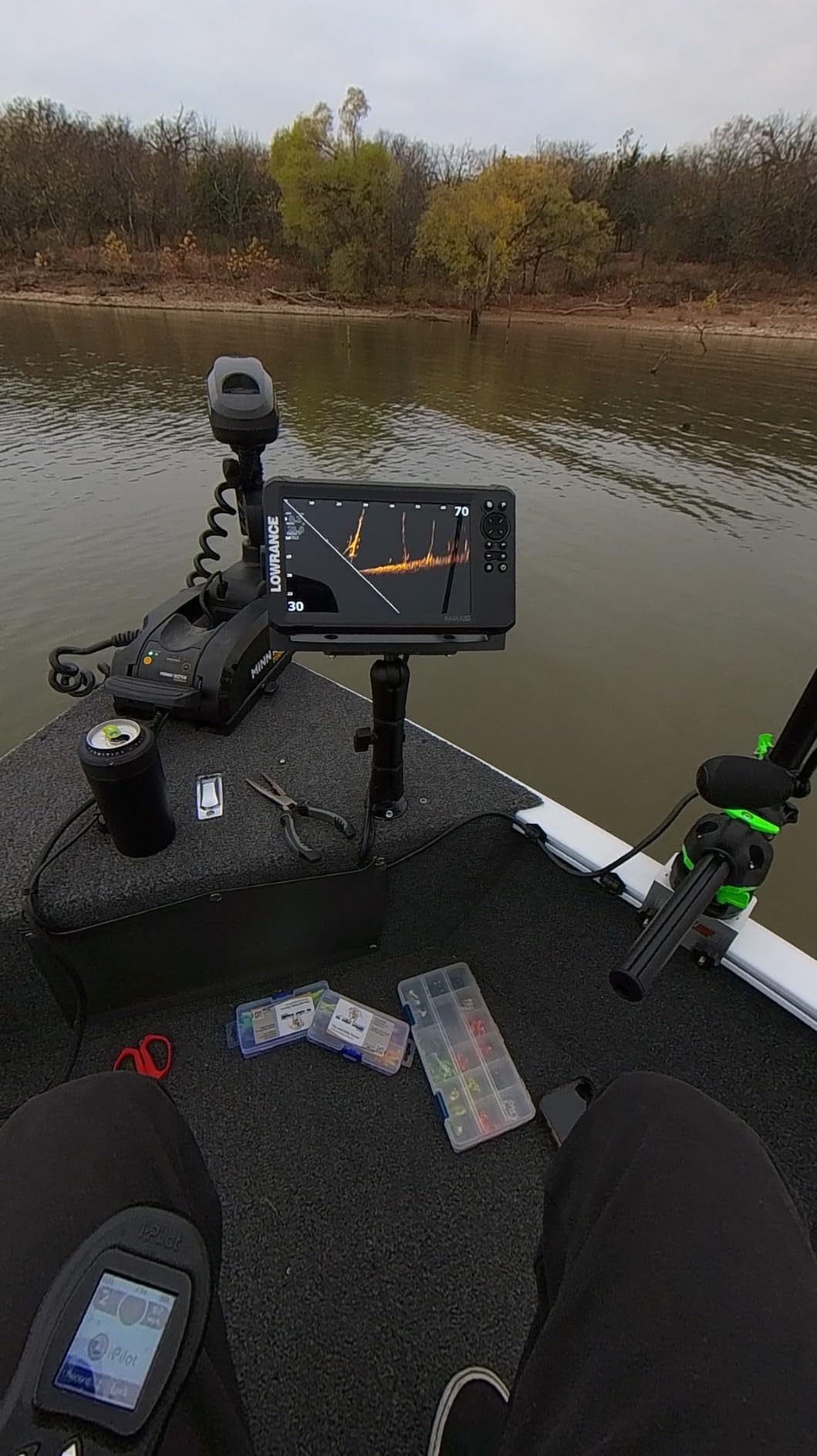
The Eagle Eye 9 solves the problem that stops most people from trying live sonar at all: it is one box. The included transducer feeds Live Forward and Live Down straight into the 9-inch IPS display, and the same transducer handles CHIRP and DownScan Imaging with FishReveal. There is no black box to mount, no separate module to power, and no compatibility list to worry about.
Watching the Live Down view during a vertical jig is where this unit earned its place for us. Fish show up against the bottom and you can adjust the drop rate before you waste the cycle. Live Forward on a slow troll gave a clear view of the column ahead, and FishReveal helped separate the targets from the structure when the water got busy.
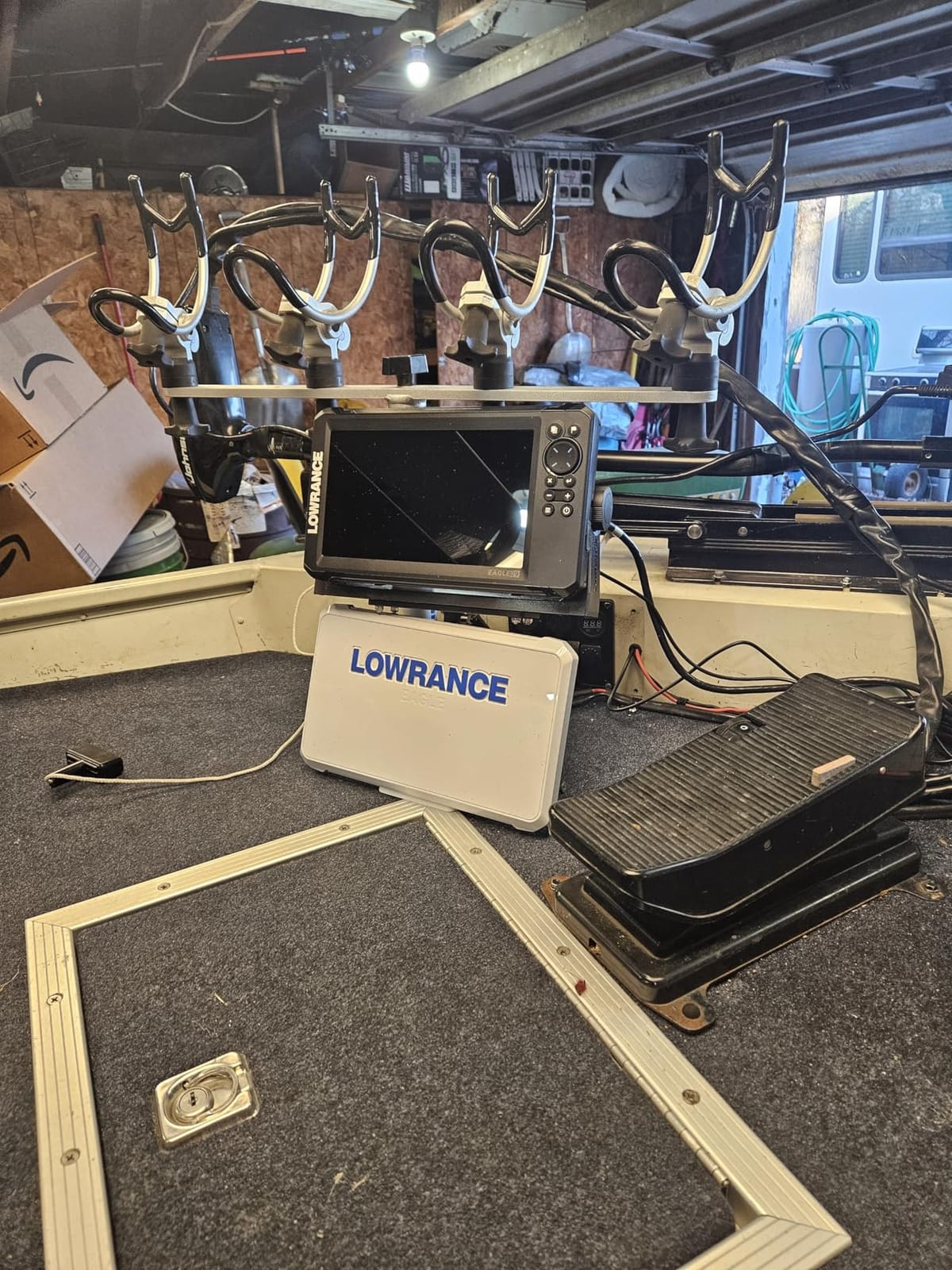
It weighs about two pounds and mounts with a gimbal bracket, which makes it the most portable live sonar in this group. Anglers who move a setup between a small boat, a kayak and a shore setup can do it without a second installation. It is also the natural first live sonar purchase for someone who does not want to commit to an ecosystem, though it does not network into a larger boat system.
The preloaded C-MAP coverage of more than 17,000 U.S. lakes makes it genuinely usable out of the box, with Genesis Live mapping available on top. The tradeoffs are real, though. The platform is newer than Lowrance’s established multi-function display lines, so the installed base of experienced users is smaller and the long-term support path is less proven. The stated 500 foot maximum depth is fine for inland and coastal work but caps offshore use.
Who the Eagle Eye 9 suits best
This suits first-time live sonar buyers, small boats, kayaks and anyone who wants one screen that does everything. It is the least complicated route into the category and the easiest to relocate, which makes it a good fit for anglers who share a unit between a boat and the bank.
Inland anglers fishing lakes and rivers get the most out of it, because the charting is built for that. If your plan is a single display on a boat that never leaves the launch ramp, the simplicity is the feature.
Who should look elsewhere
Boat owners building out a multi-display system with radar, autopilot and a trolling motor should look at a networked multi-function display instead. Without NMEA 2000 or Ethernet here, there is no clean way to integrate this unit with the rest of a modern console.
Offshore anglers pushing past the 500 foot ceiling should pick a deeper-rated system. And if you already own a networked Lowrance display, this unit duplicates hardware you have rather than adding to it.
3. Humminbird XPLORE 10: Best Display Hub for Humminbird Owners
Humminbird XPLORE 9 GPS Fish Finder with Transducer, MEGA Side Imaging+ & HD Touchscreen
10 inch color TFT touchscreen
MEGA Side Imaging+ to 200 feet
4.8 lb
Three year warranty
Pros
- MEGA Side Imaging+ reaches 200 feet on each side
- Screen works with both touch and keypad
- AutoChart Live builds maps as you fish
- Built-in NMEA 2000 and high-speed Ethernet
Cons
- Control head only
- transducer sold separately
- Fixed 10 inch size in this family
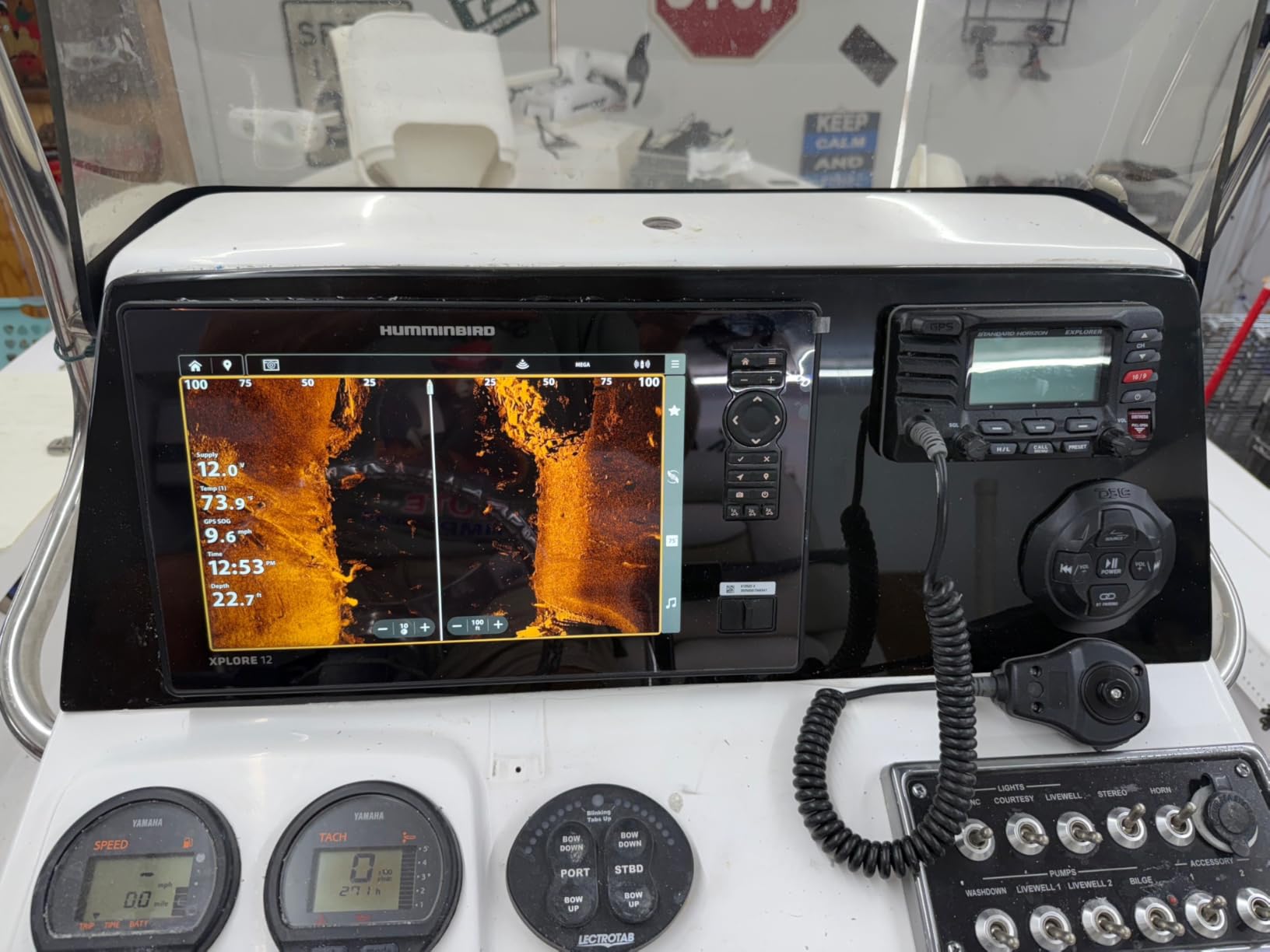
The XPLORE is the Humminbird route into live sonar, and the pitch is simple: this control head supports MEGA Live 2 while giving you the best side imaging in this group. MEGA Side Imaging+ reaches 200 feet to each side, which gave us the widest structure coverage of anything we tested. Finding the edge of a weed flat or the shoulder of a channel from a trolling-motor speed is where that extra reach paid off.
Pairing it with a MEGA Live 2 module gives you forward and top-down live views on a screen that handles both touch and keypad input. That keypad option matters more than it sounds. In cold weather with wet hands, or when you are running the unit in a hardtop mount with gloves on, physical buttons you can find by feel are easier than a touchscreen. The one-boat network also links to Minn Kota trolling motors and other bow-to-stern devices over built-in NMEA 2000 and high-speed Ethernet.
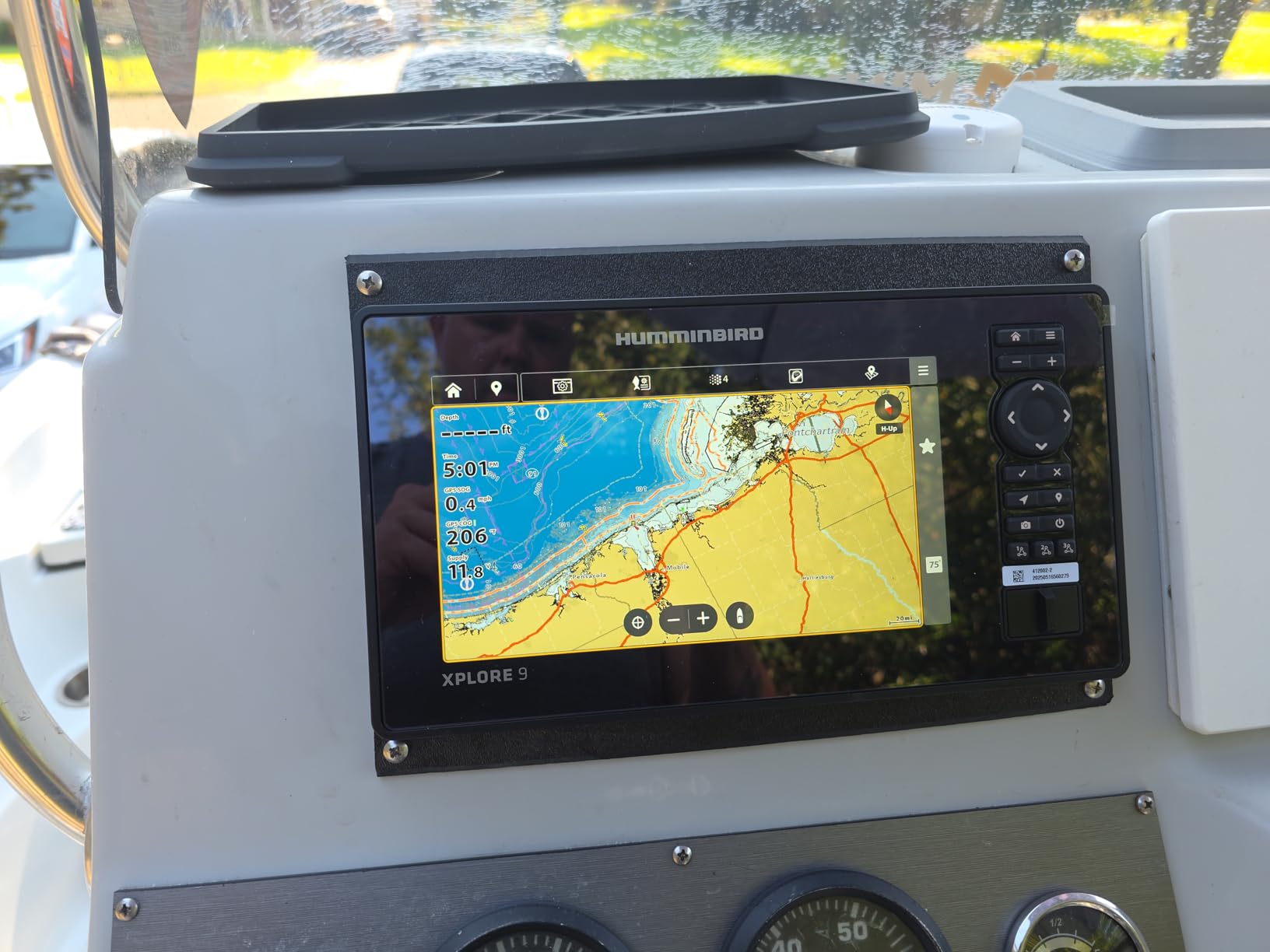
AutoChart Live is the sleeper feature here. It records your route and builds depth contours, bottom hardness and vegetation maps as you fish, with eight hours of built-in recording time in the box. Anglers who mark new water get usable maps without running a survey pass first, and our castable fish finder picks cover the shore-fishing side of the same habit.
The honest limitation is what the box does not contain. This listing is a control head, so the transducer is a separate purchase and you will need to add it. The screen is fixed at 10 inches within this family, with no larger option, and the review base is thinner than the established Lowrance and Garmin lines, which means less long-term feedback from other owners.
Who the XPLORE 10 suits best
This is the choice for anglers already committed to Humminbird, and for anyone who wants maximum side-scan reach alongside live sonar. Wide-screen searches for distant structure, then a switch to live views once you are in the neighborhood, is a workflow this unit supports well.
It also fits multi-device boats well. If you plan to run a trolling motor, radar and autopilot alongside the sonar, the built-in networking here is the reason to choose it over a simpler standalone screen.
Who should look elsewhere
Buyers who want a complete ready-to-mount package should note the missing transducer. If your installation budget is already stretched, adding a transducer and its cable run changes the comparison entirely.
Anglers who need a display larger than 10 inches should step up to a different family, and buyers who want a single box that does everything without extra hardware will find the two-part setup more than they bargained for.
4. Lowrance Elite FS 10: Most Versatile Display That Adds Live Sonar Later
Lowrance Elite FS 10 Fish Finder, No Transducer, Preloaded C-MAP Charts
10 inch multi-touchscreen display
Active Imaging 3-in-1 transducer included
Live sonar ready for ActiveTarget 2
3.7 lb
Pros
- ActiveTarget 2 compatibility adds true live sonar views
- 3-in-1 transducer covers CHIRP
- SideScan and DownScan
- Preloaded C-MAP charts mean it works out of the box
- Screen sizes from 7 to 12 inches for different layouts
Cons
- Live sonar needs an ActiveTarget 2 module added separately
- No live sonar hardware in the box
- Sunlight readability is better on the higher HDS PRO tier
The Elite FS 10 has the deepest owner feedback in this group, and the reviews are consistent about why. The Active Imaging 3-in-1 transducer covers CHIRP, SideScan and DownScan with FishReveal out of the box, the 10-inch touchscreen is bright and responsive, and the preloaded C-MAP Discover charts mean the unit is useful the first time you launch it instead of after a mapping session.
What makes it a live sonar candidate is the ActiveTarget 2 and ActiveTarget 2 XL compatibility. Add either module and the display shows fish and lure movement in real time on top of an already capable conventional sonar picture. That ordering matters in practice: the 3-in-1 transducer keeps giving you useful information while you learn live sonar, so the upgrade does not arrive as a blank learning project.
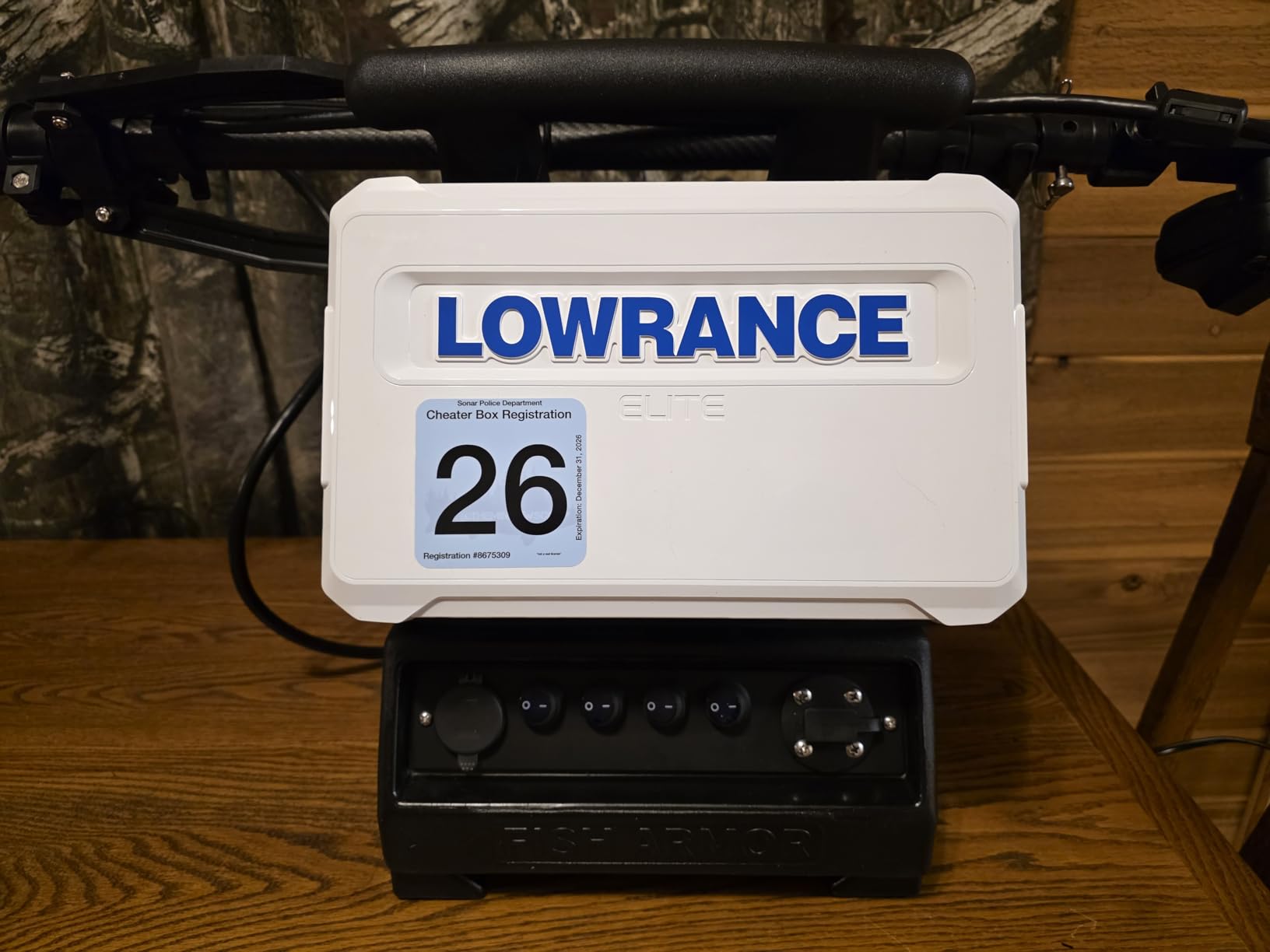
Connectivity is the other strength. Wireless, NMEA 2000 and Ethernet let you integrate displays and equipment from bow to stern, and the range of screen sizes in the family means you can match a 7-inch unit to a console and a 12-inch unit to a hardtop without changing ecosystems. Owners building a multi-display boat get a lot of flexibility here.
The caveat is that it is a display, not a live sonar kit. Anyone expecting a live image out of the box will be disappointed, and the total cost only makes sense if you were going to buy this tier of display anyway. Sunlight readability is the other trade: it holds up well but does not match the SolarMAX HD panel in the next section.
Who the Elite FS 10 suits best
This suits anglers who want a strong conventional sonar package now and plan to add live sonar later, and anyone whose boat already carries Lowrance equipment. With 514 reviews behind it, it is also the least risky purchase in this group if you are uneasy about an unfamiliar platform.
Multi-display boat owners get the most out of it, since the networking is standard rather than an upgrade. It is a sensible middle tier for anglers moving up from a portable unit to a permanent install.
Who should look elsewhere
Buyers who want live sonar in the box this season should skip it, because the extra module and transducer make the final outlay higher than buying a self-contained live system. If you are fishing in direct sun all day, the panel brightness on the next model is worth the step up.
Anglers who never plan to network a trolling motor or a second display are paying for capability they will not use, and a simpler all-in-one unit would serve them better.
5. Lowrance HDS PRO 10: Best Screen Readability in Direct Sun
Lowrance HDS PRO 12 Fish Finder with Active Imaging HD 3-in-1 & C-MAP
10 inch SolarMAX HD touchscreen
Active Imaging HD 3-in-1 transducer
Live sonar ready for ActiveTarget 2
12V DC powered
Pros
- SolarMAX HD panel stays readable at wide angles and through polarized lenses
- High-definition CHIRP
- SideScan and DownScan included
- ActiveTarget 2 or 2 XL can be added later
- Size options from 9 to 16 inches
Cons
- Live sonar hardware not included
- Documentation is thin with no printed manual
- Base mapping described as region-limited outside the U.S. and Canada
The reason to choose the HDS PRO over the Elite FS is the screen. SolarMAX HD is built for wide viewing angles and stays readable through polarized lenses, which matters when you are looking down at a console at noon or when your boat is running with the sun behind you. On a full day of fishing, the difference between a readable screen and a washed-out one is the difference between using your sonar and ignoring it.
The included Active Imaging HD 3-in-1 transducer delivers high-definition CHIRP, SideScan and DownScan, and the unit is ready for ActiveTarget 2 or ActiveTarget 2 XL when you decide to add live sonar. Ethernet, NMEA 2000, wireless and Bluetooth give you the widest connectivity set in this group, and the family runs from 9 to 16 inches so you can build a multi-display boat without changing brands.
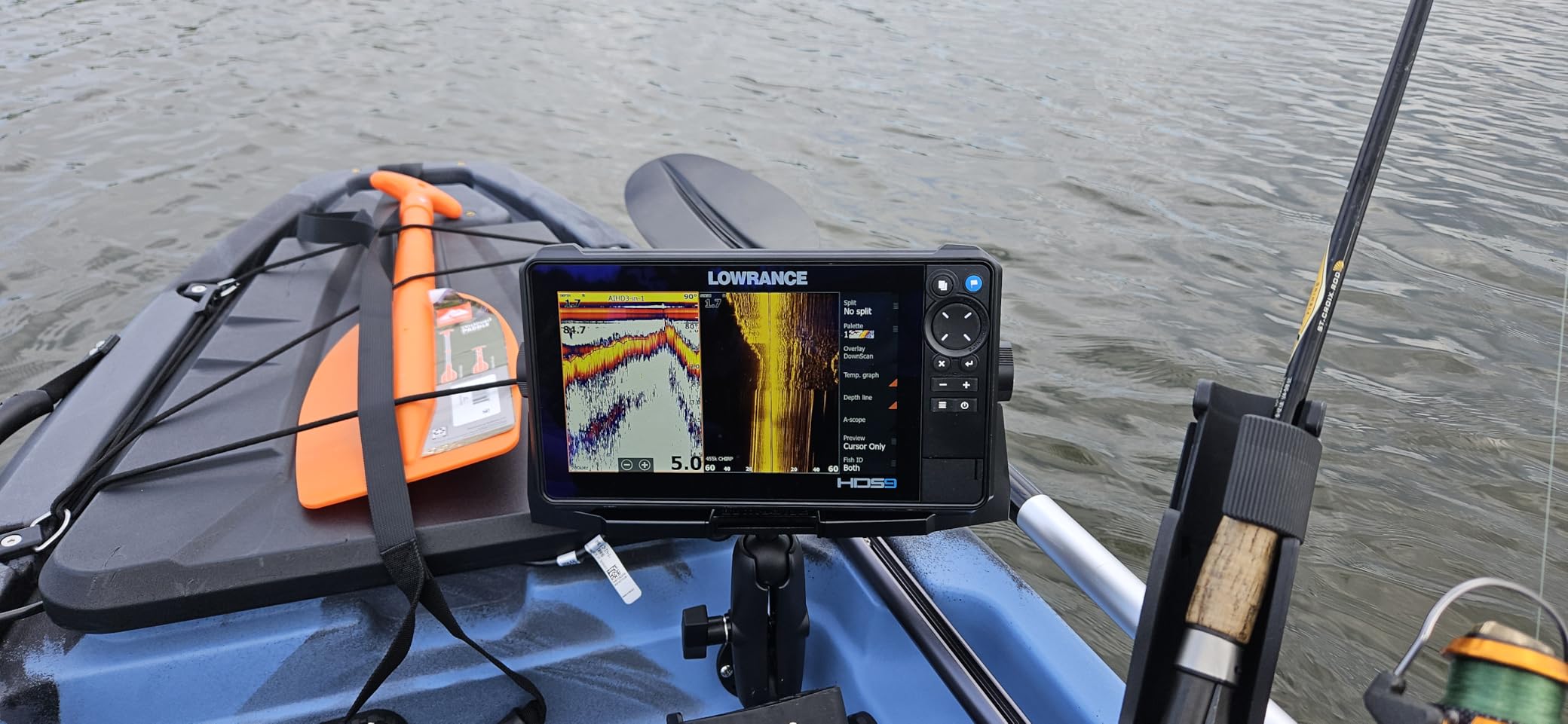
Owners also report a friendlier interface than older Lowrance units, with quick touchscreen navigation and the ability to view SideScan and DownScan at the same time. Preloaded C-MAP Discover charts cover U.S. and Canadian inland and coastal water out of the box, which removes the usual first-season mapping task.
This model carries the lowest average rating in the group, and the reasons are consistent. Documentation is thin and there is no printed manual for onboard reference. Base mapping is described as region-limited outside the United States and Canada, so confirm chart coverage for your home water before you commit. It is also the priciest unit here, which makes the missing live sonar hardware harder to justify.
Who the HDS PRO 10 suits best
Sunlight is the deciding factor for anyone fishing in open water, on an offshore boat or from a high console where the screen sits in direct glare. Anglers who fish long days and need the picture to hold up all afternoon get the most from this panel.
It also suits larger boats with room for a bigger display, since the family scales up to 16 inches, and for anglers who want the broadest networking options for a full console build. Pairing it with ActiveTarget 2 gives you the full Lowrance live sonar experience on a top-tier screen.
Who should look elsewhere
Buyers who are not going to add a live sonar module should reconsider, because this is an expensive conventional display with a bright panel. Anglers outside the U.S. and Canada should verify chart availability before committing to the preloaded basemap.
First-time buyers who want something that works immediately with no extra purchases will find the Elite FS a more sensible stopping point, and anyone who fishes mostly at dawn and dusk gains little from paying for the highest-brightness screen.
6. Garmin Panoptix LiveScope Ice Kit: Best for Ice Fishing
Garmin Panoptix LiveScope Ice Fishing Kit, Includes Panoptix LiveScope Sonar System, 010-12676-50
Portable ice kit with pole mount
Forward and Down in one transducer
Up to 200 feet of live range
Pros
- Confirms fish presence before you drill a hole
- Forward and Down modes in a single transducer
- Rugged case fits a compatible ECHOMAP UHD unit
- Works from a boat as well as on ice
Cons
- No display included
- Included 12Ah battery loses capacity after few charge cycles
- Around eight hours of runtime in cold conditions
Ice anglers describe this kit in one sentence more often than any other: it stops you from drilling empty holes. On hard water, a flasher tells you there is a fish under a spot you already chose. Live sonar shows you the fish approaching the area before you commit to a hole, and on pike and large walleye that difference between a good day and a wasted one is enormous.
The kit is genuinely portable. The swivel pole mount, foam float and cable grommet set up in a couple of minutes at the auger hole, and the rugged carrying case is sized to hold a compatible ECHOMAP UHD unit along with every included part. Forward and Down modes live in the same transducer, so you can check the column and the area ahead without moving the setup.
The included 12Ah battery, charger, power cable and transducer adapter cable mean the only thing you still need is a display. That is also the main drawback: a compatible ECHOMAP UHD unit is a separate purchase, and anyone expecting a complete package out of the box will need to plan for it.
Who the ice kit suits best
This is for anglers who fish moving species on hard water, especially pike anglers who need to see a fish coming before it reaches the hole. It also works from a boat, so an angler who fishes open water in summer and ice in winter can use the same live sonar system in both places.
Anglers who already own an ECHOMAP UHD display get the most value, since the case and mounts are built around it. If you like confirming fish before you spend a season of drilling, this removes the biggest frustration in ice fishing.
Who should look elsewhere
Skip it if you do not own a compatible Garmin display, since that purchase is unavoidable. Anglers who need all-day runtime in single-digit temperatures should plan to replace the included lead-acid battery, which owners report losing capacity after relatively few charge cycles, and a lithium pack is the usual answer. Our ice fishing fish finder guide covers the flasher and flasher-versus-digital tradeoff in more detail.
It is also not the right tool for a permanent boat install. This is a portable kit with a pole mount and a case, and it is not designed to live on a transom year round.
What a Complete Live Sonar Setup Actually Contains
The biggest source of confusion in this category is that live sonar is rarely one purchase. The transducer is the part everyone sees advertised, but it is only one piece, and on most ecosystems it will not power up without two other components.
The display. A chartplotter or multi-function display that accepts live sonar input. This is the expensive part of the equation and the piece most buyers forget. Some units bundle a display, which is why the all-in-one options here cost less in total than the modular systems.
The sonar module, when required. A black box that generates and processes the live signal. The Garmin LiveScope Plus pairing includes the GLS 10 module, while Lowrance and Humminbird systems vary by display tier.
The live transducer. Forward-facing, usually mounted on the transom or trolling motor. The LVS34 and the ActiveTarget units are the two most common, and they are not interchangeable across brands.
Mounting hardware. A trolling motor barrel mount and shaft mount for LiveScope, or the pole mount and float for the ice kit. Good mounts are in the box more often than not, which is worth something.
Power and wiring. A clean fused power connection, marine-grade cable and an Ethernet or network run between module and display. Using an existing accessory circuit is the most common cause of interference on an otherwise good install.
Installation labour. Routing cable under the deck, mounting the transducer where the hull is clean, and commissioning the unit. This is the smallest line item on most bills, but the one where cutting corners ruins the image.
Add those together and a live sonar setup costs considerably more than the transducer alone, which is exactly the shock buyers describe in forum threads after the fact. Check whether the listing you are buying includes the display before you plan your budget, and our kayak fish finder picks are a useful contrast for setups that run on a single portable battery.
How to Choose a Live Sonar Fish Finder
Which brand ecosystem should you stay in?
Stay with the brand you already own. Transducers, modules and displays are not interchangeable across Garmin, Lowrance and Humminbird, so mixing ecosystems means buying a second display and rewiring the network. The ecosystem question also decides which third view you get: Garmin offers Perspective mode, Lowrance adds Scout mode, and Humminbird provides a top-down Landscape view. All three do the same job, and the difference in clarity between them is smaller than the difference between a clean install and a bad one.
How far can forward-facing sonar really see?
Less than the box says, in most water. The Panoptix kit is rated to 200 feet in any direction, and in clear open water you will see targets near that mark. Silt, heavy vegetation and steep structure cut useful range sharply, and target separation degrades before the image disappears entirely. Treat the advertised figure as a laboratory ceiling and plan your approach around the range you actually get on your water.
Transducer mounting and the mistakes that ruin images
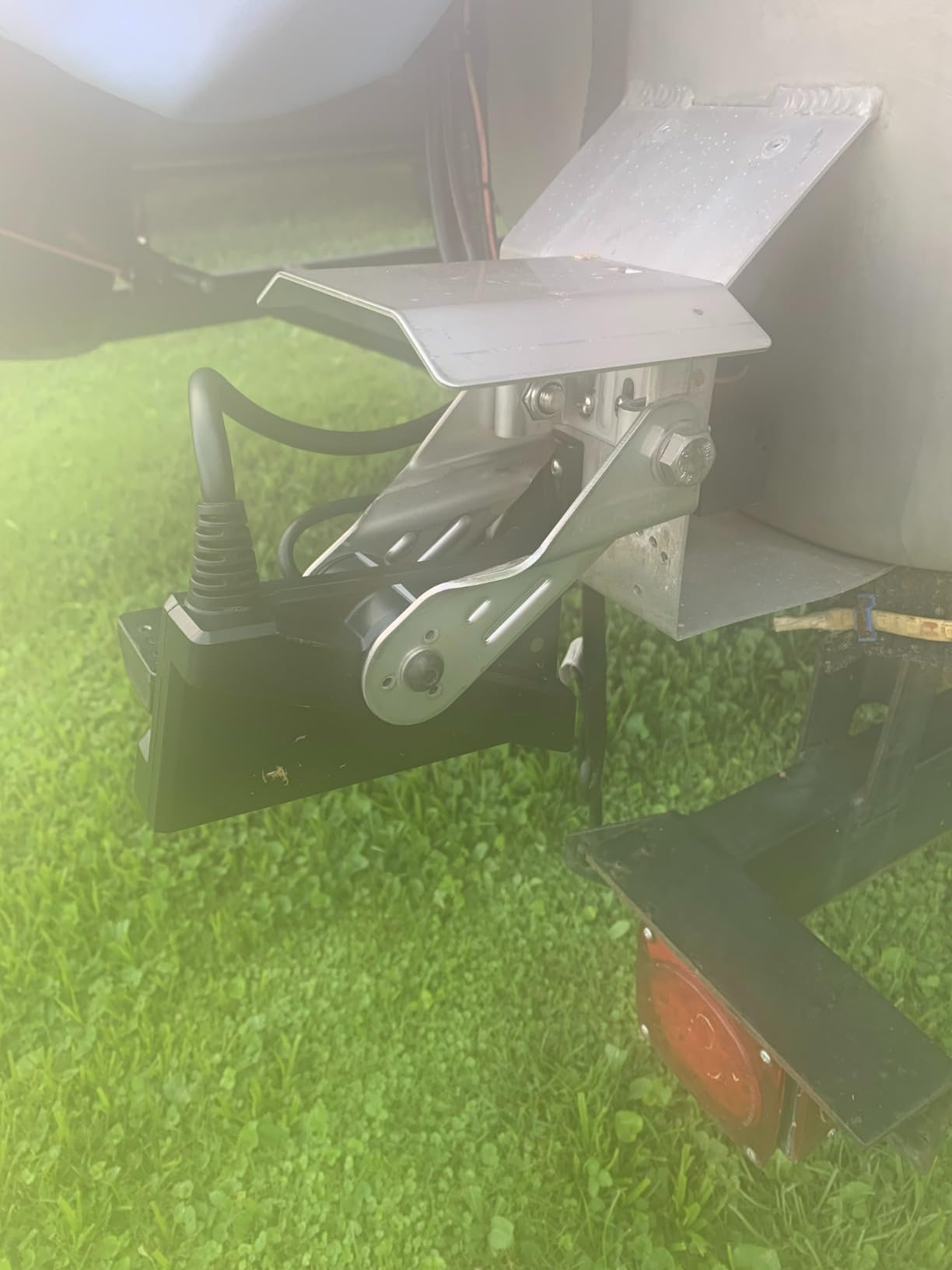
Mount the transducer where the hull is clean, clear of strakes, trim tabs and turbulence sources. Fit it at the transom or on the trolling motor with the supplied bracket and keep the cable run tidy and away from engine and accessory wiring. Do not mount it where bubbles from the hull or prop wash pass over it, and do not bury it in the dirt on a shallow boat. A loose or poorly aligned transducer produces a noisy image that looks like a bad unit, which sends buyers looking for equipment problems that are actually installation problems.
Screen size, power draw and cold weather
Screen size is decided by the boat, not by the feature list. A larger panel is easier to read at a hardtop mount, but a bright display draws more power, and that matters most on a kayak or a small jon boat running off a portable battery. On ice, budget roughly eight hours of runtime from a pack in cold conditions, and expect a lead-acid battery to lose capacity quickly at those temperatures. Cold also stiffens transducer cables, so keep bends gentle and connectors dry.
Live Sonar vs Side Imaging: Which Should You Buy First?
Buy side imaging first if your budget allows only one upgrade. Side imaging finds structure and fish at a distance, which is the job most anglers need done before live sonar matters at all. Live sonar is a refinement for when you are already on the fish and want to see what they are doing.
Buy live sonar first only if you already have a capable conventional setup. Anglers targeting individual fish near known structure, ice anglers, and anyone who spends most of their time within casting distance of a fish get far more from live images than from another scanning mode. If you are still choosing a lake from scratch, side imaging will find you more fish in the first season.
Frequently Asked Questions
Which fish finder is best with LiveScope?
The Garmin LiveScope Plus System is the strongest all-round choice, pairing the LVS34 transducer with the GLS 10 module for the cleanest forward, down and perspective images we tested. If you already own Lowrance or Humminbird electronics, stay in that ecosystem instead and add the matching module, because a live transducer will not drive a display from a different brand.
Which is better, Lowrance or Garmin LiveScope?
Garmin LiveScope leads on forward-facing clarity and target separation, and it is the easier system to add to a boat that already has Garmin displays. Lowrance ActiveTarget is the stronger value route and integrates tightly with Lowrance multi-function displays and their Scout mode. The difference in real use depends more on installation quality than on either brand of hardware.
Is MEGA Live as good as LiveScope?
MEGA Live 2 on a Humminbird XPLORE display has closed much of the gap, particularly alongside the MEGA Side Imaging+ picture that reaches 200 feet to each side. Forward-facing clarity still favours LiveScope in our testing. If you already run Humminbird electronics, the XPLORE control head with a MEGA Live 2 module is a complete live sonar package in the same ecosystem.
Are fish scared of LiveScope?
There is no good evidence that a live sonar signal deters fish. The sound pulse is brief, low energy and directional, aimed forward from the boat rather than into open water, and reviewers report normal catch rates and normal fish behaviour around an active system. Anglers who worry about it can start on low sensitivity and compare results on familiar water.
Is side scan or LiveScope better?
Side imaging is better for finding structure and fish at a distance, so it is the smarter first purchase for most anglers. LiveScope is better once you are close, because it shows you the fish and your lure in real time instead of after you have passed. Many buyers end up running both, since a conventional side imaging and down imaging transducer stays useful alongside a live system.
Does a transducer need to be in water to work?
A transducer needs to stay fully submerged and in clean water to return a usable image. It will produce nothing or a badly degraded picture when it is out of the water, in aerated water behind the prop, or against a fouled hull. On ice, keep it in the hole and clear of slush so it stays in the water column rather than against the ice or bottom.
The Bottom Line on Live Sonar
The Garmin LiveScope Plus System is our pick for the best fish finders with live sonar in 2026, with the Lowrance Eagle Eye 9 as the smarter first step for smaller boats and the Humminbird XPLORE as the answer for anyone already deep in that ecosystem. Whichever route you take, check what else the box needs before you order, and give the transducer mount the attention it deserves.
Live sonar earns its place when you fish individual fish at close range. Start there, and pick up the models below when you are ready to see what is happening before the fish knows you are there.