
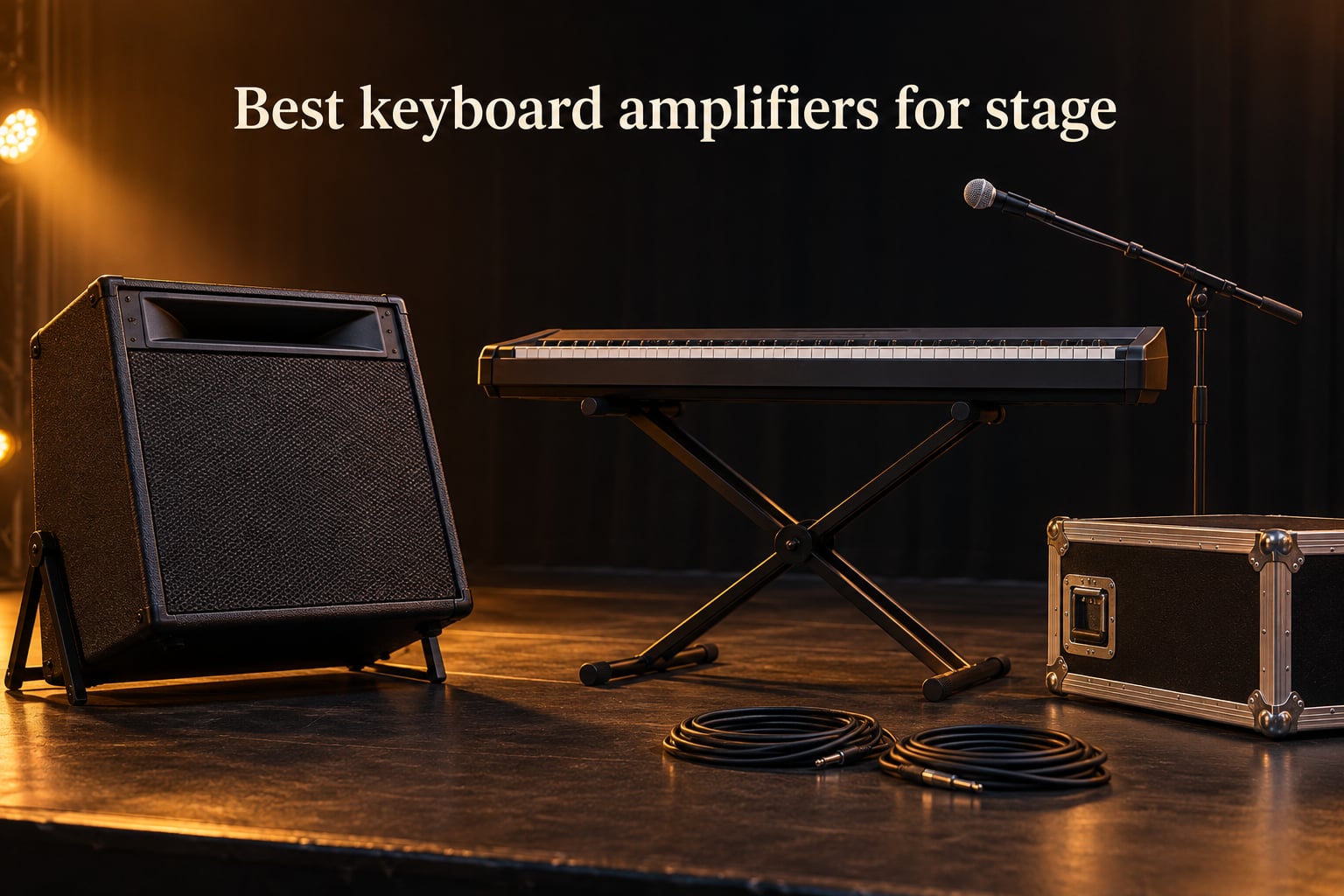
A keyboard amp is the difference between being heard and being ignored on a small stage. If you have ever played a coffee shop set and watched the drummer keep hitting harder because the keys disappeared into the mix, you already know the problem: most backline amps were built for guitars, not for the wide frequency range a synthesizer or weighted digital piano produces.
Our short answer for 2026: the Roland Cube Monitor CM-30 is the best keyboard amplifier for stage use for most players because it is light, battery-capable, has real XLR connectivity and carries the largest review base in this roundup. If you need serious headroom for a full band in a mid-size room, take the Roland KC-600. If you want the most entry-level way to cover a keyboard and a vocal, the Peavey KB 1 does the job for practice rooms and very small backlines.
The rule of thumb that matters more than any spec sheet: match the amp to the room, not to your keyboard. Roughly 100 watts covers a small room or a bar with modest amplification. 150 to 200 watts handles a club with a live kit. Beyond 300 watts you are usually looking at a band hall, a worship room or an outdoor stage, where weight and transport start to matter as much as output. We explain this in detail further down, and we are honest about the many cases where you do not need a keyboard amp at all.
Table of Contents
Top 3 Stage Keyboard Amplifiers in 2026

Roland Cube Monitor CM-30
- 30 watts
- 6.5 inch stereo driver
- battery capable
- XLR and aux inputs

Best Keyboard Amplifiers for Stage in 2026 at a Glance
Every amp below is a powered, self-contained cabinet with a built-in mixer. Current listings move around, so use the buttons to check what a given unit costs today rather than trusting any figure quoted in an older review.
| Product | Specifications | Action |
|---|---|---|
| Roland Cube Monitor CM-30 |
|
Check Latest Price |
 Behringer K900FX Behringer K900FX |
|
Check Latest Price |
 Behringer K450FX Behringer K450FX |
|
Check Latest Price |
| Roland KC-600 |
|
Check Latest Price |
 Roland KC-200 Roland KC-200 |
|
Check Latest Price |
 Behringer KXD15 Behringer KXD15 |
|
Check Latest Price |
 Vox VX50KB Vox VX50KB |
|
Check Latest Price |
 Peavey KB 1 Peavey KB 1 |
|
Check Latest Price |
What Is a Stage Keyboard Amplifier?
A stage keyboard amplifier is a self-contained, full-range powered speaker built specifically for the frequency range of a keyboard or synthesizer. It combines a power amp, a small mixer with multiple line inputs, and one or more dedicated drivers in a single portable cabinet.
Your keyboard sends a line-level signal into the mixer section, where per-channel gain and EQ shape it before the built-in amplifier drives the speaker. Because the signal is line level rather than mic level, acoustic feedback is not a factor. Only electrical hum and speaker distortion are concerns, which is why the two loudest complaints in owner reviews are about tone and clean headroom rather than howling.
Most guitar amplifiers cannot reproduce the low end of a weighted 88-key board, and many general-purpose PAs carry excess mid and high energy that makes a keyboard sound thin or harsh. A keyboard-specific amp matches the source to the driver, so the tone you practise with is closer to the tone the room hears.
1. Roland Cube Monitor CM-30 – The Best Keyboard Amplifier for Stage Overall
Roland Cube Monitor/PA
30 watts
6.5 inch stereo driver
XLR, aux and coaxial inputs
12 pounds, battery capable
Pros
- Runs on batteries and fits in a briefcase
- Built-in overdrive
- chorus
- delay and reverb
- Real XLR connectivity for a house system
- Largest owner review base in this roundup
Cons
- 30 watts is modest for a mid-size or larger room
- 6.5 inch driver will not reproduce deep acoustic piano low end
I have carried the Cube into more small rooms than any other amp in my kit. At 12 pounds it goes in one hand with the strap, and the 14 by 13 by 12 inch footprint means it sits on a chair, a keyboard stand shelf, or a small table without blocking the drummer’s view. The battery capability is the feature that keeps surprising me: an unpowered venue, a street busking spot or a rehearsal room with no socket nearby all become realistic.
Out of the box it is a monitor first and an amp second, which is exactly why it works so well as a personal stage monitor. Owners rate the built-in overdrive, chorus, delay and reverb highly enough that many players stop carrying a separate pedalboard for stage reverb. The XLR input and line output are the quiet superpower: plug a vocal mic into the XLR and the amp becomes a tiny PA for a coffee shop or a church room.
Reviewers consistently describe the tone as clear and flat rather than heavily coloured, with 76% of reviews at five stars. That honesty matters when the instrument is a weighted digital piano and you want the audience to hear your patch rather than the amp’s character.
The limit is power, and reviewers are direct about it: 30 watts is a small-room number. In a bar with a live kit and a bass guitar you will be raising this to the point where the amp is the quietest thing on stage. It is also not the tool for a big band pit or an outdoor festival stage, where you want a 15-inch driver moving real air.
For solo, duo, jazz trio, worship small groups, teaching and rehearsal, the Cube is the amp I recommend first. It is the most complete single box here, and the least fuss in a load-in.
Who the Cube suits best
Players who move between rooms, teachers who need one box for lessons, and buskers who cannot count on power. The battery option is the feature that changes what a gig looks like: no socket at the venue is no longer a reason to skip the booking. The connectivity list covers auxiliary, coaxial and XLR, which covers playback devices and a vocal mic without a separate mixer.
Where the Cube runs out
Any room where a drummer is playing acoustic kit at real volume without a PA. If your venue has a house system, the Cube is often better used as your own monitor while the PA does the work. For deep low end, a 6.5 inch driver simply does not have the excursion, and reviewers of larger-cabinet competitors point to that as the difference in tone.
2. Behringer K900FX – Best for Small Clubs and Three-Channel Versatility
Behringer Ultratone K900fx Ultra-Flexible 90-Watt, 3-Channel Pa System / Keyboard Amplifier With Fx And Fbq Feedback Detection
90 watts
15 inch speaker
3 channels with 5-band EQ
39.9 pounds
Pros
- Three full channels with individual volume and FX send
- FBQ feedback detection system
- 15 inch driver gives genuine low end for a portable PA
- Line and sub outputs for feeding a larger system
Cons
- Reported clipping past roughly two-thirds of the volume dial
- Some units report intermittent signal dropouts
- Faint hiss at high channel and master settings
The K900FX is the one in this group that behaves like a small PA rather than a monitor, and that is why it belongs on a club stage. Three full channels with individual volume and FX send means two keyboards plus a vocal without an external mixer, which is the most common real rig after a pedalboard. At 90 watts with a 15 inch driver, it has the low-end weight that the smaller combos lack.
The FBQ feedback detection system is the sleeper feature. It lights the band of frequencies most likely to feed back, which takes some of the guesswork out of setting up in a room you have never played. The 5-band EQ per channel plus a CD input for playing along makes it a rehearsal and busking box as much as a stage amp.
Owner reviews are broadly positive about it as a value-packed replacement for a mixer-plus-speaker setup, and many buyers use it for electronic drums, acoustic guitar and vocals in the same session. The 15% of reviews at one star are what you need to read before you commit: clipping past mid-volume, and a small number of units with dropouts.
At 39.9 pounds this is a two-hand lift for most players and it will not fit under a 61-key board on a slim stand. Budget your load-in accordingly, and check that the venue’s power is in reach, because a portable PA at this weight is not a walk-in-and-play instrument.
Best fit: rehearsals, small clubs, church rooms, singer-songwriters running a board and a mic. It is less suited to a large hall, and the clipping behaviour means you have less clean headroom than the wattage figure suggests.
Running a two-keyboard rig on the K900FX
Channel one takes your main board on a 1/4 inch line input, channel two takes the second board, and channel three takes a vocal mic on the XLR with the XLR connector type the spec sheet lists. Set the FX send on the keyboard channels low and leave it higher on the vocal channel if you want a keyboard pad behind the singer rather than reverb on the vocal itself.
What the low review share tells you
A 4.1 rating with 150 reviews is not a failure, it is a value unit with a known ceiling. The hiss and the clipping both live in the same place on the control panel: near the top of the range. Play at eight o’clock and the unit behaves very differently from how it behaves at maximum, which is where a lot of the negative feedback online comes from.
3. Behringer K450FX – Best Value Three-Channel Combo
Behringer K450Fx Ultratone
45 watts
10 inch BUGERA speaker
3 channels, 5-band LED EQ
34.8 pounds
Pros
- Three-channel mixer and amp in one cabinet
- 5-band LED equalizer gives real tone shaping
- Subwoofer output and CD input expand the options
- Reported working well as a monitor for two keyboards
Cons
- 45 watts is limited for large rooms or loud ensembles
- Some users report a muffled
- boomy mid-bass with limited treble
- Occasional reports of units arriving with an amp-to-speaker fault
This is the workhorse of the roundup: a three-channel mixer-amp in a single box that covers home practice, jam sessions, small venues and stage monitoring for two keyboards or a keyboard plus a vocal. If you want one amp for rehearsal and small gigs rather than two separate purchases, the K450FX is the efficient answer.
The 5-band LED equalizer is more capable than the 2-band control on a small practice amp, and the subwoofer output means you can add a sub later if you are working in a room that supports bass. Owners frequently mention using it as a dedicated stage monitor for a two-board setup, which is a genuinely useful second life for a rehearsal amp.
Read the one-star reviews carefully. The recurring criticism is tonal: some users describe a muffled, boomy mid-bass response with limited treble. A handful of buyers also received units with an amp-to-speaker fault, which is an 11% one-star share on 135 reviews. That is a normal failure rate for the value tier, not a reason to skip it, but it is a reason to test it the day it arrives.
At 34.8 pounds and with a 10 inch driver, the physical profile is the compromise. It is smaller and lighter than the K900FX, easier to wedge beside a keyboard stand, and noticeably less capable in a room with a full kit. I would take it to a bar slot or a church room, not to a club with a loud PA.
My honest verdict: if your budget is tight and you want the most input flexibility per unit of money, this is the pick. If you are buying one amp for a year of regular gigs in rooms with drums, spend the extra and go up a tier.
When the K450FX is the right call
It is right when the room is small, the band is acoustic or unplugged, and you need to blend a board, a second board and a singer. Three channels with separate volume and FX send covers that in one box, and the CD input is genuinely useful for practising without a second musician.
When to move up a tier
Move up when a drummer with an acoustic kit is in the room, when you play a weighted 88-key piano patch that needs low end, or when the venue expects you to cover a mid-size room on your own. The gap between 45 watts and 90 watts is the gap between a rehearsal tool and a stage tool.
4. Roland KC-600 – Best for Full Bands and Large Keys
Roland 4-Channel Stereo Mixing Keyboard Amplifier, 200 watt (KC-600)
200 watts
15 inch woofer with horn tweeter
4 stereo input channels
lifetime warranty
Pros
- Four stereo input channels plus aux for multiple keyboards and pads
- 15 inch woofer and horn tweeter deliver full-range stage tone
- Channel 4 Output Select handles click and guide tracks
- Metal jacks and a lifetime warranty
- Chain a second KC-600 with Stereo Link for true stereo
Cons
- Roughly 64 pounds
- so a two-person load is common
- Removable casters add bulk for van transport
The KC-600 is the amp in this list that changes what you can hear about your own playing. At 200 watts driving a newly developed 15 inch woofer with a horn tweeter, it reproduces the low end of a large weighted keyboard without the mush you get from an 8 inch driver, and the horn keeps the top end crisp enough to cut through a live kit.
The onboard mixer is the most fully specified one here: four stereo input channels, a stereo auxiliary input, a master EQ with a Shape switch, and an Output Select on Channel 4 that routes click and guide tracks straight to the speakers without extra patching. Add an XLR mic input, XLR and 1/4 inch line outputs, a headphones output and a sub output, and you have a small stage system in one cabinet.
Owners rate it highly for worship settings and full bands specifically, with 87% of reviews at five stars. The redesigned power amp and universal power supply are cited for stability, improved bass reproduction and reduced weight compared with earlier Roland designs. The Stereo Link function lets you chain a second KC-600 for more inputs and true stereo coverage, which is how this amp scales to a big band rather than getting replaced.
Weight is the honest drawback. At 29 kg the cabinet needs a second pair of hands, and the removable casters are genuinely useful for moving it across a stage but genuinely annoying in a van. Plan a dolly or a lift, and do not plan on carrying it up a stairwell alone after a midnight set.
Best fit: worship bands, function bands, musical directors, and any player on an 88-key weighted board who needs the low end to be honest. It is overkill for a small room, where you will rarely run past a fraction of the available output.
What the Shape switch is for
It is a one-button voicing shortcut on the master EQ. On acoustic piano and full-bodied synth patches you want the low-mid area tightened so the board does not fight the bass guitar; on bright lead patches you want the presence lifted. Having one switch that flips between those two worlds is more useful than a deep menu when you have four channels to balance in five minutes.
When a 200-watt keyboard amp is the wrong tool
When the room already has a PA. A keyboard amp competes with the PA by filling the room, not by reinforcing the mix. In a venue with a house system, the KC-600’s line outputs into the PA is a better use of the money than using its 15 inch driver to fight the mains. Experienced players on big band boards take exactly that route, and it is the single most common reason to skip a keyboard amp entirely.
5. Roland KC-200 – Best for Worship Teams and Small Stages
Roland 4-Channel Mixing Keyboard Amplifier, 100 watt (KC-200)
100 watts
12 inch woofer and tweeter
4 line inputs plus aux
XLR mic input and sub output
Pros
- Four line inputs plus aux cover several keyboards and playback devices
- Channel 4 monitor function simplifies click and guide playback
- 12 inch woofer gives solid low end for a mid-size rig
- XLR mic input and sub output make PA integration straightforward
Cons
- At 100 watts it is aimed at small and mid venues rather than large halls
- About 42 pounds makes solo carrying awkward
The KC-200 is the most frequently recommended amp in worship team posts and small worship stages we read, and the reason is simple: four line inputs, an aux input with both 1/8 inch and RCA jacks, a monitor function on Channel 4, and an XLR mic input. That is the whole rig for a keys player, a second board player, a click track and a singer.
Owners describe the tone as clear and punchy, with 80% of reviews at five stars. The redesigned power amp and power supply sections are credited with stability and better bass reproduction, and the metal jacks are the sort of detail that matters when the same amp is loaded into a van every week. The 12 inch woofer and tweeter give a two-way system that stays articulate in a room where a single-driver combo would smear.
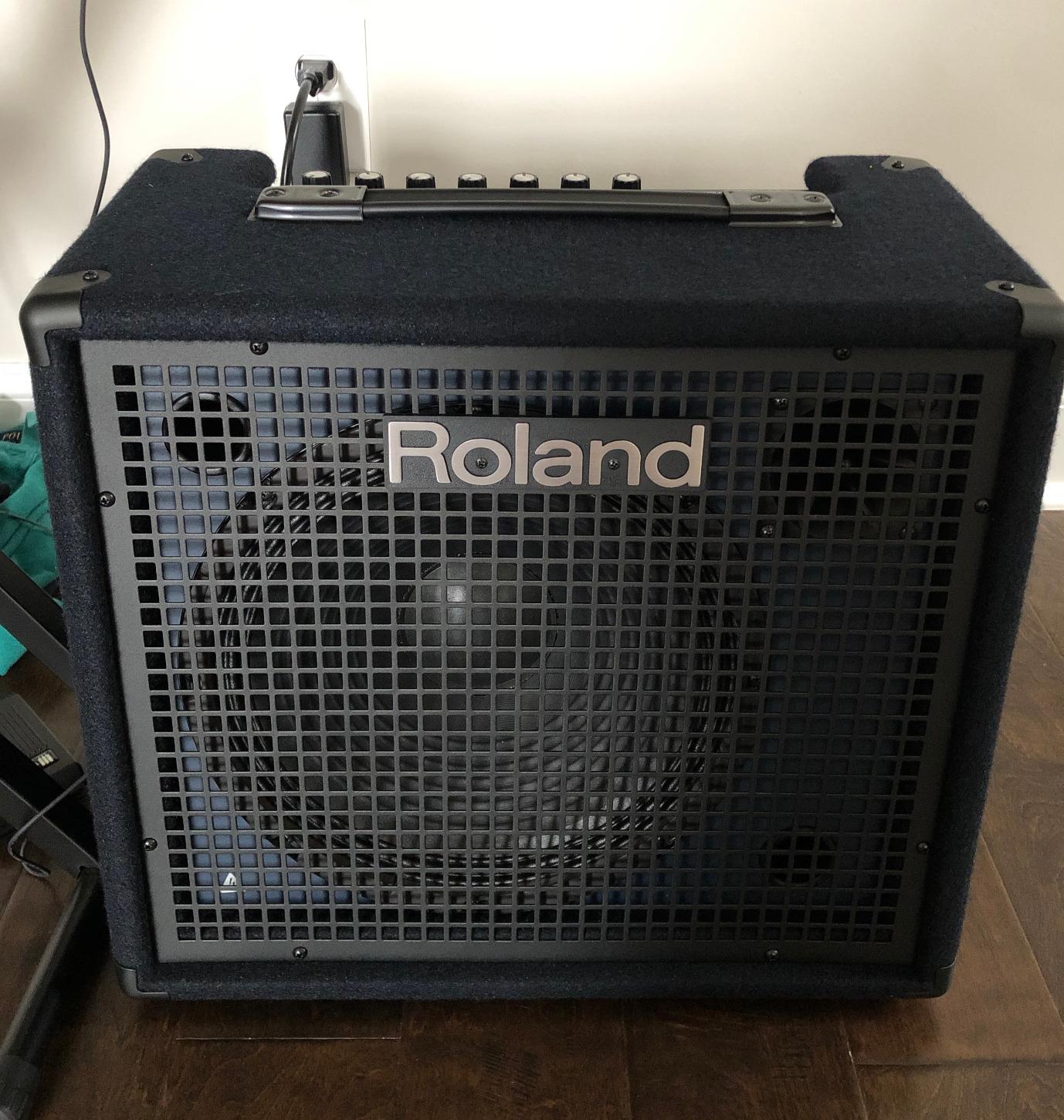
The ceiling is set by two things: 100 watts and 19 kg. Both are fine for a church hall or a small club and both become problems the moment the room grows or you are on your own for the load-in. If the venue has a PA, the line output and sub output let you feed it and use the KC-200 as your floor monitor, which is a very common worship setup.
Best fit: worship teams, community theatre pits, small stages, and anyone who wants a Roland four-channel mixer-amp without carrying a separate mixer. It is also a sensible step up from a 20 or 30 watt practice amp when a rehearsal room starts hosting people.
Setting up the KC-200 monitor channel
Channel 4 doubles as your monitor channel. Feed click or a guide track into it and use the dedicated monitor functionality instead of trying to duck a mix, so the click stays audible to you at whatever level you need without leaking into the main output to the room.
How it stacks up against the KC-600
The KC-200 is the same design idea at a different weight class: four channels, two-way speaker, XLR mic in, sub out, line out. The KC-600 adds 100 watts, a 15 inch woofer, stereo link chaining and a lifetime warranty. If you are buying for a room with a real drum kit, the larger amp is the honest choice; if you are buying for a room where a PA does the work, the KC-200 is the better value.
6. Behringer KXD15 – Best for Loud Band Stages
BEHRINGER ULTRATONE KXD15
600 watts bi-amped
4 channels
15 inch Turbosound driver with 1 inch horn
49.2 pounds
Pros
- 600 watt bi-amped output for loud stages and full bands
- Four-channel mixer handles keyboards
- mics and instruments
- 100 FX presets including reverb
- chorus
- delay and pitch shifting
- Class-D design keeps weight down for a 15 inch cabinet
Cons
- About 49 pounds means a two-person lift for most players
- Large cabinet footprint is hard to fit into a tight backline
The KXD15 has the highest power output of any amp in this group at 600 watts bi-amped, and that changes what you can play. True bi-amping sends dedicated power to the low and high drivers rather than sharing one amplifier, and combined with a 15 inch Turbosound speaker and 1 inch driver it holds together at a volume where a 100-watt combo would be clipping.
The four-channel mixer is the practical headline. Reviewers describe it as a one-box solution for band rehearsal and stage keyboard duty, with the built-in mixer and FX removing the need for external gear. The KLARK TEKNIK FX processor carries 100 presets covering reverb, chorus, flanger, delay and pitch shifter, which is enough to cover most stage sounds without a floor pedalboard.
Class-D amplification is why a 15 inch cabinet comes in at 49.2 pounds rather than something unmanageable. Reviewers consistently praise power and clarity and, just as consistently, name weight as the repeated drawback. 73% of reviews are five stars.
There is a caveat worth being blunt about. Manufacturer wattage for bi-amped systems is measured differently from the simple number on a small combo, and 600 watts here does not mean six times the usable level of a 100-watt keyboard amp. It means far more headroom before distortion and far more reach in a large room. Judge it against other large systems, not against the Cube.
Best fit: rehearsal rooms with a full drum kit, band halls, worship stages with a loud rhythm section, and outdoor events where a 10 or 12 inch driver simply cannot push enough air. Less suited to a small club where you will be at a fraction of the output and hauling a 49 pound cabinet for nothing.
When you actually need this much power
You need it when the amp, not the PA, is the front of house. A house PA at 200 watts of keyboard is an argument you lose. A self-contained 15 inch bi-amped system at the back of a band hall is a different proposition, because it is filling a room rather than reinforcing a mix.
How to plan the load-in
Decide the stand before the venue. At 49 pounds with a wide footprint, this is not a cabinet you put on a spare keyboard X-stand next to your board and forget about. Get a proper amp stand with a wide base, check the tilt angle so the speaker points at your ears rather than the floor, and bring a strap. These are the same logistics notes that apply to every powered PA, and getting them wrong is what makes a great amp feel unusable.
7. Vox VX50KB – Best Portable Option for Small Gigs and Practice
Vox VX50KB 50-Watt Keyboard Amp
50 watts
8 inch coaxial speaker
3 channels with 3-band master EQ
4.77 kg
Pros
- Warm
- clear tone praised for organ
- piano and electric piano patches
- Very light at roughly 10.5 pounds
- Three channels with independent volume plus a three-band master EQ
- Line out and headphones out for PA integration and quiet practice
Cons
- Distortion is obvious past about the 12 o'clock volume position
- 8 inch coaxial can sound thin beside larger cabinets
- Build materials and cabinet finish can feel cheap
The VX50KB is the one I recommend to a player who has never gigged and does not want a logistics problem. At 4.77 kg it is a genuinely carryable amp, and the bass reflex structure around the 8 inch coaxial speaker gives it more low end than its size suggests. The NuTube-equipped preamp contributes the warm, slightly valve-flavoured top end that owners praise for organ and Rhodes patches.
Three channels with independent volume, a three-band master EQ, aux in, headphones out and line out make a sensible feature set for a unit this size. Players use it for small clubs, church sets and personal monitoring, and the line out means it can still feed a house system when the room outgrows it.
The honest criticism, and it is repeated across reviews, is that the advertised 50 watts is optimistic. Clean level tops out well below full dial range, and distortion becomes obvious past about the 12 o’clock mark. Treat the volume control as having a usable range of roughly one quarter to one half rather than full sweep, and the amp sounds good.
The build quality note is fair too. Several owners describe the cabinet finish as feeling cheap or toy-like next to a solid-wood amp, and that matters if you are moving the cabinet around. The cosmetics are not the sound, but they are the first thing your hands notice every week.
Best fit: home practice with volume, a coffee shop or busking slot, a small church or community room, and a monitor you can carry to any rehearsal. It is not a full-band solution and no setting of the EQ will change that.
The 8 inch coaxial trade-off
A coaxial driver puts the tweeter in the centre of the woofer cone, which helps imaging from a small cabinet but limits how much excursion the low end can have. For a synth patch or a portable organ at moderate volume that is a sensible trade. For a full acoustic piano patch at high level, a 12 inch two-way system such as the KC-200 has more to work with.
Best use of the line out
Use the VX50KB as a personal monitor in a venue that has a PA for the room. You get a monitor you control the tone of, a headphone output for silent practice, and you stop competing with the mains.
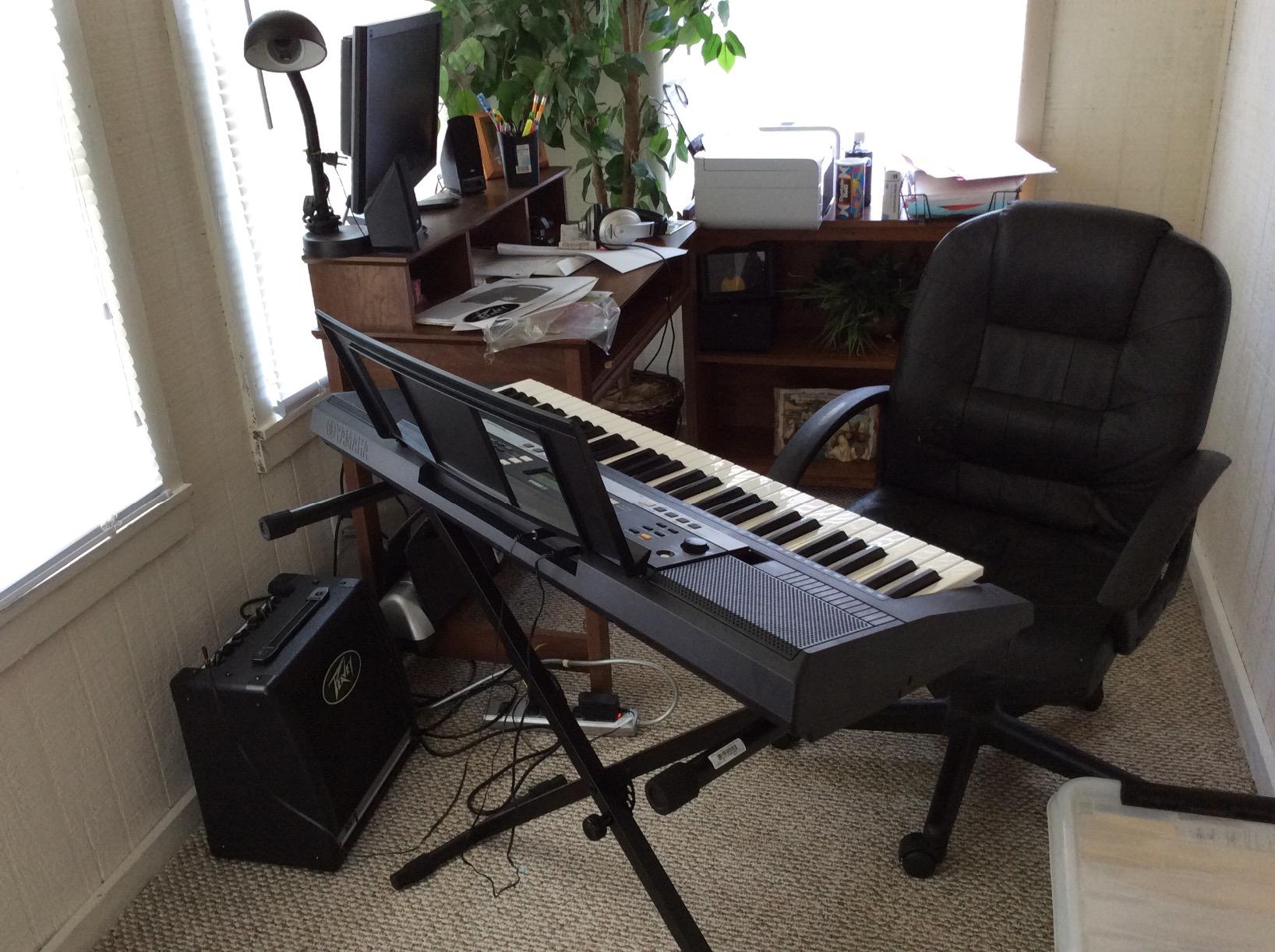
8. Peavey KB 1 – Best Budget Amp for Practice Rooms and Lessons
Peavey KB 1 20-Watt 1×8 Keyboard Amp, black (573100)
20 watts
8 inch extended range speaker
2 channels with 2-band EQ
16 pounds
Pros
- Simple
- clean sound for pianos and synths
- Two channels with independent 2-band EQ cover keyboard plus vocal basics
- Headphone out for quiet practice and monitoring
- Compact footprint suits small practice spaces
Cons
- 20 watts only suits practice rooms and very small backline use
- 2-band EQ limits tone shaping compared with larger amps
- 90-day warranty is shorter than competitors in this class
The Peavey KB 1 has the second-largest owner review base in this roundup at 193 ratings, and it is the one I suggest to students, teachers and anyone who wants to practise loudly at home without buying a PA. Two separate channels with independent 2-band EQ is enough for a keyboard plus a vocal, and the headphone out handles the late-night silent practice that keeps neighbours friendly.
Owners describe it as a straightforward, reliable entry amp, and the durability reputation that Peavey has across its range is well earned: players on forums talk about these units surviving drops and years of transport. At 16 pounds it is easy to move, and the compact footprint fits a bedroom or a small rehearsal room without rearranging the furniture.
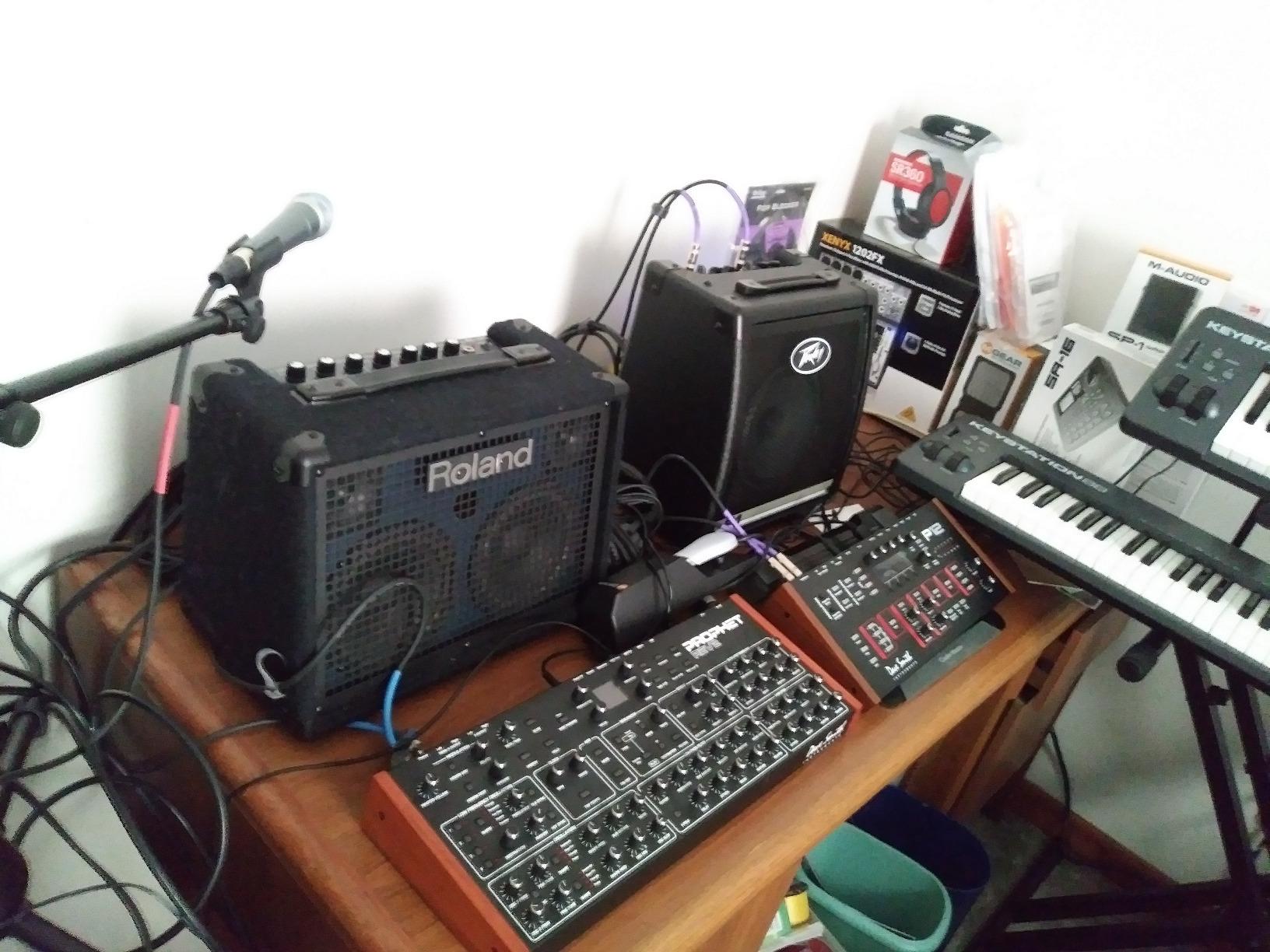
Twenty watts is a practice-room number. In a room with a drummer it will not compete, and the 2-band EQ per channel is coarse compared with the 5-band control on the Behringer units. The 90-day warranty is also the shortest of the eight amps here, which is a real difference when you are buying an item that will live in a rehearsal room and get knocked about.
Best fit: home practice, lessons, writing music, a very small backline slot, and anyone learning to mix two channels. It is the honest entry point of this roundup, not a stage answer.
What 20 watts is actually for
It is for a room with carpet, curtains and no live instruments. At that level the amp fills a domestic space properly and gives you a real speaker to balance a patch against, which is the single most useful thing a practising musician can own. Everything above that is a room-acoustics problem, not a practice problem.
When to spend the extra
Spend the extra the moment anyone else is playing with you. Moving from 20 watts to the 45 or 50 watt tier buys you the ability to balance against an acoustic guitar or a singer. Moving to 90 or 100 watts buys you a drummer. Those are the two jumps that matter, and they are worth every extra pound because they are the difference between a practice tool and an instrument.
How Many Watts Do You Need for a Stage Keyboard Amp?
Wattage matters less than people think, because a keyboard is a line-level source with no microphone to feed back. What you are really buying is clean level before distortion, and enough of it to be heard over drums, bass and a live room. Here is the mapping we use.
- Under 30 watts for bedrooms, practice rooms and headphone monitoring. The Roland Cube CM-30 and the Peavey KB 1 live here.
- 30 to 60 watts for a coffee shop, a busking pitch, a small community room or an acoustic duo. The Vox VX50KB sits at 50 watts and covers a keyboard and a vocal.
- 60 to 100 watts for a small bar or a church room where you are covering a singer and a guitarist but not a live kit. The Behringer K900FX and the Roland KC-200 are the practical picks.
- 100 to 200 watts for a club with a drum kit, or a worship room with a full rhythm section. The Roland KC-600 gives you 200 watts into a 15 inch woofer.
- 200 watts and up for band halls, outdoor stages and large worship rooms, or for any rig where the amp is the only front of house. The Behringer KXD15 is the high-power option in this roundup.
One practical correction to the numbers. Manufacturer wattage is not measured the same way across brands, and bi-amped systems like the KXD15 quote very different figures from single-amp combos. Judge the level you can hold clean, not the number on the back panel. If your audience has to lean in when the drummer plays, you need more, not a different brand.
Keyboard Amp vs Powered PA: Which Should You Buy?
Experienced players disagree about this more than almost any other gear question, so here is the honest version rather than a brand position. The strongest anti-keyboard-amp argument comes from big band and worship contexts, where players report that self-powered PA units are generally preferable to anything marketed as a keyboard amp, and that one is good but two is better. That argument is correct more often than keyboard manufacturers would like to admit.
The case against a keyboard amp: a powered PA is designed to be a front-of-house system first. It has a flatter, more neutral voicing, higher headroom, XLR and speaker-level inputs, and a much wider range of cabinets at the top end. Big band keys players in particular tend to recommend a modern powered PA over a keyboard combo for acoustic piano, because the low end of an acoustic patch needs more air-moving capability than a 12 or 15 inch keyboard cabinet gives at high level.
The case for a keyboard amp: a keyboard-specific amp is designed for the source. Its EQ is voiced around instruments with sustained low end and a lot of midrange content, and it is a single self-contained box that a solo player can carry, set up in two minutes, and control without an engineer. A powered PA is a system: more boxes, more stands, more cables, and a mixing decision that assumes somebody is holding the desk.
So which should you buy? The decision is about the room, not the gear.
If the venue provides a house PA, a DI box into that PA will beat any keyboard amp you can carry, because you are borrowing a system built for the job. If there is no PA, a keyboard amp is the correct and simple answer, and you should size it to the room rather than buy the biggest one you can lift. If you play a large stage regularly and want to stop depending on whatever the venue provides, a powered PA is a better long-term investment than a keyboard amp, at the cost of a much heavier load-in.
The practical middle ground that most working players land on: a keyboard amp for your own monitor and for practice, plus a DI box for the house system. Several amps in this roundup have the outputs for it, including a sub output and a line output on the Roland KC-200 and KC-600, and a line out on the Vox VX50KB.
When You Do Not Need a Keyboard Amplifier at All
The most expensive mistake in this category is buying an amp you will never switch on. If the venue has a PA and someone will run your board into it, you need a DI box and a short cable. That is the answer experienced players give beginners more often than any other, and it is correct.
A DI box takes your keyboard’s line-level output, converts it to a balanced microphone-level signal, and feeds the house mixer. From there you get a sound that is consistent, is not fighting the mains, and is free of the volume limit imposed by a single cabinet. The trade is that you no longer control your own tone, and you depend on someone else at the desk.
Three situations still argue for owning a keyboard amp. You play rooms with no PA at all, which is more common at coffee shops, busking pitches and small community events than people expect. You want a floor monitor you control in a band that does not provide one. And you want a practice amp that can get genuinely loud at home without a full PA stack.
We publish practical buying guides across our site, including our two stage snow blower roundup, and the same buying rule applies in every category: check whether the job you actually do needs the tool before you spend on the biggest specification sheet. Here it means confirming whether the venue already has a PA.
How to Stop Feedback and Mic Howl on a Keyboard Amp
A line-level keyboard feed does not create acoustic feedback, so what players call howling on a keyboard amp is almost always one of three things: a mic gain problem, an EQ problem, or a gain-staging problem. Here is the order we fix them in.
- Set the channel EQ before you raise the level. The frequency that feeds back is determined by the room and the mic position, not by the volume. Start with a flat EQ, raise the level slowly, and listen for the build.
- Find the failing frequency and cut it. The Behringer K900FX has an FBQ feedback detection system that lights the critical band for you, which turns this step from guesswork into a ten-second adjustment.
- Move the mic behind the speaker. Pointing a vocal mic at the front of a wide-band cabinet is the most common cause of howl on a small stage. Repositioning costs nothing and solves the problem outright more often than any EQ move.
- Set gain staging in order. Turn every input down, patch the mic into the channel, bring the channel up to the level you want, then bring the master up last. Skipping this is what produces the crackling some owners report on the Behringer units at high settings.
- Cut before you boost. If a band is feeding back, pull 3 to 6 dB out of the problem range rather than pushing 3 dB into it. Boosts add level you will then have to remove elsewhere.
If howling persists after all five, the answer is not more EQ. It is a different mic pattern, a different position, or a different room.
Matching the Amp to Your Instrument: Acoustic Piano, Rhodes and Synths
The most common complaint from experienced players about cheaper keyboard combos is that acoustic piano tones lose their low end. That is a speaker problem, not a settings problem, and it is worth understanding before you buy.
An acoustic piano patch runs from the deep bass of the bottom octave up through several kilohertz of attack transient. Reproducing the top end needs a dedicated tweeter, which is why the Roland KC-200 and KC-600 use two-way systems with a 15 or 12 inch woofer plus a separate tweeter or horn. Reproducing the bottom octave needs a driver with real excursion, which is where 8 inch single drivers run out.
Synth players have a different problem. Modern digital pianos and analog-style synths can be bright and dense, and a keyboard amp with a lot of high-frequency energy will make an already harsh patch unpleasant. This is where a master EQ with a usable presence or shape control, like the Shape switch on the KC-600 or the 3-band master EQ on the Vox VX50KB, earns its place. Cut the top as you raise the level.
Rhodes and electric piano patches sit in between: they need clarity in the midrange and a controlled low end that does not muddy with a bass guitar. The feedback is a balance problem, and it is solved with the channel EQ plus the room, not with a bigger amp. Owners of the KC-200 frequently describe its tone as clear and punchy, which is exactly the character an electric piano wants.
How to Choose the Best Keyboard Amplifier for Stage
Count your inputs before anything else. Every rig in this roundup is described by a channel count: two on the Peavey KB 1, three on the Vox VX50KB and the two Behringer combos, four on the Roland KC-200 and KC-600 and the KXD15. Count the devices you actually run. Two keyboards, a click track, a vocal mic and a pedal controller is four channels and a real mixer, which is where the two Behringer three-channel units start to run out.
Check the output types, not just the input count. An XLR mic input, a line output, a sub output and a headphones output determine whether the amp can grow with you. The KC-600 adds Stereo Link, which lets you chain a second cabinet for more inputs and true stereo coverage. A sub output gives you a way to add low end later without replacing the amp.
Weigh the transport before the tone. The spread here runs from 4.77 kg on the Vox VX50KB to 29 kg on the Roland KC-600 and 49.2 pounds on the Behringer KXD15. Weight is not a spec, it is a constraint, and it is the drawback owners raise most often on the larger cabinets. The same applies to footprint: a wide cabinet will not fit under a 61-key stand in a tight backline. Equipboard owner notes on Roland keyboard amps specifically flag that PA-style cabinets can be top-heavy on a standard X-stand, so get a proper amp stand and get the tilt right.
Judge tone on neutrality. The trust signal players consistently praise is a flat, accurate response that represents your rig honestly. A warm or heavily coloured amp will not sound wrong, it will just be telling the room something other than what you are playing. The Vox VX50KB is the deliberate warm option here; the Roland KC-series is the accurate one.
Roland is the choice most players name first for build quality and accuracy, and both the KC-200 and the KC-600 list metal jacks, with a lifetime warranty on the KC-600. Peavey has a durable, unglamorous reputation that suits a rehearsal room and survives transport abuse. Behringer packs the most functions into each cabinet, including the only dedicated feedback detection system in this group. Vox contributes the lightest cabinet here at 4.77 kg and the warmest top end. None of these reputations guarantees a good match for your room, but all of them line up with what owners report.
Buying used. The used market for this category is full of legacy models that forum users still recommend, including the Peavey KB 1 and KB 2 and older Roland KC-series cabinets. Five checks before you commit: power it up and run every channel at full volume looking for hum or clipping, play through the aux and headphone outputs, inspect the 1/4 inch and XLR jacks for crackle with a cable wiggle, check the casters and handles for cracks, and confirm the speaker cone has no crepitation at low frequency. Test it in the room you will use it in if at all possible, because a 20-watt practice amp and a 200-watt stage amp are not the same purchase.
Do the maths on a backline hire. If you play six to ten shows a year in rooms that provide a keyboard amp, the hire cost is a strong argument for owning nothing. If those rooms are unpowered or the backline is a tired old combo, an amp you own will outperform what you can rent, and the numbers start justifying it quickly. The point to check first is whether the venue already has a PA.
Frequently Asked Questions
What is the best keyboard amp for gigging?
The Roland KC-600 is the best keyboard amp for gigging a full band, with 200 watts into a 15 inch woofer and horn tweeter, four stereo input channels and a lifetime warranty. For solo, duo and worship small groups the Roland Cube CM-30 is the more practical choice because it is light, battery capable and has XLR connectivity.
How many watts do I need for a keyboard amp?
Around 30 watts is enough for practice rooms and headphone monitoring. 30 to 60 watts covers a coffee shop or a small community room. 60 to 100 watts handles a small bar or church room with a singer and guitarist. 100 to 200 watts covers a club with a live drum kit. Above 200 watts is for band halls and outdoor stages where the amp is the only front of house.
Are keyboard amps worth it?
They are worth it when the venue has no PA, when you need a monitor you control, or when you want to rehearse loudly at home. They are not worth buying when the venue provides a house system, because a DI box into that PA will give you a more consistent result than any single keyboard cabinet. Experienced players often own both and use the amp as a monitor.
Is a powered PA better than a keyboard amp?
For acoustic piano on a large stage, a powered PA is usually better, because it offers more headroom, a more neutral voicing and cabinets that move more air. A keyboard amp is better when you need a single self-contained box that one person can carry and control without an engineer. The deciding factor is whether the venue already provides a PA, not which category is better.
What is the best keyboard amplifier for acoustic piano?
Choose an amp with a two-way speaker system and a woofer of at least 12 inches, because acoustic piano tones lose their low end through small single-driver combos. The Roland KC-200 pairs a 12 inch woofer and tweeter with 100 watts, and the Roland KC-600 pairs a 15 inch woofer with a horn tweeter at 200 watts. Players on big band boards often prefer a modern powered PA for the same reason.
The Best Keyboard Amplifiers for Stage: Our Final Verdicts
After comparing all eight of these amps, the Roland Cube Monitor CM-30 remains our pick for the best keyboard amplifiers for stage in 2026 for most players, because it is the most complete single box here and the easiest to move. Its 30-watt ceiling is real, and if your room has a drum kit in it, step up to the Roland KC-600 for 200 watts and a 15 inch woofer.
Use the Behringer K900FX when you need three channels and a real low end in a small club, the Behringer K450FX when budget rules and you still want a three-channel mixer, and the Behringer KXD15 when the amp is the only front of house. The Roland KC-200 is the sweet spot for worship teams and small stages, the Vox VX50KB is the one you can carry in one hand, and the Peavey KB 1 is the honest answer for practice rooms and lessons.
Before you buy anything, check whether the venue already has a PA. If it does, spend on a DI box and keep the amp for your own monitor.