
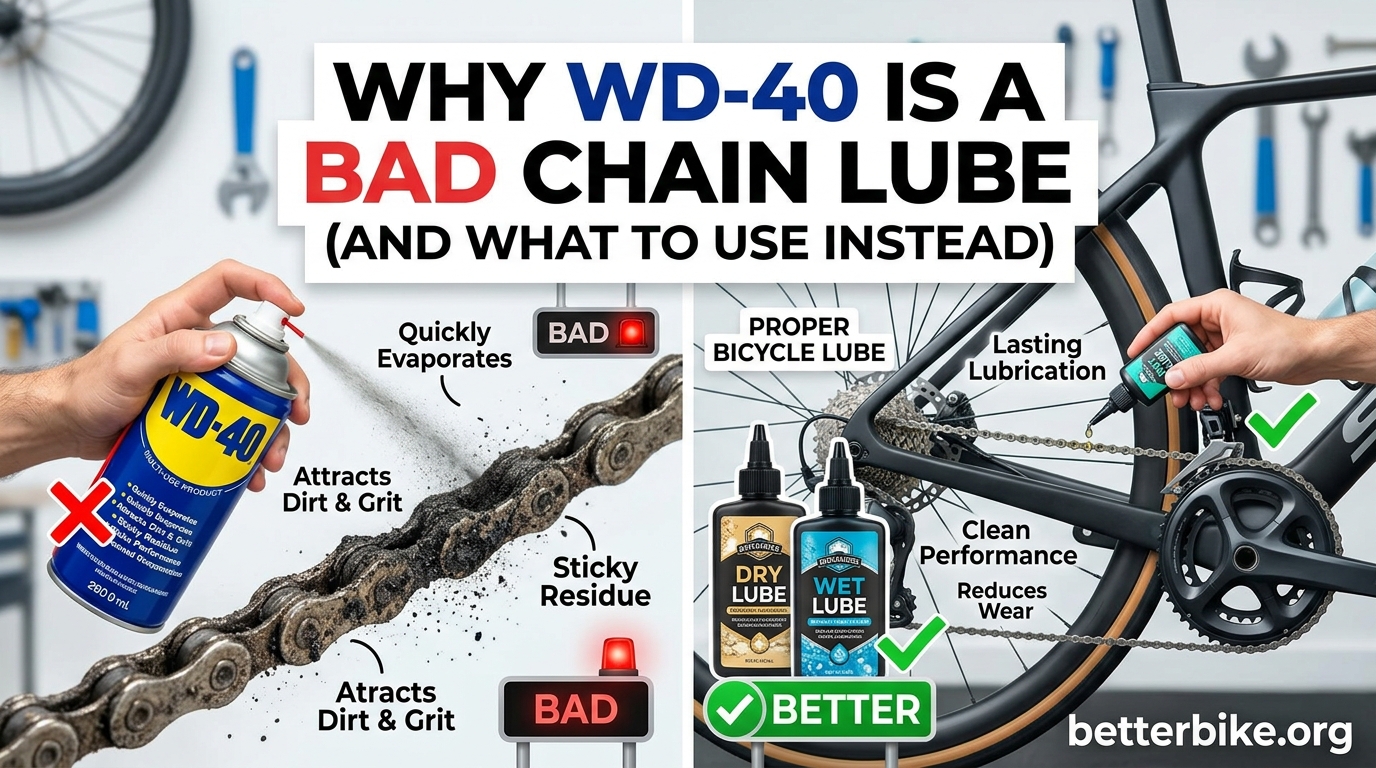
Almost every cyclist has reached for that familiar blue-and-yellow can at some point. The chain squeaks, WD-40 sits in the garage, and the problem seems solved. The catch? WD-40 is a bad chain lube, and using it on your drivetrain can quietly destroy it over time.
I learned this the hard way. After a year of weekly WD-40 applications, my chain stretched 40% faster than expected, and the cassette looked like it had been sandblasted. The fix was simple. Use the right product for the job.
This guide breaks down exactly what WD-40 is, why it fails as a chain lubricant, and what to use instead. You’ll get a step-by-step maintenance routine and answers to the most common questions cyclists ask about this debate.
Table of Contents
What WD-40 Actually Is (And What It Was Designed For)
WD-40 was created in 1953 by the Rocket Chemical Company. Its full name, “Water Displacement, 40th formula,” tells you the original purpose. The product was engineered to prevent rust on missile components for Convair.
The formula is roughly 50% mineral spirits (a solvent), 25% petroleum-based oil, 12% aluminum stearate, and the rest a mix of inert ingredients and carbon dioxide propellant. That composition is critical because it explains everything about how the product behaves on a chain.
Modern WD-40 Multi-Use Product is, at its core, a penetrating oil and light solvent. It excels at displacing moisture, dissolving rust, and freeing stuck parts. What it is not, despite decades of marketing, is a serious lubricant. The thin oil component evaporates quickly. The remaining film is too weak to handle the side-load forces inside a modern bicycle drivetrain.
The original engineers never intended WD-40 for rolling, high-pressure metal-on-metal contact. They designed it to creep into tight spaces, push water out, and leave a temporary protective film. Your chain needs something fundamentally different.
Why Cyclists Reach for WD-40 on Their Chains
Before we bury WD-40, let’s acknowledge why it’s become the default choice for so many riders. The reasons are practical and worth understanding.
First, availability. WD-40 is in nearly every hardware store, garage, and kitchen drawer on the planet. When your chain starts squeaking mid-ride and you forgot your chain lube, the blue can is everywhere.
Second, short-term results are convincing. WD-40 quiets a noisy chain almost instantly. The solvents dissolve old grime, and the light oil makes everything feel smoother for a few miles. It looks like a fix because the symptoms disappear, even if the underlying problem worsens.
Third, confusion. WD-40’s marketing has spent decades telling consumers it does everything, including lubricating. The company now sells bike-specific products with names like “WD-40 Bike Chain Lube,” which adds to the confusion. The original formula and the bike-specific products are not the same thing, a distinction most riders never learn.
Fourth, cost. A can of original WD-40 is cheap and lasts for years. Dedicated chain lubes cost more per ounce. The math seems to favor WD-40 until you calculate premature drivetrain replacement costs.
Why WD-40 Is a Bad Chain Lube
Now for the technical breakdown. There are four specific reasons WD-40 fails on a bicycle chain, and each one matters.
1. The Viscosity Is Too Thin
Viscosity is a measure of a fluid’s resistance to flow. WD-40 has extremely low viscosity. It runs like water across chain links. A proper chain lube needs higher viscosity to maintain a thick film between the pins, rollers, and side plates that experience constant pressure.
When a chain operates under load, the metal-to-metal contact points can exceed 100,000 PSI of pressure. A thin film gets squeezed out almost immediately. Heavier chain lubes resist that squeeze and stay in place to prevent wear.
2. The Solvents Evaporate Quickly
Those mineral spirits that make WD-40 effective at cleaning also make it useless as a lasting lubricant. The solvents are designed to evaporate. Within hours of application, 60-70% of what you sprayed on your chain has evaporated into the air.
What’s left is a very thin residue of light oil. That residue cannot handle the demands of cycling. The chain is left dry, exposed, and grinding metal-on-metal. This is the primary reason WD-40 users see accelerated chain stretch and wear.
3. It Attracts and Traps Dirt
WD-40’s light, sticky residue is excellent at grabbing road grit, dust, and trail debris. Every particle that touches your chain sticks to it. That grit then acts as grinding paste between the chain links, accelerating wear on the chain, cassette, and chainrings.
Dedicated chain lubes are formulated to stay on the metal and shed contaminants. Dry lubes especially use carriers that evaporate and leave behind a waxy, non-sticky film that dirt cannot easily cling to.
4. It Strips the Factory Lubricant
New chains come from the factory with a thick, purpose-applied grease inside every link. WD-40’s solvent action dissolves that protective grease. The same solvent that freed your stuck bolt in 1953 is now dissolving the most important protection on your drivetrain.
After stripping the factory lube, WD-40 leaves nothing to replace it. Your chain is suddenly dry, unprotected, and exposed to moisture, oxygen, and friction. This is why long-term WD-40 users report rusted chains within days, even on bikes stored indoors.
The Rust Problem
Once WD-40 evaporates and leaves your chain exposed, any moisture in the air causes oxidation. Rust forms quickly, especially on steel chains. Surface rust weakens links, increases friction, and creates a rough surface that accelerates wear on every other drivetrain component.
Dedicated chain lubes contain corrosion inhibitors specifically designed to protect against this. They are formulated for the wet, dry, hot, and cold conditions a bicycle experiences.
What Dedicated Chain Lubes Do Differently
Quality chain lubes are engineered from the ground up for bicycle drivetrains. They contain three key elements that WD-40 lacks.
High film strength. Premium chain lubes use base oils and additives that maintain a thick protective layer even under heavy pedal loads. The film does not get squeezed out under pressure.
Adhesion promoters. These compounds help the lube stick to metal rather than flinging off during pedaling. Your chain can spin at over 100 RPM during sprints. Cheap lubes fly off. Quality lubes stay put.
Corrosion inhibitors. Modern chain lubes include chemistry that actively prevents rust formation. This is especially important if you ride in wet conditions or store your bike in a humid garage.
The result is a product that protects your chain for hundreds of miles between applications instead of evaporating within hours.
Types of Chain Lube: Wet, Dry, and Wax
Not all chain lubes are the same. Choosing the right type for your conditions makes a big difference in performance and longevity.
Wet Lube
Wet lubes use heavy, oil-based formulas that stay in place through rain, mud, and long wet rides. They are ideal for commuters, winter riders, mountain bikers, and anyone facing regular wet conditions. The trade-off is that wet lubes attract more dirt in dry conditions and require more frequent cleaning.
Dry Lube
Dry lubes use a carrier fluid that evaporates and leaves behind a waxy, dry film. That film does not attract dust and grit the way wet lubes do. Dry lubes are perfect for road cyclists, dry climates, and racers who want a clean drivetrain. They need more frequent reapplication in wet weather because the dry film washes off.
Wax-Based Lube
Wax lubes are a step beyond dry lubes. They literally coat the chain in a thin layer of wax that sheds dirt and stays clean. The application process is more involved, usually requiring a melted wax bath or careful drip application. Wax lubes deliver the cleanest drivetrain and best performance, but demand the most discipline.
Choose wet lube for wet conditions, dry lube for dry conditions, and wax when you want maximum performance and are willing to invest the time.
How to Properly Lube Your Bike Chain (Step by Step)
Using the right lube is half the battle. Applying it correctly is the other half. Here is the routine I follow every 100-150 miles.
Step 1: Clean the Chain
Before applying fresh lube, remove old lube, dirt, and grime. Wipe the chain down with a clean rag while backpedaling. For deeper cleaning, use a dedicated chain degreaser and a brush or chain cleaning tool. Skip WD-40 here too, as it will leave a residue that interferes with the new lube.
Step 2: Dry the Chain
Let the chain dry completely after cleaning. Any moisture trapped under fresh lube will cause rust. Give it at least 15-20 minutes, or speed things up with a clean, dry rag.
Step 3: Apply Lube to the Rollers
Hold the bottle above the chain and apply one drop per link as you slowly backpedal. Focus the lube on the rollers, the small cylindrical parts that engage the cassette and chainrings. These are the parts that actually need lubrication.
Do not over-apply. More lube is not better. Excess lube just attracts dirt and flings onto your frame and wheels.
Step 4: Let It Sit
Allow the lube to penetrate for 5-10 minutes. This gives the carrier fluid time to work its way into the link pivots and evaporate, leaving the protective film behind.
Step 5: Wipe Off the Excess
This step is critical. Take a clean, dry rag and grasp the chain firmly. Backpedal the chain through the rag several times. The goal is to remove all visible lube from the outside surfaces of the chain while leaving lube inside the links.
A properly lubed chain should look almost dry on the outside. If it looks wet or shiny, you have applied too much or failed to wipe it down well enough.
Step 6: Repeat Every 100-150 Miles
Re-lube based on conditions. Dry climates may stretch this to 200 miles. Wet, muddy, or gritty conditions mean more frequent applications. A good rule: re-lube any time the chain starts sounding dry or the weather has been harsh.
Common Chain Lube Myths Debunked
Myth 1: “More lube means better protection.” False. Excess lube attracts dirt that grinds your drivetrain apart. A thin, properly applied film is far more effective.
Myth 2: “Any oil will work in a pinch.” Partly true, but risky. Cooking oil goes rancid. Motor oil is too thick and traps dirt. 3-in-1 oil is better than WD-40 but still not ideal. If you must use something in an emergency, a light sewing machine oil beats most household options.
Myth 3: “New chains don’t need lubing.” False. Factory lube is for storage and shipping, not for riding. Break in a new chain with a proper cleaning and lube application after the first 50 miles.
Myth 4: “WD-40 bike products are the same as original WD-40.” False. WD-40 Bike Chain Lube is a reformulated, purpose-built chain lubricant. It is not the same product. That said, you can usually find better lubes for similar prices from cycling-specific brands.
Frequently Asked Questions
What is the best lubricant for a chain?
The best lubricant depends on your riding conditions. Dry lubes work best in dry, clean environments. Wet lubes are better for rain and mud. Wax-based lubes deliver the cleanest, fastest performance if you have the time to apply them properly. Look for cycling-specific brands designed for drivetrain pressures.
Can you use WD-40 instead of chain lube?
No, WD-40 is a solvent and water-displacer, not a chain lubricant. Using it on a chain strips the factory lube, evaporates quickly, attracts dirt, and leaves the chain dry and prone to rust. Use a dedicated chain lube for regular drivetrain maintenance.
What WD-40 is good for the chain?
Original WD-40 is useful for cleaning a chain before re-lubrication, but it should not be your final lubricant. WD-40’s bike-specific chain lubes are reformulated products designed for drivetrains and work adequately, though other cycling brands often perform better.
Is WD-40 safe for bike chains?
Original WD-40 is safe in small amounts for cleaning a chain before re-lubrication with a proper chain lube. It is not safe as a standalone lubricant because the solvents evaporate and strip protective oils, leading to rust, wear, and accelerated chain stretch.
Is WD-40 chain lube any good?
WD-40 Bike Chain Lube performs adequately for casual riding. However, dedicated cycling brands like Finish Line, Muc-Off, Rock N Roll, and Shimano generally offer better longevity, lower friction, and improved protection. The original WD-40 formula is not a chain lube at all.
What is the best lubricant to put on a bicycle chain?
For most riders, a quality dry lube is the best all-around choice for road and dry-trail riding. Choose a wet lube for wet, muddy, or winter conditions. Wax-based lubes offer top-tier performance for cyclists willing to invest extra application time.
Final Thoughts: Skip the WD-40 and Lube Your Chain Right
WD-40 has its place in every cyclist’s toolkit, but that place is not on your chain. It is a water-displacing solvent, not a lubricant, and using it as one will cost you in worn chains, stretched cassettes, and premature drivetrain replacement.
Pick a chain lube that matches your riding conditions, apply it correctly every 100-150 miles, and wipe off the excess. Your chain, cassette, and chainrings will last thousands of miles longer. Your wallet will thank you, and your bike will roll quieter and smoother for the rest of 2026 and beyond.