
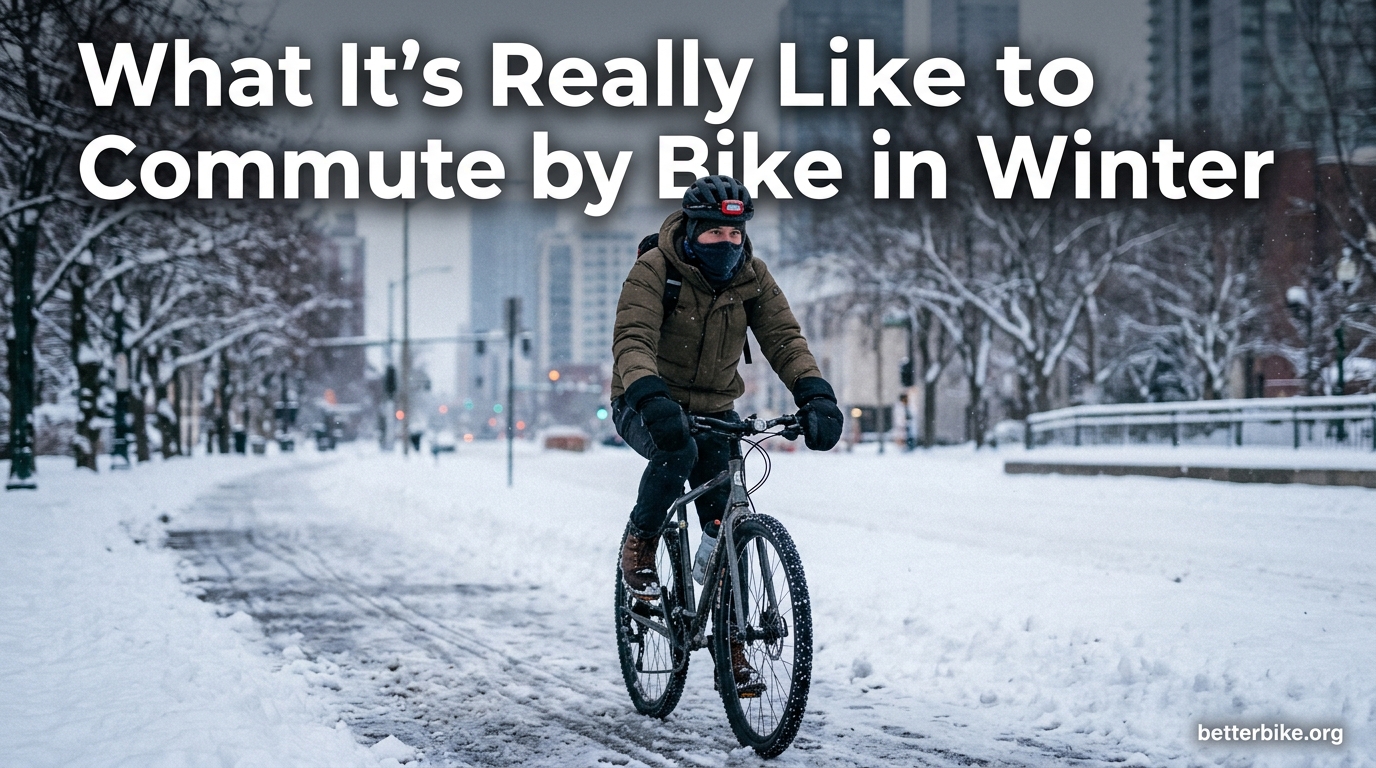
I rolled out of bed at 6:40 a.m. on a January morning, looked out the window, and saw three inches of fresh snow had fallen overnight. My coffee was hot, my warm layers were laid out, and my studded tires were already on the bike.
By 7:25 a.m., I was coasting down a silent, snow-packed street toward work, my breath fogging the air in slow clouds. No scraping the windshield. No waiting for a bus in the dark. No idling in a line of cars warming up.
That was the morning I realized commuting by bike through a full winter was not just possible. It was better than my summer commute in many ways.
If you’re thinking about riding through the cold months, this is what it actually feels like, the gear that matters, the mental shifts that make it work, and the days when you should leave the bike at home. I’ve done this for years in a climate that gets well below freezing, and I’ll share the honest version of winter bike commuting, not the Instagram one.
Table of Contents
The first ride that changed my mind about winter biking
My first real winter commute started with a mistake. I waited too long in the fall to switch to studded tires, telling myself the studs were overkill. Then we got our first hard freeze on a Tuesday, and I went down on a patch of black ice on a quiet residential street.
I wasn’t hurt, just embarrassed and cold. The bike was fine. But I learned something important: winter cycling isn’t about being tough. It’s about being prepared.
The next week, I got the studded tires, a real balaclava, and a brighter front light. I rode again. And again. Within a month, winter biking felt normal. Within two months, I actually looked forward to those cold morning rides more than my summer ones.
That is the part nobody tells you. Winter cycling can be uncomfortable for the first ten minutes, but once you get moving and dial in your layering, something clicks. The cold air feels clean. The streets feel empty. You arrive at work awake, alert, and proud of yourself.
What it feels like to commute by bike through a full winter: the honest truth
A full winter on the bike is roughly five months in my area, from mid-November through mid-March. That is a lot of cold mornings, snowstorms, and dark rides home.
Here is what the season actually looks like, week by week, for someone who rides every day it is safe to do so.
The first few weeks are the hardest. Your body has not adjusted to the cold yet, and every gust of wind feels sharper than it will in February. You will over-layer, sweat under your jacket, and arrive at work with a damp base layer that chills you the second you stop pedaling. This is normal. It takes about three weeks for your body to learn how to regulate temperature better in the cold.
By December, something shifts. You stop overthinking the gear. You know exactly which gloves work below 20°F. You have a routine for checking tire pressure on cold mornings. The cold no longer surprises you.
January is when winter cycling gets honest. The days are short, the ice is real, and the motivation to ride is tested most. This is the month you skip the most days, and that is fine. Even the most committed winter riders take a few weather days off per month.
February is often the best riding month. Your body is fully adapted, the snow is usually packed down and predictable, and the days are getting longer. You start to feel like a year-round cyclist, not a summer rider who is just toughing it out.
By March, you are faster than you were in November. Your handling on ice and snow has improved. You know your route, you know your gear, and you know the rhythm of the season.
One thing I did not expect: winter riding is often more peaceful than summer riding. A common saying among year-round cyclists is that snow muffles the world, and they are right. The sounds of traffic soften. The morning air is still. The bike paths are nearly empty. I have had some of the most contemplative mornings of my life on a winter commute.
The mental preparation that makes winter biking work
Most of winter cycling is mental, and the gear only solves maybe half the problem. The rest is showing up.
The first shift is reframing the cold. Instead of “I have to ride in the cold,” it becomes “I get to skip the crowded bus and the icy parking lot.” That sounds cheesy, but it works. You are choosing this. You are not a victim of the weather.
The second shift is letting go of perfection. On a cold morning, you will be a little slower. You will be a little red in the face when you arrive. Your hair will be a mess under your helmet. That is fine. Nobody at work cares.
The third shift is giving yourself an out. I have a personal rule: I check the temperature, the wind chill, the road conditions, and the visibility. If two of those four are bad, I take transit or drive. This rule takes the pressure off every single morning. I am not forcing myself to be a hero. I am just making a smart call based on the day.
The fourth shift is community. You will start recognizing the same winter cyclists at stoplights. A nod, a wave, a brief “stay warm out there.” Winter biking has a community that summer cycling never had, because not everyone is crazy enough to do it. That community is one of the best parts of the season.
Dressing for the cold: the layering system I actually use
Here is the layering system I have used for three winters, refined through trial and a lot of sweaty mistakes.
Base layer: A merino wool long-sleeve. Not cotton, not synthetic, merino. It wicks sweat, resists odor, and stays warm even when slightly damp. This is the single most important piece of winter cycling clothing.
Mid layer: A medium-weight fleece or wool sweater. This is your insulation. In really cold conditions (below 20°F), I add a second mid layer.
Outer layer: A windproof, water-resistant cycling jacket. Not a puffy down jacket, those are too warm once you start pedaling hard. You want something that blocks wind and light precipitation but breathes well.
Head and face: A merino balaclava on really cold days, or a thin skullcap and a neck gaiter on milder days. The trick is to cover your forehead and ears, which lose heat fast.
Eyes: Clear or yellow-tinted cycling glasses. They protect against wind, road spray, and the low winter sun that bounces off snow and blinds you at 8 a.m.
Hands: This is where most people fail. Lobster claw gloves or bar mitts. Bar mitts are handlebar-mounted pogies that turn your bars into a little warm cockpit. Below 25°F, nothing beats them.
Feet: Merino wool socks inside waterproof boots or winter cycling shoes. Avoid cotton socks. If your feet are cold, no amount of layering on your torso will make the ride enjoyable.
The number one mistake I see new winter cyclists make: too many layers. You warm up fast once you start pedaling. If you are warm standing still, you will be soaked five minutes into the ride. Dress for ten minutes from now, not for right now.
The bike setup that handles ice, snow, and salt
Your bike does not need to be a fancy winter-specific machine. Any commuter bike with the right tires and a few accessories can handle a full winter of riding.
Studded tires are non-negotiable. Studded bike tires have small metal studs embedded in the tread that grip ice and packed snow. They make the difference between confident riding and white-knuckled slipping. I run them from November through March, no exceptions.
The most common studded tire brands in my area are Schwalbe Marathon Winter, Nokian Hakkapeliitta, and 45NRTH Dillinger. Pick a width that fits your frame, usually 35mm to 45mm is the sweet spot for commuting.
Drop your tire pressure. In the summer, I run my tires around 70 psi. In winter, I drop them to 40-50 psi. Lower pressure increases the contact patch and gives you more grip on slippery surfaces. Just be careful of pinch flats if you ride on bare pavement a lot.
Fenders are essential. Full-coverage fenders keep road slush, salt spray, and dirty snow off your clothes and your drivetrain. Without fenders, you will arrive at work with a stripe of black salt up your back. I learned this the hard way.
Lights, lights, lights. Winter means riding in the dark, both ways. A bright front light (500 lumens minimum) and a bright rear light are not optional. Add reflective ankle bands or a reflective vest. Drivers have a harder time seeing cyclists in winter because of low sun angles, dirty windshields, and snow glare.
Wet lube, not dry lube. In winter, switch your chain lube to a wet formula. Wet lube does not wash off in snow and slush the way dry lube does. You will still re-lube more often, but your chain will thank you.
Riding safely on ice, packed snow, and slush
Studded tires handle 90% of winter conditions. The other 10% is technique.
First, slow down before turns, not during them. Brake early, in a straight line, and coast through the turn. If you brake mid-corner on ice, you will slide out.
Second, watch for shiny spots on the road. Shiny means ice. Black ice is the most dangerous because it is invisible, but it usually has a slight sheen, especially in early morning or late afternoon light.
Third, take the lane when needed. If the right side of the road is unplowed snow or ice, ride in the tire tracks of cars. You have every right to take the full lane when the right portion is unsafe.
Fourth, avoid frozen ruts. After plowing, snow freezes into ridges that can catch your front wheel and throw you. Pick a line that is smooth and continuous.
Finally, know when to stop. If the conditions are genuinely dangerous (heavy freezing rain, ice storm, whiteout), do not ride. I take 4-6 weather days off per winter, and I do not feel guilty about a single one.
Winter bike maintenance: salt, rust, and chain care
Road salt is the enemy of bikes. It corrodes chains, cables, brake components, and frame finishes. A little extra maintenance goes a long way.
After every snowy or salty ride, I wipe the chain down with a dry rag and re-lube with wet lube. Once a week, I rinse the bike with warm water (not hot, hot water on a cold frame can crack paint and damage bearings), dry it, and re-lube.
Once a month, I check brake pads, cables, and the drivetrain for wear. Winter eats through brake pads faster than any other season.
If you have an internally-geared hub, winter is its time to shine. Sealed hubs do not let in snow, slush, and salt the way derailleurs do. A single-speed or internal hub bike is the easiest winter commuter setup to maintain.
When winter commuting by bike isn’t worth it
I love winter biking, but I am honest about its limits. There are days I leave the bike at home.
I skip the ride when there is active freezing rain, when the temperature is below 0°F even with wind chill factored in, when visibility is under a quarter mile, or when I am sick. That is my list. Most winter days, I can ride safely. The exceptions are real but rare.
If you are new to winter cycling, give yourself permission to take more weather days than you think you need. Building the habit matters more than being hardcore. You can always add more riding days later.
Frequently asked questions about winter bike commuting
How cold is too cold to bike commute?
Most experienced winter cyclists call it quits somewhere around 0°F or below, factoring in wind chill. Between 0°F and 20°F, the right gear makes riding very doable. Above 20°F, you barely need more than a good jacket and gloves. The real limit is usually ice and visibility, not the temperature itself.
Why don’t more people ride bikes in the winter?
Most people avoid winter cycling because of three things: fear of falling on ice, the hassle of cold weather gear, and the inconvenience of arriving sweaty or cold at work. Studded tires solve the first problem. A good layering system solves the second. And once you have your routine down, the third issue basically disappears.
How much slower is winter cycling compared to summer?
On a typical commute, plan on 20-30 percent longer in winter. Packed snow, lower tire pressure, and the occasional slippery intersection all slow you down. Many winter cyclists find that this extra time is offset by skipping traffic and parking hassles, so door-to-door time ends up similar to summer.
What makes a good winter commuter bike?
A good winter commuter is reliable, simple to maintain, and has room for wider studded tires. Steel frames handle road salt better than aluminum. Internal hub gears or single-speed drivetrains shrug off slush. Mounting points for fenders and a rack are also essential. A fancy road bike is not the right tool. An old steel commuter is.
The honest verdict on commuting by bike through a full winter
Commuting by bike through a full winter is one of the most rewarding things I do each year. It is also cold, sometimes uncomfortable, and occasionally scary.
If you commit to the right gear, build the habit slowly, and give yourself grace on the truly dangerous days, you will arrive at spring a stronger, more confident cyclist than you were in October. The quiet morning rides, the empty streets, the smug satisfaction of pedaling past stuck cars in the snow. These are the things that make winter cycling worth it.
Start with studded tires, a merino base layer, and a good front light. Ride three days a week for the first month. By December, you will be hooked.