
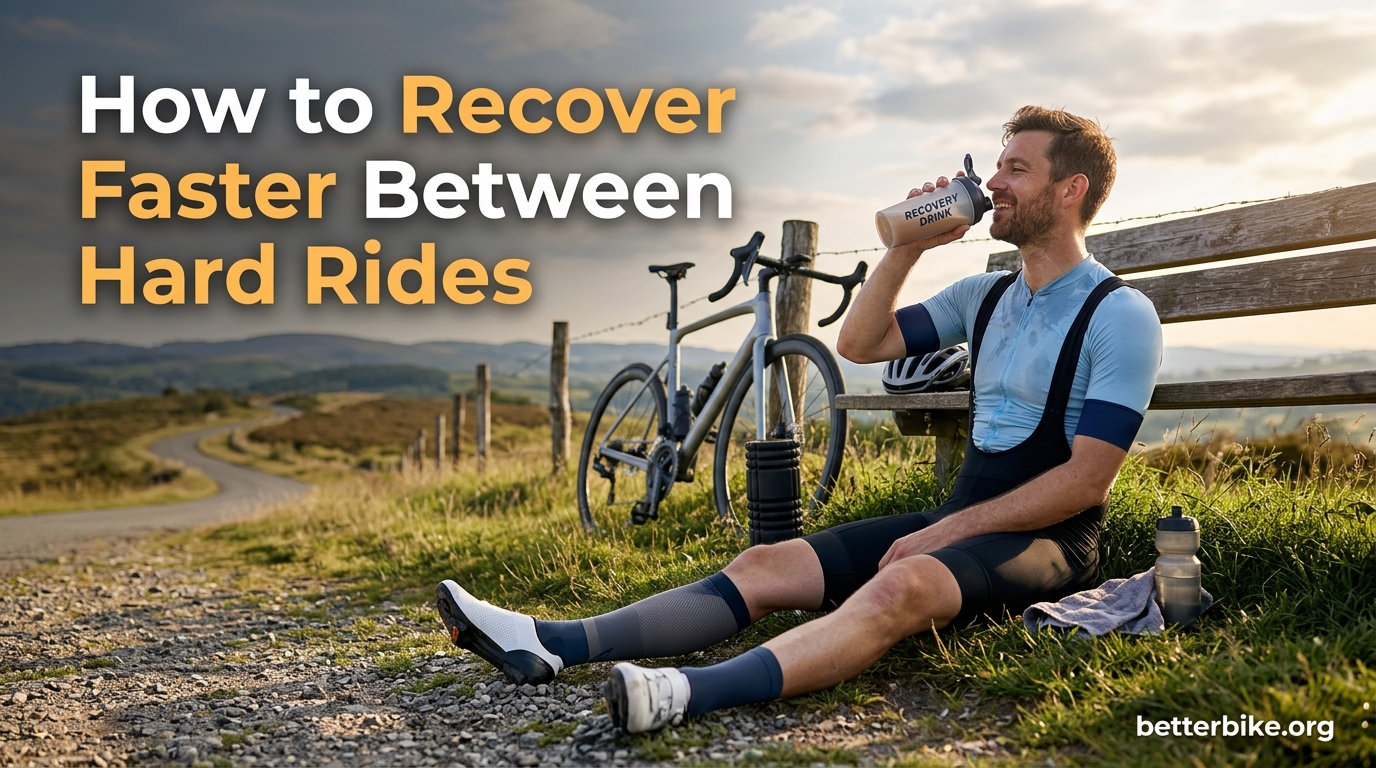
When I started racing, I treated recovery like a soft afterthought. Then a coach sat me down and walked through the science of supercompensation, and everything changed. Recovery between hard rides is the period where your body actually repairs muscle fibers, replenishes glycogen, and rewires your nervous system so you come back stronger. Skimping on that window stalls your fitness, no matter how disciplined your training is.
In this guide, I will walk you through the full recovery process, from the first 30 minutes after a hard ride to the recovery week itself. You will learn what to eat, when to sleep, how to use a recovery ride correctly, and how to read your own body to know if you are ready for the next effort. This is the system our team has used with hundreds of riders, and it works whether you ride three days a week or seven.
You will notice the keyword “how to recover faster between hard rides” woven through the article, and that is intentional. The advice below is structured to match what people actually search for and to give you a plan you can start using on your next ride home.
Table of Contents
What Happens to Your Body During Recovery
Every hard ride creates tiny micro-tears in your muscle fibers, depletes glycogen stores, and produces metabolic waste like lactate and hydrogen ions. None of that is bad on its own. The magic happens after you stop pedaling, when your body repairs, rebuilds, and adapts to the stress you just applied.
Sports scientists call this adaptation process supercompensation. Your body does not just return to baseline after a hard effort. It overcompensates, building slightly more capacity than you had before. That extra capacity is what makes you faster, stronger, and more durable on the bike. Cut the recovery window short, and you never get to the overcompensation phase. You just accumulate fatigue.
Three things happen in parallel during recovery. Your muscles rebuild protein structures and refill glycogen. Your nervous system resets, which is why you feel twitchy and slow when you skip rest. Your immune system ramps up inflammation control to clear out damage. All three of these require time, calories, and sleep, which is why the “just ride more” approach eventually breaks even the most motivated athlete.
From a practical standpoint, full recovery from a single hard ride takes 24 to 72 hours for most riders. Back-to-back hard days require a specific plan. A recovery ride on the day between efforts can shorten that window, but only if you ride slowly enough to actually recover.
The 75% and 80% Rules in Cycling
Two phrases come up constantly in cycling forums: the 75% rule and the 80% rule. They sound similar but mean different things, and understanding both will reshape how you approach recovery.
The 75% rule says that 75% of your weekly training time should be done at an easy intensity (Zone 1 or Zone 2). The remaining 25% can be hard. This rule exists because most amateur riders push too hard on days that should be easy, accumulating junk miles that fatigue them without building fitness.
The 80% rule is the broader training principle that 80% of your riding should feel comfortable enough to hold a conversation. Only 20% should feel hard. If you find yourself gasping for air on most rides, the 80% rule is a sign you are overcooking easy days and undercooking hard days.
Both rules matter for recovery. When 80% of your rides are truly easy, your hard days are harder, and your recovery is faster because the easy days are actually easy. Violate these rules and even a structured training plan will feel like constant fatigue.
How to Recover Faster: The First 30 Minutes After a Hard Ride
The first half hour after a hard ride is the highest-leverage recovery window you have. Get this part right and everything else compounds. Get it wrong and you start your next ride already behind. Here is the exact sequence I use after every interval session or race.
Step 1: Cool Down for 10 Minutes
Spend the last 10 minutes of every hard ride spinning easily in Zone 1. Do not stop pedaling the moment you get home. A short cool-down flushes lactate out of your legs and prevents blood from pooling in your lower body, which is what causes that dizzy, washed-out feeling when you stand up too fast after a hard effort.
Step 2: Refuel Within 30 Minutes
Your body is most efficient at restoring glycogen in the first 30 to 60 minutes post-ride. Aim for a 4:1 ratio of carbohydrates to protein. That means roughly 40 to 60 grams of carbs paired with 10 to 15 grams of protein. A recovery drink works, but a real meal within an hour works just as well.
Step 3: Rehydrate With Electrolytes
Water alone is not enough after a hard ride in heat. Replace sodium, potassium, and magnesium along with fluids. A simple formula is 16 to 24 ounces of fluid per pound of body weight lost during the ride, plus an electrolyte mix in at least one of those bottles.
Step 4: Change Out of Sweaty Kit
Wet kit on cool skin is a recipe for chills and shallow sleep later. Bring a dry shirt, dry socks, and a warm layer. Five minutes of effort here pays off in better sleep quality and less next-day soreness.
Step 5: Light Stretching or Foam Rolling (Optional)
Within the first 30 minutes, a few minutes of gentle stretching or foam rolling helps reduce next-day stiffness. Keep it easy. This is not the time for aggressive fascia work. Save deep tissue work for the next day.
Nutrition: What to Eat and When to Eat It
Post-ride nutrition is the foundation of faster recovery. The science here is settled: cyclists who refuel within the recovery window restore glycogen faster, repair muscle better, and report less soreness than those who wait hours to eat.
The 4:1 carb-to-protein ratio is the gold standard. Carbs refill glycogen, and protein provides amino acids for muscle repair. Examples that work well:
- Chocolate milk (about 4:1 naturally, cheap, and effective)
- A bowl of oatmeal with banana and a scoop of whey protein
- Rice cake with nut butter and honey, washed down with a glass of milk
- A real meal of rice, chicken, and vegetables within the hour
What about supplements? A daily protein intake of 1.4 to 1.8 grams per kilogram of body weight supports muscle repair without needing anything fancy. Whey protein is convenient. Casein before bed provides a slow release through the night. BCAAs are largely unnecessary if you are already eating enough protein, despite heavy marketing.
Antioxidant supplements are a different story. The training response partly depends on a small, controlled inflammatory signal after hard efforts. Large doses of vitamin C or E can blunt that signal and slow adaptation. Skip the antioxidant pills and get your antioxidants from real food, berries, leafy greens, and coffee.
Hydration Strategies for Faster Recovery
Even a 2% drop in body weight from sweat can hurt next-day performance. Hydration is one of the cheapest, easiest recovery wins available, and most riders underdo it.
The basic formula: drink 16 to 24 ounces of fluid per pound of body weight lost during the ride. Weigh yourself before and after a hard session to get a real number. Plain water covers most cases, but rides over 90 minutes, hot conditions, or sweat-soaked kit all point to needing electrolytes.
Sodium is the most important electrolyte to replace. Aim for 500 to 700 milligrams of sodium per liter of fluid in your recovery drink. Potassium and magnesium also matter, particularly if you suffer from muscle cramps. Coconut water, pickle juice, or a simple electrolyte mix covers the bases.
Spread your fluid intake over the next two to four hours. Chugging a liter at once just sends you to the bathroom and does not improve hydration. Slow and steady wins this race.
Sleep: The Single Most Powerful Recovery Tool
If you take only one piece of advice from this entire article, take this: protect your sleep. Sleep is the most powerful recovery tool available, and it is free.
During deep sleep, your body releases growth hormone, which drives muscle repair and tissue rebuilding. Your brain consolidates motor patterns from the day’s training, which is why skills feel sharper the day after a good night. Your nervous system resets, clearing out the fatigue that makes hard intervals feel impossible on day two.
Most adults need 7 to 9 hours. Cyclists in heavy training blocks often need 8 to 10. NREM deep sleep, the slow-wave stage in the first third of the night, is when most of the recovery magic happens. Alcohol, late caffeine, and screens before bed all crush deep sleep. So does that 5 a.m. alarm you set for a pre-work ride.
If you can only improve one habit, move the alarm later. The Reddit user I quoted earlier said it perfectly: he was tanking in performance until he realized his 4 a.m. rides were cutting into sleep. Sleep extension is the single highest-leverage change for most time-crunched riders.
Age matters here. Riders over 40 tend to need slightly more sleep and recover more slowly than they did in their 20s. If you are in that bracket and feeling slower, the answer is not harder training. It is more sleep, more recovery weeks, and a willingness to accept that the body you have at 45 is not the body you had at 25.
Active Recovery: Recovery Rides vs Rest Days
This is one of the most common questions I get from riders: should I do a recovery ride or take a rest day? The honest answer is: it depends on the situation, and most riders do recovery rides wrong.
A true recovery ride is 30 to 60 minutes at Zone 1, an intensity so low that you could chat with a riding partner the entire time. Average power should sit around 50 to 55% of your FTP, sometimes lower. If you cannot hold a conversation or your average power creeps above 60% of FTP, you are not doing a recovery ride. You are doing a junk mile workout that adds fatigue without building fitness.
The community has a great way to describe it: “Grannies on shopping bikes should be leaving you for dead.” That is the right effort level.
Here is how to choose between a recovery ride and a full rest day.
| Scenario | Recovery Ride | Rest Day |
|---|---|---|
| Tomorrow is an easy endurance day | Yes, short spin in Zone 1 | Optional, either works |
| Tomorrow is a hard interval session | Light spin only, kept very short | Often better, fresh legs win |
| You feel mentally drained, not just physically | Skip the ride, take the day off | Yes, full rest |
| You feel physically fine, just a little heavy | Yes, blood flow helps | Optional |
| You are getting sick or slept poorly | No | Yes, rest and recover |
| Back-to-back hard days planned | Yes between them | Rest day between blocks |
The discipline piece is real. If you cannot ride slowly enough on the road, do the recovery ride indoors on a trainer. The trainer removes traffic, wind, and ego, all of which tend to push your easy pace upward. Many experienced riders actually do all their recovery rides indoors for that exact reason.
Recovery Tools: Foam Rolling, Stretching, and Compression
Tools help, but they are not magic. Foam rolling, massage, stretching, and compression all have evidence behind them, with varying strength.
Foam rolling increases blood flow to the rolled area and reduces next-day soreness. Spend 5 to 10 minutes rolling quads, hamstrings, calves, and glutes. Do not roll directly on sore spots. Roll around them and let the tissue release gradually. Aggressive rolling on a fresh injury makes it worse.
Stretching is more useful for range of motion than for recovery per se. A short post-ride stretch routine of 5 to 10 minutes, focusing on hip flexors, hamstrings, calves, and the lower back, pays dividends in long-term comfort. Static stretching before rides can hurt power output, so save it for after.
Compression socks or tights have mixed evidence. They do not appear to improve recovery in trained athletes, but many riders swear by them for perceived leg freshness on long travel days or after races. Use them if they work for you. Skip them if you are looking for measurable gains.
Massage, when you can afford it, is one of the better tools. A 30 to 60 minute sports massage once or twice a month improves perceived recovery and reduces muscle tension. It is a real recovery investment, not a luxury.
Mental Recovery and Life Loads
Mental recovery is the most overlooked piece of the puzzle, and it is the one the community is starting to talk about more openly. Strava introduced the term life loads to describe all the non-cycling stress that affects your training: work deadlines, family commitments, sleep debt, financial worry, and relationship friction.
Life loads act like an extra hard ride on your body. Cortisol stays elevated, sleep quality drops, and the same training load that felt easy last month now feels crushing. Ignoring this is how riders end up overtrained without any change in their actual training volume.
What to do about it? First, accept that life loads are real and that backing off during high-stress weeks is not weakness. It is good training. Second, audit your week honestly. If you are sleeping 6 hours a night, dealing with a tough work project, and trying to hit PRs on the bike, something has to give. Usually it is the training intensity, not the life stress.
Mental recovery practices that actually work: short walks without your phone, time with friends who are not cyclists, a hobby completely unrelated to performance metrics, and protecting at least one full day a week where cycling is not even a thought. The riders I know who train for years without burning out all do some version of this.
How to Know If You Are Recovered Enough for the Next Ride
This is the question that keeps riders stuck: how do I know if I am recovered? Here is a simple diagnostic checklist I use, in order of importance.
- Resting heart rate is within 5 beats of normal. Take your pulse first thing in the morning. A jump of 5 to 10 beats above your baseline is a strong signal you need more recovery.
- HRV is trending stable or up. Heart rate variability drops when you are fatigued or sick. Apps like HRV4Training, Whoop, and Oura track this. A flat or rising HRV trend means you are absorbing training well.
- Subjective energy feels normal. Not great, not awful. Just normal. If everything feels like climbing a hill, you are not recovered.
- Legs feel responsive on a short warm-up. Spin for 10 minutes. If the legs come around within 5 minutes, you are probably fine. If they stay heavy for the full warm-up, ease off.
- You are looking forward to the ride. Motivation is a recovery marker. If the idea of clipping in fills you with dread, listen to that.
Use any one of these signals as a yellow flag. Two or more yellow flags is a red flag, and the right answer is rest, not a hard session.
Supplements and Cold Therapy: What Works and What to Skip
The supplement industry sells a lot of hope to tired cyclists. Here is what the evidence actually says.
Caffeine is the only supplement with strong evidence for both performance and recovery. A post-ride coffee is fine. Late caffeine hurts sleep, so time it well.
Creatine, 3 to 5 grams per day, has solid evidence for strength and recovery. It is one of the few supplements worth the money for cyclists in heavy training.
Tart cherry juice has emerging evidence for reducing inflammation and improving sleep quality in athletes. A glass before bed during heavy training blocks is a reasonable add.
BCAAs and antioxidant pills, despite heavy marketing, are unnecessary for most riders eating a balanced diet. Skip them.
Ice baths and cryotherapy are controversial. Recent research suggests they can blunt the training adaptation by reducing the inflammatory signal your body uses to adapt. For pure recovery between sessions in a tournament or stage race, they have a place. For long-term training gains, they may be counterproductive. Use them only when you need to perform again in 24 hours, not as a daily habit.
Frequently Asked Questions
What is the 75% rule in cycling?
The 75% rule says that 75% of your weekly training time should be at an easy intensity (Zone 1 or Zone 2), with the remaining 25% reserved for hard efforts. It exists because most amateur riders push too hard on easy days, accumulating junk miles that build fatigue without building fitness. Following the 75% rule is one of the fastest ways to improve recovery between hard rides.
How long does it take to recover from a hard ride?
Most cyclists need 24 to 72 hours to fully recover from a single hard ride, depending on intensity, duration, and fitness level. A recovery ride on the day after a hard effort can shorten the window if it is done in true Zone 1. Full rest days are needed when you are sick, sleep deprived, or stacking multiple hard days back to back.
Should I do a recovery ride or take a rest day?
Take a recovery ride when you feel physically fine but a little heavy, and you have an easy day planned tomorrow. Take a rest day when you feel mentally drained, slept poorly, are getting sick, or have a hard interval session the next day. Recovery rides must stay in Zone 1 to actually help. If you cannot ride that slowly, take the rest day.
What is the 80% rule in cycling?
The 80% rule states that 80% of your riding should feel easy enough to hold a conversation. Only 20% should feel hard. Riders who violate this rule by pushing hard on most of their rides end up constantly fatigued and often sick. Following the 80% rule is one of the simplest ways to recover faster between hard rides.
What should I eat immediately after a hard bike ride?
Eat a 4:1 ratio of carbohydrates to protein within 30 to 60 minutes of finishing your ride. About 40 to 60 grams of carbs and 10 to 15 grams of protein works for most riders. A recovery drink, chocolate milk, or a real meal of rice and protein all work. A daily protein intake of 1.4 to 1.8 grams per kilogram of body weight supports muscle repair.
How many rest days per week do I need?
Most riders need 1 to 2 full rest days per week, plus 1 to 2 recovery days with light spinning. Heavier training blocks and older riders often need more rest. Listen to your resting heart rate, HRV, and motivation. If those signals are off, take an extra rest day. It will not hurt your fitness. Under-recovery will.
Is biking bad for piriformis syndrome?
Biking is generally not bad for piriformis syndrome and can actually help by promoting blood flow to the area. The exception is when saddle height is too high, which can aggravate the piriformis. A proper bike fit, foam rolling of the glutes, and piriformis stretches usually resolve the issue for most riders.
Why do my legs take so long to recover from cycling?
Slow recovery is usually caused by under-fueling, poor sleep, accumulated life stress, riding too hard on easy days, or simply training more than your current fitness can absorb. Fix the inputs (food, sleep, easy-day discipline) and recovery time almost always improves. If it does not, take a full week off and consider a medical checkup, since persistent fatigue can signal overtraining or low iron.
Final Thoughts: Putting Your Recovery Plan Together
Learning how to recover faster between hard rides is not about finding a single magic trick. It is about stacking small, consistent habits: refueling within 30 minutes, sleeping 8 hours, riding easy days truly easy, drinking enough water, and taking rest days before your body forces you to.
Start with the change that gives you the most leverage. For most riders, that is sleep. Lock in 8 hours for two weeks and watch what happens to your interval power. Then layer in the next habit. Recovery is a system, and the system compounds. Pick your next ride home and start there.