
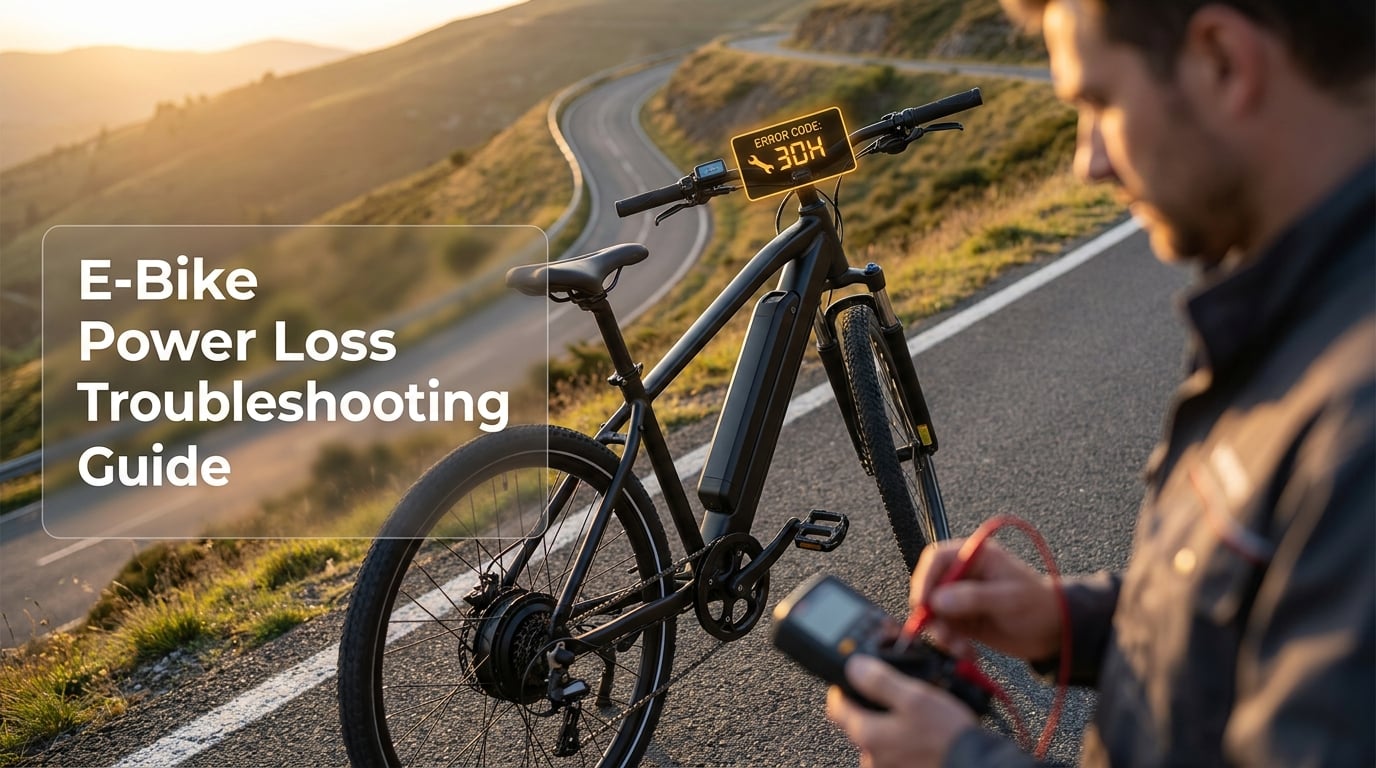
There is nothing more frustrating than your e-bike cutting out halfway up a steep hill. One minute you are cruising with full motor assistance, and the next you are pedaling a 60-pound bike with zero help from the motor. If your e-bike cuts out on hills but runs fine on flat ground, the problem almost always traces back to your battery. Specifically, weak or aging battery cells cannot maintain voltage under the high current draw that climbing demands, which triggers the Battery Management System (BMS) to shut off power as a self-protection measure.
I have helped dozens of riders diagnose this exact issue, and the pattern is remarkably consistent. The display often shows a full or near-full battery charge, yet the motor dies the moment you hit a steep incline. After waiting a few minutes, the bike powers back on like nothing happened. That recovery cycle is the telltale signature of voltage sag and BMS low-voltage cutoff, not a random electrical failure.
This guide walks through every common cause of e-bike power loss on hills, from battery voltage sag to controller overheating and faulty sensors. You will find a quick-reference symptom table, a step-by-step diagnostic procedure, pro tips for preventing cut-outs, and answers to the questions riders ask most. Whether you ride a budget commuter or a high-end mid-drive, these troubleshooting steps will help you pinpoint the problem and decide whether you can fix it yourself or need professional help.
Table of Contents
Quick Reference: Symptoms and Likely Causes
Before diving into detailed diagnostics, use this table to match your specific symptoms to the most probable cause. This is based on patterns I have seen across hundreds of e-bike power loss reports from forums and repair shops.
| Symptom | Most Likely Cause | First Check |
|---|---|---|
| Cuts out on hills, restarts after waiting 5-10 minutes | Battery voltage sag triggering BMS cutoff | Battery age, charge level, cell health |
| Cuts out randomly on rough roads or bumps | Loose connector or wiring harness rub-through | Battery contacts, motor phase connectors |
| Power dies after 10+ minutes of climbing, motor hot to touch | Controller or motor thermal shutdown | Motor and controller temperature |
| Motor cuts intermittently even on flat ground | Brake cut-off sensor stuck or PAS sensor fault | Brake levers, PAS sensor disk alignment |
| Display goes dark completely, no restart | Blown fuse, main connector failure, or dead BMS | Main fuse, battery output voltage with multimeter |
| Gradual power reduction over weeks, worse on hills | Battery cell degradation or capacity fade | Battery age, charge cycle count, range comparison |
| Cut-outs worse in cold weather below 40F | Cold temperature reducing battery chemistry output | Warm battery before riding, check cold weather range |
Battery Voltage Sag and BMS Protection: The Number One Cause
When an e-bike cuts out on hills but not on flat ground, battery voltage sag is the prime suspect in the vast majority of cases. Understanding what happens inside your battery on a climb makes diagnosing the problem much easier.
Voltage sag is the temporary drop in battery voltage that occurs when the motor draws high current. Climbing a hill demands significantly more power than cruising on flat terrain, sometimes 2 to 3 times the current. If your battery cells are healthy, they can deliver that surge while maintaining voltage above the system’s minimum threshold. But if cells are weak, aging, or damaged, the voltage plunges under load.
Here is where the BMS comes in. Every modern e-bike battery has a Battery Management System that monitors individual cell groups. When voltage in any cell group drops below a preset low-voltage cutoff, typically around 3.0 volts per cell, the BMS disconnects the battery to prevent irreversible cell damage. This is not a malfunction. It is a safety feature doing its job.
The result feels like a sudden shutdown. Your display may go dark or flash an error code. The motor goes completely dead. But here is the key clue: after waiting 5 to 15 minutes, the bike powers back on. That happens because the cells recover voltage when the load is removed. The voltage bounces back above the cutoff threshold, and the BMS allows power to flow again.
As one experienced rider on the Endless Sphere forum explained it: “It sounds like your cells aren’t up for the current draw required for the uphill climb. One or more of the cells drops below the low-voltage cutoff, and the BMS shuts off to protect the cells. After a certain period of time the cells’ voltage recovers.” This is the most accurate and commonly shared diagnosis across e-bike communities.
A Reddit user on r/ebike described the same pattern: “A very common symptom of a bad cell or group of cells is cutting out under heavy current draw, typically when going fast or uphill.” If your bike exhibits this behavior, you are almost certainly dealing with degraded battery cells.
Signs Your Battery Is the Culprit
Several indicators point specifically to battery voltage sag rather than other causes. The bike runs perfectly on flat ground at moderate assist levels. The cut-out happens specifically under heavy load like steep hills or maximum throttle. The display showed adequate charge before the cut-out occurred. The bike restarts after a brief waiting period.
Another major red flag is if the problem has gotten worse over time. A battery that used to handle your daily hill commute without issue but now cuts out after six months is showing classic signs of cell degradation. Lithium-ion cells lose capacity and increase internal resistance with age and charge cycles, making them progressively worse at delivering high current bursts.
Battery age matters more than charge percentage here. A battery can show 80 percent charge on the display but still sag below cutoff voltage on a hill if the cells are old or damaged. The charge indicator measures resting voltage, not voltage-under-load, which is why a seemingly full battery can still fail on climbs.
Loose Wiring and Corroded Connectors
After battery issues, wiring problems are the second most common cause of e-bike power loss. The difference is that wiring failures usually cause intermittent cut-outs that happen randomly, not just on hills. However, the added vibration and torque of hill climbing can worsen an already marginal connection.
The battery-to-controller connector is a frequent failure point. This high-current connection carries all the power from your battery to the motor controller. If the connector is loose, corroded, or partially burned, it creates resistance that worsens under high current draw. On hills, the increased current can cause enough voltage drop across a bad connector to trigger a system shutdown.
Motor phase wires are another common trouble spot. These three thick wires connect the controller to the motor and carry heavy current during operation. Constant vibration from riding, especially on rough roads, can loosen the bullet connectors or cause insulation to wear through. When phase wires short against the frame or each other, the controller shuts down to protect itself.
Inspect every accessible connector on your bike. Look for discoloration, melting, corrosion, or green oxidation on metal contacts. Feel for connectors that slide on too easily or feel loose compared to others. A healthy connector should have firm resistance when connecting and disconnecting.
Corrosion is especially common in humid climates or if you ride in rain regularly. Moisture sneaks into connector gaps and slowly degrades the metal contacts. The degradation is gradual, so you may not notice it until the resistance gets bad enough to cause power loss under load. Cleaning contacts with electronic contact cleaner and applying dielectric grease can restore marginal connections.
Controller and Motor Overheating on Long Climbs
Thermal shutdown is a distinct cause of power loss that affects long, sustained climbs more than short steep ones. When the motor and controller operate at high power for extended periods, heat builds up faster than it can dissipate. Most controllers have thermal sensors that shut down the system when internal temperature exceeds a safe threshold, typically around 80 to 90 degrees Celsius.
Hills generate more heat because the motor draws maximum current continuously rather than in short bursts. On flat ground, the motor cruises at partial throttle with bursts of higher draw for acceleration. On a long climb, the motor runs near maximum output for minutes at a time. That sustained load causes temperatures to climb steadily until the thermal protection kicks in.
The symptoms differ from battery voltage sag in important ways. Thermal shutdown usually happens after 10 to 20 minutes of continuous climbing, not immediately at the start of a hill. The motor may feel gradually weaker before cutting out completely, as some controllers reduce power progressively before full shutdown. After a thermal cut-out, recovery takes longer than battery recovery, often 20 to 30 minutes of cooling time.
If you suspect overheating, check the motor and controller immediately after a cut-out. A motor that is too hot to comfortably touch is running near its thermal limit. Controllers mounted inside sealed enclosures or tucked against the frame with no airflow are most prone to overheating.
Hub motors are particularly susceptible because they have limited cooling airflow and all the heat-generating components are inside a small enclosed space. Mid-drive motors generally handle heat better because they are larger and benefit from the rider’s pedaling input reducing the motor’s share of the workload.
Faulty Sensors: Brake Cut-Off, PAS, and Torque Issues
Sensor malfunctions can cause power loss that feels similar to battery or controller problems but has entirely different causes. The three sensors most commonly responsible are the brake cut-off sensors, the pedal assist system (PAS) sensor, and the torque sensor on mid-drive bikes.
Brake cut-off sensors are safety devices that instantly cut motor power when you apply the brakes. They are required by law on e-bikes in most jurisdictions. The problem occurs when a brake sensor malfunctions and sends a constant or intermittent brake signal even when you are not squeezing the lever. This causes the motor to cut out unpredictably, and the added torque of hill climbing can flex the brake lever just enough to trigger a marginal sensor.
To test brake sensors, squeeze each brake lever slightly while riding on flat ground at low speed. If the motor cuts out with barely any lever movement, the sensor is too sensitive or the lever is not returning fully to its rest position. Check for sticky brake levers, damaged sensor magnets, or misaligned sensor positions. Unplugging the brake cut-off connectors one at a time can isolate which brake is causing the issue.
PAS sensor problems usually cause a complete loss of pedal assist rather than intermittent cut-outs, but they can also cause surging or delayed power delivery on hills. The PAS sensor uses a magnetic ring on the crank to detect pedaling. If the ring slips, gets dirty, or the sensor gap changes, the system may not detect your pedaling consistently, resulting in power dropping out when you need it most.
Torque sensors, found on higher-end mid-drive e-bikes, measure how hard you are pedaling and adjust motor output proportionally. A failing torque sensor can cause erratic power delivery, sudden drops in assist level, or complete power loss under high torque loads like hill climbing. Torque sensor issues typically require professional diagnosis because the calibration and testing procedures are model-specific.
Environmental Factors: Cold, Heat, and Water
Environmental conditions play a bigger role in e-bike power loss than most riders realize. If your bike cuts out on hills during certain seasons or weather conditions, the environment may be contributing to or causing the problem.
Cold weather is particularly hard on lithium-ion batteries. When temperatures drop below 40 degrees Fahrenheit, battery chemistry slows down and internal resistance increases. This means the battery cannot deliver as much current before voltage sag triggers the BMS cutoff. A battery that handles your daily hill climb fine in summer may cut out in winter even at full charge.
The fix is simple but requires planning. Store your battery indoors at room temperature when not riding. If you must park outside, remove the battery and bring it inside. Let the battery warm up for 15 to 20 minutes before starting your ride. Some riders carry insulated battery covers for winter commuting.
Extreme heat affects the controller more than the battery. Riding in temperatures above 95 degrees Fahrenheit dramatically reduces the controller’s ability to shed heat, making thermal shutdown more likely on hills. If you ride in hot weather, plan your hill climbs for cooler parts of the day and consider adding airflow around the controller mount.
Water ingress is a slow-acting but serious problem. Rain and road spray can work their way into connectors over time, causing corrosion that increases resistance and eventually leads to power loss under load. If you ride in wet conditions regularly, inspect connectors every few months and apply dielectric grease to prevent moisture penetration. Pay special attention to connectors located low on the frame where road spray accumulates.
Step-by-Step Troubleshooting Guide: E-Bike Cuts Out on Hills
Follow these steps in order to systematically diagnose why your e-bike loses power on hills. Each step builds on the previous one, so do not skip ahead even if you think you know the cause.
Step 1: Verify Battery Charge and Seating
Charge the battery to 100 percent and confirm the charger shows a full charge indicator. Remove the battery and reinstall it firmly, listening for a solid click if your bike uses a locking mechanism. Check that the battery sits flush against its mount with no gaps. A partially seated battery is a surprisingly common cause of intermittent power loss.
If your battery is removable, examine the contact points on both the battery and the frame mount. Look for discoloration, pitting, or oxidation. Clean contacts with a dry cloth or electronic contact cleaner. Bent or worn contacts can cause high-resistance connections that fail under the heavy current draw of hill climbing.
Step 2: Inspect All Wiring and Connectors
Trace every visible wire from the battery to the controller to the motor. Look for pinched wires, melted insulation, corroded connector pins, or connectors that have pulled partially loose. Pay special attention to areas where wires pass through frame openings or are secured with zip ties, as these are common rub-through points.
Disconnect and reconnect each accessible connector one at a time. Listen for the click of properly seated connectors. Feel for pins that push in instead of making solid contact. Apply dielectric grease to each connection before reassembling to prevent future corrosion.
Step 3: Test on Flat Ground Versus Hills
Ride the bike on flat ground at maximum assist and full throttle for several minutes. Then find a moderate hill and attempt the climb. If the bike runs flawlessly on flat ground at full power but cuts out specifically on hills, you have confirmed the problem is load-related rather than a general electrical fault.
Note whether the cut-out happens immediately when you start climbing or after sustained effort. Immediate cut-outs point to voltage sag and BMS protection. Cut-outs after 10-plus minutes of climbing suggest thermal shutdown. Random cut-outs on both flat and hills suggest wiring or sensor issues.
Step 4: Check Error Codes on the Display
Most e-bike displays show error codes when the system detects a fault. Common codes include E001 through E010 or similar alphanumeric codes depending on the manufacturer. Check your bike’s manual for the specific code meanings. Error codes related to battery voltage, overcurrent, or communication errors are the most relevant to power loss on hills.
If your display goes completely dark during a cut-out, note whether it comes back on after a restart. A display that resets completely suggests a main power interruption, while a display that stays on but shows reduced assist points to a motor-specific issue.
Step 5: Perform a System Reset
Most e-bikes do not have a physical reset button despite what many riders expect. The standard reset procedure is: turn off the bike using the display power button, remove the battery if it is removable, wait 30 seconds, hold the display power button for 10 to 15 seconds to discharge any residual capacitance, reinstall the battery, and power on.
This clears temporary fault states and can resolve cut-outs caused by controller glitches or minor sensor calibration issues. If the bike runs normally after a reset but the problem returns on the next hill climb, you are dealing with a persistent hardware issue, not a software glitch.
Step 6: Isolate with Component Substitution
If you have access to a spare battery from the same model bike, test whether the cut-out persists with the different battery. This is the single most definitive test for battery-related power loss. If the problem disappears with a different battery, your original battery has degraded cells that need replacement.
If you do not have a spare battery, try riding the same hill at a lower assist level. Drop from turbo or maximum assist to eco or low assist. If the bike climbs without cutting out at reduced power, it confirms the battery cannot handle high-current demands but still functions at lower draw. This is a clear sign of cell degradation.
Pro Tips: Reducing Load to Prevent Hill Cut-Outs
While you diagnose the root cause, these techniques can help you get up hills without power loss. They work by reducing the current demand on your battery and motor.
Drop to a lower gear before you start climbing. Many riders stay in a high gear and rely on motor power to muscle up hills. Shifting to a low gear before the climb lets your legs contribute more, reducing the motor’s current draw significantly. Aim for a cadence of 70 to 90 RPM rather than grinding at 40 RPM in a high gear.
Lower your assist mode one level for climbs. If you usually ride in turbo, switch to sport or standard for the hill portion. The slightly lower assist combined with your own pedaling effort often keeps current draw below the threshold that triggers BMS cutoff.
Check your tire pressure. Underinflated tires create more rolling resistance, which increases motor load and current draw. Inflate to the upper end of the recommended pressure range printed on the tire sidewall for road and commute riding. This single adjustment can measurably reduce power consumption on hills.
Reduce total weight when possible. A loaded rear rack, panniers full of groceries, or a heavy backpack all increase the work the motor must do on hills. If your battery is borderline, shedding extra weight can make the difference between making it up the hill and walking.
Consider your approach speed. Entering a hill at higher speed carries momentum that reduces the duration of maximum current draw. This is not always practical or safe, but on familiar routes, building speed before a short climb can help you clear it before the battery has time to sag.
When to Seek Professional Help
Some power loss problems are beyond the scope of home diagnosis and repair. Knowing when to take your bike to a professional saves time and prevents you from causing additional damage through well-intentioned but misguided repairs.
Seek professional help immediately if you notice any of these warning signs. The battery is swollen, bulging, or hot to the touch when not in use. You smell burning plastic or see smoke from any component. The cut-outs are getting more frequent and severe over a short period. Your display shows persistent error codes that do not clear after a reset. The bike cuts out in traffic or at intersections where the sudden loss of power creates a safety hazard.
A swollen or hot battery is a serious safety issue that requires immediate attention. Do not attempt to charge or use a battery that shows these signs. Contact the manufacturer or a qualified e-bike shop for safe disposal and replacement.
For persistent power loss that you cannot diagnose with the steps above, a professional e-bike shop has specialized equipment. They can perform load testing on your battery to measure voltage sag under controlled current draw. They can read detailed diagnostic data from the controller that goes beyond basic error codes. Expect to pay 50 to 150 dollars for a professional diagnosis, which typically takes 1 to 2 hours of shop time.
If your battery is more than 3 to 5 years old or has accumulated 500 or more charge cycles, cell degradation is likely the root cause. In this case, a new battery is the fix, not further diagnosis. Compare the cost of a replacement battery against the value of your bike before deciding.
FAQ’S
Why does my electric bike lose power uphill?
Your e-bike loses power on hills because climbing requires high current draw that exposes weak battery cells or triggers BMS protection. When cells cannot maintain voltage under load, the BMS shuts off power to prevent damage. The bike often restarts after a few minutes because cell voltage recovers once the load is removed.
Where is the reset button on an electric bike?
Most e-bikes do not have a dedicated reset button. To reset your system: turn off the bike, remove the battery if possible, wait 30 seconds, hold the display power button for 10 to 15 seconds, then reinstall the battery and power on. This clears temporary faults without needing any physical reset switch.
Why does my ebike power keep cutting out?
E-bike power cut-outs are typically caused by one of five issues: 1) Battery voltage sag triggering BMS protection, 2) Loose wiring or corroded connectors, 3) Controller or motor thermal shutdown from overheating, 4) Faulty brake cut-off or PAS sensors sending false signals, 5) Firmware errors. Battery problems are the most common cause.
Can you still ride an e-bike if it loses power?
Yes, most e-bikes can be ridden without motor power, but the difficulty depends on the bike’s weight and drivetrain resistance. Heavier e-bikes over 60 pounds are significantly harder to pedal unassisted, especially on hills. If you lose power unexpectedly, avoid steep inclines and busy roads, and shift to your lowest gear to make pedaling easier.
Conclusion
When your e-bike cuts out on hills, the battery is the first place to look in almost every case. Voltage sag from aging or damaged cells triggers the BMS protection circuit, causing the sudden shutdown that so many riders experience. The diagnostic steps in this guide will help you confirm whether the battery is truly the problem or if wiring, overheating, sensors, or environmental factors are to blame.
Start with the quick-reference symptom table to narrow down the cause, then work through the step-by-step troubleshooting procedure. Try the load reduction techniques while you diagnose, and do not hesitate to seek professional help for persistent issues or safety concerns. Knowing how to troubleshoot e-bike power loss on hills gives you confidence on every ride and can save you from costly unnecessary repairs.