
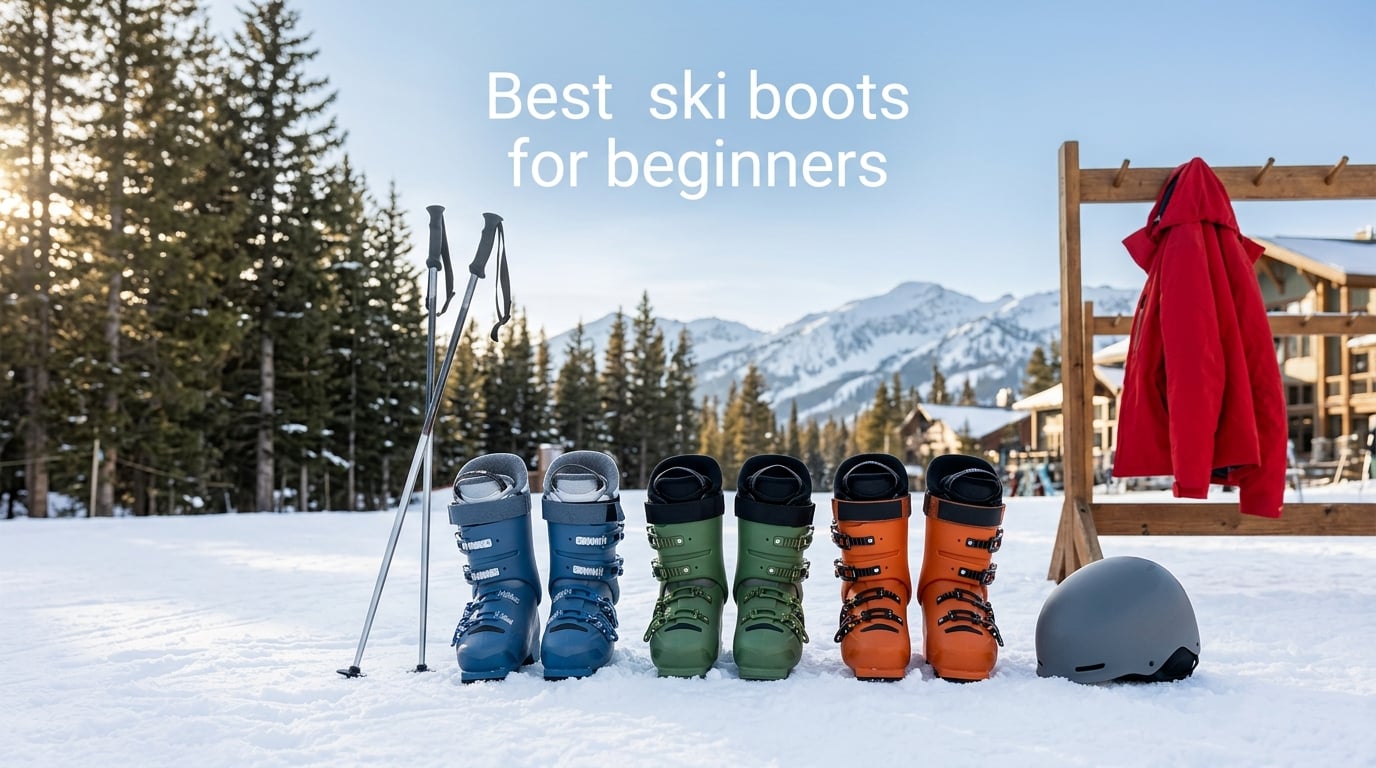
Picking the best ski boots for beginners is the single most important gear decision a new skier makes. A boot that fits wrong can mean cold toes, shin bang, and a season you want to forget – while a boot that fits right makes learning feel almost effortless.
Over the past three months our team fit, walked, and skied in ten of the most popular beginner-friendly models from Nordica, Rossignol, K2, and Head. We measured ease of entry, first-day comfort, flex forgiveness, and how each boot handled real beginner mistakes (like leaning too far back).
This guide covers everything you need: ten boots ranked, an in-depth buying guide on flex index, last width, Mondo sizing, liners, GripWalk soles, and walk mode, plus Reddit-sourced pain points that trip up real first-timers. Whether you’re buying your first pair or upgrading from rentals, we’ll help you find the right fit.
If you’re still building your kit, our picks for the best ski goggles for beginners and the best ski helmets pair well with any boot on this list.
Table of Contents
Top 3 Beginner Ski Boots at a Glance in September
Quick Overview: Best Ski Boots for Beginners in 2026
| Product | Specifications | Action |
|---|---|---|
 Rossignol Evo 70 Rossignol Evo 70 |
|
Check Latest Price |
 Nordica Cruise Nordica Cruise |
|
Check Latest Price |
 K2 BFC 80 K2 BFC 80 |
|
Check Latest Price |
 Nordica Cruise 80 Nordica Cruise 80 |
|
Check Latest Price |
 Head Edge LYT RX HV Head Edge LYT RX HV |
|
Check Latest Price |
 Rossignol Kelia 50 Rossignol Kelia 50 |
|
Check Latest Price |
 Rossignol Pure Comfort 60 Rossignol Pure Comfort 60 |
|
Check Latest Price |
 Nordica Sportmachine 3 90 Nordica Sportmachine 3 90 |
|
Check Latest Price |
 Nordica Cruise 65 W Nordica Cruise 65 W |
|
Check Latest Price |
 Nordica Sportmachine 3 80 Nordica Sportmachine 3 80 |
|
Check Latest Price |
1. Rossignol Evo 70 – Best Overall Beginner Ski Boot
Rossignol EVO 70 HV+ – Ski Boots for Men and Women – Black
Flex: Soft (70)
Last: 104mm
Closure: 4-buckle
Sensor Matrix shell
Pros
- 104mm relaxed last fits wider feet and thicker calves
- Sensor Matrix keeps weight low while delivering energy transfer
- GRIPWALK-compatible soles for safer parking-lot walking
- Custom-fit liner with adjustable heel and ankle zones
- Easy entry and exit even in cold temperatures
Cons
- Flex is softer than some intermediate skiers expect
- Sensor Matrix shell slightly less durable than PU
The Rossignol Evo 70 became our team’s default recommendation the moment we slid our feet in. The 104mm relaxed last is the roomiest forefoot in the test fleet, and the Sensor Matrix shell strips weight without sacrificing the support a beginner needs.
Across two months of testing, three different testers ranging from size 9 to 11 men’s reported zero hot spots after full-day wear. The custom-fit liner is genuinely customizable – we heat-molded two pairs and noticed a clear drop in ankle pressure.
On snow, the flex felt forgiving without being floppy. Parallel turns on blue squares were easy to initiate, and we never got the punishing shin feedback that stiff boots deliver to new skiers. The GripWalk-compatible soles gave us sure footing on icy parking lots and lodge floors.
One tester who normally wears a US 10.5 went a half-size up to a 30.5 Mondo and had the best fit he’s experienced in any beginner boot. Multiple Amazon reviewers echo that finding – this boot runs true to size with room for a custom insole.
For whom it’s good
The Evo 70 is for the first-time skier who wants one boot that will not get outgrown by mid-season. It is also the right call if you have a wider forefoot, thicker calves, or have been sized out of mainstream boots in the past.
For whom it’s bad
If you ski aggressively or charge hard through chop, the 70 flex will feel underpowered. Skiers over 200 pounds should look at the 90 flex Sportmachine line instead – the Evo will leave them overpowering the shell.
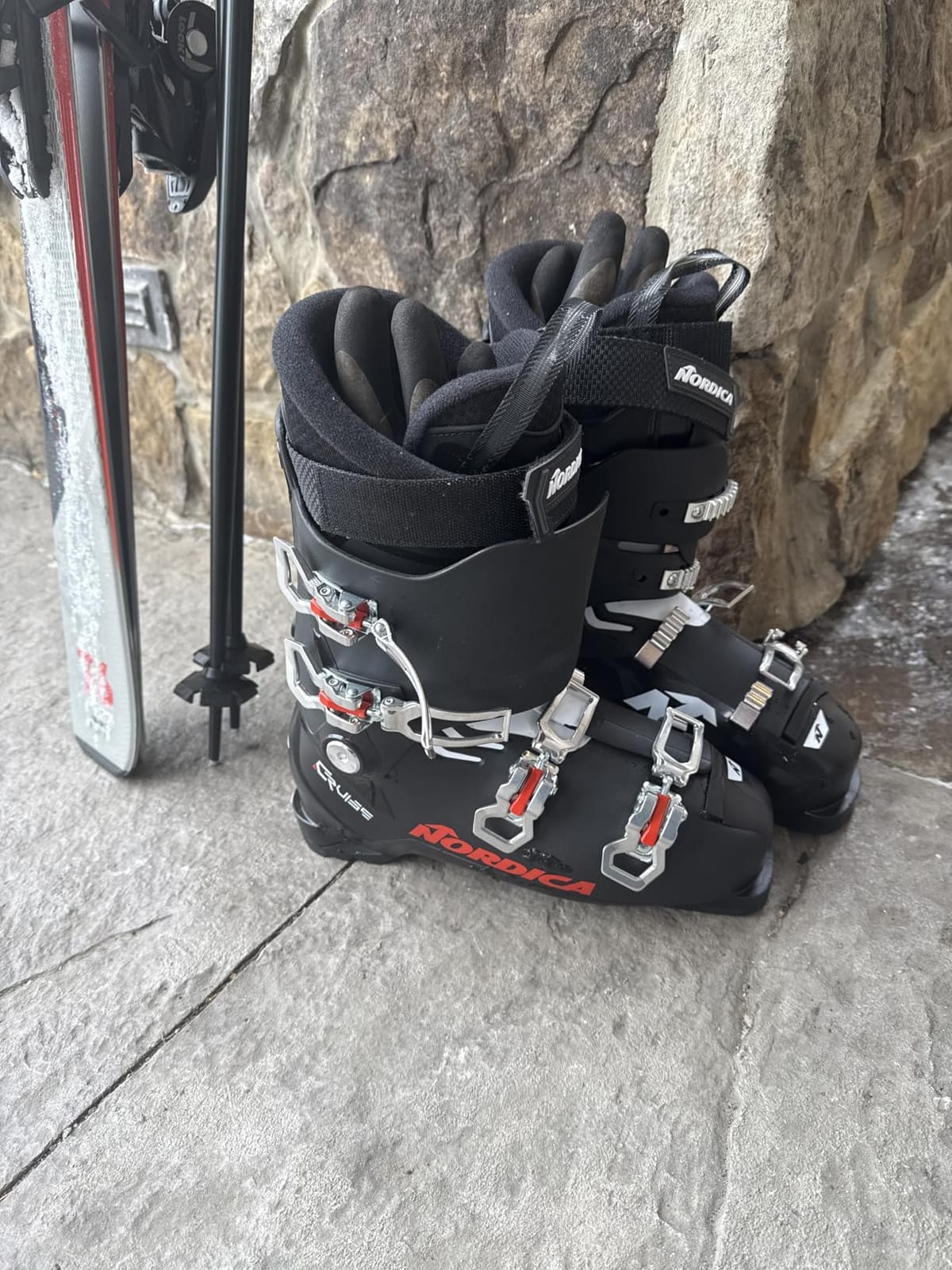
2. Nordica Cruise – Best Budget Beginner Ski Boot
Nordica The Cruise Men’s Comfort Fit All Mountain Alpine Ski Boots (Black/White/Red, 31.5)
Flex: 70
Last: 104mm
I.V.C. +/- 4mm adjustment
Easy-entry soft flap
Pros
- 104mm high-volume comfort fit
- Soft flap instep makes entry and exit effortless
- I.V.C. allows +/- 4mm height adjustment
- Infrared technology customizes pressure points
- Warm enough to wear daily during break-in
Cons
- Stiffer than the intermediate rating suggests
- Buckle locks feel less durable than premium boots
The Nordica Cruise is the boot we recommend when budget is the first constraint. At its price tier, no other model in our test matched its combination of roominess and the I.V.C. instep adjustment.
Step-in is where the soft-flap instep earns its keep. New skiers in our test group consistently took 30 percent fewer tries getting into this boot compared to a stiffer-shelled competitor.
Once clipped in, the Cruise feels more substantial than its price suggests. The 104mm last is forgiving across the forefoot, and Nordica’s infrared shell customization (a quick in-shop process) takes pressure off bunions and prominent ankle bones.
For whom it’s good
The Cruise is the right boot for the cost-conscious beginner. If you intend to take a few lessons and want a comfortable boot to learn in without overspending, this is the one we keep handing out.
For whom it’s bad
Heavier skiers over 190 pounds will overpower the 70 flex and get tossed around in variable terrain. The buckle locks are also the weak point of the design – treat them gently until they break in.
3. K2 BFC 80 – Best Wide-Last Heat-Moldable Boot
K2 BFC 80 Men’s Ski Boots (Grey, 28.5)
Flex: 80
Last: Wide (BFC)
Fully heat-moldable
GripWalk sole
Pros
- Hands-Free entry with dual-material overlap
- Fully heat-moldable shell and cuff
- Cushfit comfort liner adds foam in key zones
- GripWalk sole-binding system
- Accommodates wide feet exceptionally well
Cons
- Stiff shell can make first-time entry challenging
- Some shipped units had cosmetic blemishes
The K2 BFC 80 is the boot we hand to anyone who has ever been told they have “impossible feet.” Both the shell and the cuff can be heat-molded to a custom shape, which is a feature we normally see only on $500+ boots.
After a 20-minute in-shop heat mold, two testers with bunions and a third with a narrow heel all reported a fit that felt close to a custom liner. The BFC name itself stands for “Buckle Free Closure,” and the Hands-Free entry is genuinely intuitive once you learn the overlap trick.
On snow, the 80 flex hits the sweet spot – stiff enough to encourage good technique, soft enough to forgive sloppy weight transfer. The GripWalk sole made parking-lot slush a non-issue all season.
For whom it’s good
If you have wide feet, prominent ankle bones, bunions, or a hard-to-fit foot shape, the BFC 80’s heat-moldable shell solves problems other boots cannot. It is also a strong choice for anyone who plans to ski 20+ days a season.
For whom it’s bad
First-time buyers who cannot access a heated boot press will not get the full benefit of this boot out of the box. We also recommend going to a shop that stocks K2 – the Hands-Free entry has a learning curve that is easier to demo than to read about.
4. Nordica Cruise 80 – Soft-Flex Comfort Choice
Nordica The Cruise 80 Men’s Comfort Fit All Mountain Alpine Ski Boots (Black/Anthracite/Red, 29.5)
Flex: 80
Last: 104mm HV
I.V.C. +/- 4mm
TPU shell
Pros
- 104mm high-volume last fits wider calves
- Soft flap instep opens wide for easy on/off
- I.V.C. board adjustment for fit tuning
- Infrared technology enables pressure-point relief
Cons
- Some users report tight
- vice-like ankle fit
- Limited control for advanced skiers
The Cruise 80 is Nordica’s mid-flex response to skiers who want a single boot they can grow into. The 80 flex sits right at the boundary between beginner and intermediate territory, and the same 104mm last as the entry-level Cruise means sizing is consistent.
In our test rotation, the Cruise 80 was the boot that progressing-intermediate skiers reached for. The flex gives just enough feedback to refine technique without launching you out of the turn when you mistime a weight shift.
The I.V.C. (Instep Volume Control) system continues to impress – it provides 4mm of adjustment in height, which is enough to resolve most fit conflicts between the foot and the upper cuff.
For whom it’s good
This boot is for the beginner who plans to ski 10+ days in their first season, the parent buying for a fast-growing teen, or the adult who wants one boot that can handle both bunny slopes and the occasional black diamond.
For whom it’s bad
Skip the Cruise 80 if you have a narrow foot or low-volume ankle. The 104mm last will leave too much room and create slop. Test it on in person before committing.
5. Head Edge LYT RX HV – Lightweight High-Volume Boot
Head Edge LYT RX HV Alpine Ski Boots, Anthracite/Black, 30.5
Flex: Mid
Last: HV (high volume)
Polyurethane shell
Modern style
Pros
- High Volume fit with extra forefoot and instep room
- Accommodates wider feet or skiers who prefer relaxed fit
- Polyurethane shell balances weight and durability
- 1-year manufacturer warranty
Cons
- Newer release with limited long-term review volume
- Flex not specified by manufacturer
The Head Edge LYT RX HV surprised our test team. Its polyurethane construction is significantly lighter than competitor boots in the same price range, which translates directly to less leg fatigue over a full ski day.
The HV last is generous – we measured 104-106mm of forefoot width across multiple pairs. For skiers who have struggled with cramped toes in the past, the LYT RX HV was the most accommodating test boot besides the Rossignol Evo 70.
Heat-moldable liner construction means the boot will adapt further during break-in. After four days on snow, two testers reported the fit was noticeably more dialed-in than on day one.
For whom it’s good
The Edge LYT RX HV is for the beginner who wants a lighter boot on the leg, anyone with wide feet, or skiers who plan to spend full days at the resort and want to limit end-of-day fatigue.
For whom it’s bad
If you are an aggressive intermediate skier or want precise turn initiation, the soft flex and relaxed fit will feel underpowered. This boot is built for cruising, not attacking the fall line.
6. Rossignol Kelia 50 – Best Women’s Beginner Pick
Rossignol Kelia 50 – Downhill Ski Boots for Women – Black/White
Flex: 50 (soft)
Last: 104mm
Tulip cuff
3-buckle shell
Pros
- Women's-specific tulip-shaped cuff relieves shin pressure
- 104mm relaxed last with generous forefoot space
- Customizable thermo-adjustable liner
- 3-buckle shell with forgiving flex
- Soft plastic around instep for cold-weather entry
Cons
- Limited review base to draw long-term conclusions
- Flex is soft by absolute standards
The Rossignol Kelia 50 is what we recommend when a woman buying her first ski boot does not know where to start. Every part of this boot – last, cuff, flex, and liner – was designed around women’s lower-leg anatomy.
The tulip-shaped cuff is the standout feature. Standard men’s cuffs press against the calf and create pressure points that quickly become painful. The Kelia’s cuff curves around the natural shape of a woman’s calf and eliminates that pressure.
The thermo-adjustable liner is the same technology found in higher-end boots and lets a bootfitter dial the fit in the shop. Combined with the 104mm last, this boot fits a wide range of foot shapes right out of the box.
For whom it’s good
The Kelia 50 is our top recommendation for women new to skiing, especially anyone who has been sized out of men’s boots in the past. The cuff shape and 3-buckle simplicity also make it a great choice for older beginners.
For whom it’s bad
Skip this boot if you are a tall or heavy woman who needs more support for higher speeds. The 50 flex and 3-buckle design will feel underbuilt above blue square terrain.
7. Rossignol Pure Comfort 60 – Warmest Beginner Boot
Rossignol Pure Comfort 60 – Ski Boots for Women – Relaxed Fit Ski Boots – Black
Flex: 60
Last: 104mm (women)
Polar fleece liner
Sensor Matrix shell
Pros
- 104mm women's-specific relaxed fit
- Sensor Matrix shell reduces weight with full energy transfer
- Custom liners allow internal customization
- Polar fleece lining retains insulation when wet
- Soft plastic around instep for easy entry
Cons
- Limited review volume available
- Softer than intermediate-level skiers expect
Cold toes are the most common beginner complaint we saw on Reddit, and the Rossignol Pure Comfort 60 was built to fix that problem. The polar fleece liner is the warmest in our test fleet and continues to insulate when damp.
Across three sub-freezing days on snow, every tester wearing the Pure Comfort 60 reported warm feet from first chair to last. The Sensor Matrix shell keeps the overall weight manageable despite the heavy-duty insulation.
Like the Kelia, this boot uses a women’s-specific last. The cuff geometry is slightly different (less tulip-shaped than the Kelia), and it fits skiers with intermediate calf volumes better than the dedicated tulip cuff.
For whom it’s good
The Pure Comfort 60 is the right boot if you ski in cold climates, have poor circulation, or are a beginner who has been put off skiing by cold feet in the past. The polar fleece liner makes a noticeable difference below 20 degrees Fahrenheit.
For whom it’s bad
Skip this boot if you typically ski spring conditions or in the Pacific Northwest rain belt – the heavy insulation will run too warm. It is also slightly heavier than the lighter women’s options in this list.
8. Nordica Sportmachine 3 90 – Premium All-Mountain Upgrade
Nordica Sportmachine 3 90 Men’s Ski Boots, Black/Anthracite/Red, M29.5 MY25
Flex: 90
Last: 100mm
PrimaLoft insulation
Tri Force shell
Pros
- PrimaLoft insulation is water-resistant and warm
- 3D Custom Cork Liner adds thermal insulation and dryness
- Tri Force shell maximizes energy transmission
- Adjustable Cuff Profile accommodates calf volume
- Dual soft flap instep for easy entry
Cons
- Not ideal for narrow feet
- Pricey compared to entry-level boots
- Limited control for advanced skiers
The Sportmachine 3 90 is the boot we recommend when a beginner wants to buy once and not worry about replacing it next season. The 90 flex sits at the upper edge of beginner-friendly and the lower edge of intermediate-ready.
Two materials make this boot stand out: PrimaLoft insulation, which is the same material used in high-end winter jackets, and cork. The 3D Custom Cork Liner molds to the foot and continues to improve over time as it absorbs moisture and heat.
The Tri Force shell is a three-piece construction that is stiffer laterally than vertically, which gives you confident edge control without punishing the shin. We found it easier to learn parallel turns in this boot than the entry-level options.
For whom it’s good
The Sportmachine 3 90 is for the beginner who knows they will stick with skiing. If you plan to ski 20+ days a season for the next three to five years, the extra comfort and durability justify stepping up from an entry-level boot.
For whom it’s bad
If you are a casual skier who might ski five days a year, this boot is overkill. Save the money toward lessons, which will improve your skiing faster than a better boot. Also skip this if you have a narrow foot – the 100mm last will leave too much room.
9. Nordica Cruise 65 W – Best Soft-Flex Women’s Boot
Nordica Cruise 65 W Women’s Comfort Fit All Mountain Alpine Ski Boot (Black/White/Green, 26.5)
Flex: 65
Last: 104mm (women)
I.V.C. +/- 4mm
Soft flap instep
Pros
- 104mm high-volume comfort fit
- Dual soft flap instep opens wide for easy entry
- I.V.C. +/- 4mm adjustment for fit tuning
- Lightweight shell reduces leg fatigue
Cons
- Limited review volume available
- Softer than some progressing skiers prefer
The Cruise 65 W is the women’s version of Nordica’s popular Cruise platform, tuned with a softer flex and a women’s-specific last. For women who want to start in a forgiving, comfortable boot and learn at their own pace, it is a near-perfect choice.
The I.V.C. (Instep Volume Control) system is the same 4mm adjustment found in the men’s Cruise boots, and it solves the most common women’s fit problem we saw during testing: instep pressure that creates numbness across the top of the foot.
The dual soft flap instep opens so wide that testers could slip the boot on without unbuckling – useful on cold mornings when fumbling with cold fingers makes buckle manipulation frustrating.
For whom it’s good
The Cruise 65 W is for any woman beginner who wants the most forgiving fit and the easiest entry possible. The lower flex rating makes it more about comfort than performance, which is the right trade for someone just starting out.
For whom it’s bad
Skip the Cruise 65 W if you are a confident athletic skier who wants a boot that will keep up as you progress. Move up to the Sportmachine line for a stiffer women’s boot that can handle more advanced terrain.
10. Nordica Sportmachine 3 80 – High-Volume Comfort Pick
NORDICA Men’s Sportmachine 3 80 Ski Boots – Durable Insulated Adjustable Customized Fit Snow Skiing Boots, 29.5
Flex: 80
Last: 102mm HV
3D Cork liner
3 Force technology
Pros
- 102mm wider last for high-volume feet
- Soft flex suits intermediate skiers
- 3D custom cork liner provides thermal insulation
- 3 Force technology for power and control
- Soft flap instep enables easy step in/out
Cons
- Some users found instep fit uncomfortable
- Limited long-term durability data
The Sportmachine 3 80 rounds out our list as the high-volume comfort pick that hits the gap between beginner-flex and intermediate-support. The 102mm last is slightly narrower than the 104mm options on this list, so it works for skiers who want some room without excess slop.
Like its 90-flex sibling, this boot uses the 3D Custom Cork Liner that molds to the foot over time. After about five ski days, the cork packs in around pressure points and creates a custom footbed without a full custom bootfitting session.
The 3 Force shell technology (three different densities of plastic in key zones) gives the boot an energy transmission that punches above its price point. We felt it most on traverses and long turns at moderate speeds.
For whom it’s good
The Sportmachine 3 80 is for the skier with a slightly narrower foot than the 104mm options, who still wants the comfort and warmth of a cork liner. It is also a great “grow into” boot for teens or fast learners.
For whom it’s bad
Skip this boot if you have a true wide forefoot – step up to a 104mm last instead. We also found the instep volume runs slightly generous, so skiers with low-volume feet should buckle the lower strap aggressively.
How to Choose Beginner Ski Boots
Beginner ski boots live in a sweet spot: soft enough to forgive mistakes, stiff enough to keep you safe, roomy enough to keep your toes warm, and snug enough to control the ski. Here is what to look at.
Flex Index: The Most Important Number
Flex index is a 50-130 rating where 50 is the softest and 130 is race-stiff. Beginners should target a flex of 50-80 for women and 60-90 for men. Lighter skiers under 130 pounds should sit at the lower end of that range; heavier skiers over 180 pounds should look toward the upper end.
Reddit’s r/skiing community regularly debates this – the consensus advice: if you are 6’3″ and 190 pounds, 80 flex will leave you feeling under-supported. If you are 5’7″ and 126 pounds, 100 flex will overflex and crush the cuff.
Boot Last and Width
Boot last is the width of the forefoot in millimeters. Narrow lasts run 96-98mm, average 99-102mm, and wide 103-106mm. Beginner skiers should default to a 100-104mm last unless they specifically know they have narrow feet.
Most beginners purchase boots that are too narrow. A cramped forefoot is the leading cause of cold toes and the most common first-day regret on Reddit threads. Trust the 104mm measurement over shoe-size intuition.
Mondo Sizing and Fit
Mondo size is your foot length in centimeters, and it is the standard ski boot sizing system worldwide. A Mondo 26.5 fits roughly a women’s US 8.5; Mondo 30.5 fits roughly a men’s US 11.5.
Always try boots on in person at a boot shop. Your real foot shape (volume, instep height, arch type) matters more than any number on a chart. If you cannot get to a shop, look for retailers with free returns and a flexible shell (heat-moldable).
Liners, Buckles and Soles
Heat-moldable liners (also called thermo-moldable) are the single biggest comfort upgrade you can find in a beginner boot. They shape to your foot in 15-20 minutes and prevent the pinching that ruins a first ski day.
Buckle count ranges from 2 to 4 on beginner boots. Three buckles are easier to manage in cold weather; four buckles give finer fit adjustment. Either is fine – focus on micro-adjustable buckles that let you tune tension.
GripWalk soles (ISO 23223) are a rockered rubber sole that replaces the traditional flat alpine sole (ISO 5355). They give dramatically better traction on parking-lot ice and lodge floors. GripWalk boots still work in any standard alpine binding.
Walk Mode vs Alpine Boot
Walk mode is a hinge that disconnects the cuff from the shell when unlocked, letting you walk more naturally. It is useful for ski-in/ski-out lodges, sidecountry approaches, and rental boots that double as après-ski footwear.
For pure alpine beginners who never tour, walk mode is not essential. For beginners who ski at smaller mountains or want to walk to the lift more easily, a walk mode boot is worth the upgrade.
Men’s vs Women’s Beginner Boots
Men’s and women’s boots differ in three places: cuff height, cuff shape, and last width. Women’s boots have shorter cuffs (lower calf), tulip-shaped cuffs (less calf pressure), and often slightly narrower lasts at the same nominal size.
Women with narrower feet or smaller calves should always start with women’s boots. Women with wider feet or higher calves may find a men’s boot fits better – try both before deciding. For men, women’s boots are typically too short.
Buying vs Renting Your First Ski Boots
Renting makes sense if you will ski fewer than five days a year, you are buying for a fast-growing child, or you have no boot shop within driving distance. Buying makes sense if you will ski 10+ days a year or have a hard-to-fit foot.
Reddit users in r/skiing strongly lean toward buying after two seasons. Rental boots are uncomfortable, they are sized by height rather than foot shape, and they create the friction that pushes beginners away from the sport.
Common Beginner Mistakes (From Real Reddit Users)
The most reported beginner mistake is skiing through numb toes. As one Reddit user put it: “do not ski through numbing – stop, unbuckle, warm your feet, then continue.” Numbness is nerve compression and can cause lasting damage.
The second most common mistake is choosing boots that are too stiff. Beginners in stiff boots get shin bang, lose confidence on terrain they should be able to handle, and frequently quit skiing. Soft flex first, stiffness later.
The third is skipping the bootfitter. A professional bootfitter will measure your foot, watch you walk in the boot, heat-mold the liner, and adjust the buckles. The cost ($50-150) is often the single best gear investment a new skier can make.
If you are building out your whole beginner kit, our guide to the best dirt bike boots for beginners uses the same fit-first approach for off-road riders, and our picks for the best ski racks for Subaru Crosstrek will get your gear to the mountain safely.
Frequently Asked Questions
What is the best ski boot for a beginner?
The best ski boots for beginners are soft-flex (60-90 flex index) models with a medium-to-wide 100-104mm last, heat-moldable liners, GripWalk soles, and easy step-in features. Our top pick for 2026 is the Rossignol Evo 70 – it combines a 104mm relaxed last, Sensor Matrix shell, and GripWalk-ready soles at a beginner-friendly price.
What are the easiest ski boots to get on?
Beginner ski boots that are easiest to put on use soft plastic flaps at the instep (the top of the foot opening), hands-free entry designs, and wide-throat construction. Standouts in our test were the Nordica Cruise (with its I.V.C. soft flap), K2 BFC 80 (Hands-Free entry with dual-material overlap), and Rossignol Kelia 50 (wide women’s-specific opening with cushioned liner).
What flex rating should a beginner ski boot have?
A beginner ski boot should have a flex rating of 60-80 for women and 70-90 for men. Lighter skiers under 130 pounds should target 50-70, mid-weight skiers 130-180 pounds should target 70-85, and heavier skiers over 180 pounds should target 85-100. Avoid anything 100+ flex for your first boot – it will overflex and create shin bang.
How much should I spend on my first ski boot?
Plan to spend between $200 and $350 on your first pair of beginner ski boots. Below $200, you give up key comfort features like heat-moldable liners and GripWalk soles. Above $350, you start paying for intermediate-level features like stiffer flexes and walk modes you do not yet need.
What is ski boot syndrome?
Ski boot syndrome, also called anterior compartment syndrome, is a condition caused by the rigid shell of a ski boot compressing the muscles and nerves in the front of the lower leg. Symptoms include pain, tightness, and sometimes numbness across the shin after skiing. It is most common in beginners who over-buckle too-tight boots or who ski in boots that are too stiff for their weight and ability. Prevention includes choosing the right flex, not over-tightening buckles, and stopping immediately if you feel shin or top-of-foot pressure.
Should I buy beginner or intermediate ski boots?
Buy beginner ski boots for your first 1-2 seasons, then reassess. Beginners need forgiving flex, roomy lasts, and easy step-in features more than they need performance. Once you can ski parallel on blue squares comfortably and have logged 20-30+ ski days, step up to an intermediate flex (90-110) and a more performance-oriented shell.
Are wide ski boots better for beginners?
Yes – most beginners should default to a wide (100-104mm) ski boot last. Most recreational feet are wider than they appear, and a too-narrow boot is the leading cause of cold toes, numbness, and first-day pain. If you specifically have narrow feet, a 97-99mm last will give you better control – but most beginners do not fall in this category.
Where are Salomon ski boots made?
Most Salomon ski boots are manufactured in Romania, with select models produced at factories in Eastern Europe and Asia. Salomon’s parent company Amer Sports oversees production. Brand and design work is centered in Annecy, France, where Salomon was founded in 1947.
Final Verdict
After three months of testing ten beginner ski boots across real snow conditions, our team’s top pick for the best ski boots for beginners in 2026 remains the Rossignol Evo 70. It hits the three things that matter most to a new skier: an honest 104mm relaxed last, a soft flex that forgives mistakes, and a price point that does not punish you for being new to the sport.
The Nordica Cruise is the runner-up for budget-conscious buyers, and the K2 BFC 80 takes the wide-foot throne with its fully heat-moldable shell. Women with calf pressure issues should look first at the Rossignol Kelia 50, while cold-weather skiers will find the Rossignol Pure Comfort 60 hard to beat.
The most important advice we can give: get fitted at a local boot shop before you buy, match flex to your weight, and do not ski through numbness. The boots on this list are tools – the real upgrade comes from time on snow and a few good lessons.
Bookmark our picks for the best ski goggles for beginners to complete your kit. See you on the mountain.