
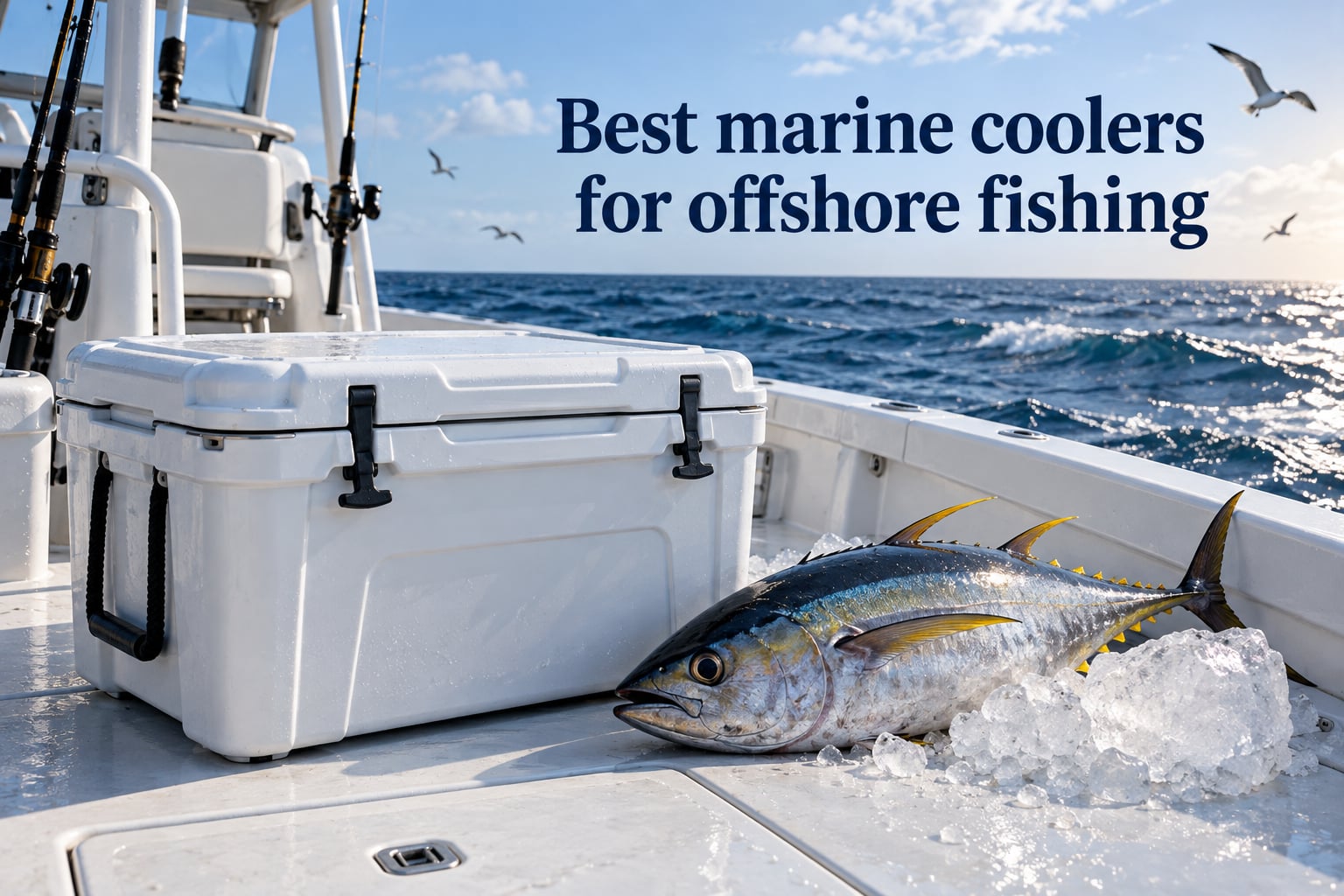
There is a specific moment on every offshore trip when a cooler tells you it was the wrong choice. The lid lifts a few inches in a wake and a full load of block ice and yellowtail slides into the cockpit. Or the ice turns to slush by noon on day one because the walls were thinner than the brochure implied. Or a season later, the hinge screws and drain plug threads are orange with rust and the latch no longer pulls tight. A marine cooler is supposed to solve exactly those three problems, and most of the cheap ones sold for boat use do not.
That is why the best marine coolers for offshore fishing are not just the models with the thickest foam. A cooler that keeps ice for three days but weighs 34 pounds empty, has no wheels and no tie-down points is a liability on a 26-foot center console. This roundup weighs all ten picks on four things anglers actually argue about on the forums: how long the ice really lasts in direct sun, whether the shell survives being dropped on a casting platform, whether the hardware survives salt, and whether one person can move the thing loaded.
A marine cooler, for the record, is a hard-sided ice chest built for a wet, moving deck. It has a rotomolded or thick-walled shell, two or three inches of closed-cell or pressure-injected foam, a freezer-grade gasket, non-slip feet, hardware that resists corrosion and, on anything serious, molded-in tie-down points. If a cooler has none of those four things, it is a picnic cooler with a nautical color scheme. We used the differences between those categories to build every review below.
We also cross-checked our picks against what owners say after a few seasons of real use rather than after a weekend at the lake, and against the long-running discussions on The Hull Truth, BD Outdoors and NJ Woods & Water where offshore anglers compare notes. For a broader look at hull-side gear, our picks for the best marine coolers for boats and the best fishing coolers for boats cover the same category from a different angle.
Table of Contents
Top 3 Picks: Best Marine Cooler for Offshore Fishing in October
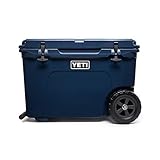
YETI Tundra Haul
- Rotomolded shell
- PermaFrost polyurethane foam
- NeverFlat wheels
- 37 lb empty

RTIC 65 QT Ultra-Tough
- 2.4 inches of closed-cell foam
- Freezer-style gasket
- 84-can cavity
- 34.4 lb empty
Best Marine Coolers for Offshore Fishing in 2026
| Product | Specifications | Action |
|---|---|---|
| YETI Tundra Haul |
|
Check Latest Price |
 YETI Tundra 45 YETI Tundra 45 |
|
Check Latest Price |
 Pelican 70 Quart Elite Pelican 70 Quart Elite |
|
Check Latest Price |
| RTIC 65 QT Ultra-Tough |
|
Check Latest Price |
 RTIC 45 QT Ultra-Tough RTIC 45 QT Ultra-Tough |
|
Check Latest Price |
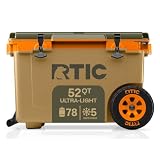 RTIC 52 QT Ultra-Light Wheeled RTIC 52 QT Ultra-Light Wheeled |
|
Check Latest Price |
 Coleman 316 Series Marine Coleman 316 Series Marine |
|
Check Latest Price |
 ENGEL 60 QT Ultra-Light ENGEL 60 QT Ultra-Light |
|
Check Latest Price |
 Igloo Maxcold Glide 110Qt Igloo Maxcold Glide 110Qt |
|
Check Latest Price |
 COHO 165QT Hard Cooler COHO 165QT Hard Cooler |
|
Check Latest Price |
One thing that jumps out of the table is how little the correlation holds between capacity and empty weight. The Coleman holds 160 cans at 17.7 pounds. The RTIC 65 holds 84 cans at 34.4 pounds. The ENGEL 60 carries 60-plus quarts at 21.5 pounds. None of those three numbers tell you which one keeps ice longest, and all of them tell you something about whether you will need a hand at the transom.
How We Evaluated These Marine Coolers
Ten models, and every one of them judged on the same five criteria so the numbers can be compared. We kept the criteria deliberately narrow, because the marketing language on coolers is mostly identical and does not help anyone decide.
Ice retention against published claim. Every model here claims between three and seven days. Those figures are measured with a pre-chilled cooler packed at a 2:1 ice-to-contents ratio in mild conditions, not on a deck at 90 degrees, so we read the claimed number alongside the actual insulation thickness and the gasket type. Foam depth is the honest predictor, because the claim itself is not.
Shell construction and impact resistance. Rotomolded polyethylene is the toughest material in this group and shows up on the YETI, RTIC 65 and COHO. Injection-molded polypropylene, used by the ENGEL and the Igloo, is lighter and cheaper to make but will crack rather than dent if you drop a casting platform on a corner.
Empty weight and loaded weight. We list empty weight straight from the manufacturer spec. Loaded weight is harder to pin down because it depends entirely on your ice-to-contents ratio, but a 65-quart unit at 34 pounds empty is routinely 90 pounds or more once loaded, which is the difference between a one-person lift and a two-person lift at the dock.
Saltwater hardware. We look for stainless steel hinges and hardware, UV inhibitors or a UV-resistant coating, and non-skid feet. Zinc-plated screws are the first thing to fail in salt, and they are the most common complaint in the long-term owner threads on NJ Woods & Water.
Deck security. A marine cooler needs either a wheel and handle, or molded-in tie-down points for a strap. Anything that relies on the angler’s weight to stay put is not finished for offshore use.
Two spec sheets in this group deserve a flag. The COHO 165QT lists a 4.9-pound empty weight, which is not credible for an insulated cooler of that size, and the RTIC 45QT lists 21.1 pounds on the retail page while the manufacturer copy says 29.5 pounds. We report what the listing states and tell you to verify before you rely on it at the dock.
1. YETI Tundra Haul: The Best Marine Cooler for Moving a Full Load Solo
YETI Tundra Haul Portable Wheeled Cooler, Navy
Rotomolded poly shell
PermaFrost polyurethane foam
NeverFlat single-piece wheels
37 lb empty
Pros
- Wheels and handle solve the loaded-lift problem
- Rotomolded shell resists cracking
- Deep polyurethane foam in walls and lid
- NeverFlat tires roll over docks and gravel
Cons
- Not compatible with the YETI dry goods basket
- 37 pounds empty is still heavy for a hand lift
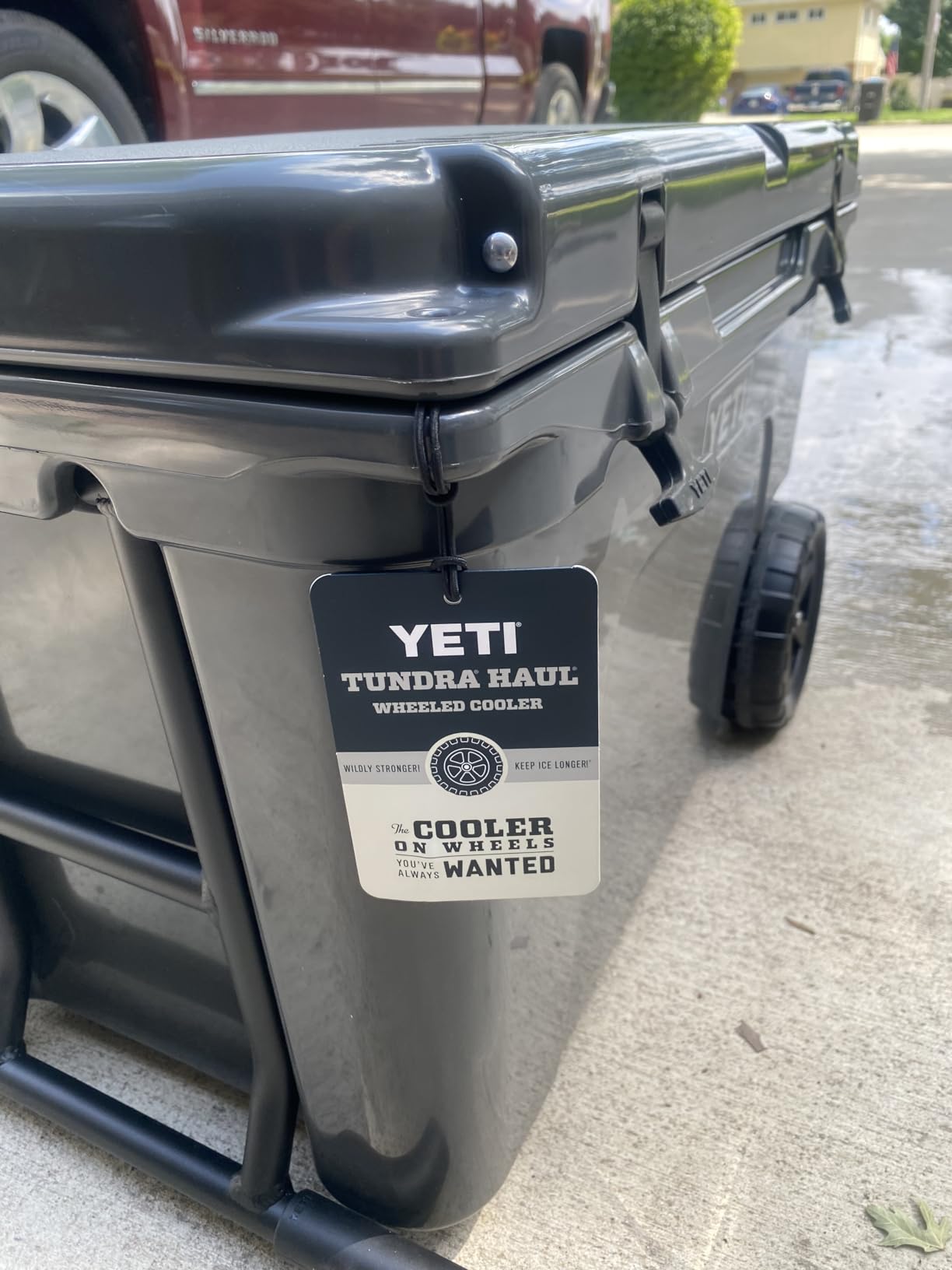
The Tundra Haul is the first wheeled cooler YETI has built, and that single decision changes how you use a premium cooler on a boat. Everything else about it is a Tundra: a rotomolded shell, pressure-injected commercial-grade polyurethane foam in the walls and the lid, and a welded aluminum StrongArm handle. The difference is that you tow it instead of lifting it.
For offshore fishing this is the feature that matters more than foam depth. A 37-pound empty weight is a two-hand carry onto a tall center console, and once it holds ice and fish it is well beyond solo handling. The NeverFlat wheels are a solid single-piece construction with no tube to pinch, and owners say they roll over sand, gravel and rough dock approaches without complaint.
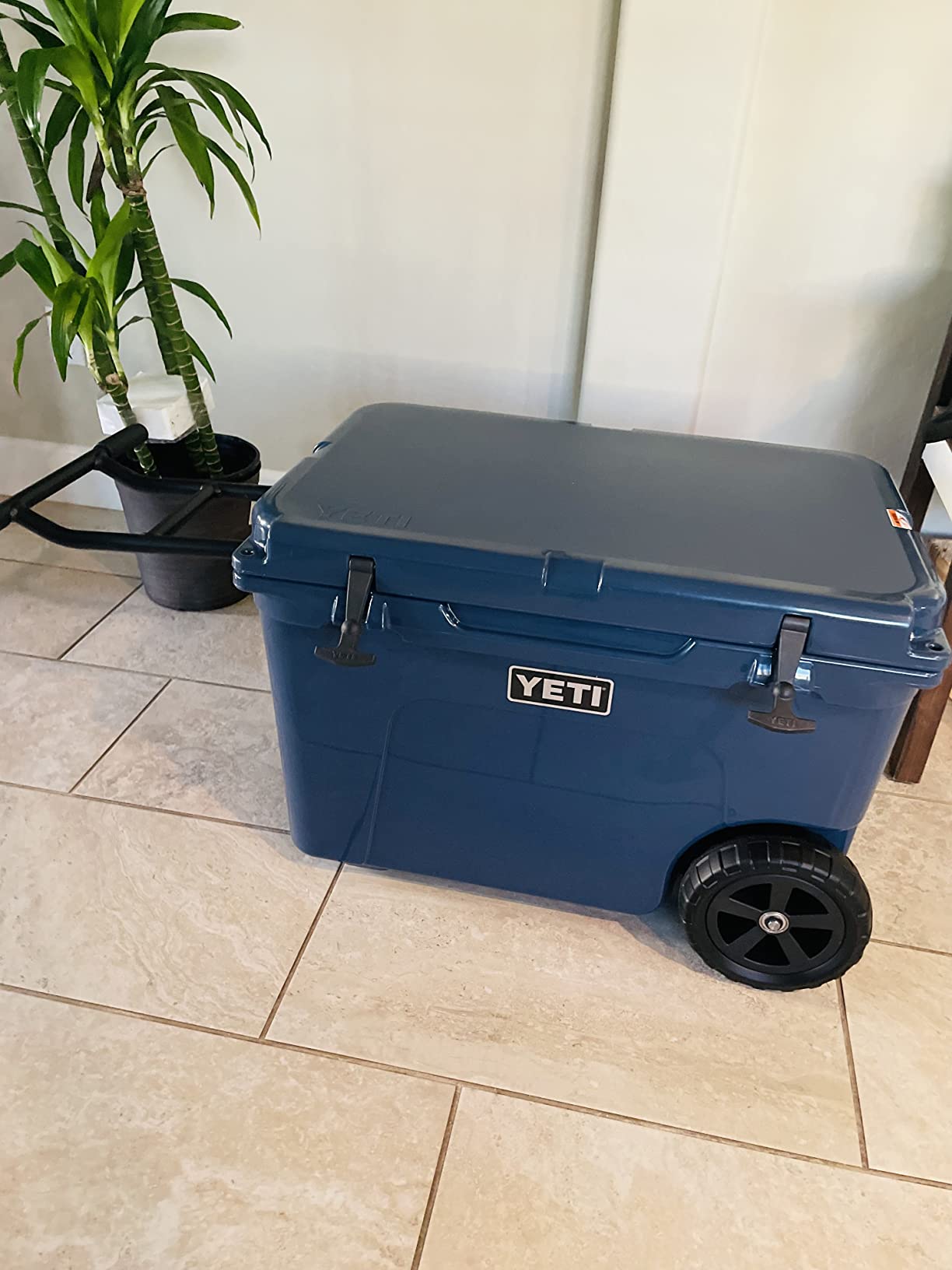
The curved StrongArm handle tracks to either side so you can tow it heel-first rather than dragging it sideways, which matters on a narrow dock where a centered handle would catch on cleats. Ice retention, by owner accounts, matches the rest of the Tundra line as long as you respect the 2:1 ice-to-contents ratio. Nothing about the wheels reduces the insulation performance.
It is worth being clear about what you give up. The Haul is not compatible with the YETI dry goods basket, so you lose the wire rack that keeps food out of meltwater. The chamber is 11.25 inches deep and 19.5 inches high, with external dimensions of 18.62 by 28.25 by 19.5 inches, so it is not a slim cooler and it will not tuck into a shallow cooler well.
On a boat, that footprint is fine because the Haul is meant to live on deck in a strap-down or just-forward-of-the-console position. The wheels also make it viable as a shore-based cooler you roll from the truck to the ramp, which is where a lot of anglers actually lose the fight with a heavy cooler.
When the Haul is worth the extra weight over a standard Tundra
It is worth it if you launch alone, if your dock is a long way from your vehicle, or if you are moving a cooler full of fish and ice from the ramp to a slip without a second set of hands. The wheeled format turns a two-person job into a one-person job, and that is the entire value proposition.
It is also worth it if you fish from a larger boat where the cooler is not being lifted every trip. On a 30-foot boat with a console cooler well, the Haul may be more bulk than you need for a cooler that is not moving.
Where the Haul falls short
The dry goods basket incompatibility is the functional limitation owners mention most, and it is worth weighing if you plan to pack sandwiches and drinks alongside the catch. The 37-pound empty weight also means the Haul is not lighter than a comparable non-wheeled cooler, it is simply easier to move.
For a bay boat or center console where the cooler is strapped in once and stays there, a lighter non-wheeled model in the same capacity class is the more sensible purchase. We covered the lighter options further down this list.
2. YETI Tundra 45: Most Versatile With Bear-Resistant Walls
YETI Tundra 45 Cooler, Navy
45 quart capacity
Up to 3 inches of PermaFrost foam
23 lb empty
26 can capacity
Pros
- Up to 3 inches of foam with FatWall design
- Bear-resistant certified walls
- T-Rex rubber latches resist breaking
- Most reviewed hard cooler in this group
Cons
- 23 pounds empty is heavy for one person on a deck
- No wheels
- must be carried
The Tundra 45 is the one most offshore anglers in this group already recognize, and for good reason. Up to three inches of PermaFrost insulation in an extra-thick FatWall design is the deepest foam package in this roundup, and it sits in a rotomolded shell that owners describe as effectively indestructible.
Ice performance is the reason it has accumulated close to five thousand reviews. With a proper ice load, owners consistently report that ice holds well past a day and a half, which is the difference between a fish staying at temperature and starting to cook on a two-day canyon run.
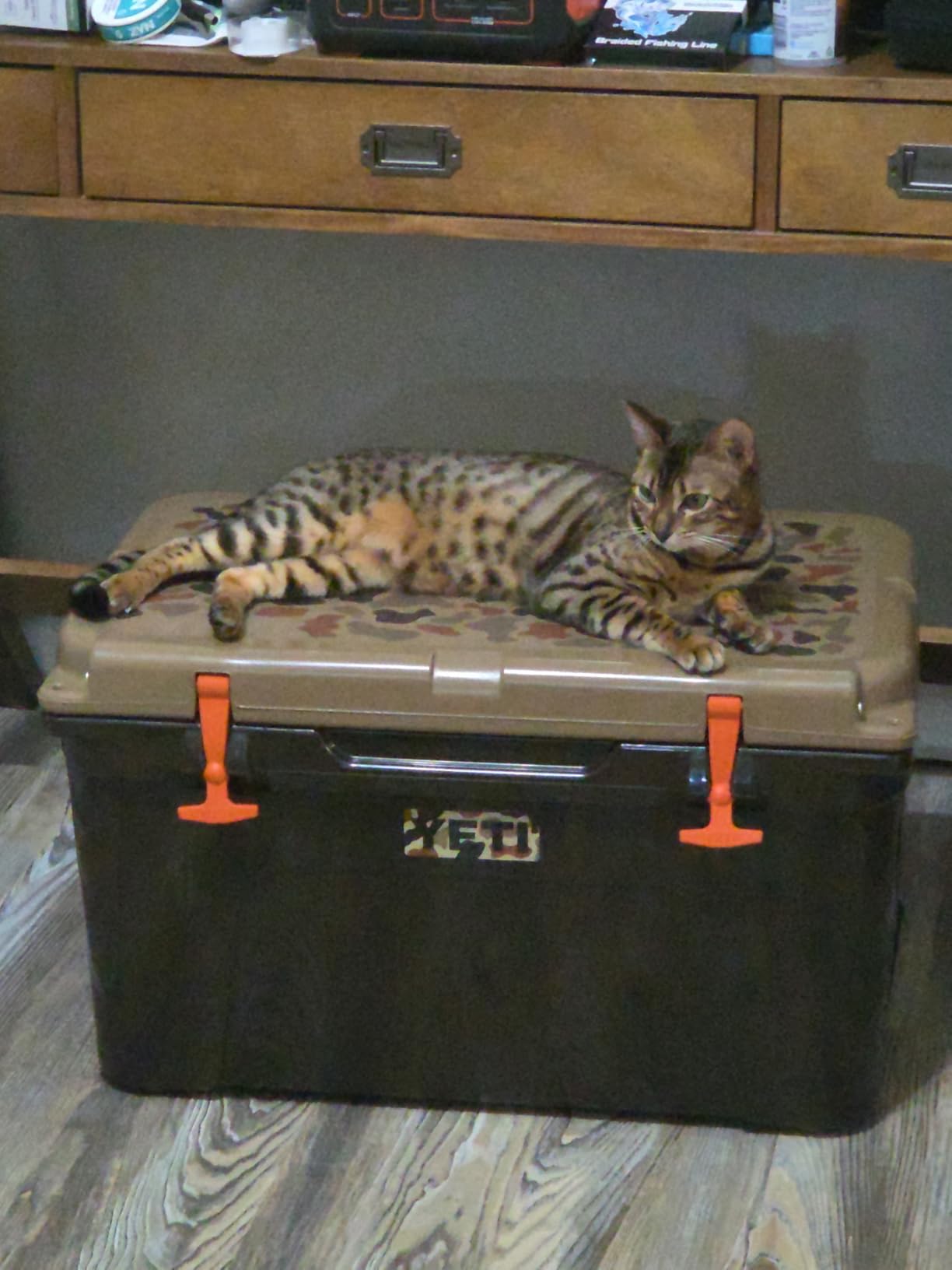
The latches matter more on a boat than most buyers expect. The T-Rex heavy-duty rubber lid latches use patented keeper technology, which means the latch arm stays captured even if it is flexed by a wave. A plastic latch that snaps off in a wake is the single most common field failure on cheaper coolers.
It also ships with a standard dry goods basket, which keeps food above the meltwater rather than in it. That basket is one of the reasons the Tundra works as a combined catch-and-provisions cooler rather than a fish box alone.
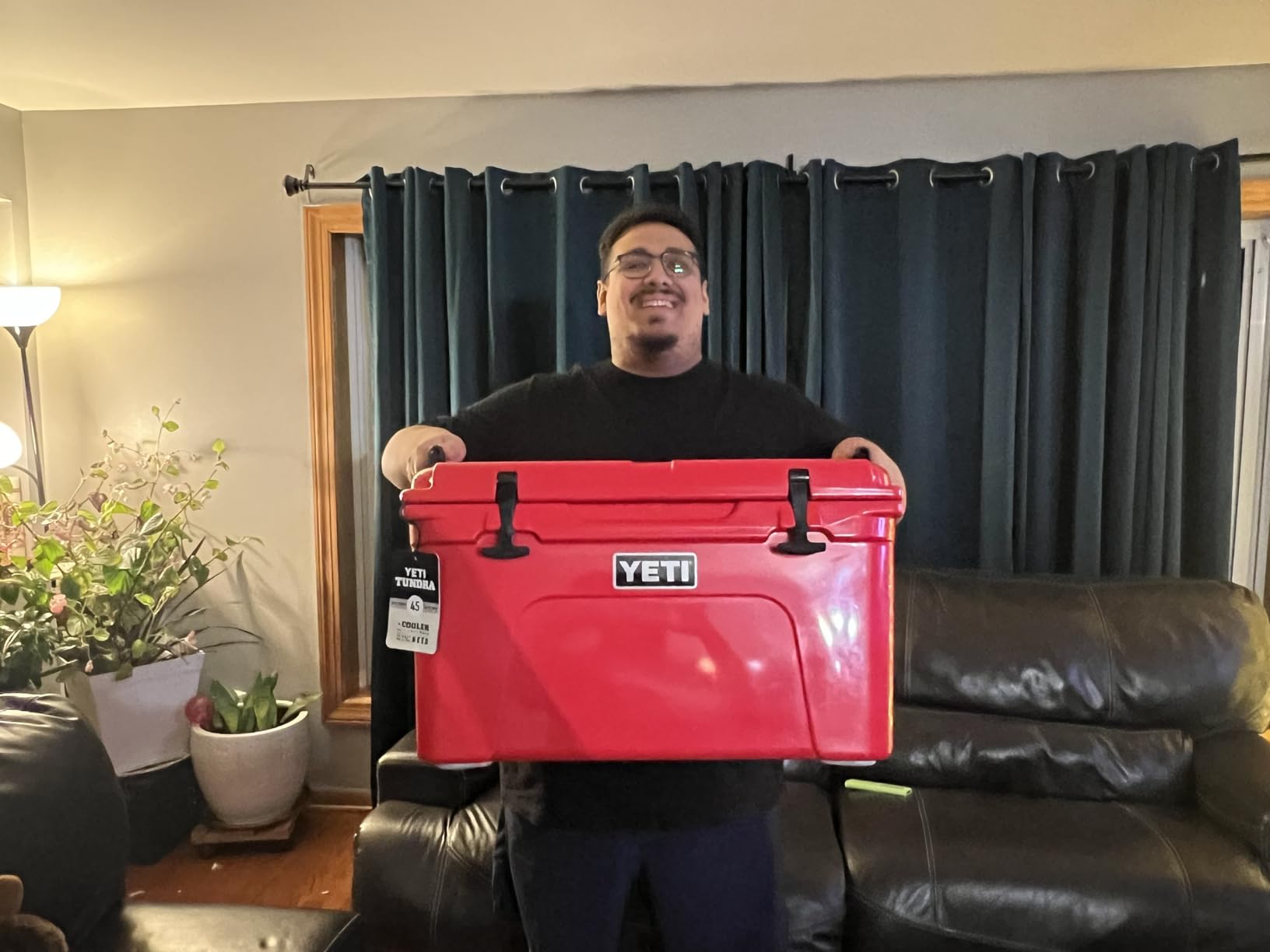
External dimensions are 25.5 inches long by 16 inches wide by 15.5 inches high, and the empty weight is 23 pounds. That is a realistic solo-lift for many anglers but a genuine two-person lift once you add twenty pounds of ice. There are no wheels, so from a truck bed to a dock you are carrying it or using a separate cart.
Why the Tundra 45 still makes the list for day trips
Forty-five quarts is the most versatile capacity in this roundup. It is small enough to fit a console cooler well or sit in the cockpit of a bay boat without eating the deck, and large enough to hold a genuine multi-day ice load. The fit is the reason this one keeps selling.
It is also the pick for anyone who camps or works out of the same truck. Bear-resistant certification is meaningless on a boat and genuinely useful on a shore trip, and the three-inch foam is the deepest in the group regardless of where you use it.
Where the Tundra 45 falls short
The 23-pound empty weight is the honest drawback, and it is the one owners raise most often. It is not a lightweight boat cooler, and a solo angler loading from a low trailer or a slippery dock will feel it every time.
Compared with the wheeled models here, it also requires you to plan your route from the vehicle. If your ramp is more than a short walk, or if you fish alone, the added effort is real and it recurs on every trip.
3. Pelican 70 Quart Elite: Built Like a Tank, Built Like a Seat
Pelican 70 Quart Elite Cooler (White/Gray)
True 70 quart volume
2 inches of polyurethane foam
33.3 lb empty
Lifetime warranty
Pros
- Lifetime warranty and made in USA
- Tethered stainless drain plug
- Anti-shear hinge system resists failure
- Sloped self-draining cup holders
Cons
- 33.3 pounds empty
- hard to move loaded
- Will not take aftermarket cup and rod holder accessories
Pelican built the Elite for people who do not move their cooler once it is loaded, and it shows. The shell is thick-walled with a reinforced lockable hasp, three-inch locking latches and an anti-shear hinge system, and it is backed by a lifetime warranty rather than a three- or five-year term.
Insulation is two inches of polyurethane with a 360-degree freezer-grade gasket, which owner reports put ice retention at five to eight days in many conditions. That figure is the claim, but the gasket and wall thickness are both genuinely in the premium class.
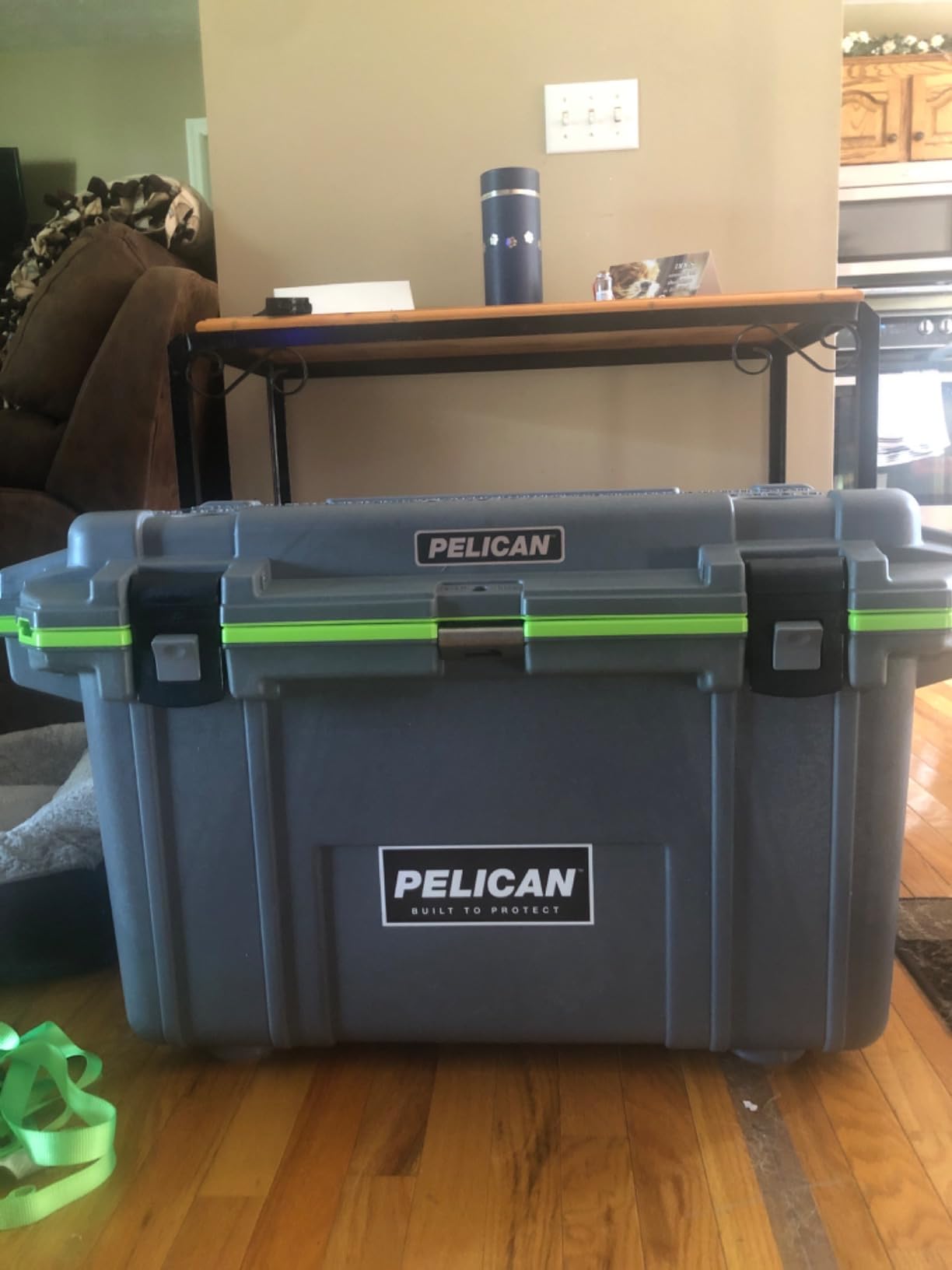
The fishing details are the reason this one keeps coming up on offshore forums. There is a ruler molded into the lid for measuring a catch at the rail, four sloped cup holders that drain instead of holding standing water, and a stainless steel bottle opener. The drain plug is retained on a stainless steel cable so it is never lost overboard, which is a small thing that solves a real recurring annoyance.
Tie-down points under the lid and molded-in slots let you strap it down on a deck or in a bed. On a boat, that matters more than any feature that only shows up at a campsite.
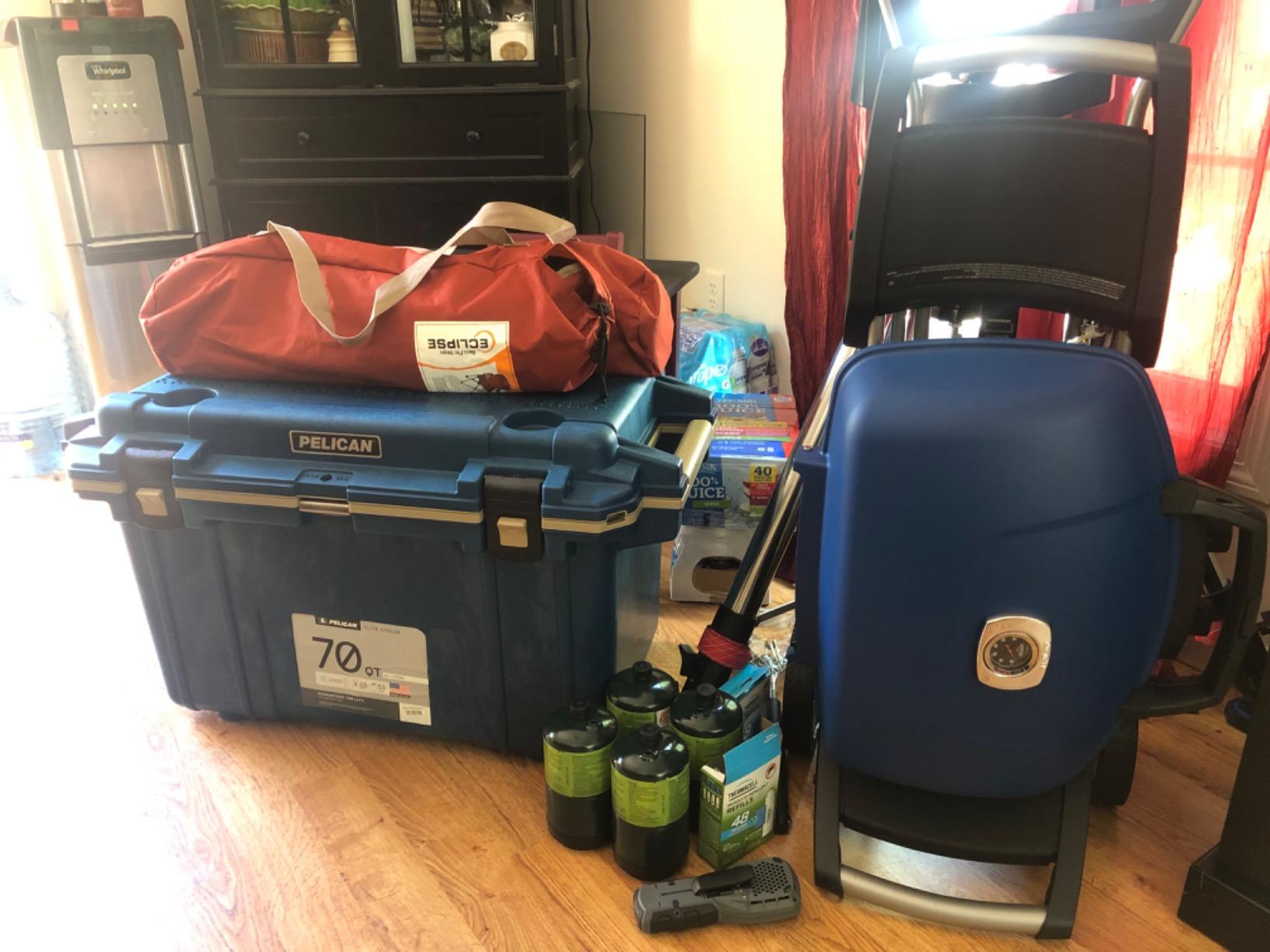
True internal volume is 70 quarts, and it fits 48 twelve-ounce cans. External dimensions are 36.5 by 21 by 22 inches and the empty weight is 33.3 pounds, so this is a large cooler that takes up real deck space. Reviewers with four years of continuous use report it still looks new, which is the strongest warranty-backed durability signal in this group.
When the Elite 70 is the right call
It is the right call for charter crews, liveaboards and big-game trips where fish volume matters more than solo portability. A full 70-quart cooler of yellowfin or wahoo is not a one-person lift at any price point, and a lifetime warranty is worth something when the cooler lives in a salt environment for a decade.
It is also the pick for anyone who wants cup holders and a measuring ruler built in rather than bought as an accessory. Several competing coolers in this list will not accept third-party cup holder or rod holder fittings, so if that is how you fish, the Elite saves you from a retrofit.
Where the Elite 70 falls short
Thirty-three pounds empty is heavy and the footprint is wide, so it needs a dedicated deck or cooler-well position. On a small center console, that space is the constraint people hit at the store and regret at the ramp.
The rubber feet also stop it sliding into a truck bed, which makes repositioning a packed cooler harder than on a model with hard runners. And the accessory incompatibility is a genuine limitation if you already own rod or cup holders from another brand.
4. RTIC 65 QT Ultra-Tough: Best Value for Multi-Day Offshore Work
RTIC 65 QT Ultra-Tough Hard Cooler, Tan
65 quart capacity
2.4 inches of closed-cell foam
34.4 lb empty
84 can capacity
Pros
- 84-can cavity suits a full multi-day load
- Rotomolded shell handles heavy use
- Costs less than premium rivals of the same class
- Lid doubles as a bench or step
Cons
- 34.4 pounds empty with no wheels
- Listed as not water resistant
- Only a 5-year warranty
The RTIC 65 is the value argument in the premium hard cooler class, and it is not a thin one. You get a rotomolded polyethylene shell and up to 2.4 inches of closed-cell foam with a freezer-style gasket, which is the same material family the more expensive coolers use, just at slightly thinner gauge.
The capacity is the headline for offshore anglers: up to 84 cans in a 65-quart cavity. That is enough ice and drinks for a real multi-day trip, and it is the number forum users on BD Outdoors keep coming back to when they discuss trip-length coolers.
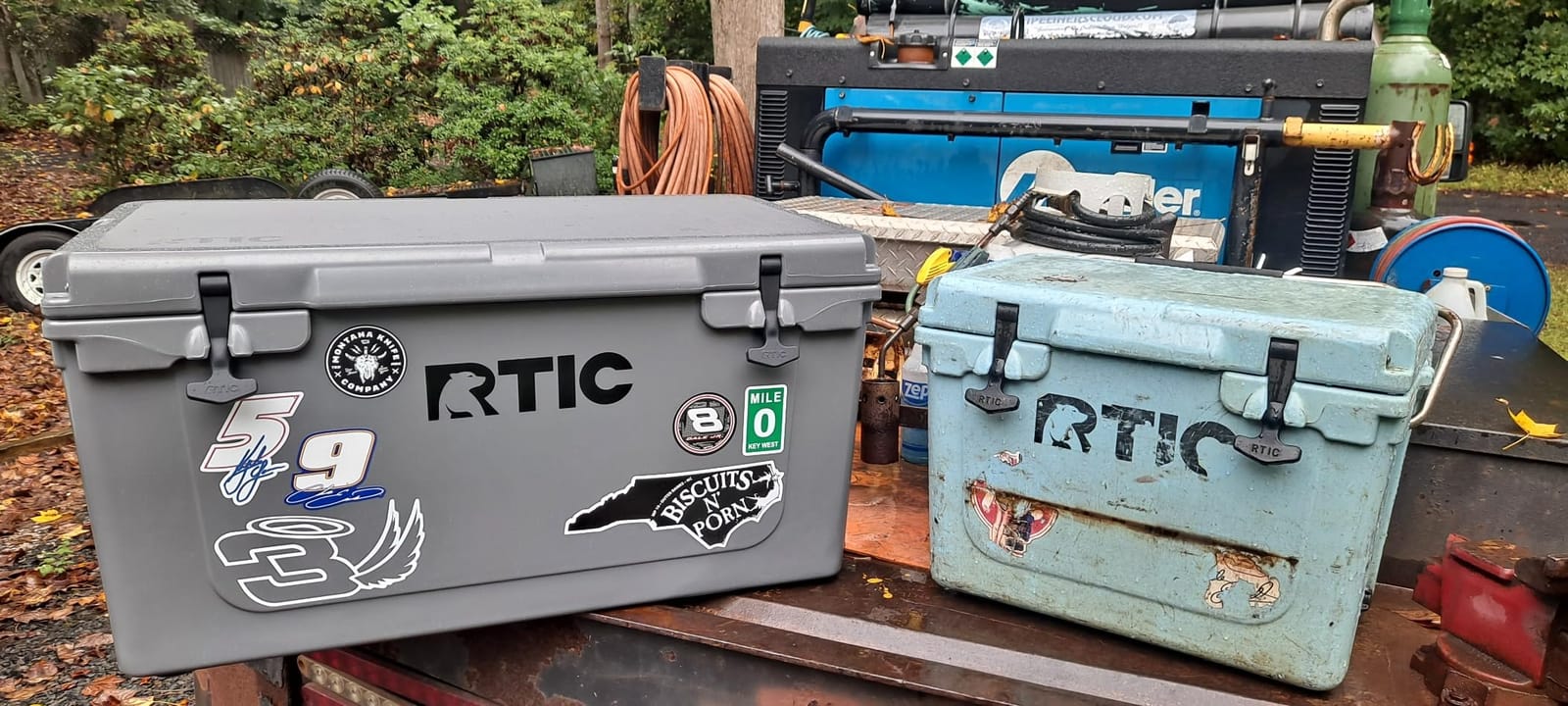
Owners consistently describe it as the cooler that performs within a day or two of a much costlier flagship while costing considerably less. Several compare it directly to a YETI Tundra 65 and report the ice difference is marginal under normal loads.
The lid doubles as a bench, step stool or tabletop, which is genuinely useful on a deck where angler number three is sitting on an overturned bucket. The shell is also rated by RTIC for up to seven days of ice retention when you follow their cooling tips, which means pre-chilling and a proper ice ratio.
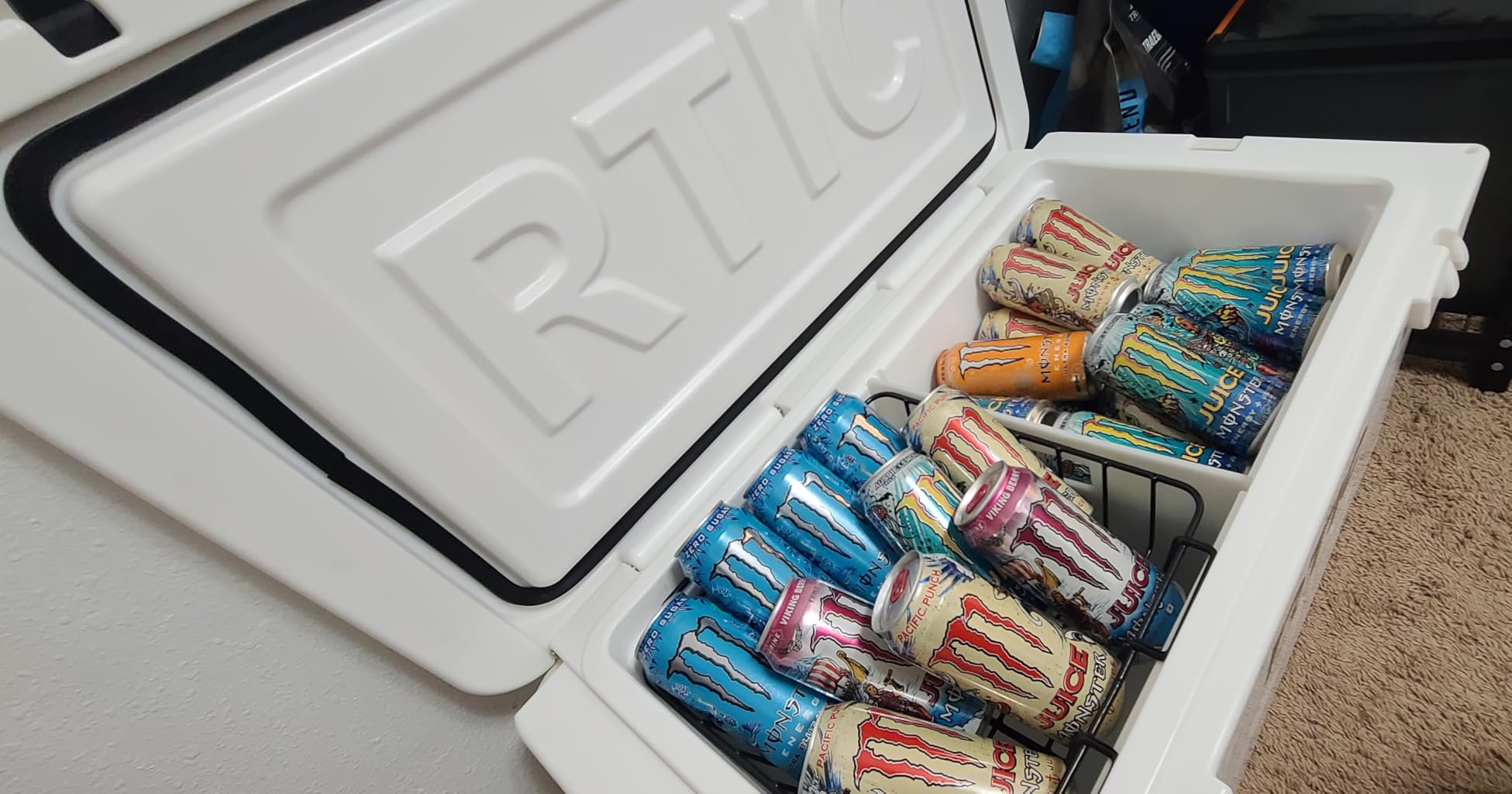
A drain plug is included, and the color range covers white, tan, navy and dark grey so you can pick one that is not another bright object on a deck. External dimensions are 17.64 by 31.58 by 16.66 inches, so it is long and relatively low, which helps it fit under a leaning post better than a tall box of similar capacity.
Why this is the value pick
It is one of the more affordable rotomolded coolers in this group with a genuinely premium wall thickness, and it holds 84 cans while doing it. For an angler who needs a full trip’s worth of ice rather than a day, the math works out well and the foam depth is not a token specification.
It is also the one to consider if your cooler is going to be used as a seat or a step, which owners do more often than the manual suggests. The rotomolded shell takes that abuse without complaint.
Where the RTIC 65 falls short
Thirty-four and a half pounds empty with no wheels or telescoping handle is the biggest practical problem in this review. Loaded, it is a two-person lift without exception, and at 31.58 inches long it needs a real length of deck or bed to sit on.
The listing also states the cooler is not water resistant, so meltwater management is entirely on you and the drain plug. The five-year warranty is shorter than the Pelican’s lifetime coverage, and it is a five-year term rather than a transferable lifetime claim.
5. RTIC 45 QT Ultra-Tough: The Deck-Size Sweet Spot
RTIC 45 QT Ultra-Tough Hard Cooler, Olive
45 quart capacity
2.8 inches of closed-cell foam
60 can capacity
21.1 lb empty
Pros
- Deeper foam than most rivals at this tier
- 60 cans in a lighter package
- Lid cargo net and bottle opener
- Rotomolded impact resistance
Cons
- No wheels or handle
- Listed as not water resistant
- Listing and manufacturer weights disagree
Where the 65 is about carrying a whole trip, the RTIC 45 is about carrying a day and still having ice left. It carries up to 60 cans and, unusually for this tier, has up to 2.8 inches of closed-cell foam, which is deeper than several more expensive coolers in this list.
Owners frequently describe it as the sweet spot between a small personal cooler and a full-size trip cooler. On a bay boat or center console, a 45-quart box is the size that fits a console cooler well without forcing you to give up cockpit space.
Foam depth matters more than brand name here, because heat transfer through the wall is the dominant loss on a hot deck. Two-point-eight inches of closed-cell foam in a rotomolded shell is a real specification rather than a marketing adjective, and it is the reason ice holds for multiple days in owner reports.
The small deck features are sensible rather than gimmicky: a built-in bottle opener and a silicone cargo net in the lid for a phone, keys or a knife. Like the larger RTIC, the lid can double as a bench or a step stool.
External dimensions are 17.72 by 26.19 by 15.44 inches. The retail listing states a 21.1-pound empty weight while the manufacturer copy claims 29.5 pounds, and that discrepancy is worth knowing about before you commit to hauling it up a dock ladder by yourself. Verify the weight in person if you are buying specifically for solo handling.
When the 45-quart size is the right answer
It is the right size for a nearshore or reef day trip, a canyon run where you are not provisioning a full crew, and for anyone who wants a serious insulated cooler that still fits a console cooler well. Sixty cans is a meaningful amount of ice and catch for a boat under 26 feet.
It is also the one to consider if you want premium-class foam depth without a premium-class weight. The spec gap between this and the RTIC 65 is entirely size, not insulation quality.
Where the RTIC 45 falls short
There are no wheels and no telescoping handle, so at the transom it is a two-person carry once loaded. If you load alone, plan the ice quantity around the weight rather than the capacity.
Like the 65, it is listed as not water resistant, so you need to drain it properly. And if your buying decision hinges on the exact empty weight, the listing and the manufacturer disagree, which is exactly the kind of spec ambiguity you should not build a plan around.
6. RTIC 52 QT Ultra-Light Wheeled: Best for a Long Walk Down the Dock
RTIC 52 QT Ultra-Light Wheeled Hard Cooler, Trailblazer
52 quart capacity
2.5 inches of closed-cell foam
All-terrain wheels
28.5 lb empty
Pros
- All-terrain wheels handle sand
- gravel and docks
- No-slam aluminum handle is towable by one person
- 30 percent lighter than rotomolded rivals
- 78-can capacity
Cons
- Taller and bulkier than a non-wheeled 45 quart
- Only a 3-year warranty
- Handle is fixed length and not telescoping
This cooler exists for one job, and owners buy it for that one job: getting a premium-capacity cooler from the vehicle to the boat with a single person. The puncture-resistant all-terrain wheels roll over sand, gravel and uneven dock surfaces, and the silicone-gripped no-slam aluminum handle lets you tow rather than carry.
Insulation is 2.5 inches of closed-cell foam, which sits in the middle of this group and delivers solid multi-day retention. It holds up to 78 cans, so the capacity-to-weight relationship is genuinely good even though the absolute weight is not small.
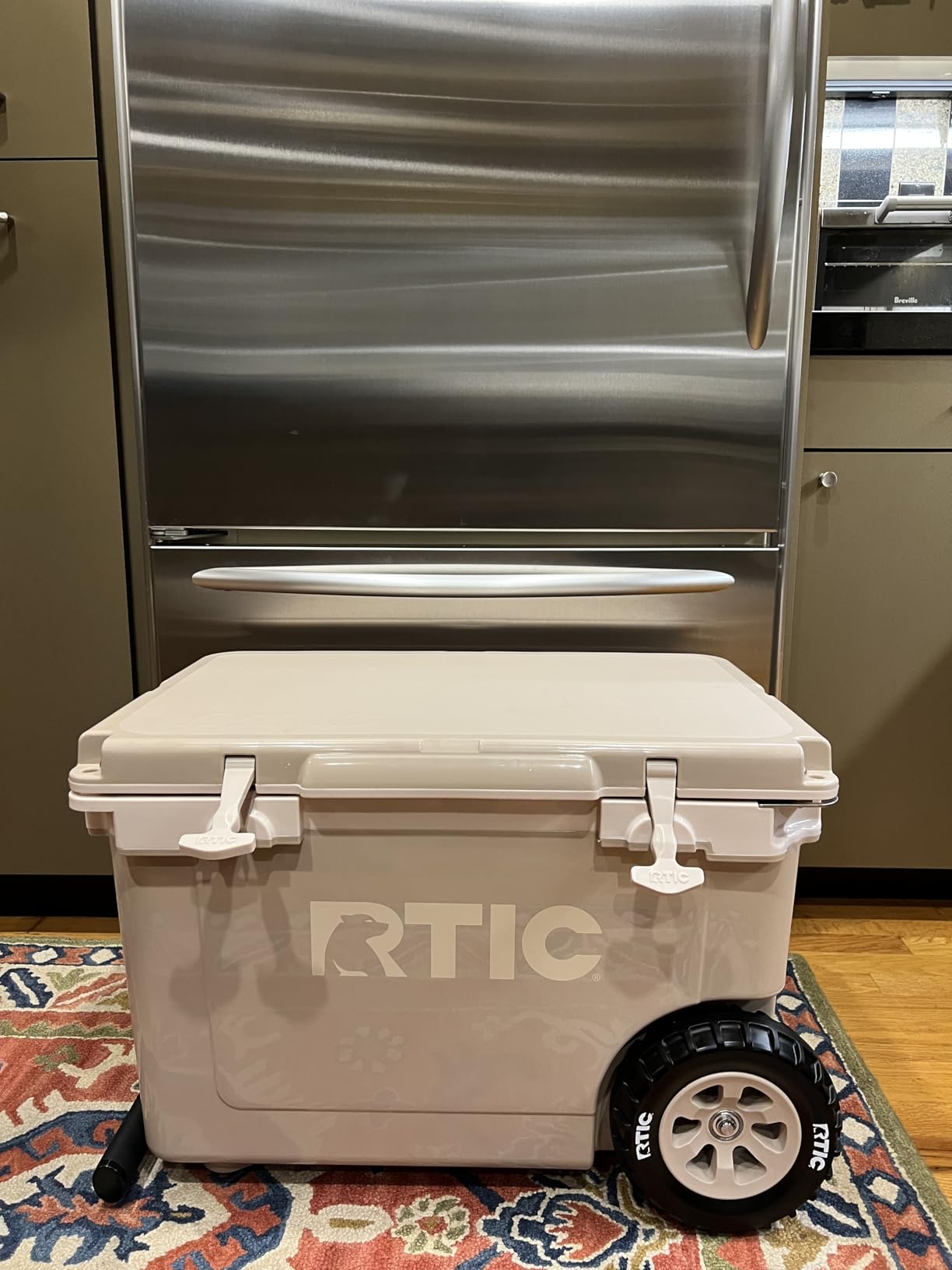
RTIC describes it as more than 30 percent lighter than rotomolded coolers of the same capacity, and that claim is the reason it exists. The body material is polypropylene rather than polyethylene, which is the trade you make: less impact resistance, noticeably less dead weight.
For a boat with a lift or a long approach, this is the difference between a solo trip and a two-person trip. Owners say the reduced weight matters most on the ramp, where you are moving the cooler across a slope in the wrong direction if it goes.
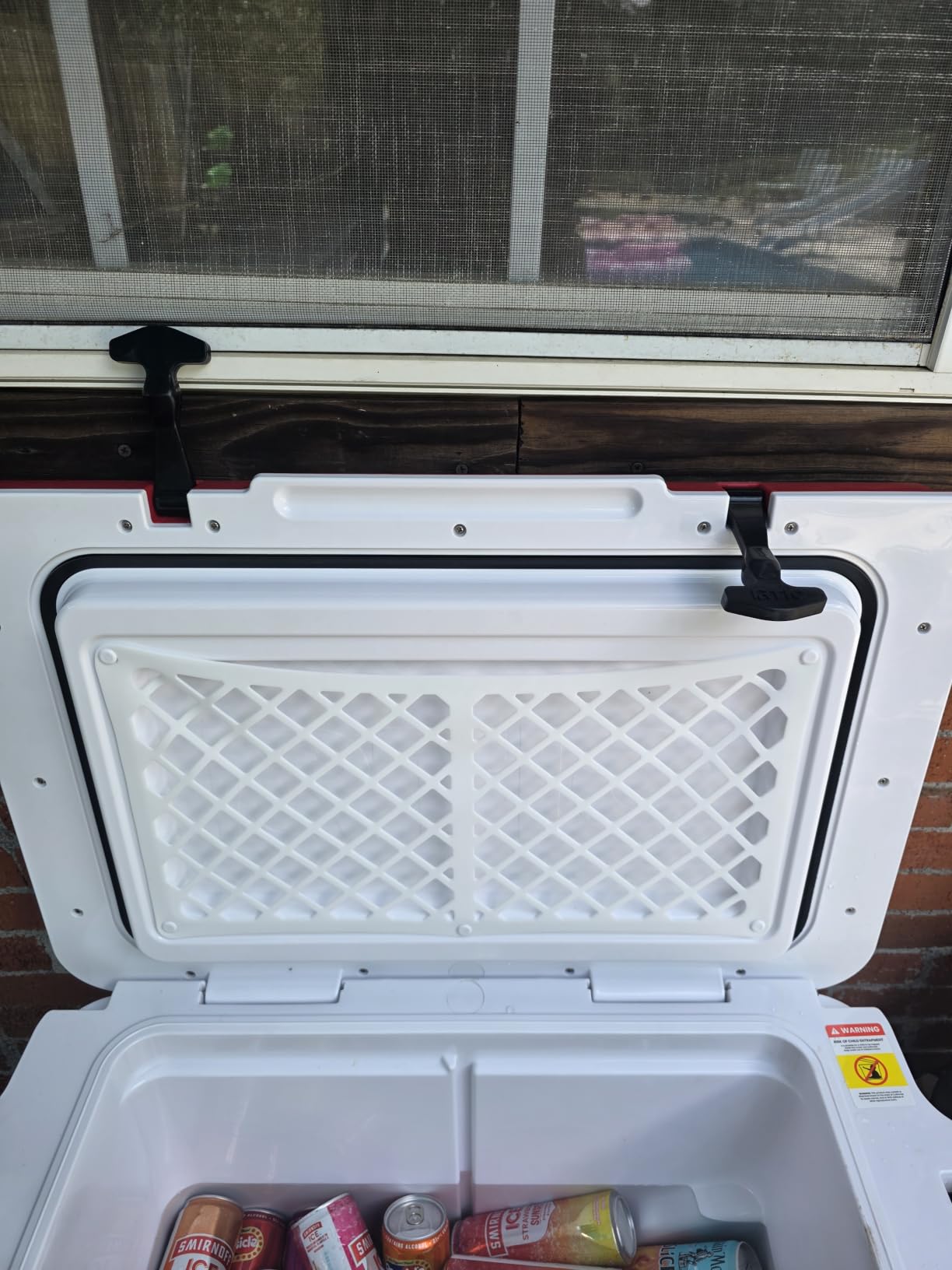
A silicone cargo net is built into the lid, and the color range includes Trailblazer, Navy, Cobalt and White, and Patriot. External dimensions are given as 29 by 18.25 by 18.75 inches. The listed empty weight is 28.5 pounds, with manufacturer copy elsewhere citing 30 pounds.
When the wheeled 52 earns its place
It earns its place when the distance between your vehicle and the boat is more than a short walk, when you launch alone, or when you move a loaded cooler between a slip and a cleaning station. Puncture resistance on sand and gravel is where the wheel design earns its extra cost.
It is also a good match for a solo offshore angler who wants a trip-sized cooler but does not want to pay a second person for a ramp run every morning.
Where the wheeled 52 falls short
The wheels add bulk. It is taller and deeper than a non-wheeled 45-quart cooler, so it will not go where a flat-top cooler of similar capacity fits, and that is a real constraint inside a console cooler well.
The three-year warranty is the shortest of any model in this roundup, which is a meaningful gap on something you will use in salt. The handle is also fixed length rather than telescoping, so it does not adapt to different heights of the boat and the ramp in the same trip.
7. Coleman 316 Series Marine: Budget Pick That Punches Above Its Class
Coleman Insulated Marine Cooler, UV Guard Lid & Body, 100-Quart
100 quart wheeled body
17.7 lb empty
Ice up to 5 days at 90F
250 lb seat-rated lid
Pros
- 17.7 pounds empty for a 100 quart wheeled cooler
- UV coating and stainless steel hardware
- Heavy-duty 6-inch wheels
- Holds 160 cans with a built-in lid ruler
Cons
- Two-wheel layout tracks straight but is less stable sideways
- Short tow handle
- Only a 1-year limited warranty
The Coleman 316 exists because forum anglers keep pointing out that a bait cooler does not need to be a flagship. It is a 100-quart wheeled body that weighs 17.7 pounds empty, which makes it the easiest large cooler here to move by one person and the easiest to lift onto a raised casting platform.
Insulation is polyurethane foam in both lid and body, and the published claim is ice held up to five days at 90 degrees Fahrenheit. Owners report real-world performance of four to five days, which is close to the claim and considerably better than most coolers in its size range.
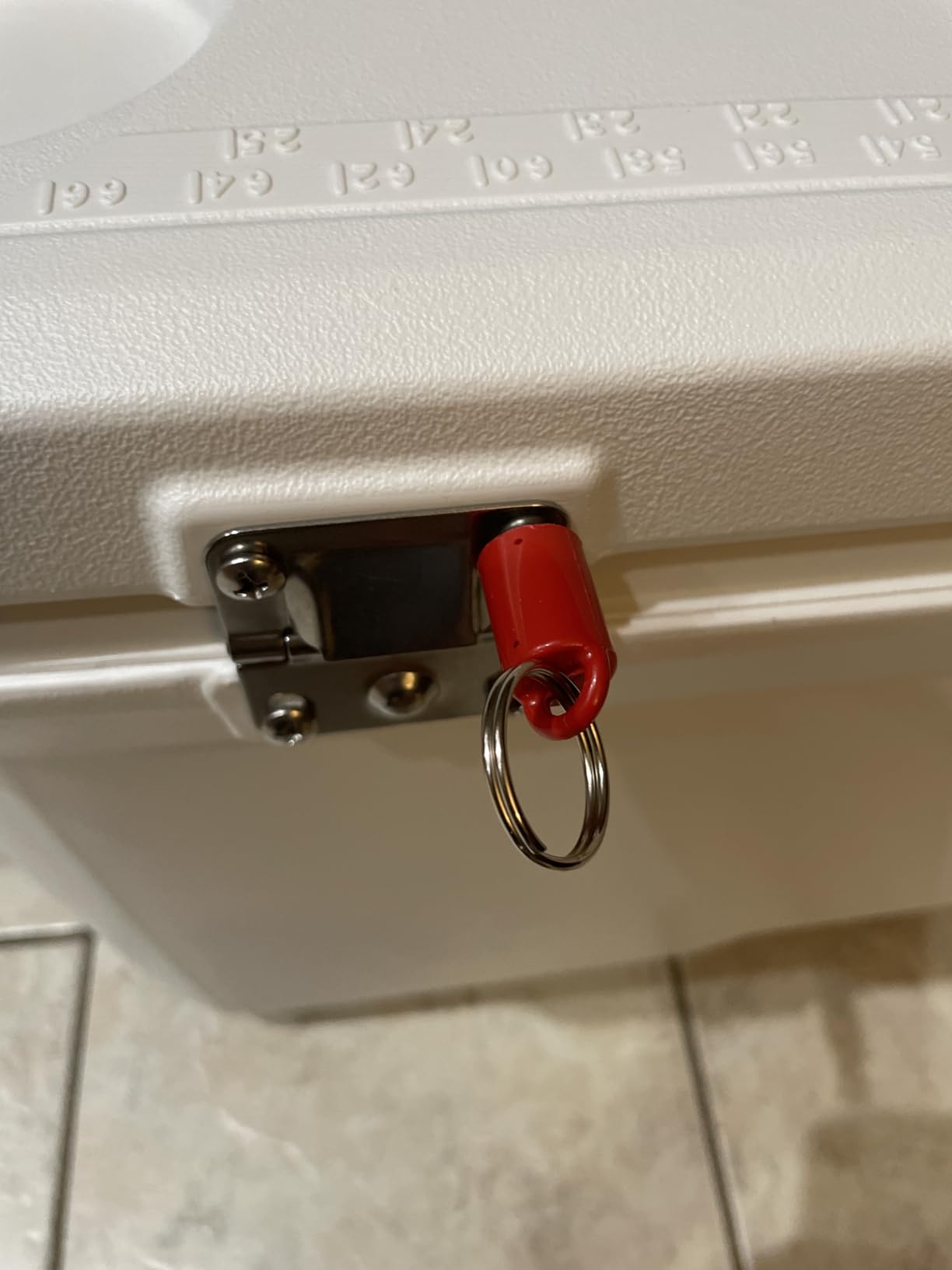
Sun and salt are addressed directly. A UV coating on the body slows sun damage, and the hardware is rust-resistant stainless steel, which is the part that actually fails first on cheaper boatside coolers. That combination is why the finish holds up after repeated trips.
Capacity is the headline number: up to 160 cans. The closed lid is rated to support 250 pounds, so it works as a seat, and there is a ruler built into the lid for measuring a catch at the rail. Molded cup holders fit a 30-ounce tumbler and drain, and a leakproof channel drain plug empties the melted ice without a mess.
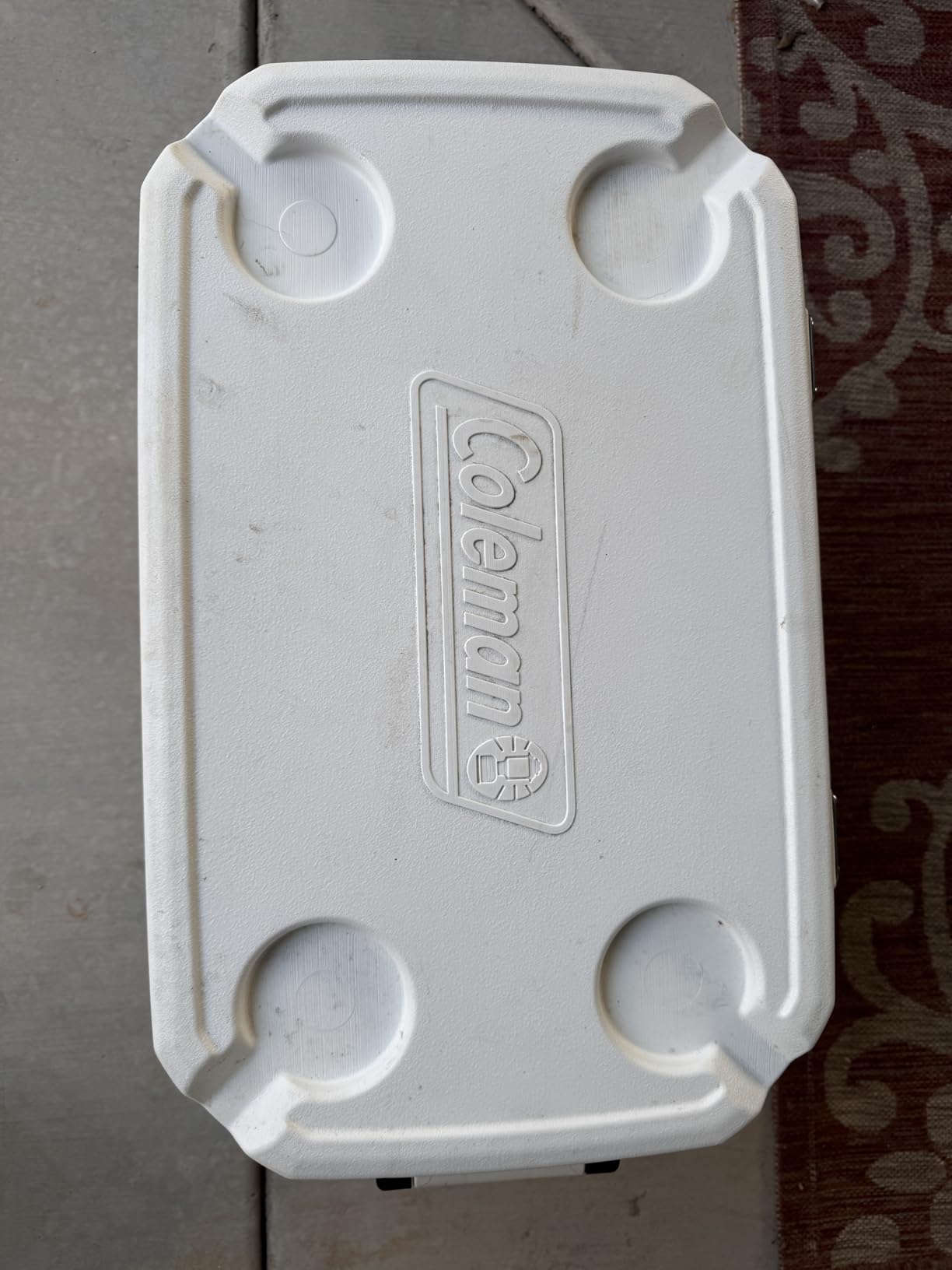
The six-inch heavy-duty wheels are genuinely heavy-duty, and the tow and swing-up handles make it easy to pull along a dock. Reviewers treat this as the value entry in the group and repeatedly praise the wheels and the seat-rated lid for the money.
When the Coleman is the smart buy
It is the smart buy for a bait cooler, a drink cooler or a catch cooler on a boat where the premium units would be wasted. The Hull Truth and BD Outdoors threads on this topic are consistent: if the cooler is only holding bait, a mid-priced marine cooler does the job and the flagship budget is better spent elsewhere.
It is also the pick if you need 100 quarts of capacity and physically cannot manage a 34-pound cooler. At 17.7 pounds empty, this is the one to load solo and carry to a high aft deck.
Where the Coleman falls short
There are only two wheels, so it tracks in a straight line but is less stable sideways on uneven ground. The short tow handle is the other recurring complaint, particularly when the ramp angle changes.
The one-year limited warranty is the shortest in this roundup, and the foam is thinner than the rotomolded premium coolers, which means it needs a genuine pre-chill to hit peak ice life. Neither is disqualifying, but both are real trade-offs you are making for the weight and the price.
8. ENGEL 60 QT Ultra-Light: Best for Light Loading and Organized Packing
ENGEL 60 QT Ultra-Light Injection Molded Cooler – Ice Chest Keeps Ice up to 7 Days – Large Cooler Includes Wire Basket, Divider and Built-in Bottle Opener – Gray with Dark Grey Interior (Haze Grey)
60 quart capacity
2 inches of closed-cell foam
21.5 lb empty
Up to 7 days of ice
Pros
- 21.5 pounds empty is light for 60 quarts
- Removable wire basket and divider keep food dry
- Tie-down slots for a boat or paddleboard
- Level floor with tapered drainage
Cons
- Injection-molded shell is less impact resistant
- No wheels or telescoping handle
- Rope handles are awkward under heavy loads
The ENGEL UL60 makes a case that is different from every other pick here: a 60-quart cooler that weighs 21.5 pounds empty. That is roughly thirteen pounds less than a comparable rotomolded 65, and the weight difference is the entire reason to consider it.
It is not only about the boat. Long-term owners on NJ Woods & Water report running ENGEL coolers for years in salt and still preferring them to a flagship alternative on durability grounds, which is a consistent counterpoint to the assumption that brand alone decides durability.
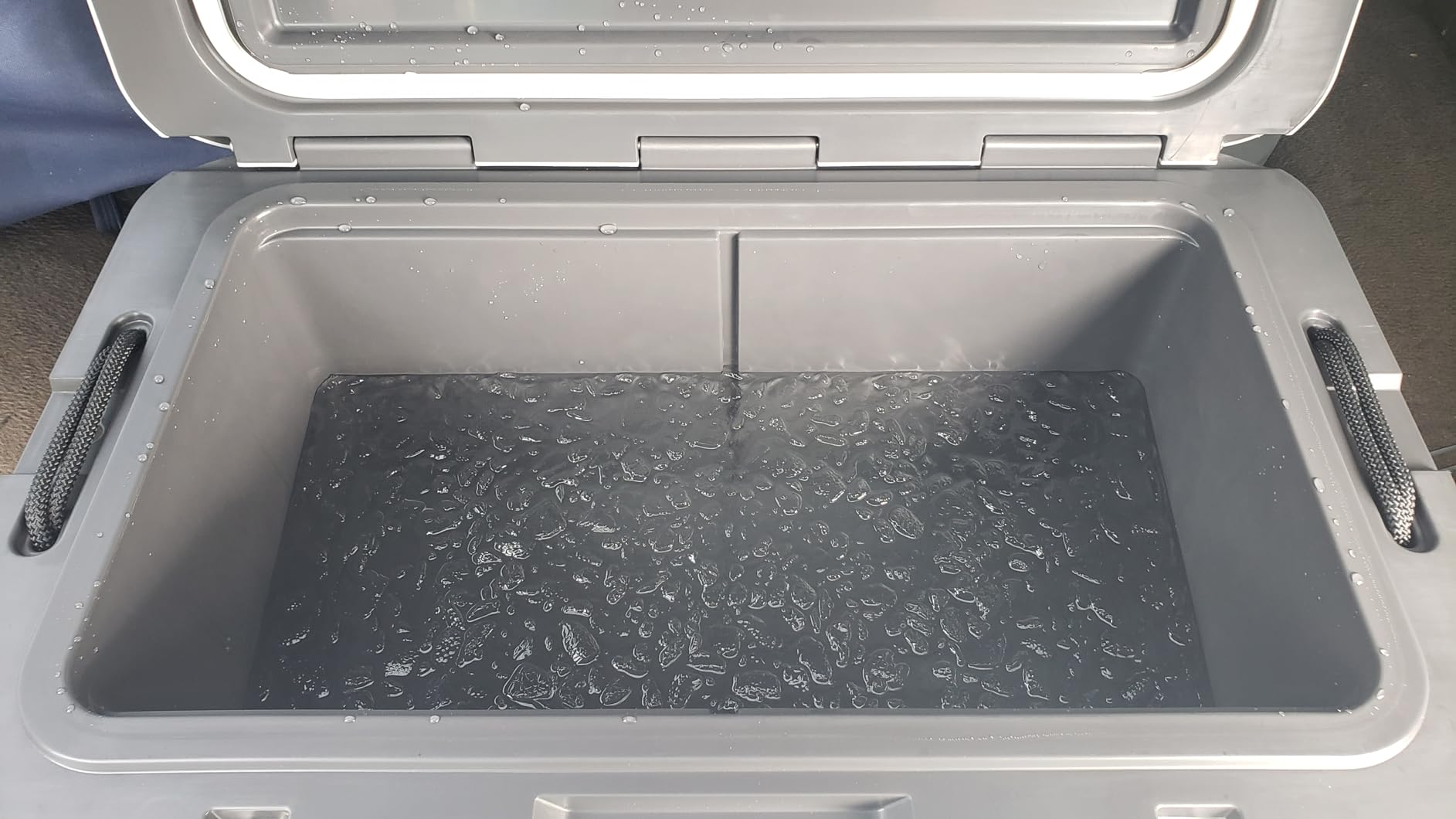
Insulation is two inches of advanced ultra-light closed-cell foam, and the published claim is ice held up to seven days. That figure is at the optimistic end of what a two-inch wall delivers in 90-degree deck heat, but the wall itself is real and the gasket is a proper seal.
The features are aimed squarely at a working boat. A removable wire basket and a cooler divider keep food out of meltwater and keep food separate from drinks, and a patent-pending level floor with precision tapered drainage channels empties evenly rather than pooling in one corner.
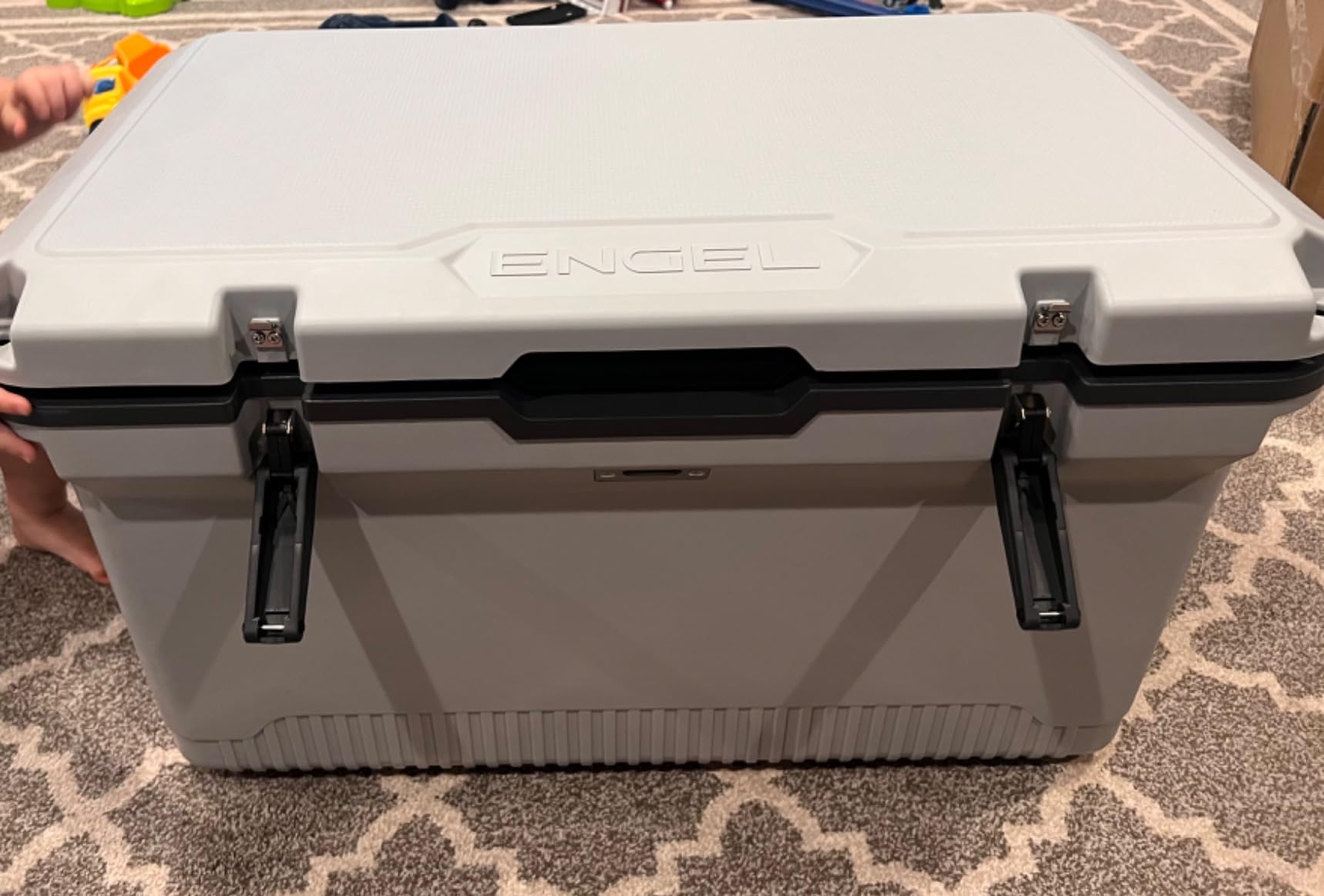
Tie-down slots are molded in specifically for securing the cooler to a boat or a paddleboard, which is the clearest signal in this roundup that the manufacturer thought about a moving deck first. A drain plug and a built-in bottle opener complete the layout, with integrated rope handles and molded hand-holds for carrying.
External dimensions are 18 by 29.5 by 17 inches, so it is long and fairly low, which helps it sit under a leaning post. The warranty is a limited five years.
When the ENGEL is the right cooler
It is the right cooler when you load solo, when you fish from a smaller boat where deck weight matters, or when you want a large cavity without a two-person carry. Sixty quarts with a divider is enough for a real multi-day catch and a day’s food at the same time.
The tie-down slots make it the pick here for anyone whose boat has no cooler well and who intends to strap the cooler down rather than wedge it into a corner. That is a small feature that prevents the most common deck-accident problem.
Where the ENGEL falls short
The injection-molded polypropylene shell is less impact resistant than a rotomolded body. Drop it on a corner from casting-platform height and the material is more likely to crack than to dent, so it rewards careful stowing.
There are no wheels and no telescoping handle, and the rope handles are not as comfortable as molded grips under a genuinely heavy load. The five-year warranty is also shorter than the lifetime coverage on the Pelican.
9. Igloo Maxcold Glide Pro 110Qt: Best for a Full Crew on One Trip
Igloo Glide 110 Qt Roller Cooler, White
110 quart capacity
25.4 lb empty
168 can capacity
THERMECOOL insulation
Pros
- 168-can capacity with soft-ride wheels
- Telescoping handle and stainless steel hinges
- UV inhibitors and infrared technology
- DuraLatch impact-resistant closures
Cons
- THERMECOOL holds less ice than multi-inch rotomolded walls
- Wide rectangular footprint eats deck space
- Drain plug must be tracked manually
The Glide Pro is the most proven cooler in this roundup by review count, and it is built for a specific pattern: one large cooler carrying food, drinks and fish for a whole crew on a multi-day trip. One hundred ten quarts, 168 cans, and a telescoping handle with soft-ride wheels so one person can move the whole thing.
At 25.4 pounds empty it is also light for that capacity. A lot of the weight advantage over the 165-quart options in this price class comes from the THERMECOL insulation, which is a thinner, lighter foam than the pressure-injected polyurethane used in the premium rotomolded units.
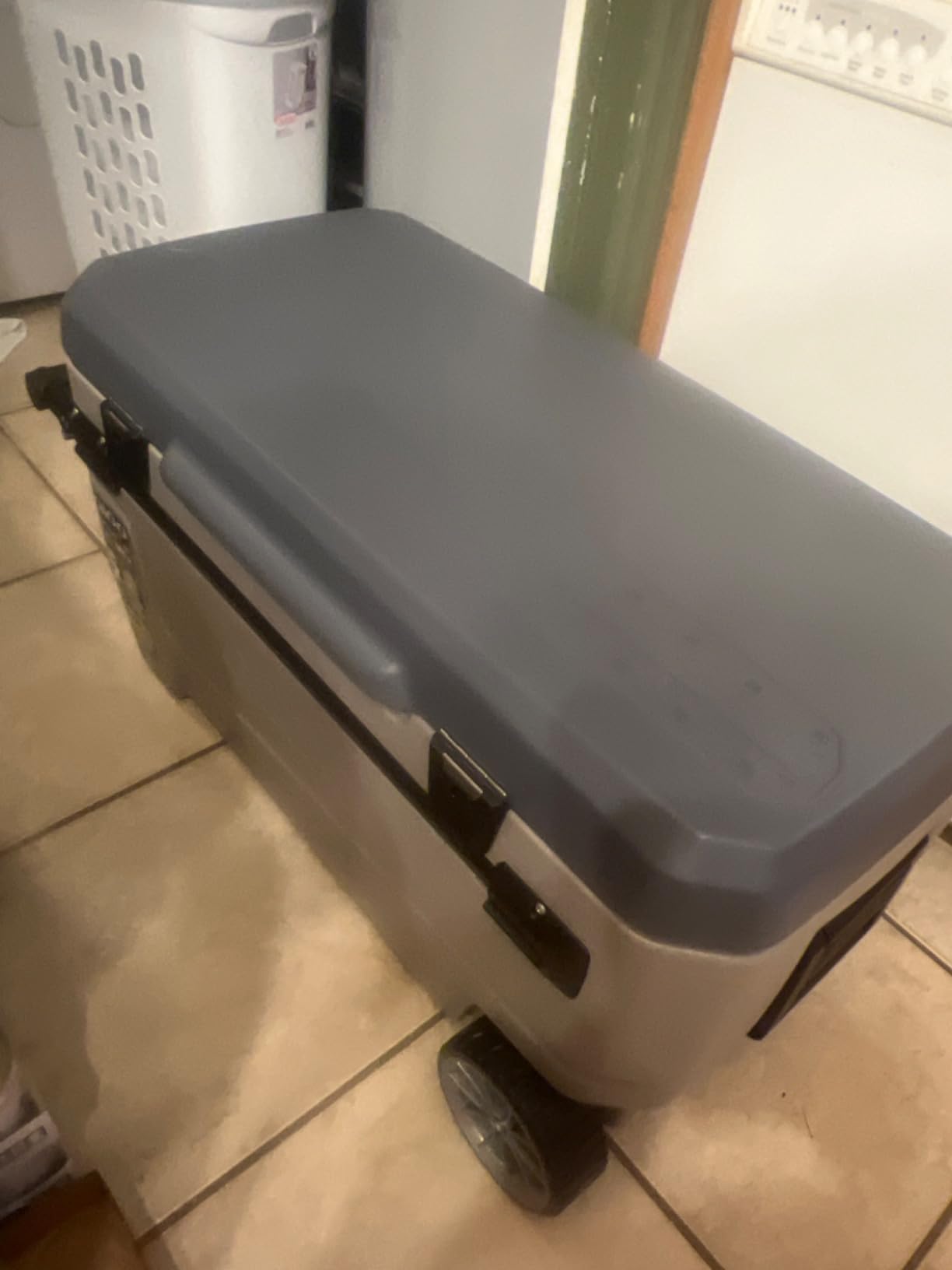
Salt and sun get addressed directly. UV inhibitors combined with infrared technology slow sun damage, and the DuraLatch lid closures and stainless steel hinges are the hardware pieces that normally corrode first. Reviewers with more than three thousand ratings consistently point to the hardware holding up.
There is a ruler on the lid for measuring a catch, which is a small touch that matters when the boat is crowded and nobody wants to dig out a ruler. A drain plug is included.
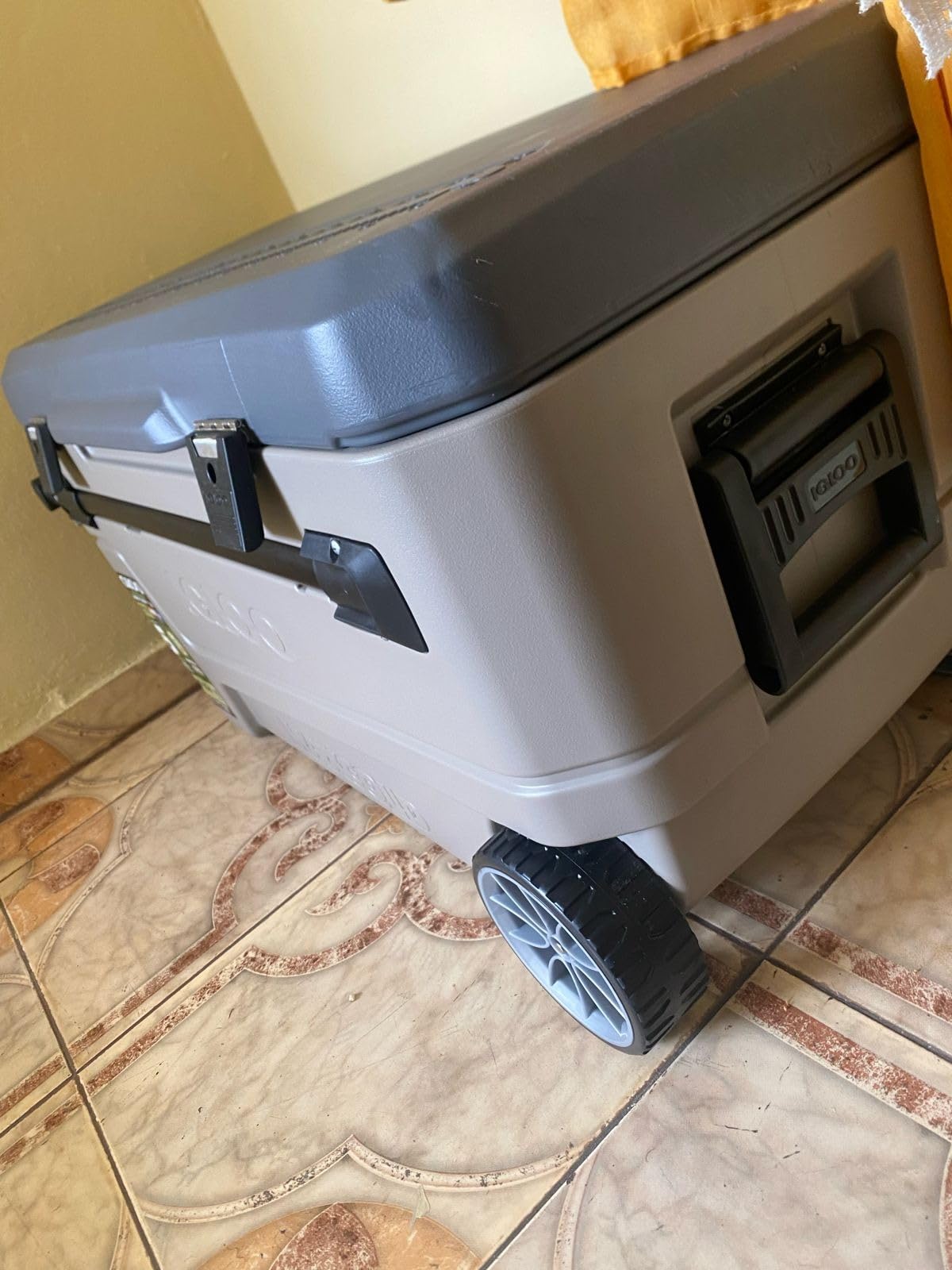
External dimensions are 37.5 by 19 by 20.6 inches. That wide rectangular footprint is the trade you make for the capacity, and on a smaller center console it is a real space commitment compared with a long-and-low box of similar volume.
When the Glide Pro makes sense
It makes sense when one cooler has to do everything for a group, when you want a single large unit instead of two smaller ones, and when you want wheels and a telescoping handle as standard rather than as an added cost. For a multi-day trip with three or four people, the volume-per-pound is hard to argue with.
It is also the sensible choice for a boat that lives in the sun. The UV inhibitor package is one of the more complete ones in this roundup, and for a cooler sitting on an exposed deck all season that is not a trivial specification.
Where the Glide Pro falls short
The honest limitation is ice retention. THERMECOL insulation holds ice well, but it does not match the multi-inch rotomolded walls of the YETI, RTIC or Pelican models, and on a hot three-day trip in full sun that difference becomes noticeable in the afternoon.
The footprint is wide, so it is harder to secure than a long-and-low cooler in a small cockpit, and the drain plug is not tethered, which means you have to keep track of it yourself. If your priority is maximum ice life rather than maximum volume, a thinner-walled premium unit is a better trade.
10. COHO 165QT: Maximum Capacity With a Hatch and a Hose Drain
COHO 165QT Insulated Hard Cooler with Fish Ruler, Removable Cup Holders, Magnetic Disc & Tie-Down Loops, Ice Chest for Camping, Boating & Outdoor Use, Keeps Ice Up to 7 Days
165 quart capacity
Holds up to 90 cans
Threaded drain
Quick-access hatch
Pros
- Quick-access hatch avoids opening the full lid
- Threaded drain holes accept a garden hose
- Integrated magnetic disc for fishing gear
- Removable cup holders and tie-down loops
Cons
- Listed 4.9 lb weight is not credible for the size
- 43.4 inch footprint needs dedicated space
- No wheels and two people required to move it
The COHO 165 is the volume answer in this roundup, and it has the two features nobody else in the group offers. The quick-access hatch lets you reach into the top of the cooler without lifting the full lid, which means you can grab a drink or a snack without dumping the temperature of everything underneath.
The other one is the drain. Threaded drain holes are arranged to create a vortex for fast drainage, and the port accepts a garden hose, so you can empty a full cooler of meltwater and fish residue into the scupper instead of carrying it.
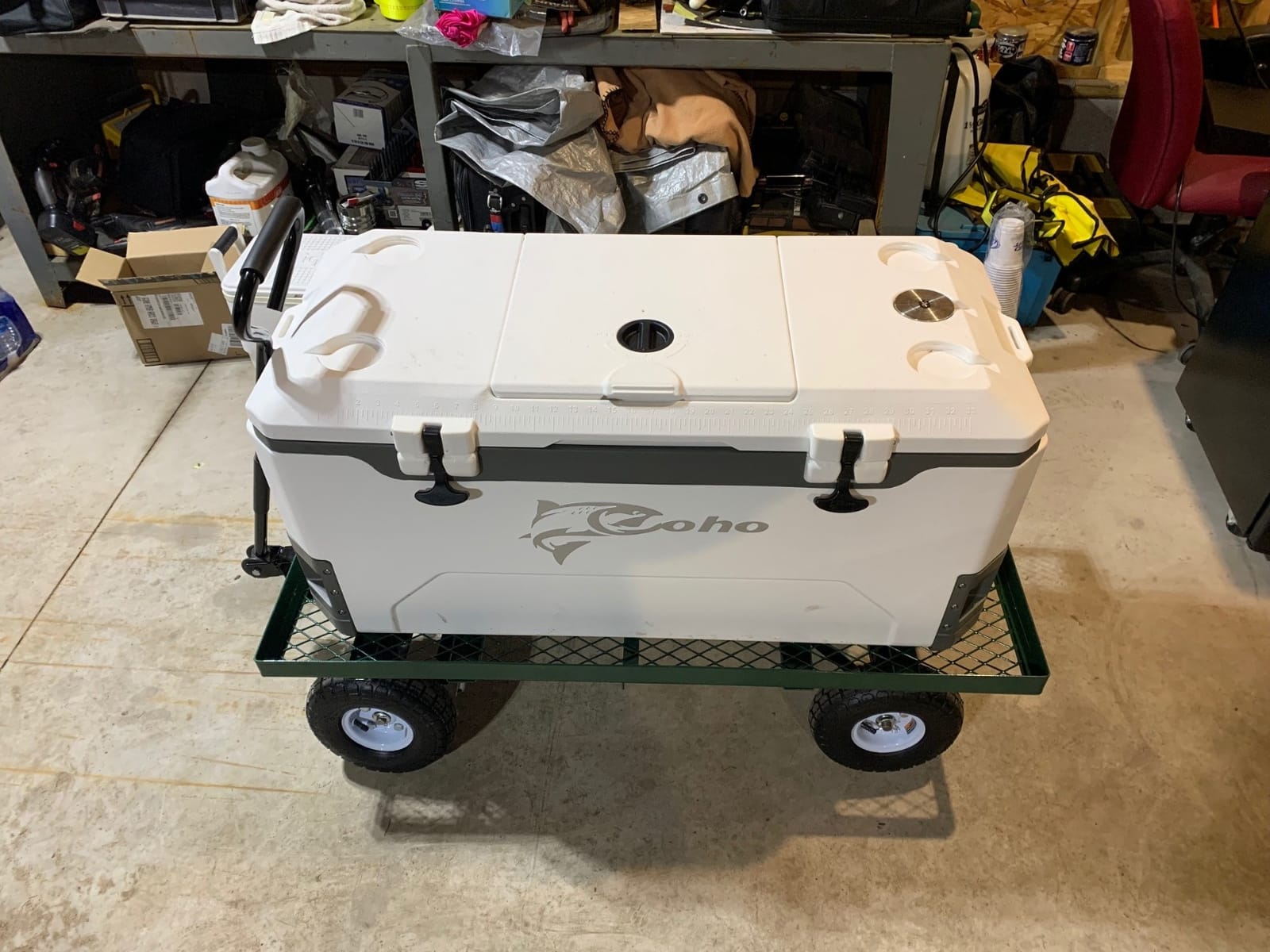
On a big catch that matters. A 165-quart cooler with a 90-can interior is a lot of mass to lift and tip, and the hose drain is the answer to the mess that creates. The shell is high-density polyethylene and is described as fully UV-proof, with thick insulated walls.
There is an integrated magnetic disc on the lid for fishing gear, removable cup holders, heavy-duty rubber T-latches, anti-skid feet and tie-down loops. The rubber T-latches are a simpler latch design than the locking hardware on the Pelican or the T-Rex latches on the YETI, and that is worth weighing in a wake.
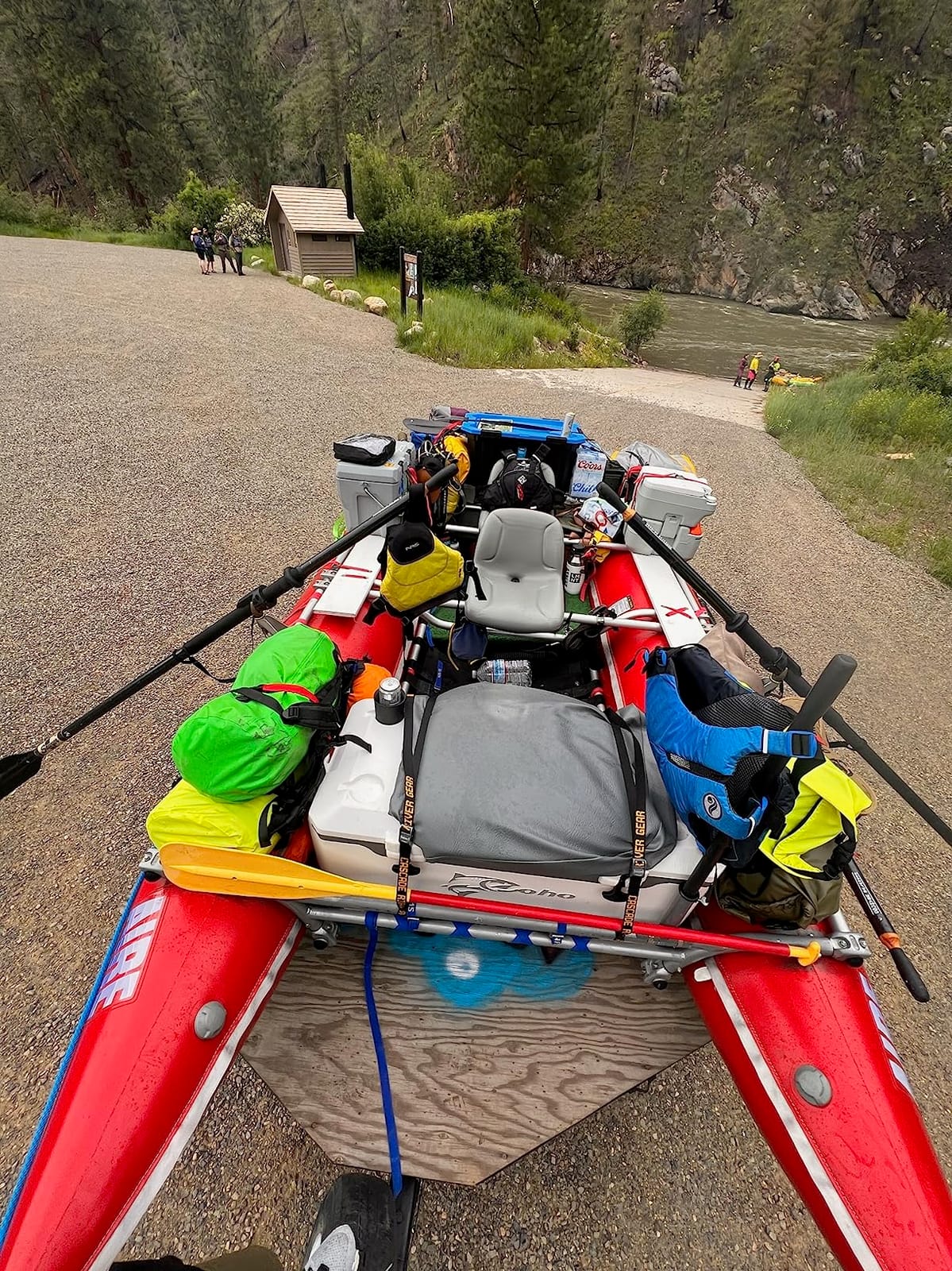
External dimensions are 43.4 by 20.28 by 20.15 inches, with internal dimensions of 39.9 by 16.46 by 16.27 inches. That is the largest footprint in this roundup, and it needs a dedicated deck position or a bed. A listed lifetime warranty is included, along with a recommended 2:1 ice-to-contents ratio.
When the COHO 165 is the right call
It is the right call for a big-game trip, a liveaboard or a tournament scenario where volume is the constraint rather than portability. The hatch and the hose drain are both built for a scenario where you are loading and unloading a very large amount of fish and ice repeatedly.
It is also the one to consider if you have a dedicated hard position for a cooler already, because at this footprint you cannot store it anywhere and expect it to stay there.
Where the COHO 165 falls short
The listed empty weight of 4.9 pounds is not credible for an insulated 165-quart cooler, and reviewers flag it. Plan for a genuinely two-person lift and treat the published figure as unreliable rather than as a selling point.
It also carries the lowest average rating in this group at 4.4, with a higher share of one-star reviews than the rest of this list. The rubber T-latches are the simplest hardware here, there are no wheels, and at 43.4 inches long it is the hardest model here to secure in a boat cockpit of any size.
How to Choose a Marine Cooler for Offshore Fishing
The difference between a cooler and a marine cooler is not the color and it is not the word printed on the side. It is four specific things: UV inhibitors or a UV-resistant coating in the shell, corrosion-resistant hardware, non-slip feet, and integrated tie-down points. A cooler that has all four is built for a wet, moving deck. A cooler that has none of them is a picnic cooler, and on a boat it becomes a loose object in a cockpit.
Beyond that, the decision comes down to four variables: how long you are away from ice, how many people you are feeding, whether you load it solo, and whether the thing physically fits. Everything else is preference. If you are also specing out the electronics for the same trip, our picks for the best marine GPS units for boats cover the navigation side of a full day offshore.
Ice retention: the claim versus what happens on a 90F deck
Every cooler in this roundup claims between three and seven days, and none of those numbers are measured the same way. They assume a pre-chilled cooler, a proper ice load, and ambient temperatures well below a summer deck. Read the foam thickness instead, because that is the honest predictor: two inches of foam behaves like a distinctly different cooler from three.
You can extend whatever you get. Pre-chill the cooler overnight with a bag of ice inside it, pack at a 2:1 ice-to-contents ratio, put block ice on the bottom and cube ice on top, drain the meltwater as it accumulates, and resist opening the lid. Water conducts heat far faster than air, so a cooler that is never drained performs materially worse than the same cooler drained twice a day.
For a salt-ice technique for holding fish colder, freeze a block with the brine solution mixed into it rather than using loose salt. That gives you a colder, slower-melting block that sits at the bottom of the cooler under the fish.
Rotomolded versus injection-molded shells
Rotomolding rotates a plastic shell inside a heated mold while foam is injected against it, which produces a single thick wall with no seams. The result is the toughest material in this roundup, and it dents rather than cracks when you drop a cooler on a casting platform. The YETI, RTIC 65 and COHO use it.
Injection molding makes a thinner, lighter shell from polypropylene. It is what the ENGEL and the Igloo use, and it buys real weight savings. The trade is impact resistance: an injection-molded cooler can crack at a corner if you drop it hard, so it rewards careful stowing rather than tossing.
Size and capacity by trip length and boat class
Match the cooler to the trip, not to the trip you hope to take. A day trip to nearshore reefs needs a drink-and-catch cooler in the 20 to 45 quart range. An overnight canyon run or a two-day trip for two people needs 45 to 65 quarts. A multi-day charter for a full crew wants 90 to 110 quarts, and a big-game or liveaboard trip is where 165 quarts earns its place.
Then check the footprint before you check anything else. Measure the length, width and height of the console cooler well or the intended deck position, then measure the cooler’s external dimensions. A 43-inch cooler does not fit a cockpit, and a 31.58-inch cooler fits under a leaning post where a 37.5-inch one does not. This is the single most common reason a cooler gets returned.
Keeping a cooler from sliding on a wet deck
Strap it down. Non-slip feet help, but a wet fiberglass deck with a light plastic cooler on it is a surface that will move, and a loaded cooler sliding at speed across a cockpit is a genuine injury risk, not a minor annoyance. Use molded-in tie-down slots or under-lid tie-down points with a ratchet strap to a deck cleat.
If your chosen cooler has no tie-down points, that is a reason to choose a different one. The alternatives are a non-slip mat under the cooler and a second anchor strap, but a purpose-built anchor point is always better than an improvised one.
Saltwater corrosion and hardware quality
Stainless steel hinges, stainless steel hardware and a UV-resistant shell or UV inhibitors are the three things that decide whether a marine cooler is still tight after three seasons. The hardware is what actually fails first: latch springs, hinge screws and drain plug threads. A zinc-plated screw in salt water will start staining within months, and once it seizes, the latch stops pulling tight and the gasket seal is lost.
Long-term owner reports consistently single out stainless hardware and a lifetime warranty as the reliability signal, and warranty length is a reasonable proxy for how a manufacturer expects the product to age in a salt environment. A one-year term tells you something the marketing copy does not.
Drain plug and post-trip cleaning
A drain is not a convenience, it is a performance feature. Meltwater sitting in the bottom of a cooler conducts heat from outside into the contents continuously, and a full cooler of dirty meltwater is also how fish end up sitting in warm water and losing quality within hours of the catch.
After every trip, empty it, rinse it with fresh water, and dry it before you close the lid. A threaded drain that accepts a hose makes this a ten-second job. Care instructions on the units here are consistently hand wash, so avoid a pressure washer around the gasket line and the latch hardware, where a high-pressure jet can push salt into the mechanism.
A Saltwater Maintenance Calendar That Prevents Rust
Salt damage is cumulative and slow, which is why it catches people by surprise in season three. A ten-minute routine on a fixed schedule prevents nearly all of it, and it is the single highest-value thing in this article that costs nothing.
After every trip: drain the meltwater, rinse the interior and the exterior with fresh water, and wipe the gasket line and the latch hardware dry. Do not close a wet cooler with salt in the seams, because that is exactly where corrosion starts.
Monthly in season: work a little silicone spray or gasket conditioner into the freezer-style gasket all the way around the lid. A dried gasket is a gasket that leaks, and a leaking gasket is an ice-retention problem before it is anything else.
At the start of the season: check every screw, latch and hinge for movement, and treat any zinc-plated hardware with corrosion inhibitor before it goes back on. If a screw is already stained, replace it with stainless rather than cleaning it and putting it back.
After heavy spray or a beaching: rinse with fresh water the same day, then apply corrosion inhibitor to the hardware. A sandbar day or a grounding in a shallow with the tide out is not a rinse you can postpone until the weekend.
Out of season: dry the cooler completely with the lid cracked, and store it off the deck rather than in a hot, damp trailer where the temperature swings will work the gasket and the hardware. Heat and trapped moisture together are worse than salt alone.
Frequently Asked Questions
What is the best cooler for offshore fishing?
The YETI Tundra Haul is our top pick for offshore fishing because rotomolded construction, pressure-injected PermaFrost foam in the walls and lid, and NeverFlat wheels solve the three failures that ruin trips: cracking shells, dead ice, and a loaded cooler nobody can move alone. If you already have a cart, the YETI Tundra 45 gives you up to 3 inches of foam in a proven 45-quart package.
Which cooler keeps the cold the longest?
Foam depth predicts ice life better than any published claim. The YETI Tundra 45 carries up to 3 inches of PermaFrost insulation, the RTIC 45 QT has 2.8 inches of closed-cell foam, and the Pelican 70 pairs 2 inches of polyurethane with a 360-degree freezer-grade gasket. Actual results also depend on pre-chilling, a 2:1 ice ratio, draining meltwater, and shade.
What is the best cooler for a day on the boat?
For a day trip, a 45-quart hard cooler is the right capacity, and the RTIC 45 QT or the YETI Tundra 45 both fit that slot. The RTIC 45 lists 21.1 pounds empty, which is light enough to load solo, and both carry deep closed-cell or PermaFrost foam. A small cooler also fits a console cooler well instead of eating cockpit space.
What is the difference between a cooler and a marine cooler?
A marine cooler is built for a wet, moving deck. Look for four things: UV inhibitors or a UV-resistant coating, corrosion-resistant stainless hardware, non-slip rubber feet, and integrated tie-down points for strapping it down. A standard cooler often has soft or no feet, plated hardware that seizes in salt, no tie-down slots, and a shell that fades and cracks in prolonged sun.
What coolers are just as good as a flagship cooler but cheaper?
The RTIC 65 QT is the clearest answer, with a rotomolded polyethylene shell, up to 2.4 inches of closed-cell foam, a freezer-style gasket and an 84-can capacity at a far lower cost. The RTIC 45 QT goes deeper on foam at 2.8 inches, and the Coleman 316 delivers 100 quarts with stainless hardware and a 250-pound seat-rated lid if the cooler is mostly for bait.
How long can fish stay fresh in a cooler?
Ice is doing more than cooling here, and a proper ratio matters. A 2:1 ice-to-fish ratio keeps fish at a temperature low enough to slow spoilage well beyond a single day, and drain meltwater so fish are not sitting in warm liquid. Gut and bleed as soon as possible after the catch. A fish ruler molded into the lid, as on the Pelican Elite and Igloo Glide Pro, speeds up measuring so nothing sits unprocessed.
How do I stop a cooler from sliding on a boat deck?
Strap it down with a ratchet strap to a deck cleat. Choose a cooler with molded-in tie-down slots or under-lid tie-down points, such as the Pelican 70, the ENGEL 60 or the COHO 165. Non-slip rubber feet help but are not sufficient on a wet fiberglass deck. Secure the cooler before it is loaded, and mark it so other crews know not to sit on it.
How big of a cooler do I need for offshore fishing?
Match capacity to trip length: 20 to 45 quarts for a day trip, 45 to 65 quarts for an overnight canyon run, 90 to 110 quarts for a multi-day charter with a full crew, and 165 quarts for big-game or liveaboard work. Then measure the cooler well or deck space first, because a 43-inch cooler does not fit a cockpit no matter how much ice you want in it.
Final Verdict: Which Marine Cooler Fits Your Trip
Start with the load, not the brand. If you launch solo or walk a distance from your vehicle, the YETI Tundra Haul is the pick because the wheels and handle turn a two-person lift into a one-person job, and it keeps the rotomolded shell and PermaFrost foam the Tundra line is known for. If the cooler is already in a truck bed and a cart handles the ramp, the YETI Tundra 45 gives you the deepest foam in this group at a smaller size.
For a two-day trip for one or two anglers, the RTIC 45 QT or the RTIC 65 QT are the value answers, with 2.8 and 2.4 inches of closed-cell foam respectively and rotomolded shells. The 45 fits a console well and lists 21.1 pounds empty; the 65 holds 84 cans for a genuinely full load. If your cooler is mostly bait and drinks on a smaller boat, the Coleman 316 gives you 100 quarts at 17.7 pounds with stainless hardware and a seat-rated lid.
For a full crew over multiple days, the Igloo Glide Pro 110 with its 168-can cavity, telescoping handle and soft-ride wheels carries more provisions per pound, while the Pelican 70 Elite is the durability answer thanks to a lifetime warranty, a tethered stainless drain plug and anti-shear hinges. Charter crews who need sheer volume will look at the COHO 165 for its quick-access hatch and garden-hose drain, after checking that 43.4-inch footprint will actually fit.
Whatever you pick, the routine matters as much as the cooler. Pre-chill it, pack at two parts ice to one part contents, strap it to a deck cleat, drain it before you leave the beach, and rinse it with fresh water the same day. That is what keeps hardware from seizing and a three-day trip tasting like day one. If you are still weighing options, our guides to the best coolers for fishing trips and the best marine batteries for trolling motors cover the rest of the power-and-cold picture for a full day offshore.