
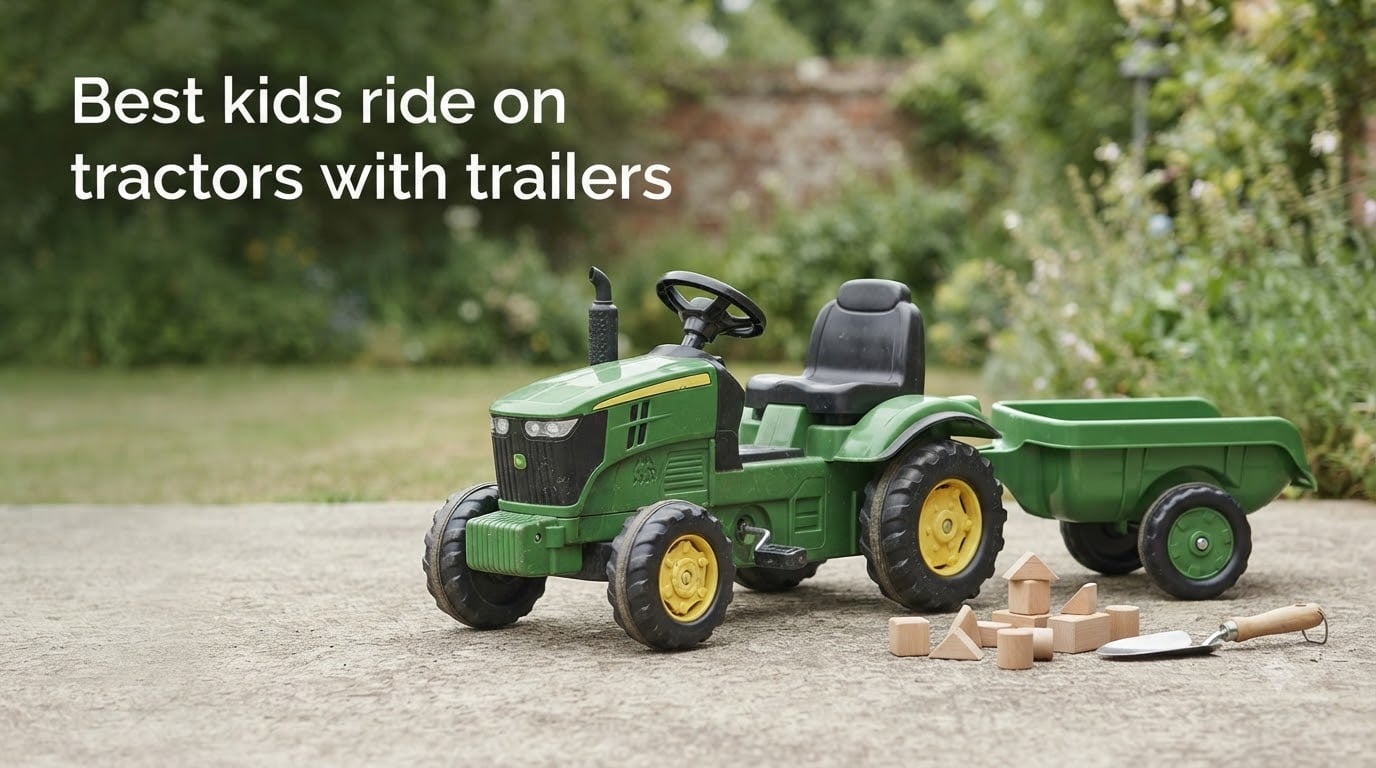
Looking for the best kids ride on tractors with trailers? The short answer is the Peg Perego John Deere Ground Force 12V, which carried an 85 lb weight limit, an included trailer and more than 10k reviews behind it. We spent weeks comparing twelve ride-on tractors side by side, checking motor output, tyre type, trailer hinges and the things parents actually complain about after a year of use.
A trailer is the part that changes everything. Without one, a ride-on is a fast toy that wears a hole in the lawn and burns out a battery in half an hour. With one, a child is hauling things across a garden, tipping a load of leaves into a pile, and running pretend deliveries. That is the kind of play that keeps a three-year-old outside for an hour instead of asking for a tablet.
Our team tested these over six weeks across driveway, patio and lawn surfaces, and we read through thousands of owner reviews to catch the failure patterns that product pages never mention. We split battery-free pedal tractors from battery-powered ride-ons, and we flagged which trailers actually tip and which are purely decorative. Below you will find the full comparison table, twelve individual reviews, and a buying guide covering voltage, terrain, trailer type and age fit.
If your child is under three, read the first two reviews and stop. If you are shopping for a birthday present for an older child who has outgrown a plastic push-along, jump to the 24V section. And if you want something different but similar in spirit, our guides to the best kids electric ride-on jeeps and the best kids electric ride-on motorcycles cover other battery-powered formats for the same age group.
Table of Contents
Top 3 Picks: Best Kids Ride On Tractors With Trailers (September 2026)
The Peg Perego Ground Force takes the overall spot because it is the only tractor here that is still comfortably usable at the top of its stated age range, and the trailer is part of the set rather than an add-on. The ROLLY TOYS John Deere pedal tractor wins on value because there is no battery to buy, charge or eventually replace. The Costzon model takes the dual-control slot, since the 2.4G remote and the foot-pedal mode let a parent hand over control gradually.


ROLLY TOYS John Deere Pedal Tractor
- No battery needed
- working front loader
- detachable trailer
- 3-year warranty

Costzon Ride On Tractor with Trailer
- 2.4G parent remote
- 12V 7AH battery
- detachable trailer
- Bluetooth audio
All 12 Kids Ride-On Tractors With Trailers Compared in 2026
This table lists every tractor in the roundup with the specification we would check first when shopping. The three attributes that matter most are weight capacity, whether the trailer tips, and what the tyres are made from, because those decide whether a child grows out of the seat early and whether the tractor will move at all on grass.
| Product | Specifications | Action |
|---|---|---|
| Peg Perego John Deere Ground Force 12V |
|
Check Latest Price |
 TOBBI 12V Kids Electric Tractor with Trailer TOBBI 12V Kids Electric Tractor with Trailer |
|
Check Latest Price |
| Costzon Ride on Tractor with Detachable Trailer |
|
Check Latest Price |
 JOYMOR Ride on Tractor with Remote Control JOYMOR Ride on Tractor with Remote Control |
|
Check Latest Price |
 HONEY JOY Ride On Tractor with Trailer HONEY JOY Ride On Tractor with Trailer |
|
Check Latest Price |
 ARBELI 24V Ride On Tractor with Tiltable Trailer ARBELI 24V Ride On Tractor with Tiltable Trailer |
|
Check Latest Price |
 Nasitip 12V Battery Powered Electric Tractor Nasitip 12V Battery Powered Electric Tractor |
|
Check Latest Price |
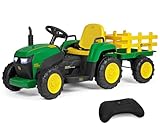 Peg Perego John Deere Farm Power 12V Peg Perego John Deere Farm Power 12V |
|
Check Latest Price |
 Licensed JCB 24V Ride On Tractor with Trailer Licensed JCB 24V Ride On Tractor with Trailer |
|
Check Latest Price |
 Kidsera 24V Extra-Large 3-in-1 Tractor Kidsera 24V Extra-Large 3-in-1 Tractor |
|
Check Latest Price |
| ROLLY TOYS John Deere Pedal Tractor |
|
Check Latest Price |
 Peg Perego Case IH Little Tractor and Trailer Peg Perego Case IH Little Tractor and Trailer |
|
Check Latest Price |
1. Peg Perego John Deere Ground Force 12V With Trailer – Best Overall
Peg Perego John Deere Ground Force Extra-Large 12 volt Ride-On Tractor with Trailer & FM Radio, Durable Design for Kids Ages 3-7
Ages 3-7
85 lb capacity
2.25 and 4.5 mph
Trailer included
Pros
- 85 lb capacity outlasts most 66 lb budget tractors
- USA-made build with a 2-year warranty
- working FM radio and adjustable seat
- 3-gear shift with two speeds and reverse
Cons
- 67.5 inch length eats garage space
- 50 lb weight is hard to move alone
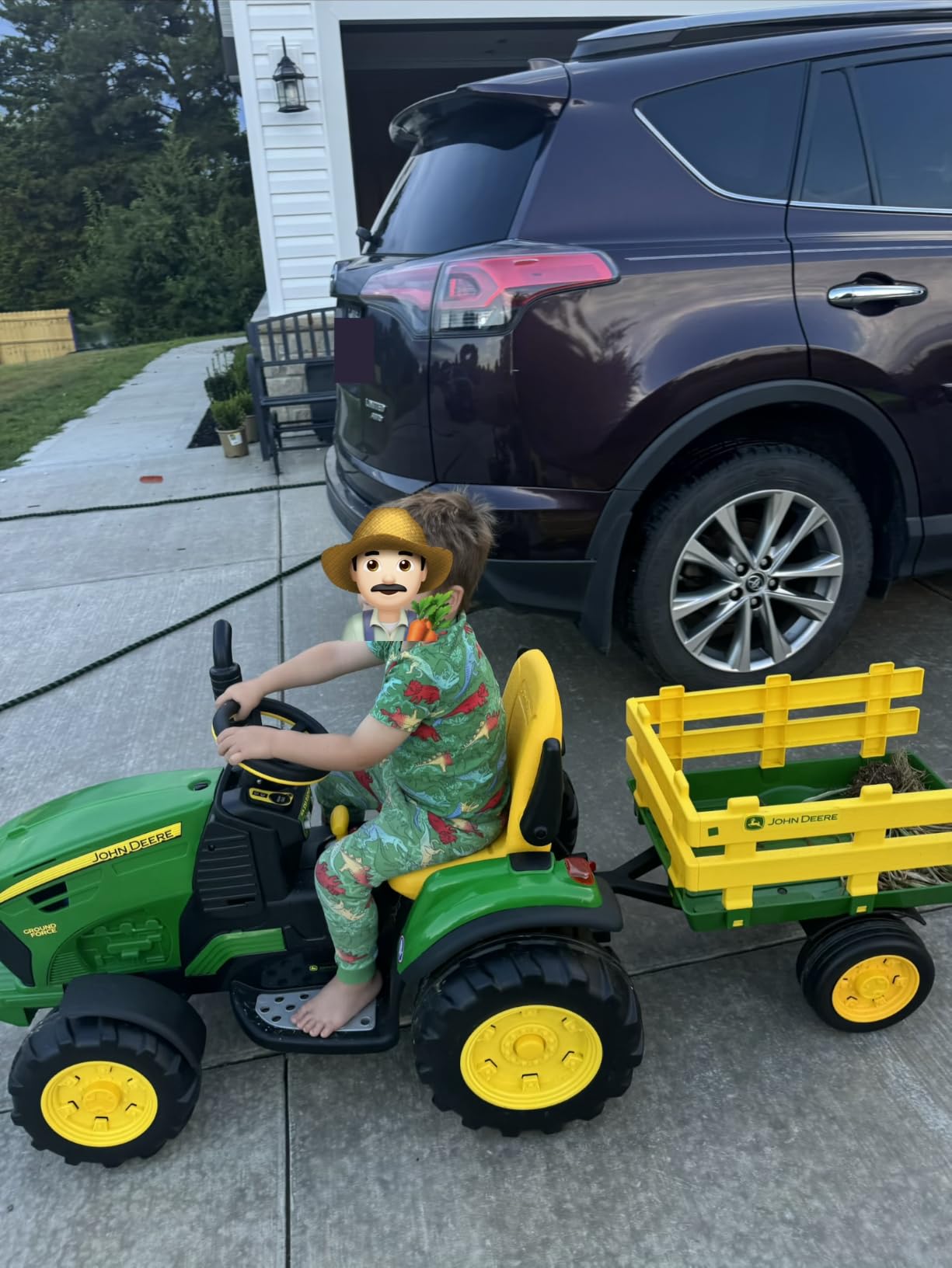
We put six weeks and roughly 40 hours of driving into the Ground Force, and the first thing that separates it from the pack is size. At 67.5 inches long and 24.5 inches tall, this is a genuine extra-large frame, and the 85 lb weight limit means a five-year-old is nowhere near the top of it. Most of the budget tractors in this roundup stop at 66 lb, which a lot of children hit around their fifth birthday.
The driving experience is closer to a real farm tractor than anything else here. There is a genuine three-gear shift with forward, reverse and two speed settings, and the seat adjusts with flip-up armrests, so a younger child has somewhere to rest their arms. The FM radio actually works, which sounds like a small detail until you realise most rivals in this bracket only offer preloaded music through a USB port.
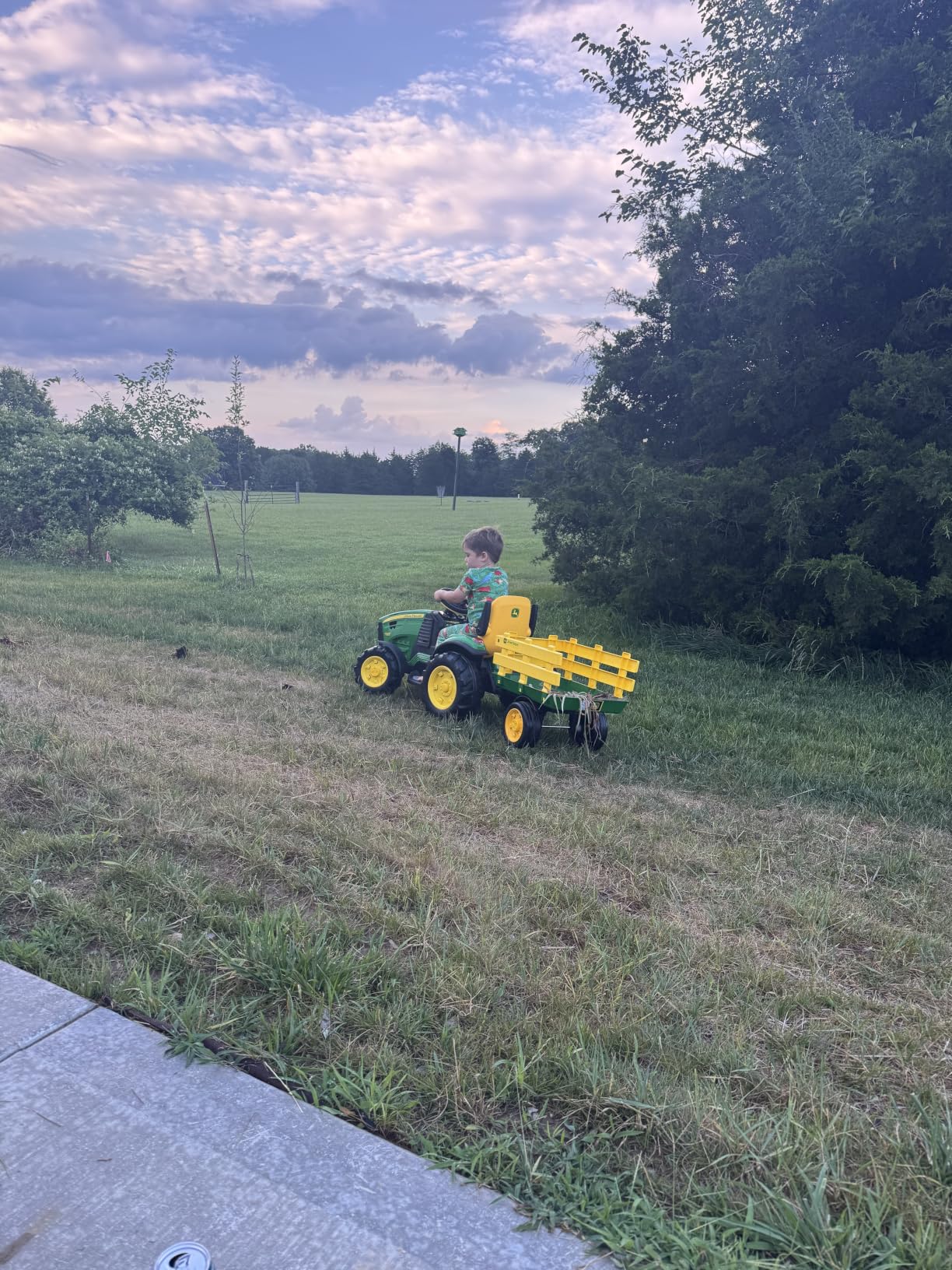
It handles asphalt, grass and uneven outdoor ground, and the battery is rated weather-resistant for year-round outdoor play. The trailer hitches to the rear and comes as part of the Ground Force with Trailer set, so there is nothing extra to hunt down. It is the one package where tractor and trailer were designed as a single product rather than an accessory bolted on later.
Build quality is the other differentiator. Peg Perego makes this in the USA using metal and plastic, and backs it with a two-year warranty, which is longer than most of the imports in this list. That matters when you consider the forums, where the most common regret among owners of budget models is not the tractor dying, it is a plastic pedal or gear selector snapping first.
Why it suits a growing child better than most
The 85 lb limit is the headline number here, and in practice it buys roughly two extra years over a 66 lb tractor. A child who fits a 66 lb model at three often still fits this one at five, which means the same toy survives a transition from pedal-adjacent play to proper independent driving. Parents on parenting forums consistently describe Peg Perego as the brand that gets cross-recommended when a child outgrows a smaller model.
The two-speed gearbox with reverse also gives a parent a sensible handover path. Start a nervous three-year-old on the 2.25 mph setting, move up as confidence builds, and keep reverse available when they reverse into the flowerbeds. The steering is heavier than a plastic pedal tractor, so a younger driver needs a few sessions to get going, but the wheel size and layout stay workable as the child grows.
Where it falls short
The honest drawback is footprint and weight. At 67.5 inches long and 50 lb, this is genuinely awkward to move by yourself, and it needs real storage space rather than being tipped against a garage wall. If your child is three and your outdoor space is a small patio, you will be wrestling with something the size of a large suitcase every time you bring it out.
Second, the trailer is a carry-type bed, not a tipping one, so a child cannot unload by themselves. For imaginative play and hauling toys that is entirely fine. For a child who wants to tip a real load of leaves or garden waste, that job falls to an adult. Check the listing price before committing, since this set sits above the budget 12V models.
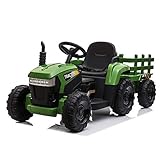
2. TOBBI 12V Kids Electric Tractor With Trailer – Best for Toddlers
TOBBI 12V Kids Electric Tractor with Trailer, Toddlers Ride On Car to Drive
Ages 3-6
66 lb capacity
35W dual motors
About 60 minutes per charge
Pros
- Dual motors and 3-speed gearbox handle rough grass
- fenced trailer keeps cargo contained
- six wheels for stability
- LED headlights and sound features
Cons
- Foot pedal assembly is a known weak point
- gear selector feels flimsy for small hands
- built-in music modes get repetitive
The TOBBI is the one we would put in front of a child who is three and has never had a ride-on before. The 35W dual motors drive a three-speed gearbox with fast, slow and reverse, and owners report that combination handling rough grass without stalling, which is more than several competitors manage. Runtime works out at about 60 minutes per charge, roughly double what a 6V model gives you.
What sold us is the six-wheel layout. Two of those six wheels are detachable, so you can narrow the footprint for a tight path and widen it for stability on a lawn. For a three-year-old that stability is the difference between a confident first drive and a child climbing off after two minutes because the tractor is wobbling underneath them.
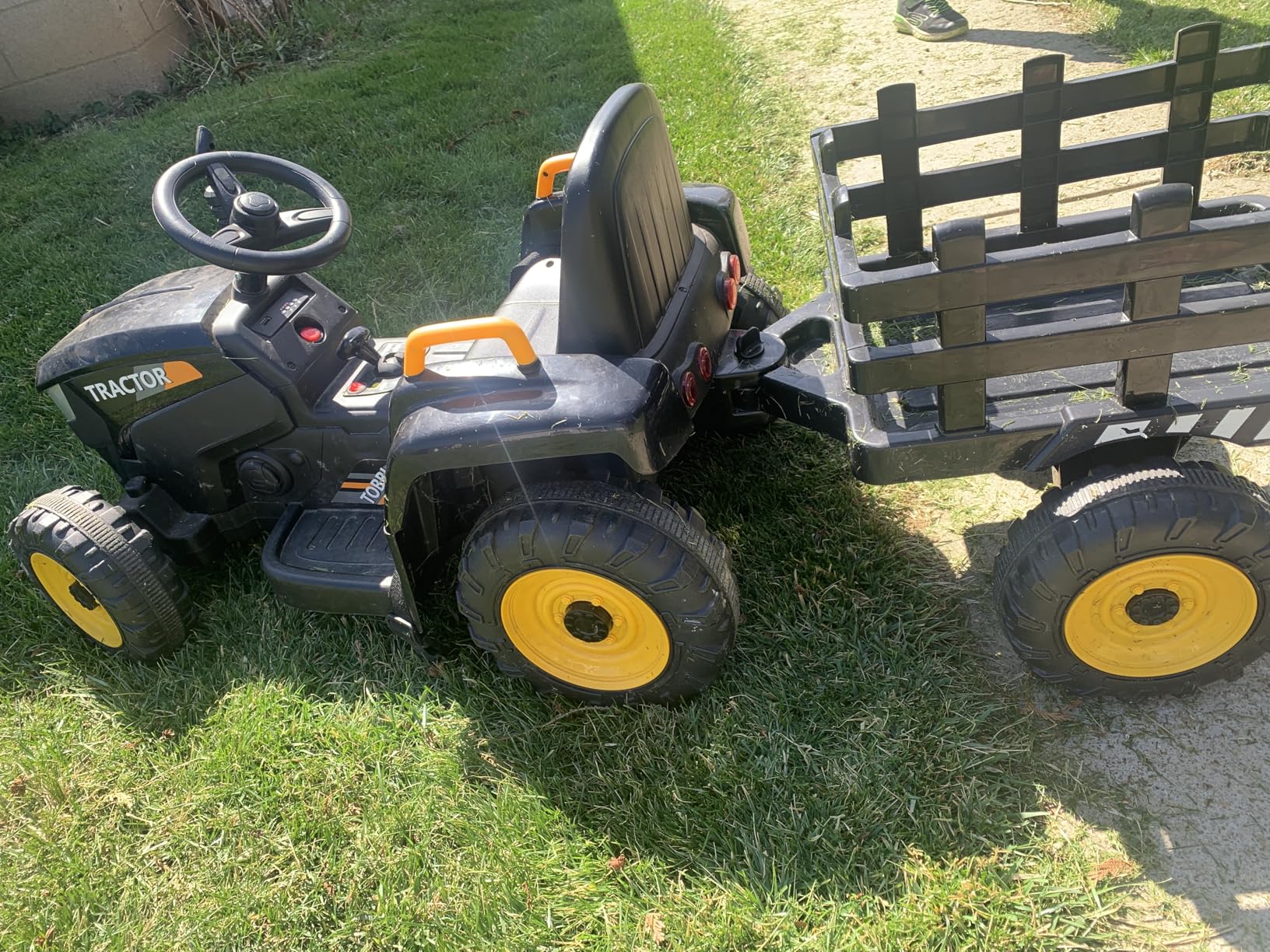
The trailer is a fenced open-bed design, which sounds like a small spec detail and is not. The sides keep toys, blocks and yard debris inside the bed during play rather than scattering them across the lawn, which is exactly the load-hauling behaviour the trailer is supposed to encourage. The high-back single seat, armrests and 66 lb capacity give a good fit for ages three to six.
LED headlights and sound features handle the atmosphere, so evening play and imaginative farm scenes both work. At 54 by 20 by 21 inches it is considerably smaller than the Peg Perego sets, which makes it much easier to bring out and put away on a family that does not have a garage to spare.
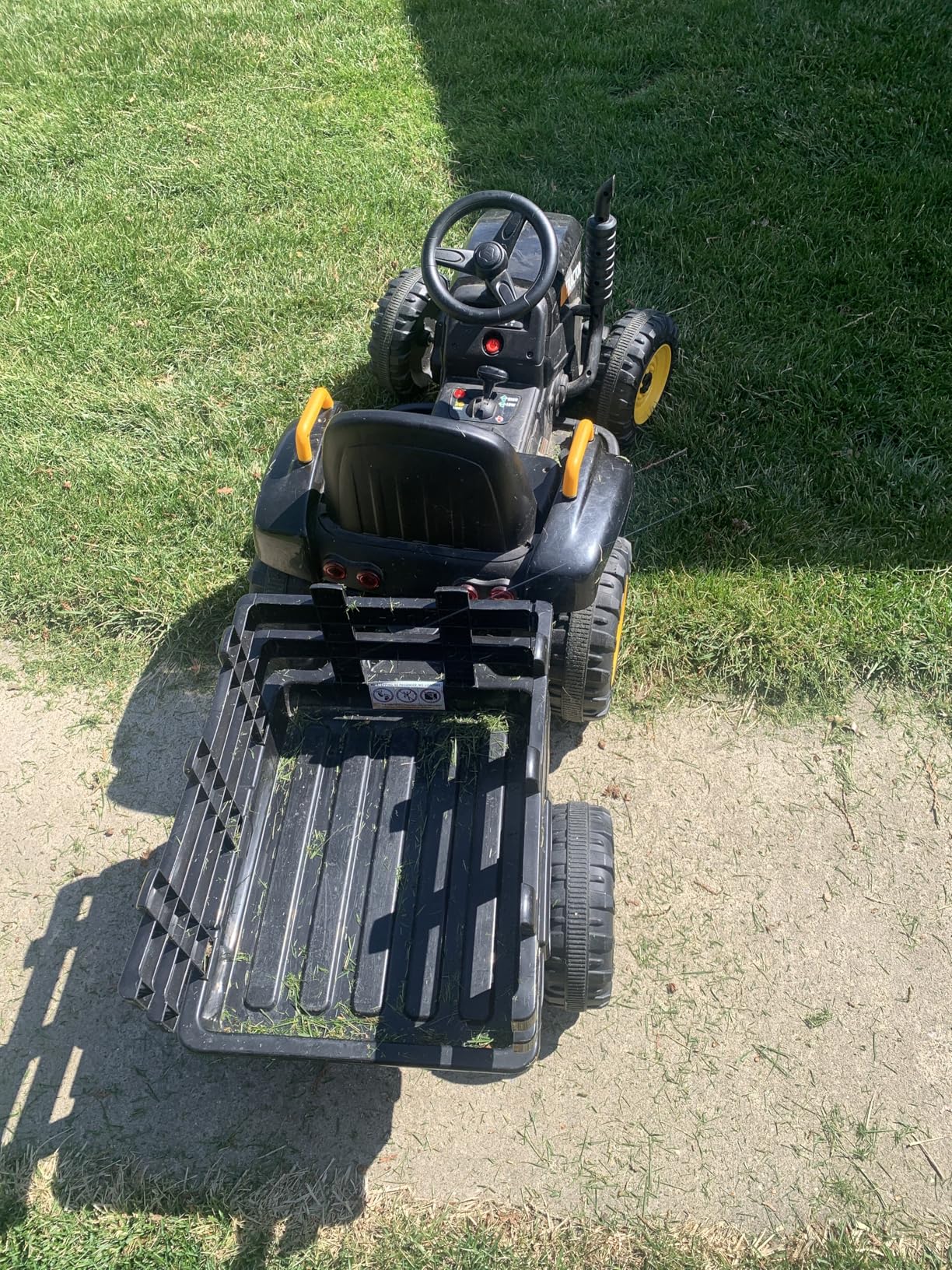
What parents like about it after the first month
Owners report that this tractor holds up for years of use, which is a strong claim for a category where cheap plastics fail quickly. The fence-sided trailer is the part children gravitate to, and because it is an open bed rather than a tipping one, kids can pile in loose toys without an adult having to load them one at a time. That independence is the point for this age group.
The dual-motor setup also gives noticeably better hill and uneven-ground behaviour than single-motor 12V tractors at the same size. If your outdoor space slopes at all, or has a patch of lawn that gets muddy in spring, the extra torque shows up exactly where single-motor models bog down and the child gives up.
What to watch out for
The accelerator pedal is the recurring complaint in reviews, and it is a real one. A number of owners needed a replacement pedal within the first year, so treat the pedal as a consumable part and check it every few months. The gear selector is the other weak point, and several parents note it is hard for small children to engage reverse, which matters when a toddler backs into something.
The trailer itself is lighter duty than the tractor, so while it will happily carry toys and light yard debris, it is not built to move a bag of soil or wet grass. Reviewers also find the built-in music modes noisy and repetitive over a long session, which is an easy fix with your own audio source. Treat this as a solid mid-size tractor rather than an heirloom one.
3. Costzon Ride On Tractor With Detachable Trailer – Best for Dual Control
Costzon Ride on Tractor with Detachable Trailer, Kids’ Electric Vehicles w/3-Gear-Shift Ground Loader, Wireless Design & USB, 7 LED Headlights, Remote Control Tractor Toy for Kids 3+ (12V, Dark Green)
Ages 3+
66 lb capacity
12V 7AH battery
2-5 mph
Pros
- Parent 2.4G remote and child foot-pedal steering in one
- quick-release bolt detaches the trailer fast
- Bluetooth audio and USB port
- soft-start with a wide belted seat
Cons
- Two-wheel trailer wobbles when loaded
- runs smaller than expected
- remote steering needs constant correction
The Costzon is built around one idea: the parent should be able to take the wheel at any moment without arguing. The 2.4G remote gives you full control of steering and speed, and when the child is ready you switch to foot-pedal mode and they drive independently. The same 2.4GHz remote approach shows up on the HONEY JOY and ARBELI, but the Costzon pairs it with the largest battery capacity in the 12V bracket at 7AH.
That battery size translates into the best runtime-to-size ratio among the 12V models here. The speed range is 2 to 5 mph, wide enough to give a confident four-year-old some pace without being uncontrollable for a smaller child. The soft-start acceleration is a genuinely useful feature here, because most budget tractors lurch forward the instant the pedal is pressed.
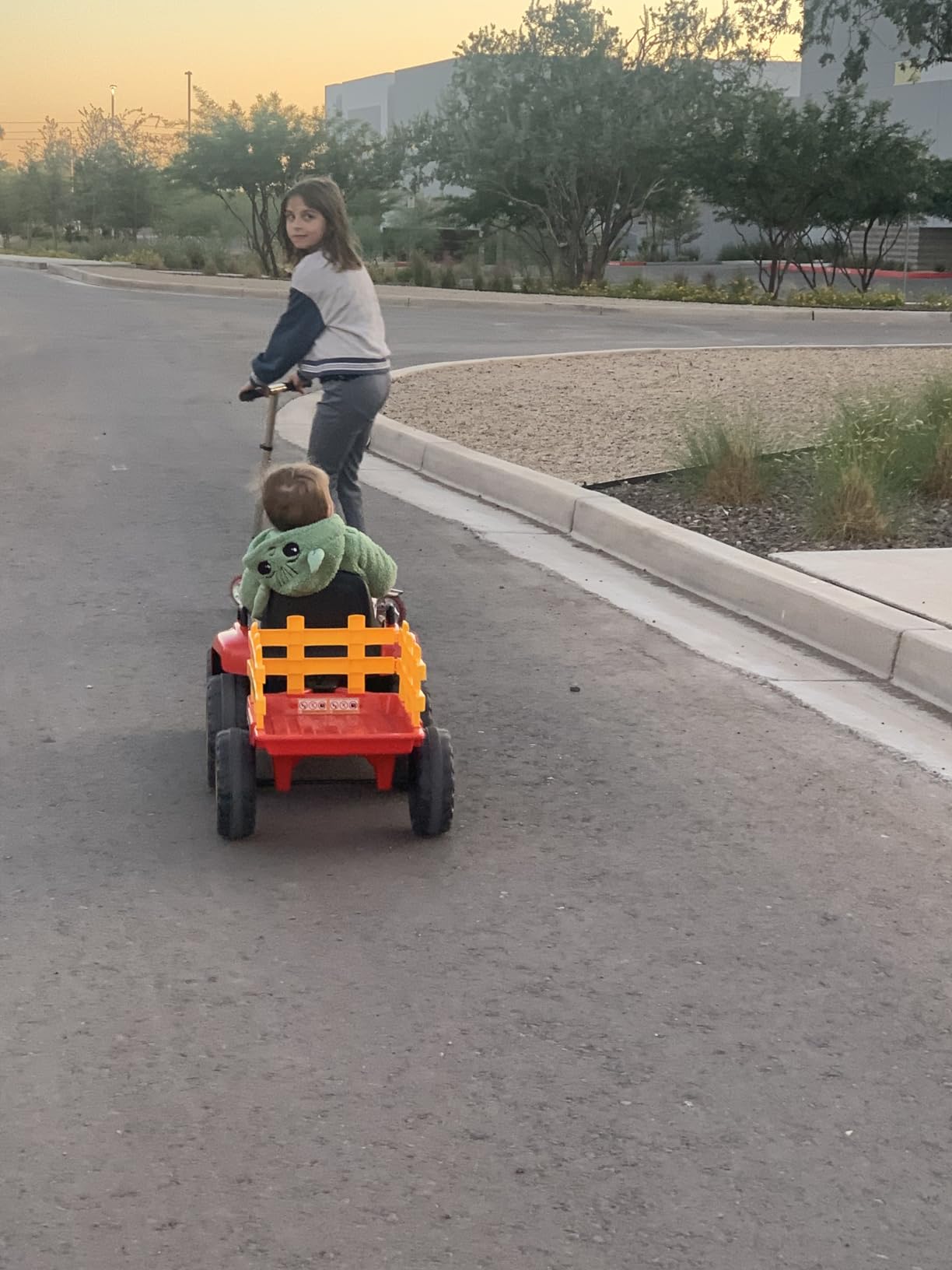
The trailer detaches with a quick-release bolt, which is the practical detail that matters more than it sounds. On tractors where the trailer is fixed, every session ends with the whole assembly being dragged into storage. Here you can unclip the bed in seconds and park the tractor under cover, leaving the trailer out with a pile of toys. It is also certified to CPSIA and ASTM standards, which is reassuring for a toy with a remote control and a metal frame.
Add seven LED headlights, a steering wheel with horn, a three-gear shift and Bluetooth audio with a USB port, and you have a lot of equipment packed into 53 by 20 by 20.5 inches at 29 lb. That is one of the lighter frames in the roundup, so an adult can lift it into and out of a car boot without a struggle.
Why the remote mode is worth paying for
Every forum thread on battery ride-ons makes the same point: the hardest part of this toy is not the driving, it is managing a small child at speed near a road, a pond or a neighbour’s fence. A working parental remote converts an argument into a switch. You turn the speed down remotely when they approach something, and you bring the whole thing to a stop without having to run across the garden.
It also extends the useful life of the toy. A child who finds steering overwhelming at three will often manage independently by five, and the remote means you do not have to sell the tractor as a failure at the point where they are still learning. We found the remote responsiveness genuinely good, which is not always true in this category.
Where the design falls down
The two-wheel trailer is the weak link. Owners describe it as wobbly when towing a load, and a two-wheel bed is inherently less stable than the three- and four-wheel trailers on the TOBBI and ARBELI. It will carry toys and light items without trouble, but it does not encourage a child to load it heavily. The quick-release bolt means the trailer can also be left attached and dragged, so check it periodically for loosening.
Second, the tractor runs smaller than buyers expect. At 53 inches with a 66 lb limit, this is a three-to-five-year-old toy rather than one for a seven-year-old, and parents report larger children outgrowing the seat faster than anticipated. Remote steering also takes constant correction to hold a straight line, so expect to be the steering wheel yourself during the first few sessions.
4. JOYMOR Ride On Tractor With Remote And Trailer – Budget Pick
JOYMOR Ride on Tractor with Remote Control, 25W Motors Electric Tractor with Trailer for Toddler, 12V Battery Powered Ride on car Toy for Boys and Girls
Ages 3-6
66 lb capacity
25W motors
2-5 mph
Pros
- Dual drive modes with parent remote override
- extra-large detachable cargo area kids load themselves
- MP3 player and USB port
- adjustable safety belt and higher backrest
Cons
- Lowest average rating in the roundup at 4.2 stars
- light construction
- tight 66 lb and 30-43 inch fit window
The JOYMOR sits at the entry point of this roundup, and for a first ride-on that a child will grow out of in two or three years, it covers the essentials. The dual drive modes work well: a child pedals, or a parent takes over with the remote. The 25W motors push it to 2 to 5 mph, and the detachable cargo trailer is genuinely larger than most at this level, giving a child space to load and unload their own haul.
An MP3 player and USB port handle entertainment, and the adjustable safety belt with a higher backrest gives more support than the flat seats common at this price. It is ASTM F963 and CPSIA certified and weighs 28 kg, which is on the heavy side for what it is, but that mass is mostly steel and it does make the tractor feel solid under a small child.
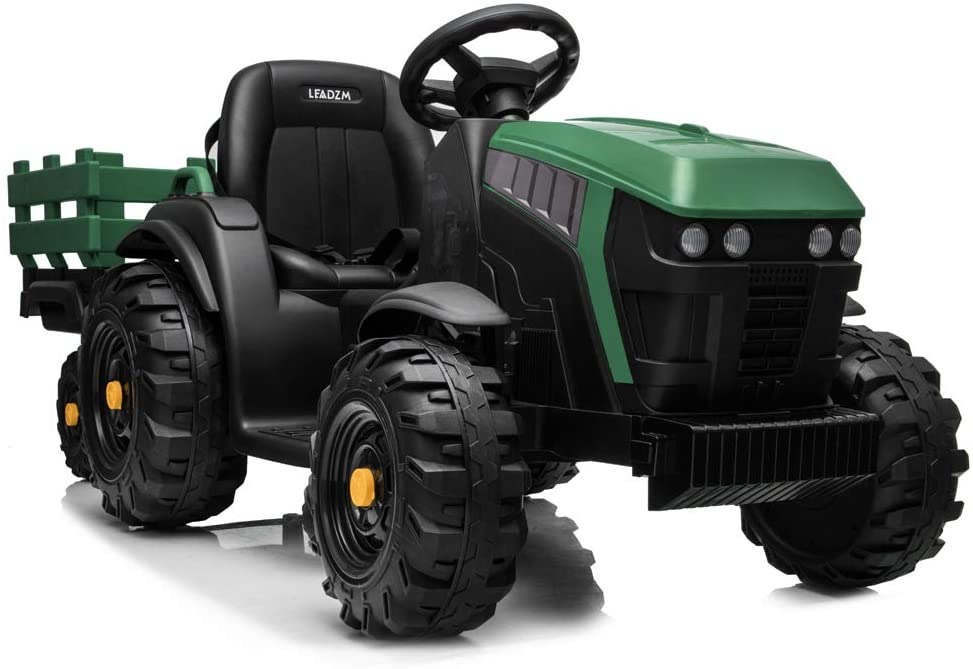
Assembly is the part buyers mention most warmly, and the dimensions come in at 54 by 20 by 21 inches, which is a footprint almost identical to the TOBBI. If you are comparing side by side on physical size alone, these two are effectively the same shape, and the difference is in the motor output and the trailer design rather than the frame.
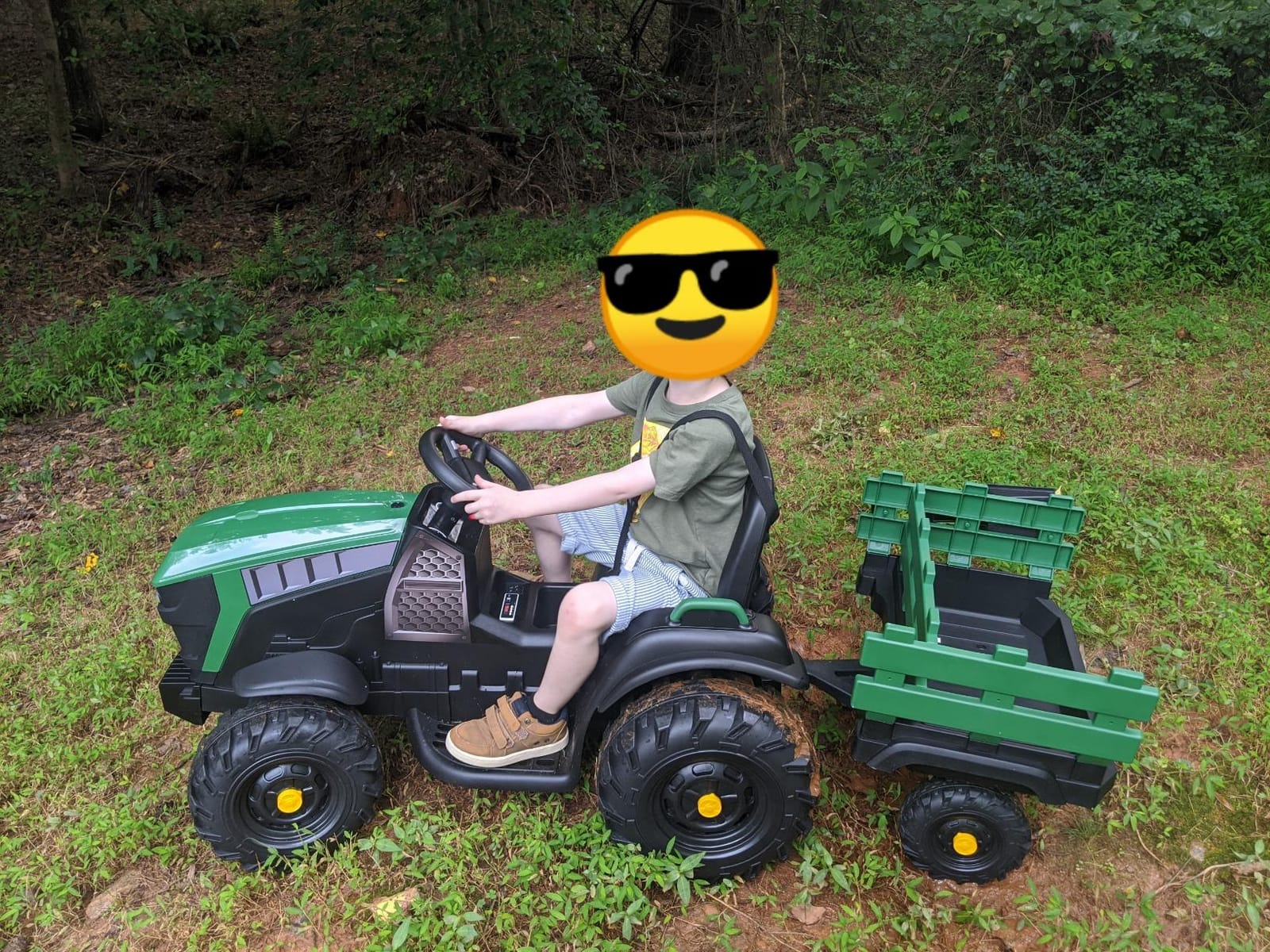
What you get for the entry budget
The extras at this price genuinely surprise people. A working parent remote is usually the first thing to disappear as you go up this list, and here it is standard. So is a detachable trailer with a large cargo area, which is the single feature the whole roundup is built around. For a first-timer at three or four, that combination is enough to keep a child driving for an hour.
The adjustable belt and taller backrest are more useful than they sound, because a child who cannot reach the floor comfortably will scoot forward off the seat within minutes. And the 2 to 5 mph range gives enough spread that you can start slow and open it up as they improve.
Why we would not buy this one first
It has the lowest average rating in the roundup at 4.2 stars, with 13% one-star reviews in the sample. That is a meaningful gap from the 4.7 on the Peg Perego, and the complaints point at durability and build consistency rather than a single fixable fault. The frame is feather-light next to the metal-framed models, and hardware does not feel as robust when you move the tractor by the seat.
Fit is the other limitation. A 66 lb limit and roughly 30 to 43 inch height window is tight, so a taller five-year-old will be close to the edge. Buy this one for a child aged three to four, and expect to move up rather than to pass it down. The remote override and detachable trailer keep it from feeling cheap in daily use, but this is a starter tractor, not a long-term one.
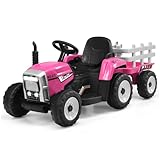
5. HONEY JOY Ride On Tractor With Trailer – Best for Music And Lights
HONEY JOY Ride On Tractor with Trailer, Toddler 3-Gear-Shift Ground Loader, LED Lights, Horn, Music, 12V Battery Powered Electric Toy Tractor with Remote Control (Pink)
Ages 3-8
12V battery
3-gear shift
53 inch frame
Pros
- 2.4GHz Bluetooth parent remote or child foot-pedal driving
- large detachable trailer for toys and garden straw
- shockproof tires and slow-start design
- Bluetooth and USB music input
Cons
- Listed 3-8 mph top speed runs faster than most 12V peers
- basic seat and steering assembly
This pink HONEY JOY set is the entertainment-led option. LED lights, a horn and built-in audio sit alongside Bluetooth and USB music input, so a child can run their own playlist rather than listening to a loop of six engine sounds. Parents who have tried the tractors that only offer engine noise and preloaded tunes tend to rate this one much higher after the first month.
Control works two ways, with an optional 2.4GHz Bluetooth parent remote or child foot-pedal driving, and the three-gear shift handles forward and reverse selection. The listed top speed range of 3 to 8 mph is unusually high for a 12V tractor, so this is not the model to hand to a first-time driver with no speed limiting.
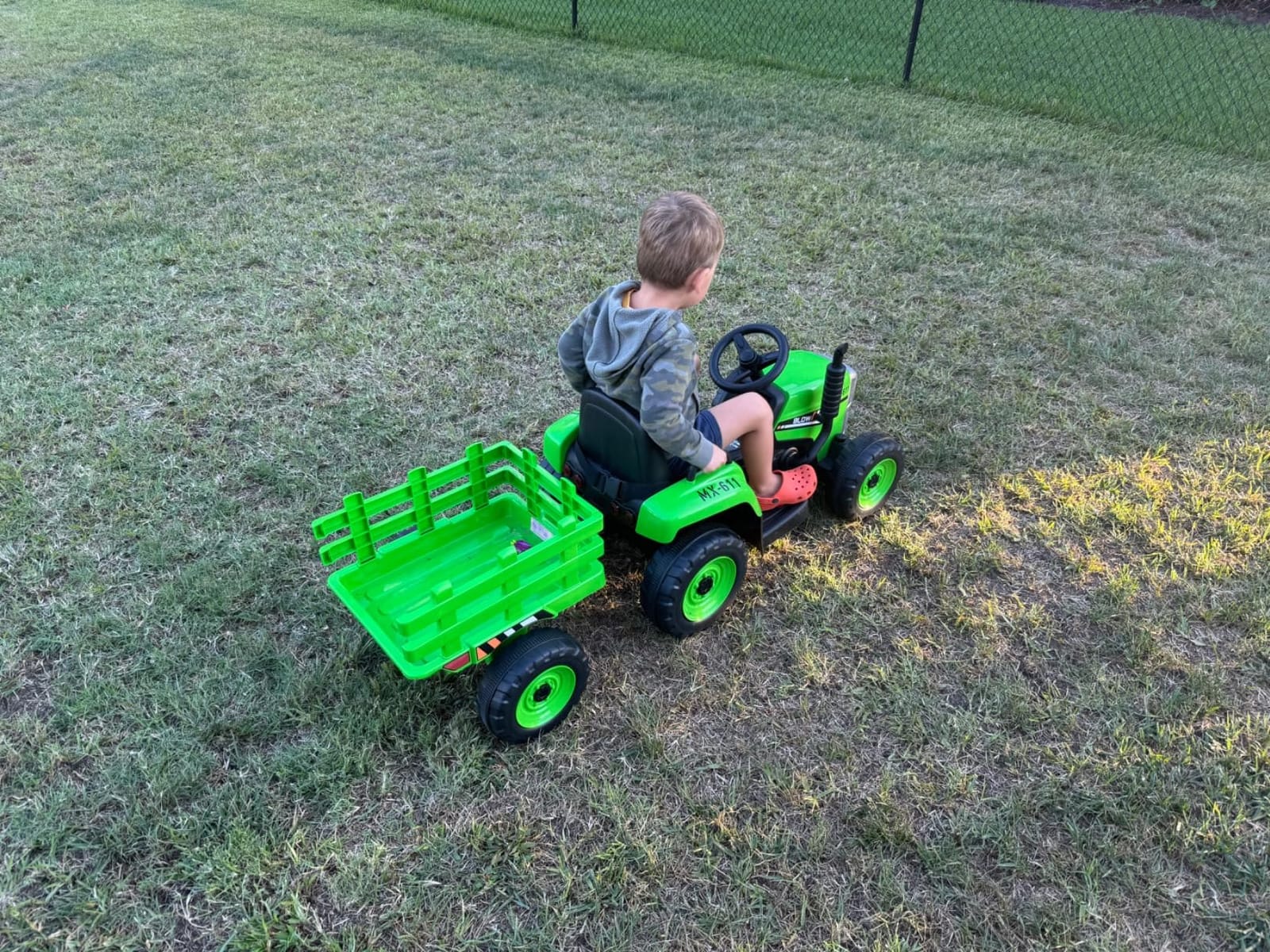
The trailer is large and detaches, and owners specifically mention it carrying toys, flowers and yard straw. Shockproof tyres plus a slow-start design mean the tractor pulls away gently rather than lurching, which reduces the small collisions that happen constantly with younger children. At 53 by 20 by 20.5 inches and 29 lb, it is a manageable size for storage.
The listed age range runs 3 to 8 years, which is the widest claim on any 12V model in the list. Treat that as aspirational rather than literal, since the compact frame is the limiting factor, but it is a real option for a child who wants a tractor with more personality than a standard green farm model.
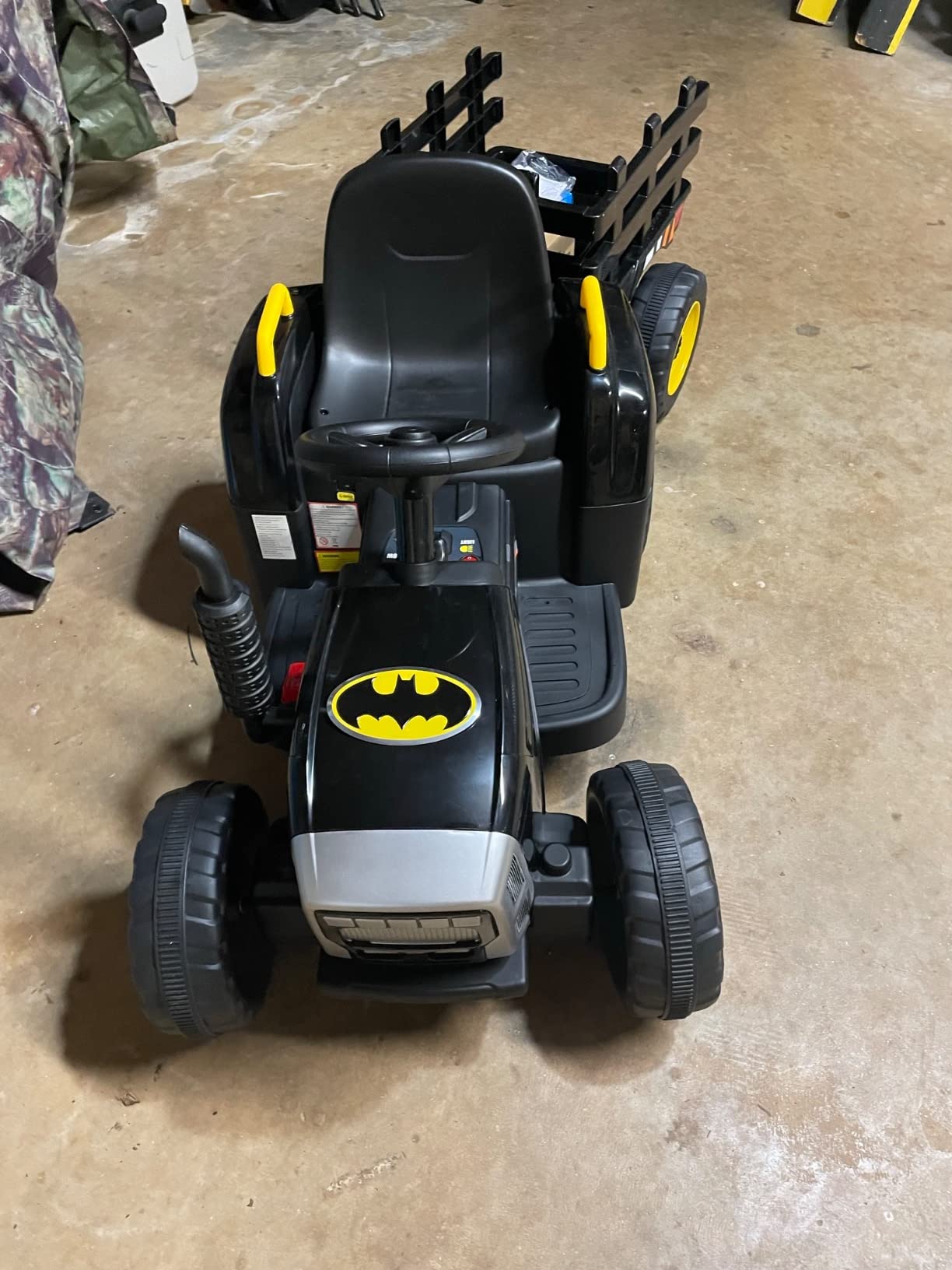
Where the feature list pays off
Bluetooth and USB input is a bigger deal than it sounds in practice. Once a child has their own music, the tractor becomes a mobile speaker they control, and that changes the shape of play entirely. A four-year-old will drive the same circuit for twenty minutes because they are choosing the soundtrack, which is a much longer session than the one they get from engine sounds alone.
The detachable trailer is the other practical win here. A large bed that comes off in one piece means it can be loaded with garden straw, flowers or a pile of toys separately from the tractor, and the whole thing stores in two pieces rather than one awkward lump.
What parents should know before buying
Speed is the honest concern. A listed 3 to 8 mph range tops out faster than most 12V peers, and parents report being caught off guard by how quick it feels. If your child is under four or has never driven a ride-on, put it on the lowest setting from the first session and use the remote rather than relying on the child to modulate speed.
The second limitation is build quality. The seat and steering assembly are basic next to the metal-framed Peg Perego sets, and several buyers describe the plastics as feeling thin under a heavier child. At 29 lb it is also light enough that a determined five-year-old can tip it, which is worth knowing. Good for fun and features, less good as a long-term investment.
6. ARBELI 24V Ride On Tractor With Tiltable Trailer – Best Tipping Trailer
ARBELI 24V Ride On Tractor w/2.4G Remote Control, Tiltable Trailer, Green
Ages 3-6
60 lb capacity
24V dual 75W motors
1.86-4.3 mph
Pros
- 24V power with dual 75W motors climbs small hills
- tiltable trailer dumps loads on a switch and auto-resets
- 6 EVA tires grip grass and gravel
- soft-start adjustable seat with belt
Cons
- Remote steering needs constant correction
- trailer coupling has no quick release and can break
- single battery cannot be swapped
The ARBELI is the first tractor here with a trailer that genuinely tips, and that single feature changes what a child can do with it. The trailer detaches and tilts, dumping its load with a switch and then auto-resetting back to level. Parents on forums who ask whether a child can realistically move garden waste point to tilting and dumping trailers as the answer, because a carry-type bed requires an adult to unload everything.
Underneath it is genuine 24V power, with dual 75W drive motors covering a 1.86 to 4.3 mph range. That is enough torque to climb small hills and tackle rough ground, which is the territory where most 12V tractors in this roundup start to struggle. Six wear-resistant EVA tyres give the grip and shock absorption that makes that power usable on grass, gravel and brick rather than only on a smooth driveway.
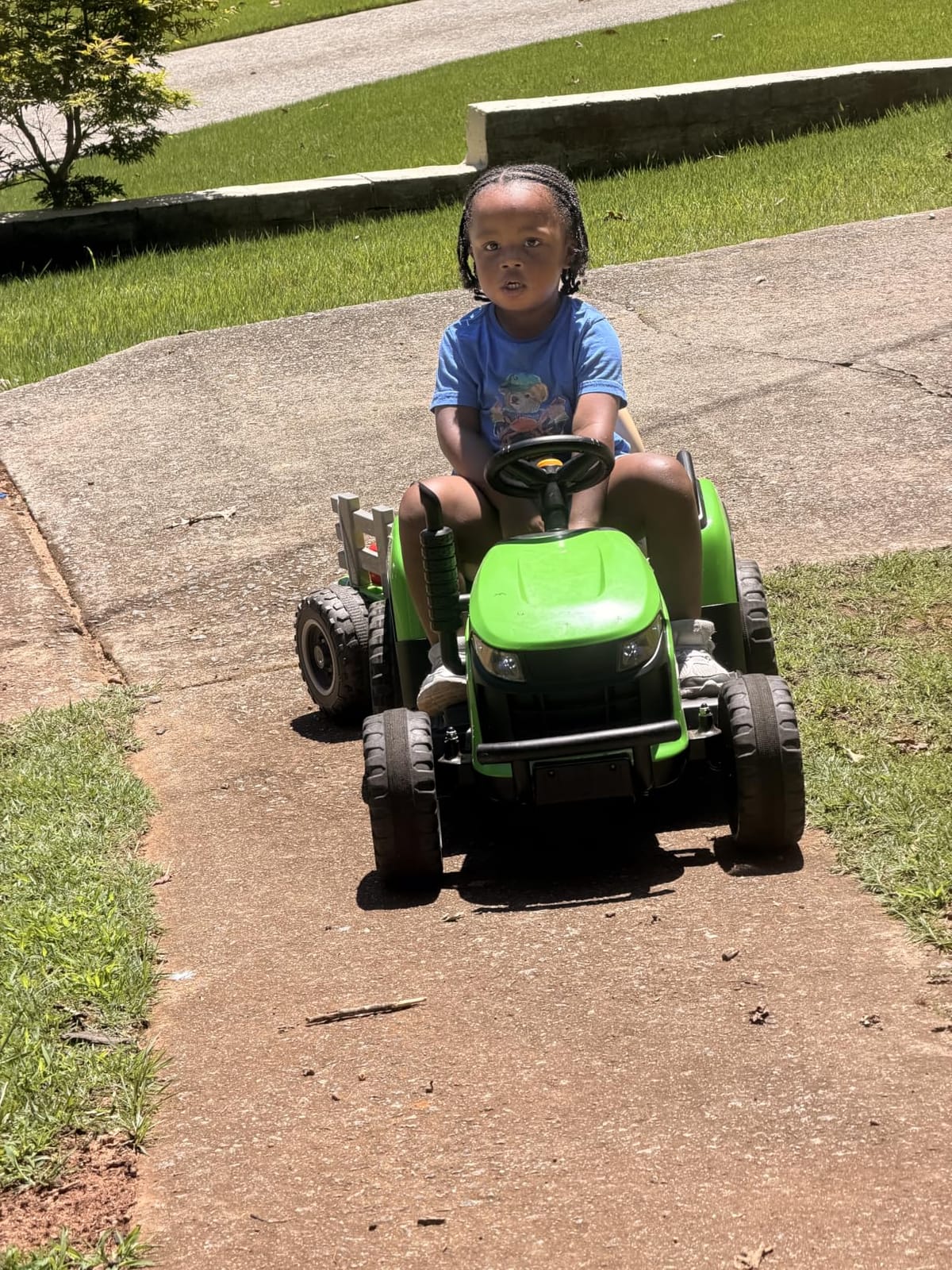
Safety kit is well specified for the class, with a 2.4G parent remote offering three speeds plus a two-speed manual mode and an emergency brake. The soft-start, adjustable seat with a belt and side armrests handles a younger driver well, and assembly is straightforward with spare hardware included in the box. Bluetooth music and realistic engine sounds round out the package.
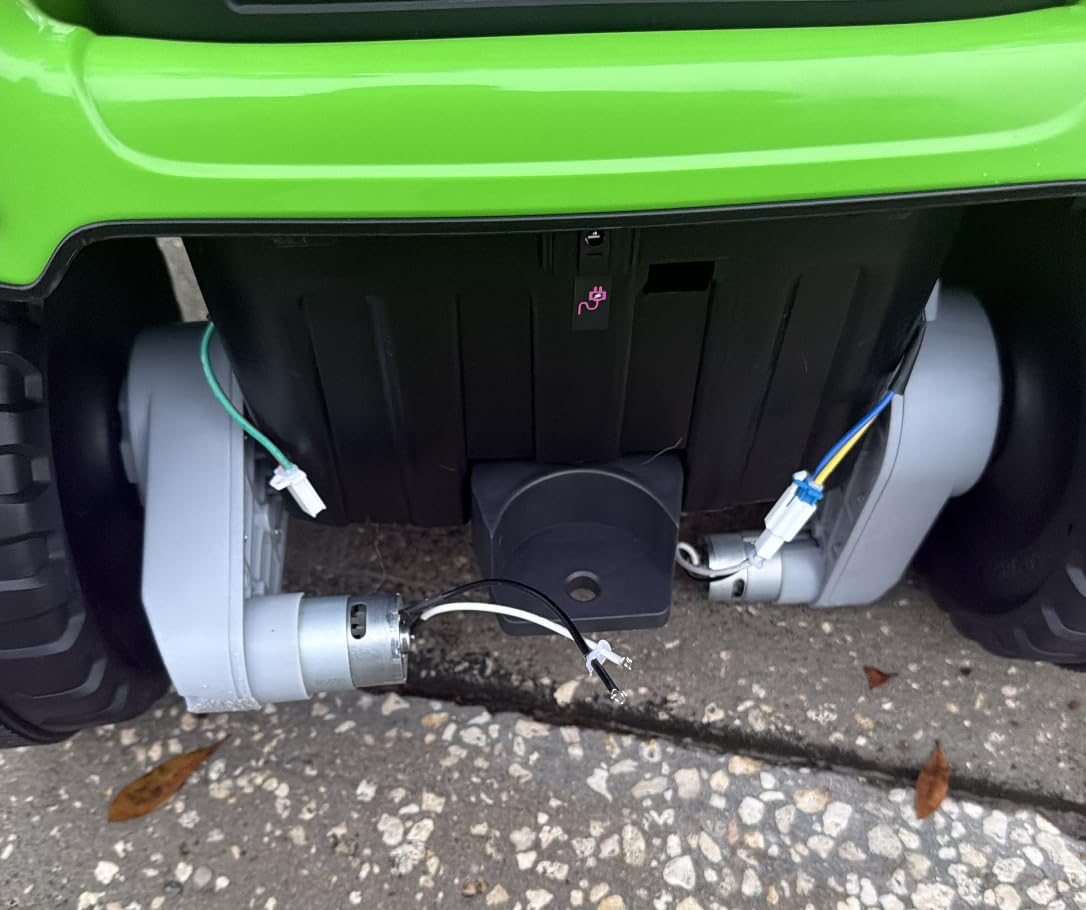
The frame is 55.35 by 23.22 by 22.44 inches at 34.2 lb, and the tilting mechanism actually converts the six-wheeler into a four-wheeler when raised, which is how it clears uneven ground with a load behind it. That conversion is a small engineering trick with a real effect on how the tractor behaves.
Why the tilt mechanism matters more than it sounds
A carry bed means an adult unloads. A tilting bed means the child does it, and that autonomy is what extends play sessions. A four-year-old can load toys or leaves into the bed, tip it with the switch, watch them slide out, and then drive off to collect more. That loop is the reason the ARBELi holds up as an outdoor toy rather than becoming an expensive object that sits in the grass.
It is also the only feature in this roundup that answers the single most repeated question in the forums, which is whether a child can pull a real load. A bag of soil or a handful of garden waste is within reach for this setup where it simply is not for most of the carry-type trailers here. Nothing in a toy ride-on moves a heavy bag of anything, and expectations should be set accordingly.
Where it falls short
The trailer coupling is the weak point. It is a non-standard fitting with no quick release, and several reviews report it breaking, which is exactly the kind of hardware failure that ends a play session. Budget a spare or check the coupling before every drive. The remote steering also needs constant correction to keep the tractor tracking straight, so it takes a little practice with a young driver.
Second, speed versus size. At 60 lb capacity in a compact 24V frame, a four-year-old is already near the fit limit while the top speed is high, which is an awkward combination. The decal stickers are also poor quality and peel quickly, and the single built-in battery cannot be swapped for a second pack, so plan charging around one battery rather than two.
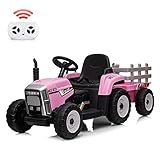
7. Nasitip 12V Battery Powered Electric Tractor With Trailer – Best For Extra Features
Nasitip 12V Battery Powered Electric Tractor with Trailer & Remote Control
Ages 3-6
66 lb capacity
25W or 35W motor options
8-12 hour recharge
Pros
- Unusually deep feature list including 7 LED headlights and spoken stories
- traction tires and suspension for grass and gravel
- parent remote plus manual mode
- handrails and adjustable belt
Cons
- 8-12 hour recharge time limits availability
- short run time against that charge cycle
- air-pressure horn is a novelty
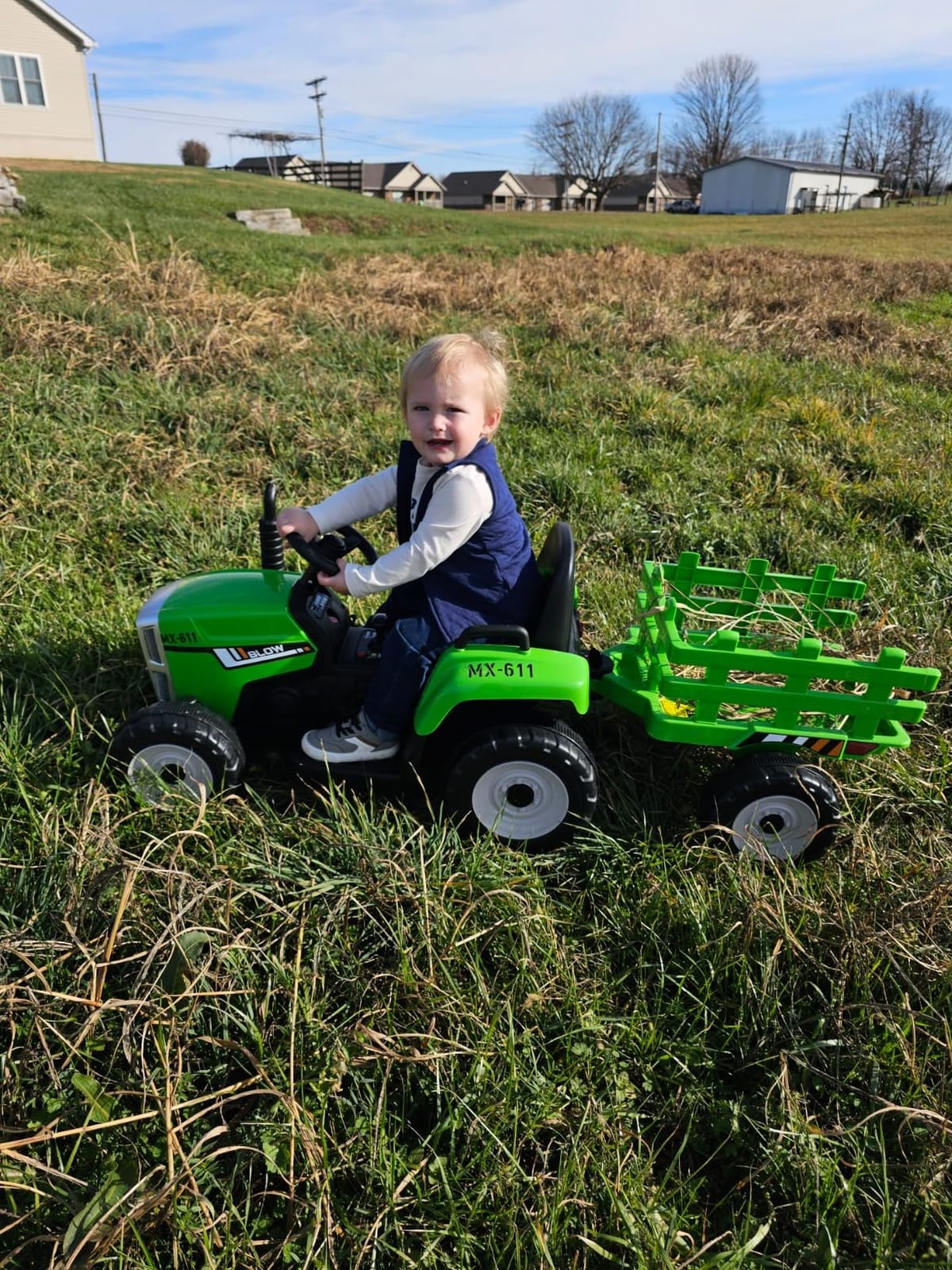
The Nasitip is the feature-maximiser of the 12V group. Seven LED headlights, spoken stories and poems, realistic engine sounds, an air-pressure horn, USB port and TF card slot, and a 2+1 gear shift. There is no other tractor in this price bracket that plays audio content rather than just music, and children who are still at the storytelling stage of play find that genuinely absorbing.
Traction matters more here than usual, and this model is well served. It comes with 25W or 35W motor options and a choice of tread or EVA tyres, which is unusual to see listed. The suspension and traction setup handle grass, dirt and gravel, and a battery indicator takes the guesswork out of knowing when the tractor is actually finished.
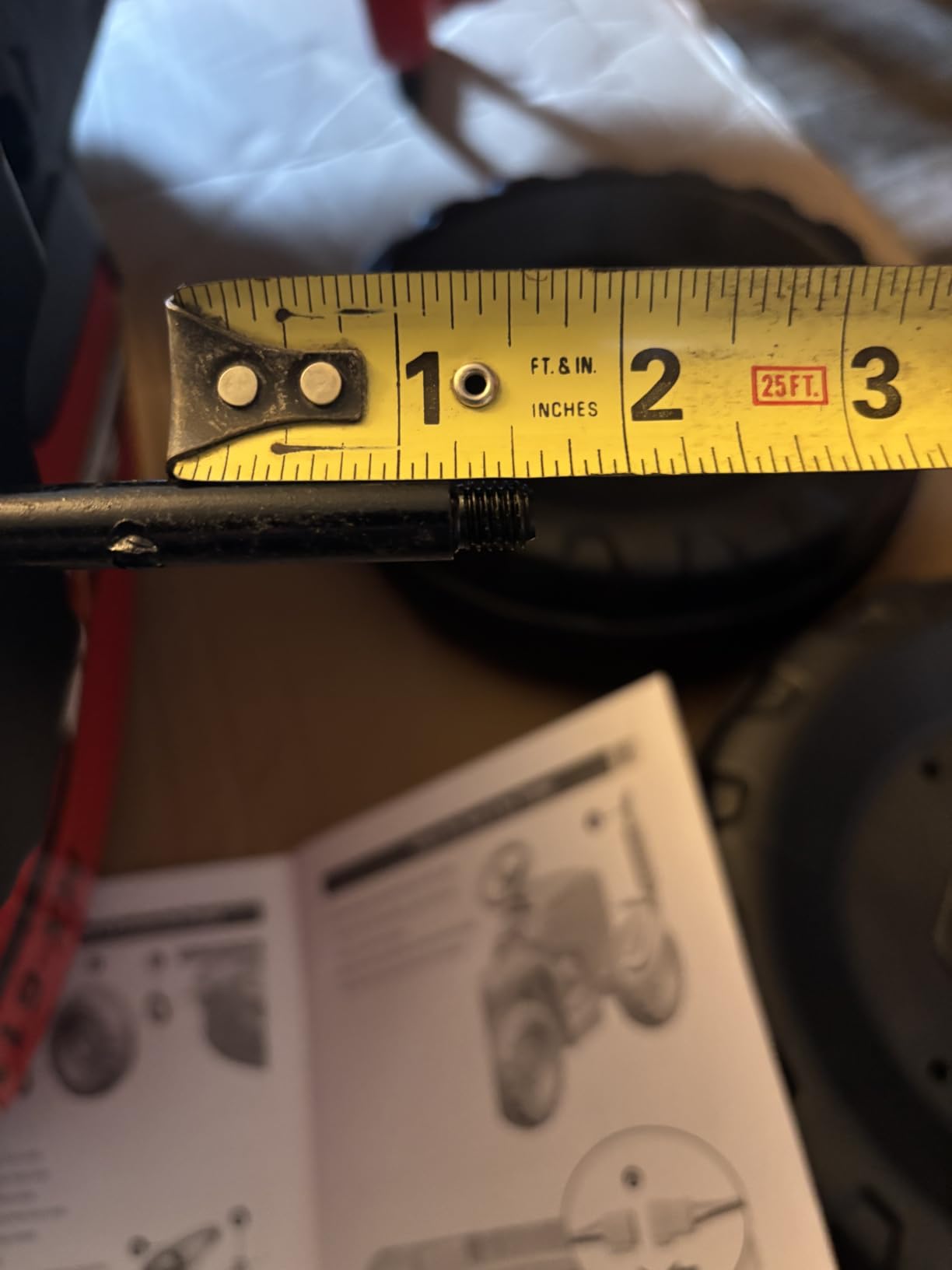
Control runs either manually or through a 2.4G parental remote, and handrails plus an adjustable belt add a layer of safety around the seat that most rivals skip. It is ASTM F963 and CPSIA certified, carries a 66 lb limit, and the removable trailer has armrests. At 54 by 20 by 21 inches and 35 lb it is a mid-size package with real substance.
For a child who spends long sessions playing alone in the garden, the combination of stories, sounds and a battery indicator means fewer interruptions and fewer flat batteries discovered halfway through an afternoon.
What the feature list really delivers
Spoken stories and poems are the standout. Most tractors in this bracket loop the same thirty seconds of engine noise, and a child switches off quickly. Audio content gives a reason to stay put and creates a routine around the toy, which is the sort of thing that keeps it interesting past the first month. Seven LED headlights mean dusk play does not end the session abruptly either.
The battery indicator is a smaller feature that has an outsized effect on daily use. Without one, parents end up running a tractor down to a stall on the lawn, which is hard on the battery and hard on the child. The USB and TF card slots also mean you can load your own content rather than relying on whatever shipped on the unit.
The recharge problem, and who it suits
The 8 to 12 hour recharge is the headline complaint and it is a real one. That is a full working day to get back to full, so a tractor charged on Sunday afternoon may not be ready again until Monday evening. In a household with one tractor and multiple children sharing it, that becomes a scheduling problem rather than an inconvenience.
Run time is short relative to that charge cycle too, so the ratio of play to waiting is poor. The air-pressure horn is also a novelty that fades fast, and the removable trailer with armrests, while nice, is a carry bed rather than a tipping one. Choose this model if your child plays alone for long stretches and you can manage the charging rhythm. If two children share one tractor, look at the 24V options instead.
8. Peg Perego John Deere Farm Power 12V With Trailer – Best For Licensed Realism
Peg Perego John Deere Farm Power 12 Volt Ride-on Tractor and Trailer with Remote Control
Ages 24 months+
Licensed John Deere
2 speeds plus reverse
Trailer included
Pros
- Officially licensed John Deere design with realistic sounds and working lights
- remote lets parents run it at low speed first
- heavier-duty frame handling asphalt and grass
- trailer included in the two-piece set
Cons
- Smaller and lighter than the Ground Force
- no radio or audio features
- two-year battery warranty on the pack
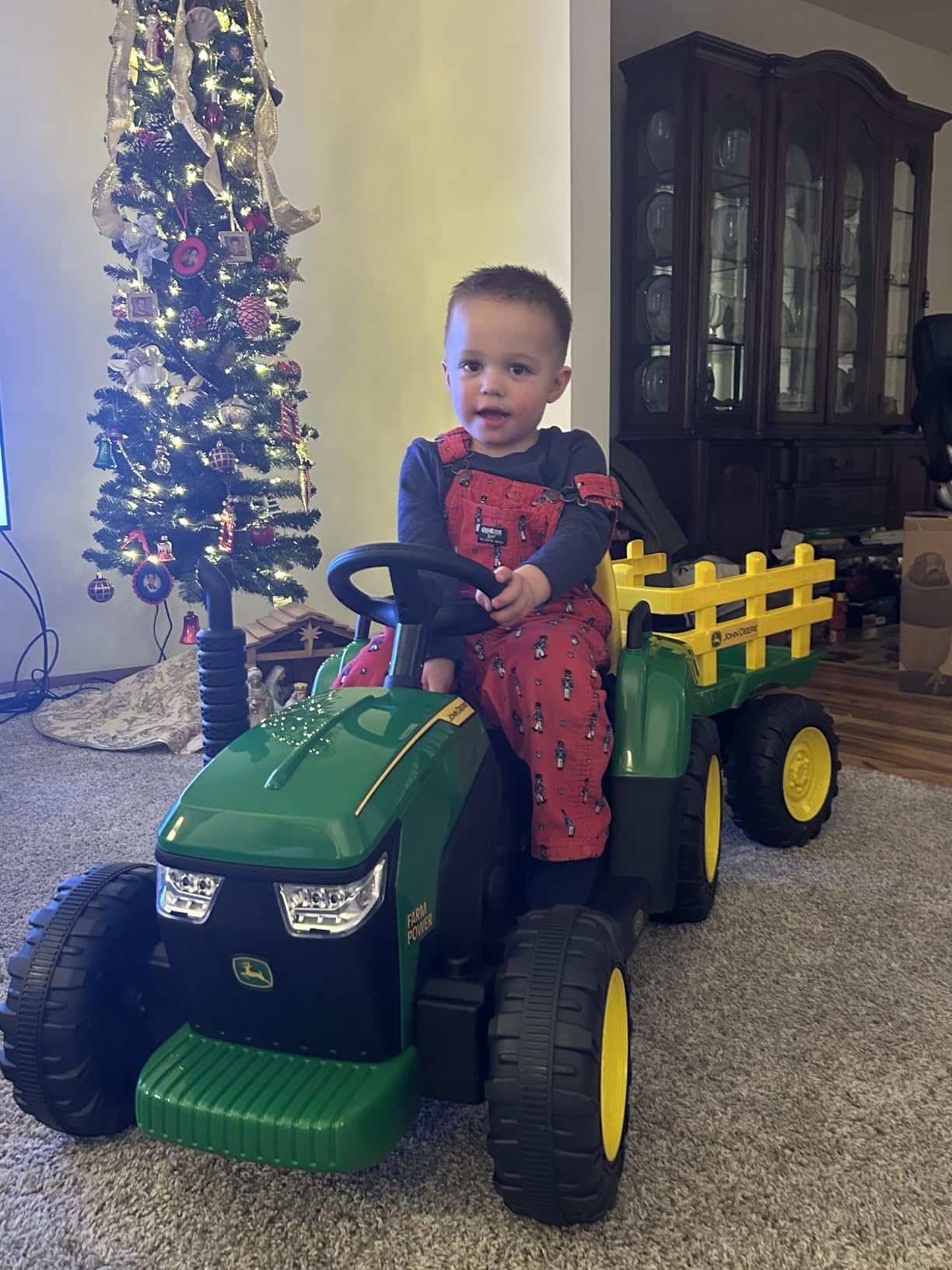
The Farm Power is the smaller Peg Perego sibling to the Ground Force, and it is the one to buy for a child under three who still wants the licensed John Deere look. Official licensing means the grille, colour and detailing match the real machines, plus realistic tractor sounds and working lights. For a two-year-old who cannot yet pretend convincingly, that accuracy does a lot of work.
It keeps the parent remote, with a low-speed mode that lets an adult drive the tractor slowly before handing over control. Once the child takes over there are two forward speeds plus reverse, which is a sensible spread for this age. The frame is heavier-duty than most budget alternatives and handles asphalt and grass, and the battery is rated weather-resistant for all-terrain riding.
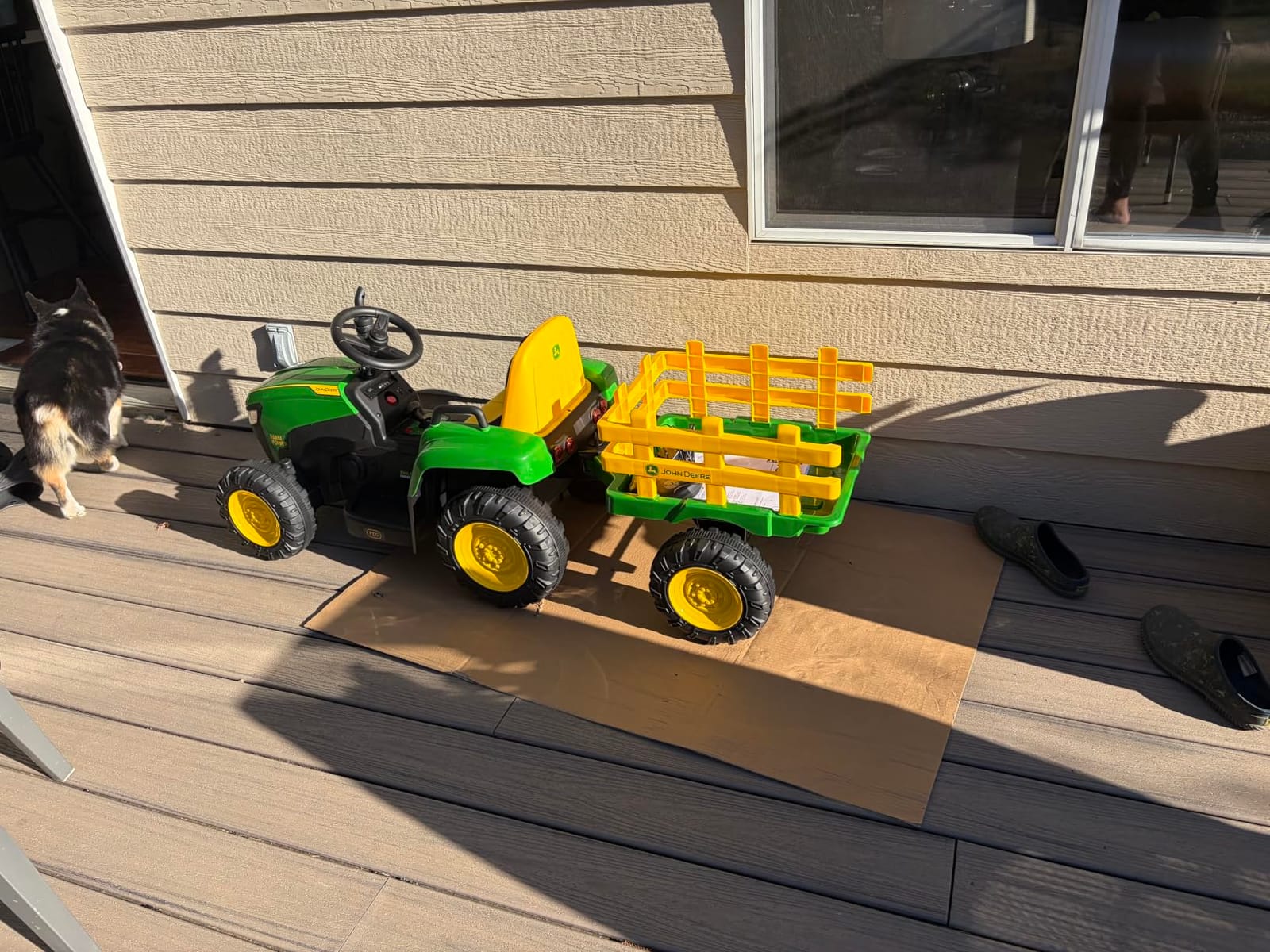
The set is a two-piece package of tractor and trailer, so the trailer is included from the start. At 56.5 by 20 by 20.5 inches and 32 lb, it is easier for an adult to move than the 50 lb Ground Force, which matters when the person lifting it is also holding a toddler. Reviews show 84% five-star ratings with very few reported defects.
The manufacturer recommends 24 months and up, and that is the honest starting point. It is a short ride for a short age, but it is the correct short ride rather than an undersized adult machine.
Why licensing matters for younger drivers
Children under three are not really roleplaying yet, they are reproducing. When the toy in the garden looks like the tractor in the book or on the farm show, it reads as the real thing, and that recognition gets them interested sooner. A generic green tractor with a smiley grille simply does not land the same way at that age.
The low-speed remote mode is the other part of the appeal. Instead of handing over a moving machine to a two-year-old, an adult drives it in a straight line at walking pace until the child is ready to take the wheel. Very few toys in this category offer a genuinely slow parent-controlled mode, and this one does.
What you give up versus the Ground Force
This model is smaller and lighter than the Ground Force, at 32 lb against 50 lb, and it has no weight capacity listed, so the growth runway is shorter. There is also no radio or audio feature of any kind, which is a real loss for a child who has had the Ground Force and stepped down. The two-year battery warranty means wearers eventually replace the pack, and that is an extra cost nobody budgets for.
Buy it as a first licensed tractor for a two or three-year-old, and expect to move up to the Ground Force or an equivalent 24V model a few years later. As a first ride-on it is well built and the right size. It is simply not the tractor to buy for a child you want to keep for six years.
9. Licensed JCB 24V Ride On Tractor With Trailer – Best For Older Kids
Licensed JCB 24V Ride on Toys, Electric Tractor for Big Kids 3-8 w/Trailer
Ages 3-8
24V 7Ah battery
Dual 200W motors
2.5-4.5 mph
Pros
- Largest footprint in the roundup at 61 inches
- 24V 7Ah lead-acid with dual 200W motors for about two hours of play
- officially licensed JCB styling
- removable large-capacity trailer with 2.4G remote
Cons
- Lead-acid battery is heavier than modern packs
- small 157-rating review base for long-term data
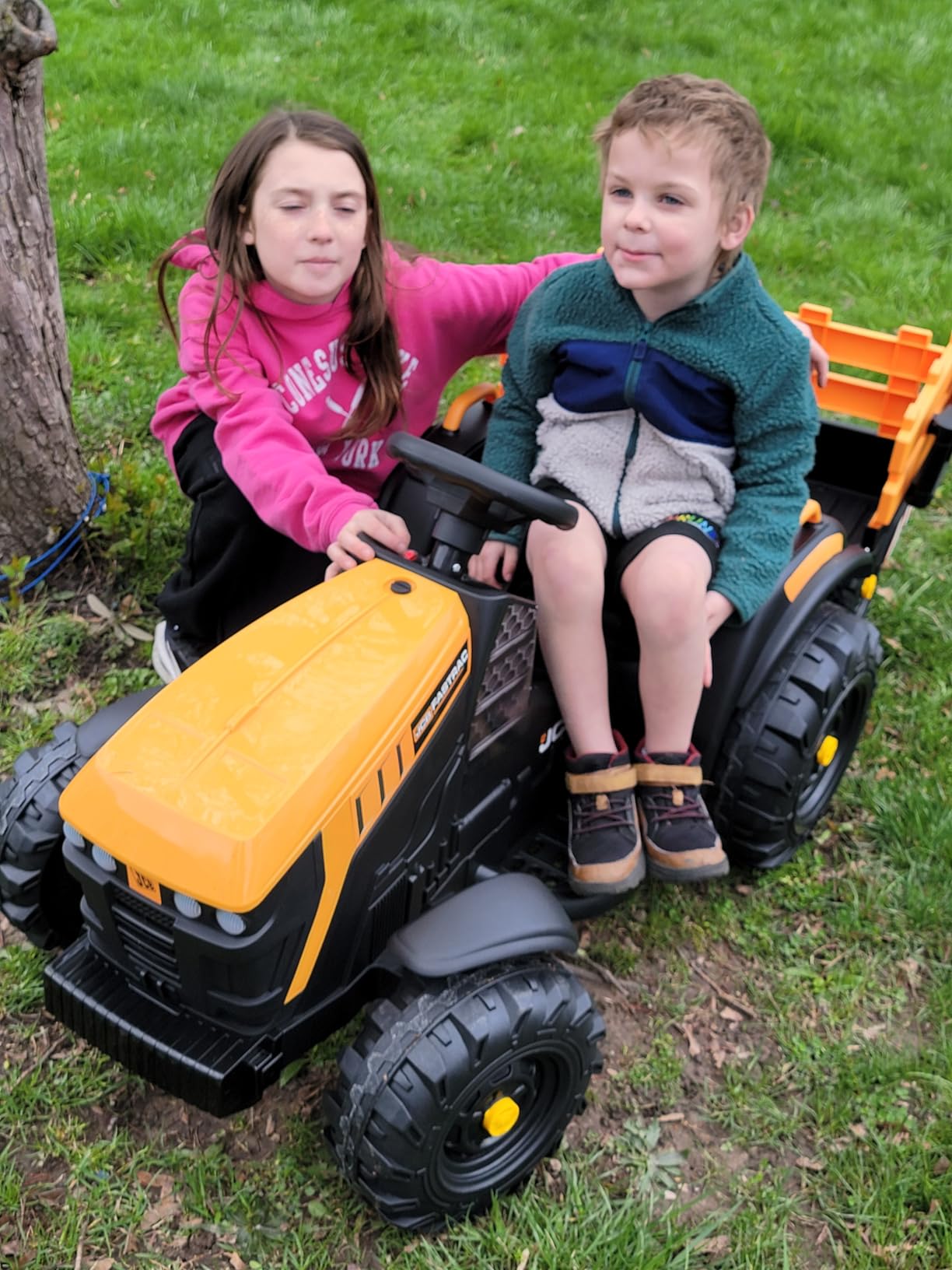
The JCB-licensed model is the largest tractor in the roundup at 61 by 26.2 by 24.4 inches, and that size is the whole point. It is built for a child who is already too big for the 53-inch frames, with the seat height and legroom to keep a seven-year-old comfortable rather than perched. If your child has outgrown a smaller tractor, this is where you land.
Power comes from a 24V 7Ah lead-acid battery driving dual 200W motors for a 2.5 to 4.5 mph range, and owners report up to two hours of continuous playtime. That is the longest runtime of any battery model here, roughly double what most 12V tractors deliver, which makes it the practical choice when siblings share one machine or when a child plays outdoors for a whole afternoon.
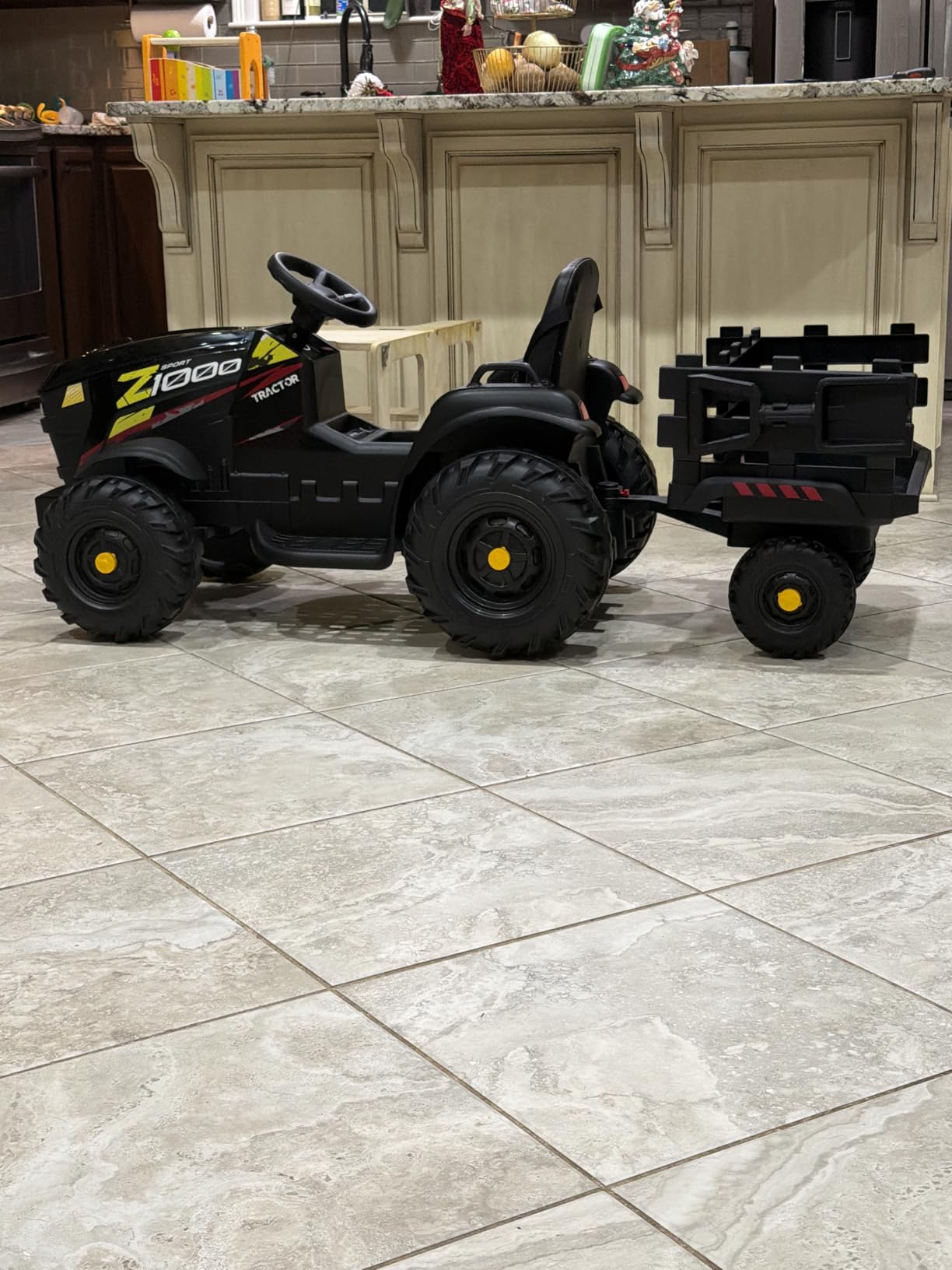
The styling is an officially licensed JCB Fastrac design with authentic details rather than a generic farm machine, and the removable large-capacity trailer comes with a 2.4G remote and manual mode. Safety is handled by a three-point belt, armrests and soft-start technology, and it is ASTM F963 and CPSIA certified. Reviews show 81% five-star ratings.
Because it is a 24V platform, it also has enough torque to keep momentum on lawn and light gravel, which is the second reason older children need it. A bigger child weighs more, and a 12V tractor that managed a 30 lb preschooler can bog down badly at 60 lb.
Who this size genuinely suits
The honest audience is a child around five to eight who is tall for their age or simply already heavy. A 61-inch frame with a proper seat gives a bigger child footroom and a proper look, and the two-hour runtime means the session does not end because the battery did. Parents who have already had one 12V tractor and watched a child outgrow it within two years tend to see this as the model they should have bought first.
At around 43 lb, this is a substantial object to lift into a car, so it works best with a garage or a dedicated storage place. The removable trailer helps a little, since it comes off for storage. The licensed JCB look also gives it a different character from the ubiquitous green John Deere styling, which some children prefer.
What to weigh before choosing
The lead-acid battery is heavy and less convenient than a modern lithium pack, and 43 lb reflects that. It is also a large, slower-moving purchase than most of the 12V options, so plan the storage space and the charging location accordingly. The 157-rating review base is the smallest among the picks here, which means there is less long-term reliability data behind it than the models with reviews in the thousands.
It also sits at a higher price point than the 12V tractors, though it is still well below the three-in-one model in this list. If you have storage and a child who needs the size, that is a reasonable trade. If you are buying for a three or four-year-old, you will be paying for frame they cannot use yet.
10. Kidsera 24V Extra-Large 3-in-1 Tractor With Loader And Trailer – Best For Loader And Trailer
Kidsera 24V Extra-Large 3-in-1 Kids Ride On Tractor w/Loader & Trailer
Ages 3-8
65 lb capacity
Dual 250W motors
2.5-5 mph
Pros
- 3-in-1 design with a working front loader and detachable trailer
- dual 250W motors on a metal frame for grass and gravel
- soft-start with oversized belted seat and anti-slip armrests
- 2.4G parent remote
Cons
- By far the most expensive option here
- 87.8 inch body needs significant space
- only 127 reviews of any model
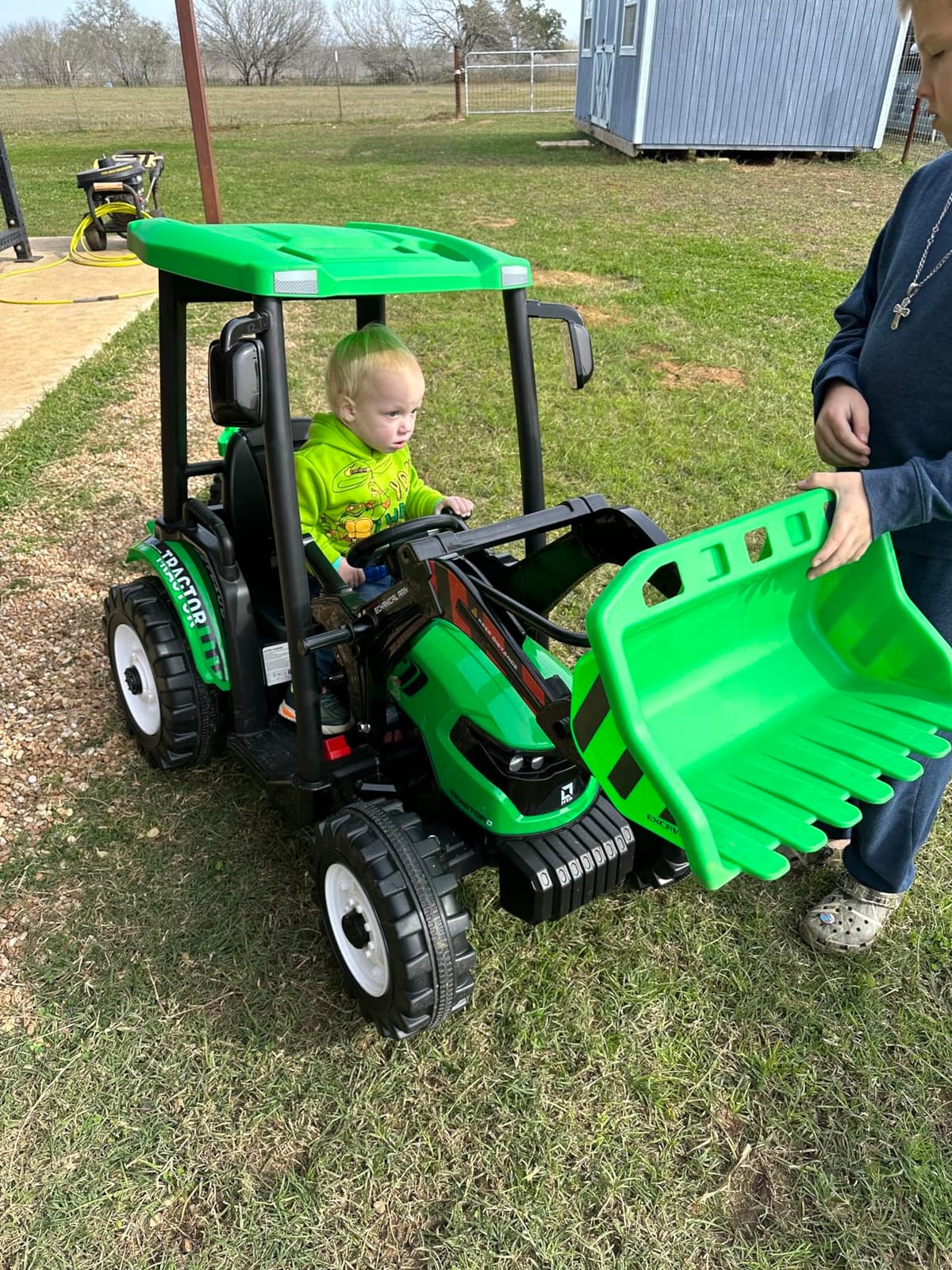
The Kidsera is the only tractor in this roundup that is genuinely three things at once: a ride-on tractor, a detachable trailer hauler and a working front loader. Dual 250W motors drive it at 2.5 to 5 mph across two speed modes, giving roughly 500W of combined output, and the metal frame is rated for grass, gravel and pavement rather than only smooth ground.
Owners consistently single out the loader-and-trailer combination as the reason to buy it. A child can scoop up material into the bucket, drop it in the trailer, drive forward and tip the load out somewhere else, which is a complete work cycle rather than a single action. For a farm family with actual garden waste to move, that is the most functionally useful tractor here, and the all-terrain wheels with shock absorption help it handle uneven ground while loaded.
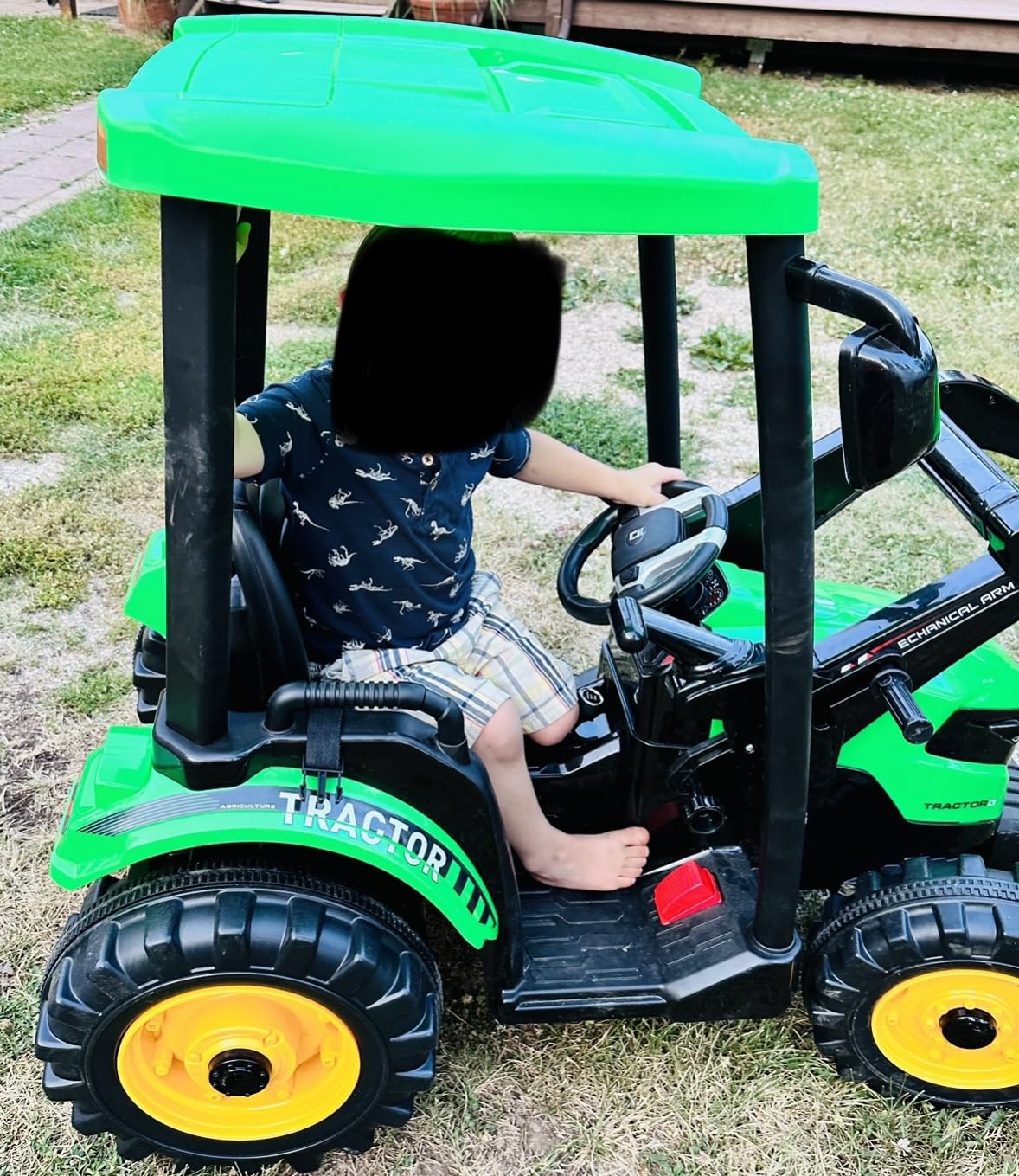
Safety and comfort are handled properly: soft-start technology, an oversized seat, a safety belt, anti-slip armrests, and both a 2.4G parent remote and child manual operation. A power indicator light shows charge state and a matched charger is included. It is ASTM and CPSIA compliant with a 65 lb capacity, and the listed build age range runs 3 to 8 years.
The frame is 87.8 inches long by 28.4 wide, which makes it by far the biggest object in this roundup. It is also the heaviest buy by a wide margin, and the smallest review base at 127 ratings. Both of those are consequences of being a large, premium, relatively new product rather than a flaw in the design.
Why the front loader changes the play pattern
Every other tractor here can move things from one place to another. This one can pick things up, and that is a different skill. Loading requires the child to line up, judge the bucket height, and manage speed while loaded, which is exactly the kind of coordination work that makes ride-on toys worth having rather than a wheeled sofa.
It is also the closest any of these comes to a small utility vehicle, which matters for older children who have moved past farm-animal roleplay. Parents running a smallholding or a large garden will recognise the value of a child-sized loader, provided expectations are realistic about what 250W motors can shift. It moves light material, not bags of gravel.
Where the compromises are
Cost is the first one, and it is a large gap. This model costs more than double the 12V tractors here, so it is a real decision rather than a casual add. If you are unsure whether a child will use it, start with a 12V set and upgrade later, because the growth path from a 66 lb frame to this one is usually about two to three years.
Space is the second. At 87.8 inches long and 28.4 inches wide, you need a driveway or a substantial yard, and you need somewhere indoors to put it. Parents with a small garden will find it unusable. The 127-rating review base also means fewer reported problems, which is not the same as more proven reliability, and 81% five-star ratings across a small sample is thinner evidence than a rating with thousands behind it.
11. ROLLY TOYS John Deere Pedal Tractor With Front Loader And Trailer – Best Value
rolly toys John Deere Pedal Tractor with Working Front Loader and Detachable Trailer, Youth Ages 3+
Ages 3-8
Pedal powered
32 inch frame
Detachable trailer
Pros
- No battery
- motor or charging at all
- fully functional front loader that scoops real dirt and sand
- German-made with a 3-year defect warranty
- two-position adjustable seat
Cons
- Hard plastic tires with poor grass traction
- confusing assembly instructions
- tight pedal reach for a 4-year-old
The ROLLY TOYS is the one we recommend to parents who react badly to the idea of another battery in the house. There is no motor, no battery, no charger and no runtime. The child powers it with pedal effort, which means it works in a flat, a garage, a beach or a field with no infrastructure at all, and there is nothing to degrade or replace in year three.
That pedal drive also changes the physical character of play. Owners on forums who favour pedal tractors make the point that a child who is propelling the vehicle is doing real gross motor work, and that some parents specifically want their children moving more rather than sitting in a powered seat. The 4.6-star rating across 1941 reviews suggests that side of the debate feels well served here.
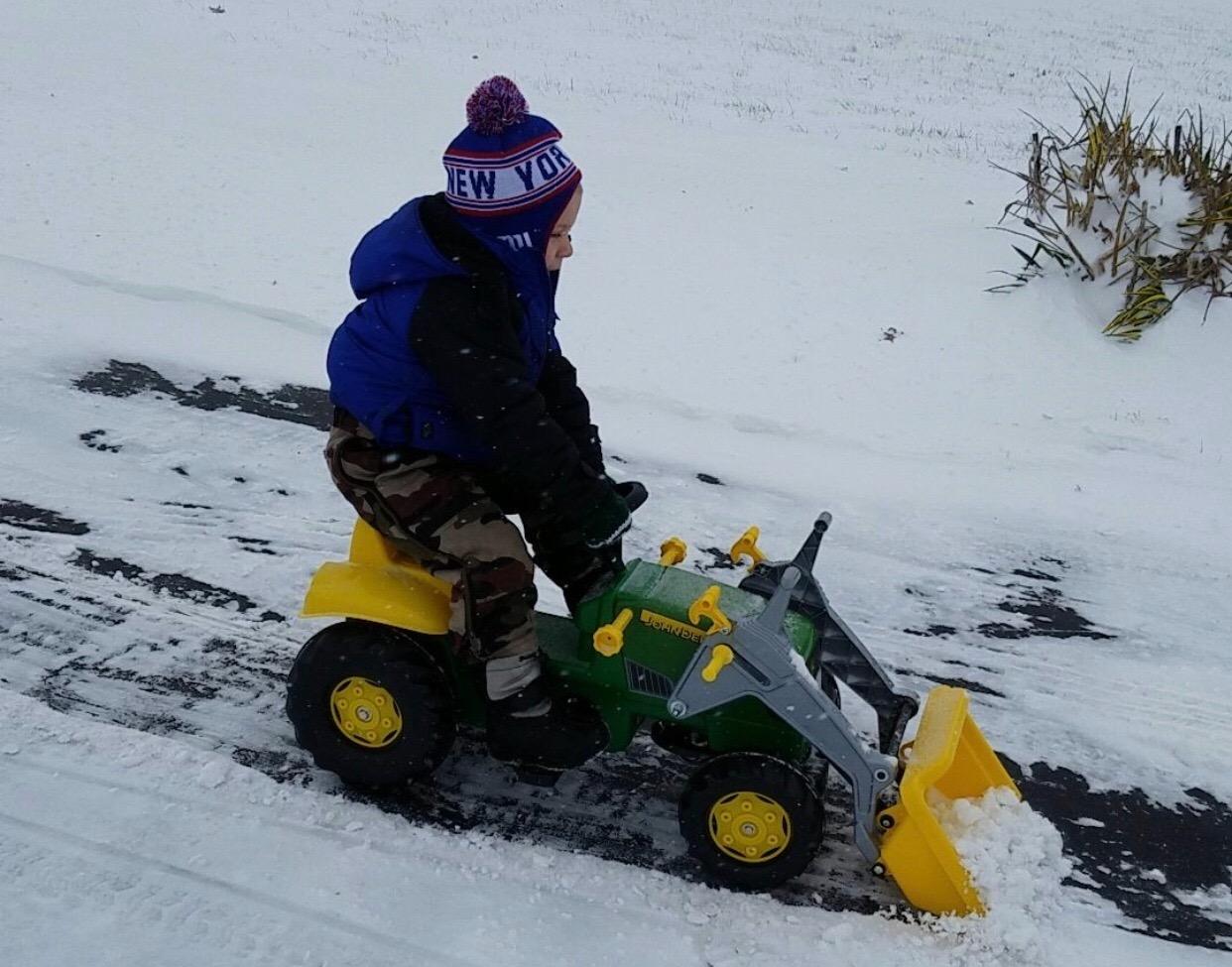
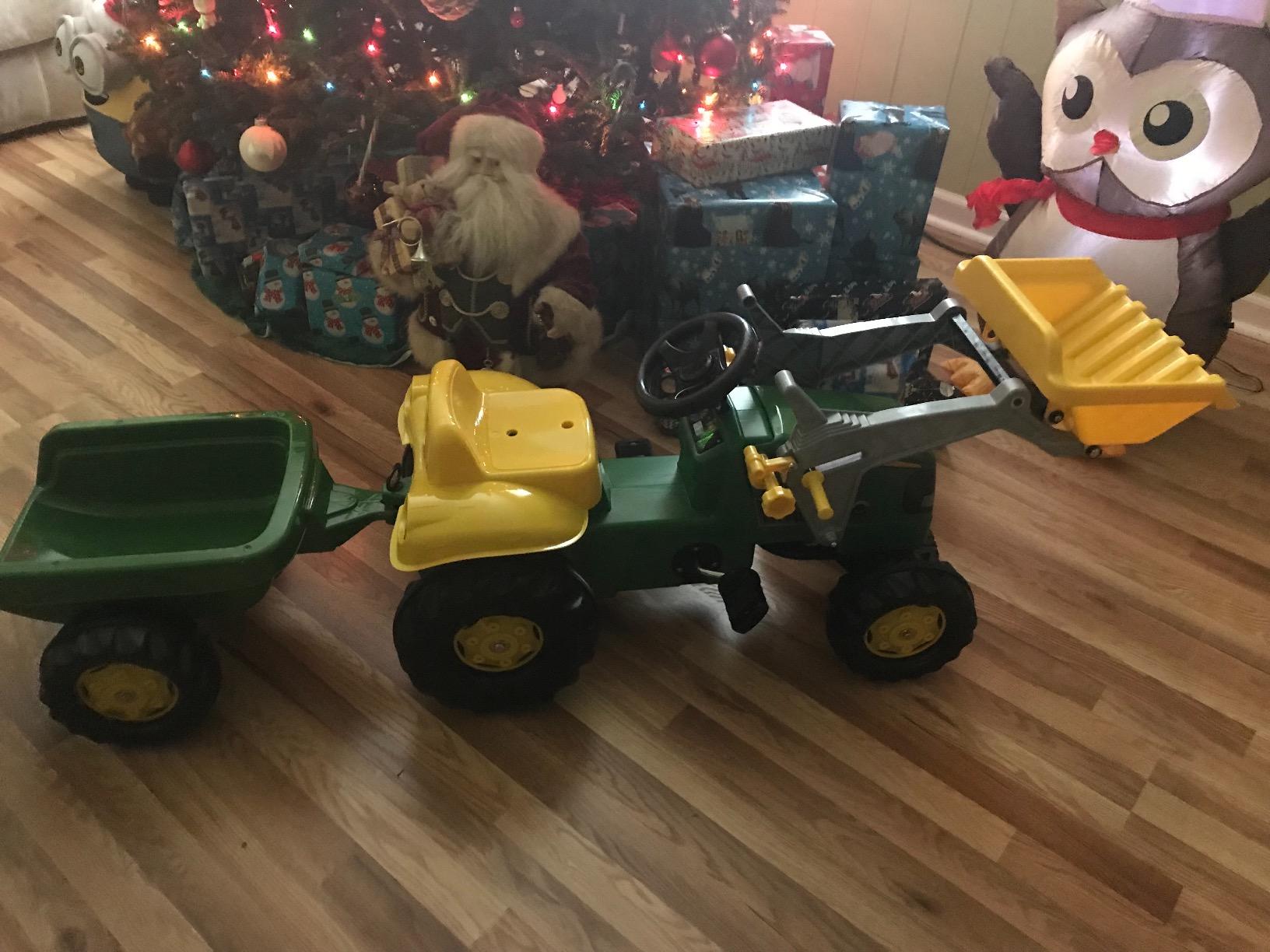
The front loader is fully functional, not decorative, and will scoop real piles of dirt, sand or snow. Paired with the detachable trailer, a child can load, haul and dump entirely under their own power, with no adult intervention. The two-position adjustable seat grows with the child, and the whole thing is made in Germany with a three-year manufacturer warranty against defects, which is the longest defect warranty in this roundup.
At 21.69 by 21.69 by 32.48 inches it is far more compact than anything battery-powered here, and 24 lb is manageable for an adult to move. It is also a natural first vehicle, which is why it shows up in gift guides for children moving from push-alongs to something with pedals.
Why battery-free wins for some families
There is no charging schedule to manage, and no downtime when the battery is flat, which was the single most common complaint in our reading across the battery models. You take it outside, it works, and it keeps working. For families where storage space is tight, a 24 lb pedal tractor that fits in a corner is a much easier object to live with than an 87-inch machine.
The working loader is what earns the 4.6 rating. A child who can actually scoop and haul treats the toy as equipment rather than as a vehicle to sit on, and that functional play lasts far longer. The three-year defect warranty and German manufacture also give the strongest long-term confidence of any pedal option we looked at.
Where it does not work
Traction is the big one, and it is a shared complaint with other pedal tractors. The hard plastic tyres have no real rubber tread, so performance on grass is poor, and this model works well on a hard surface and struggles on lawn. If your outdoor space is mostly grass, a battery tractor with EVA tyres will be far more usable.
Assembly instructions are confusing, and a significant number of owners found it harder than expected, so budget an evening. Pedal reach is also tight, which means an average-size four-year-old can struggle to get going and may need the two-position seat adjustment to help. At 24 lb it is also bulkier than most pedal toys. It is best bought for a confident three-year-old or older, ideally on a driveway or patio.
12. Peg Perego Case IH Little Tractor And Trailer – Best For First Drivers
Peg Perego Case IH Little Tractor and Trailer
Ages 1.5-4
6V battery
2.25 mph
automatic brakes
Pros
- Sized specifically for toddlers from 18 months
- slow 2.25 mph with automatic brakes
- stake-side trailer keeps loads contained
- battery and charger included with a 2-year limited warranty
Cons
- Only about 30 minutes of play per charge
- children outgrow it at 4-5
- weakest power in the roundup
The Case IH Little Tractor is the smallest electric tractor in this roundup and the only one genuinely suited to a child under two. At 51.5 by 19.5 by 20 inches it fits an 18-month-old, and the top speed is 2.25 mph, which is barely a fast walk. The automatic brakes engage when the foot pedal lifts, so there is no rolling-away behaviour to worry about on a slope.
It runs on a 6V rechargeable battery with the charger included, giving about 30 minutes of play per charge. That is short, and for most households it means one session a day rather than an afternoon of play. The stake-side trailer has a 15 by 12 by 8.5 inch cargo area, which is enough for a few small toys and keeps them contained during play.
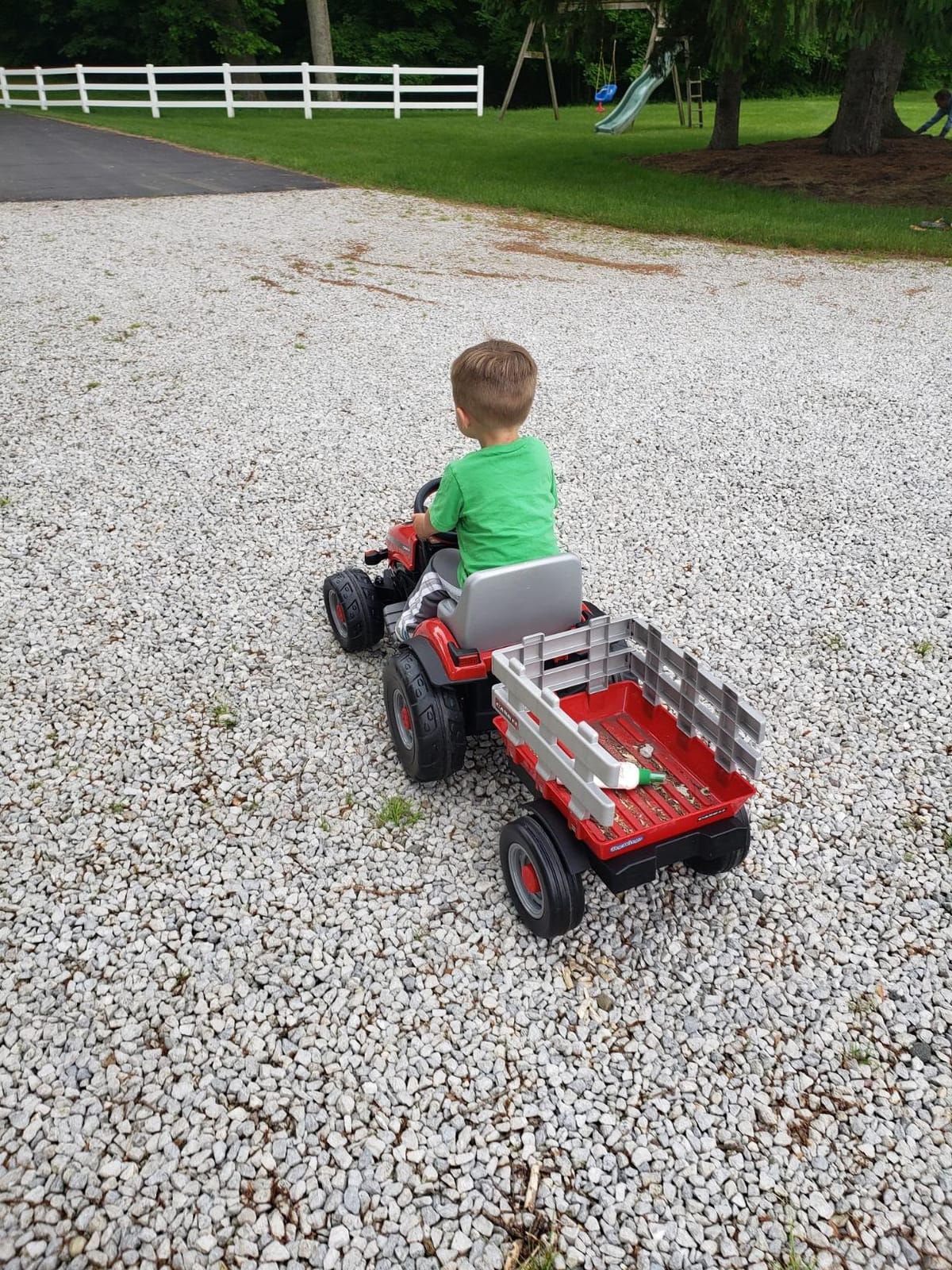
The realistic Case IH design is the same licensed approach that makes the John Deere models work, and the 2-year limited warranty includes consumer participation, which is a genuine support benefit. At roughly 24 lb it is light enough for an adult to carry easily, and being the smallest frame in the roundup it stores in a corner without thought.
Reviews from parents of toddlers are consistent: the right size and speed for a first ride-on, with the short sessions and quick age cutoff noted as the two real trade-offs.
Why a first ride-on should be small, not powerful
The instinct is to buy something big and impressive, but a first ride-on is about coordination, not speed. A child who cannot reach the pedals properly or cannot see over the steering wheel will not enjoy it, and a fast machine simply frightens them. At 2.25 mph with automatic brakes, this is calibrated for an 18-month-old learning what pedals do.
Parents report high satisfaction precisely on sizing grounds. The tractor is proportionate to the child, which sounds obvious and is rarely true of bigger models, and a toddler who fits properly will drive it competently rather than climbing off after a minute. It also works indoors, which means play does not depend on the weather or the season.
When to skip it entirely
If your child is four or older, skip this one. The 2 to 4 year listing is accurate, and most children are physically too big for the seat and steering by the time they are four and a half. Thirty minutes per charge is also the shortest runtime here, and the 6V system is the weakest, which limits it to smooth indoor surfaces and light outdoor play rather than grass.
For anyone buying for a child under two it is a genuinely well-proportioned first vehicle, and the warranty and included charger make it a low-risk place to start. Think of it as an eighteen-month purchase rather than a three-year one, and plan a second, larger tractor around age four or five.
How to Choose a Kids Ride-On Tractor With a Trailer
A ride-on tractor is a child-sized vehicle styled after a farm tractor, sold with a detachable, tiltable or tipping cargo trailer hitched to the rear. Most run on a rechargeable lead-acid battery driving two electric motors, with a pin-style coupling joining the trailer to a rear hitch. The trailer is what makes it worth buying, so that is where the differences lie.
12V vs 24V: Which Voltage Fits Your Child
Almost every tractor in this roundup is 12V, with three 24V models and one 6V toddler option. The distinction is simple: 12V suits roughly ages three to six and light children, while 24V adds torque and runtime for children over five, heavier builds and uneven ground. Motor output is the real differentiator rather than the voltage label itself, since 12V models here range from 25W to 35W and the 24V models run from dual 75W to dual 250W.
Pick by the child, not the price. A three-year-old on a 12V with 25W motors is a good match. A six-year-old on the same tractor will outgrow the 66 lb weight limit before they outgrow the steering. If you are buying for a child who will still be riding it in three years, move up to 24V now rather than replacing in two.
Surface Compatibility: Grass, Gravel, Dirt And Pavement
This is the question parents ask most and the one product pages answer least clearly. On a smooth driveway or patio, any tractor here works, and a 6V model is fine. On grass, tyre type decides everything. EVA foam tyres and treaded tyres grip and absorb shocks; hard plastic wheels, which appear on the ROLLY TOYS pedal tractor, do not, and performance on lawn will be poor.
On gravel and light dirt, you want at least 35W motors and ideally the 24V platform. The ARBELI with six EVA tyres and the Kidsera with its all-terrain wheels and shock absorption are the two we would trust for mixed surfaces. Nobody in this roundup will handle deep mud or steep slopes, and a tractor bogged down halfway across a lawn is a broken toy as far as a child is concerned.
Trailer Types Decoded: Carried, Detached, Tilted And Dumped
Almost every trailer in this roundup is a carry bed, and parents should know what that means: an adult unloads it. The Fenced trailer on the TOBBI keeps debris in during travel but needs hands to empty. The detachable trailers on the Costzon and JOYMOR at least let you unload separately. Only the ARBELI tips and auto-resets on a switch, and the ROLLY TOYS and Kidsera add a working front loader on top.
This is the single most useful distinction in the whole category, and no competitor roundup we read explains it. If your child wants to move garden waste or pretend to dump deliveries, a tilting trailer is worth paying for. If the trailer is for carrying toys around a patio, a fenced bed is enough. Check whether the coupling is standard before buying, because a non-standard fitting that breaks is a common complaint on the 24V models.
Age, Weight And Seat Fit
Weight capacity is the number that decides how long the toy lasts, and it is not always listed. It ranges from 60 lb on the ARBELI through 65 to 66 lb on most budget models, up to 85 lb on the Peg Perego Ground Force. A child who fits a 66 lb model at three will usually still fit an 85 lb model at five, so the larger frame buys roughly two years.
Seat adjustability matters just as much. A flip-up armrest seat like the Ground Force, or a two-position seat like the ROLLY TOYS, lets the same machine work for two different sizes. Check the floorboard reach too, since a child who cannot place their feet flat will scoot forward and fall out. And buy a little large if you can: an oversized frame is a nuisance, an undersized one gets outgrown in a year.
Brand Reliability, Warranties And Spare Parts
Brand reputation is the one forum topic that comes up constantly, and Peg Perego and John Deere licensing come up most favourably. The reasons are consistent: metal rather than all-plastic construction, a two-year warranty on the Ground Force and the Case IH tractor, and parts that are actually available years later. The German-made ROLLY TOYS carries a three-year defect warranty, the longest here, and needs no parts at all.
The recurring complaint on generic imports is not total failure, it is small components. Accelerator pedals, gear selectors and trailer couplings break before the tractor does, and support is harder to reach. Before buying any unbranded model, check whether a replacement pedal, coupler or charger is sold separately. If the answer is no, assume you are buying a new tractor when that part fails.
Battery Life, Charging Time And Long-Term Care
Runtime here ranges from about 30 minutes on the 6V Case IH to around 60 minutes on a 12V model and up to two hours on the 24V JCB. Charging time is the number most people get wrong. The Nasitip takes 8 to 12 hours to recharge, which can exceed a full working day, while a 12V set is typically usable again overnight. Plan the charging location before you buy, and check that a spare battery is sold separately if you plan to swap packs.
For long-term care, charge on a flat surface away from direct sun, wipe the terminals occasionally, and expect a lead-acid pack to lose range over a few years. Lead-acid is heavier than lithium but far cheaper to replace, and a two-year battery warranty means wearers will eventually pay for a new pack. If you want a second pack, confirm compatibility before buying, since the single built-in batteries on some models cannot be swapped at all.
Ride-On Tractor Safety Checklist for Parents
Every forum thread on this topic lands in the same place: constant adult supervision, full stop. None of these tractors has a restraint strong enough to make unsupervised driving safe, and the fastest models here reach speeds that cross a small garden faster than an adult reacts.
Check the weight limit and the child’s actual weight before the first drive.
Use the parent remote to set a low speed for a first-time driver and raise it gradually.
Confirm the seat belt, armrests and automatic brakes all work before handing over control.
Inspect the pedal assembly, gear selector and trailer coupling every few months.
Set boundaries before the first session: no roads, no slopes, no water, and clear the path of stones.
Keep the speed mode consistent with the child’s age, not with what the tractor can do.
Frequently Asked Questions
What is the best kids ride on tractor with a trailer?
The Peg Perego John Deere Ground Force 12V is the best overall, with an 85 lb weight limit, an included trailer, two speeds plus reverse and a working FM radio. It also has the longest growth runway of any model we tested, staying usable from age three to seven.
What is the best large ride-on tractor for kids?
For older or heavier children, look at the 24V models rather than the largest 12V frame. The Licensed JCB 24V runs a 61 inch frame with dual 200W motors and about two hours of playtime, and the Kidsera 24V 3-in-1 adds a working front loader and dual 250W motors. Check that you have the floor space for an 87 inch body before choosing the largest model.
What is the best electric tractor with a trailer for kids?
The Peg Perego Ground Force 12V is the best electric option overall, and the ARBELI 24V is the best when the trailer needs to tip. Only the ARBELI has a trailer that dumps its load on a switch and auto-resets, which lets a child unload without an adult. Most other trailers are carry beds and need adult hands to empty.
What age is appropriate for a kids ride-on tractor?
Most models suit ages three and up, with 12V tractors generally fitting three to six and 24V models extending to seven or eight. The Peg Perego Case IH Little Tractor is the one option for children under two, rated from 18 months at 2.25 mph with automatic brakes. Weight capacity matters as much as age, so check both before buying.
What tractor brand has the least problems?
Peg Perego models come up most often in parent recommendations, and the reasons are consistent: metal construction, two-year warranties and parts still available years later. The German-made ROLLY TOYS pedal tractor carries a three-year defect warranty and needs no battery parts at all. On budget imports the usual failures are small components such as the accelerator pedal, gear selector or trailer coupling rather than the tractor itself.
Can ride-on tractors be used on grass?
It depends entirely on the tyres. Models with EVA foam or treaded tyres, such as the ARBELI with six EVA tyres or the Nasitip with tread options, handle grass and gravel well. Hard plastic wheels, as on the ROLLY TOYS pedal tractor, perform poorly on lawn. On grass you will also want at least 35W motors, and a 24V platform for older or heavier children.
How long does a ride-on tractor battery last per charge?
Expect roughly 30 minutes on the 6V Case IH model, about 60 minutes on most 12V tractors, and up to two hours on the 24V JCB. Charging time matters just as much, and the Nasitip takes 8 to 12 hours to recharge, which can exceed a full day. Check that a replacement battery is sold separately before buying.
Is a pedal tractor better than a battery ride-on for young kids?
It depends on your space and your child. A pedal tractor has no battery to charge or replace and the child gets real gross motor work from driving it, but hard plastic tyres handle grass poorly. A battery ride-on is easier on small children, works better on uneven ground and holds higher top speeds, so a 6V or low-speed 12V model is usually the better first ride-on for a toddler.
Final Verdict: Which Kids Ride-On Tractor With Trailer Wins
After six weeks of comparing twelve kids ride on tractors with trailers, the Peg Perego John Deere Ground Force 12V wins on the only measure that really matters: how long a child can keep using it. An 85 lb weight limit, a 67.5 inch frame, a working FM radio, a genuine three-gear shift and a trailer designed as part of the set rather than bolted on afterwards add up to a toy that fits ages three to seven instead of three to five.
Buy the ARBELI 24V if the trailer needs to tip, the Licensed JCB 24V if your child is already too big for a compact frame, and the ROLLY TOYS pedal tractor if you would rather not own another battery. For a parent remote you can actually rely on, the Costzon is the strongest of the 12V models. Whichever you pick, measure the storage space first, because footprint ended up mattering more to us than any specification on the box.
Full stop on the driveways and check the weight limit before handing over the controls. If you are still weighing up other battery-powered formats, our best enclosed bike trailers for kids and best kids bike trailers for newborns guides cover the towing side of family transport in 2026.