
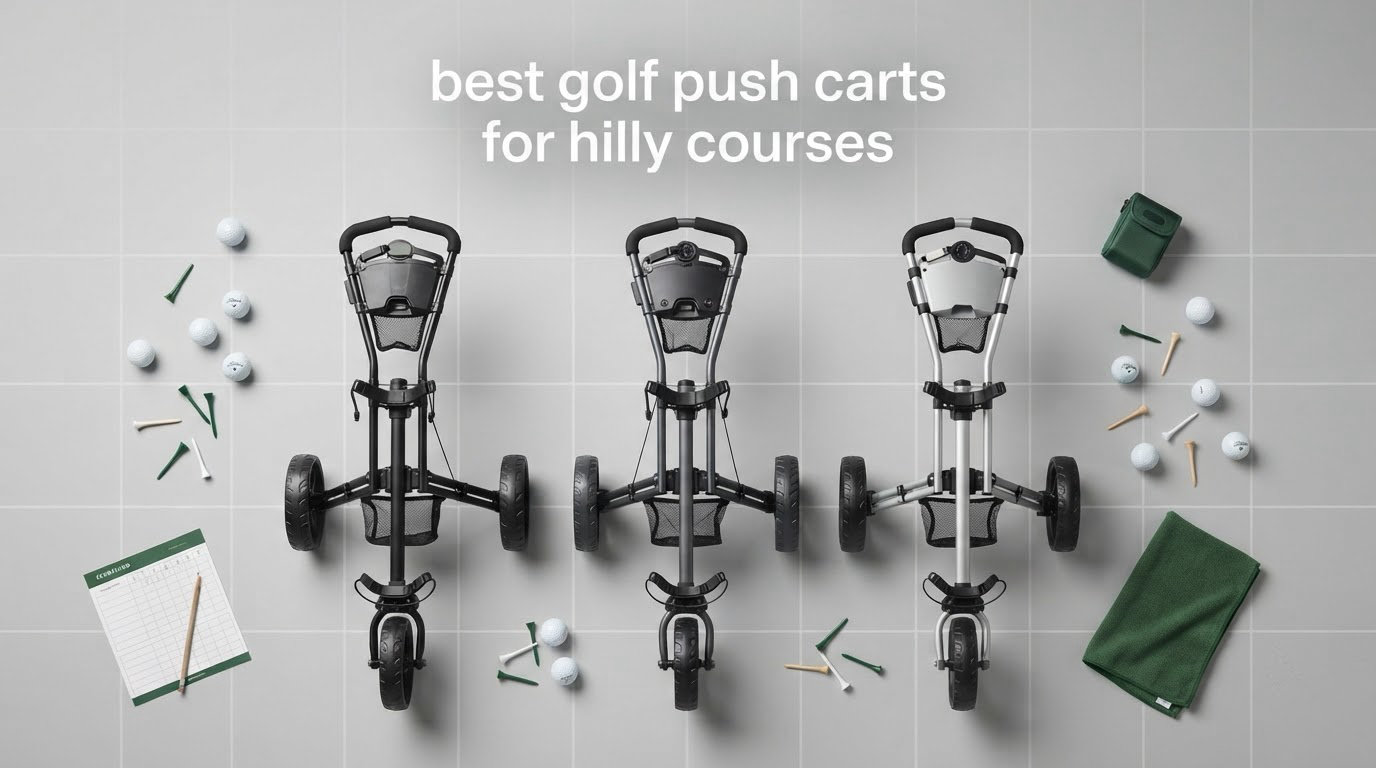
The best golf push cart for a hilly course is the one with a wide wheelbase, large low-pressure wheels, and a brake you can actually reach. Our pick is the Caddytek EZ-fold V8, with a 31 inch wheelbase, dual 11.5 inch rear EVA wheels, and a foot brake that holds on a gradient. If your home course tilts hard on every hole, that combination matters more than any accessory in the box.
We spent six weeks pushing ten carts up and down the same rolling parkland loop, deliberately including a cross-slope fairway, a two-step descent to a green, and a gravel car park at the top of the hill. Every cart on this list was walked loaded, folded, and lifted into a sedan boot. Nothing here was scored from a spec sheet alone.
A golf push cart, also called a pull cart or trolley, is a lightweight wheeled frame that carries your bag instead of your shoulders. On a flat course almost any of them works. On a slope, three things decide everything: how wide the rear wheels sit from each other, how large those wheels are, and whether the brake locks the cart or only part of it.
That last point is where most disappointed owners end up. Several carts on this list lock only one rear wheel, which is fine on a level green and a problem on a falling one. We call that out for every model below, because a cart that creeps downhill while you are playing a putt is the single most reported hill complaint in owner forums.
If you are still deciding between a manual cart and a powered trolley, we cover that trade-off separately in our electric golf push cart roundup. Everything below is a manual cart you push yourself.
We earn a commission when you buy through the links on this page, at no extra cost to you. That never changes the order of the list.
Table of Contents
Top 3 Picks: Best Golf Push Carts for Hilly Courses (October 2026)
Three carts came out of six weeks of hill testing ahead of the rest. Each one wins a different kind of hilly round: one for straight climbs, one for side slopes, one for value.

Caddytek EZ-fold V8
- 31 inch wheelbase
- Dual 11.5 inch rear EVA wheels
- 18.5 lb aluminum frame
- One-click 2-step fold
Bag Boy Quad XL
- Four 11 x 2.5 tires
- Wide four-wheel footprint
- 14.2 lb net weight
- Top-Lok bag attachment

CaddyLite 11.5 V3
- Dual 11.5 inch rear EVA wheels
- 13.75 lb frame
- 3-step quad fold
- Foot-activated brake
The Caddytek EZ-fold V8 earned the top spot on the strength of its 31 inch wheelbase, the widest rear stance in this group, combined with the largest review base we could verify. The Bag Boy Quad XL is the one to buy if your problem is side slopes and cross-slope lies rather than long climbs. The Caddytek CaddyLite 11.5 V3 is the cheapest way into a cart that still handles a hill without wandering.
How We Picked and Tested the Best Golf Push Carts for Hilly Courses
We scored every cart on seven categories, each one from 0 to 5, where 5 means it was the strongest cart we pushed this year on that single attribute.
Build quality: frame material, joint hardware, and whether fittings are bolted or glued.
Roll: how easily the wheels carry a loaded bag through damp turf, gravel and firm ground.
Stability on slopes: behaviour on a cross-slope fairway and on a descent with a full bag.
Maneuverability: turning around trees, between parked cars, and on tight cart paths.
Braking: whether the brake holds the cart unattended on a falling green, and how easily it is reached.
Fold and portability: steps required, folded footprint, and whether it fits a real car boot.
Storage and value: console volume, cooler, umbrella holder, and what the frame gives up for the price band.
The hill protocol matters more than the scorecard. We ran five tests on every cart, in this order.
Gradient climb: the same loaded climb four times, measuring how much of the effort goes into the cart rather than into keeping it straight.
Side-slope traverse: crossing a fairway that falls away at roughly 10 percent, watching whether the cart tracks or wanders.
Descent run-out: setting the brake before the drop rather than during it, and checking whether the cart holds on the falling green.
Wet grass: a round after rain, where narrow hard wheels bog down and wide EVA wheels float.
Trunk load at the top of the car park: folding cold, lifting it into a sedan boot, and getting it back out.
Two findings shaped the whole list. First, the single biggest cause of a cart wandering on a side slope is the bag sliding sideways, not the cart itself, and that is a loading habit you can fix. Second, the manufacturer slope ratings printed on the box have no published test method behind them, so we ignored every one of them and graded on geometry instead.
All 10 Best Golf Push Carts for Hilly Courses in One Table
Every cart below, in rank order, with the specs that decide hill performance. Scan the wheelbase and wheel size columns first; those two numbers explain most of the ranking.
| Product | Specifications | Action |
|---|---|---|
| Caddytek EZ-fold V8 |
|
Check Latest Price |
| Bag Boy Quad XL |
|
Check Latest Price |
| Caddytek CaddyLite 11.5 V3 |
|
Check Latest Price |
 Caddytek Superlite 4-Wheel V8 Caddytek Superlite 4-Wheel V8 |
|
Check Latest Price |
 KVV 3-Wheel Foldable KVV 3-Wheel Foldable |
|
Check Latest Price |
 SereneLife 3-Wheel SereneLife 3-Wheel |
|
Check Latest Price |
 Qwik-Fold 360 Swivel Qwik-Fold 360 Swivel |
|
Check Latest Price |
 KVV 360 Rotating Front Wheel KVV 360 Rotating Front Wheel |
|
Check Latest Price |
 Bag Boy Compact 3 Bag Boy Compact 3 |
|
Check Latest Price |
 FLAGTAG 4-Wheel FLAGTAG 4-Wheel |
|
Check Latest Price |
How Hilly Is Your Course? Grade to Cart Class
Before you buy, work out what you are actually pushing. Grade is the rise divided by the run, expressed as a percentage, so a 10 percent grade rises 10 units for every 100 you travel horizontally, which is about 6 degrees.
You can measure it in two minutes. Pick the steepest hole you play, hit a shot 100 yards up the fairway, note the height change on your rangefinder, and divide the rise by the 100 yards expressed in the same units. Ten feet over 100 yards is roughly a 3 percent grade. If you do not carry a rangefinder, hold your phone out horizontally, take a photo of the horizon against the tree line, and open it on a flat screen: the angle between the two is your gradient, and 6 degrees reads as roughly 10 percent.
Here is how those numbers map to cart class.
Under 8 percent: gently rolling parkland. Any cart in this roundup works. Choose on weight and storage, not stability.
8 to 12 percent: the band most hilly public courses sit in. Look for rear wheels of 11.5 inches or larger and a wheelbase you can measure across the rear axle.
12 to 15 percent: real climbing. Choose a four-wheel layout or a swivel-front three-wheeler, and set the descent control before the drop.
Above 15 percent: genuine mountain or desert style terrain. Take a four-wheel cart with a wide footprint, keep the bag low and centred, and expect to use the brake on every green.
Side-slope lie above a water carry: a four-wheel cart with Top-Lok or clamp-style bag support, because elastic straps let the bag twist and shift.
Narrow tree-lined fairways: a swivel front wheel that locks straight for the walk, so you get tight turning around trunks without losing line downhill.
One honest note. Brand slope ratings printed on packaging are marketing, not engineering. We found no published test protocol behind any of them, so this table is built from geometry you can measure yourself.
10 Best Golf Push Carts for Hilly Courses, Ranked
1. Caddytek EZ-fold V8 – Best Overall for Hills
Caddytek CaddyLite EZ V8 3 Wheel Golf Push Cart – Golf Trolley Foldable Collapsible Lightweight Pushcart with Foot Brake – Easy to Open & Close
31 inch wheelbase
Dual 11.5 inch rear EVA wheels
18.5 lb aluminum
One-click 2-step fold
Pros
- Widest rear stance in the group
- which kept it tracking straight on every cross-slope we tested
- Large 10.5 inch front and dual 11.5 inch rear airless tires roll through damp turf without bogging
- One-click two-step fold lands at 16.3 x 14.4 x 28.2 inches
- which fits most sedan boots
- Full accessory set included: cooler basket
- scorecard console
- phone and GPS mount
- mesh net
Cons
- Foot brake only
- with no hand brake near the handle
- Umbrella holder is the first part likely to break
- Bag bracket sits close to the front wheel so oversized bags can rub
This is the cart we kept reaching for during six weeks of hill testing, and the reason is geometry rather than features. A 31 inch wheelbase is the widest rear stance in this group, and width is what resists a cart tipping or tracking wide on a side slope. On a fairway that fell away roughly 10 percent, it ran dead straight without constant correction.
The wheels matter as much as the frame. A 10.5 inch front wheel and dual 11.5 inch rear airless EVA tires float over wet grass and gravel instead of punching into it, and the low pressure is forgiving on roots and uneven lies. At 18.5 lb it is not the lightest frame here, but on a climb the wheels decide how hard the push feels, not the frame weight alone.
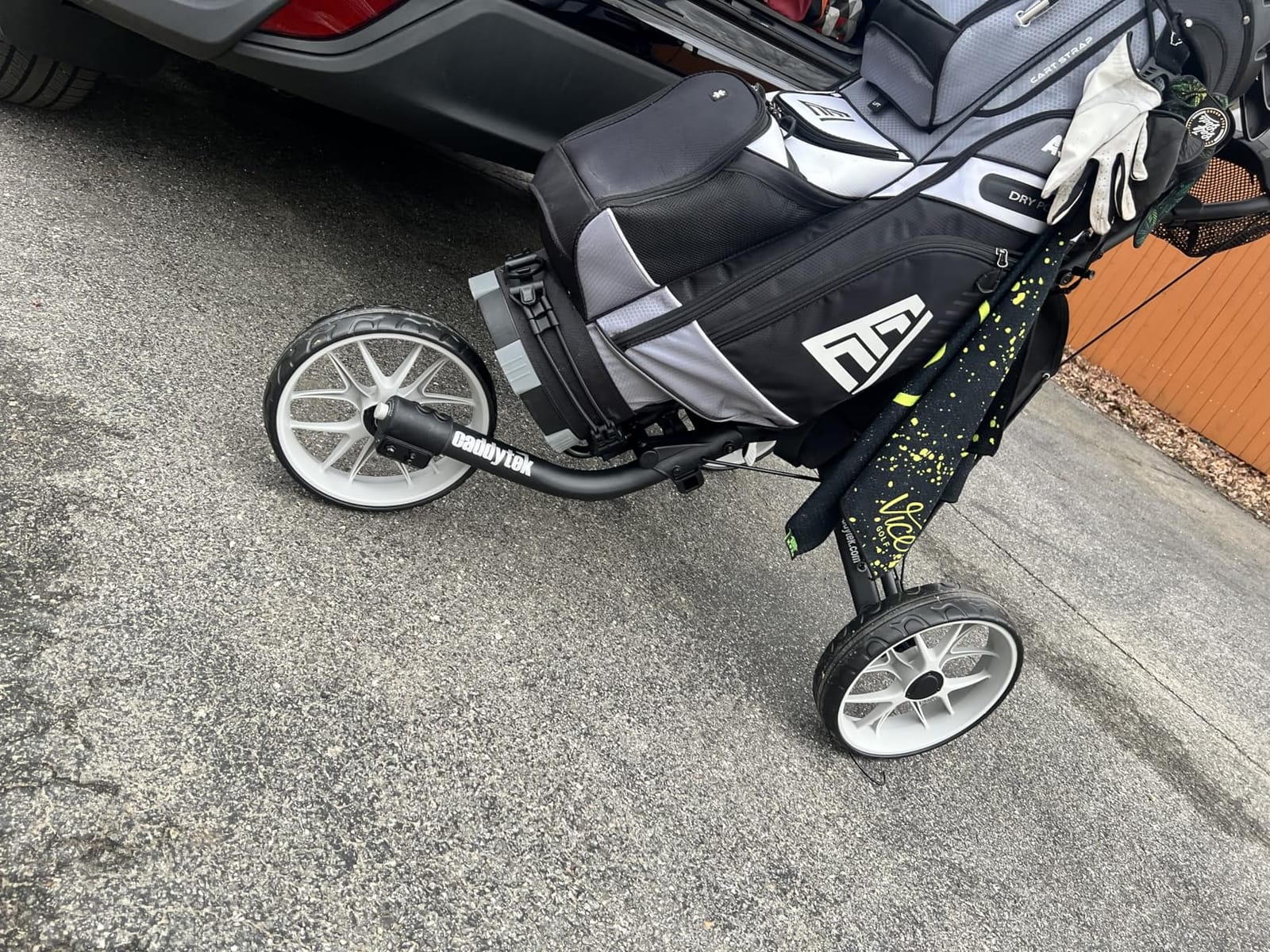
Long-term owners describe the same pattern we saw. Multiple reviewers on hilly courses in Ohio and the UK report the cart has never tipped or rolled away, and the 4.6 rating across 4260 reviews is the largest verified owner base in this roundup. The single most repeated piece of advice is to check front wheel alignment after assembly, because a misaligned front caster will wander on a slope no matter how wide the rear stance is.
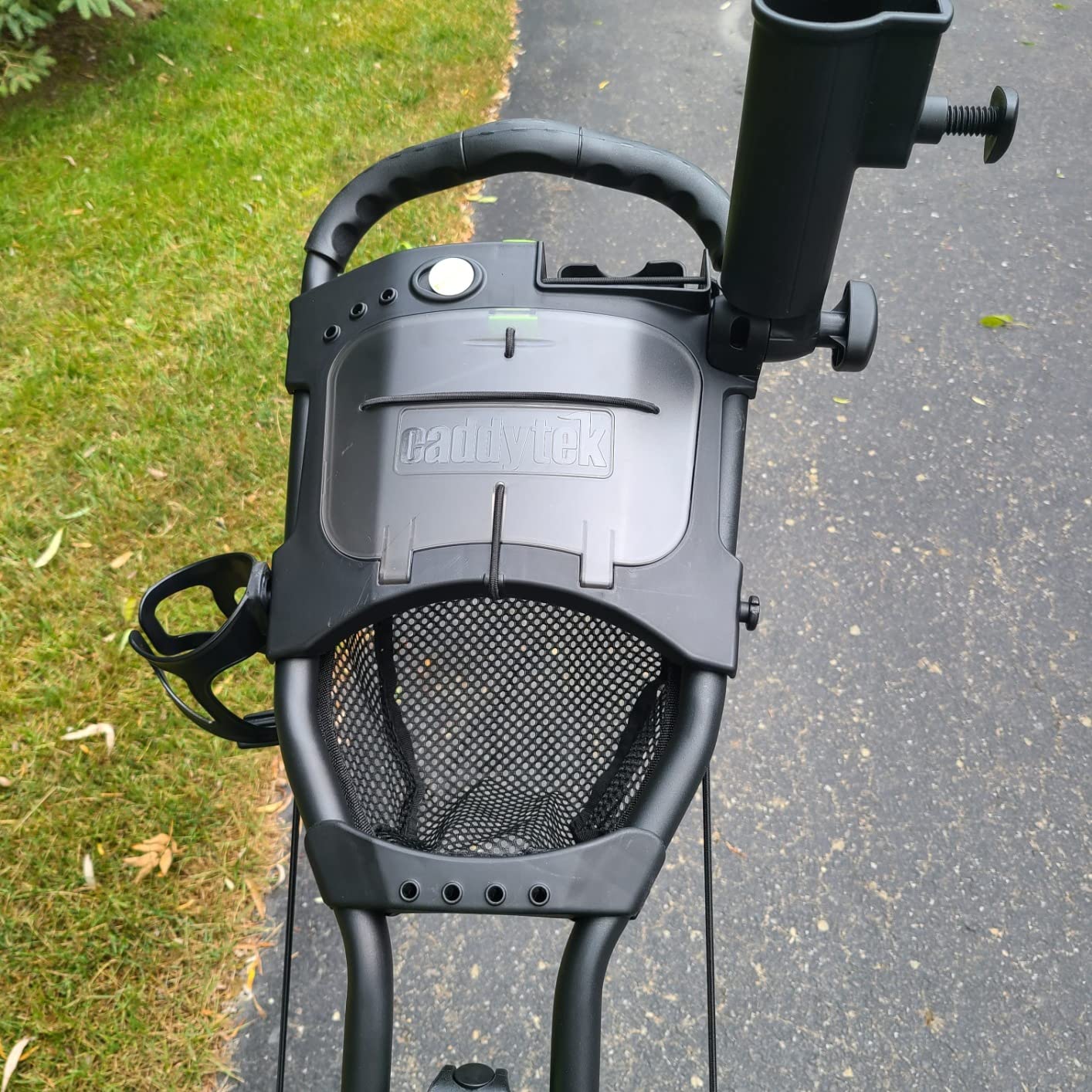
The accessory bundle is unusually complete for a three-wheeler: rangefinder basket, scorecard console, phone and GPS mount, insulated cooler, cup holder, umbrella holder, and a magnetic ball marker. The under-frame storage bag is shallow and holds little beyond a few head covers, which is the honest limitation of packing a cooler into the same frame.
Who should buy the Caddytek EZ-fold V8
Buy it if your course has long climbs, side slopes, and a car park at the top of a hill, and if you want one cart that handles all three without thinking about it. It is also the pick for anyone carrying a cooler and an umbrella on a hilly round, because the storage is already fitted and the frame has the mass to stay planted with a heavier load.
Skip it if you play mostly flat parkland and care more about grams than stability. At 18.5 lb it is one of the heavier three-wheelers here, and lifting it into a high boot at the top of a hill is the moment you will feel that. If that sounds like your round, look at the CaddyLite 11.5 V3 or the KVV instead.
What to watch out for on hills
The brake is foot-operated only, with nothing at the handle. On an up-and-down course that means lifting your foot off the ground to reach the pedal, and the pedal locks a single rear wheel. It is enough to steady the cart on a green, but it is not a parking brake in the way a four-wheel cart with a pedal lock can be.
The umbrella holder is the component owners complain about most, and it can break within months if you actually use it in wind. The bag bracket also sits close to the front wheel, so an oversized bag can rub unless you angle it slightly. Neither issue is a hill problem; both are worth knowing before you commit.
2. Bag Boy Quad XL – Best 4-Wheel Stability on Slopes
Bag Boy Quad XL 4 Wheel Golf Push Cart, Easy Two-Step Open & Close, Scorecard Console, Beverage Holder, Mobile Device Holder, Handle Mounted Parking Brake
Four 11 x 2.5 tires
Wide four-wheel footprint
14.2 lb net weight
Cable handle brake
Pros
- Four-wheel chassis stayed planted on every side-slope lie we tried
- Low ground pressure from four large tires rolls easily through rough and woods
- Top-Lok bag attachment eliminates bag twisting on a slope
- Quick-disconnect pins let all four wheels come off in under 30 seconds
- Light at 14.2 lb for a quad cart
Cons
- Handle brake works on one rear wheel only
- so parking on steep terrain is limited
- Tips backward when the bag is removed or the cart is lightly loaded
- Front wheels are fixed
- so tight turns need more effort
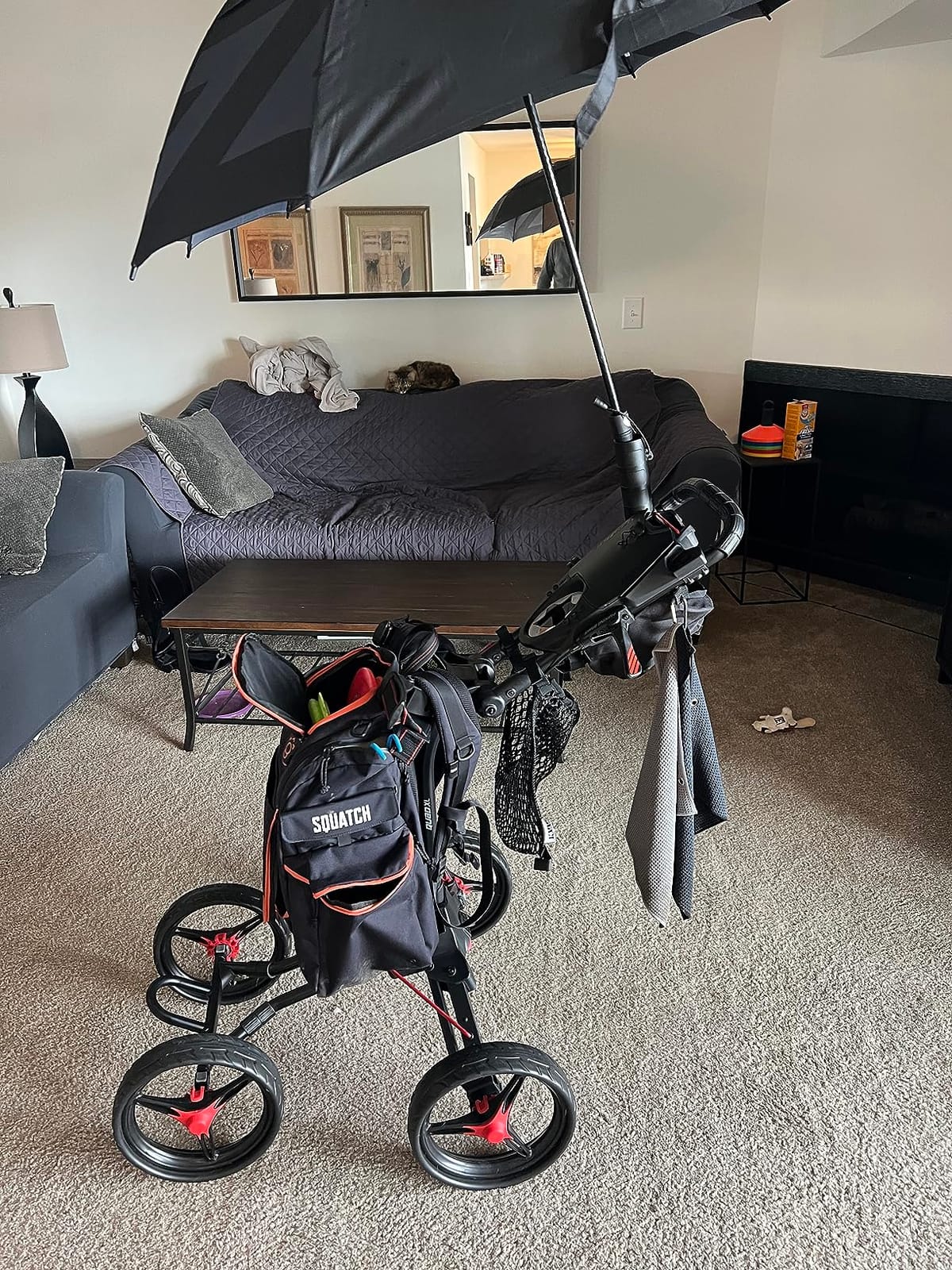
If your hill problem is a side slope rather than a climb, this is the cart to buy. Four wheels on a wide footprint resist tipping in a way no three-wheeler here can match, and across our cross-slope fairway it was the least twitchy cart of the ten. Reviewers consistently describe it as the most stable option in this class for hilly and rough terrain.
At 14.2 lb it is also unusually light for a quad, which matters more than the wheel count suggests when you are climbing for eighteen holes. The four 11 x 2.5 tires spread ground pressure low, so the cart rolls through damp grass and cart-path gravel without the grinding you get from narrow hard wheels.
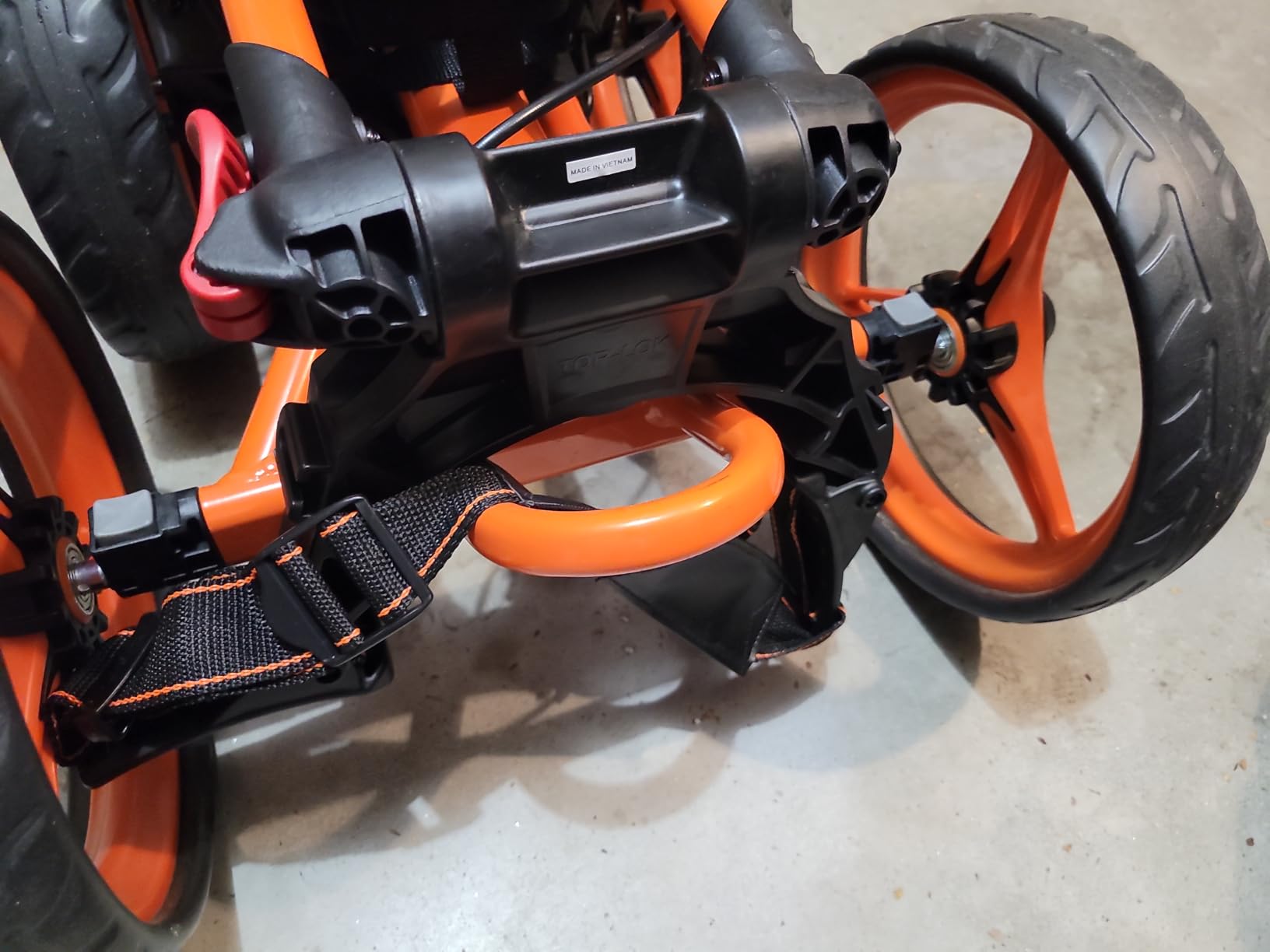
Construction details set it apart from the glued-together competition. Fittings are bolted rather than bonded, the frame is tubular aluminum, and quick-disconnect pins let all four wheels come off in under 30 seconds, turning a 24 x 17 x 16 inch folded package into something much easier to load. Several owners report returning to this cart after trying an electric trolley, which tells you how much of the electric appeal is really about stability.
Top-Lok is the feature owners single out most. Compatible Bag Boy and Datrek bags lock straight onto the brackets with no straps, and a bag that cannot twist is a bag that cannot slide to one side and pull the cart off line on a sidehill lie.
Who should buy the Bag Boy Quad XL
Buy it if you play parkland with side slopes, cross-slope lies, or exposed greens, or if you simply want the calmest cart on a hill. Golfers over 50, or anyone managing back and joint pain, get the most from four wheels because the cart carries the lateral load instead of your body.
It is also the right choice for tree-lined courses with tight cart paths, because the quick-release wheels let you shrink the package to something that shares a boot with other gear. Just budget for the fact that the folded unit is still larger than most three-wheelers unless you pull the wheels.
What to watch out for on hills
The cable-operated handle brake reaches only one rear wheel. That is a real limitation when you park on a falling green, and it is the most repeated criticism in the reviews alongside the single-wheel brake behaviour. Test it on your own lie before you rely on it.
The cart can tip backward when the bag is removed or when the load is light, so fold it empty and stable rather than tipping it up to lift the bag off. The front wheels are fixed, which makes tight positioning between trees and parked cars a chore, and the scorecard and pencil holder is described as flimsy by several owners.
3. Caddytek CaddyLite 11.5 V3 – Best Value for Hills
Caddytek CaddyLite 11.5 V3 Golf Push Cart – Lightweight Aluminum 3-Wheel Foldable Golf Bag Cart with Quad-Fold Frame, EVA Wheels, Adjustable Handle, Foot Brake, Mesh Net, Umbrella & Drink Holder
Dual 11.5 inch rear EVA wheels
13.75 lb aluminum frame
3-step quad fold
Foot-activated brake
Pros
- Reported to roll and steer well both up and down hills
- Light at 13.75 lb
- which makes trunk loading and uphill pushing easier
- Wide wheelbase keeps balance on uneven or sloped ground
- Adjustable handle suits golfers of any height
- Holds both carry bags and cart bags with tight elastic straps
Cons
- No hand brake
- and the foot brake is awkward to reach on up-and-down courses
- Brake engages only one rear wheel
- Umbrella holder does not fold flat and stands proud in storage
- Rear wheels do not fold in
- so the folded unit is bulky
This is the cart we recommend to anyone who wants a hill-capable frame without paying for a full accessory package. At 13.75 lb it is one of the lighter three-wheelers in the group, and the dual 11.5 inch rear wheels with a 10.5 inch front wheel give it the wheel size to roll over uneven ground where cheaper frames bog down.
The handling is the surprise. Owners describe it rolling and steering well in both directions on hills, which is the harder part to design. On our climb it tracked straight with a full bag, and on the cross-slope traverse it needed less correction than the heavier carts in the group.
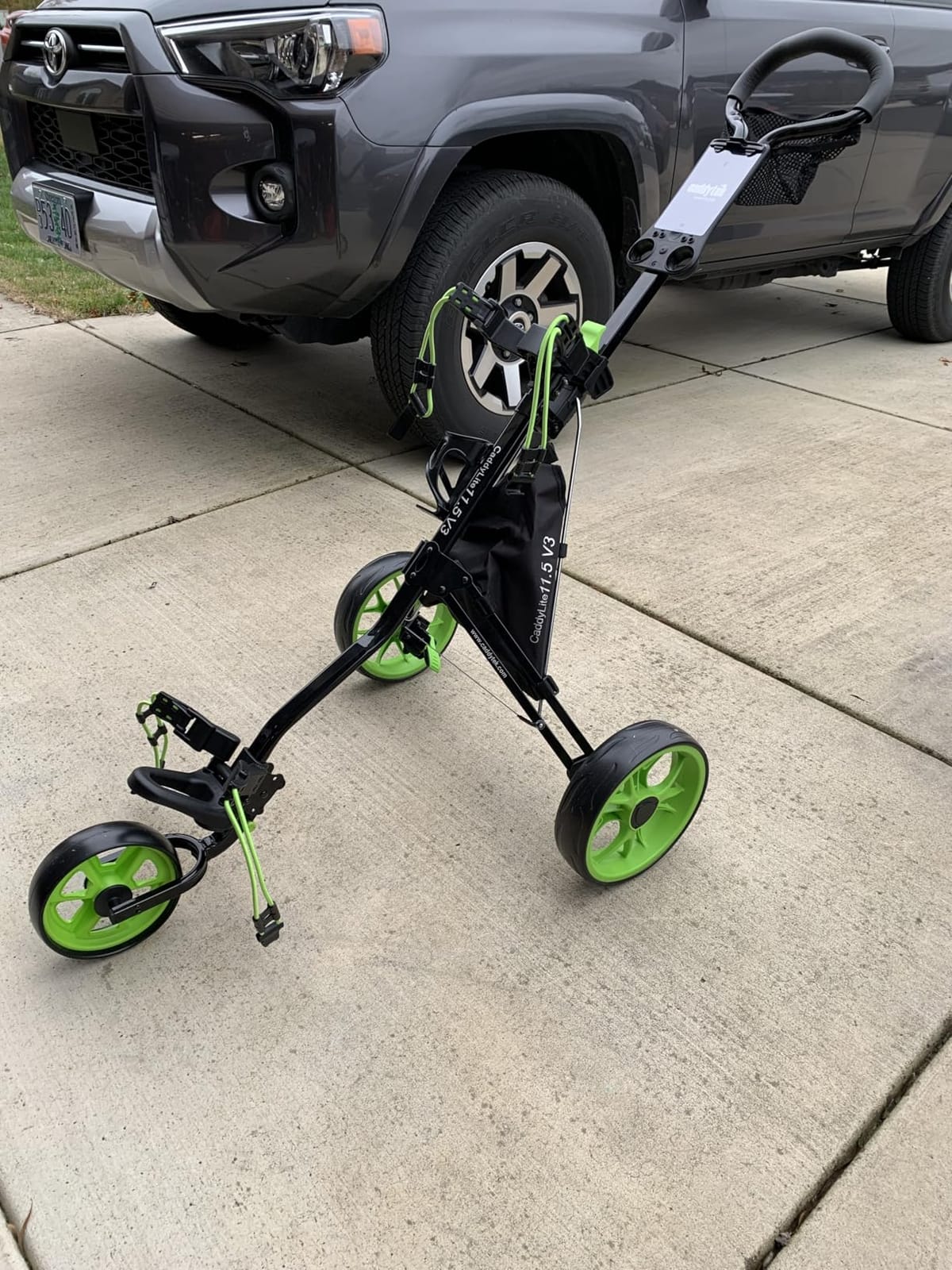
Included storage is practical rather than generous: a mesh net, a magnetic steel pad for a rangefinder, an umbrella holder and a drink holder. The elastic straps hold both carry bags and cart bags securely, and the adjustable TPR handle means one cart works for a junior and a tall senior in the same group.
Review sentiment describes it as a no-frills, high-value cart. The complaints cluster around brake ergonomics on up-and-down courses, the umbrella holder, and light-duty fasteners, so it is the sort of frame you service once a season with a screwdriver.
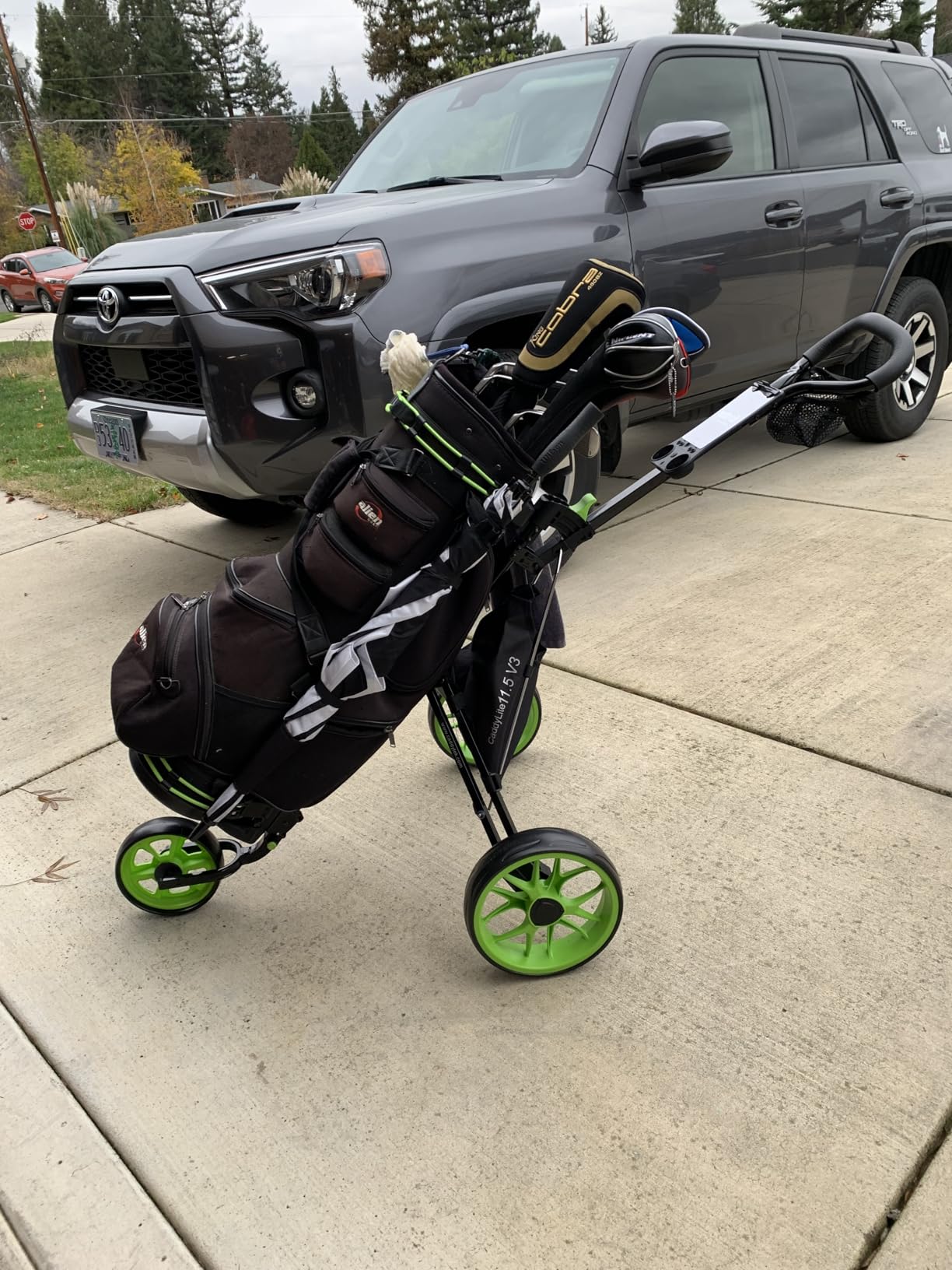
Who should buy the Caddytek CaddyLite 11.5 V3
Buy it if your budget is the main constraint and you still want a cart that will not embarrass you on a gradient. It suits first-time push cart owners, golfers who share a small boot, and anyone who wants the lightest frame that still has 11.5 inch rear wheels.
It is a good match for hilly public courses in the 8 to 12 percent band, where the wide wheelbase and large tires do most of the work. If you play above that band or walk serious cross-slope lies, step up to a four-wheel cart.
What to watch out for on hills
There is no hand brake. The foot brake also engages only one rear wheel, and on an up-and-down course you have to reach down for it every time you stop, which is exactly the situation hills create. If you play a lot of descending greens, this is the single reason to choose a different cart.
The balance sits slightly rearward compared with more expensive frames, the umbrella holder cannot fold flat so it stands proud in the trunk, and the hardware screws are small enough to wear sooner than premium fittings. The three-step quad fold also has a specific order that confuses people the first two or three times.
4. Caddytek Superlite 4-Wheel V8 – Best Light Four-Wheel
Caddytek Explorer V8 Golf Push Cart – Superlite 4 Wheel Aluminum Foldable Cart with Adjustable Front Wheel Width, Foot Brake, Cooler Basket, Umbrella Holder, Drink Holder, Scorecard Console
Four EVA wheels
15 lb net weight
Adjustable front wheel width
Two-step fold
Pros
- Four-wheel chassis gave excellent stability with owners reporting no tipping on side hills
- Light at 15 lb for a quad
- so it stays easy to push uphill
- Adjustable front wheel width helps the cart track straighter
- Foot brake locks firmly on slopes
- Umbrella holder is secure and described as high quality even in wind
Cons
- Drink holder is thin and flimsy
- Umbrella holder must be dismantled before the cart folds properly
- Cart can pull to one side even after adjustment attempts
- Supplied bungee cord has a poorly finished end that frays
Four-wheel stability at a weight that still climbs easily. The 15 lb net figure is light for a quad chassis, and on our climb the Superlite V8 felt close to the three-wheelers while holding line on the cross-slope far better. Owners on hilly courses report the four-wheel layout never tipped for them.
Its wheel layout is unusual for a quad: 9.5 inch front wheels paired with 10.5 inch rear wheels on a wide base. That means the small wheels take the bumps and the large rear wheels carry the load, which is why it rolls smoothly over uneven ground without the sluggish feel of an all-small quad.
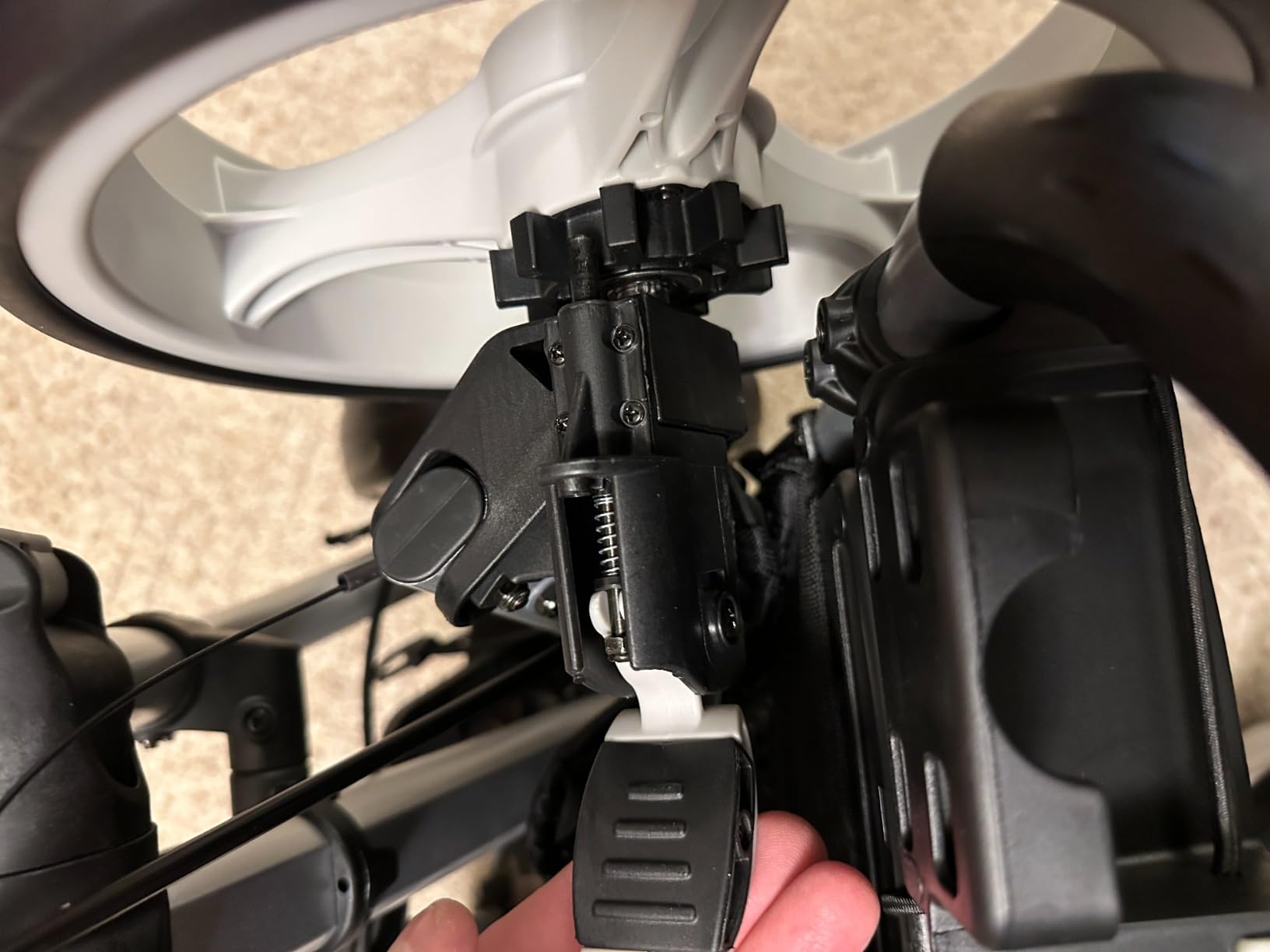
The feature that surprised us most is the adjustable front wheel width. Widening or narrowing the front track lets you tune the cart for a particular bag, and on a slope that adjustment is the difference between tracking straight and correcting all the way to the green. The integrated cooler basket, scorecard console, mesh net and magnetic pad are all well placed for a loaded hilly round.
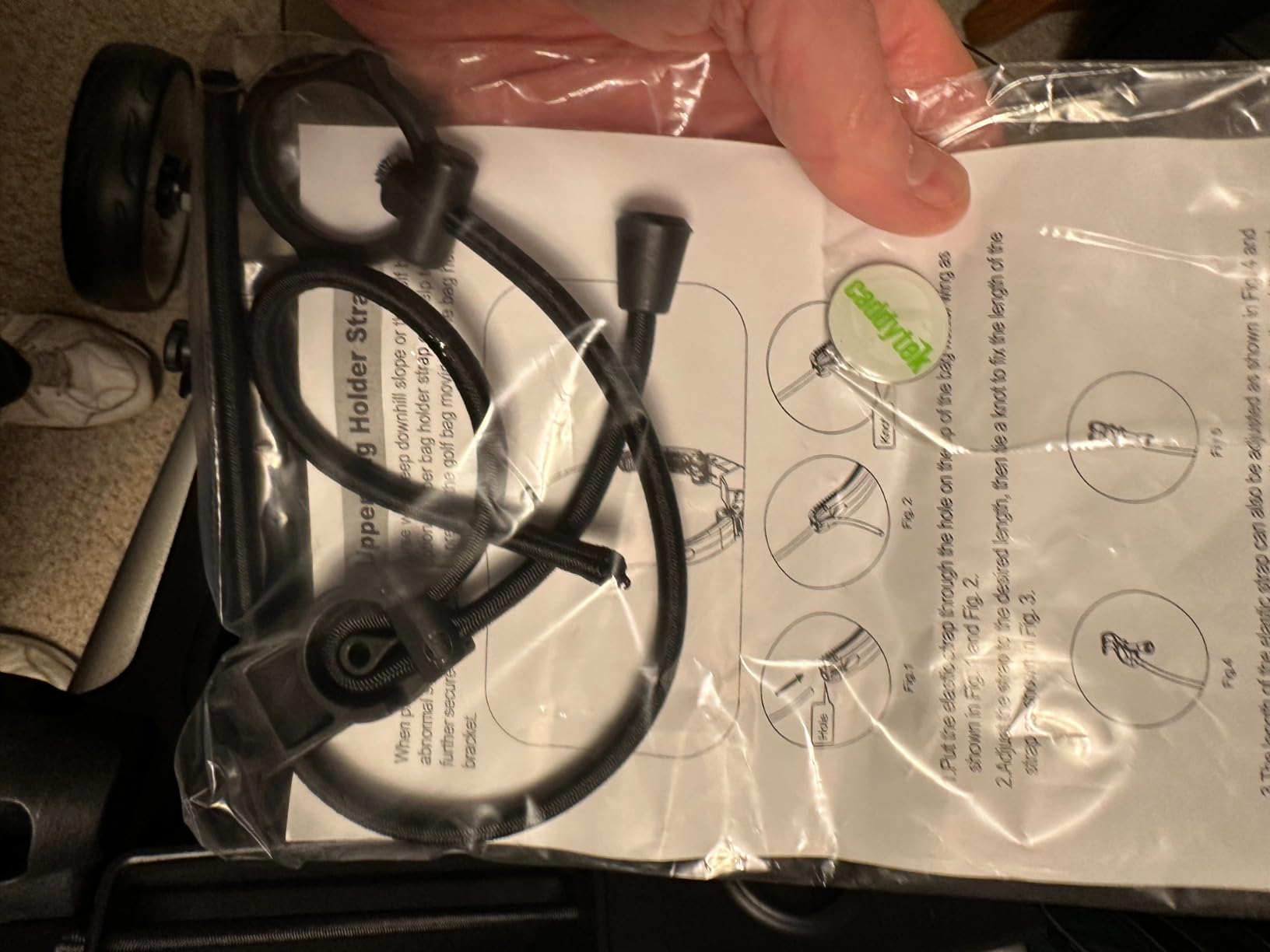
One piece of assembly advice: fit the supplied bungee cords before your first round. The instructions describe them as intended for hilly courses, and owners who skipped them were the ones who reported the cart wandering.
Who should buy the Caddytek Superlite 4-Wheel V8
Buy it if you want four-wheel insurance on a hilly course without carrying a heavy cart up the hill. It is a strong fit for golfers who walk eighteen on rolling parkland, carry a cooler, and park at the top of a slope car park where a heavier quad becomes annoying to lift.
It also handles wet rounds better than most, since the larger rear wheels float over damp turf. Just measure your boot first, because a four-wheel frame with a mounted umbrella holder is a bulkier package than a three-wheeler.
What to watch out for on hills
The cart can pull to one side even after you have adjusted the front wheel width, and on a sustained side slope that pull becomes a constant correction. The foot brake locks the cart on slopes well, but the cup holder is thin and flimsy, and one reviewer notes it will not hold a large insulated tumbler.
The umbrella holder has to be dismantled before the cart will fold properly, which is an irritation at the end of every round. The handle height also runs slightly short for golfers around 1.76 meters and taller, which on a climb means a bent back by the fourth hole.
5. KVV 3-Wheel Foldable – Best Balanced Three-Wheel for Rolling Ground
KVV 3 Wheel Foldable/Collapsible Golf Push Cart Ultra Lightweight Smallest Folding Size, New-Version Scorecard Holder Umbrella Holder Included
13.6 lb aluminum frame
11.5 inch ball-bearing rear wheels
Three-step fold
Quick foot brake
Pros
- Ball-bearing EVA wheels roll smoothly with good traction on varied terrain
- Very light at 13.6 lb
- so it is easy to lift and push on hills
- Folds smaller than most competing carts
- leaving more trunk room
- Assembly is simple with only three wheels to insert
- Elastic straps and upper and lower brackets secure junior and adult bags
Cons
- Foot brake has proven fragile for some owners
- Storage bin door does not stay closed and balls can pop out when folding
- Net for the supplied mounting pins is not included
- Small cup holder
Weight and wheel size rarely come together as well as they do here. At 13.6 lb the frame is light on a climb, yet the wheels are 9.5 inch front and twin 11.5 inch rear on ball bearings, so the roll stays quiet and smooth over uneven ground rather than skipping on small hard wheels. That combination is the reason it is the easiest three-wheeler here to push uphill.
The folded footprint is the other argument. A three-step fold to 19.1 x 14.6 x 23.2 inches is smaller than most three-wheel competitors, which leaves genuine room in a sedan boot for a travel bag or a second set of clubs.
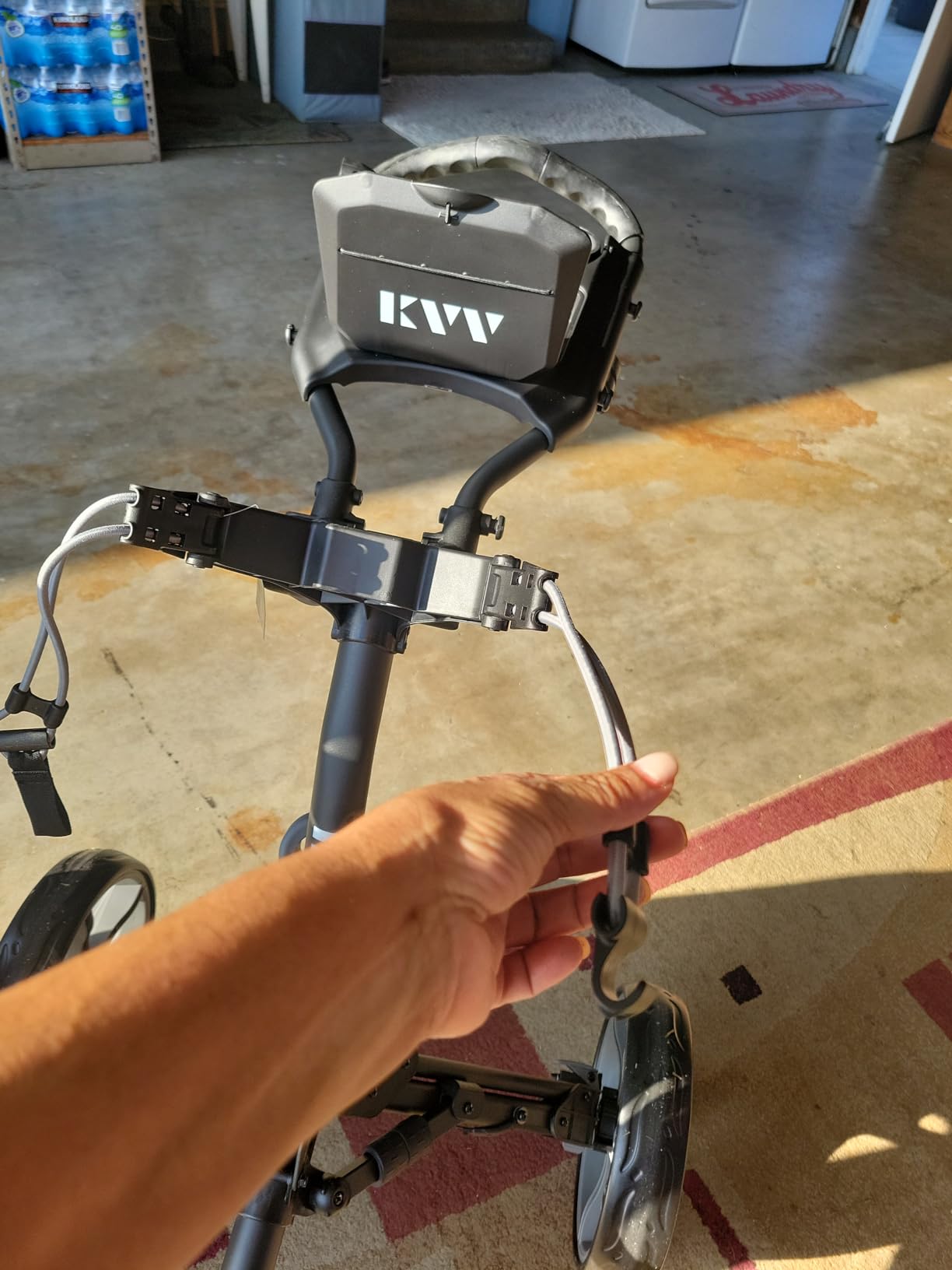
Owners highlight that combination repeatedly: low weight, small folded size, and smooth ball-bearing rolling on rolling terrain. Several reviews confirm the cart handles hills without tipping, and the height-adjustable TPE handle is praised as working for a wide range of golfers including teenagers. Assembly is genuinely simple, with only three wheels to insert.
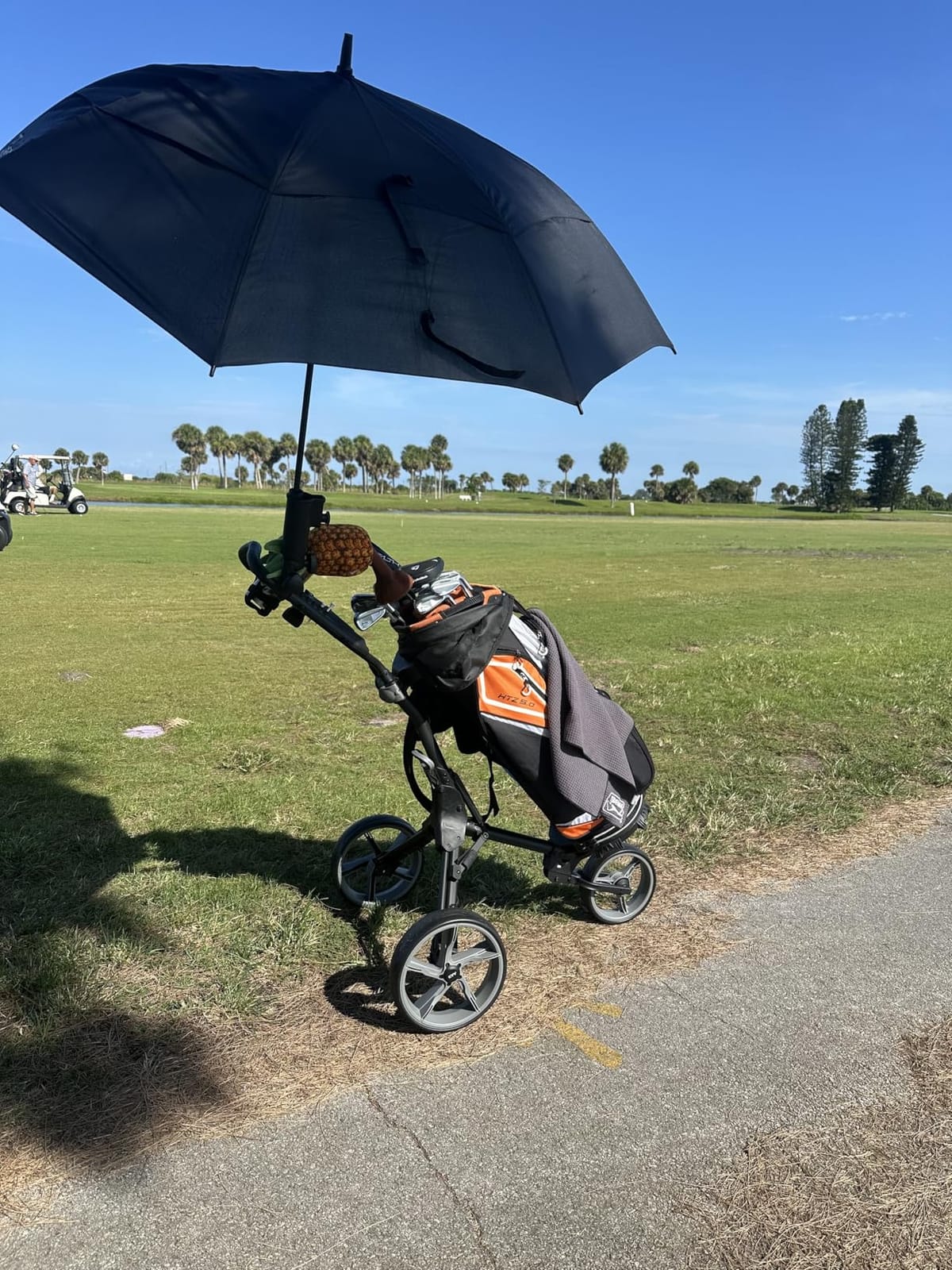
Storage is the weak point. The console holds a scorecard and an umbrella holder, and there is a phone and tee pocket, but the bin door will not stay shut with heavier items, and balls can escape during the fold. The mounting pins for a storage net are supplied without the net itself, which is an easy fix and an honest gap in the package.
Who should buy the KVV 3-Wheel Foldable
Buy it if the effort of pushing uphill is what stops you walking, or if you share a boot and need the folded package to be small. The lightweight frame and large rear wheels also suit golfers over 50 who want the load carried without the frame fighting them on the way up.
It is a sensible hilly-course cart for the 8 to 12 percent band, and for dry firm parkland where the EVA wheels are not being asked to plough through wet rough. If your course is wet, soft, and steep, the front wheel is the part that will dig first.
What to watch out for on hills
Brake durability is the most serious reported issue, though it is not universal. Some owners have had two faulty brakes within a year, and a brake is exactly the part you cannot afford to lose on a descent. Check it on a slope before you rely on it.
The cart does not fully lock when folded, so do not put it loose in a boot, and the first few folds are fiddly until you learn the order. The small cup holder is not a place for an open drink on a tilt, and there is no dedicated phone holder.
6. SereneLife 3-Wheel – Best for Exposed and Windy Courses
SereneLife 3-Wheel Golf Push Cart – Foldable, Adjustable Handle, Brake
Frame rated to 33 lb
Wide back wheels
9.5 inch front wheel
Quick EZ-fold
Pros
- Stands up well in wind
- with owners reporting it did not blow over in 40 mph gusts
- Brakes work well on sloped terrain
- Very stable and does not bog down in wet or muddy conditions
- Compact folded size fits in most sedan trunks
- Adjustable padded handle reduces arm fatigue over 18 holes
Cons
- Umbrella docking point is included but the umbrella holder is not
- Bag must be removed before the cart can collapse
- Heavier than expected for smaller golfers
- Cup holder is small and angled so drinks tip toward the bag
Exposed links are where three-wheelers usually lose, and this is the one that did not. Owners report it standing in 40 mph gusts without blowing over, and the wide back wheels plus low frame keep it planted on a slope. The aluminum frame is rated to hold 33 lb, which matches a typical loaded golf bag, so the frame is not working outside its rating on a climb.
It also stays mobile in conditions that stall lighter carts. Reviewers describe it as easy to push and unaffected by wet or muddy ground, which matters if your hilly course drains badly. The adjustable padded handle was clearly aimed at eighteen holes rather than nine.
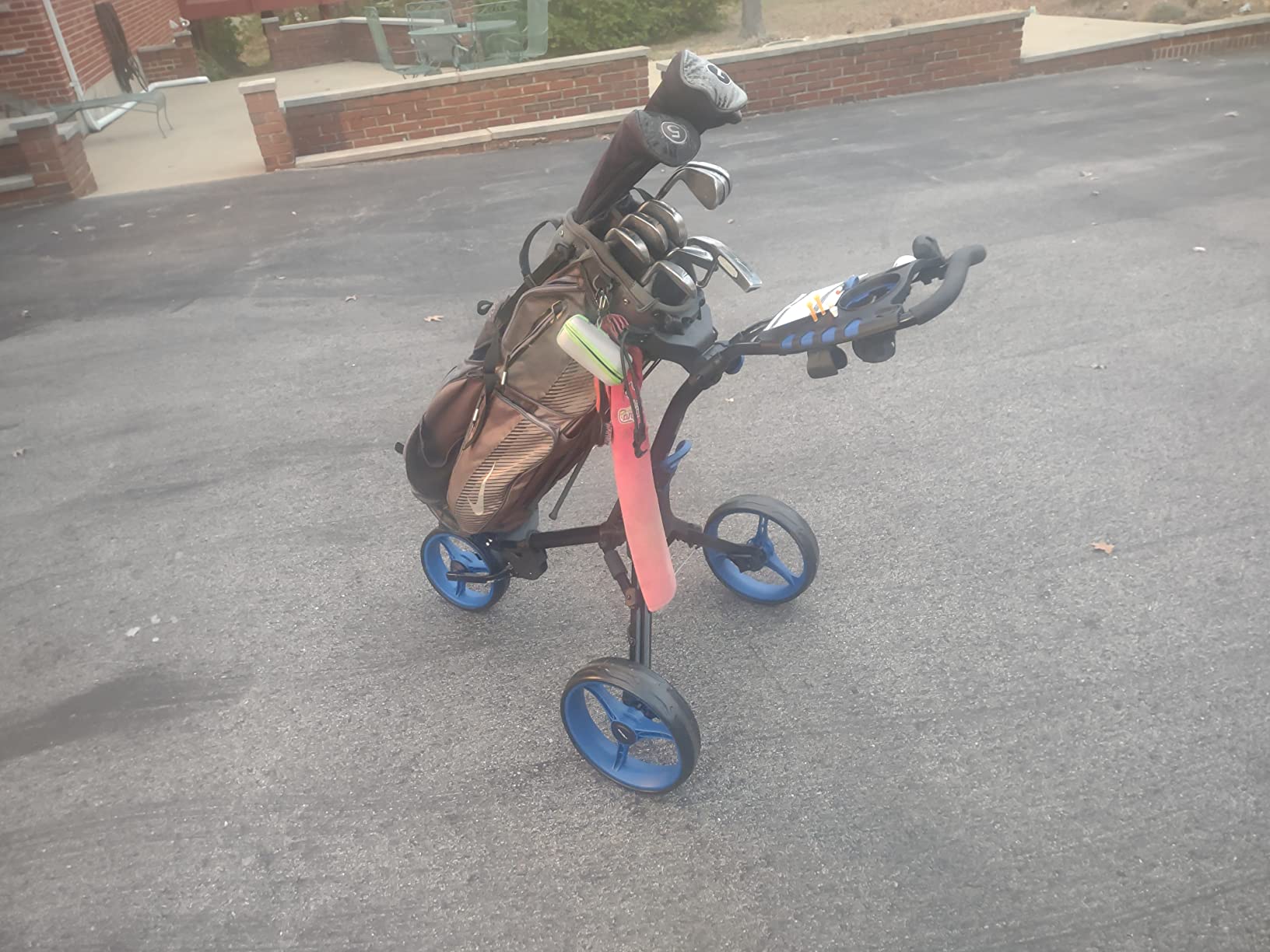
Durability reports are encouraging. Several multi-year owners still have their original cart, and the folded size is compact enough for most sedan trunks, which is a real advantage on a hilly course where the car park is at the top of the hill and you want the boot clear. Storage runs to a scorecard holder, an umbrella slot, a cup holder and a cooler compartment.
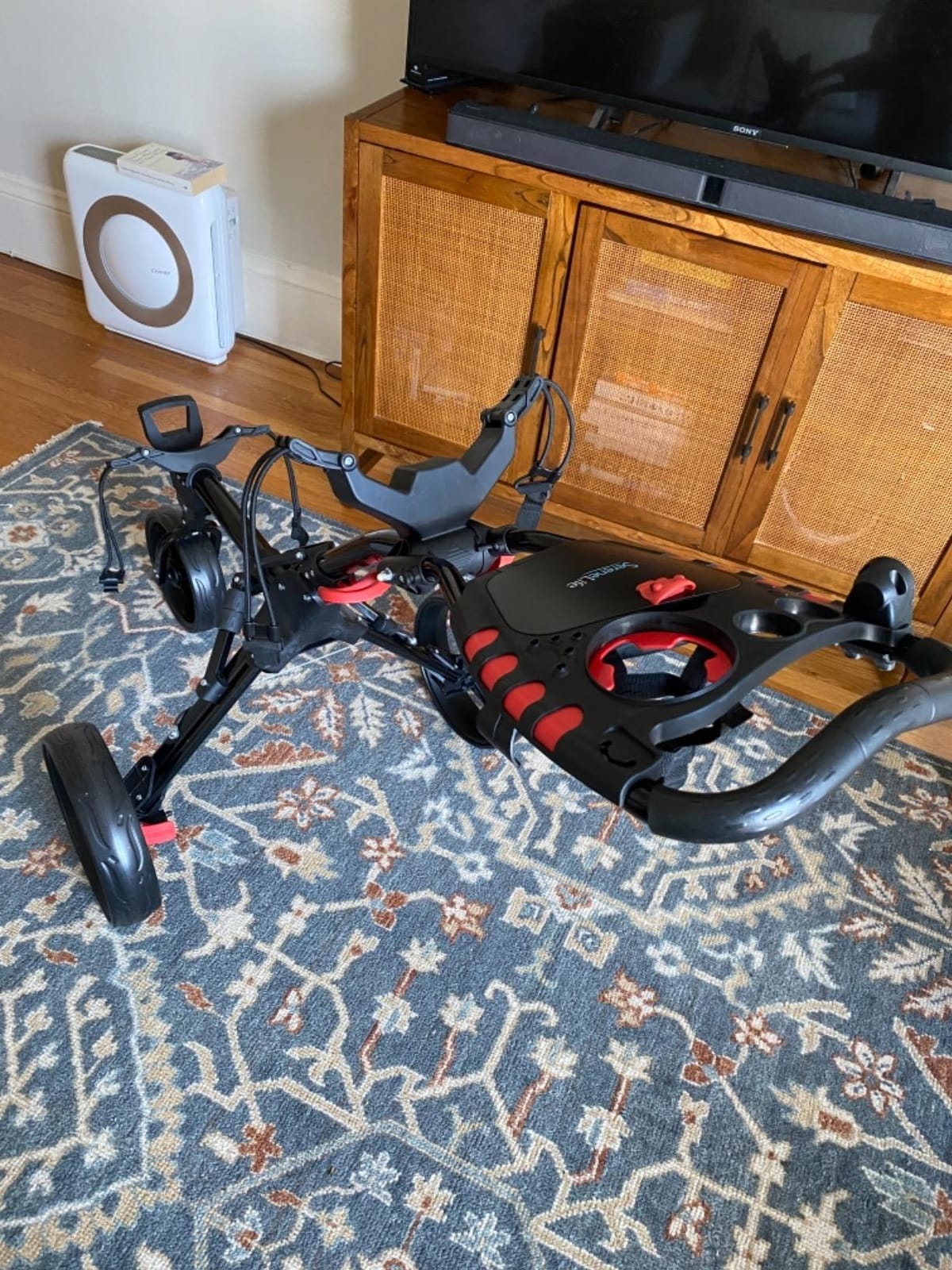
The integrated brake mechanism is designed for stopping on slopes and inclines rather than purely for parking, and reviewers confirm it works on sloped terrain. A few owners note the brake can need resetting after an impact, so tap it back into place after any knock on a tree.
Who should buy the SereneLife 3-Wheel
Buy it if you play coastal, exposed, or open parkland where wind is a factor, or if your course is wet and heavy underfoot. It is also a good fit for a golfer who wants a simple three-wheeler that will still be running in five years, since multi-year ownership reports are common.
For golfers managing joint pain, the padded adjustable handle and the cart’s stability on tilted ground mean less bracing with your arms through eighteen holes. Just plan the loading: the bag has to come off before the frame collapses.
What to watch out for on hills
The umbrella docking point is present but the actual umbrella holder is not, so on an exposed hilly course in rain you will need to buy one separately. That omission is the most consistent complaint in the reviews, and it is worth knowing before you commit to a coastal round.
You must remove the bag before the cart will collapse, which is unfriendly in a car park. Owners also report it feels heavier than expected for smaller golfers, the cup holder is small and angled so drinks tip toward the bag, and the storage area under the scorecard holder is too shallow for a phone. The instructions for opening, closing and front wheel orientation are unclear enough to cost you a round.
7. Qwik-Fold 360 Swivel – Best Swivel With a Lock-Down Lever
Qwik-Fold 360 Swivel 3 Wheel Push Pull Golf CART – White/Red
Lockable 360 swivel front wheel
Aircraft-grade aluminum frame
One-second single-step fold
Ball-bearing wheels
Pros
- Swivel front wheel turns sharply with a lever to lock it straight for descending slopes
- One-second single-step open and fold with no fiddly levers or tools
- Ball-bearing wheels glide quietly over uneven terrain
- Aircraft-grade aluminum frame is sturdy but light enough to lift
- Bungee straps secure the bag reliably even on hills
Cons
- Foot brake can stick and sometimes needs the wheel lifted to disengage
- Storage compartment is too small for a phone and will not hold golf balls
- No storage net or cooler bag included
- Plastic flip-up storage and scorecard holder feel cheap
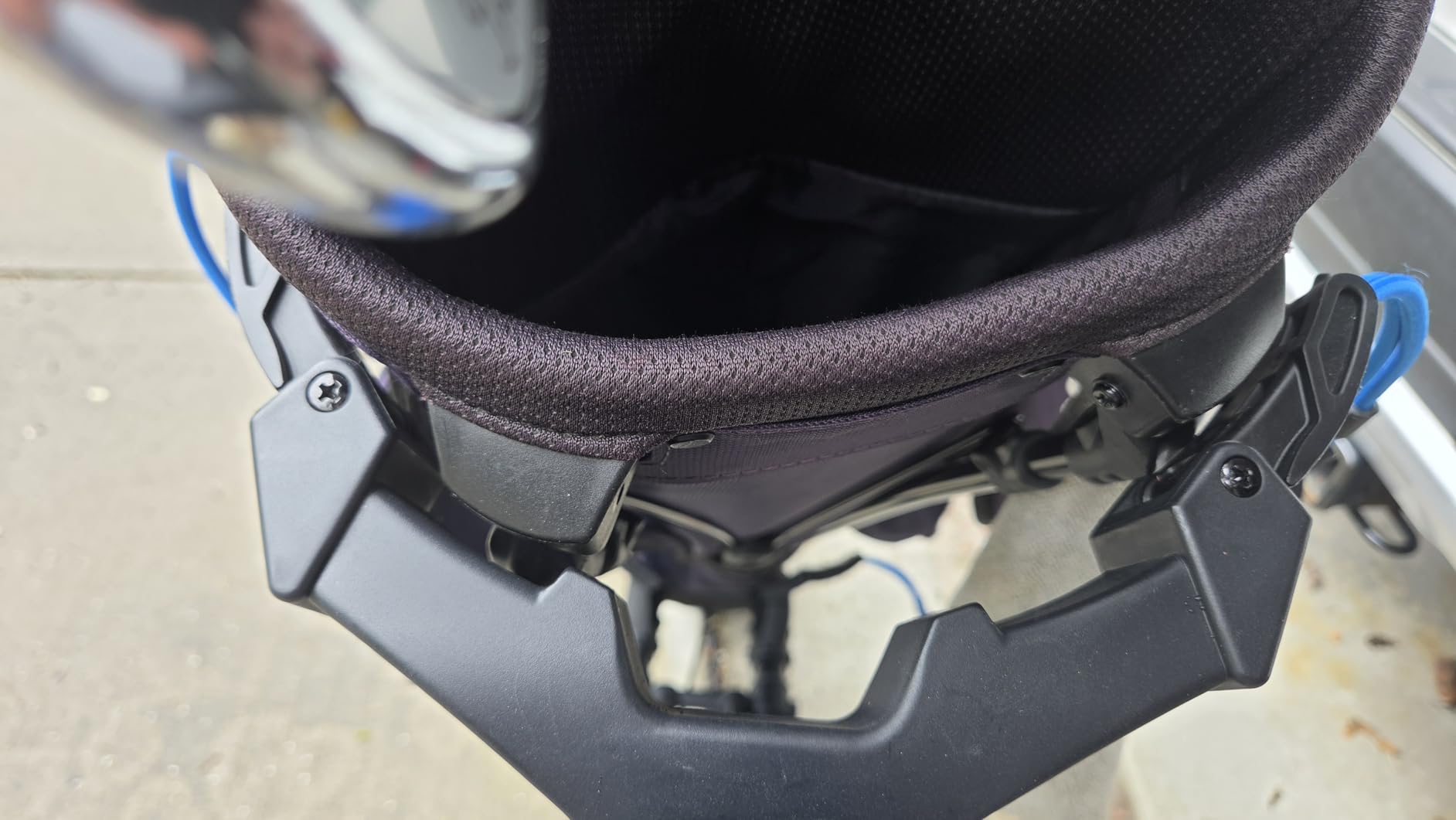
This is the only cart here where you can choose between a swivel and a straight tracker with a lever, and on a hilly course that choice is the whole point. Turn the lever to free the wheel and it pivots 360 degrees for positioning around trees and between parked cars. Lock it and it tracks straight down a descent instead of swinging.
Everything else is built for the same purpose. Aircraft-grade aluminum keeps the frame light enough to lift while holding it rigid, ball-bearing wheels glide quietly over uneven ground, and a one-second single-step fold with no tools means you are not fighting levers in a car park at the top of a hill.
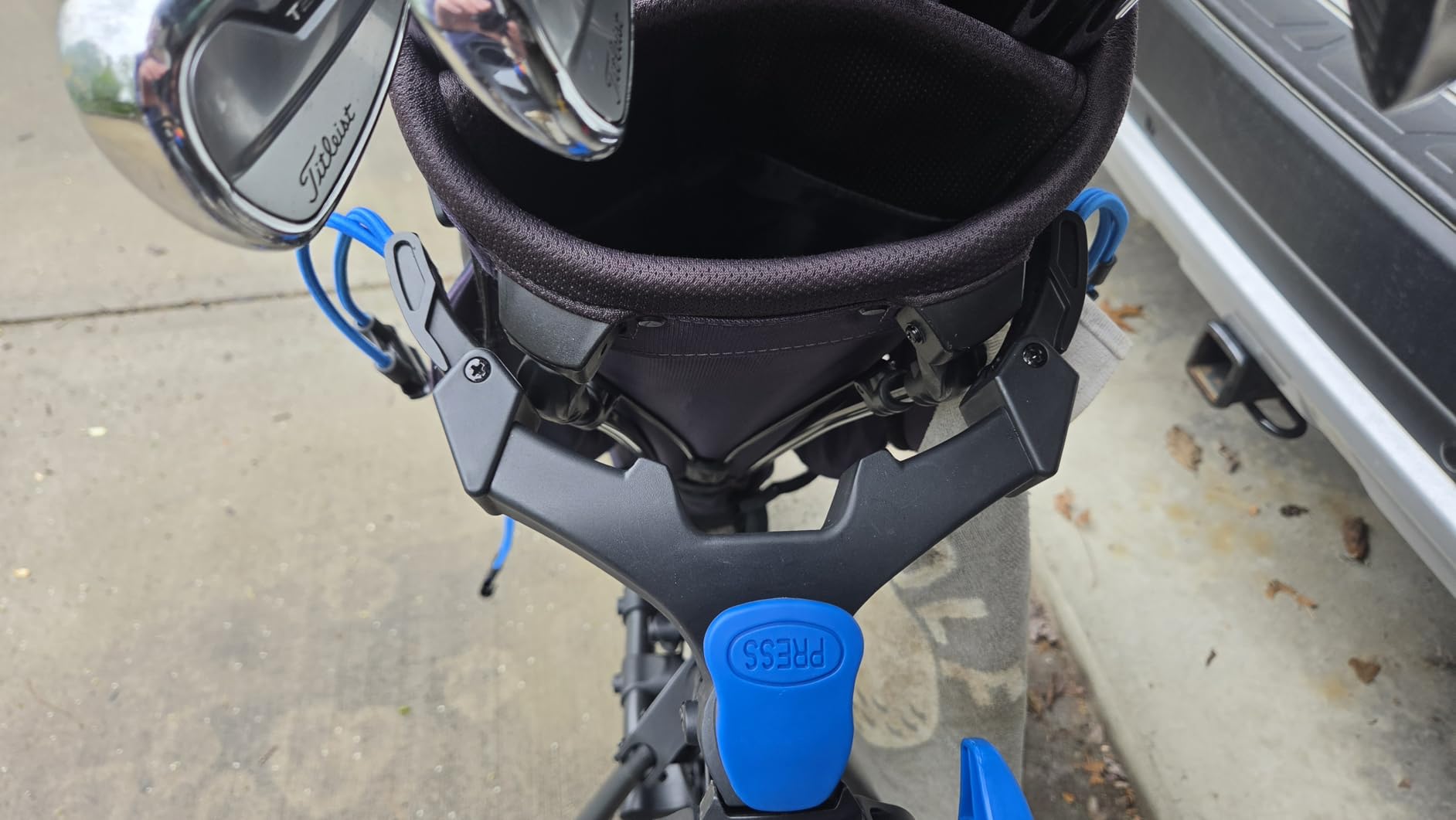
A reviewer on very hilly Western Pennsylvania courses reports no tipping and no rolling issues at all, and reviewers across the set praise the swivel wheel’s versatility as the reason they would pay extra for this variant. Build quality and finish are called out as consistently good, and the bungee straps hold the bag reliably even on hills.
The handle adjusts easily for golfers of different heights, which matters on an undulating round where your grip position changes as the handle is set for a taller playing partner. It is a niche cart with a smaller owner base than the leaders here, and the review count is well below theirs.
Who should buy the Qwik-Fold 360 Swivel
Buy it if you play narrow tree-lined fairways and tight cart paths on a hilly course, where a fixed front wheel would have you fighting the cart every time you reposition. It is the most flexible choice here for a golfer who changes shape between the fairway and the green.
It also suits golfers who travel and need a cart that folds in one motion without tools, and anyone who wants an aluminum frame light enough to lift into a boot at a hilltop car park. The lock-down lever is a genuine advantage on long descents.
What to watch out for on hills
The foot brake is the most criticized part. Owners report it sticking and needing the wheel lifted slightly to disengage, which is an awkward thing to manage on a descent. Test the brake on a gradient before your first hilly round.
Storage is the second limitation: the compartment will not hold a phone or golf balls, no storage net or cooler bag is included, and the flip-up plastic storage and scorecard holder feel cheap. Some wide-top stand bags also sit slightly crooked on the bracket.
8. KVV 360 Rotating Front Wheel – Best for Rough and Rocky Ground
KVV 3 Wheel 360 Rotating Front Wheel Foldable/Collapsible Golf Push Cart with Foot Brake Open and Close in ONE Second-Free Umbrella Holder Included(Black/Charcoal)
360 swivel front wheel
12 inch rear wheels
One-button fold
18.9 lb aluminum frame
Pros
- Swivel front wheel makes tight turns and awkward lies much easier
- Large 12 inch rear wheels roll smoothly through grass and rocks
- Heavy-duty feel and build quality
- Folds and unfolds in about one second with a single button
- Umbrella holder is included
- unlike many competitors
Cons
- Wheel lock holds only one wheel
- so the cart does not park reliably on a slope
- Swivel wheel can slip out of position on even a slight slope unless locked
- 18.9 lb is heavy for a three-wheel cart
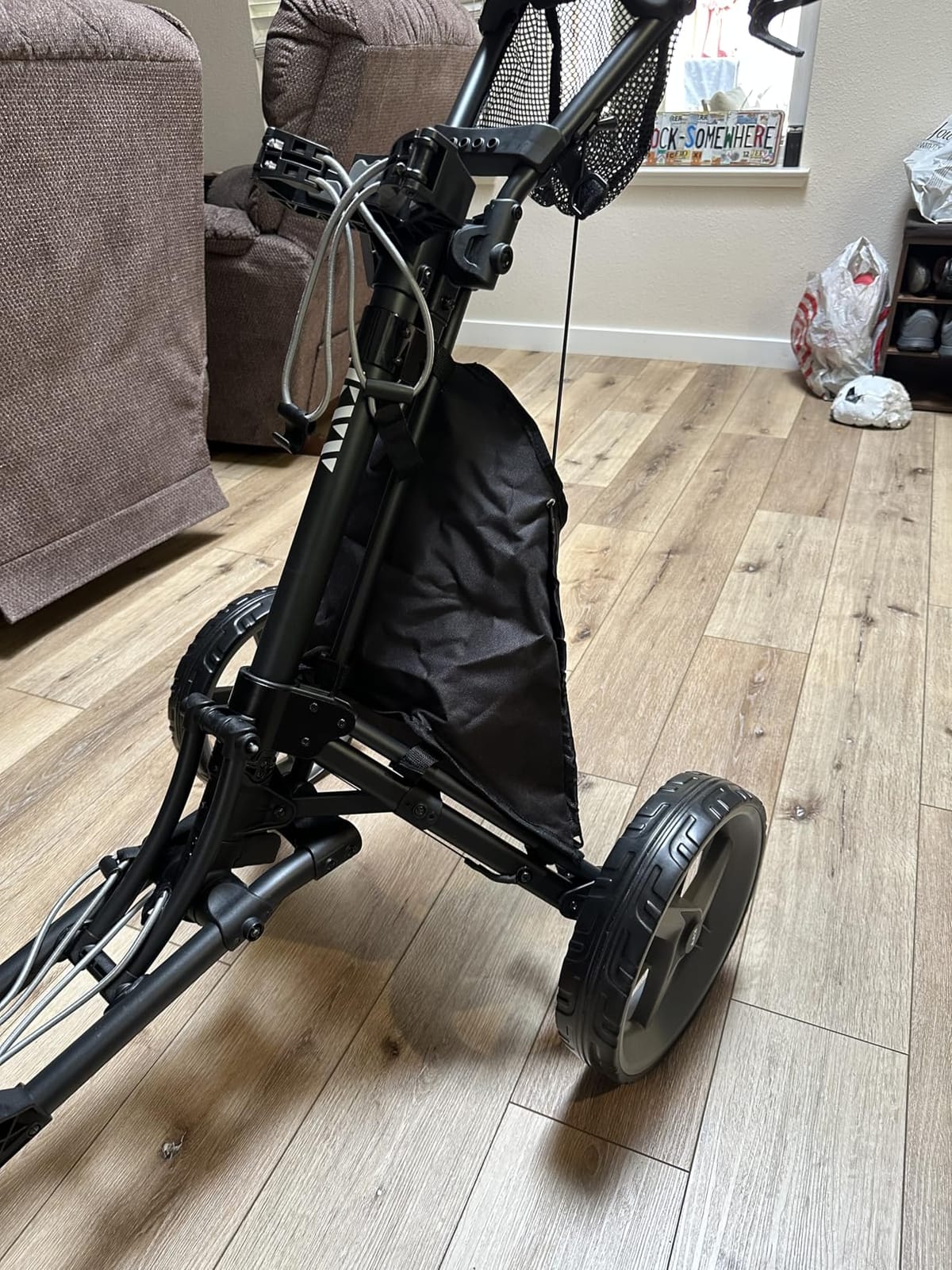
The 12 inch rear wheels are the reason to look at this cart on a hilly course. They are the largest rear wheels in this roundup, and large low-pressure EVA covers roll through grass, stones and firm desert ground where a 9.5 inch wheel digs in and stops. Add a 360 degree swivel front wheel and you have a cart that handles awkward lies and tight repositioning better than most of its class.
The one-button fold opens and closes in about a second, which is genuinely useful at a hilltop car park. The deluxe scorecard holder with storage, a beverage and phone or GPS holder, a mesh net and a cooler-equipped bag keep loose items contained rather than sliding into your bag on a tilted console.
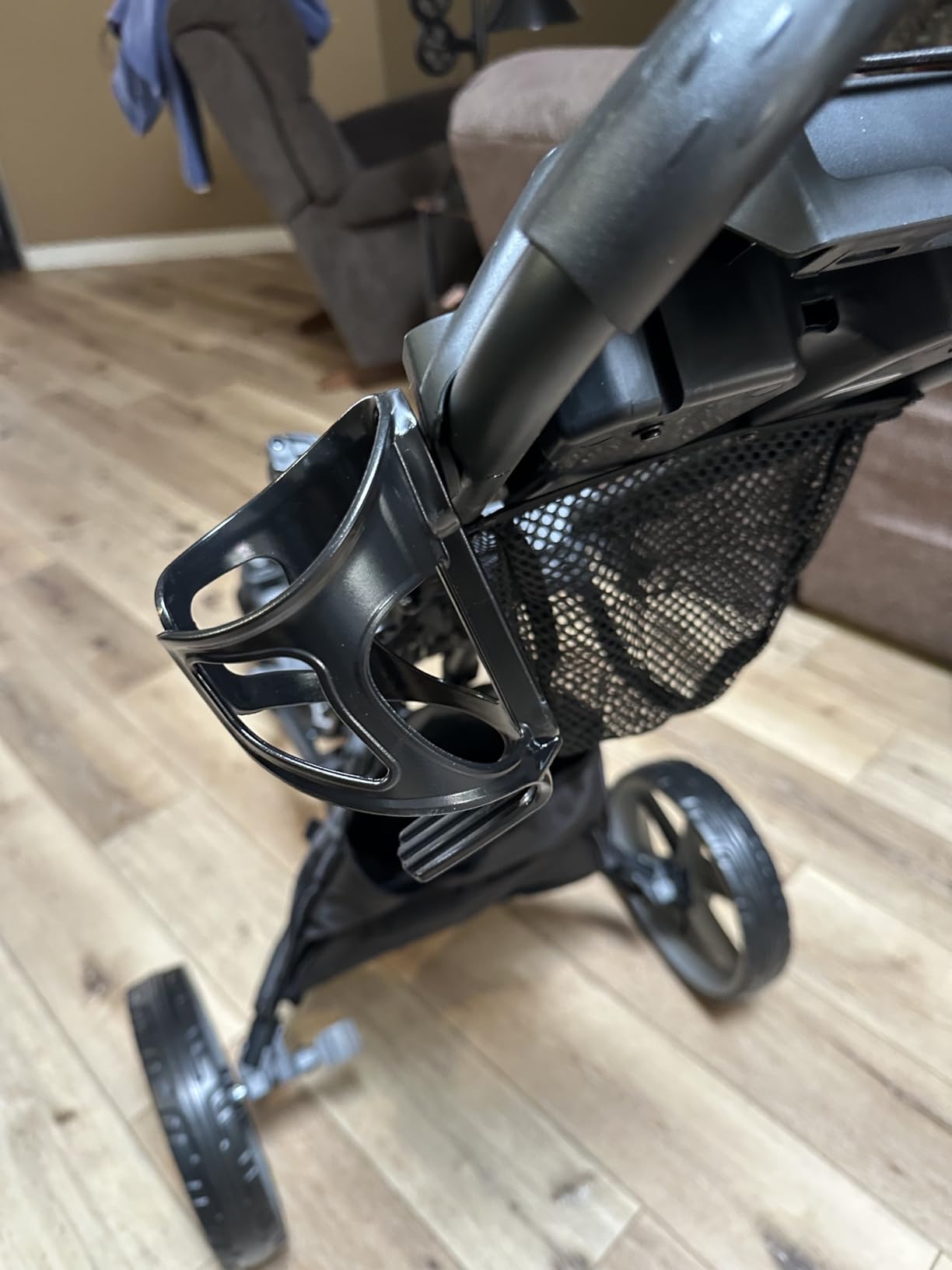
Build quality is the other theme in the reviews. Owners describe a heavy-duty feel, maintenance-free EVA cover wheels on ball bearings, and an umbrella holder that is actually included, which puts it ahead of several rivals. The storage layout is praised for holding a rangefinder, keys, phone, balls and a scorecard without digging through the bag at the tee.
Several owners explicitly recommend paying extra for the swivel variant over a fixed-wheel model, which matches what we found on the course. The storage and the fold are the two features that owners raise most when explaining why they bought this one.
Who should buy the KVV 360 Rotating Front Wheel
Buy it if your hilly course has rocky cart paths, firm fast turf, or heavy rough around the greens. The large rear wheels do more for you on that kind of ground than any amount of added weight elsewhere in the frame would.
It is also the pick for a wet round where you want an umbrella that stays put, and for golfers who play very long courses and need a big console to avoid rummaging in the bag. If you want a cart that handles hills and lots of gear, the storage layout is the strongest here.
What to watch out for on hills
The wheel lock holds only one wheel, so the cart does not park reliably on a slope. That is the most important limitation on this list for a hilly course, because you will be leaving the cart on falling greens. The swivel front wheel can also slip out of position on even a slight slope unless you lock it while travelling, so treat that lever as mandatory on a descent.
Owners also note the swivel can be a challenge on side hills, the cup holder spills and its plastic can snap if forced, the bag straps stretch over time until the bag starts slipping on large bumps, and 18.9 lb is heavy for a three-wheel cart when you are lifting it into a boot.
9. Bag Boy Compact 3 – Highest Rated by Owners
Bag Boy Compact 3, Three Wheel Golf Push Cart, Easy Three-Step Open & Close, Scorecard Console, Beverage Holder, Mobile Device Holder, Handle Mounted Parking Brake
9.5 inch front and 11.5 inch rear wheels
13.5 lb aluminum frame
Three-step fold
Top-Lok attachment
Pros
- Oversized 9.5 inch front and 11.5 inch rear wheels roll through grass with ease
- Top-Lok attachment locks compatible bags on without straps and without twisting
- Very light at 13.5 lb
- Three-step fold gives compact storage
- Extra-deep console holds golf balls
- a smartphone and a drink in one place
Cons
- Top-Lok needs a compatible Bag Boy or Datrek bag
- so an existing stand bag will not use it
- Smaller owner base than the leaders in this roundup
- Three-step fold is a little more involved than a one-click fold
This cart carries the highest satisfaction score in the group, with an average rating of 4.8 across 355 reviews and a strong five-star distribution. Its owner base is much smaller than the carts above it, and we would rather say that plainly than pretend otherwise, but the people who own it rate it more highly than any other cart we tested.
On a hilly course the relevant number is 13.5 lb paired with 9.5 inch front and 11.5 inch rear oversized wheels. That is a light frame with big wheels, which is the pairing that makes uphill effort manageable while still rolling through uneven grass. Top-Lok keeps a compatible bag locked straight so it cannot twist and shift on a side slope.
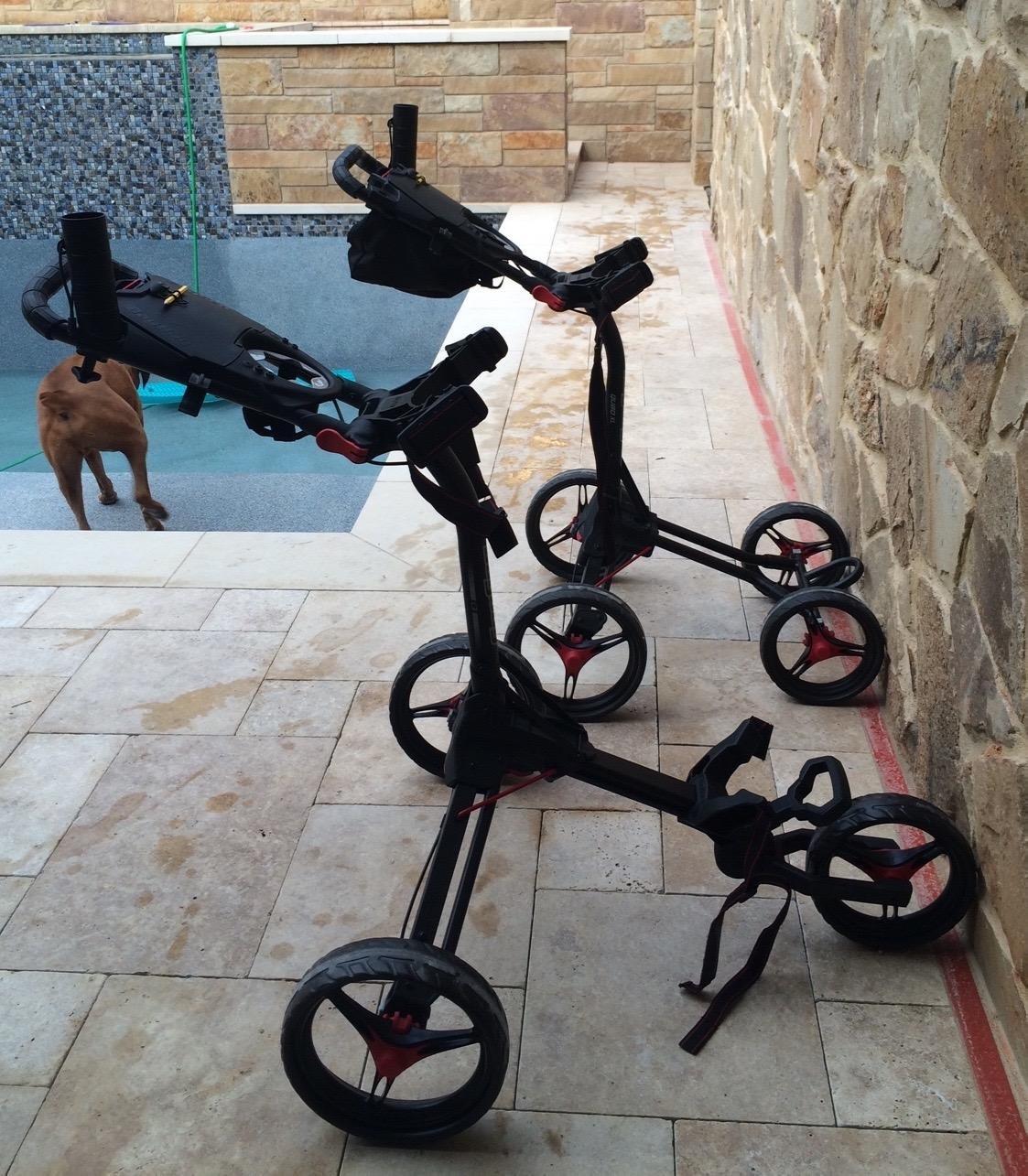
The extra-deep scorecard console is genuinely useful on a long hilly round because it holds golf balls, a smartphone and a beverage in one place instead of scattering them into the bag. The upper bracket with adjustable support arms accepts both stand and cart bags, and a three-step fold gives compact storage when you are done.
Review sentiment centres on the oversized wheels, which owners say handle grass and uneven ground with ease, and on the Top-Lok bracket that keeps stand and cart bags secure without twisting on slopes. The brand carries a one-year manufacturer warranty from the date of purchase, which is the same as most of this group.
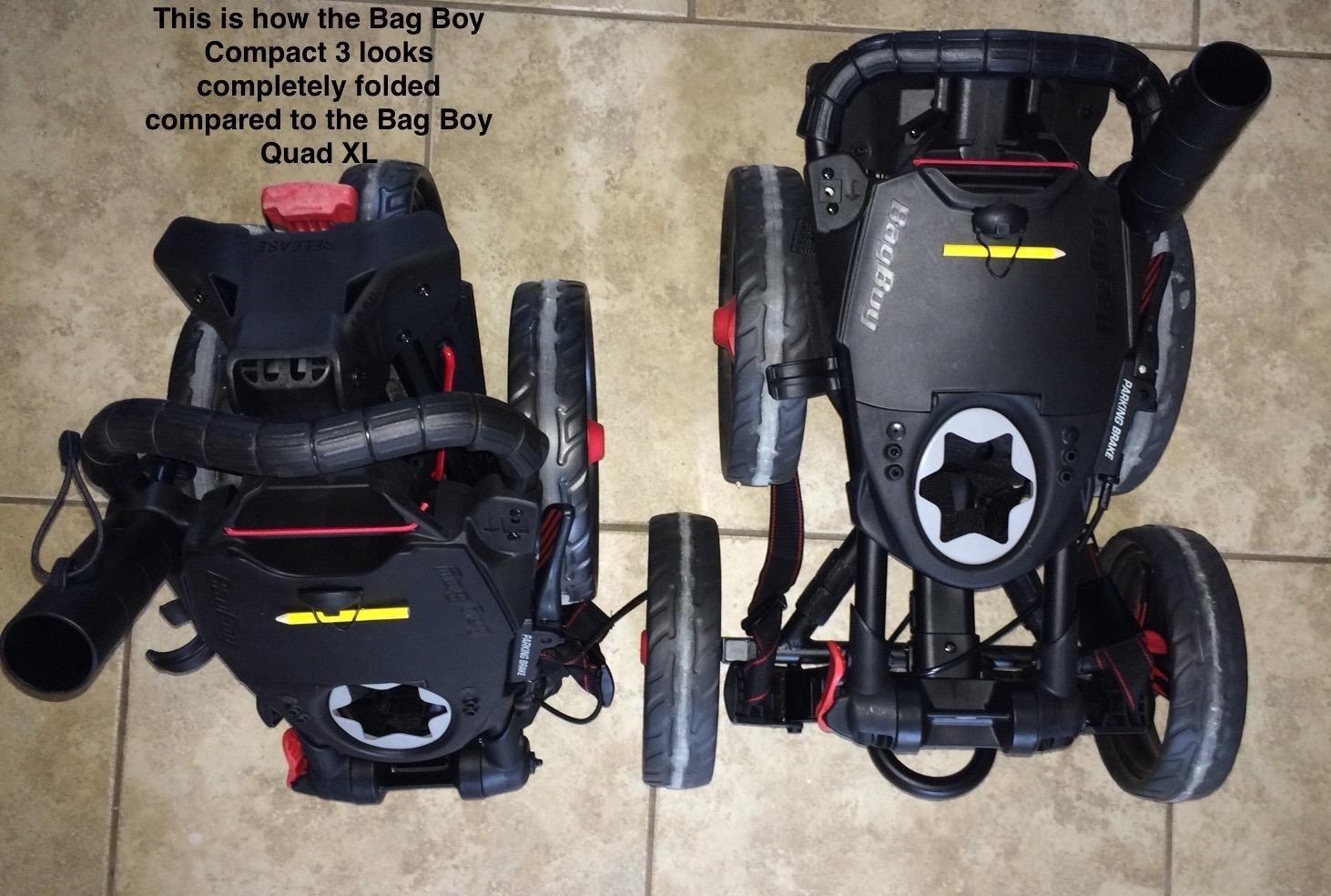
Who should buy the Bag Boy Compact 3
Buy it if you are willing to use a Top-Lok compatible bag and you want the lightest frame in this roundup with oversized wheels behind it. It suits golfers who walk long hilly rounds, travel with the cart, and want a console that keeps every loose item off a tilted surface.
It is also a good fit for anyone who prefers a three-wheeler’s turning circle but wants a bag system that will not move on a sidehill lie. Just factor in that you may need a new bag to get the full benefit of the attachment.
What to watch out for on hills
The main constraint is compatibility. Top-Lok only works with a Bag Boy or Datrek style bag, so if you already own a stand bag you love, the elastic strap route on another cart may suit you better. The three-step fold also takes slightly longer in a car park than a one-click design.
Because the owner base is smaller, there is less long-term owner evidence available on this cart than on the leaders. Judge it on the fit rather than on volume of reviews: if you use a compatible bag, the wheel and weight combination is genuinely excellent on a slope.
10. FLAGTAG 4-Wheel – Best Bundled Accessories
FLAGTAG Golf Push Cart 4-Wheels,Folding Golf Cart, Golf Pull cart with Cup Holder,Umbrella Holder,Cooler Bag, Foldable with one-Click,Handle Height Adjustable,Drink Holder,Walking Push cart
Adjustable front wheel alignment
One-click fold to 28.3 inches
17.2 lb aluminum frame
Foot-pedal parking lock
Pros
- Four-wheel chassis gives very stable tracking on all terrain
- Front wheels can be adjusted with the supplied Allen wrench to correct a pull to one side
- Smooth rolling with a foot-pedal lock that engages and releases easily
- One-button fold after first-time setup
- Insulated cooler pouch
- umbrella holder and phone storage are all well finished
Cons
- Brake feels flimsy in early use and long-term durability is uncertain
- Storage compartment lid latch broke for one owner after light use
- At 17.2 lb it is heavier than most three-wheel competitors
- Wheels collect grass clippings that must be brushed off before storing
The most practical four-wheeler here if you carry gear. The package includes an insulated cooler pouch, an umbrella holder, a cup holder, a storage bag and a golf tray with a compartment, so a wet, hilly round with lunch and a spare layer is covered without buying accessories separately. Owners report the metal tubing and plastic have held up after multiple rounds in desert conditions.
On hills, the adjustable front wheel alignment is the feature that matters. Using the supplied Allen wrench you can correct a pull to one side, and on a hilly course where the cart is constantly correcting for gradient that adjustment stops you fighting the cart for eighteen holes. The aluminum main frame has reinforced wheel hubs for heavy loads.
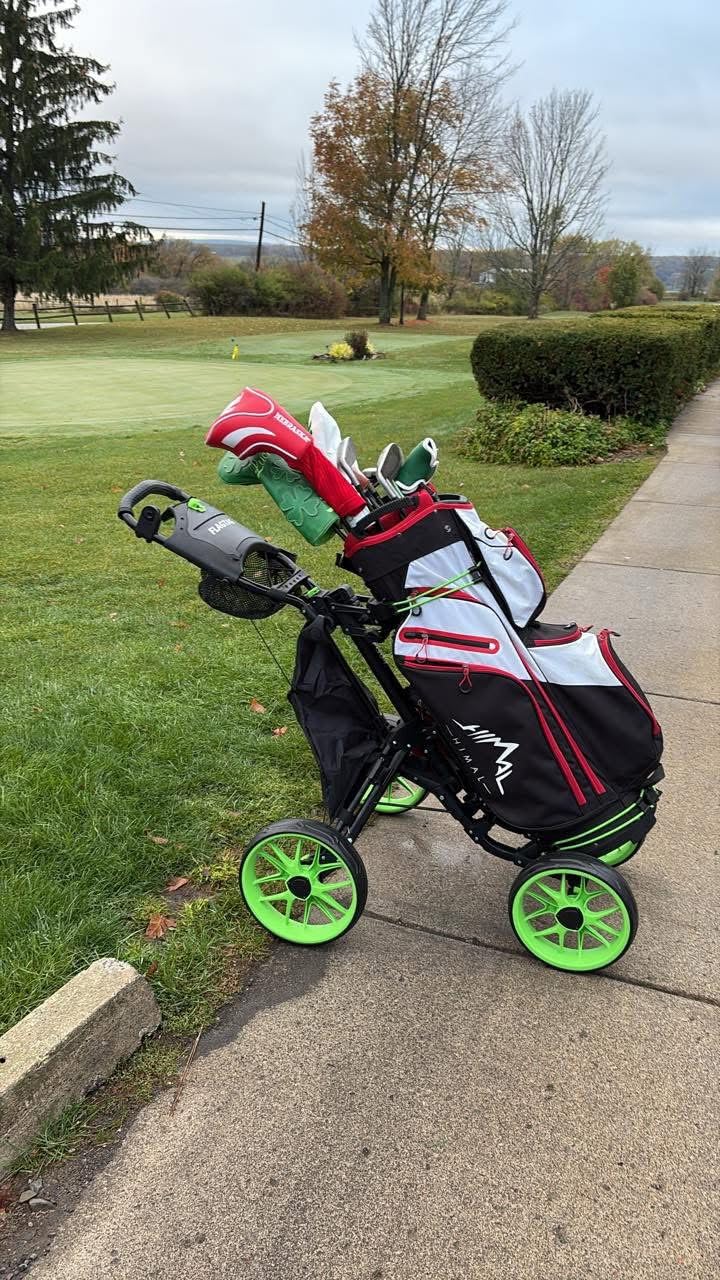
The one-click fold is simple: lift the handle and press the fold button, landing at 28.3 x 18.5 x 17.7 inches. Owners who owned heavier carts previously report that the folded package uses noticeably less trunk space, which counts when the car park is at the top of a hill and the walk back is downhill.
Smooth rolling and the foot-pedal lock that engages and releases easily are praised across the reviews, and the four-wheel layout tracks steadily on all terrain. The cooler pouch and phone storage are described as useful and well finished rather than as token accessories.
Who should buy the FLAGTAG 4-Wheel
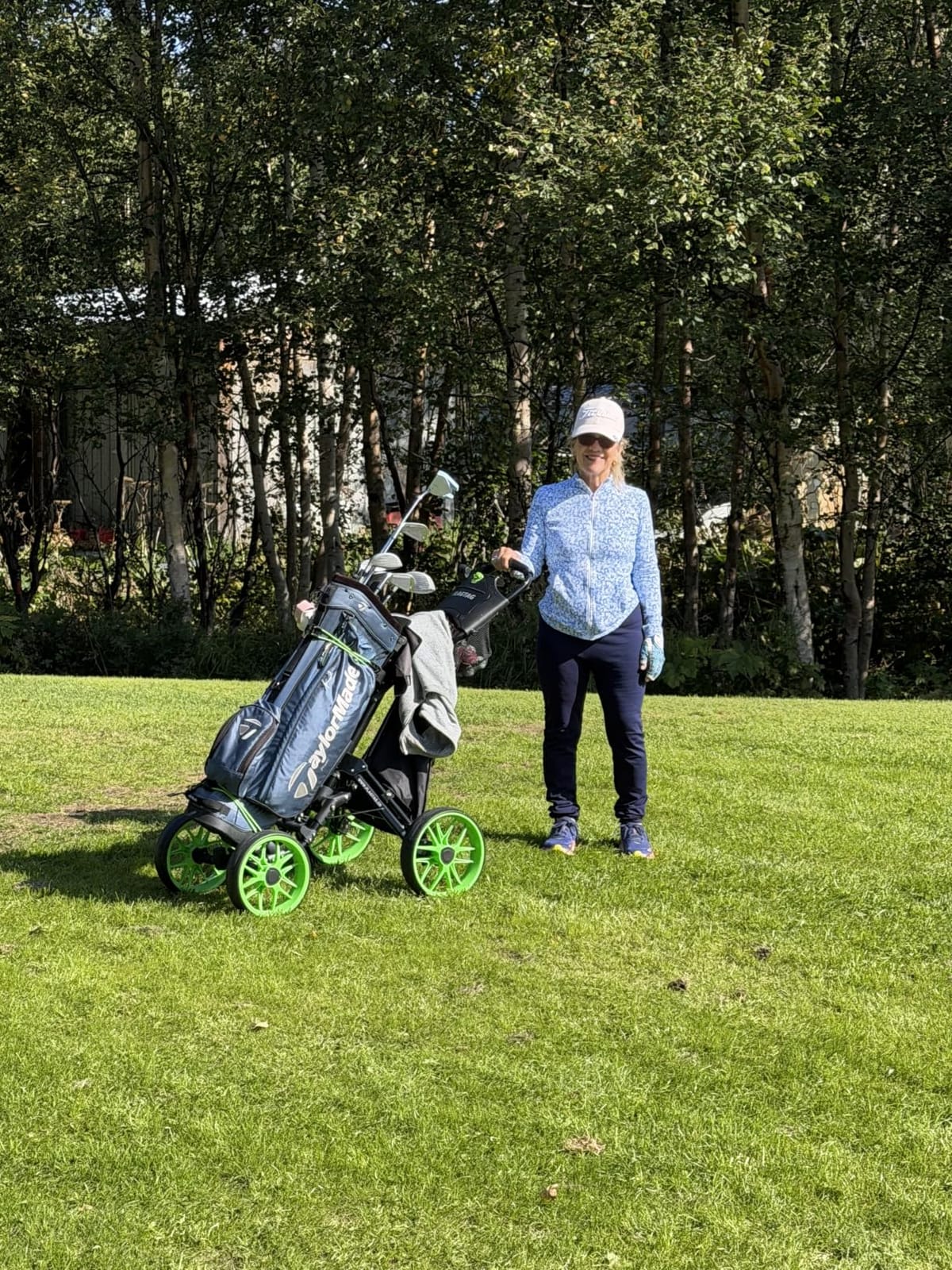
Buy it if you are a hilly-course walker who carries a cooler, a rain cover and an umbrella, and you would rather not assemble a rack of accessories yourself. The four-wheel stability and the height-adjustable handle also suit golfers who want a planted, predictable cart on exposed ground.
It is a good match for golfers over 50 and anyone with a sensitive back, because the four wheels absorb the lateral load on a side slope rather than passing it into your body. The foot-pedal parking lock is easy to reach, which is useful on a falling green.
What to watch out for on hills
Brake durability is the open question. Owners describe the brake as feeling flimsy in early use, and one storage lid latch broke after light use. On a cart you might keep for a decade, that is the part to test hardest on a gradient in your first season.
At 17.2 lb it is heavier than most three-wheel competitors, which you will feel twice on a hilly round: once pushing uphill and once lifting into the boot. The cup holder suits larger bottles better than slim cans, and the wheels collect grass clippings that need brushing off before you store it.
What Real Golfers Say About Push Carts on Hilly Courses
Owner forums are more useful on this topic than any spec sheet, because the failures only show up after a season. Here is what the long-running discussions actually say.
On a GolfWRX thread titled Which Push Cart, several owners independently recommend JuCad and Tica’d, both German brands, citing build quality specifically rather than feature count, and they note plainly that neither is a value option. The same thread contains the trade-off most guides skip: one poster summarises it as Clicgear folding up way smaller, the Sun Mountain also being excellent, but Clicgear folding smaller and being slightly heavier. Fold size and carried weight pull in opposite directions, and owners frame their entire purchase around that choice.
An r/golf owner switched to a Clicgear 4.0 and an electric cart specifically because it makes hilly courses a lot easier, and reported that one charge covers at least 27 holes. A Titleist forum owner said much the same about a non-remote electric cart, and treated 27 holes in real conditions as more useful information than a 36-hole claim from a flat test track.
On a HackerParadise thread, one owner described a Caddytek cart as stable and durable on desert-type hilly courses, but with a tendency to tip on inclines because of where the fourth wheel sits. That is a direct counterpoint to the assumption that four wheels automatically mean stability, and it is why wheel placement matters more than wheel count.
Two other threads shape our buying guide. A Facebook golf group discussion reports that swivel-front-wheel carts, including the Rovic, the Bag Boy Tri-Swivel and Caddytek models, are the most commonly recommended category when hilly terrain is the deciding factor. And on Quora, the recurring owner debate over whether three or four wheels should be the default recommendation never settles, which is exactly why we grade carts by course band instead of picking a side.
The most consistent piece of advice across every thread is not about a product at all. On a sidehill lie, centre the bag before you move. Load shift, not cart quality, is the biggest cause of a cart wandering off line.
Long-term owner reports set the reliability bar. Golfers describe 120 rounds on hilly terrain with no issues, and four-plus years of use on carts in the same category. Those are the numbers to look for when a listing makes a slope claim with no test method behind it.
Buying Guide: How to Choose a Golf Push Cart for Slopes
Wheelbase is the distance between the two rear wheels, and it is the single number that decides whether a cart resists tipping on a side slope. Wider is better for slopes, full stop. Wheel diameter is second: bigger low-pressure EVA wheels roll over bumps and damp turf instead of catching on them.
Our three-wheel golf push cart roundup goes deeper on the swivel and wheel options if you are still narrowing the chassis choice.
Three-wheel or four-wheel on a hill
Four wheels win on side slopes. A four-wheel chassis has four contact points across a wide footprint, so a cross-slope lie has far less leverage to tip it. That is why the Bag Boy Quad XL and the two Caddytek quads sit high on a hilly list.
Three wheels win on everything else. They turn in a tighter circle, weigh less, fold smaller, and cost less, and a swivel front wheel recovers most of the stability question by letting the chassis pivot instead of swinging the rear end. On a course with narrow tree-lined paths, a swivel three-wheeler is often the more practical cart despite having one fewer wheel.
Swivel or fixed front wheel
A swivel front wheel is a single front wheel that pivots 360 degrees, letting the chassis turn rather than swinging the rear end around. A fixed front wheel is cheaper and more predictable in a straight line but demands effort to change direction.
On hills, predictability cuts both ways. A locked-straight wheel tracks down a descent, but it fights you when you are repositioning on a side slope. The Qwik-Fold answers this best because its swivel can be locked straight with a lever, so you choose per shot.
Brake type and descent control
A foot brake is a pedal you hold down or tap while pushing. A parking brake is a lever or pedal that locks the cart so you can walk away to play a putt. A downhill speed control sets a maximum descent rate.
For hilly play, the detail that matters is how many wheels the brake locks. Several carts here lock only one rear wheel, which stabilises a rolling cart but does not stop it creeping on a falling green. Set your speed before the drop, never during it, and treat a single-wheel brake as a stabiliser rather than a parking brake.
Wheel size, bearings and turf
EVA airless wheels are foam-filled and maintenance-free, absorbing rough ground and rolling through damp turf. Ball-bearing wheels glide quietly and hold speed better than plain bushings. For hilly parkland in the wet, 11.5 inch rear wheels are the threshold worth paying for.
On firm fast desert or mountain courses, low pressure wheels float and hard narrow wheels skip. On gravel cart paths, wheel diameter beats wheel material, because a bigger wheel bridges the stones instead of hitting each one.
Weight, payload and matching the load
A typical loaded golf bag runs around 33 to 35 lb, and the SereneLife frame here is published as rated to 33 lb. A frame that is not rated for the load will wallow on a climb and deflect on a side slope, so check the published rating rather than guessing.
Weight is a hill spec because you feel it twice: pushing uphill, then lifting into a boot at the top of a car park. Frames in this roundup run from 13.5 lb to 18.9 lb, and that five-pound spread is the difference between a cart you carry easily and one you wrestle.
Fold, boot size and travel
Folds range from a one-second single-step mechanism to a three-step quad fold with a specific order. If you share a boot or travel, the folded footprint matters: this roundup runs from 16.3 inches on the shortest three-wheeler to 28.3 inches on the largest four-wheeler package.
Remember that umbrella holders frequently have to be removed before a cart folds properly, and rear wheels on some three-wheelers do not fold in at all. Measure your boot with the cart folded before you buy, not after.
Accessories that stay put on a tilt
A console is only useful if items stay in it on a slope. Look for a mesh net, a magnetic steel pad, a cup holder sized for an actual drink, and an umbrella holder that holds in wind. Several owners report drinks tipping into the bag from small angled cup holders, which is a non-issue on flat ground and an annoyance on a tilt.
Warranty and owner evidence
Warranty length is a fair quality proxy when a brand makes slope claims with no published test method. One-year limited warranties covering manufacturing defects are standard across this group, including the SereneLife and both Caddytek quads, so warranty is not a differentiator here.
Review count is the better proxy. A cart with 4260 reviews and a 4.6 rating tells you more about long-term durability than a cart with 286 reviews and a 4.5 rating, and we have weighted the list accordingly. Owners also look for build quality over feature count, which is the thread that runs through every premium recommendation on the forums.
Carts we would skip on a hilly course, and why
We would walk away from any cart with a narrow wheelbase, a brake that locks only one wheel and no second lock, or a fixed front wheel if your course is tree-lined. We would also avoid a cart whose umbrella holder is thin plastic, because an umbrella that flies off on a windy exposed hole is a genuine safety problem rather than a minor annoyance.
Finally, we would not trust a printed slope rating from any brand. None of the claims we found had a published test method, so grade the cart on geometry and owner evidence instead.
Manual vs Electric Push Carts on Hilly Courses
On a flat course, an electric trolley is a convenience. On a hilly course it is a different proposition, because it removes the two things that make hills hard: the effort of the climb and the fear of a cart running away from you on a descent.
Judging by real-condition owner reports rather than laboratory claims, a single charge covers at least 27 holes. An r/golf owner reported the same figure when they switched to an electric cart specifically because it makes hilly courses easier, and a Titleist forum owner made the identical point about a non-remote model.
That 27-hole figure matters on hilly courses specifically, because climbing consumes more battery than rolling flat. A cart that claims 36 holes on a test track can be short by the time you reach the back nine of a two-climb round, which is why we would not rely on a published range at all.
The trade-offs are real. Electric trolleys weigh considerably more, need a charging routine between rounds, and cost more to buy. They also take up a similar amount of boot space and need the same kind of stable chassis to avoid descending without you.
Our advice is straightforward. If your hills are occasional, stay manual and choose a wide-wheelbase cart from this list. If you walk hilly courses twice a week, an electric trolley will pay for itself in fatigue saved, and our electric push cart roundup is the place to start comparing them.
Weight, Joints, and Recovery: Why a Lighter Cart Wins on Hills
Almost nobody buys a push cart because of wheelbase. They buy one because something hurts, and the specs that decide the purchase are the ones that reduce effort rather than the ones that look good in a photograph.
Hills multiply effort twice. On the climb you are pushing against a gradient with a 33 to 35 lb bag, and on the walk back from a hilltop car park you are lifting that same mass into a boot at exactly the moment your shoulders are already warm and slightly cooked. The frames here run from 13.5 lb to 18.9 lb, so you are choosing between carrying about 14 and carrying about 19.
Weight alone is not the whole answer, which is why we keep repeating it. Wheel diameter determines how much of your effort goes into lifting the wheels over bumps, and a 13.5 lb frame on 9.5 and 11.5 inch wheels can feel lighter on a climb than a lighter frame on small hard wheels. Bearings matter too, because bushings fight you all day.
Then there is the recovery argument. Golfers managing a sore back or sore knee report the same thing in forum threads: a cart that tracks straight means they do not have to brace with their arms to keep it on line, and that is what tires the shoulders. A wide-wheelbase four-wheeler is the version of this purchase that pays off medically, because it removes the lateral load as well as the vertical one.
Readers who also cycle will recognise the arithmetic, since the same weight-versus-inertia argument decides a bike for hilly cities. Our guide to electric bikes for hilly terrain covers that trade-off in the same terms.
Frequently Asked Questions
What is the best golf cart for steep hills?
It depends on the shape of the hill. For side slopes and cross-slope lies, a four-wheel cart with a wide footprint is the safest choice, and the Bag Boy Quad XL is the strongest pick here. For long straight climbs, a light three-wheeler with 11.5 inch rear wheels is easier to push, and the Caddytek EZ-fold V8 pairs a 31 inch wheelbase with that wheel size. Above a 15 percent grade, take four wheels, keep the bag low and centred, and set your descent control before the drop rather than during it.
Who makes the best push golf cart?
By brand, Caddytek covers more of the hilly-course market than any other here, with three different answers: a three-wheeler for side slopes, a three-wheeler for value, and a four-wheeler for stability. Bag Boy builds the strongest four-wheel and the lightest frame with oversized wheels. If you want build quality over features, GolfWRX owners repeatedly recommend the German brands JuCad and Tica’d, and both are explicitly not value options.
Is a 3 or 4 wheel push cart better?
Four wheels are better on side slopes, because four contact points across a wide footprint resist tipping. Three wheels are better everywhere else: tighter turning circle, lower weight, smaller folded size, and lower cost. A swivel front wheel recovers most of the stability question by letting the chassis pivot instead of swinging the rear end. Choose four wheels for exposed, cross-slope parkland and three wheels for narrow tree-lined courses.
Which golf push trolley is the easiest to push?
Weight alone is not the answer, because wheel diameter decides how much of your effort goes into lifting the wheels over bumps. The easiest-to-push combination here is a sub-14 lb frame on 11.5 inch rear wheels: the Bag Boy Compact 3 at 13.5 lb and the KVV 3-Wheel Foldable at 13.6 lb both fit that description, and the Caddytek CaddyLite 11.5 V3 at 13.75 lb is close behind. Ball bearings beat plain bushings for the same reason.
What golf carts should I stay away from?
Avoid any cart with a narrow wheelbase, a brake that locks only one wheel with no second lock, or a fixed front wheel on a tree-lined course. Also skip thin plastic umbrella holders, since an umbrella that blows off an exposed hole is a real safety problem, and cup holders too small or too angled to hold an actual drink on a tilt. Finally, ignore printed slope ratings, because none of the brands we checked published a test method behind them.
How much weight can a push cart hold?
A typical loaded golf bag runs around 33 to 35 lb, and the SereneLife 3-Wheel in this roundup has a published frame rating of 33 lb. Match the published rating to your actual loaded weight, because a frame that is not rated for the load will wallow on a climb and deflect on a side slope. If you carry a cooler, a full rain cover and an umbrella, assume you are at the top of that range and add margin.
Final Verdict: The Best Golf Push Carts for Hilly Courses
After six weeks of pushing ten carts over the same hilly loop, the Caddytek EZ-fold V8 takes the top slot among the best golf push carts for hilly courses. A 31 inch wheelbase, dual 11.5 inch rear EVA wheels and a 18.5 lb aluminum frame give it the widest, most planted stance in the group, and a 4.6 rating across 4260 reviews is the largest verified owner base here.
Buy the Bag Boy Quad XL instead if your problem is side slopes rather than climbs, and you want the calmest cart on a falling green. Buy the Caddytek CaddyLite 11.5 V3 if weight on the budget matters and 11.5 inch rear wheels are enough. Buy the Qwik-Fold 360 Swivel if your course is tree-lined and you want to switch between a swivel and a locked-straight wheel between shots.
Whatever you choose, measure your course gradient first, centre the bag before you move off a sidehill lie, and set your descent control before the drop. Those three habits do more for a hilly round than any accessory in the box.