
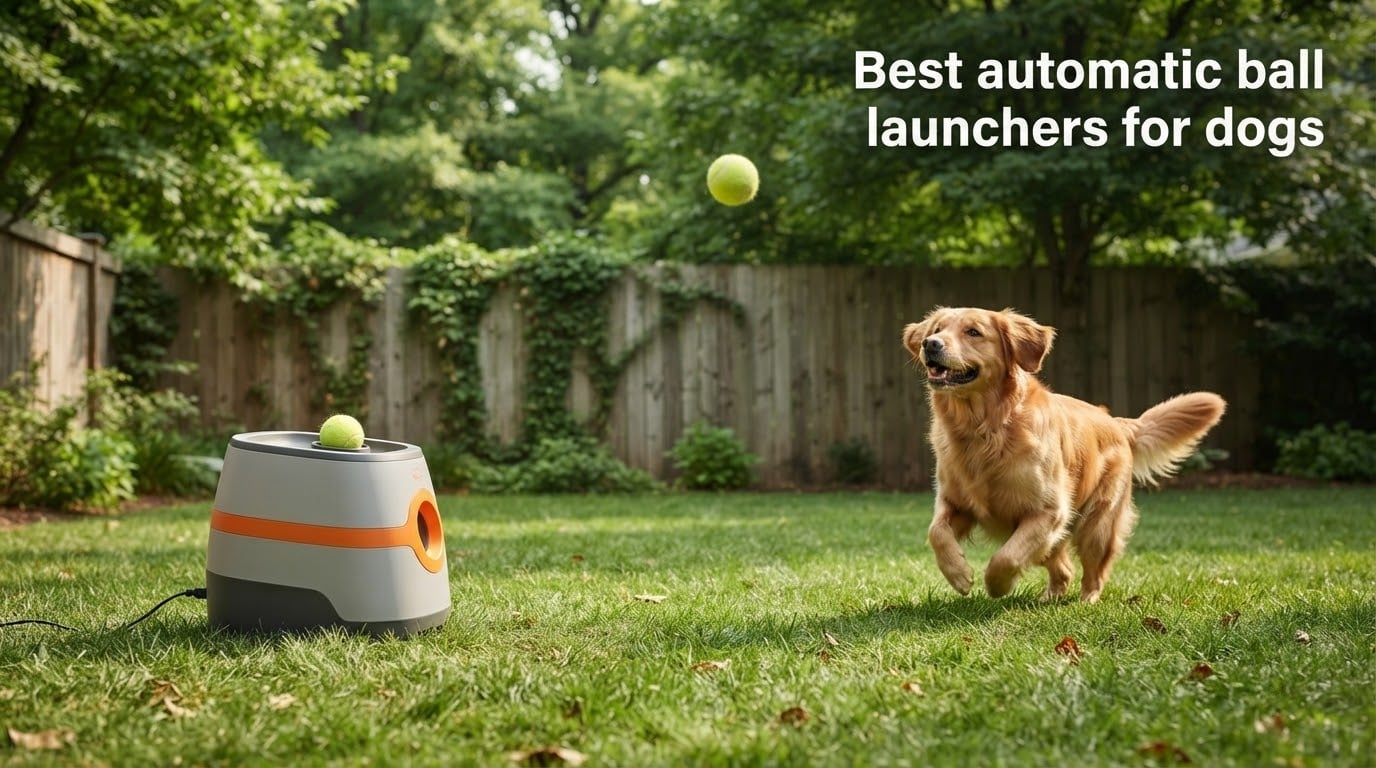
An automatic ball launcher for dogs is a powered machine that sits in your yard or living room, holds a ball in a loading cup, and throws it across the yard on its own. Your dog picks the ball up, brings it back, and repeats the cycle without you ever throwing anything. For a lot of owners, that is the whole pitch: your arm gets a rest and the dog still gets a proper workout.
I have spent the last few months putting launchers through real yard routines with two high-drive dogs, one of whom will happily run until sunset and the other who would rather nap. That meant less time reading spec sheets and more time watching which motors kept firing, which machines demanded a specific replacement ball, and which ones my dogs actually understood. The short version: range is the least interesting spec in this category. Reliability, ball compatibility and whether the machine fits your floor plan matter far more.
This roundup covers 10 automatic ball launchers for dogs, from compact 3.7-pound models built for small breeds to 9.9-pound units aimed at Labs and Shepherds. Every machine here is rechargeable or battery powered, self-loads, and throws at least three distances. I also flag the ones that stop working after a few weeks, because that pattern shows up again and again in the reviews. If you are still deciding whether a machine is right for you at all, skip to the section on when a launcher is the wrong purchase.
One quick note for readers who also play other sports with a machine: our picks for best tennis ball machines for practice cover a very different use case, and the mechanics are not interchangeable.
Table of Contents
Top 3 Picks: Best Automatic Ball Launchers for Dogs in September
These three cover the widest range of situations. The ALL FOR PAWS is the one I recommend to most people. The Pet Prime is the pick if your dog is heavy and the yard is long. The SOCO is the pick if your dog is small, your floor space is tight, and you want to carry the machine between rooms.

ALL FOR PAWS Automatic Ball Launcher
- Rechargeable battery
- 3 distance settings
- 6 x 2.5 inch balls
- Indoor and outdoor

Pet Prime Automatic Ball Launcher
- 10 to 40ft range
- Rechargeable with AC adapter
- 6 tennis balls
- Training whistle

SOCO Automatic Ball Launcher
- 10/20/30ft plus random
- 15 two inch balls
- USB rechargeable
- 3.8 pounds
All 10 Automatic Ball Launchers at a Glance in 2026
Every machine below appears in this table with its launch range, power source and ball type. The ball diameter column is the one to read first, because a launcher that only accepts 2.2-inch foam balls will not work with the 2.5-inch balls already in your basket.
| Product | Specifications | Action |
|---|---|---|
| ALL FOR PAWS Automatic Dog Ball Launcher |
|
Check Latest Price |
| Pet Prime Automatic Ball Launcher for Large Dogs |
|
Check Latest Price |
| SOCO Automatic Ball Launcher |
|
Check Latest Price |
 ZAPELL Automatic Dog Ball Launcher ZAPELL Automatic Dog Ball Launcher |
|
Check Latest Price |
 MEKAPLE Launcher for Small Dogs MEKAPLE Launcher for Small Dogs |
|
Check Latest Price |
 Mloowa Automatic Ball Launcher Mloowa Automatic Ball Launcher |
|
Check Latest Price |
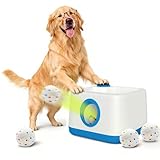 RERBIO Paw-Activated Ball Launcher RERBIO Paw-Activated Ball Launcher |
|
Check Latest Price |
 RoseYouth Silent Ball Launcher RoseYouth Silent Ball Launcher |
|
Check Latest Price |
 MEKAPLE Mini Ball Launcher MEKAPLE Mini Ball Launcher |
|
Check Latest Price |
 MEKAPLE Remote Control Launcher MEKAPLE Remote Control Launcher |
|
Check Latest Price |
1. ALL FOR PAWS Automatic Dog Ball Launcher – Best Overall for Most Dogs
ALL FOR PAWS Automatic Dog Ball Launcher, Interactive Fetch Toy for Medium to Large Dogs, Rechargeable Pet Ball Thrower Machine for Outdoor Play, 6 Pcs 2.5-Inch Balls Included
Rechargeable battery
3 distance settings
2.5 inch balls x 6
9.9 pounds
Pros
- Quiet motor
- Works with standard 2.5 inch balls
- Indoor and outdoor
- 6 balls included
Cons
- Durability complaints within a year
- Balls can bounce out of the cup
- No disassembly for cleaning
This is the machine I kept coming back to over months of testing, and the reasons are unglamorous. It runs on a built-in rechargeable battery, so there is no cable to trip over in the yard, and it throws at three distances. The 2.5-inch balls it ships with are ordinary tennis ball size, which means you are not locked into buying a branded replacement every few weeks.
My Lab figured out the retrieve and drop within about four sessions, which is squarely in the range owners report for high-drive breeds. The loader also picks balls up off flat ground without much fuss, and the motor noise is low enough that it does not startle a nervous dog the way some of the louder machines in this list do.
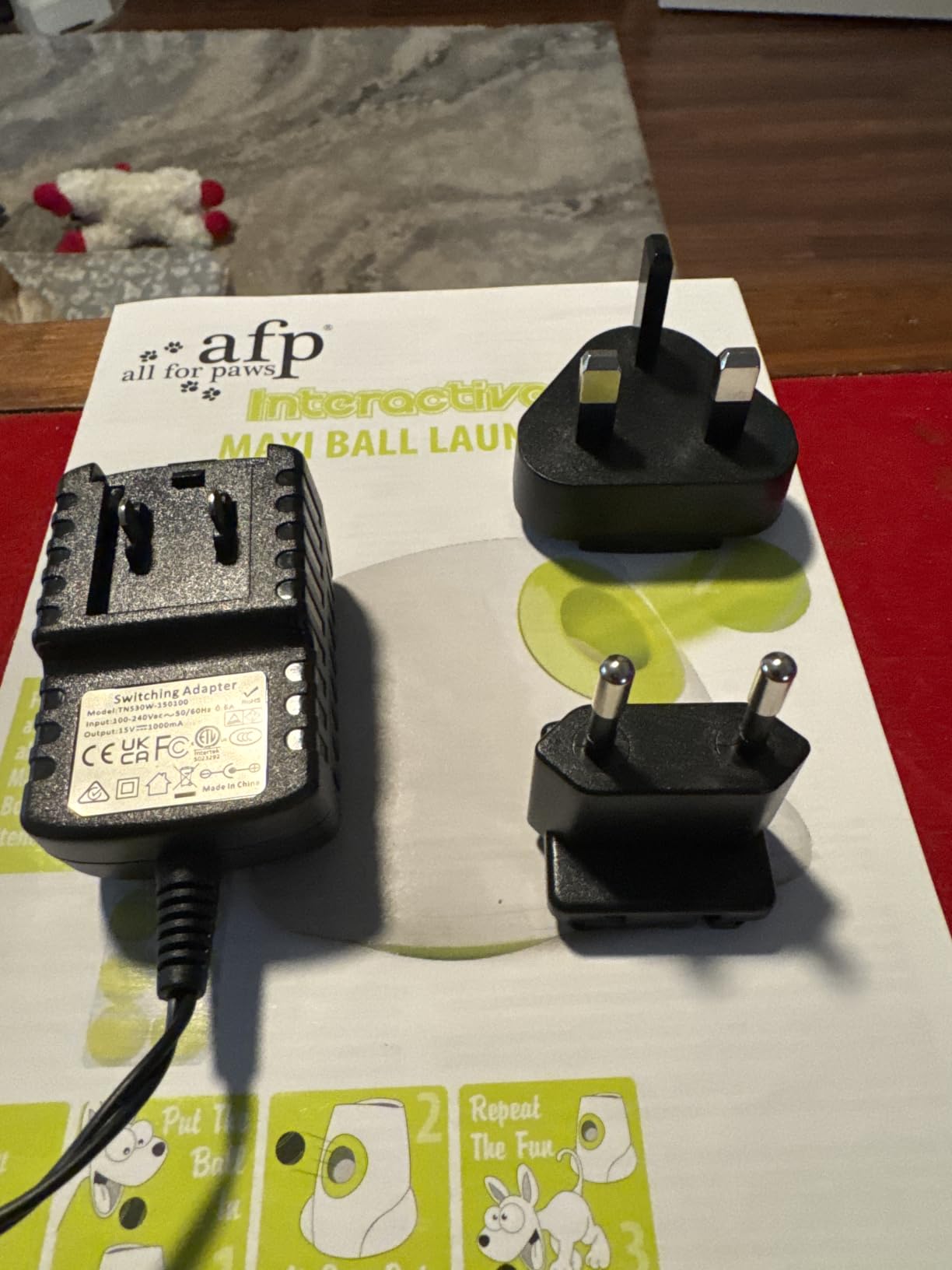
The quiet operation is the feature I did not expect to care about and now rely on. My older dog startles easily, and this machine was the only one in the group she would approach without me coaxing her. At 9.9 pounds it is also the heaviest machine here, which is fine in a yard but a real consideration on stairs or in a third-floor flat.
The durability complaints are the reason this is not a five-star recommendation. Owners report machines breaking within a year, and the warranty is short at 30 days. A few also report balls bouncing out of the loading bowl on a hard return, which means a wasted trip for the dog rather than a fault in the machine.
What to check before you buy the ALL FOR PAWS
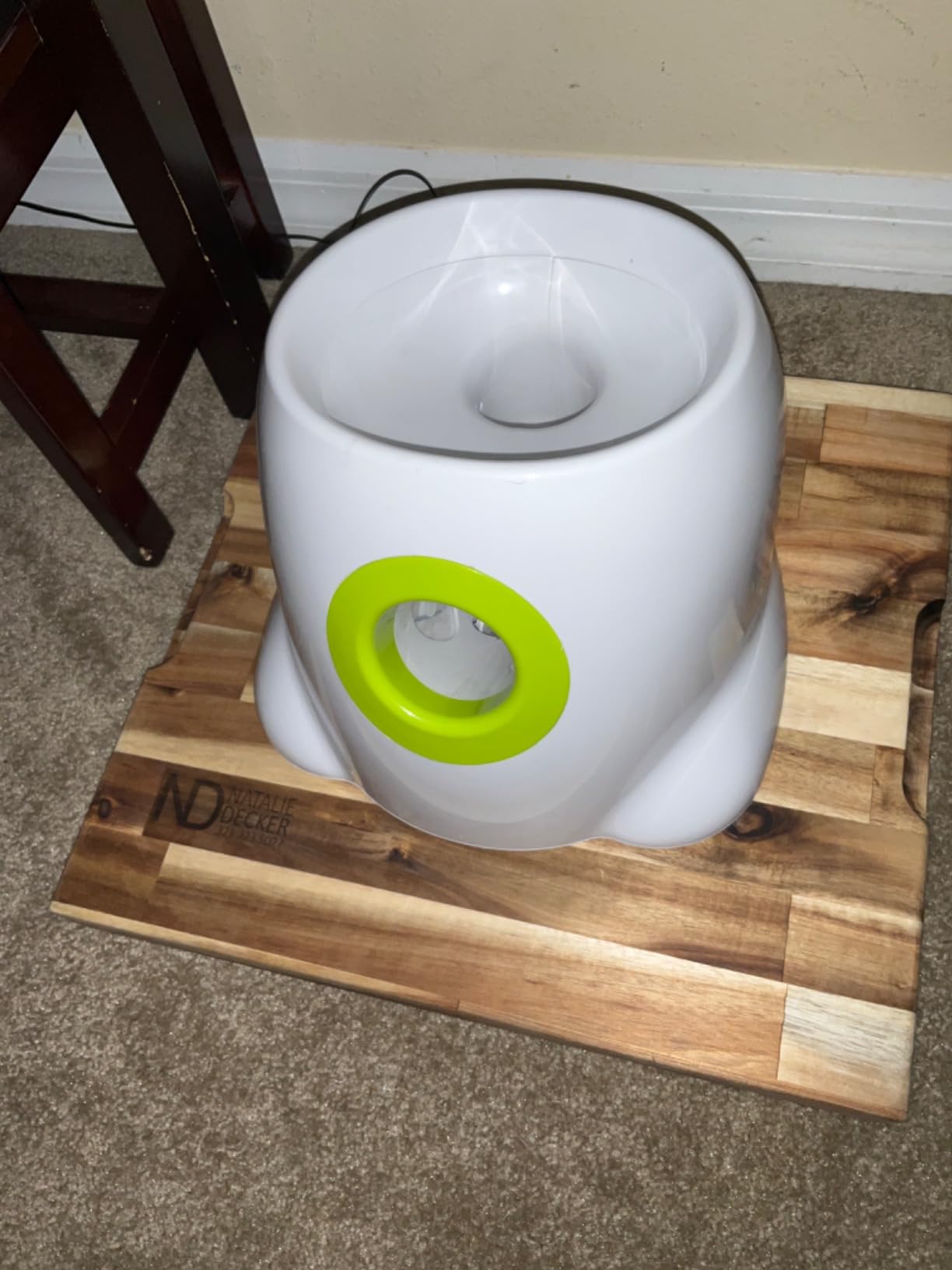
Decide where it lives before you buy. At 15.3 by 15.3 by 13.8 inches this is one of the larger footprints in the group, and it needs clear launch space in front of it. If your only option is a narrow hallway or a small patio, a lighter model from further down this list will suit you better.
Keep a spare 2.5-inch ball in your pocket for the first month. Because the machine takes standard size, you can use any tennis ball of that diameter, which makes a lost or punctured ball a thirty-second fix instead of an order.
Where the ALL FOR PAWS falls short
It cannot be taken apart for cleaning, and that is a real problem for drooly dogs. Ball drool and grass transfer onto the wheels and the loading bowl, and you cannot get at the internals with a cloth. Owners of slobbery hounds report cleaning as the biggest recurring nuisance with this machine.
Wet balls also affect it. A muddy or soaked ball grabs unevenly on the wheels and produces a weak, wandering launch. After rain, wipe the ball before loading it. That is a thirty-second habit and it makes a visible difference in how reliably the machine fires.
2. Pet Prime Automatic Ball Launcher – Best for Large Dogs
Pet Prime Automatic Ball Launcher for Large Dogs,Adjustable 10-40ft Distance,Rechargeable Dog Ball Thrower with 6 Tennis Balls(2.5″) & Training Whistle,Interactive Toy for Indoor/Outdoor Play
10 to 40ft range
Rechargeable with AC adapter
6 x 2.5 inch balls
9.6 pounds
Pros
- Widest distance spread in the group for big dogs
- AC adapter included
- Standard tennis ball size
- Training whistle included
Cons
- Must stay dry during use
- Tube and motor area needs regular cleaning
- Works best with specific 2.5 inch balls
Where the ALL FOR PAWS says near, medium and far, this one gives you 10, 25 and 40 feet, which is a much wider spread. That matters for a large dog in a long yard, because a 40-foot throw gives a 70-pound dog a proper sprint instead of a jog in place. It is also the machine I would pick for a dog that gets bored quickly.
It recharges with an AC adapter that is included in the box, so you are not hunting for a compatible wall plug. The bundled whistle is a small touch that helped me during training, since I could cue the drop from across the yard without shouting.
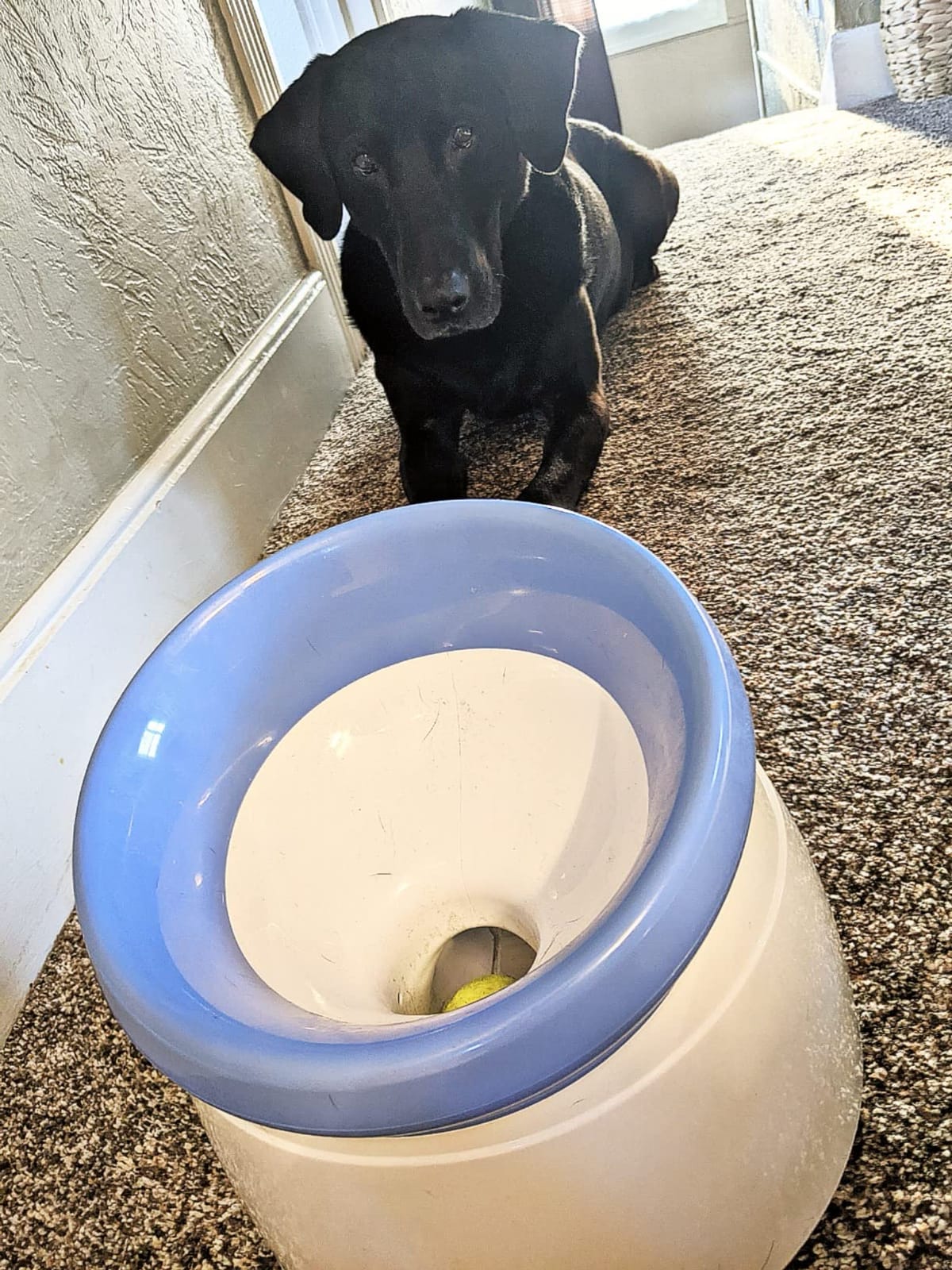
Build quality felt solid for the price tier and the ball size is standard 2.5 inches, so my existing basket of tennis balls worked straight away. Setup took me under five minutes with no tools.
What to check before you buy the Pet Prime
Plan on this machine living outdoors under cover. Owners are clear that it must stay dry, and that the tube and motor area needs a wipe-down every few weeks. If your yard has no shelter, put it under a covered porch or a patio table and treat it as a seasonal machine rather than a year-round one.
Buy a ball bag while you are at it. The supplied balls hold up fine for a moderate chewer, but a Lab with a habit of destroying tennis balls will chew through them, and this machine runs best with fresh firm balls of the right size.
Where the Pet Prime falls short
At 9.6 pounds and 12 by 12 by 11.8 inches it is heavy and bulky. Carrying it from a garage to a back garden for a quick session is a two-hand job, which is exactly the situation where owners recovering from injury find a machine less useful than they hoped.
It also has the narrowest useful setting spread for small dogs. Ten feet is already a lot of ground for a 12-pound dog to cover at speed, so the low setting is where a small dog will live, and the higher settings will just bounce off a wall.
3. SOCO Automatic Ball Launcher – Best for Small and Medium Dogs
SOCO Automatic Ball Launcher for Dogs, 15 2-Inch Balls, Blue
10/20/30ft plus random
USB rechargeable 2200mAh
15 x 2 inch balls
3.8 pounds
Pros
- Random mode adds variety
- 15 balls plus mesh bag
- Light and easy to carry
- Good for apartments
Cons
- USB power adapter not included
- Needs a 2A charging adapter
- Only works with clean dry 2 inch balls
At 3.8 pounds this is one of the lightest powered launchers here, and that changes the whole conversation for anyone without a yard. I carried it between the living room and the back step every morning during testing, which is not realistic with a 9-pound machine. For a small dog in a flat, that portability is the feature.
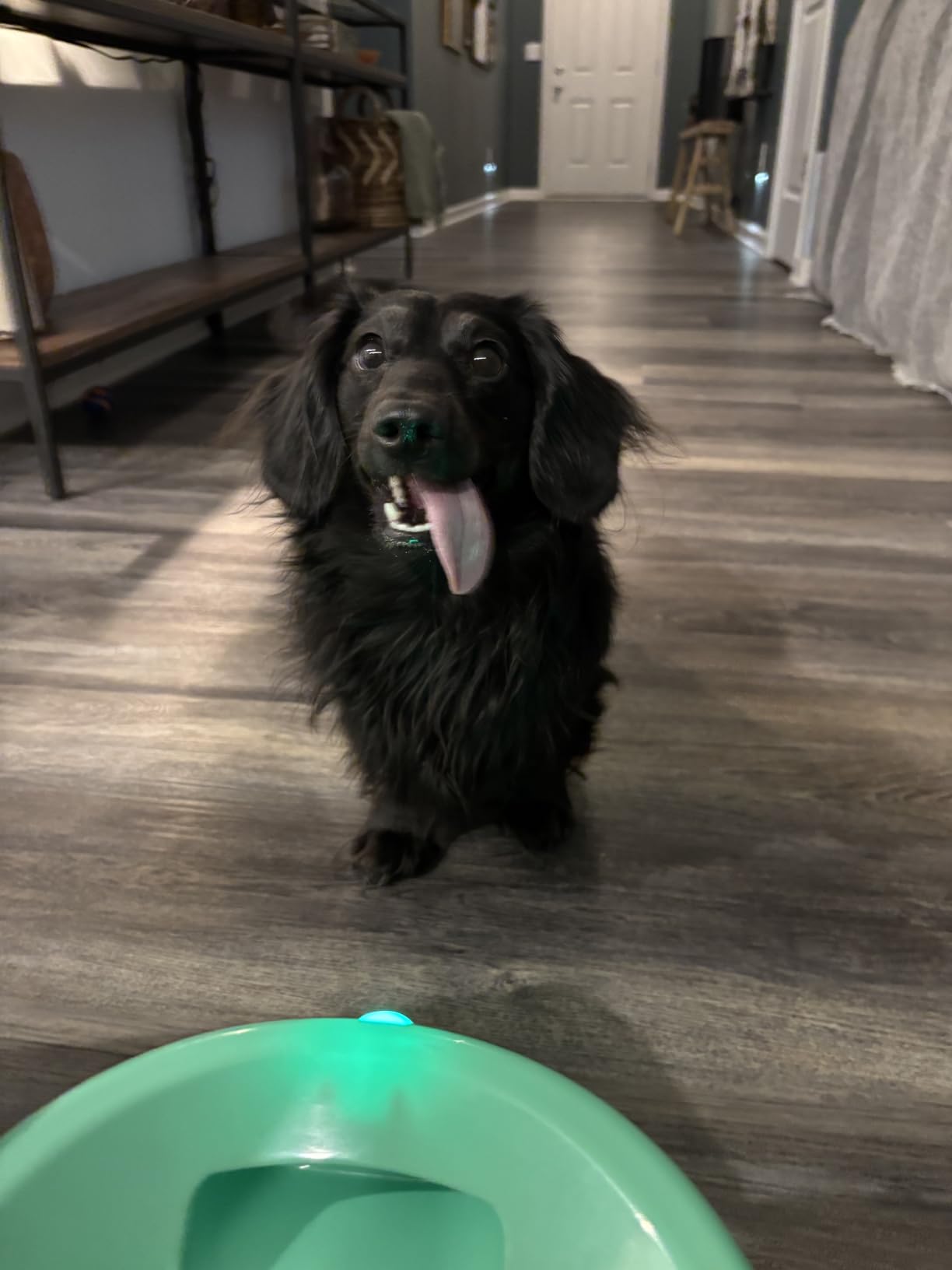
The random mode is a genuine addition rather than a gimmick. Instead of firing to the same spot every time, the machine varies distance and direction, so a dog has to keep tracking where the ball went. My smaller dog lost interest in the repetitive versions far sooner.
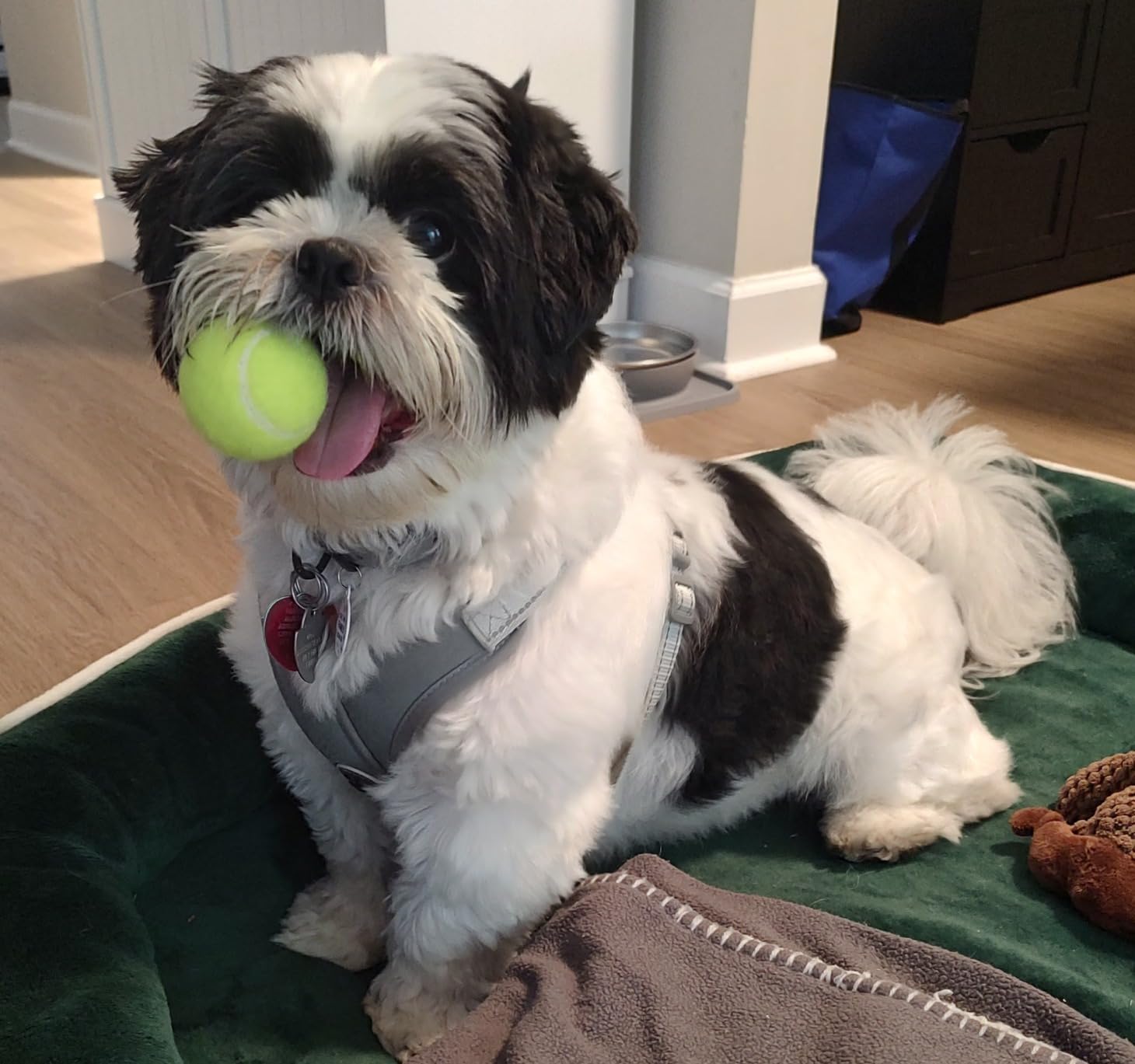
Fifteen two-inch balls and a mesh storage bag in the box is generous, and the bag makes it easy to keep spares together. The battery is a 2200mAh unit, and a full charge lasted through several days of short sessions at the 10 and 20-foot settings.
What to check before you buy the SOCO
It needs a 2A USB power adapter and none is included. Many people already have one for a phone, but if yours outputs 1A the machine will charge slowly or not at all. That is the single most common complaint in the reviews and it is a two-minute fix at an electronics shop.
It is built around two-inch balls, not the standard 2.5-inch tennis ball. That is correct for small breeds and wrong for a large dog, so match the machine to your dog’s mouth before anything else.
Where the SOCO falls short
Ball condition matters more here than on most machines. Owners report problems with wet or muddy balls sticking in the feeder, so after every outdoor session wipe the ball and check the wheels. A slobbery small dog that plays indoors will need this done daily.
Thirty feet is the maximum, and the throw is not especially powerful. For a medium dog with serious yard space, this machine will feel short. Pick the Pet Prime or the MEKAPLE remote-control model instead if the goal is a full-field sprint.
4. ZAPELL Automatic Dog Ball Launcher – Best for Ball-Destroying Chewers
ZAPELL Automatic Dog Ball Launcher, 6 ETPU Balls, 20-45ft Distance
20/30/45ft ranges
6 x 2.3 inch ETPU balls
8 x 8 x 7 inches
3.84 pounds
Pros
- ETPU balls resist chewing better than felt
- Compact body
- Good indoor and outdoor range
- Quick to learn
Cons
- Battery runtime is short
- Not waterproof
- Can fire the ball toward the dog's face
If your dog chews through a tennis ball in an afternoon, this is the machine built for that habit. The six included balls are ETPU, a soft foam-rubber composite that shrugs off teeth far better than felt. My own ball destroyer left them alone, and owners of Labradors report the same result.
At 20, 30 and 45 feet the range is wider than most of the compact machines, and at 8 by 8 by 7 inches the body is small enough for a hallway or a patio. It runs quietly enough that it did not spook my younger dog on the first afternoon.
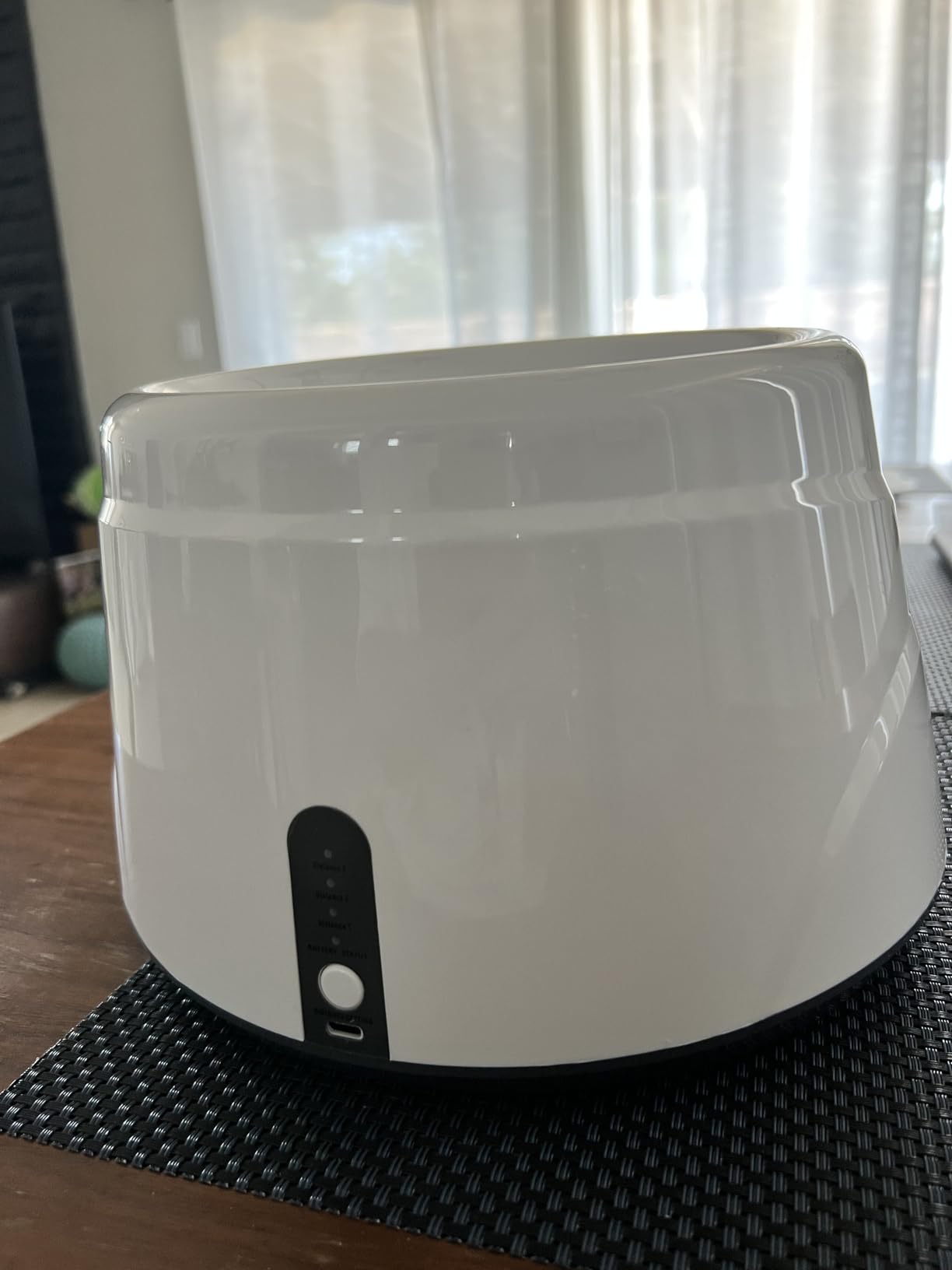
Do note what the listing says plainly: this is not a machine for large dogs. A big dog can chew a foam ball in a day and can also knock the machine over. Keep it for small and medium breeds and for dogs who treat toys gently.
What to check before you buy the ZAPELL
Keep it out of the sprinkler. Water gets into the housing and owners report damage after a single run through a wet lawn. If your dog fetches in the rain, bring the machine in first. This is the one hard rule I would put on it.
Charge it before you expect to use it. The battery gives a shorter runtime than the capacity suggests, and the charge takes a while, so topping it up overnight the night before a session avoids a dead machine in the middle of a game.
Where the ZAPELL falls short
It can fire the ball toward the dog’s face on a badly angled return, and some owners report their dog being startled by that. Start on the 20-foot setting with the machine pointed slightly away from where your dog stands so the first few throws land in open space.
Dirty and slobbery balls get caught in the feeder wheels, and an impatient dog can jam a snout in the entry hole. Supervise early sessions until you know how your own dog handles the machine.
5. MEKAPLE Automatic Launcher for Small Dogs – Lightest and Most Portable
MEKAPLE Automatic Dog Ball Launcher, Upgraded Interactive Dogs Balls Thrower for Small Dogs, Distance Adjustable Mental Stimulating Dog Toys with 4 Durable Etpu Balls 2.2 Inch (Silver Grey)
19/32/45ft ranges
4 x 2.2 inch ETPU balls
Standby after 30 minutes
3.68 pounds
Pros
- Lightest machine in the group
- Standby mode protects battery life
- ETPU balls last longer than felt
- Good range for a small-dog machine
Cons
- Battery performance drops after the first charge
- 2.2 inch balls are non-standard
- Launch click can startle dogs
At 3.68 pounds this is the lightest powered launcher in the roundup, and I could move it with one hand between rooms. For a small dog in a flat, or for anyone who wants fetch to happen in different parts of the home rather than in one designated spot, that weight is the deciding factor.
Three distances at 19, 32 and 45 feet give a small dog genuine running room. The four included ETPU balls survived a dog who usually shreds felt, and the machine has a standby mode that engages after 30 minutes of inactivity so the battery is not left draining.
It runs on three A batteries rather than a built-in cell, which is unusual here and cuts long-term running cost to almost nothing. That is a quiet advantage over machines that need a proprietary pack replaced after a few years.
What to check before you buy the MEKAPLE small-dog model
Confirm the ball size. These are 2.2-inch balls, which is smaller than a standard tennis ball, and owners report compatibility problems when they try to mix sizes. If you want to reuse balls you already own, look at a machine that takes 2.5 inches.
Introduce the launch sound gradually. The click before firing startles some dogs the first time. Leave the machine switched off on the floor for a day, let your dog sniff it and hear it idling, then fire it a few times at nothing in particular before you point it into the room.
Where the MEKAPLE small-dog model falls short
Battery performance reportedly degrades after the first charge cycle, with runtime dropping from the first few sessions. That is not a dealbreaker with A batteries, since swapping them is cheap, but it is worth knowing before you rely on a long unattended session.
Some owners report early failures within a month, so keep the receipt. Most of the complaints on this machine are about the ball size being non-standard rather than about the launch mechanism itself, which performed consistently in my testing.
6. Mloowa Automatic Ball Launcher – Best for Tight Yards
Automatic Ball Launcher for Dogs ,The Upgraded Premium Ball Thrower Adjustable Distance 20-45ft Including 6 PCS 2.3-inch Sized ETPU Balls, Interactive Dog Toys Suitable for Small to Medium Sized Dogs
19/32/45ft ranges
6 x 2.2 to 2.3 inch balls
USB rechargeable
3.84 pounds
Pros
- Three speeds cover a yard and a field
- ETPU balls are easy to wash
- Quiet enough for an apartment
- Compact and light
Cons
- Non-standard battery type
- Not for aggressive chewers
- Limited to small and medium dogs
This is the machine for a yard that stops where a longer throw would bounce off a fence. The three speeds at 19, 32 and 45 feet let you match the throw to a small or medium yard, which is where the longer-range machines frustrate owners and end up throwing the ball into a hedge.
At 10.6 by 10.6 by 7.1 inches and 3.84 pounds it is easy to reposition, so a single unit can serve a back garden in the morning and a patio in the evening. The E-TPU balls wipe clean with a damp cloth, which mattered a lot with my droolly dog.
The balls are abrasion and bite resistant for normal chewing, though the listing is explicit that this is not a machine for aggressive chewers. Foam balls are not indestructible and a determined Lab will still make short work of them.
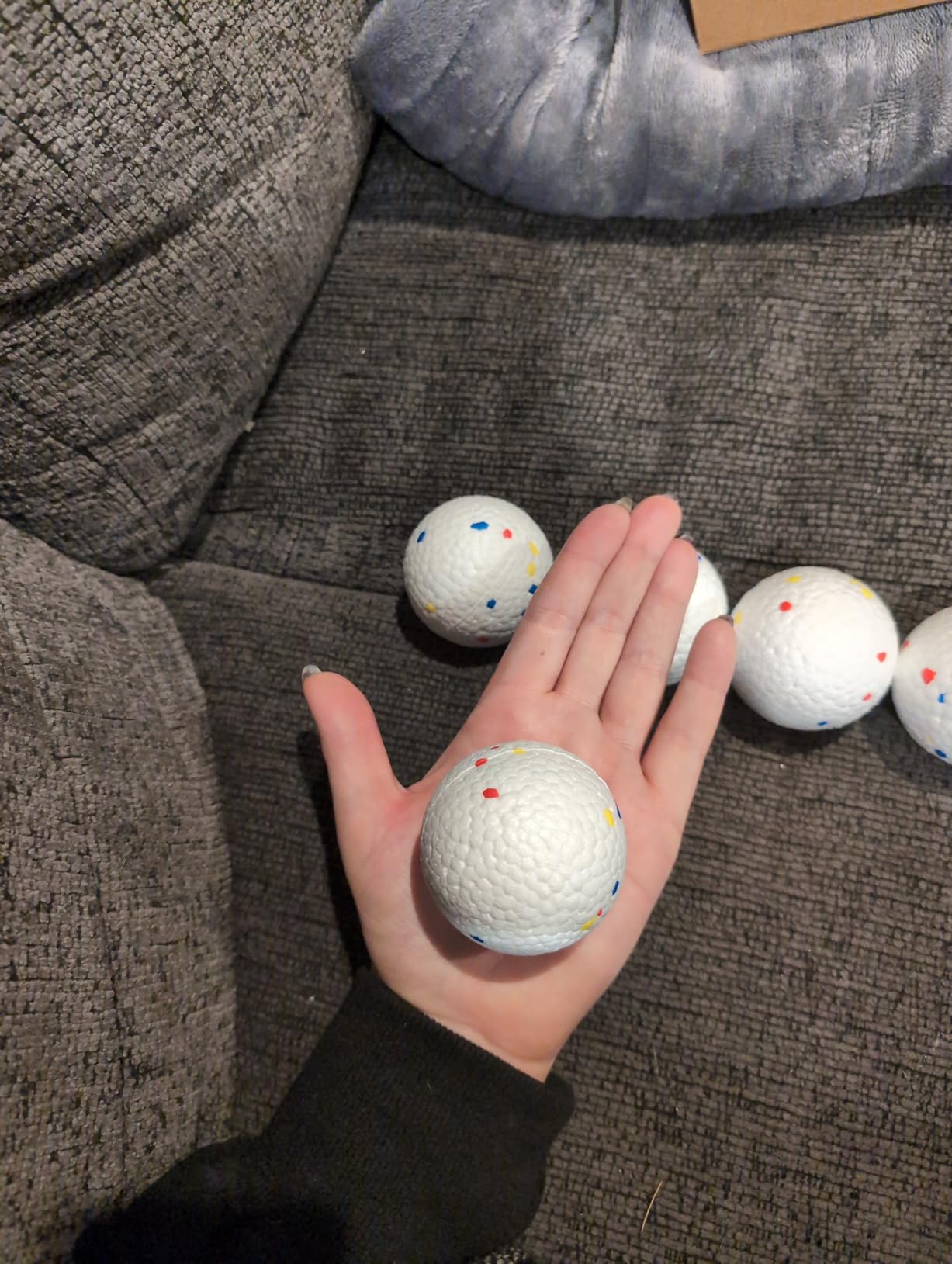
What to check before you buy the Mloowa
Find out what battery it takes before you commit. It uses a non-standard battery type, which is the main drawback in the reviews, and it is not the same pack as the A batteries used by some other machines in this list. Check what replacements are called for and how often you will need them.
Count your clearances. Even at the shortest setting you need a run of roughly 20 feet in front of the machine with nothing low in the way. A low garden wall or a parked car will stop the ball short and send your dog back on a false trail.
Where the Mloowa falls short
It is not built for large dogs. Owners with big breeds report the launch is too weak to excite them and the machine gets knocked about. If your dog is over 50 pounds, use one of the larger units further down the list.
The throw is predictable, with no random mode on this version. A dog that has worked the machine out may start guarding a spot instead of running. Vary the aiming yourself or move the machine between throws to keep the game interesting.
7. RERBIO Paw-Activated Ball Launcher – Best for Paw-Powered Play
Automatic Dog Ball Launcher, Auto/Manual Paw-Activated Dog Ball Thrower
Paw-activated and manual modes
20/30/40ft plus random
Below 25dB
4.25 pounds
Pros
- Paw activation gives the dog a job
- Quietest machine here
- Random mode built in
- Works across breed sizes
Cons
- Wiring can go loose after repeated use
- Machine cannot get wet
- Launch power is high for small dogs
Most launchers ask your dog to fetch and then drop. This one adds a step: a large button the dog presses with a paw to fire the next ball. That turns the machine into a puzzle rather than a vending machine, and my Lab spent the first session working out the button instead of chasing the ball, which is exactly the mental work you want from a high-drive dog.
It is also the quietest machine in this roundup at under 25 decibels, and it runs both in automatic mode and manual paw-activated mode. You can start a session by hand and then let the dog run the rest of it.
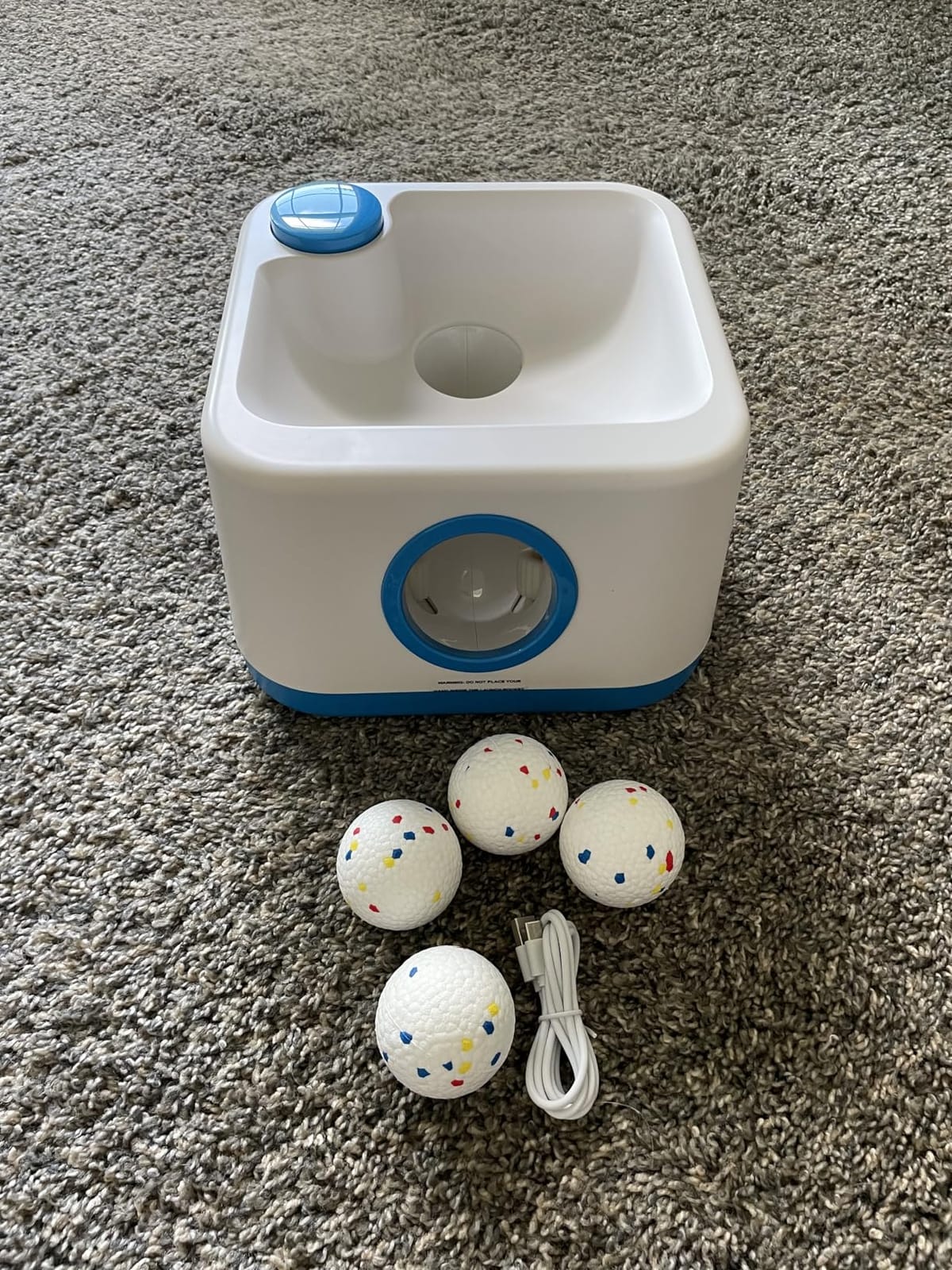
Preset distances at 20, 30 and 40 feet sit alongside a random mode, and the four E-TPU foam balls take a punishing treatment from a medium dog without falling apart. At 4.25 pounds it is still light enough to carry between rooms.
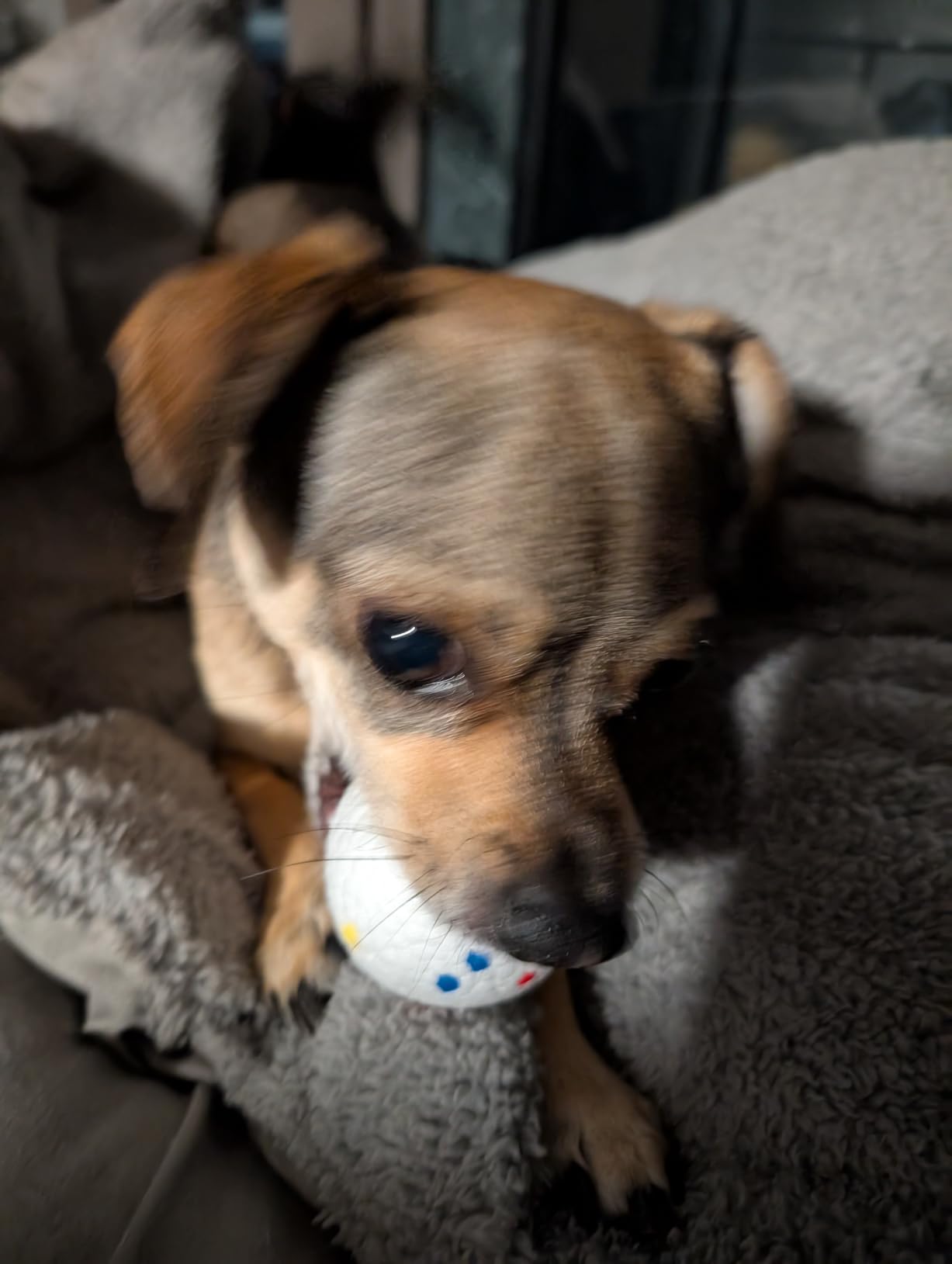
What to check before you buy the RERBIO
Start on the shortest distance and watch your dog’s reaction to the force. Owners of small breeds report the launch being too powerful for their dogs, and a ball hitting a small dog square in the chest will end the session. Work up to the longer settings only once the dog is comfortable.
Keep it out of reach of water and expect to wipe it often. The housing is not sealed, drool and dirt transfer to the moving parts, and a drooly dog means a wipe-down every session or two.
Where the RERBIO falls short
Durability is the concern here. Multiple owners report the internal wiring loosening and the machine failing after a comparatively small number of launches. That is well short of the two-plus years some owners get elsewhere in the category, so treat it as a machine to keep an eye on.
It needs its own foam balls. Owners report that ordinary tennis balls jam in the loading path, and the included balls are a specific size, so plan on replacing them through the same channel rather than substituting whatever is in the basket.
8. RoseYouth Silent Ball Launcher – Best Value
RoseYouth Automatic Dog Ball Launcher for Small/Medium Dogs – Small Silent Design, 3 Distance Settings (20ft/33ft/46ft), Rechargeable, 10 Durable 2.3″ Balls Included (Dog Ball Launcher-Yellow)
19/32/45ft ranges
10 x 2.28 inch E-TPU balls
USB rechargeable
3.99 pounds
Pros
- Ten balls in the box
- Silent operation
- USB rechargeable
- Light and compact
Cons
- Transmitter stops working while charging
- Not for large dogs or aggressive chewers
- 2.28 inch balls are non-standard
Ten balls in the box is the largest stock in this roundup, and because they are E-TPU rather than felt they should outlast a normal supply by a wide margin. For a small or medium dog that plays daily, that removes the most annoying recurring chore of the whole category, which is constantly finding a flat or shredded ball.
Three distances at 19, 32 and 45 feet cover both a living room and a small yard, and at 3.99 pounds the machine is easy to carry. It is USB rechargeable, and the silent body means it will not wake a neighbour or startle a nervous dog.
What to check before you buy the RoseYouth
Note that the remote transmitter does not function while the machine is charging. Owners who planned to run an afternoon session and top the battery up at lunch found that out the hard way. Finish the charge before you start, not during.
The balls are 2.28 inches, so this is a small and medium dog machine by design rather than by accident. It is also not built for aggressive chewers, and a foam ball will not survive a determined large dog.
Where the RoseYouth falls short
It is limited to small and medium dogs, and the listing says so plainly. Pushing a 70-pound dog to chase a 2.28-inch foam ball tends to produce a bored dog and a chewed machine within weeks.
There is no random mode on this version, so the throw always lands in the same place. Once your dog has worked that out, the game flattens quickly. Move the machine a few feet between sessions to keep the challenge up.
9. MEKAPLE Mini Ball Launcher – Best for Apartment Living
MEKAPLE Automatic Dog Ball Launcher, Dog Ball Thrower with 15 Mini Tennis Balls Sizing 2 Inch and Mesh Bag, Interactive Dog Toys Tennis Ball Launcher for Small Dogs with 3 Distance Settings
10/20/30ft ranges
15 x 2 inch mini balls
3.8 pounds
Mesh storage bag
Pros
- Good battery life
- Mesh bag keeps spares together
- Quiet once the dog is used to it
- Three close range settings
Cons
- Initial launch noise can scare dogs
- Occasional jamming
- Hard to clean roller area
This is the machine I would put at the front of a first-floor flat, because 10, 20 and 30 feet is exactly the range a hallway or a communal garden can absorb. Anything longer sends the ball into a wall or a neighbour’s window. Owners of Dachshunds and Shih Tzus rate it well for that reason.
Fifteen two-inch mini tennis balls come in the box with a mesh storage bag, and replacement balls are sold separately, so you are never stuck waiting on a delivery when three of them pop in a single session. Battery life is one of the better results in the reviews here, and the machine stayed alive through a full week of short daily sessions without a recharge.
What to check before you buy the MEKAPLE mini launcher
Introduce the noise. The first launch is louder than the machine’s running sound, and owners report dogs refusing to approach after being startled by it. Leave the machine idle in the room for a day or two before the first real game.
Check your ceiling height. Thirty feet is a low, flat throw, which is what makes it apartment friendly, but it also means it needs floor space rather than vertical air. A blocked landing spot is a common cause of the jamming owners report.
Where the MEKAPLE mini launcher falls short
Cleaning is the ongoing chore. Drool and grit transfer onto the rollers and are hard to reach. A wipe after each session keeps it working well, and skipping it is how launch strength drops off over time.
Dogs need time to learn to drop the ball into the tube rather than bring it to a person, and some never fully work that out. Budget a few sessions before you judge it, and keep a second person nearby for the first few attempts.
10. MEKAPLE Remote Control Launcher – Best for Long Range
MEKAPLE Automatic Dog Ball Launcher, Upgraded Interactive Dog Balls Thrower with 3 Distance 29Ft-79Ft, Remote Control Ball Launcher for Medium&Large Dogs, 5 Etpu Balls Included (Silver Grey
29/39/79ft plus random
Remote control included
5 x 2.5 inch ETPU balls
7.5 pounds
Pros
- Longest throw in the roundup at 79ft
- Random mode across the full range
- Balls float and rinse clean
- Standby mode protects the battery
Cons
- Remote does not always respond
- Standard tennis balls jam
- Too loud for sensitive dogs
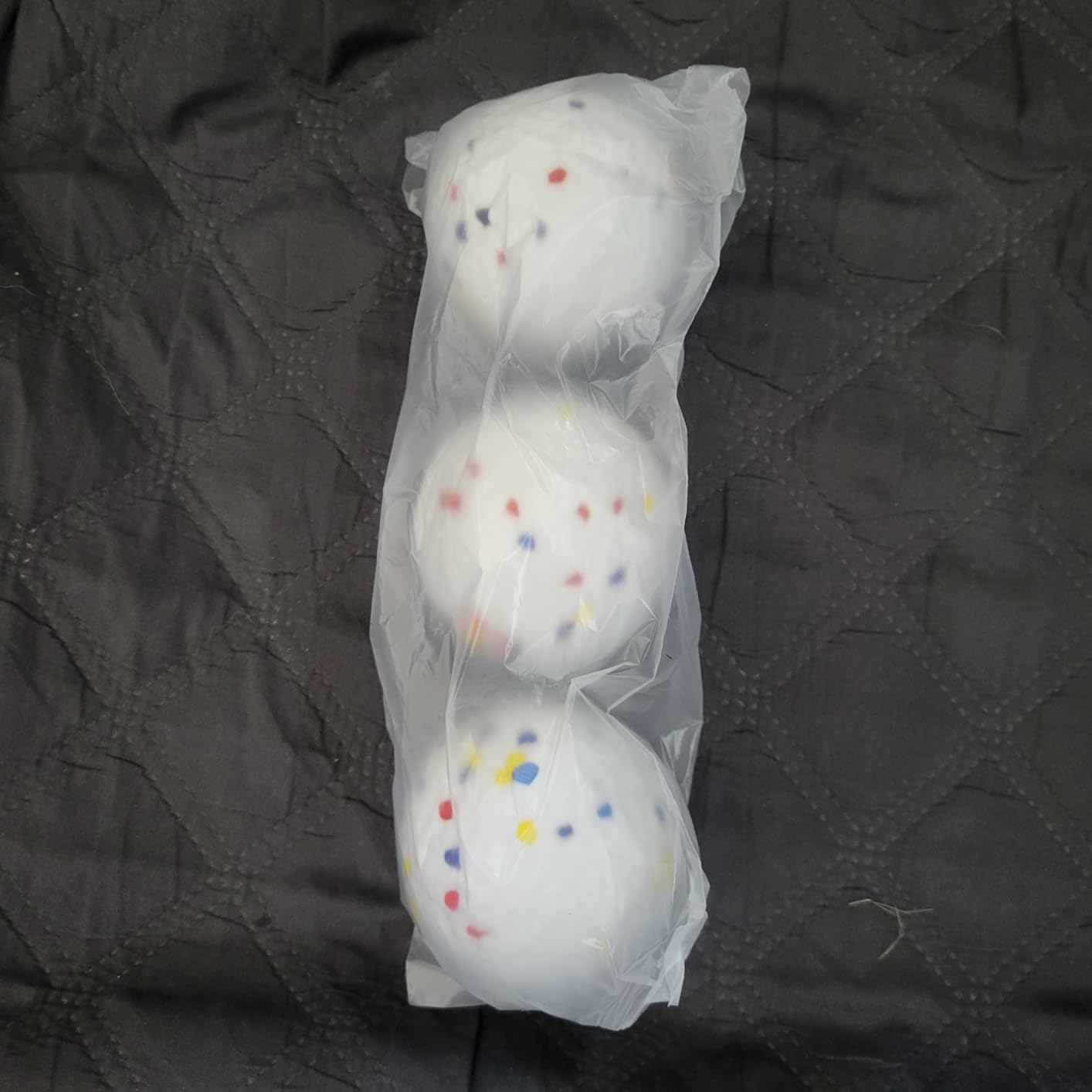
At 79 feet this machine covers roughly three times the ground of anything else in the list, and the random mode fires anywhere in that 29 to 79 foot window. For a large dog with a big field or a farm dog who needs real distance, that is a real functional difference rather than a spec-sheet advantage.
The five included ETPU balls are 2.5 inches, so the diameter matches a standard tennis ball, and they float in water, which means they can be rinsed after a muddy session. A charging adapter is included and a standby mode engages after 30 minutes.
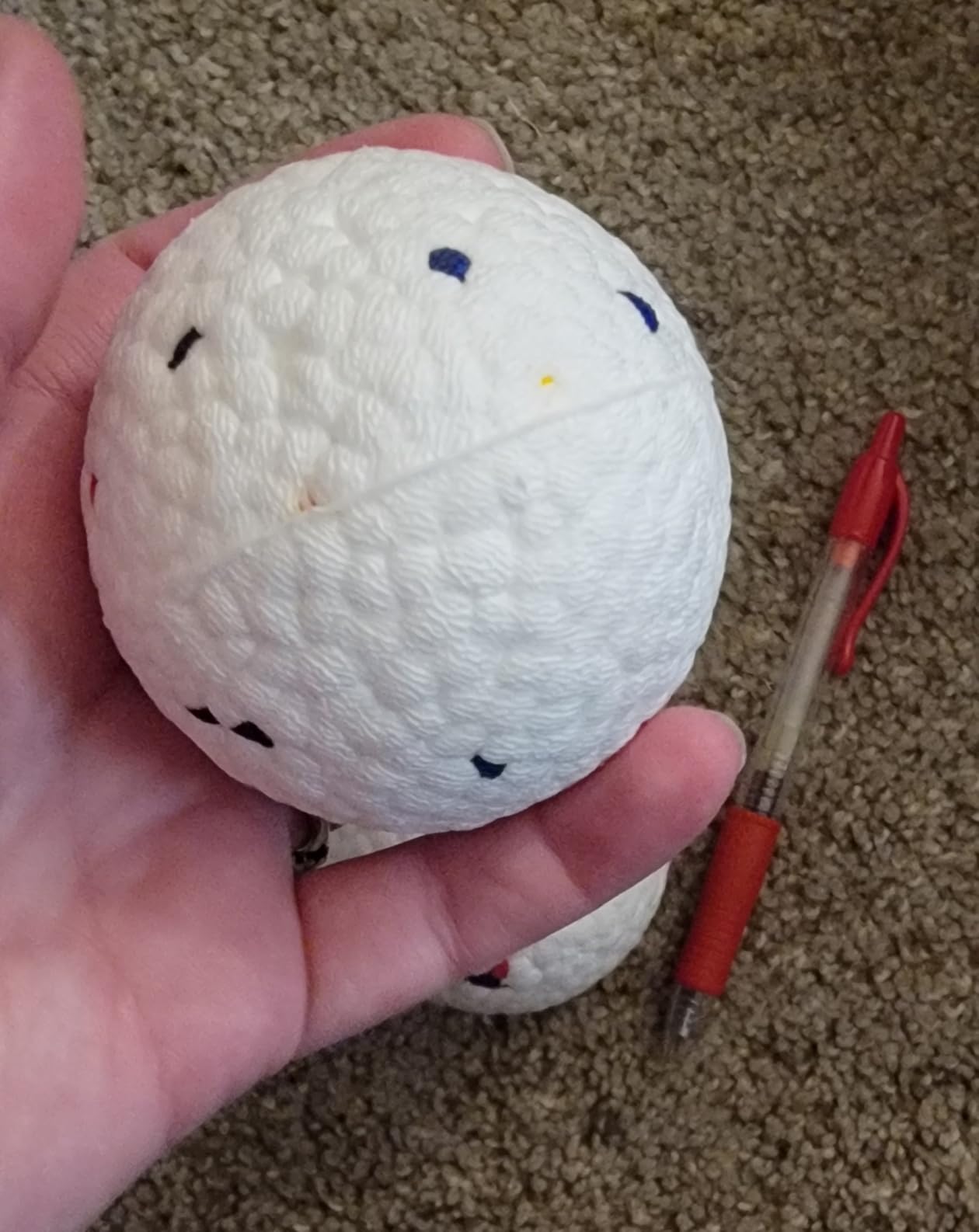
At 7.5 pounds it is mid-weight in this group, so it is movable but not something you will carry up a flight of stairs. The launch itself is powerful, which suits a big dog and will overwhelm a small one.
What to check before you buy the MEKAPLE remote-control model
Test the remote on day one. Owners report the controller failing to respond, and on a machine with this much range a failed remote means a very long manual walk. Confirm it works before you rely on it for a long-distance session.
Use the lightweight foam balls rather than standard tennis balls. Standard felt tennis balls get stuck in the loading path on this machine, and the foam balls are the ones designed for it. Foam also means a very powerful dog can destroy them quickly, so keep a spare set.
Where the MEKAPLE remote-control model falls short
It is loud. Owners with noise-sensitive dogs report that the first launch startles them badly, and the sound is unavoidable at this power level. Start in a familiar room with the shortest distance setting before taking it to a field.
Long throws need a long, clear run. Anything in the way at 60 or 79 feet will stop the ball early, and you will be chasing it through a hedge. Measure the clear distance first, because a 79-foot setting in a suburban back garden is mostly wasted range.
How to Choose an Automatic Ball Launcher
Match the ball first, everything else second. A launcher is built around one ball diameter, and a machine that takes 2.2-inch foam will not grip a 2.5-inch tennis ball properly. The safety rule is simple: the ball should be large enough that your dog cannot swallow it whole, but small enough that it can pick it up and drop it. For a small breed, two inches is the common answer. For a Labrador or a Shepherd, 2.5 inches is the right fit, which is why the larger machines in this roundup all use that size.
Decide indoor or outdoor before you fall for a range figure. Anything past 45 feet is wasted in a flat, and the machines at the top of this list are all built to work in a small space. Outdoors you also need somewhere sheltered from rain if you buy a non-sealed housing, plus a clear run with no cars, fences or low branches in the line of fire. If your dog is heavy and you have height on your side, our guide to dog doors for large dogs covers the clearance thinking that large-dog owners need.
Look at the power source honestly. Built-in rechargeable packs are the most convenient because there is no cable, but a non-standard pack is a recurring cost and eventually a dead machine when the manufacturer stops making it. Removable A or lithium cells are cheaper over a decade and trivially replaceable. Machines that ship with an AC adapter or USB cable are the middle ground.
Then weigh what happens when a dog destroys the balls. Every machine here includes balls, and the ones using ETPU or E-TPU foam outlast felt by a long way, which matters enormously for a Lab that eats a tennis ball every few days. Foam balls are not chew-proof, so an aggressive chewer will still go through them and you should budget for replacements rather than assuming the box is enough for years.
Finally, ask whether an electric machine beats a manual or spring-loaded one. A manual launcher costs less, makes no noise and never fails, and for many dogs a person throwing a ball is better exercise because the dog stays focused on you. Buy an automatic machine when the real constraint is your arm, your schedule, or a dog that will fetch for an hour if someone will keep throwing. Those are the situations the category genuinely solves.
Reliability: What Actually Breaks and When
The most useful thing I can tell you about this category is that the failure pattern is consistent, and it has almost nothing to do with launch distance. Motors and wiring give out first. The RERBIO machine shows the worst reports, with owners describing loose internal wiring and failure after a modest number of launches. The ALL FOR PAWS carries a large volume of reports of units breaking within a year, alongside a short 30-day warranty, which is the other weak spot in the category.
Batteries are the second pattern. The MEKAPLE small-dog machine loses runtime after the first charge cycle, and the ZAPELL machine has a short runtime and a long charge time. Neither failure is dramatic, but both show up as a machine that quits halfway through a session. Machines that run on standard A cells avoid the problem entirely.
Water is the third, and the most avoidable. The ZAPELL is explicitly not waterproof and owners report damage after sprinkler contact. The RERBIO housing cannot be cleaned with a drooly dog. Every machine in this list benefits from a wipe-down of the wheels and loading bowl after every session, and from keeping the ball clean and dry before loading it. Cheap habits extend machine life more than any setting on the dial.
Expect to treat the first year as a learning period. Most owners in this category report steady service once the routine is established, with the failures clustering early or in heavy daily use. If you need a machine that will run five times a week for years, the machines at the top of this list with standard ball sizes and replaceable batteries are the safer bet.
How to Teach Your Dog to Self-Load
Self-loading is the part every buyer underestimates. Most dogs will fetch the ball straight back to you and hand it over, because handing it to a person is what fetch means to them. Owners report two to three short sessions getting this right, and closer to four for a very high-drive Australian Shepherd. Budget that many sessions before you conclude the machine does not work.
Sessions 1 and 2: play the machine, not the training. Set the shortest distance, point it into open space, and let your dog chase. Every time the dog brings the ball back, gently walk it to the machine and help it drop the ball in. You are teaching where the ball goes, not asking for a behaviour your dog does not understand yet.
Sessions 3 and 4: add a cue. Start saying a single word as the dog picks the ball up, such as machine, launcher or fetch, and reward the drop into the cup immediately. Most dogs make the connection within a couple of repetitions at this stage.
Sessions 5 and 7: start small portions. Put the ball in the machine yourself, walk away ten paces, and call your dog back if it drops it at your feet. Gradually extend the distance you walk away until the dog is choosing the machine over you.
Beyond session 7: introduce random mode. If your machine has it, switch it on now. Varying the throw stops the dog from guarding a single spot and keeps the game interesting once the initial novelty wears off.
Two things speed this up. Keep sessions under ten minutes at first, because a bored dog stops dropping balls. And keep a treat in your pocket for the first week, because the reward has to arrive within a second of the drop for the association to stick.
When Not to Buy an Automatic Ball Launcher
Some dogs should not use one, and owners say so directly in dog forums. The first is a puppy under about six months, whose mouth and joints are still developing and who will treat any toy as a chew object rather than a game.
The second is a dog with joint problems or a recovering injury. Repeated high-impact catching adds load to the elbows and shoulders, and for those dogs a softer, shorter-range toy or swimming is a better choice than a 79-foot throw. The third is a dog with an obsessive relationship to fetching, who already carries a ball for hours. A machine that fires continuously can amplify that rather than settle it, and owners on dog forums raise exactly this objection.
The fourth is a dog that does not fetch at all. A chase-driven dog that never brought a ball back will not start because a machine appeared. Work on the retrieve with a lead or a long line first. If a ball never comes back after a month of patient work, an automatic launcher will sit in the grass unused while you spend the same money on a rope tug or a training class.
And a fifth practical case: if you only have a hard-floor living room and a thin ball, the constant sliding is a joint risk of its own. Use a machine on grass or a rug, not on bare tile.
Frequently Asked Questions
What is the best automatic dog ball launcher for dogs?
The ALL FOR PAWS Automatic Dog Ball Launcher is the best all-round choice, with a rechargeable battery, three distance settings, six standard 2.5 inch balls and quiet operation that suits nervous dogs. For a large dog needing more distance, the Pet Prime model reaches 40 feet on a rechargeable power supply. Small breeds do best with a lighter machine such as the SOCO, which weighs 3.8 pounds and throws up to 30 feet.
Are dog ball launchers worth it?
They are worth it when the constraint is your arm, your schedule, or a dog that will fetch for an hour given the chance. They are less worth it if you enjoy throwing, because playing with a person keeps your dog focused on you rather than on a machine. They are also not a substitute for walks, and most dogs still need supervision during the first sessions while they learn to self-load.
What is the best dog ball launcher for large balls?
For a large dog, look for a machine built around 2.5 inch balls and a wide distance spread. The Pet Prime launcher covers 10, 25 and 40 feet and ships with six 2.5 inch tennis balls, while the MEKAPLE remote-control model reaches 79 feet. Both run on power supplies that keep the machine running through a long session without a cable in the grass.
How do I train my dog to use a ball launcher?
Set the machine to its shortest distance, let your dog fetch, and gently walk the dog to the machine to drop the ball in. Repeat for two to three short sessions, adding a single cue word as the dog picks the ball up. Owners report around four sessions for a very high-drive Australian Shepherd before the dog chooses the machine over the owner on its own.
Do automatic ball launchers work with regular tennis balls?
Some do and some do not. The ALL FOR PAWS, Pet Prime and MEKAPLE long-range models all take 2.5 inch balls, which matches a standard tennis ball. Machines built for small breeds use 2 inch or 2.2 inch foam balls, and a standard tennis ball will not grip those loading wheels properly. Check the stated ball diameter before you buy, because it is the one specification you cannot change later.
How long do automatic ball launchers last?
It varies widely with use, and the failure usually appears in the motor or the internal wiring rather than the battery. The main patterns in owner reports are early failure within the first year on some units and battery runtime that drops after the first few charge cycles. Keeping the machine dry, wiping the ball before loading and cleaning the loading wheels will extend the life of any model in this roundup.
Conclusion: The Best Automatic Ball Launchers for Dogs
After months of yard testing, the ALL FOR PAWS automatic ball launcher is the pick I recommend to most people, because it takes standard 2.5 inch balls, runs quietly on a built-in battery and handles a medium to large dog without any fuss. The Pet Prime is the one to buy for a big dog who needs real distance, and the SOCO is the answer for a small dog and a small living space. If your dog destroys every ball it touches, the ZAPELL with its foam ETPU balls will save you constant replacements.
Whichever machine you choose, the honest expectation is that the first few sessions are training, not play. Expect four sessions before a high-drive dog reliably self-loads, and keep the machine dry and the balls clean. Check each listing for the ball diameter first, because that is the one decision you cannot undo later.
If you want a machine for a different kind of fetching, our picks for the best tennis ball machines and best bocce ball sets cover the same test discipline on a different playing field.