
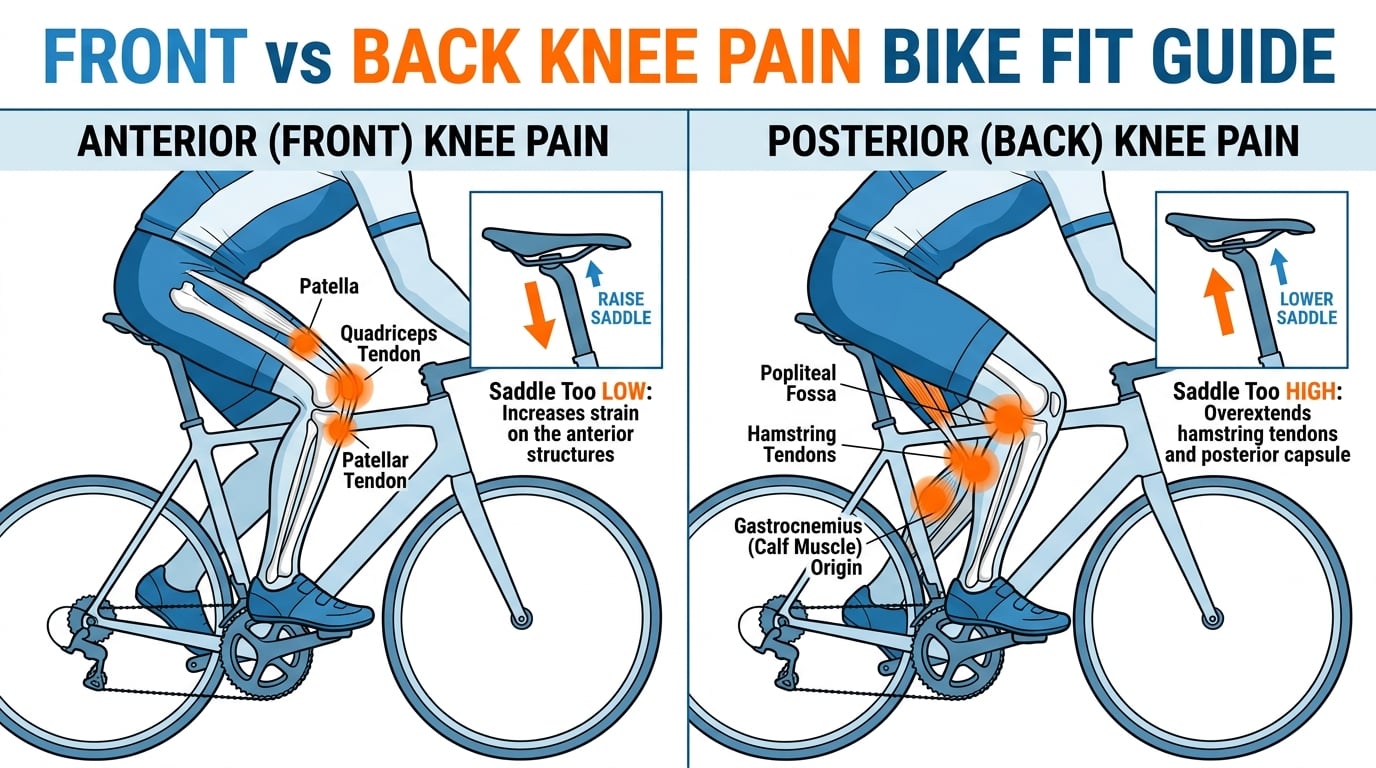
Knee pain is the most common complaint among cyclists, and here is the most important thing I have learned from years of fitting riders: the location of your pain is diagnostic. When you understand front of knee vs back of knee pain and what your bike fit is telling you, you can usually identify the problem in under five minutes.
The general rule is simple. Front-of-knee pain typically points to a saddle that is too low or positioned too far forward, which compresses the patellofemoral joint with every pedal stroke. Back-of-knee pain typically points to a saddle that is too high, which overloads the hamstring tendons at the posterior knee. Fixing the wrong one will make your pain worse, so getting the diagnosis right matters.
In this guide, I walk you through exactly what each pain location means, which bike fit factor is likely responsible, and how to make safe, incremental adjustments. I also cover the exercises, cadence habits, and warning signs that most cycling resources skip entirely. Whether you are dealing with a new twinge after a recent bike fit or chronic discomfort that has been building for months, this article gives you a clear path forward.
If your knee pain started after a break from riding, the underlying cause may be a combination of bike fit and lost conditioning. Our guide on returning to cycling after a break covers how to ramp up safely without aggravating your joints.
Table of Contents
Quick Diagnostic: Front vs Back Knee Pain at a Glance
If you only read one section of this article, make it this one. The table below maps each pain location to its most likely bike fit cause, the tissue involved, and the adjustment you need to make. This is the diagnostic framework I use with every cyclist I work with.
| Pain Location | Most Likely Bike Fit Cause | Tissue Involved | What to Do |
|---|---|---|---|
| Front of knee (anterior) | Saddle too low or too far forward; cleat too far forward | Patellofemoral joint, patellar tendon, quadriceps tendon | Raise saddle 3 to 5mm; move saddle back slightly |
| Back of knee (posterior) | Saddle too high; over-reaching at bottom of pedal stroke | Hamstring tendons (semi-tendinosis, semi-membranosis), popliteus | Lower saddle 3 to 5mm |
| Outside of knee (lateral) | Q-factor too wide or too narrow; cleat lateral position | Iliotibial band (ITB), lateral retinaculum | Adjust stance width; check cleat lateral position |
| Inside of knee (medial) | Q-factor too wide; cleat rotation; forefoot valgus | Pes anserinus, medial meniscus, medial retinaculum | Narrow stance width; check cleat rotation and wedging |
Front-of-knee pain typically points to a saddle that is too low or a cleat positioned too far forward. Back-of-knee pain typically points to a saddle that is too high. These two rules account for roughly 80 percent of cycling knee pain cases.
Use this table as a starting point, not a final answer. Many cyclists have more than one issue going on at the same time, which is why I cover a full diagnostic process later in this article.
Anatomy of Cycling Knee Pain
The knee is a hinge joint. It wants to flex and extend in a straight vertical line, and it does not tolerate twisting or lateral shearing well. When your bike fit forces the knee to track at an angle or through an excessive range of motion, specific tissues get overloaded with every single pedal stroke.
Consider this: at a cadence of 90 revolutions per minute, you complete 5,400 pedal strokes per hour. If your saddle is 5mm too low, that is 5,400 repetitions of excessive patellofemoral compression every single hour you ride. This is why small fit problems become big pain problems over time.
The front of the knee houses the patellofemoral joint, where your kneecap glides against the femur, along with the patellar tendon and quadriceps tendon. The back of the knee contains the hamstring tendon attachments (semi-tendinosis and semi-membranosis), the popliteus muscle, and the joint capsule itself. Different bike fit errors stress different tissues, which is why pain location is so diagnostic.
This concept, known as regional interdependence, means that a problem in one area of your bike fit can cause pain in a seemingly unrelated area. A cleat that is too far forward shifts your weight distribution, which changes how hard your quads work, which changes patellofemoral loading. Everything is connected.
Front of Knee Pain (Anterior Cycling Knee Pain)
Anterior knee pain is by far the most common type of cycling knee pain, accounting for over half of all cases. The pain usually centers on or around the kneecap and tends to worsen during climbs, hard efforts, and after long rides. If you feel a dull ache under or around your patella that intensifies when you walk upstairs after a ride, you are dealing with anterior knee pain.
Patellofemoral Pain Syndrome
Patellofemoral pain syndrome is the most common diagnosis for front-of-knee pain in cyclists. It happens when the kneecap does not track properly in its groove on the femur, causing irritation of the sub-patellar cartilage. Over time, this can progress to chondromalacia patellae, a softening of the cartilage beneath the kneecap.
In cycling, the primary bike fit culprit is a saddle that is too low. When your saddle is too low, your knee never gets close to full extension at the bottom of the pedal stroke. This keeps the patellofemoral joint in a constantly compressed state throughout the power phase, multiplying the load on the cartilage with every revolution.
The secondary culprit is a saddle positioned too far forward. This shifts your knee ahead of the pedal spindle at the 3 o’clock position, increasing the moment arm of the quadriceps tendon and amplifying compressive forces on the kneecap. Combined with a low saddle, this is a recipe for anterior knee pain.
Patellar Tendonitis
If your pain is sharp and localized to the tendon just below your kneecap rather than behind it, you may have patellar tendonitis. This is an inflammation of the tendon that connects your patella to your tibia. Cyclists typically develop this from pushing big gears at low cadence, which dramatically increases the force the tendon must transmit per stroke.
The bike fit fixes are the same as for patellofemoral pain (raise the saddle, check fore-aft position), but you also need to address your gearing and cadence habits. I cover that in detail in the cadence section below.
Bike Fit Culprits for Front Knee Pain
Here is a quick checklist of the most common bike fit mistakes that cause anterior knee pain:
- Saddle too low by even 5 to 10mm (the most common cause)
- Saddle too far forward, pushing the knee ahead of the pedal spindle
- Cleat positioned too far forward under the ball of the foot, increasing leverage on the patellar tendon
- Crank arms too long, increasing knee flexion at the top of the pedal stroke
- Low cadence and high gear riding, multiplying compressive forces per stroke
If you have recently switched to shorter cranks (165mm or shorter) or raised your saddle, that is worth noting. Many cyclists on forums like r/bikefit report that switching from 172.5mm to 165mm cranks produced significant improvement in anterior knee pain. Shorter cranks reduce the maximum knee flexion angle at the top of the stroke, which directly reduces patellofemoral compression.
Back of Knee Pain (Posterior Cycling Knee Pain)
Posterior knee pain is less common than anterior pain but often more confusing for cyclists. The pain sits in the crease behind the knee and may feel like a deep ache, tightness, or a pulling sensation. Unlike front knee pain, which builds gradually, back-of-knee pain can appear suddenly after a single aggressive ride or saddle change.
Hamstring Tendon Overload
The most common cause of posterior knee pain in cyclists is hamstring tendon overload. When your saddle is too high, your leg must over-extend at the bottom of the pedal stroke to maintain contact with the pedal. This places the hamstring tendons (specifically the semi-tendinosis and semi-membranosis attachments) under excessive stretch and tension with every revolution.
Think of it this way: your hamstrings are working to both extend the hip and control knee flexion. If the saddle is too high, they are being asked to work at their maximum length repeatedly, which is where tendons are weakest and most vulnerable to injury.
Popliteus Strain
The popliteus is a small muscle at the back of the knee that helps unlock the knee from full extension. While less commonly discussed, it can become irritated from the same over-extension that strains the hamstrings. Pain from popliteus involvement tends to be deeper and more difficult to pinpoint.
Bike Fit Culprits for Back Knee Pain
The bike fit causes of posterior knee pain are essentially the mirror image of anterior pain causes:
- Saddle too high by even 3 to 5mm (the primary cause)
- Saddle too far back, forcing over-reaching at the bottom of the stroke
- Cleats positioned too far back (less common but possible)
- Excessive toe-down pedaling posture, which changes the effective leg length
- Overly flexible rider who can reach too far, masking a saddle that is effectively too high for their functional range
The fix is straightforward: lower your saddle in small increments. I recommend starting with 3mm, riding for two to three sessions, and then re-evaluating. Many cyclists are surprised by how small the adjustment needs to be.
One important warning from the cycling community: if you lower your saddle too much to fix posterior pain, you can swing directly into anterior pain. This is why small, incremental changes are essential. Never move your saddle more than 5mm at a time.
How Bike Fit Relates to Knee Pain Location
Now that you understand the basic front-versus-back diagnostic, let me break down each bike fit factor in detail. Understanding how each adjustment affects your knee biomechanics is what separates a guesser from someone who can actually solve their own pain.
Saddle Height: The Single Biggest Factor
Saddle height is the most impactful bike fit variable for knee pain, period. A saddle that is too low increases patellofemoral compression (front knee pain). A saddle that is too high increases hamstring tendon strain (back knee pain). The window between the two can be as narrow as 10 to 15mm.
There are several methods to estimate correct saddle height. The simplest is the heel-on-pedal test: sit on your bike in riding position, place your heel on the pedal at the bottom of the stroke (6 o’clock position). Your leg should be fully extended but not locked. When you clip in, this leaves a slight knee bend of about 25 to 35 degrees.
More precise methods include the LeMond formula (inseam measurement multiplied by 0.883 for center of bottom bracket to top of saddle) and the knee extension angle measured via video motion capture. A knee extension angle of 140 to 150 degrees at the bottom of the pedal stroke is the accepted range for most cyclists.
However, no formula works for everyone. Individual factors like flexibility, foot mechanics, pedal system, and riding style all shift your ideal saddle height. This is why formulas are starting points, not answers.
Saddle Fore-Aft Position
Where your saddle sits fore and aft (front to back) affects load distribution between your quadriceps and glutes. A saddle too far forward shifts load toward the quads and increases anterior knee stress. A saddle too far back shifts load toward the hamstrings and glutes, which can strain the posterior knee if taken too far.
The traditional method for checking fore-aft position is the KOPS test (Knee Over Pedal Spindle). With your pedals at the 3 o’clock and 9 o’clock positions, a plumb line dropped from the front of your forward knee should pass through or just behind the pedal axle. This is a starting guideline, not a rule.
The KOPS test has been criticized because it ignores individual anatomy and riding style. A rider with long femurs will naturally sit further back, and forcing them forward to meet KOPS can create new problems. Use it as a reference point, then adjust based on comfort and pain response.
Cleat Position and Knee Tracking
Cleat position affects knee tracking in three dimensions: fore-aft, lateral (medial-lateral), and rotational. Each dimension can cause a different type of knee pain.
Fore-aft cleat position: Cleats too far forward (under the ball of the foot) increase the leverage on the patellar tendon and quadriceps, raising anterior knee stress. Moving cleats back by 3 to 5mm reduces this load and is one of the fastest fixes for front knee pain that does not respond to saddle height changes.
Lateral cleat position: This determines your effective stance width, which connects to Q-factor. Cleats positioned too close together create a narrow stance that can cause the knee to track laterally. Cleats too far apart can cause medial knee pain through the pes anserinus.
Cleat rotation and float: Cleats that force your foot into a position it does not naturally want to be in will stress the knee. Most clipless pedal systems offer float (degrees of rotational freedom). Speedplay pedals offer the most float at up to 30 degrees, while standard SPD-SL pedals offer 3 to 9 degrees. If your knee pain developed after switching pedal systems, float differences may be the cause.
Q-Factor and Stance Width
The Q-factor is the distance between the outside edges of your crank arms at the pedals. Stance width is your effective foot spacing once cleats are mounted. Both affect how your knee tracks through the pedal stroke.
A Q-factor or stance width that is too narrow for your hip width forces your knees outward at the top of the stroke and inward at the bottom, creating a lateral wobble that stresses the IT band (causing lateral knee pain) and the medial structures. A stance too wide does the opposite, straining the medial knee through the pes anserinus and medial meniscus.
Signs your Q-factor needs attention include knees that bow inward or outward during the pedal stroke, lateral knee pain (ITB syndrome) that develops after 20 to 30km, or one-sided knee pain related to your stance. Cleat lateral position is the easiest way to fine-tune stance width without changing cranks.
Crank Length
Crank length affects how much your knee flexes at the top of the pedal stroke. Longer cranks (175mm and above) force the knee into deeper flexion, which increases patellofemoral compression. This is why tall cyclists on long cranks are prone to anterior knee pain.
The trend toward shorter cranks (165mm and even 155mm) is driven largely by knee comfort. Multiple cyclists on r/bikefit report that shortening cranks nearly completely resolved their anterior knee pain. Shorter cranks also open up the hip angle at the top of the stroke, which can improve comfort for riders with hip flexibility limitations.
The trade-off is a small loss of leverage for climbing. For most recreational and endurance cyclists, the knee comfort benefit far outweighs the minimal power difference. If you are tall, have long legs, or struggle with front knee pain that will not resolve, shorter cranks are worth serious consideration.
Diagnosing Your Pain: Step-by-Step Self-Assessment
Now I will walk you through a structured diagnostic process you can do yourself. Follow these steps in order and make only one change at a time.
Step 1: Pinpoint Your Pain Location
Before touching your bike, get specific about where your pain is. Is it directly under the kneecap, below the kneecap (patellar tendon), behind the knee, on the outside (lateral), or on the inside (medial)? Is it on one side or both? Does it hurt during the ride, after the ride, or both? Write this down.
Step 2: Check Saddle Height
Do the heel-on-pedal test described earlier. If your heel cannot reach the pedal at the bottom of the stroke without rocking your hips, your saddle is too high (posterior knee pain risk). If your leg is significantly bent at the bottom with your heel on the pedal, your saddle is too low (anterior knee pain risk).
Step 3: Check Saddle Fore-Aft
Use the KOPS test as a starting point. Drop a plumb line from the front of your kneecap with the pedal at 3 o’clock. If the line falls well in front of the pedal axle, move your saddle back. If it falls well behind, move it forward. Make adjustments of 3 to 5mm at a time.
Step 4: Check Cleat Position
Look at your cleats. Are they mounted all the way forward (under the ball of the foot)? For anterior knee pain, try sliding them back 3 to 5mm. Check lateral position: do your knees track straight up and down during the pedal stroke, or do they bow in or out? If they waver, you may need to adjust stance width or cleat lateral position.
Step 5: Make One Change and Test
This is the most important step. Make one adjustment, ride for two to three sessions over a week, and then evaluate. Track three things: pain frequency (how often it occurs), pain intensity (how bad it is on a scale of 1 to 10), and pain duration (how long it lasts after the ride). If all three are improving, keep going. If not, move to the next variable.
Step 6: Consider Crank Length and Q-Factor
If saddle height, fore-aft, and cleat adjustments have not resolved your pain, crank length and Q-factor are the next variables to investigate. These are more involved changes (new cranks or cleat spacers), so they are best explored with the help of a professional bike fitter.
Cadence, Gearing, and Knee Stress
Most cycling knee pain articles skip this entirely, which is a mistake. How you pedal matters just as much as how your bike is set up. Grinding along at 60 rpm in a big gear generates far more patellofemoral compressive force per pedal stroke than spinning at 90 rpm in a lighter gear, even if the power output is the same.
Think of it this way: every pedal stroke transmits force through your knee. At 60 rpm, you are doing fewer strokes but each one carries roughly double the force of a stroke at 90 rpm. Your knee does not care about total work done; it cares about peak force per repetition. Lower cadence means higher peak force per stroke.
For knee health, aim for a cadence of 80 to 90 rpm on flat terrain and at least 70 rpm on climbs. If you find yourself dropping below 70 rpm regularly, shift to an easier gear. This is especially important for cyclists with anterior knee pain, where reducing compressive force per stroke is a primary goal.
Low cadence riding is often a gearing problem rather than a strength problem. If your lowest gear is not low enough for the terrain you ride, you will be forced to grind. Consider installing a wider-range cassette or a compact crankset if your local hills regularly push your cadence below 70 rpm.
Prevention: Exercises and Maintenance
No competitor article I reviewed covers exercises in depth, which is a major gap. Bike fit adjustments address the mechanical cause of knee pain, but they do not address the tissue weakness that made you vulnerable in the first place. You need both.
Exercises for Front Knee Pain
If you have anterior knee pain (patellofemoral pain or patellar tendonitis), your goal is to strengthen the quadriceps and improve patellar tracking:
- Wall sits – hold for 30 to 60 seconds, three sets. Builds isometric quad strength without high compressive forces.
- Single-leg squats – 3 sets of 8 to 10 reps per side. Addresses asymmetries and builds functional strength.
- Terminal knee extensions with a resistance band – 3 sets of 15 reps. Strengthens the vastus medialis oblique (VMO) for better patellar tracking.
- Eccentric step-downs – 3 sets of 10 reps per side. Builds quad control and tendon resilience.
Exercises for Back Knee Pain
For posterior knee pain related to hamstring overload, focus on eccentric hamstring strength:
- Nordic hamstring curls – 3 sets of 5 reps. The gold standard for hamstring tendon strength.
- Romanian deadlifts – 3 sets of 8 to 10 reps. Builds posterior chain strength in a controlled range.
- Glute bridges – 3 sets of 15 reps. Reduces hamstring overload by improving glute activation.
- Hamstring stretches – hold 30 seconds, three times per side. Addresses tightness that contributes to tendon strain.
General Knee Maintenance
Regular foam rolling of the quads, IT band, and hamstrings helps maintain tissue quality. I also recommend checking your bike fit every few months, especially if you have changed shoes, pedals, saddle, or riding volume. Small changes in equipment can shift your fit enough to cause problems.
If you are coming back from time off the bike, your tissues need time to re-adapt to cycling loads. Our guide on returning to cycling after a break walks through how to rebuild volume safely without triggering knee pain.
When Your Bike Fit Makes Things Worse
One of the most common complaints I see in cycling forums is that knee pain got worse after a professional bike fit. This is a real and frustrating experience. A Reddit user in r/cycling reported severe knee pain 20 minutes into every ride after a professional fitter pushed their seat too far forward. Another rider tried multiple professional fitters without success until they combined bike fit changes with strength training.
There are several reasons a bike fit can make things worse. First, a fitter may use a generic formula that does not account for your individual anatomy or flexibility. Second, making too many changes at once makes it impossible to identify which adjustment caused the new pain. Third, some fitters prioritize aerodynamics or power over comfort, which can work for racers but backfire for recreational riders.
If your pain worsened after a fit, do not panic. Return to the diagnostic process above. Identify the new pain location, work backward through the changes that were made, and revert them one at a time. A good fitter will welcome your feedback and adjust their work. A fitter who dismisses your pain is not worth returning to.
The cycling community consensus is clear: changes should be made in small increments and tested over two to four rides before evaluating. If your fitter made dramatic changes all at once, that is a red flag. Be patient with tissue healing, which can take two to six weeks even after the mechanical cause is corrected.
When to See a Professional Bike Fitter
Self-diagnosis works for many cyclists, but some situations call for professional help. Here are the signs that it is time to book a fitting session:
- Your pain has not improved after two to three weeks of self-adjustment
- Your pain is on one side only and you suspect a leg length discrepancy or asymmetry
- You have changed multiple components (shoes, pedals, saddle, cranks) and cannot isolate the problem
- Your pain is severe enough to force you off the bike
- You have a history of knee injury or surgery
When choosing a fitter, look for credentials and methodology. The best fitters for pain-related issues combine bike fitting with physical therapy or sports medicine knowledge. They should use video motion capture or 3D analysis, assess your off-bike movement patterns and flexibility, and explain the reasoning behind every adjustment.
Ask questions before booking. Do they work with cyclists who have knee pain? What tools do they use? How long is a session? What is their follow-up policy if the fit does not resolve your pain? A fitter who offers a free follow-up within 30 days is signaling confidence in their work.
The cost of a professional fit ranges widely, but consider it an investment in your riding future. A good fit can save you months of pain, lost training time, and medical bills. That said, if a fit makes things worse and the fitter cannot explain why, trust your body over the fit. Seek a second opinion or consult a sports physical therapist.
FAQ’s
Why does my bike fit hurt behind my knee?
Back-of-knee pain from cycling almost always means your saddle is too high. When the saddle is too high, your leg over-extends at the bottom of the pedal stroke, overloading the hamstring tendons (semi-tendinosis and semi-membranosis) and the popliteus muscle with every revolution. Lower your saddle by 3 to 5mm and test for two to three rides.
What is the number one mistake that makes bad knees worse?
The number one mistake cyclists make is continuing to ride with poor bike fit and ignoring early pain signals. Small fit problems become chronic tissue injuries when multiplied across thousands of pedal strokes. The second biggest mistake is making too many adjustments at once, which makes it impossible to identify what helped and what hurt.
Will a bike fit fix my knee pain?
A proper bike fit can fix knee pain when the cause is mechanical, which it is in the majority of cycling knee pain cases. However, if your pain is related to tissue weakness, muscle imbalance, or an underlying injury, bike fit changes alone will not fully resolve it. The best results come from combining bike fit corrections with targeted strength training and gradual load building.
How long does knee pain from a bike fit take to go away?
Most cycling knee pain improves within two to six weeks after the bike fit issue is corrected, assuming you reduce riding volume during the healing period. Acute inflammation may subside in a few days, but tendon and cartilage tissue needs longer to fully recover. If pain persists beyond six weeks after a correct fit change, consult a sports physical therapist.
Can a bike fit cause knee pain?
Yes. A poorly executed bike fit can absolutely cause new knee pain, especially if the fitter makes multiple large changes at once or uses generic formulas that do not match your individual anatomy. Common fit-induced pain causes include a saddle set too high or too low, cleats positioned incorrectly, or a saddle moved too far forward or back. Always make incremental changes and test them before committing.
Should I stop cycling if my knee hurts?
You do not need to stop completely, but you should reduce volume and intensity until the pain subsides. Light cycling at high cadence and low resistance can actually promote blood flow and healing. Stop riding entirely if the pain is sharp, worsening during the ride, or causing a limp off the bike. Address the bike fit cause before ramping back up.
Is cycling bad for knees with arthritis?
Cycling is generally considered good for arthritic knees because it provides low-impact cardiovascular exercise that promotes joint lubrication without the pounding of running. However, a poor bike fit can aggravate arthritis. If you have knee arthritis, prioritize a comfortable fit with a slightly higher cadence, lower gears, and a saddle height that avoids excessive knee flexion at the top of the stroke.
Conclusion: Your Knee Pain Is Trying to Tell You Something
Understanding front of knee vs back of knee pain and what your bike fit is telling you is the single most important skill for any cyclist who wants to ride pain-free. The diagnostic rule is your foundation: front-of-knee pain typically points to a saddle that is too low, and back-of-knee pain typically points to a saddle that is too high. Start there, make one small change at a time, and listen to your body.
Remember that bike fit is only half the equation. Tissue strength, cadence habits, and patience with the healing process are equally important. If you have been struggling with knee pain for months, combine your fit adjustments with the exercises in this guide and give your tissues two to six weeks to respond before making further changes. For more on safely rebuilding your cycling fitness after time off, see our guide on getting back into cycling shape.
Your knee pain is not a mystery. It is a signal, and now you know how to read it.