
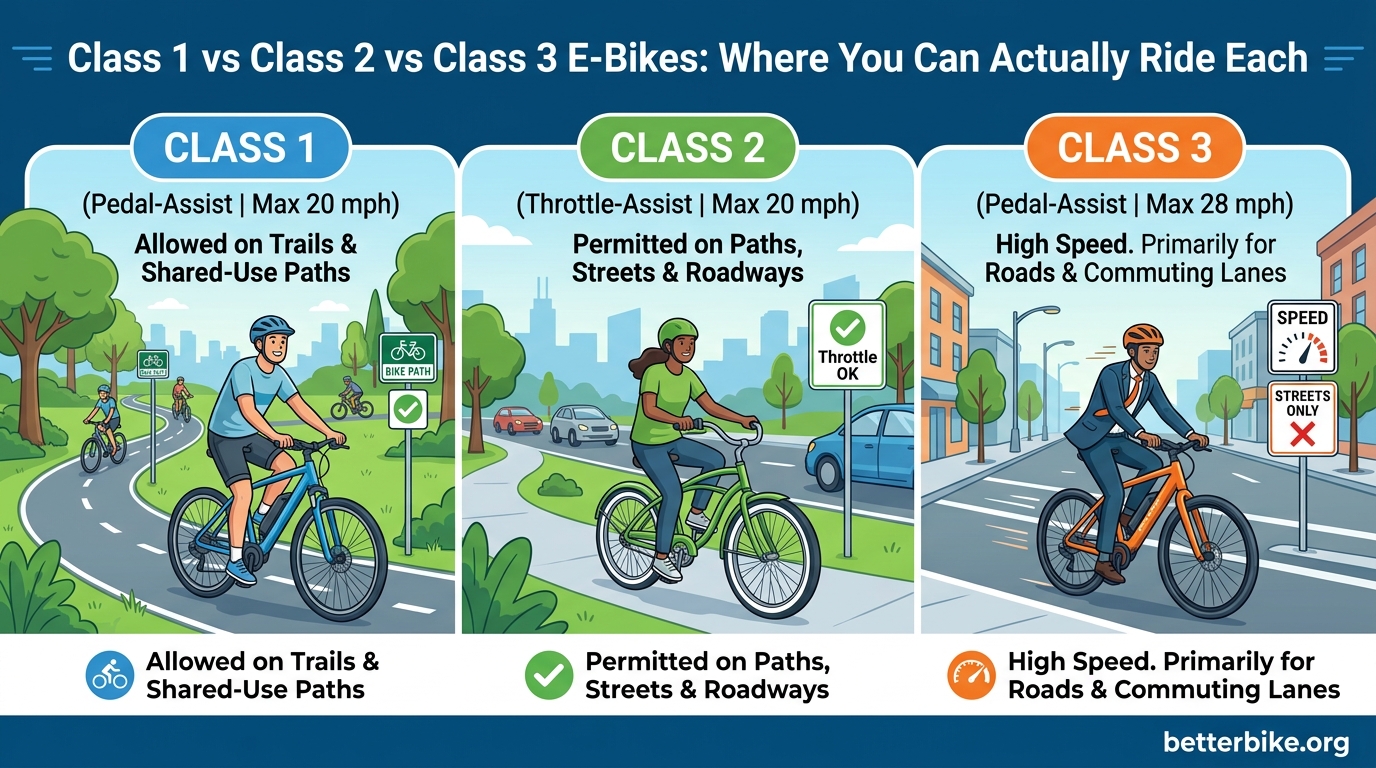
Electric bikes are everywhere in 2026, but not all e-bikes are treated the same under the law. If you are trying to figure out Class 1 vs Class 2 vs Class 3 e-bikes and where you can actually ride each, you are in the right place.
The class system determines how fast your motor will help you go, whether you get a throttle, and most importantly, which trails, bike paths, and roads you are legally allowed to use. Buying the wrong class can mean getting turned away from your favorite trail or fined on a bike path.
Our team has spent months researching e-bike regulations across all 50 states, digging through forum discussions from real riders, and comparing the laws that actually affect where you can ride. What we found is that most guides oversimplify things. The reality is that your riding privileges can change from one city to the next, even within the same state.
This guide breaks down every class in plain language, covers exactly where each one is welcome (and where it is not), and helps you pick the right class before you spend your money.
Table of Contents
Why E-Bike Classes Exist
The three-class system was created by PeopleForBikes and the Bicycle Product Suppliers Association (BPSA) to give states, cities, and land managers a standardized way to regulate e-bikes. Before this system existed, e-bikes existed in a legal gray area that confused riders, law enforcement, and park rangers alike.
The model legislation classifies e-bikes as bicycles (not motor vehicles) as long as they have a motor under 750 watts and meet the speed and throttle rules for their specific class. Over 40 states have adopted some version of this framework as of 2026, which means most riders can treat their e-bike like a regular bicycle for legal purposes.
The key idea is simple: the class tells officials how the bike behaves, and that determines where it is welcome. A Class 1 bike behaves almost like a traditional bicycle, so it gets the widest access. A Class 3 bike can hit 28 mph, so it faces more restrictions on shared paths.
Without this system, every trail and path would need its own custom rule set. The three-class approach keeps things manageable for land managers while giving riders a clear framework to follow.
What Is a Class 1 E-Bike?
A Class 1 e-bike is a pedal-assist-only electric bike with a maximum motor-assisted speed of 20 mph. The motor only kicks in when you pedal, and it stops helping once you reach 20 mph. There is no throttle on a Class 1 bike.
This is the closest riding experience to a traditional bicycle. You still have to put in effort to move forward, but the motor amplifies your pedaling power to make hills easier, headwinds less brutal, and long commutes more manageable.
Here is what makes a Class 1 e-bike:
- Motor activates only when you pedal
- Maximum assisted speed: 20 mph
- No throttle of any kind
- Motor wattage capped at 750W
- Classified as a bicycle in most states (no license, registration, or insurance required)
Reddit riders consistently describe Class 1 as a “no-brainer” for anyone replacing car trips. You get the workout feel of cycling with enough assistance to arrive at work without being drenched in sweat. The lack of a throttle means you are always engaged, which many riders see as a positive.
Where Class 1 really shines is trail access. Because it behaves like a regular bike, most trail systems, national parks, and state parks that allow e-bikes allow Class 1 specifically. If mountain biking or greenway riding is your priority, this is your class.
What Is a Class 2 E-Bike?
A Class 2 e-bike has both pedal assist and a throttle, with a maximum speed of 20 mph for both modes. The throttle can propel the bike on its own without any pedaling, which is the defining feature that separates Class 2 from Class 1.
This is where things get interesting from a rider experience perspective. You can pedal with assistance like a Class 1 bike, or you can twist the throttle and ride without pedaling at all. Some riders love this flexibility; others find they use the throttle more than they expected.
Here is what defines a Class 2 e-bike:
- Has a throttle that works independently of pedaling
- Also includes pedal assist functionality
- Maximum speed: 20 mph (both throttle and pedal assist)
- Motor wattage capped at 750W
- Treated as a bicycle in most states (no license required)
Forum discussions reveal that Class 2 is the go-to choice for riders with physical limitations, injuries, or anyone who wants the option to take a break from pedaling. The throttle is genuinely useful in stop-and-go traffic, at intersections, and when you need a burst of power to get moving from a dead stop.
The trade-off is trail access. Some trail systems and state parks restrict Class 2 bikes because the throttle is seen as more akin to a motor vehicle. The logic from land managers is that a throttle-enabled bike could be operated recklessly at speed without pedaling effort. Whether this concern is justified is debated heavily in e-bike forums.
For urban riding, bike lanes, and bike paths, Class 2 is generally welcome. The 20 mph cap keeps speeds reasonable for shared infrastructure.
What Is a Class 3 E-Bike?
A Class 3 e-bike is a pedal-assist electric bike with a maximum assisted speed of 28 mph. Like Class 1, it is pedal-assist only, but the higher speed cap and mandatory speedometer set it apart. In most states, Class 3 bikes cannot have a throttle that operates above 20 mph.
This is the fastest class in the standard three-tier system, and it is designed for riders who want to keep up with urban traffic, cover longer distances, and commute efficiently. The extra 8 mph over Classes 1 and 2 makes a real difference on open roads.
Here is what defines a Class 3 e-bike:
- Pedal assist only (no throttle in most states, or throttle capped at 20 mph)
- Maximum assisted speed: 28 mph
- Speedometer is required by law
- Motor wattage capped at 750W
- Often subject to age restrictions (riders must be 16 or older in most states)
- Helmet typically required regardless of rider age
Many people ask: can an e-bike be both Class 2 and Class 3? The answer is yes, and these are called hybrid or dual-class bikes. Some manufacturers build bikes with a throttle that works up to 20 mph and pedal assist that continues to 28 mph. In states following the model legislation, these bikes are typically classified as Class 3, since the higher speed category takes precedence. However, this means they may face Class 3 restrictions even though they have a throttle.
Forum riders report that the speed difference between Class 2 (20 mph) and Class 3 (28 mph) feels significant on open roads but less impactful in stop-and-go city traffic. One Reddit commuter noted that traffic lights, hills, and congestion meant their average speed was nearly identical regardless of class. Where Class 3 shines is on longer stretches without stops.
The downside of Class 3 is access restrictions. Many bike paths, multi-use trails, and greenways explicitly ban Class 3 bikes because 28 mph is considered too fast for shared paths with pedestrians and traditional cyclists.
Class 1 vs Class 2 vs Class 3: Side-by-Side Comparison
Here is how the three classes stack up against each other on the specs that matter most.
- Throttle: Class 1: No | Class 2: Yes | Class 3: No (or capped at 20 mph)
- Max Assisted Speed: Class 1: 20 mph | Class 2: 20 mph | Class 3: 28 mph
- Pedal Assist: All three classes have pedal assist
- Motor Wattage: All three capped at 750W
- Speedometer Required: Class 1: No | Class 2: No | Class 3: Yes
- Minimum Age: Class 1: None | Class 2: None (varies) | Class 3: Usually 16+
- Helmet Required: Class 1: Varies by state and age | Class 2: Varies | Class 3: Usually required for all ages
- Trail Access: Class 1: Widest | Class 2: Moderate | Class 3: Most restricted
- License Required: None for any class in states following model legislation
The biggest differentiators are throttle presence and top speed. Everything else is either shared across all three or varies by state. If you remember nothing else, remember this: throttle makes it Class 2, 28 mph makes it Class 3, and pedal-assist-only at 20 mph makes it Class 1.
Head-to-Head: Which Class Wins Where?
Class 1 vs Class 2: Trail Access vs Throttle Convenience
The choice between Class 1 and Class 2 comes down to one question: do you want a throttle? Both cap at 20 mph, both have pedal assist, and both are treated as bicycles in most states.
Class 1 wins on trail access. National parks, state parks, and most mountain bike trail systems that allow e-bikes specifically allow Class 1 only. If you want to ride singletrack, rail trails through national forests, or greenways in regulated parks, Class 1 is the safe bet.
Class 2 wins on convenience. The throttle is a genuine quality-of-life feature for riders with knee issues, anyone recovering from injury, or commuters who deal with frequent stops. Being able to twist the throttle and glide through an intersection without frantically pedaling is something Class 1 riders do not get.
One Reddit rider put it bluntly: “If you have any physical limitation, get Class 2. If you want to ride trails, get Class 1. It really is that simple.”
Class 2 vs Class 3: Throttle vs Speed
This comparison is where things get nuanced. Class 2 gives you a throttle but caps at 20 mph. Class 3 gives you 28 mph but no throttle (or a throttle limited to 20 mph in states that allow it).
For pure commuting on roads with traffic, Class 3 is the better choice. The extra 8 mph helps you keep pace with cars in 30 mph zones, which makes drivers less likely to make aggressive passes. Forum commuters who switched from Class 2 to Class 3 consistently report feeling safer in traffic.
For riders who value flexibility and ride in mixed environments (bike paths, neighborhoods, some road), Class 2 is more versatile. The throttle is useful at low speeds and in crowded areas where you are constantly stopping and starting.
The real-world speed difference is smaller than the numbers suggest. Riders report that average commuting speeds between Class 2 and Class 3 are closer than expected because of traffic controls, hills, and congestion. Class 3’s advantage shows up on longer uninterrupted stretches.
Class 1 vs Class 3: Trail vs Road
These are the two pedal-assist-only classes, and they appeal to opposite rider profiles.
Class 1 is the trail and fitness rider’s choice. You get exercise, wide trail access, and a riding experience that feels like cycling with a boost. If your typical ride involves greenways, rail trails, mountain bike paths, or leisurely neighborhood loops, Class 1 fits perfectly.
Class 3 is the road and commuter’s choice. The 28 mph cap lets you cover serious distance, keep up with urban traffic, and turn a 45-minute car commute into a 35-minute e-bike commute. You will sacrifice trail access, but if your riding is road-focused, that trade-off is worth it.
One thing to note: some riders buy Class 3 thinking they will use it everywhere, then discover their local bike path bans Class 3. Check your regular routes before committing.
Where You Can Actually Ride Each Class
This is the section most guides gloss over. Let’s get specific about where each class is welcome and where it is not.
Where You Can Ride a Class 1 E-Bike
Class 1 has the widest access of any e-bike class. In general, if regular bicycles are allowed, Class 1 e-bikes are allowed.
- National Parks: Allowed on roads and paved trails where traditional bikes are permitted
- State Parks: Allowed on most trails (some states require specific trail designation)
- Mountain Bike Trails: Allowed on many trail systems, especially IMBA-affiliated trails
- Bike Lanes: Allowed in all bike lanes
- Bike Paths and Greenways: Generally allowed
- Rail Trails: Almost universally allowed
- Sidewalks: Varies by local ordinance (same rules as traditional bikes)
- Roads: Allowed on all roads where bicycles are permitted
When a trail has no posted e-bike rules, Class 1 is the class most likely to be permitted by default. Park rangers and land managers generally treat Class 1 the same as a traditional bicycle.
Where You Can Ride a Class 2 E-Bike
Class 2 access is a mixed bag. You get most of the same infrastructure access as Class 1, but with more trail restrictions.
- National Parks: Allowed on roads; trail access varies by park
- State Parks: More restrictive than Class 1; some parks ban throttle-equipped e-bikes on trails
- Mountain Bike Trails: Often restricted or banned; many trail systems are Class 1 only
- Bike Lanes: Allowed in all bike lanes
- Bike Paths and Greenways: Generally allowed, but some paths specifically ban throttle e-bikes
- Rail Trails: Usually allowed
- Sidewalks: Varies by local ordinance
- Roads: Allowed on all roads where bicycles are permitted
The main friction point for Class 2 is mountain bike trails. Many trail networks explicitly state “Class 1 only” on their signage. This is the single biggest complaint from Class 2 owners on forums. If trail riding is important to you, verify the rules before buying.
Where You Can Ride a Class 3 E-Bike
Class 3 has the most restrictions of the three recognized classes. The 28 mph top speed makes land managers nervous about shared paths.
- National Parks: Generally restricted to roads; trail access is rare
- State Parks: Trail access is limited; often restricted to paved paths and roads
- Mountain Bike Trails: Almost universally banned
- Bike Lanes: Allowed in bike lanes on roads
- Bike Paths and Greenways: Frequently banned; many paths post “no Class 3” signs
- Rail Trails: Hit or miss; many rail trails ban Class 3
- Sidewalks: Typically banned unless no bike lane is available
- Roads: Allowed on all roads where bicycles are permitted
The pattern is clear: Class 3 is designed for road use. If your riding is primarily on streets and in bike lanes, Class 3 works well. If you want to use bike paths, greenways, or any kind of trail, you will likely face restrictions.
Some Class 3 riders get around path restrictions by using a lower assist setting, but this does not change the legal classification of the bike. The class is determined by the bike’s capabilities, not how you ride it on a given day.
What About Class 4 E-Bikes?
Class 4 is not an officially recognized category in the three-class model legislation. When people talk about Class 4, they are usually referring to e-bikes that exceed the 28 mph cap, have motors above 750 watts, or both.
These bikes fall outside the e-bike classification system entirely. In most states, they are treated as mopeds or motor-driven cycles, which means they require a driver’s license, registration, and insurance. They cannot be ridden on bike paths, bike lanes, or most trails.
If you see a bike marketed as a Class 4 e-bike, understand that you are buying what the law considers a motor vehicle. The performance may be impressive, but the legal restrictions are significant. You lose essentially all the bicycle infrastructure access that makes e-bikes appealing in the first place.
State Law Variations You Need to Know
While over 40 states have adopted the three-class model, the details vary significantly. Here are the key variations that catch riders off guard.
Age Requirements: Most states require Class 3 riders to be at least 16 years old. Class 1 and Class 2 typically have no age restriction, but a handful of states set minimum ages for all e-bike classes.
Helmet Laws: Class 3 riders are almost universally required to wear a helmet regardless of age. For Class 1 and Class 2, helmet laws usually follow the same rules as traditional bicycles, which often means helmets are required only for riders under 18. But some states require helmets for all e-bike riders.
Throttle Rules for Class 3: This is where it gets confusing. Some states allow Class 3 bikes to have a throttle capped at 20 mph. Others prohibit throttles entirely on Class 3. A bike that is Class 3 in one state might not qualify as an e-bike at all in another.
Sidewalk Rules: Many states ban all e-bike classes from sidewalks, while others follow traditional bicycle rules. New York City, for example, has specific rules that differ from the rest of the state.
Local Ordinances: Even within a state that follows the model legislation, individual cities, counties, and park districts can set their own rules. A trail system in one county might welcome Class 2 while the neighboring county bans it. Forum riders consistently say this is their biggest frustration.
The best practice is to check both your state’s e-bike laws and the local rules for any trail or path you plan to ride regularly. PeopleForBikes maintains a state-by-state law tracker that is updated regularly.
Which E-Bike Class Is Right For You?
By now you know the technical differences. Here is a practical guide based on real rider experiences from e-bike forums and our research.
Choose Class 1 if:
- You want the widest possible trail and path access
- You ride primarily for fitness but want help on hills
- You want to ride mountain bike trails
- You want the most bicycle-like riding experience
- You plan to ride in national or state parks
Choose Class 2 if:
- You have knee, hip, or back issues that make pedaling difficult
- You ride in stop-and-go city traffic
- You want the option to ride without pedaling
- You are recovering from an injury
- You primarily ride on roads and bike paths (not mountain trails)
Choose Class 3 if:
- You commute by e-bike on roads with traffic
- You want to cover long distances quickly
- You want to keep pace with urban car traffic
- You do not need trail or mountain bike access
- You are a confident rider comfortable at higher speeds
Real riders on Reddit’s r/ebikes community frequently recommend Class 1 for first-time buyers because it gives you the most flexibility. If you discover you need more speed or a throttle later, you can always upgrade. Starting with Class 3 and then discovering you cannot ride your local path is a costly mistake.
Another common recommendation from forum riders: if you cannot decide between Class 2 and Class 3, look for a dual-class bike that offers both a throttle (capped at 20 mph) and pedal assist up to 28 mph. Just be aware it will be classified as Class 3 for access purposes in most states.
FAQ’s
Can an e-bike be both Class 2 and Class 3?
Yes. Some e-bikes feature both a throttle (capped at 20 mph) and pedal assist up to 28 mph. These are called hybrid or dual-class bikes. In most states following the model legislation, these bikes are classified as Class 3, meaning they face Class 3 trail and path restrictions even though they have a throttle.
Are Class 4 e-bikes legal?
Class 4 is not an officially recognized category in the three-class e-bike model legislation. Bikes exceeding 28 mph or 750 watts are typically classified as mopeds or motor vehicles, which means they require a license, registration, and insurance. They are generally banned from bike paths, bike lanes, and trails.
Should I get a Class 1 or Class 3 e-bike?
Choose Class 1 if you want the widest trail and path access, enjoy fitness-focused riding, or plan to ride mountain bike trails. Choose Class 3 if you commute on roads with traffic, want higher speeds for longer distances, and do not need trail access. Class 1 has the most riding flexibility; Class 3 is best for serious road commuting.
Is there a Class 4 for e-bikes?
There is no officially recognized Class 4 in the three-class model legislation adopted by over 40 states. The term Class 4 is informally used for e-bikes that exceed 28 mph or have motors above 750 watts. These bikes are regulated as mopeds or motorcycles in most jurisdictions and cannot use bicycle infrastructure.
Can Class 2 e-bikes go on bike paths?
Yes, Class 2 e-bikes are generally allowed on bike paths and bike lanes. However, some bike paths and greenways specifically ban throttle-equipped e-bikes. Mountain bike trail systems frequently restrict access to Class 1 only. Always check local signage and trail rules before riding.
Do Class 3 e-bikes have throttles?
In most states, Class 3 e-bikes are pedal-assist only with no throttle. However, some states allow a throttle on Class 3 bikes as long as it is capped at 20 mph. The rules vary by state, so check your local regulations. If a throttle is present, the bike is typically still classified as Class 3 because of the 28 mph pedal assist capability.
The Bottom Line
Understanding Class 1 vs Class 2 vs Class 3 e-bikes and where you can actually ride each comes down to three simple rules. Class 1 gives you the widest access and the most bicycle-like experience. Class 2 gives you a throttle for convenience and physical limitations. Class 3 gives you speed for road commuting but restricts your trail and path options.
Before you buy, check your state laws and the specific rules for the trails and paths you ride most often. The class system is only useful if you understand how it applies where you live and ride.
Take five minutes to look up your local trail rules and state e-bike regulations. It could save you from buying a bike you cannot ride where you want to ride it.