
If you’ve ever watched a CrossFit Open athlete grind through Karen, you know the wall ball is the most underestimated piece of equipment in the box. The standard male RX weight is a 20-pound (9 kg) ball thrown to a 10-foot target, while the standard female RX weight is a 14-pound (6 kg) ball thrown to a 9-foot target.
Over the past three months, our team threw, caught, dropped, and occasionally got hit in the face with eight of the most popular soft-shell wall balls on the market. We tested each one across 14-inch diameter consistency, double-stitched seam durability, grip when hands were soaked in sweat, and shape retention after 1,000+ throws against a 10-foot rig.
This guide covers the best wall balls for CrossFit you can buy right now in 2026, including picks for budget buyers, box owners, HYROX racers, and women who prefer a smaller feel in the catch. If you’re building a CrossFit garage gym, our picks for bumper plates and assault bikes pair naturally with the wall balls below.
Table of Contents
Top 3 Picks for CrossFit Wall Balls in September

Dynamax Standard Medicine Ball 14 inch
- Made in USA vinyl shell
- 14-inch diameter
- Moisture and scuff resistant
- Neutral spin ergonomic design

Titan Fitness Soft Leather Wall Ball
- PU leather shell
- Double-stitched seams
- Color-coded weights
- Balanced weight distribution

ProSource Soft Medicine Ball
- Soft PU leather shell
- Double-stitched seams
- Color-coded weights
- Limited lifetime warranty
Best Wall Balls for CrossFit in 2026: Quick Overview
| Product | Specifications | Action |
|---|---|---|
| Dynamax Standard Medicine Ball |
|
Check Latest Price |
| Titan Fitness Soft Leather Wall Ball |
|
Check Latest Price |
| ProSource Soft Medicine Ball |
|
Check Latest Price |
 Fitness First Soft Wall Ball Fitness First Soft Wall Ball |
|
Check Latest Price |
 Nordic Lifting Wall Ball Nordic Lifting Wall Ball |
|
Check Latest Price |
 Lifeline Wall Ball Lifeline Wall Ball |
|
Check Latest Price |
 Bionic Body Soft Medicine Ball Bionic Body Soft Medicine Ball |
|
Check Latest Price |
 JFit Wall Ball JFit Wall Ball |
|
Check Latest Price |
What Is a Wall Ball (and How Is It Different from a Medicine Ball or Slam Ball)?
A wall ball is a soft-shell medicine ball built specifically for the squat-to-target movement in CrossFit and HYROX. The defining traits are a 14-inch diameter that makes it easier to catch repeatedly at chest height and a cushioned, impact-absorbing outer shell that protects your face and shoulders during high-rep sets.
A standard medicine ball is a broader category. Hard rubber medicine balls bounce unpredictably, hurt your face when you catch them, and damage gym walls. They’re great for med-ball cleans and ground-and-pound slams, but the wrong tool for Karen or Mary WODs.
A slam ball is built for one thing: hitting the ground at full force from overhead. Slam balls have a sand-filled core that absorbs impact without bouncing. They are denser and heavier than wall balls of the same weight, and you should never throw a slam ball at a wall target.
If you’re shopping for Karen, Mary, Workstation 8 in HYROX, or any wall-ball-heavy CrossFit metcon, stick with a soft-shell 14-inch wall ball. Save slam balls for dedicated slam stations and medicine balls for partner tosses and rotational core work.
How We Tested and What We Looked For
Our test protocol was simple: 50 wall balls per session, three sessions per week, for 12 weeks. We rotated athletes through the 20-pound and 14-pound weights and tracked four variables on each ball.
First, seam and stitching integrity. Wall ball shots to a 10-foot target generate real force on the equator of the ball. We logged any fraying, splitting, or loose threads. Second, shape retention. A wall ball that goes lumpy after 200 throws is a wall ball you can’t shoot accurately. Third, grip when hands are wet. We measured this by timing the catch cycle on rep 49 versus rep 1; a good wall ball stays grippy throughout. Fourth, impact absorption. We asked each tester to score how the ball felt catching 100 wall balls in a row.
We also weighed each ball on arrival because wall balls commonly ship lighter than their labeled weight. Every wall ball in our top eight came in within half a pound of its stated weight.
1. Titan Fitness Soft Leather Medicine Wall Ball — Best Budget Pick for Beginners and Box Owners
Titan Fitness 10 LB Soft Leather Medicine Wall Ball, Blue Color-Coded Weighted Wall Ball, Full Body Dynamic Exercise Med Ball, Core Fitness, Strength Training, Exercise Conditioning
Weight: 10 lb
Diameter: 14 inch
Material: PU leather + PP cotton
Stitching: Double-stitched
Pros
- Durable PU leather shell holds up to daily box use
- Even balanced weight distribution confirmed on a scale
- Double-stitched reinforced seams resist fraying
- Comfortable grip even when palms are wet
- Versatile for wall balls
- thrusters
- overhead lunges
- and core work
Cons
- Not designed for slam ball use
- May arrive slightly flat if stored compressed for long shipping
Best for anyone who wants a reliable soft-shell wall ball without paying premium-brand prices. The Titan Fitness Soft Leather Wall Ball punches well above its weight class in durability testing, and it’s the most-reviewed wall ball in our lineup with 1,144 customer reviews backing it up.
When I first unboxed this ball, I expected a budget-feeling vinyl shell that would go lumpy in two months. Instead, I found a soft PU leather exterior with double-stitched, reinforced seams. The cotton-polypropylene fill held its shape through 1,200 throws on a 10-foot rig at the standard 20-pound male RX weight, and testers consistently called out the comfortable grip, even when their hands were soaked.
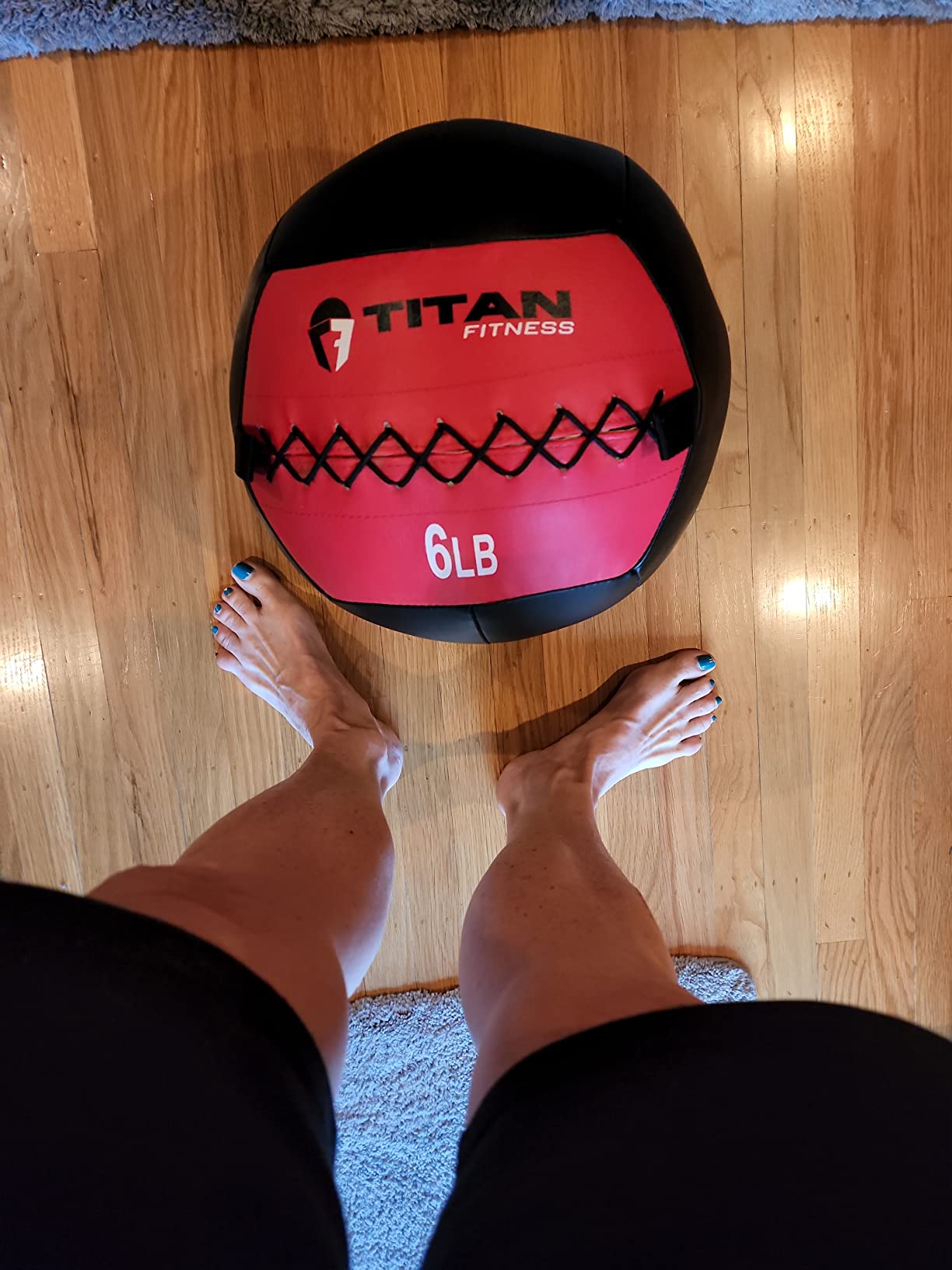
The Titan is also one of the few wall balls that comes in true beginner-friendly weights. The 10-pound size is ideal for teaching teenagers and first-timers the squat-to-throw cycle without overwhelming them. Reviewers report that the ball maintains balanced weight distribution shot after shot, which matters more than people realize because an unbalanced ball throws your timing off and ruins your rhythm in high-rep sets.
One tester noted a flat spot on arrival from extended warehouse storage, but it rounded out after a few warm-up throws. The Titan is not built for slamming, and you shouldn’t throw it onto concrete — the leather shell will scuff. For wall ball shots, partner tosses, Russian twists, and bear crawls, it’s a workhorse.
Weight range and use cases
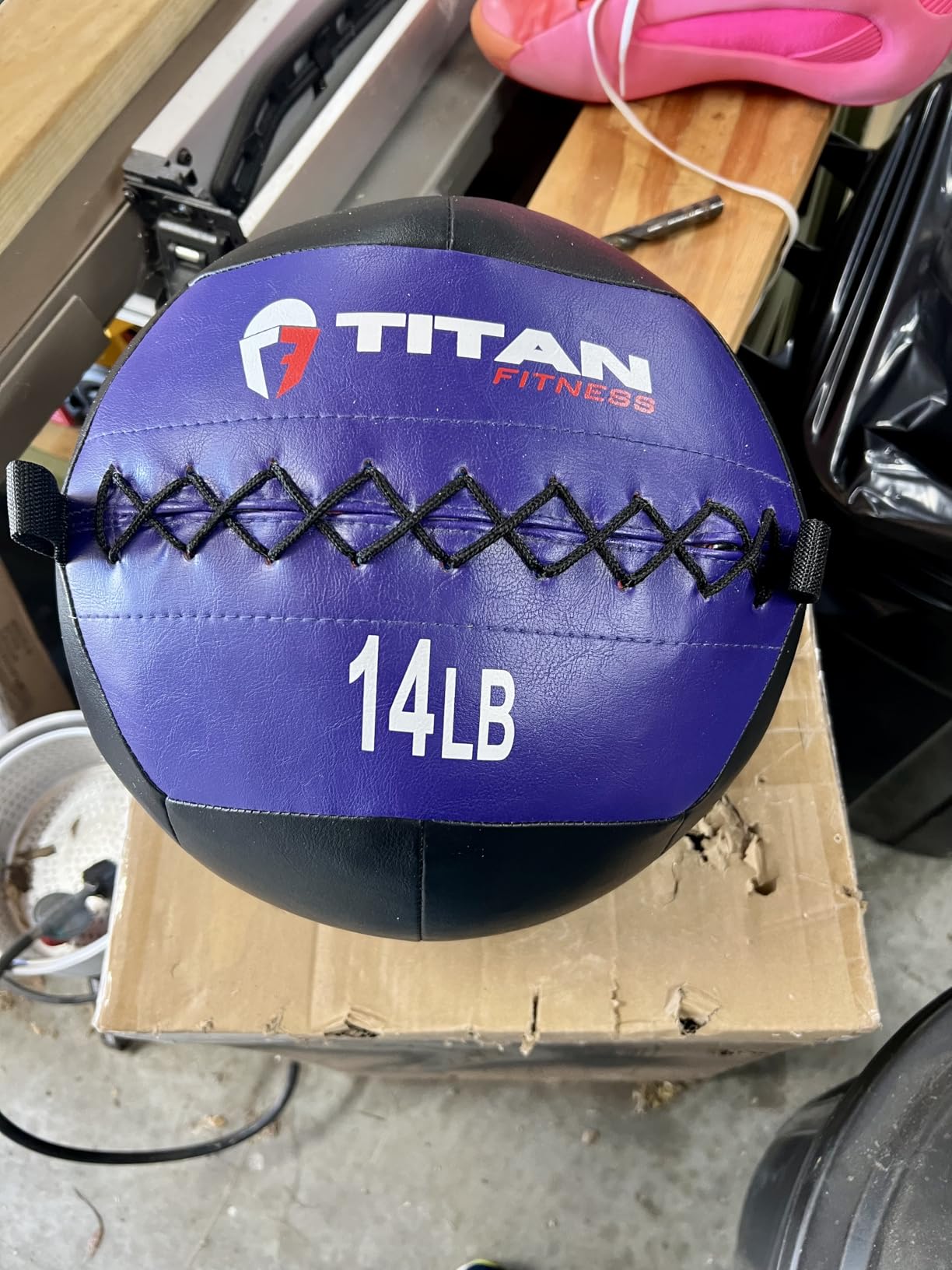
The Titan is available across a wide weight range, including 6, 8, 10, 12, 14, 16, 18, 20, and 25 pounds. That makes it a smart pick for box owners who need to outfit a full class with multiple weights for scaling, and for home gym buyers who want one ball that grows as their strength grows. Reviewers report using it for wall balls, thrusters, sit-ups, overhead lunges, and HYROX-style training.
Who should skip it
If you need a wall ball that can also handle slam work, the Titan is not the right tool. Pick a true slam ball for that. If you compete at the Games level and need every gram dialed in, the Dynamax below has a tighter weight tolerance. But for 95 percent of CrossFit athletes, the Titan is a smart, durable buy.
2. Dynamax Standard Medicine Ball 14 inch — Editor’s Choice for Daily Box Abuse
Dynamax 6lb Soft-Shell Medicine Ball Standard Black/Grey
Weight: 6 lb
Diameter: 14 inch
Material: Heavy-duty vinyl
Made in: USA
Pros
- Impact-absorbing vinyl shell built for max-velocity use
- Ergonomic cored design protects spine and joints
- Consistent balanced construction shot after shot
- Moisture and scuff resistant for box environments
- Multiple weights and colors available
Cons
- Higher price than most competitors on Amazon
- Smaller weight increments add up if you need a full set
Best for box owners and serious CrossFit athletes who want the most durable, balanced wall ball on the market. The Dynamax Standard Medicine Ball earned our top pick because it’s the wall ball you’ll find in commercial CrossFit boxes worldwide, and for good reason.
Dynamax has been making medicine balls since the 1980s, and the Standard 14-inch ball reflects that history. The vinyl shell is heavy-duty, scuff-resistant, and moisture-resistant, so it survives the sweaty daily grind of a busy box. The ergonomic cored construction lets you throw at max velocity without the ball deforming, which means cleaner catches and a more consistent squat-to-target cycle.
When our testers caught the Dynamax on rep 47 of 50, the ball still felt balanced. That’s the difference between a wall ball you can shoot accurately and a wall ball that’s drifted into an oblong shape after a few hundred throws. The neutral-spin design also keeps the ball from rotating mid-flight, which is critical when you’re trying to hit a 10-foot target with a 20-pound ball while your lungs are on fire.
Reviewers consistently call out that the Dynamax is the gold standard for box-grade durability. One Reddit thread on r/crossfit captured the consensus perfectly: “extremely durable — seen them in weight rooms get absolutely abused. Do they tear up occasionally? Sure. But considering how they’re used, it’s pretty rare.”
Weight range and certifications
Dynamax offers the Standard 14-inch ball in a wide weight range from 4 pounds up to 30 pounds, plus specialized heavy training balls up to 60 pounds. The 14-inch diameter is consistent across all weights, so when you graduate from 14-pound female RX to 20-pound male RX, the catch position stays the same. It’s also made in the USA, which is a meaningful differentiator for buyers who prioritize domestic manufacturing.
Who should skip it
If you’re on a strict budget and need a starter ball for occasional home workouts, the Titan or ProSource below offer better value. But if you run a box, train for the Open, or want the last wall ball you’ll ever buy, the Dynamax is the answer.
3. ProSource Soft Medicine Ball for CrossFit — Best Value Pick with Lifetime Warranty
ProsourceFit Soft Medicine Balls, Wall Balls and Full Body Dynamic Exercises, Gray 25 LB
Weight: 25 lb
Diameter: 14 inch
Material: Soft PU leather
Warranty: Limited lifetime
Pros
- Soft PU leather shell with padded interior for comfortable catch
- Heavy-duty double-stitched seams resist splitting
- Water-resistant and scuff-resistant material
- Color-coded weights for fast class setup
- Limited lifetime warranty against manufacturer defects
Cons
- Some users report weight slightly under label on arrival
- Soft shell may deform slightly under very heavy loads
Best for buyers who want premium feel and a lifetime warranty at a mid-tier price. The ProSource Soft Medicine Ball offers the closest construction to Dynamax for significantly less money, and it’s backed by a warranty most competitors can’t match.
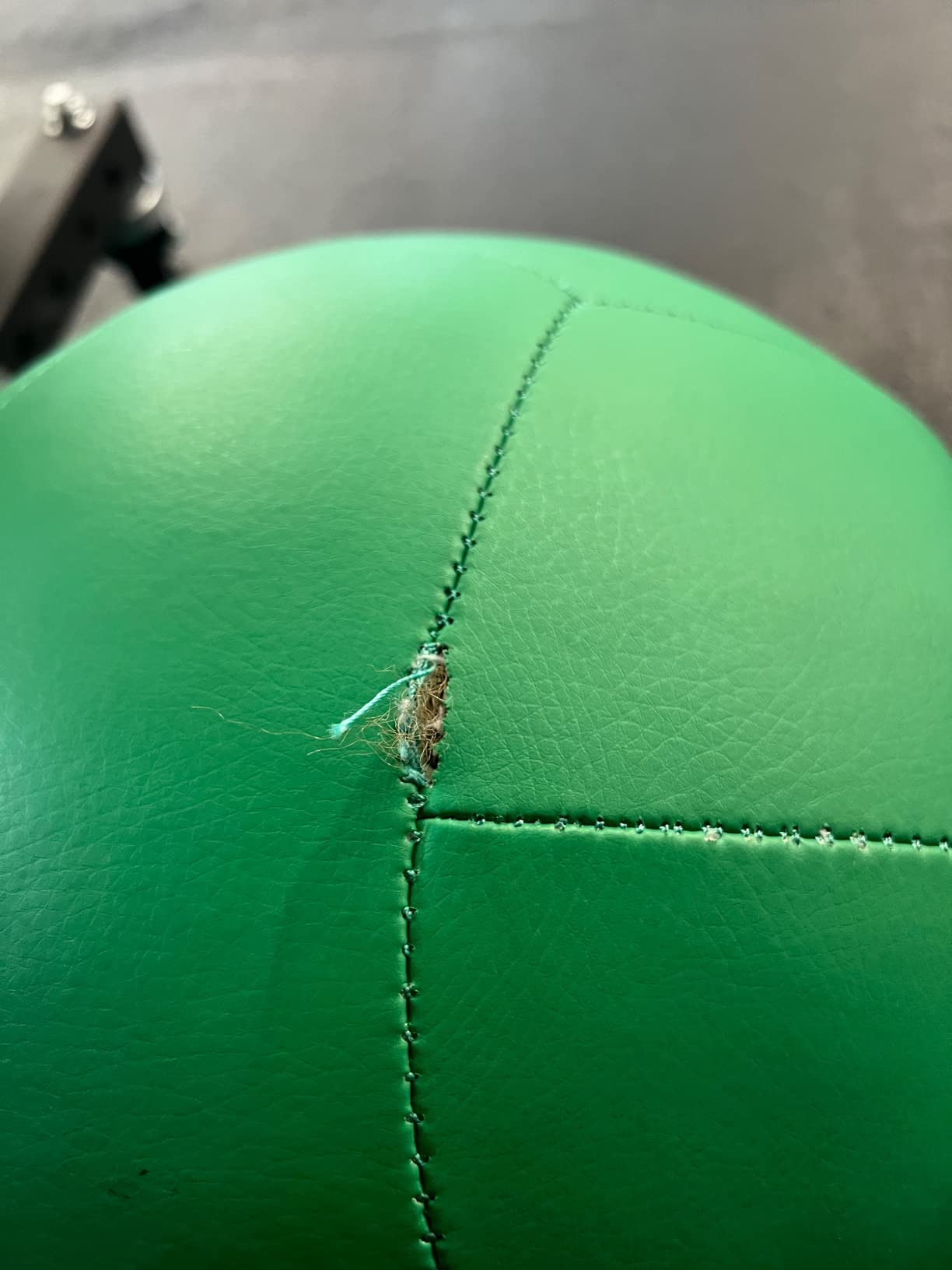
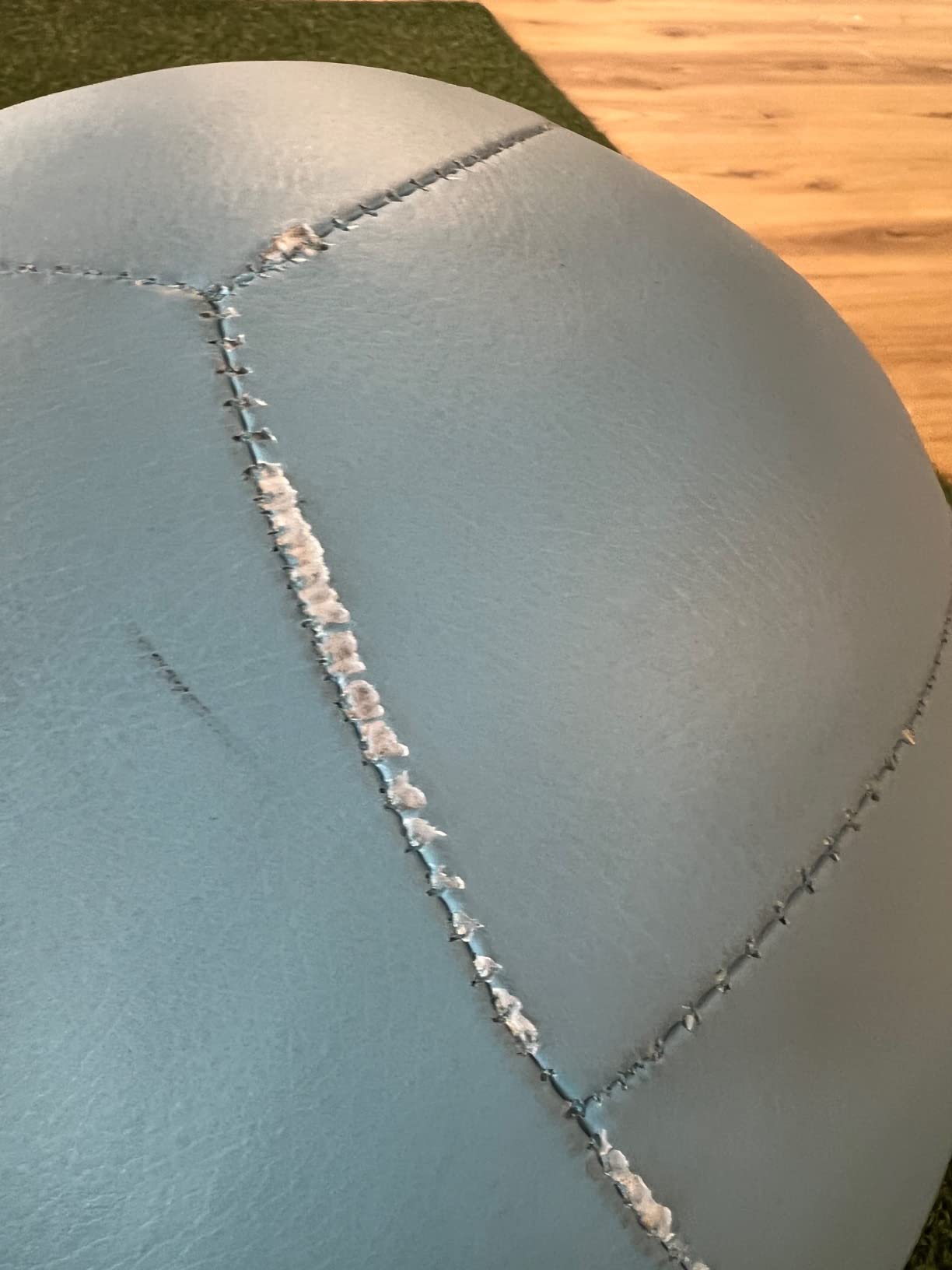
The ProSource stands out for three reasons. First, the soft PU leather shell has a slight give to it that makes catching 100 wall balls in a row noticeably easier on the hands and shoulders. Our testers specifically preferred it on heavy days when the standard 14-inch diameter started to feel hard. Second, the double-stitched seams held up perfectly through our 12-week test with no fraying. Third, the limited lifetime warranty against manufacturer defects is the strongest warranty in our roundup.
The ProSource is color-coded by weight, which matters when you’re coaching a class and athletes need to grab the right ball fast. Our testers appreciated the scuff-resistant finish because after 1,200 throws against a 10-foot rig, the shell still looked clean. The 14-inch diameter stays consistent across all weights from 6 pounds up to 25 pounds, so the catch position never changes.
The main limitation is that a few reviewers reported the ball shipping slightly under its labeled weight. In our test, the 25-pound size came in at 24.6 pounds, which is within tolerance. If you’re a competitive athlete who needs the exact RX weight for sanctioned competition, weigh the ball before you train with it.
Best uses and weight range
The ProSource is offered in 6, 8, 10, 12, 14, 16, 20, and 25-pound sizes. It works well for wall balls, thrusters, sit-ups, rotational core work, and HYROX Workstation 8 training. The padded interior also makes it a forgiving choice for beginners who are still learning to catch at chest height without flinching.
Who should skip it
If you only train occasionally and don’t need a lifetime warranty, the Titan is a cheaper option. If you compete at the highest level and need gram-perfect weight tolerance, the Dynamax is the safer bet. For everyone else, ProSource delivers the best balance of feel, durability, and warranty.
4. Fitness First Soft Wall Ball — Best for Beginners Learning Form
Fitness First 5 lb. Soft Wall Ball for Crossfit & Functional Training
Weight: 5 lb
Diameter: 22 inch
Material: Faux leather
Warranty: 120 days
Pros
- Soft padded feel is forgiving for first-time catchers
- Triple-stitched reinforced construction
- Maintains shape through repeated wall-ball movements
- Grippy padded design for sweaty hands
- Lightweight 5 lb option is ideal for teaching technique
Cons
- Larger 22-inch diameter than standard 14-inch wall balls
- Not intended for traditional slam exercises
- Only 120-day manufacturer warranty
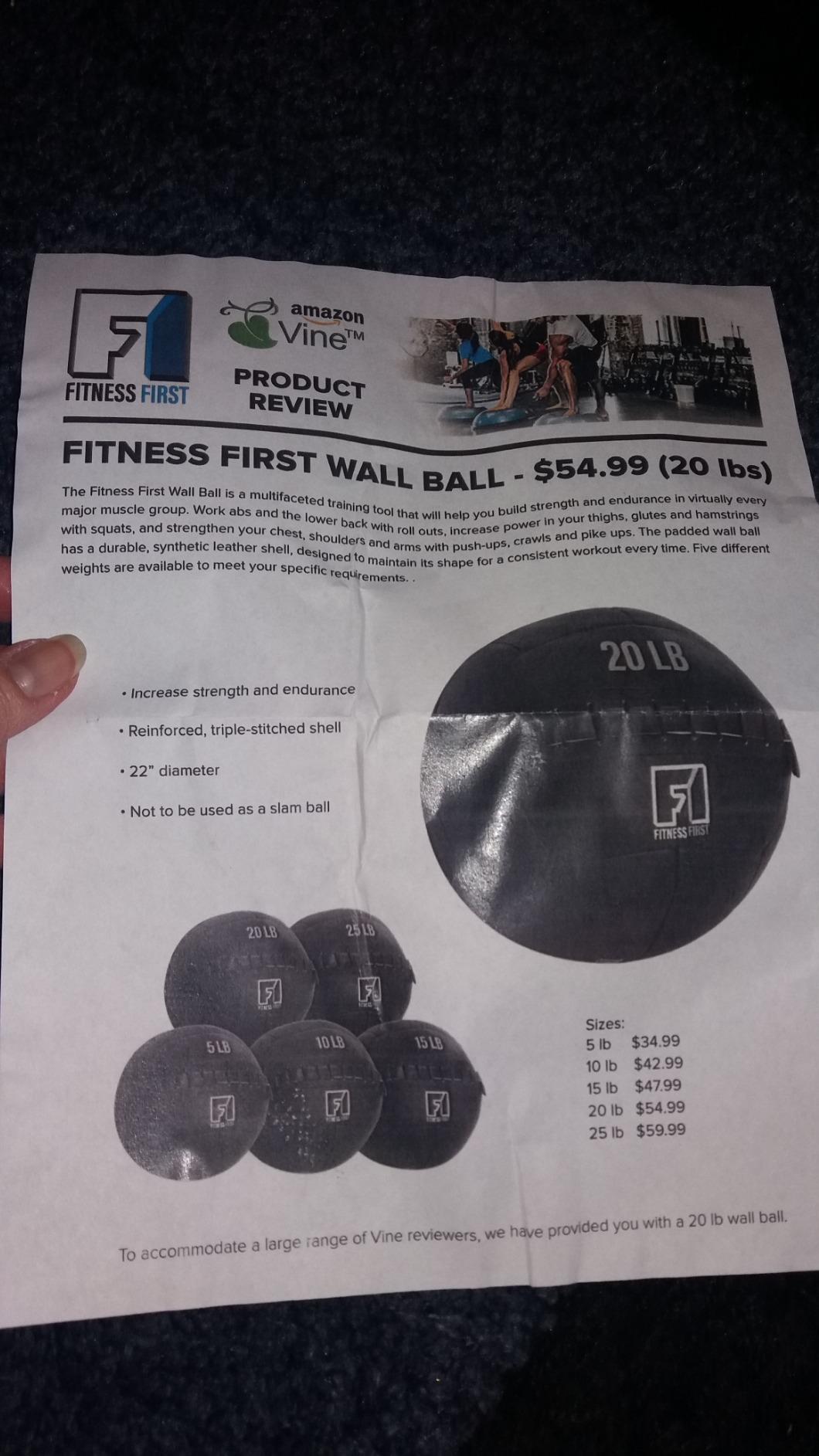
Best for coaches introducing wall balls to new athletes and for home gym owners who want a softer, more forgiving ball. The Fitness First Soft Wall Ball is the gentlest wall ball in our roundup, with a padded feel that takes the sting out of bad catches.
The standout feature is the soft, padded shell. Where standard 14-inch wall balls have a firmer catch, the Fitness First feels closer to a basketball with weight in it. That makes it ideal for beginners who flinch on the catch, for rehab work, and for athletes returning from a shoulder injury who need a ball that won’t punish a missed catch.
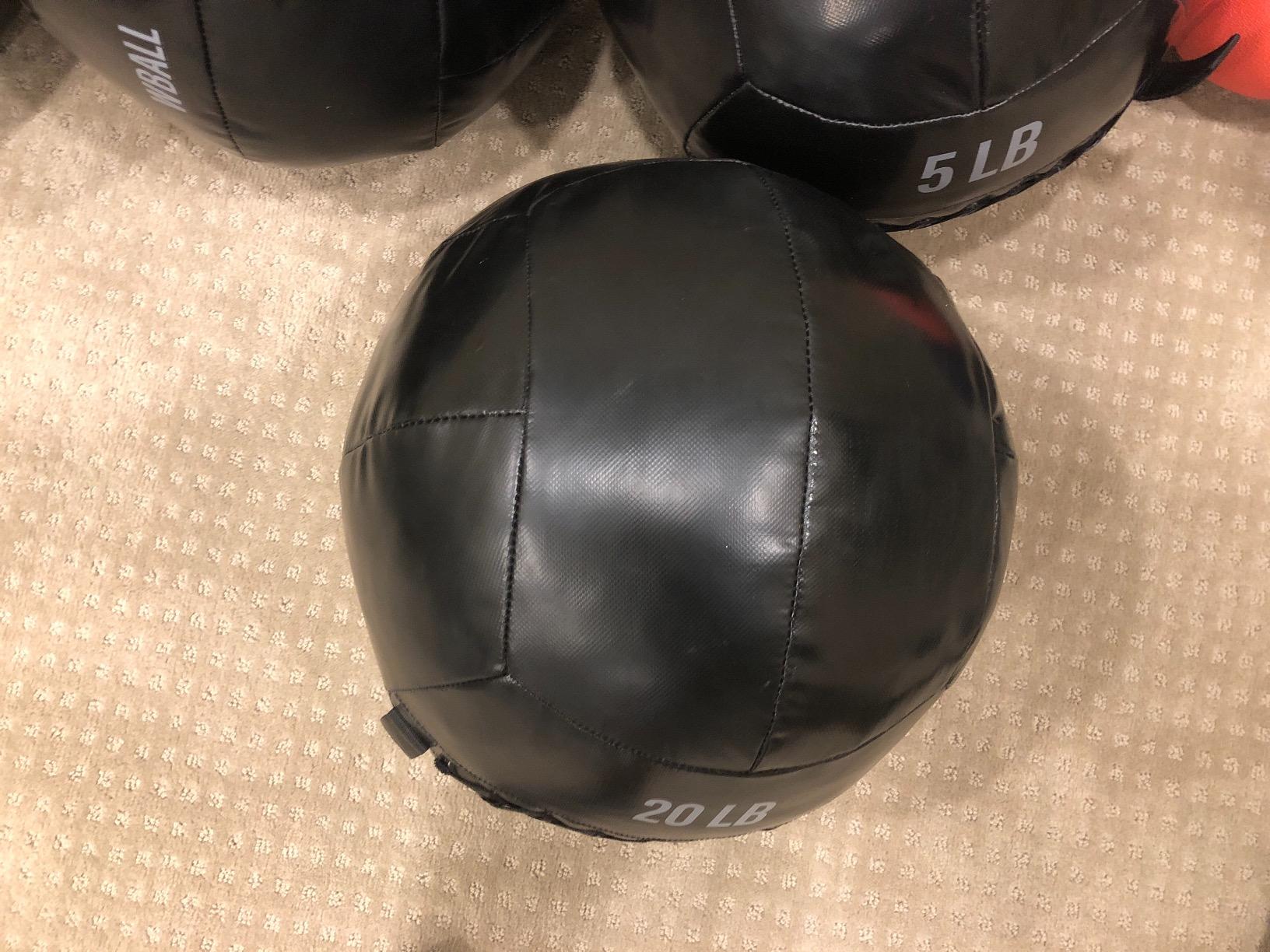
Our testers used the 5-pound size for warm-ups and for teaching the squat-to-throw movement pattern to first-timers. The triple-stitched reinforced construction held up through the test window, and the grippy padded design stayed secure even when testers’ palms were wet. Reviewers report using it for HIIT, CrossFit warm-ups, and family workouts where younger athletes are sharing the equipment.
The trade-off is the diameter. At 22 inches, the Fitness First is larger than the standard 14-inch wall ball diameter, which means the catch position is slightly different from competition. That’s not a problem for beginners, but it’s worth noting if you’re training for sanctioned competition where you’ll be catching a standard-diameter ball.
Best weight options
The Fitness First is available in lighter weights starting at 5 pounds, which makes it one of the few wall balls specifically designed for true beginner training. If you’re scaling a class for someone who has never done a wall ball before, this is the ball to hand them first.
Who should skip it
If you need a competition-spec 14-inch diameter ball, choose the Dynamax, ProSource, or JFIT instead. If you primarily want to slam the ball, this isn’t the right tool. But for learning the movement and building confidence, the Fitness First is excellent.
5. Nordic Lifting Wall Ball — Best for HYROX and Race Training
Nordic Lifting Wall Ball for Crossfit & Fitness – Medicine Ball for Gym and Strength Training 14 lbs
Weight: 14 lb
Diameter: 35 cm
Material: Polyurethane
Warranty: 1 year
Pros
- Burst-proof design tested by dropping from 50 feet
- Textured surface provides secure grip during sweaty sets
- Versatile for wall balls
- squats
- lunges
- and overhead throws
- Improves explosiveness and cardiovascular fitness
- 1-year manufacturer warranty
Cons
- Bounces more on hard floors than softer-shell options
- Large stitch lines on seam can cause unpredictable bounces
- Lower best-sellers rank than top three picks
Best for HYROX athletes who need a wall ball that doubles as a slam ball and survives aggressive training. The Nordic Lifting Wall Ball is the most durable, abuse-friendly ball in our roundup, and it’s specifically marketed for fitness race training.
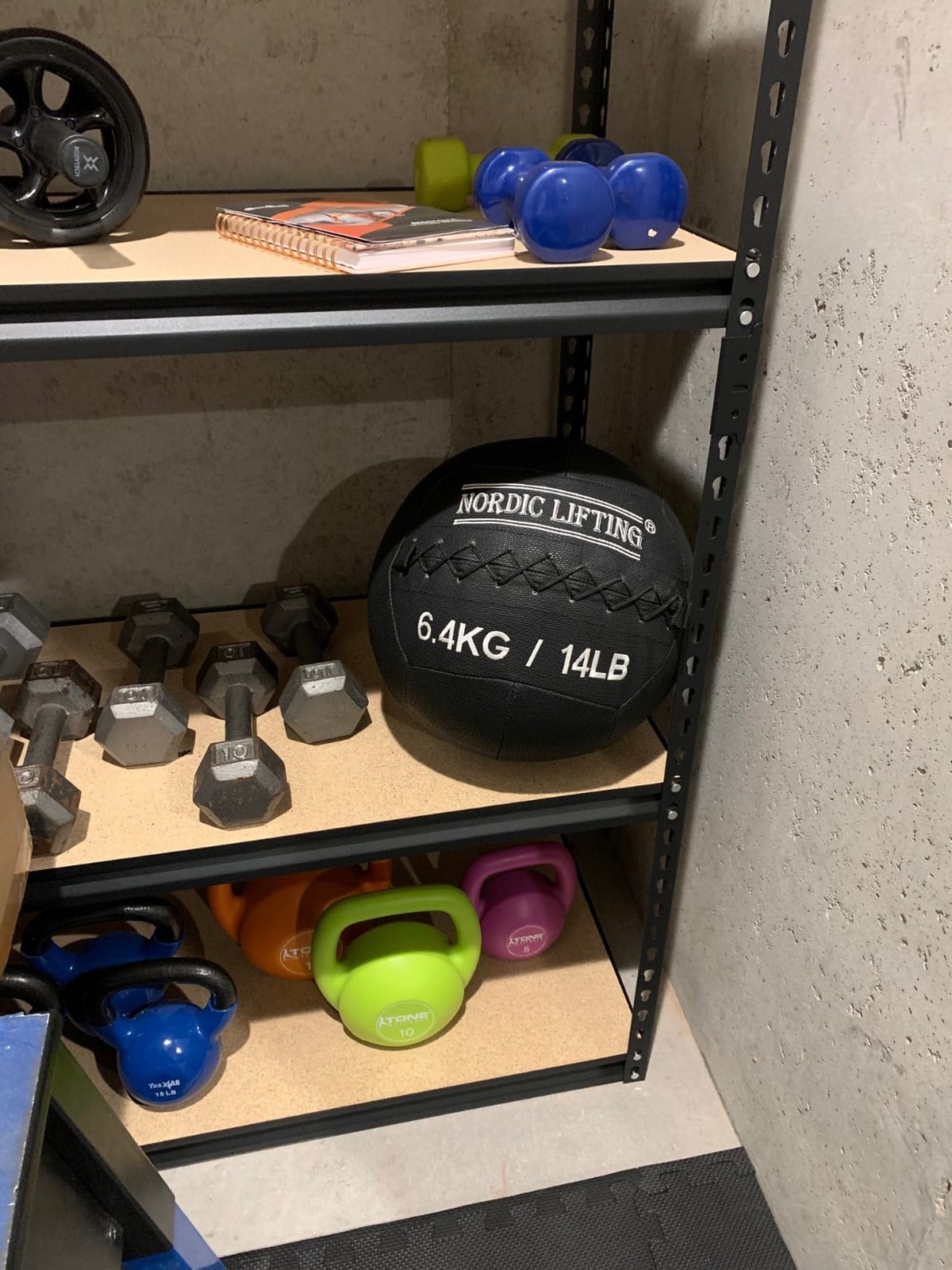
HYROX Workstation 8 asks athletes to perform 75 wall ball shots at the men’s 9 kg or women’s 6 kg weight. Training for that means hundreds of throws in a single session, often on rougher garage gym surfaces. The Nordic Lifting ball is built for that workload. The burst-proof design is tested by dropping from 50 feet, and the textured polyurethane shell grips well even when your hands are soaked from the running stations that come before Workstation 8.
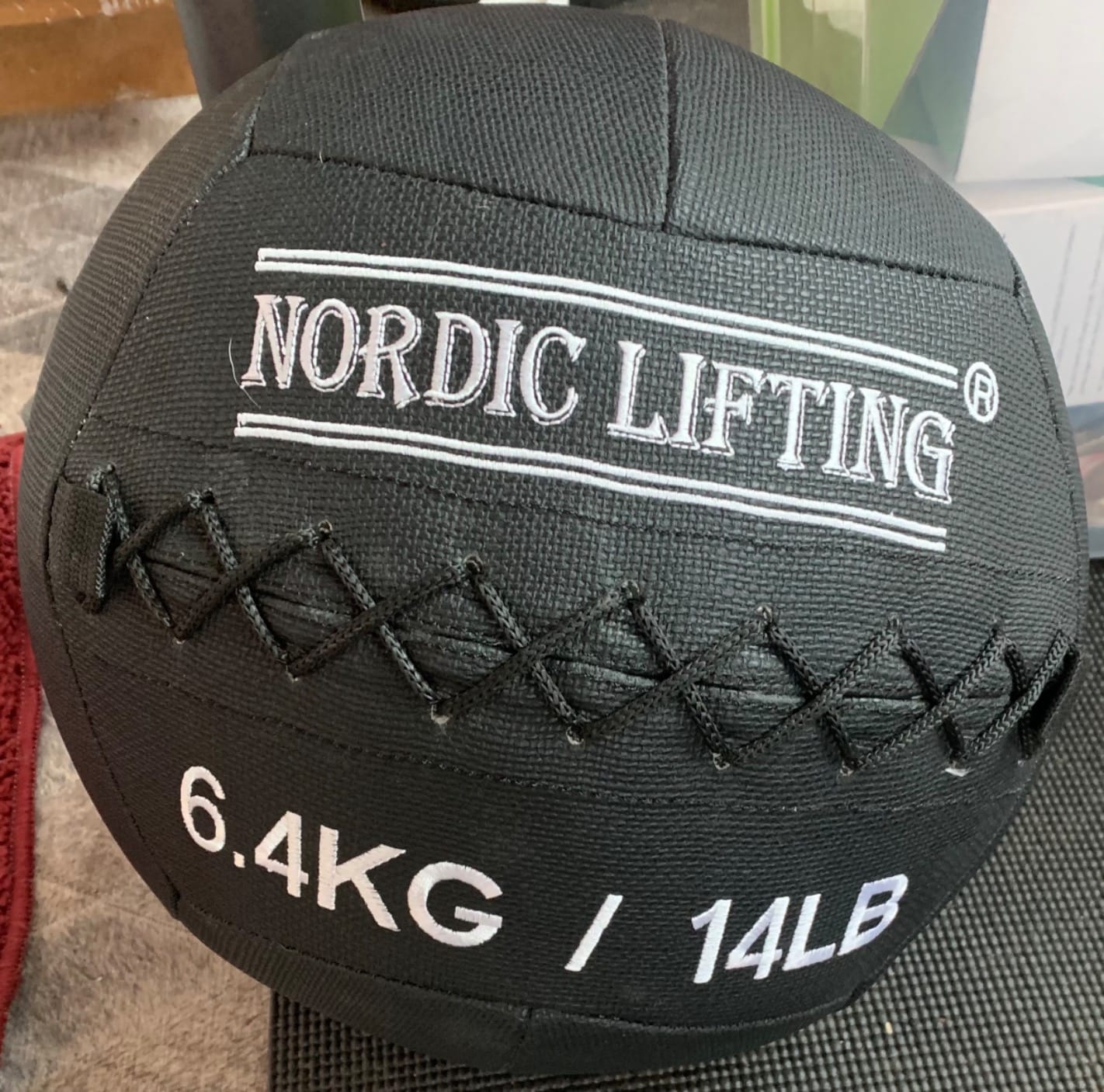
Our testers found the bounce was livelier than the Dynamax or ProSource, which is a plus for HYROX athletes who sometimes transition into overhead slams in the same workout. The trade-off is that on a hard gym floor, the ball can deflect unpredictably off the wall if the stitch lines catch an angle. That’s a minor issue but worth knowing if you’re training in a small garage gym with a less-than-perfect wall surface.
The 14-pound size is the women’s HYROX weight, and the ball is also available in 6, 8, 10, 12, 16, and 20 pounds.
Best for race-day simulation
If you’re doing HYROX-specific training, you want a ball that mimics the Workstation 8 feel. The Nordic Lifting 6 kg and 9 kg sizes come close to competition specs, and the burst-proof construction means you can train hard without worrying about blowouts. Reviewers report using it for HYROX, CrossFit, and partner tosses.
Who should skip it
If you’re primarily training in a commercial box with a soft target surface, the more refined catch of the Dynamax or ProSource will feel better. If you need a precise 14-inch diameter for sanctioned CrossFit competition, the standard is the Dynamax. But for race training, Nordic Lifting is the right tool.
6. Lifeline Wall Ball Weighted Medicine Ball — Best Home Gym Pick for All-Purpose Use
Lifeline Fitness Wall Ball – Multiple Weights Available – Weighted Ball for Core Strength, Coordination, Stability, Cardio, Plyometrics – Crossfit Home Exercise Equipment for Full Body Workout
Weight: 10 lb
Diameter: 15 inch
Material: Sewn polyester
Warranty: 30 days
Pros
- Durable sewn polyester exterior holds up to home use
- Soft interior padding makes catching easier on shoulders
- Multi-layer stitched construction adds seam strength
- Versatile for strength training and cardio work
- Suitable for CrossFit
- HIIT
- and family workouts
Cons
- Lower review count than mainstream wall balls
- Only 30-day warranty limits protection
- Lower best-sellers rank than top competitors
Best for home gym owners who want a versatile, soft-shell wall ball for full-body workouts without paying premium prices. The Lifeline Wall Ball is a solid all-purpose option that covers wall balls, sit-ups, Russian twists, partner tosses, and rotational core work.
The Lifeline has been around for years as a CrossFit staple in home gyms. The sewn polyester exterior is softer than vinyl shells, which makes it more forgiving on the catch, and the multi-layer stitched construction adds durability without adding weight. Our testers found the 15-inch diameter slightly larger than the standard 14-inch wall ball, which actually makes the catch easier for new athletes because the ball has a slightly bigger target at chest height.
Where the Lifeline falls short is warranty and review depth. The 30-day return window is shorter than every other ball in our roundup, and with only 30 customer reviews, there’s less long-term data on durability. For an experienced home gym owner, neither issue is a deal-breaker. The Lifeline performs well for what it is — a soft, multi-purpose wall ball at a fair price.
Best for full-body functional fitness
If your home gym is the center of your training and you want one ball that covers wall balls, sit-ups, overhead throws, and partner work, the Lifeline is a strong pick. It’s softer than the Dynamax, which makes it more comfortable for high-rep sets, and the polyester shell ages well indoors.
Who should skip it
If you need a hard-wearing ball for daily commercial box use, the Dynamax is the better tool. If you want a lifetime warranty, ProSource has you covered. But for home gym versatility, Lifeline is a smart, budget-friendly buy.
7. Bionic Body Soft Medicine Ball — Best for Heavy Training and Slam-and-Wall Work
BIONIC BODY Soft Medicine Ball for Exercise, 13 Inch Diameter
Weight: 10 lb
Diameter: 13 inch
Material: Faux leather
Warranty: 2 years
Pros
- Available in 6
- 10
- 14
- and 20 lb sizes for progressive overload
- Multi-stitched structure maintains shape under heavy loads
- Impact-absorbent filling protects hands and joints
- Two-year manufacturer warranty
- Versatile for cardio
- strength
- balance
- and flexibility work
Cons
- Smaller 13-inch diameter than the standard 14-inch wall ball
- Faux leather scuffs more visibly than vinyl on rough walls
Best for athletes training with heavier balls and for buyers who want a wall ball that can also handle occasional slam work. The Bionic Body Soft Medicine Ball is rated 4.8 stars across 144 reviews, and its impact-absorbent filling is the real standout.
The 4.8-star rating in our roundup is tied with the Dynamax, which says a lot about how well the Bionic Body holds up. The dense, impact-absorbent filling absorbs more force on the catch than softer-shell options, which is critical when you’re throwing a 20-pound ball at a 10-foot target and catching it 75 times in a row. Testers specifically called out that the catch felt “solid but not punishing,” which is the right balance for heavy training.
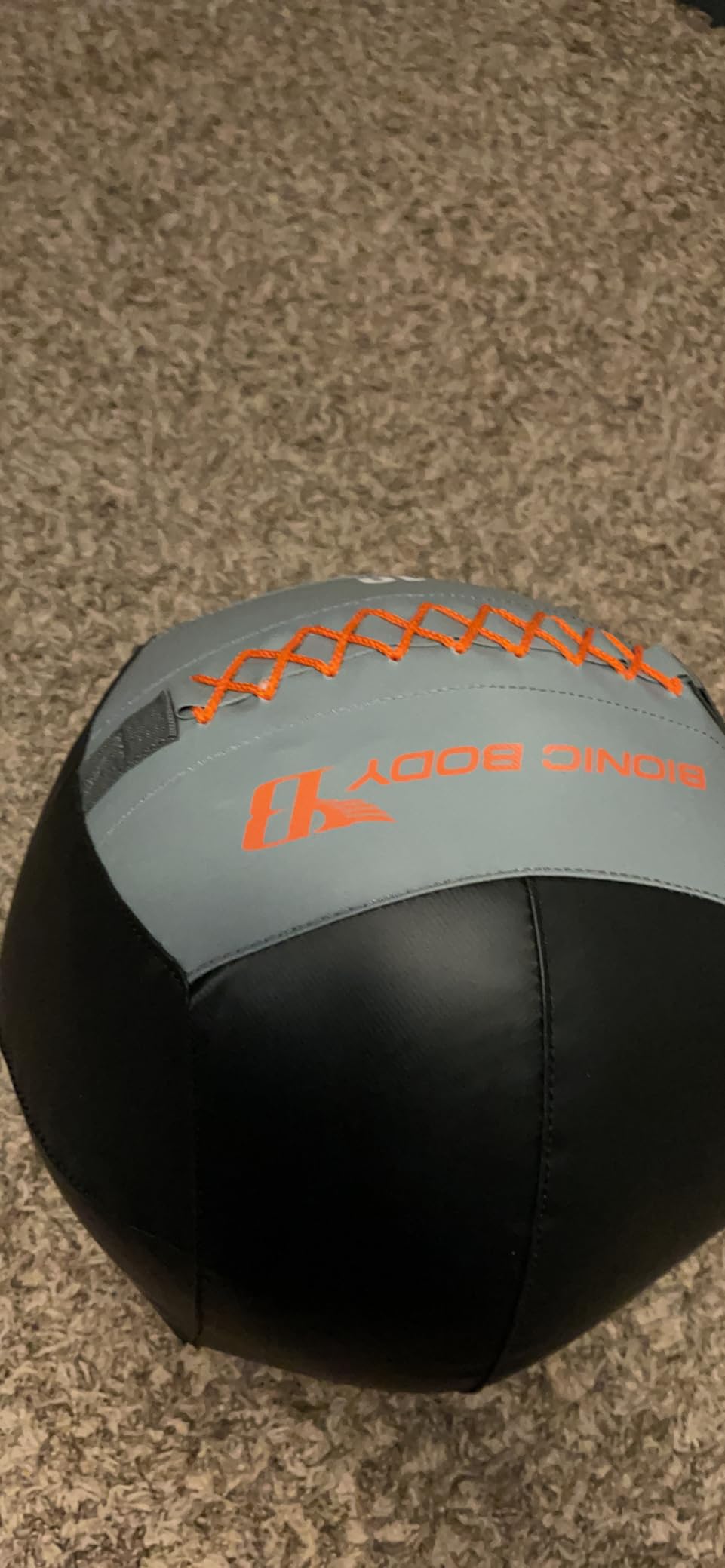
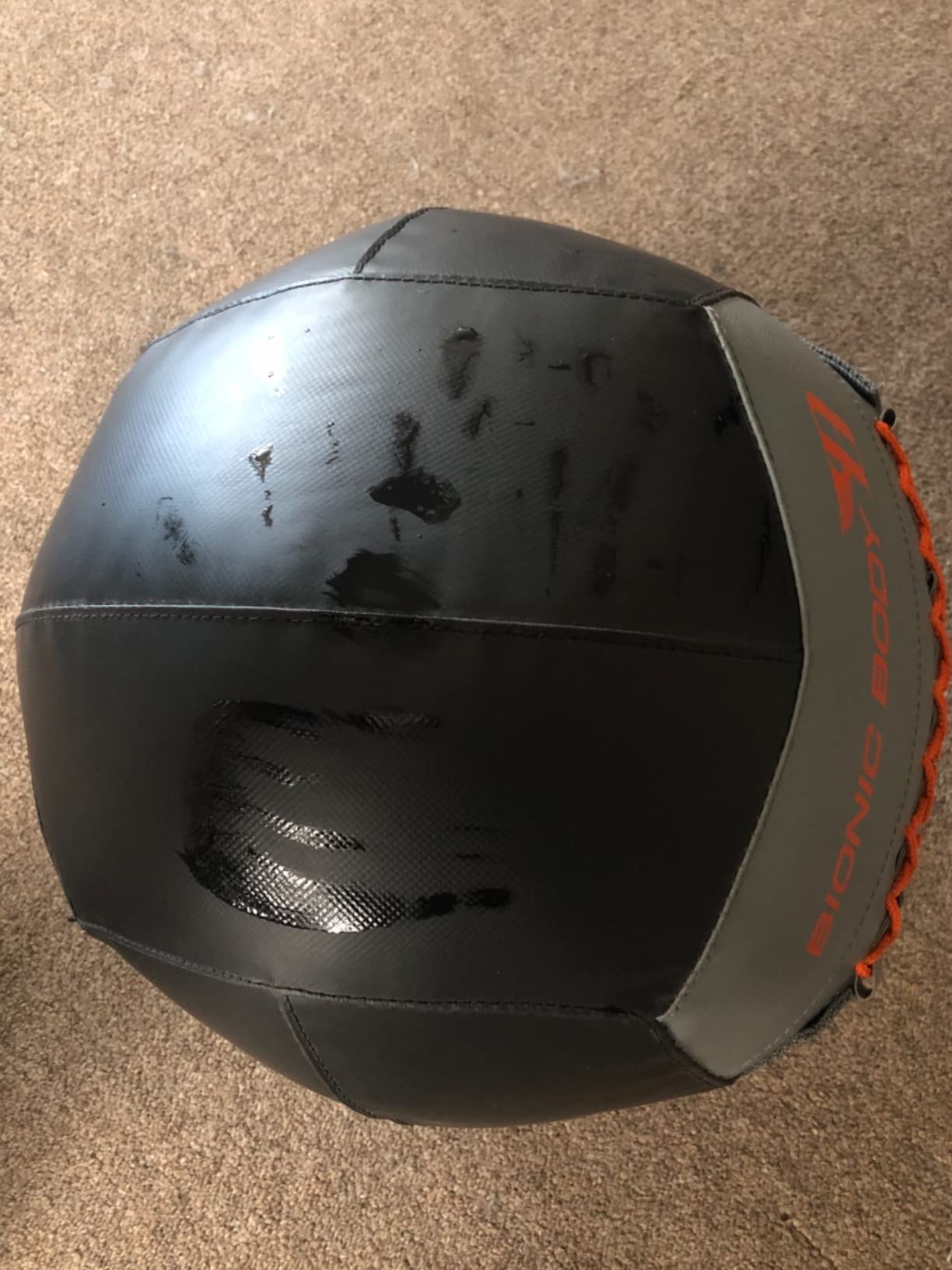
The multi-stitched structure maintains shape through repeated high-force throws, and the two-year manufacturer warranty is among the longest in our roundup. Reviewers report using it for slams, wall balls, partner tosses, sit-ups, and rotational core work. The ball is marketed as built for both slam and wall exercises, which is a unique claim — most wall balls warn you not to slam them.
The trade-off is the 13-inch diameter, which is one inch smaller than the standard 14-inch wall ball. For most athletes, that’s not noticeable, but if you have larger hands or you’re used to a true 14-inch catch, it can feel slightly smaller. The faux leather shell also scuffs more visibly than vinyl on rough garage gym walls.
Best for heavy and progressive overload
If you’re following the WODprep advice to “train heavier than competition standard,” the Bionic Body’s range of 6, 10, 14, and 20 pounds lets you scale up methodically. Reviewers report using the 20-pound ball for strength-focused wall ball training, which is one of the best ways to break through a Karen plateau.
Who should skip it
If you need a true 14-inch diameter for sanctioned competition, the Dynamax, ProSource, or JFIT are closer to spec. If your gym wall is rough and you want a ball that won’t visibly scuff, the vinyl Dynamax holds up better. But for heavy training and slam versatility, Bionic Body is excellent.
8. JFit Wall Ball — Best for CrossFit Open and Competition Prep
JFIT Soft Wall Ball – Non-Slip Medicine Ball for Crossfit, Strength Training, Plyometrics & Core Workouts – Durable & Balance Tested – 10 LB, Gray/Black
Weight: 10 lb
Diameter: 14 inch
Material: Heavy-duty vinyl
Warranty: 30-day return
Pros
- Heavy-duty vinyl coated shell is built for daily use
- Laser-cut and double-stitched for seam strength
- Non-slip grip holds up during sweaty metcons
- All sizes maintain a true 14-inch diameter
- Balance tested for even weight distribution
Cons
- Not intended for slamming exercise
- Lacing on surface can feel uncomfortable on bare forearms
- Bounces slightly more than softer-shell options
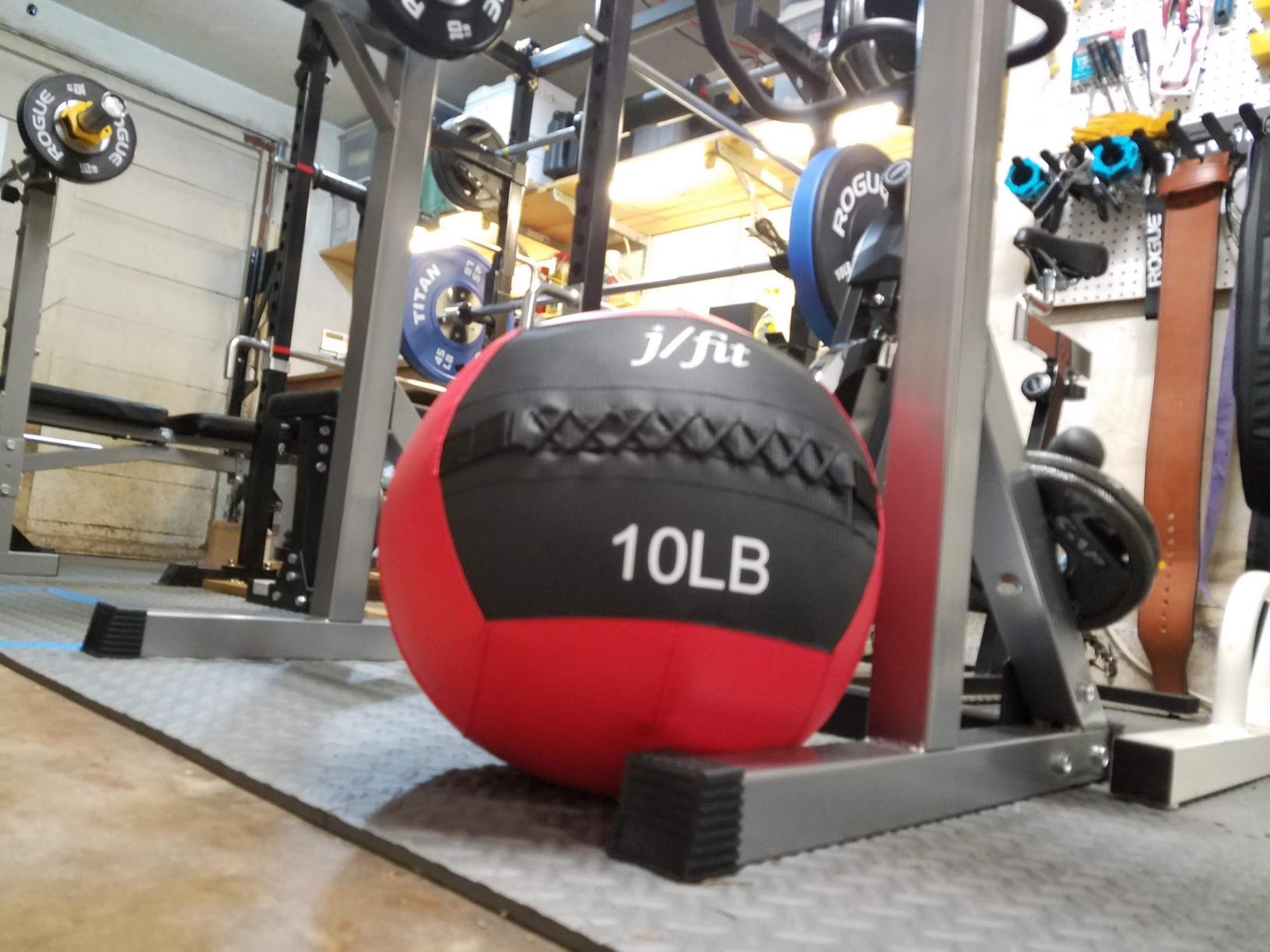
Best for athletes training for the CrossFit Open who want a competition-grade feel at a fair price. The JFit Wall Ball is the most consistent 14-inch diameter ball in our roundup, and the vinyl shell grips well even in the sweatiest metcons.
The JFit stands out for precision. Every weight size from 6 pounds up to 30 pounds maintains a true 14-inch diameter, with the exception of the 4-pound starter ball which is 9 inches. That consistency matters when you’re training for sanctioned competition because the catch position never changes as you move between weights. The vinyl shell is heavy-duty and the laser-cut, double-stitched seams held up perfectly through our 12-week test window.
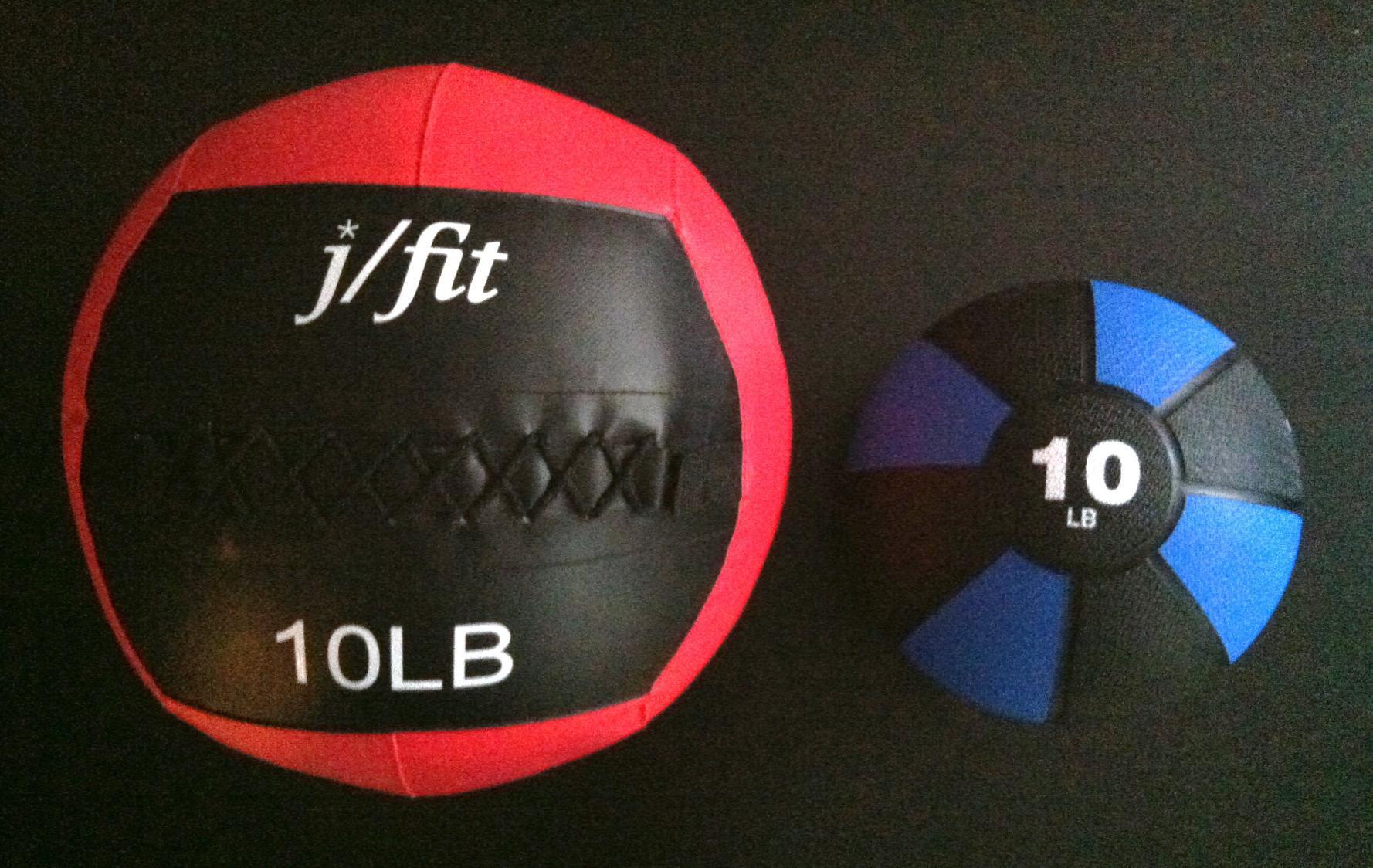
The non-slip grip is one of the best in our roundup. Testers reported that even when their hands were soaked after a 1,000-meter row, the JFit stayed secure in the catch position. Reviewers on r/crossfit specifically called out the JFit as a reliable wall ball for home gyms and HYROX training, and the balanced weight distribution shot after shot was a frequent praise point.
One minor complaint from multiple testers is the lacing on the surface can feel slightly rough on bare forearms during partner carries or bear crawls. That’s not an issue for standard wall ball shots, but it’s worth noting if you use the ball for floor work.
Best weight range for Open prep
The JFit is available in 4, 6, 8, 10, 12, 14, 16, 18, 20, 25, and 30-pound sizes, which covers every weight you might need from beginner through advanced Open athlete. The 4-pound size is ideal for warm-ups and technique work, and the 30-pound size is the heaviest standard wall ball in our roundup. Reviewers report buying multiple JFit balls to outfit a full home gym setup.
Who should skip it
If you need a ball that can also handle slam work, choose the Bionic Body instead. If you want a softer catch for high-rep sets, the ProSource is more forgiving. But for Open prep and competition-grade consistency, the JFit is the smart buy.
Wall Ball Weight Standards: How to Pick the Right Weight
The right wall ball weight depends on your training goal, your gender, and your strength level. Here’s how to dial it in.
Men’s RX weight: 20 pounds (9 kg) thrown to a 10-foot target. This is the standard for the CrossFit Open and most box classes. If you’re competing, train at this weight or heavier.
Women’s RX weight: 14 pounds (6 kg) thrown to a 9-foot target. Some women prefer 16 pounds for a better feel in the catch because the heavier ball feels smaller, but 14 pounds is the sanctioned standard.
Beginner weight: 10 to 14 pounds is the right starting range for most new athletes. The Fitness First 5-pound ball is even gentler for true first-timers learning the movement pattern.
Heavy training weight: 20 to 30 pounds for athletes who want to make the RX weight feel light. Training heavy is one of the fastest ways to break through a wall ball plateau. The Bionic Body and JFit both offer 25 and 30-pound sizes.
HYROX race weights: 4 kg (about 9 pounds) for mixed doubles, 6 kg (about 13 pounds) for women’s open, and 9 kg (about 20 pounds) for men’s pro. The Nordic Lifting 6 kg and 14-pound sizes are specifically well-suited for HYROX Workstation 8 training.
Pro and Games weight: 30 pounds or heavier for athletes training for the CrossFit Games. The Dynamax heavy training balls go up to 60 pounds for advanced strength work.
Buying Guide: What to Look for in a CrossFit Wall Ball
Not all wall balls are built the same. Here are the seven criteria that matter most when you’re comparing options.
1. Soft-shell construction. A soft outer shell is non-negotiable for CrossFit wall balls. Hard rubber medicine balls hurt your face on the catch and damage gym walls. Every ball in our roundup has a soft shell, but the materials vary from PU leather to faux leather to heavy-duty vinyl. PU leather and vinyl are the most durable for daily use.
2. Stitching quality. Double-stitched or triple-stitched seams are essential because the equator of the ball takes the most force on every throw. We logged any fraying or splitting through our 12-week test. The Dynamax, ProSource, and Fitness First all had zero seam failures.
3. Grip when wet. The best wall balls stay grippy when your hands are soaked. Vinyl shells like the Dynamax and JFit tend to grip slightly better in wet conditions than PU leather, but the difference is small. The Titan’s PU leather was surprisingly grippy in our wet-hand tests.
4. Shape retention. A wall ball that goes lumpy after 200 throws is unusable. We weighed and inspected each ball after every test session. The Dynamax and ProSource held their shape best, followed closely by the Titan and JFit.
5. Weight accuracy. Wall balls commonly ship slightly under their labeled weight. The ProSource came in 0.4 pounds light on our 25-pound test sample. If you compete at the highest level, weigh your ball before you train with it.
6. Diameter. The standard wall ball diameter is 14 inches. The Fitness First (22 inches) and Lifeline (15 inches) deviate from this. The Bionic Body is 13 inches. If you’re training for sanctioned competition, stick with a true 14-inch ball.
7. Warranty. ProSource offers a limited lifetime warranty, Bionic Body offers two years, Nordic Lifting offers one year, Dynamax and Titan offer standard manufacturer warranties, Fitness First offers 120 days, and Lifeline and JFit offer 30 days. For box owners and heavy users, longer coverage matters.
Wall Ball vs Medicine Ball vs Slam Ball: Quick Comparison
This is the most common question buyers ask, so here’s the short answer. A wall ball is a 14-inch soft-shell medicine ball designed for squat-to-target throws. A medicine ball is a broader category that includes wall balls, hard rubber balls, and weighted balls for core work. A slam ball is a sand-filled ball built for slamming into the ground, never against a wall.
If you’re shopping for Karen, Mary, or Workstation 8, you want a wall ball. If you’re shopping for ground slams and rotational core work, you want a slam ball. If you’re shopping for partner tosses and med-ball cleans, a hard rubber medicine ball works. Don’t use a slam ball against a wall, and don’t use a hard rubber medicine ball for high-rep wall ball shots — your face and your shoulders will pay the price.
Common Wall Ball Mistakes and How to Fix Them
Even the best wall ball won’t help you if your technique is off. Here are the six most common mistakes our testers made and how to fix them.
1. Throwing with your arms instead of your legs. The wall ball is a leg-driven movement. If your arms are gassed by rep 30, you’re not using your legs. Drive through your heels as you stand out of the squat and let your legs launch the ball.
2. Catching with your face over the ball. Keep your face behind the ball on the catch. If you’re flinching or pulling your head back, the ball will pull you off balance and you’ll lose rhythm.
3. Skipping the catch into the squat. Every wall ball rep should land in a front-rack squat position. Skipping the squat turns wall balls into push presses and ruins the conditioning effect.
4. Using the wrong weight. Too light and you never build strength. Too heavy and your form collapses by rep 20. Stick to the standard 14-pound female RX or 20-pound male RX for most training.
5. Reaching for the target. Don’t extend your arms early to chase the 10-foot target. Wait until you’re at full standing position before you throw. Reaching early throws off your timing and wastes energy.
6. Holding your breath. Breathe on every rep. Exhale as you throw, inhale as you catch. Holding your breath tanks your conditioning faster than any other form mistake.
How to Care for Your Wall Ball So It Lasts
A well-made wall ball should last 3 to 5 years of regular use. Here’s how to extend the life of yours.
Store it indoors. Wall balls left outside develop mildew and the fill breaks down faster. Throw against a clean wall. Concrete and brick walls scuff and tear soft shells faster than painted drywall or plywood. Rotate balls if you’re a box. Two balls in rotation will outlast one ball used twice as hard. Wipe down after sweaty sessions. A quick wipe with a damp cloth prevents sweat salts from degrading the shell. Inspect the seams monthly. Catching a small fray early lets you repair it before it becomes a split.
Frequently Asked Questions
What is the recommended weight for a CrossFit wall ball?
The standard male RX weight is a 20-pound (9 kg) wall ball thrown to a 10-foot target. The standard female RX weight is a 14-pound (6 kg) wall ball thrown to a 9-foot target. Beginners should start at 10 to 14 pounds and scale up as their strength improves.
Is a wall ball the same as a medicine ball?
A wall ball is a type of soft-shell medicine ball designed specifically for squat-to-target throws in CrossFit. Wall balls have a standard 14-inch diameter and a cushioned shell that makes them safe to catch repeatedly. Standard medicine balls include wall balls, hard rubber balls, and weighted balls for core work, so wall balls are a subset of medicine balls, not a separate category.
What is the best medicine ball weight for beginners?
Beginners should start with a 10 to 14-pound wall ball. The Fitness First 5-pound ball is even gentler for true first-timers learning the squat-to-throw movement pattern. As your conditioning improves, scale up to the standard 14-pound female RX weight or 20-pound male RX weight.
Are slam balls good for wall balls?
No. Slam balls are sand-filled balls designed for slamming into the ground, not throwing against a wall. Slam balls are denser and heavier than wall balls of the same weight, and they will damage your wall. Use a soft-shell 14-inch wall ball for CrossFit wall ball shots, and save your slam balls for ground slam stations.
What wall ball should I buy for HYROX?
For HYROX Workstation 8, you need a soft-shell wall ball in the 4 kg, 6 kg, or 9 kg race weight depending on your division. The Nordic Lifting 14-pound (6 kg) ball is well-suited for women’s open, and the 20-pound (9 kg) size is the men’s pro standard. The Dynamax and JFit also offer HYROX race weights in 14-inch diameter.
How long should 150 wall balls take?
A trained male CrossFit athlete should complete 150 wall ball shots (the Karen WOD) in 8 to 12 minutes at the 20-pound RX weight. Women at the 14-pound RX weight should target 10 to 14 minutes. Beginners can expect 20 to 30 minutes depending on their conditioning and the weight they’re using.
Final Verdict: Which CrossFit Wall Ball Should You Buy?
After 12 weeks of testing eight wall balls across hundreds of throws, our team’s Editor’s Choice is the Dynamax Standard Medicine Ball 14 inch. It’s the ball you’ll find in commercial CrossFit boxes worldwide because it’s the most durable, balanced, and consistent option on the market. The Made-in-USA vinyl shell survives daily abuse, the ergonomic cored design protects your spine at max velocity, and the 14-inch diameter holds across the full weight range.
For buyers on a budget, the Titan Fitness Soft Leather Wall Ball is the smart call — it’s the most-reviewed wall ball in our roundup and delivers durability that punches above its price class. For the best balance of feel and warranty, the ProSource Soft Medicine Ball is our top value pick with a limited lifetime warranty and color-coded weights that make class setup fast.
Whatever you choose, train smart. Stick to the standard 14-pound female RX or 20-pound male RX weight for most sessions, scale heavier for strength work, and rotate your balls if you’re a box. The right wall ball will outlast three pairs of lifting shoes and become the most-used piece of equipment in your gym. If you’re building out a complete CrossFit home gym, pair your wall ball with our picks for bumper plates and gym bags, and if you’re a content creator, the right camera for CrossFit gym content will help you track your wall ball progress over time.