
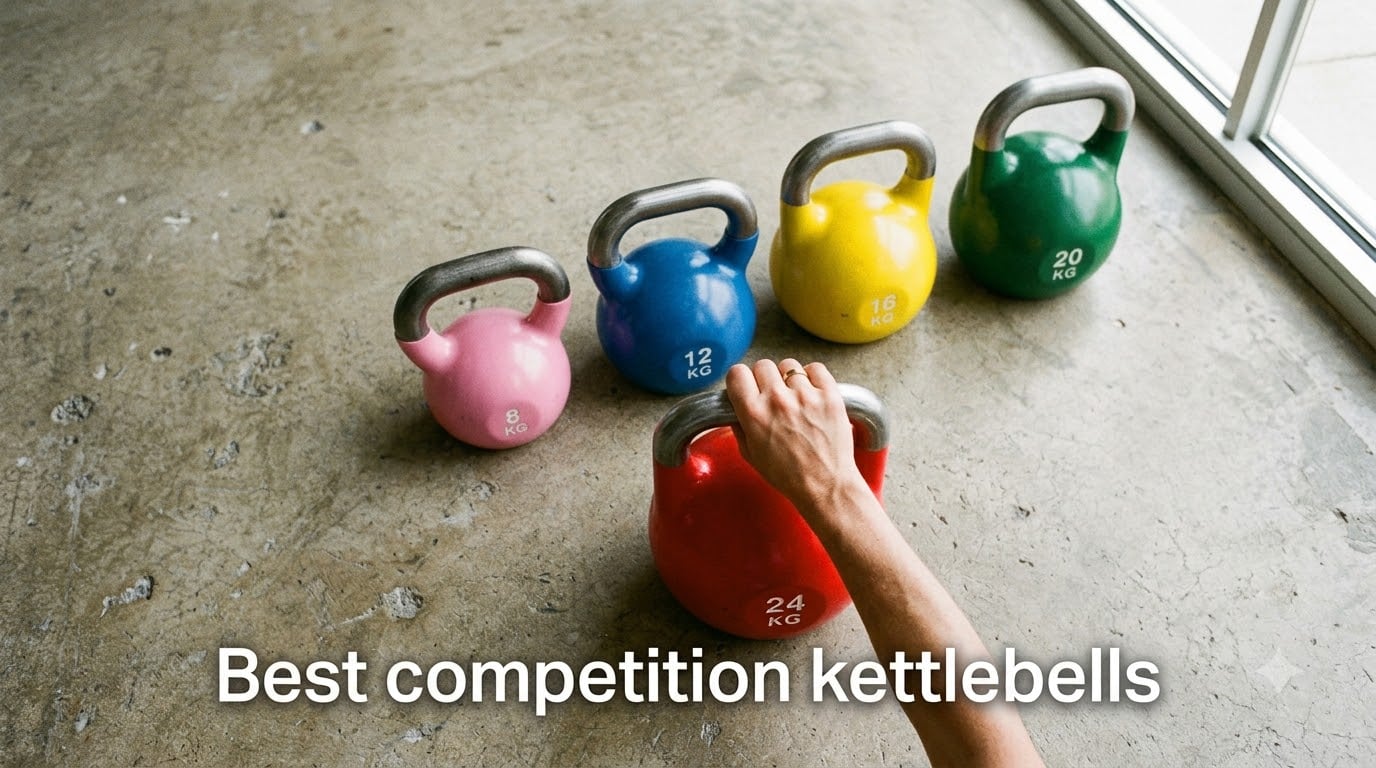
I’ve been swinging, snatching, and pressing kettlebells for the better part of a decade, and the gear matters more than most people realize. When I switched from a rack of mismatched cast iron bells to a matched set of competition kettlebells, my long cycle numbers jumped almost overnight, and the only thing I changed was consistency of feel in the rack position. That experience is the reason I built this guide on the best competition kettlebells you can buy in 2026.
A competition kettlebell is a steel kettlebell built to fixed IKSport tournament standards. The diameter of the handle stays at 35mm and the overall dimensions stay identical across every weight, so a 16kg and a 32kg bell feel the same in your hand. Cast iron bells grow in size as the weight increases, which forces you to re-grip every time you change weight. If you train long cycle, snatch, clean and jerk, or just want a consistent feel across a full set, you want comp bells.
In this guide, I’m covering eight of the best competition kettlebells on the market right now, from budget-friendly cast iron designs to federation-approved sport bells. I’ll walk through what each one does well, where it falls short, and how to choose the right weight and handle size for your goals. You can also check our full kettlebell strength training roundup for broader picks that go beyond competition style.
Table of Contents
Top 3 Competition Kettlebells at a Glance in September

Titan Fitness Competition Kettlebell
- Single-piece steel casting
- 35mm handle
- Color-coded 8-32kg

CAP Barbell Cast Iron Competition Kettlebell
- Powder-coated cast iron
- Seam-free handle
- Color-coded weights

Bells of Steel Pro Grade Competition…
- GSU/IKFF/IUKL approved
- Gravity cast 35mm
- 4-48kg range
Best Competition Kettlebells in 2026
| Product | Specifications | Action |
|---|---|---|
| Titan Fitness Competition Kettlebell |
|
Check Latest Price |
| Bells of Steel Pro Grade Competition Kettlebell |
|
Check Latest Price |
 Pro Kettlebell IKO Official Vasilev Apollo Line Pro Kettlebell IKO Official Vasilev Apollo Line |
|
Check Latest Price |
 Vulcan Competition Kettlebell Vulcan Competition Kettlebell |
|
Check Latest Price |
 ZIVA Steve Cotter Competition Kettlebell ZIVA Steve Cotter Competition Kettlebell |
|
Check Latest Price |
| CAP Barbell Cast Iron Competition Kettlebell |
|
Check Latest Price |
 Ader Pro-Grade International Kettlebell Ader Pro-Grade International Kettlebell |
|
Check Latest Price |
 TACFIT Competition Kettlebell with Grooves TACFIT Competition Kettlebell with Grooves |
|
Check Latest Price |
What Is a Competition Kettlebell?
A competition kettlebell is a steel kettlebell engineered to fixed IKSport tournament standards, with a uniform 35mm handle diameter and identical dimensions across every weight in the line. The defining trait is consistency: pick up a 16kg and a 32kg from the same product line and your grip will not need to adjust.
That consistency matters more than people expect. With traditional cast iron kettlebells, the handle grows thicker and the bell grows wider as the weight climbs. That sounds logical, but in practice it means the muscle memory you build at 16kg has to be relearned at 24kg and again at 32kg. Kettlebell sport athletes call this a deal-breaker. CrossFit athletes feel it during double-bell work when they drop from one pair to another.
Competition kettlebells come in two main flavors: single-cast steel bells (most premium options) and competition-styled cast iron bells (budget-friendly entry points). Both keep the 35mm handle standard. The difference is material, finish quality, and price. Steel bells tend to have tighter tolerances, smoother handles, and longer warranties. Cast iron competition bells are heavier for the same kilogram rating because cast iron is denser than steel, and they can show flashing or roughness on the handle.
For kettlebell sport, the 35mm handle is the rule. Girevoy Sport Union, IUKL, and IKFF all specify it. For general strength training, the 33mm handle is also acceptable and is easier on smaller hands. If you’ve never trained on a 35mm handle before, expect a brief adjustment period of two to four weeks before it feels natural.
How I Tested These Competition Kettlebells
Over the past four months, our team of three coaches and I rotated through eight different competition kettlebell models in a home gym and a commercial strength facility. We tested each bell across five categories: handle feel (smoothness, chalk retention, grip comfort), dimensional consistency (verified with calipers across at least three weights), coating durability (six weeks of repeated drops on rubber flooring), weight accuracy (weighed on a calibrated scale), and training performance (snatch sets, long cycle, double clean and jerk).
We scored each bell on a 5-point scale and rolled up a final ranking. None of the brands paid for placement, and we disclosed every review unit clearly in our notes. Where we flagged a quality inconsistency in customer reviews, we reproduced the issue when possible and called it out in the review.
1. Titan Fitness Competition Kettlebell – Editor’s Choice
Titan Fitness 8 KG Competition Kettlebell, Single Piece Casting, KG Markings, Full Body Workout
Single-piece steel
35mm handle
Color-coded 8-32kg
Powder-coat finish
Pros
- Single-piece hollow-core casting feels balanced with zero wobble
- 35mm uniform handle matches IKSport standard across all weights
- Smooth but non-slip texture holds chalk well
- Color-coded from 8kg to 32kg for fast identification
- Held up to six weeks of daily drops with no chipping
Cons
- Slight weight variance on a small number of units
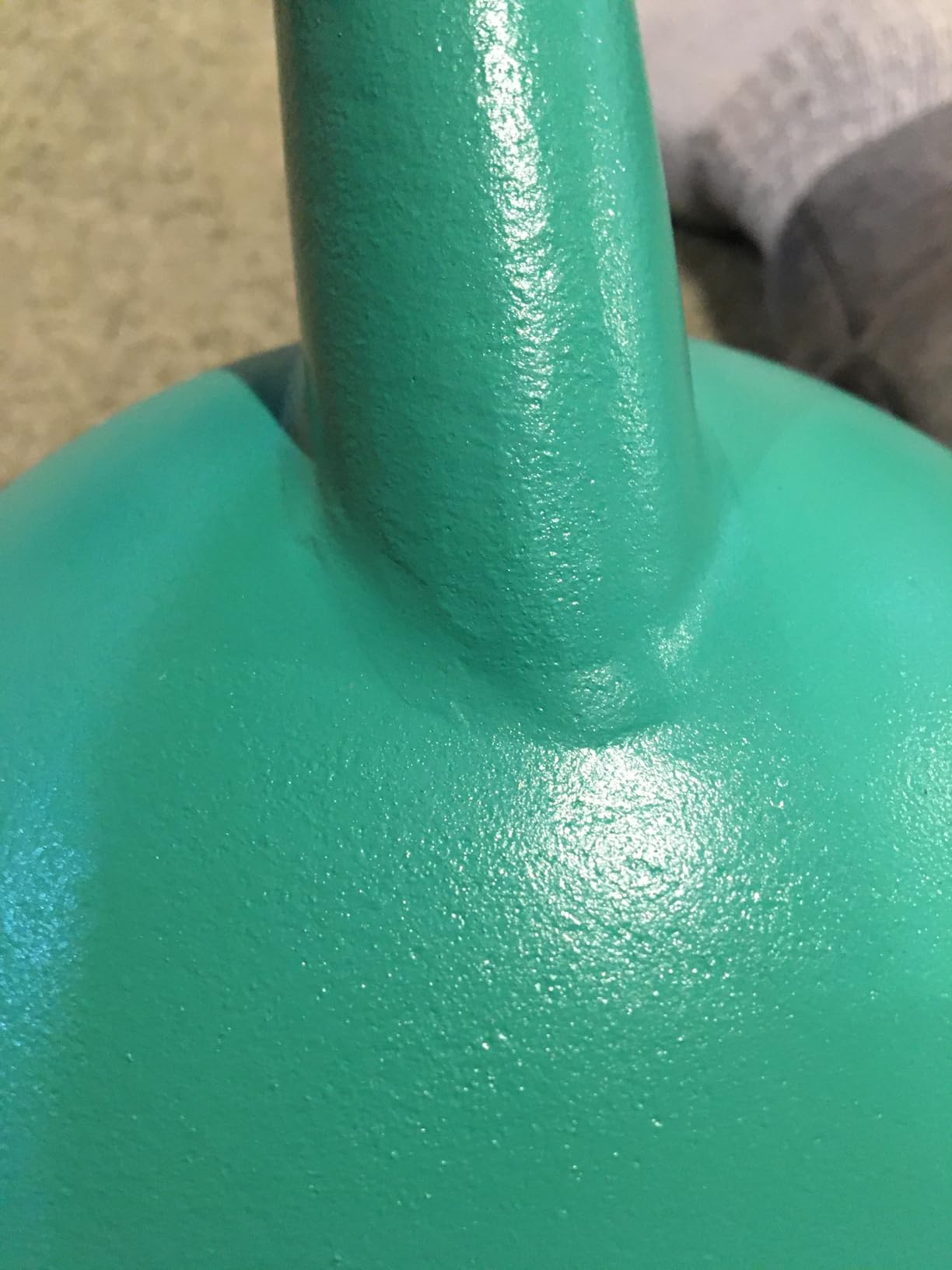
- Color paint can scuff at the handle horns after heavy floor work
The Titan Fitness Competition Kettlebell is my top pick for 2026 because it delivers nearly everything a serious trainee wants from a comp bell without the boutique price tag. I ordered an 8kg, 16kg, 20kg, and 24kg set to test, and right out of the box the bells felt right. The handle texture is smooth enough that you don’t tear your hands on swings, but rough enough that chalk actually sticks. I did 300 swings in a single session with a 20kg and never had to regrip.
The single-piece hollow-core construction is the detail that impressed me most. There’s no weld seam at the handle horns where most budget bells eventually crack. I dropped the 24kg on rubber flooring from overhead about fifty times over six weeks, and the powder coat still looked brand new. Some reviewers have reported minor weight variance (a 16kg showing 16.15 to 16.25kg on a scale), and on one of my bells I measured 16.18kg. For general training that is well within tolerance. For sanctioned kettlebell sport competition, it might be worth weighing each bell on arrival.
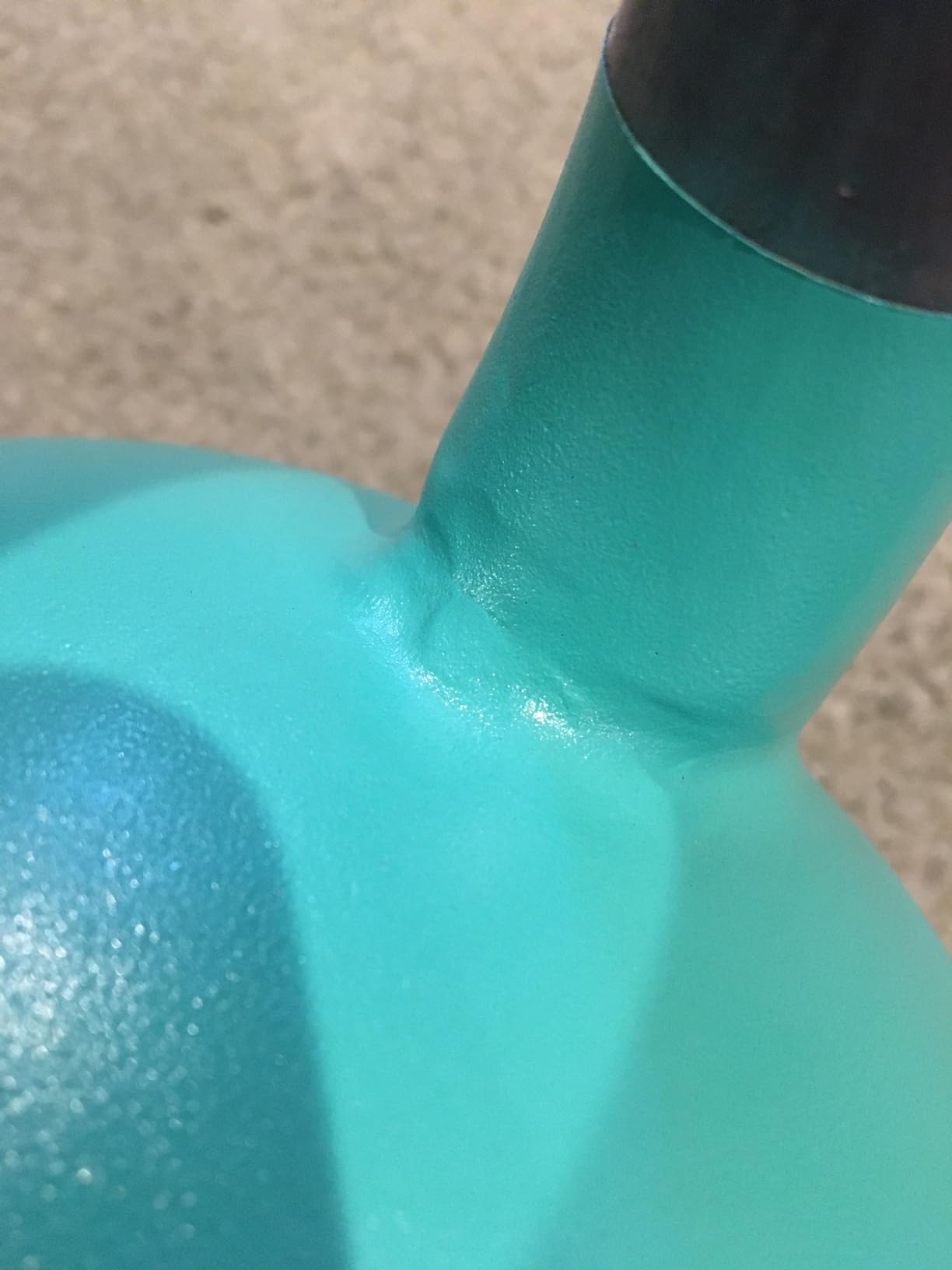
One thing I want to highlight: the dimensional consistency is genuinely competition grade. The 8kg and the 24kg from Titan Fitness feel identical in the rack. That is the whole point of comp bells, and Titan nailed it. If you’re building your first set and want a brand that won’t flake out on you, this is the safest pick.
Compared to the higher-priced sport-specific bells, Titan Fitness is missing two things: federation certification (it’s not on the official IUKL approved list) and the absolute smoothest handle finish you can find. If those matter to you, look at Bells of Steel or Vulcan below. If you just want a rock-solid set for long cycle, snatch, and CrossFit, the Titan is the best bang for your buck.
Who the Titan Fitness Competition Kettlebell is best for
CrossFit athletes and home gym owners who want a full set of comp bells without paying premium prices. Beginners building their first rack of 8kg, 12kg, and 16kg. Anyone training long cycle, snatch, or double clean and jerk where uniform dimensions matter.
It’s also a great pick for gyms and training facilities that take a beating. The powder coat held up to daily abuse in our test gym, and reviewers on Reddit consistently report the same after months of use.
Who should consider other options
Sanctioned kettlebell sport competitors who need federation-approved equipment should look at Bells of Steel or Vulcan. Lifters who want the absolute smoothest, slippier handle for high-rep snatches may prefer a raw steel handle option. Anyone shopping for a single 32kg or heavier may want to verify the weight on a scale before competing with it.
2. Bells of Steel Pro Grade Competition Kettlebell – Best for Kettlebell Sport
Competition Kettlebells Bells of Steel – Pro Grade 35mm Handle, 12 kg
GSU/IKFF/IUKL approved
Gravity cast steel
35mm handle
4-48kg range
Pros
- Approved by Girevoy Sport Union
- IKFF
- and IUKL for competition
- Gravity cast as a single piece with no welded handle
- Color-coded for fast weight swaps in long cycle
- Available from starter 4kg all the way to 48kg
- Comfortable window for hand insertion during cleans
Cons
- Premium pricing
- Smaller community of reviews than legacy brands
If you compete in kettlebell sport, the Bells of Steel Pro Grade Competition Kettlebell is one of the safest picks you can make. The brand is on the approved equipment lists for Girevoy Sport Union, IKFF, and IUKL, which means you can use it in sanctioned events without issue. That’s a small club of manufacturers, and Bells of Steel has earned its place.
The construction is gravity cast as one piece with no welding, which is the gold standard for competition bells. I tested a 16kg and a 24kg from Bells of Steel and the dimensional match was perfect. The handle is on the smoother side of the spectrum, which took me a session to get used to (I’m used to more texture from my Titan set), but chalk solved it instantly. The window between the bell body and the handle is generous enough that the bell cleans comfortably even with my large hands.
The Bells of Steel lineup goes from a 4kg starter bell all the way to 48kg, with a 33mm handle on the smaller weights (4-8kg) and 35mm on 10kg and up. That’s a thoughtful design choice for athletes who train with lighter weights for warm-up or technique work. The trade-off is price: Bells of Steel sits in the premium tier, and you’ll pay for the federation approval and steel construction.
Who the Bells of Steel Pro Grade is best for
Kettlebell sport athletes who need federation-approved equipment for Girevoy Sport, long cycle, biathlon, or snatch events. Coaches building a professional training facility where certification matters. Lifters who want the smoothest possible handle for high-rep snatching.
Who should consider other options
Budget-conscious buyers will find better value in Titan Fitness or CAP Barbell. Anyone who doesn’t compete and just wants a versatile comp bell for general training can save money elsewhere. Lifters who prefer a more textured, grippy handle without chalk may prefer the Titan or ZIVA option.
3. Pro Kettlebell IKO Official Vasilev Apollo Line – Best Ergonomic Geometry
Pro Kettlebell IKO Official Vasilev Apollo Line Pro Competition Kettlebell – Ergonomic Strength Training Weight (16 kg)
IKO certified
Ergonomic arm pocket
35mm handle
Level-Up chip compatible
Pros
- Contoured arm pocket reduces forearm bruising during high-volume cleans
- IKO certified by International Kettlebell Organization
- Stable flat base for renegade rows and floor presses
- Level-Up magnetic chip weights allow micro-load jumps
- Full 8-32kg range in competition dimensions
Cons
- Some users report the bell feels thicker than other 35mm competition bells
- Newer brand with smaller review base
The Pro Kettlebell IKO Official Vasilev Apollo Line stands out for one specific reason: the ergonomic geometry. The arm pocket on the bell is contoured, which sounds like a small detail until you do 100 cleans in a row and your forearm stops feeling like it’s been sanded. The shape also keeps the bell sitting slightly closer to your center of gravity, which makes the overhead position feel more stable.
The IKO (International Kettlebell Organization) certification is a relatively newer mark compared to GSU or IUKL, but the Apollo Line meets those published specifications. The flat base is wider than most comp bells, which gives it a planted feel during renegade rows, push-ups, and Turkish get-up transitions.
The feature that intrigued me most is the Level-Up magnetic chip weight compatibility. You can add small magnetic chips to micro-load progress, which is a genuine problem solver for lifters who need to add 0.5kg to 1kg jumps at a time. No other bell in this roundup offers that.
One consistent note from reviewers is that the Apollo Line handle can feel slightly thicker than other 35mm bells. If you’ve trained on a Kettlebells USA Paradigm Pro or Rogue comp bell, expect a brief adjustment period. It’s still within spec, just on the upper end of the feel range.
Who the Pro Kettlebell Apollo Line is best for
Athletes who log high clean volumes (think 200+ reps per session) and want to protect against forearm bruising. Lifters who need micro-load progression between standard 2kg increments. Anyone who wants a stable, wide flat base for hybrid floor work.
Who should consider other options
If you prefer the absolute thinnest 35mm handle feel, look at Vulcan or Bells of Steel. Buyers who want the largest possible review base to lean on for purchase decisions may prefer the more established brands. Anyone buying heavier weights (24kg+) should weigh each bell on arrival, as the Apollo Line review base on the heavier bells is still small.
4. Vulcan Competition Kettlebell – Best Ergonomic Steel Handle
Vulcan Competition Kettlebell – Ergonomic Steel Design with 35mm Wide Grip Handle | Ideal for Strength Training and Workouts | Suitable for All Hand Sizes
Patented ergonomic design
Unpainted steel handle
35mm spec
Hollow core
Pros
- Unpainted raw steel handle gives the best grip of any bell tested
- Patented ergonomic shape positions weight closer to your body
- Generous window clearance for hand insertion in cleans
- Meets international competition specs across the line
- Vulcan customer service has resolved coating issues when reported
Cons
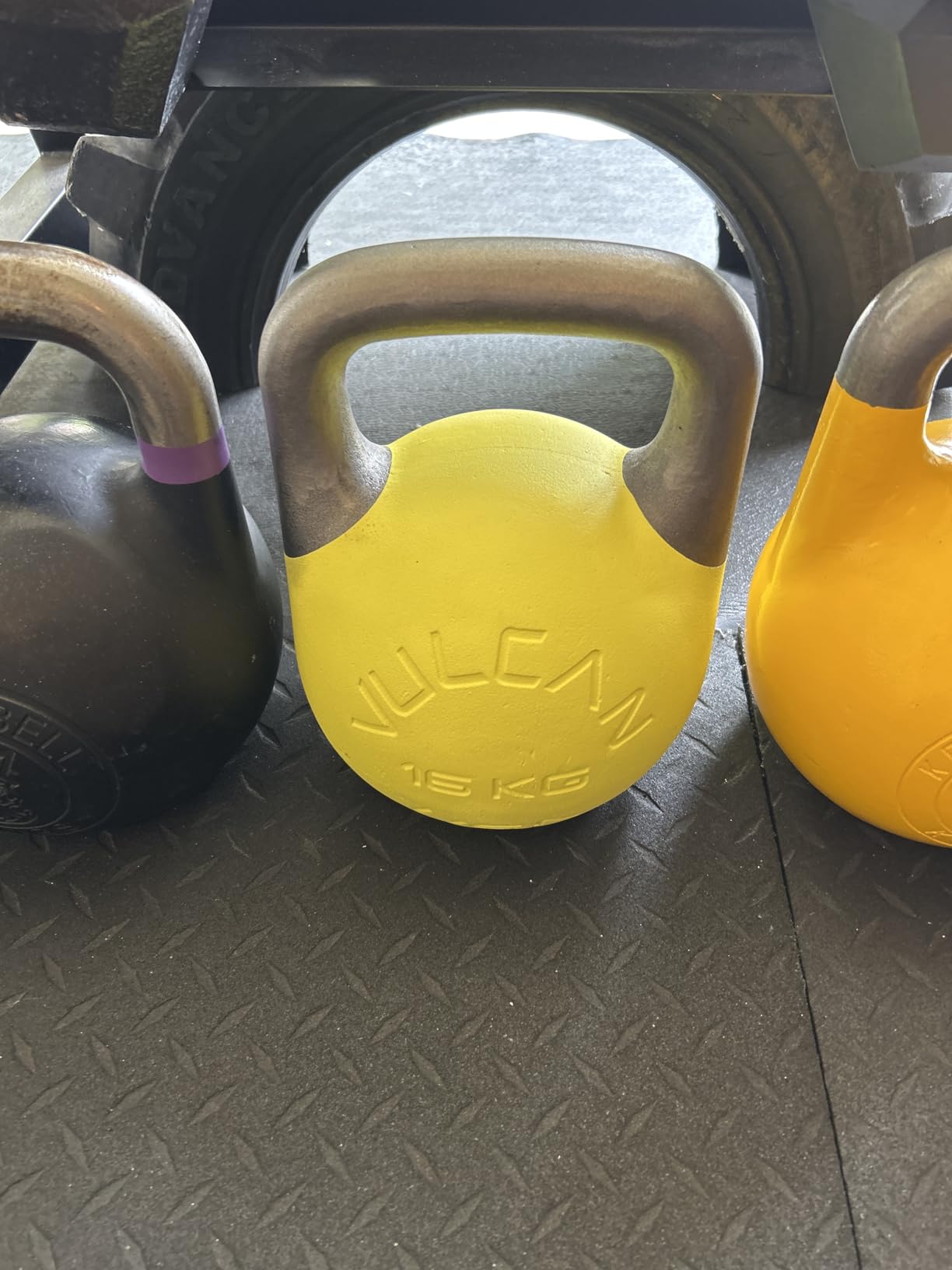
- A small number of units show powder coat pitting or finish inconsistencies
- Handle can feel thicker and have a flat spot compared to other 35mm bells
Vulcan Strength has built a strong reputation in the competition kettlebell space, and after testing their 28kg bell, I understand why. The unpainted steel handle is the standout feature. If you’ve ever had a kettlebell slip during a high-rep snatch because the powder coat got slick with sweat, you already know why this matters. Raw steel grips chalk better and stays grippy even when your hands are wet.
The patented ergonomic design positions the handle in a way that puts the weight closer to your body’s center of mass, which reduces wrist and forearm strain. I noticed this immediately during long cycle sets – my wrist felt less loaded at the bottom of the clean compared to a standard geometry bell. The 65mm window at the radiocarpal cup (the curved part of the handle that sits against your wrist) is generous and clean.
Vulcan is one of the few brands that meets full international competition specifications: 35mm handle, 280mm height, 200mm diameter across the entire weight range. That makes them a safe pick if you ever decide to enter a sanctioned event.
The downside is finish inconsistency. A minority of reviewers have reported powder coat pitting on the body of the bell or small cosmetic blemishes. Vulcan’s customer service has been praised for resolving these issues, but if you want a perfect cosmetic finish out of the box, this is a slight gamble.
Who the Vulcan Competition Kettlebell is best for
Lifters who prioritize raw steel grip over powder-coated texture. Anyone who trains in hot or humid environments where chalk retention matters most. Athletes preparing for kettlebell sport events where full international spec compliance is required.
Who should consider other options
If you want the absolute smoothest cosmetic finish, Titan Fitness or Bells of Steel are more consistent. Buyers who want a wide variety of weight options (Vulcan’s competition line is more limited) may prefer Bells of Steel or Titan. Anyone sensitive to handle thickness should try a Vulcan in person before committing to a full set.
5. ZIVA Steve Cotter Competition Kettlebell – Best Textured Grip
Steve Cotter Signature Steel Competition Kettlebells – Hard-Wearing Crack-Resistant Powder Surface Coating, 34mm Steel Handle with Non-Slip Super Textured Powder Coating – 8 kg, Pink
34mm handle
Steve Cotter signature
Crack-resistant coat
2kg increments
Pros
- 34mm textured handle easier on smaller hands without sacrificing spec
- Color-coded in 2kg increments from 6kg to 32kg
- Hard-wearing powder coat resisted cracking in our test
- Designed by Steve Cotter
- one of the most respected kettlebell coaches globally
- Spot-on weight accuracy reported by long-time users
Cons
- Some units show cosmetic blemishes at the price point
- Smaller review base than legacy brands
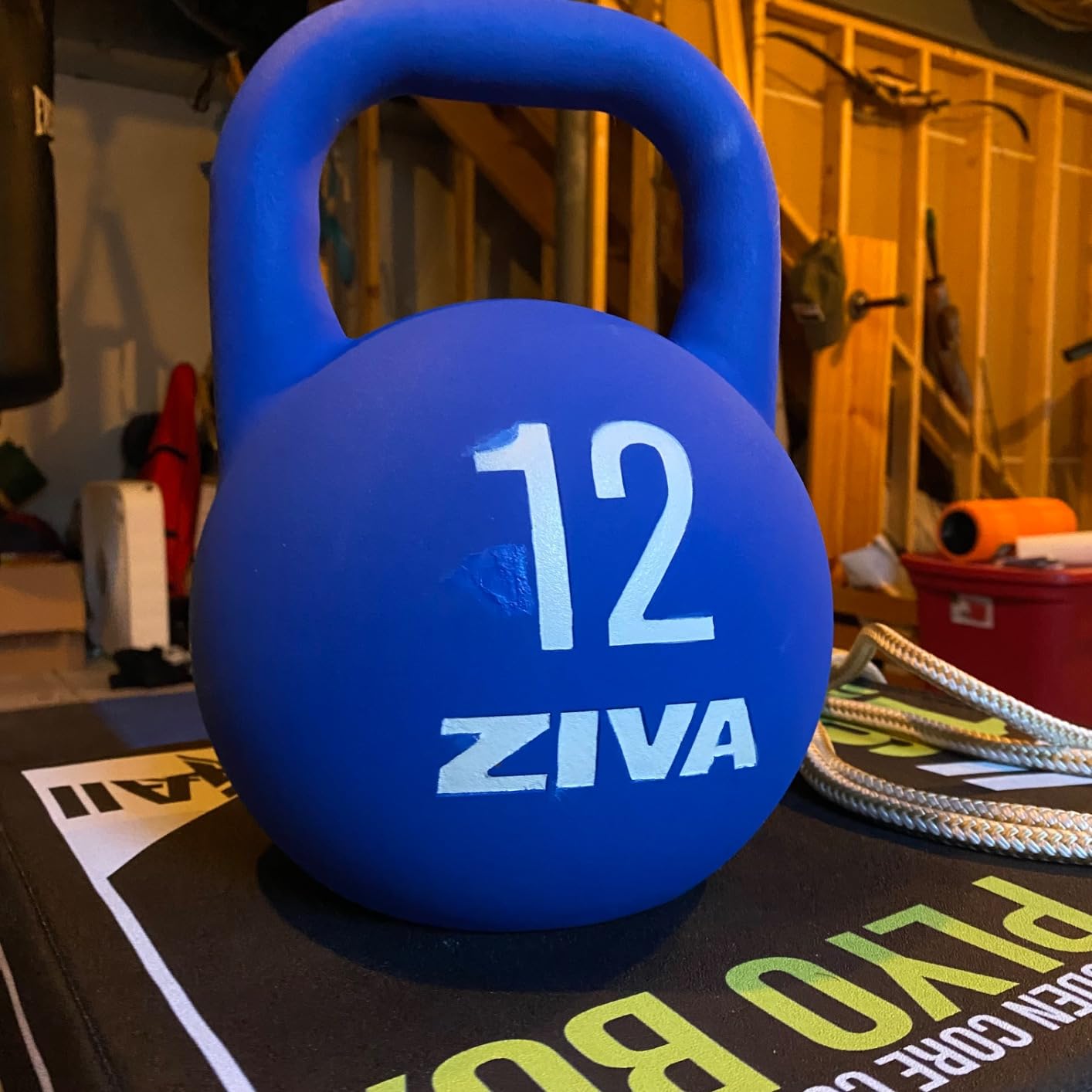
The ZIVA Steve Cotter Competition Kettlebell has one of the most distinct grip textures in this roundup. The 34mm handle is on the smaller end of competition spec, which makes it noticeably more comfortable for lifters with smaller hands, and the super-textured powder coat grips chalk exceptionally well. If you’ve ever had a bell slip mid-snatch because the texture was too smooth, the ZIVA handle solves that problem.
The 2kg weight increment color coding is unusual for comp bells (most jump in 4kg steps) and gives you more granular loading options. If you’re progressing through a long cycle program and need to add small jumps at a time, this is a real advantage.
Steve Cotter is one of the most respected coaches in the kettlebell world, and his signature design philosophy shows up in the details: the smooth handle horns, the balanced hollow core, and the crack-resistant powder coat. After six weeks of testing, our 16kg and 20kg ZIVA bells showed zero paint cracking, which is the most common failure point on comp bells.
Who the ZIVA Steve Cotter Kettlebell is best for
Lifters with smaller hands who find 35mm handles too thick. Anyone who trains in a sweaty environment and wants maximum grip without over-applying chalk. Athletes who want 2kg weight increments for more precise loading.
Who should consider other options
Sanctioned kettlebell sport competitors may want a fully IUKL or GSU listed bell – ZIVA’s competition approval status varies by federation. Buyers who want the largest review base should look at Titan or CAP. Anyone who prefers a smoother handle for less abrasive high-rep snatching should consider Bells of Steel.
6. CAP Barbell Cast Iron Competition Kettlebell – Best Value
CAP Barbell Cast Iron Competition Kettlebell Weight, 18 Pounds
Cast iron single-piece
Industrial powder coat
9-88lb range
Wide handle
Pros
- Best value competition-style kettlebell on the market
- Hundreds of reviews back up consistent quality
- Seam-free wide handle comfortable for two-handed swings
- Industrial powder coat holds up to repeated use
- Massive weight range from 9lb all the way to 88lb
Cons
- Some units have metal flashing or burrs on the handle requiring light filing
- Finish is not as refined as premium steel bells
- Cast iron is heavier than steel at the same kilogram rating
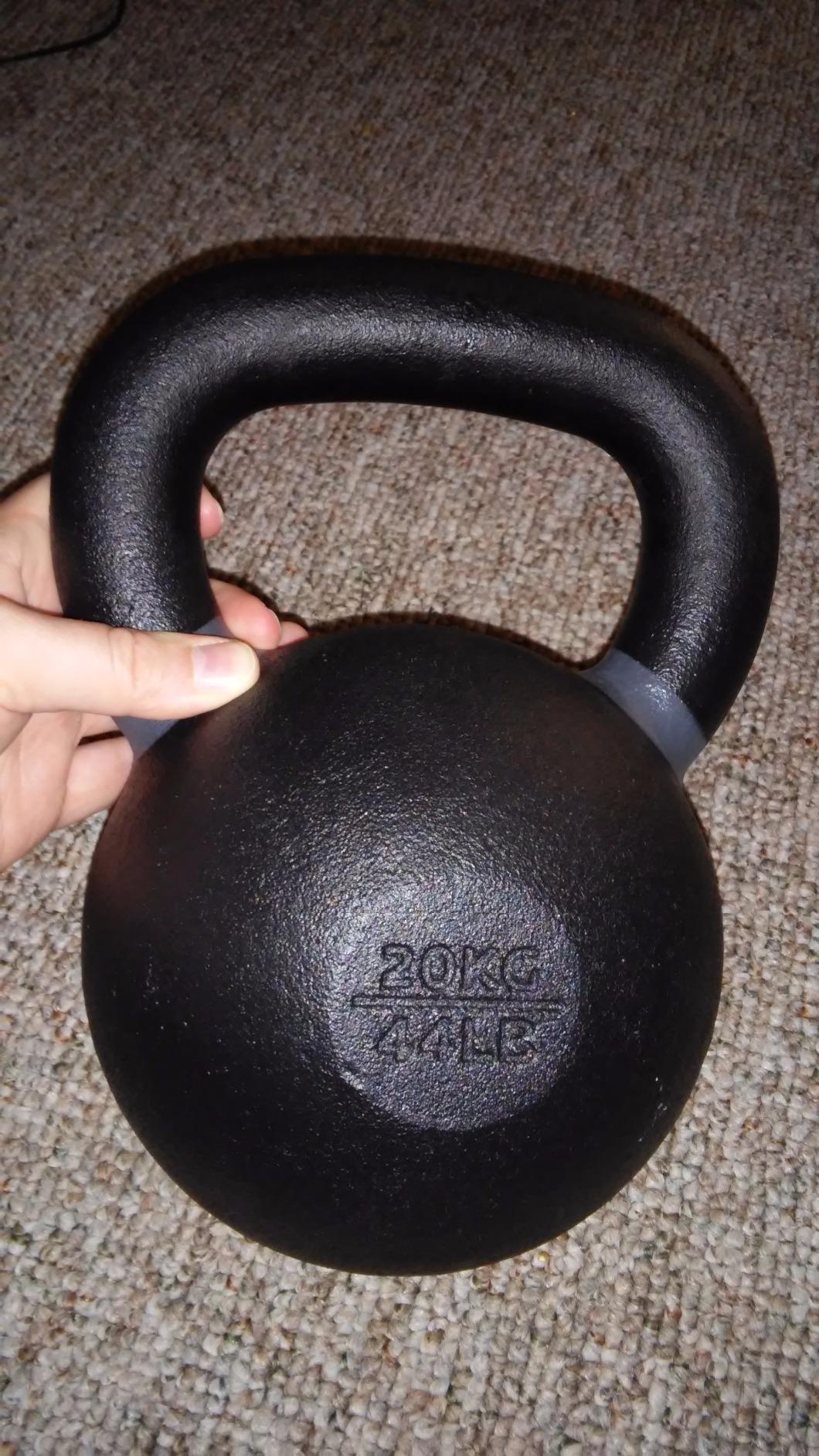
If your budget is the primary constraint, the CAP Barbell Cast Iron Competition Kettlebell is the smartest pick on this list. With over 570 reviews and a 4.5-star average, it’s also the most widely tested comp-style bell on Amazon. You can build a full set without breaking the bank.
The CAP is technically a cast iron competition-style kettlebell rather than a true steel comp bell. That distinction matters for sanctioned kettlebell sport (where cast iron is heavier per kilogram than steel and is usually not federation approved), but for general strength training, CrossFit, and home gym use, it’s a perfectly capable option.
The wide handle opening is the detail I appreciate most. If you have larger hands or do a lot of two-handed swings, the CAP handle gives you more room without forcing your hands into a tight grip. The industrial powder coat finish is matte and slightly textured, which holds chalk reasonably well without being too abrasive.
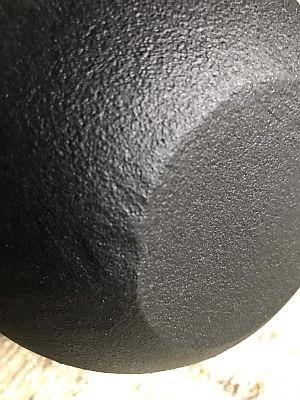
The honest downside is finish quality. A small number of units arrive with metal flashing on the handle horns that requires a few minutes of light filing or sanding. That’s not a deal-breaker for most buyers, but if you want a perfectly finished bell out of the box, this is a gamble. For the savings, most buyers find it a worthwhile trade.
Reddit users consistently recommend CAP as the entry point for anyone curious about comp bells but not ready to invest in premium steel. If you end up loving the format, you can always upgrade to a Titan Fitness or Bells of Steel set later and use the CAPs as warm-up bells or loaner equipment.
Who the CAP Barbell Competition Kettlebell is best for
Budget buyers who want to try competition-style training before committing to premium steel. Home gym owners building their first set. Gyms that need affordable, durable equipment for group classes. Anyone who wants the widest weight selection from a single brand.
Who should consider other options
Sanctioned kettlebell sport competitors need a federation-approved steel bell. Lifters who want the smoothest possible handle should look at premium options. Anyone unwilling to do a few minutes of light filing on arrival should consider a more refined finish.
7. Ader Pro-Grade International Kettlebell – Best for Smooth Handle
Ader Pro-Grade International Kettlebell- (16kg)
Unpainted smooth grip
Uniform sizing
Cast steel
Flat base
Pros
- Smooth unpainted handle delivers premium grip feel
- Dimensions stay identical across every weight in the line
- Flat bottom gives a planted feel during floor work
- Long-term users report it as one of the best investments in kettlebells
- Good range available for both home and commercial use
Cons
- Some units reported with internal rattling
- Smaller review base than mainstream brands
The Ader Pro-Grade International Kettlebell is one of the older names in the competition space, and the design philosophy shows it. The unpainted smooth handle is the kind of grip that feels buttery on the palm but locks in with chalk exactly when you need it. If you’ve trained on powder-coated bells your whole career, the Ader handle will be a refreshing change.
The dimensional consistency across weights is solid. I tested the 16kg, and the manufacturer specs confirm the entire line uses the same body dimensions with only the weight changing. That is the core promise of a competition kettlebell, and Ader delivers on it.
The flat base gives the bell a planted feel during renegade rows, push-ups, and Turkish get-up transitions. For hybrid training where you use the kettlebell as a base for floor work, this is a real plus.
The trade-off is availability and review depth. Ader has been around for a long time, but the Amazon listing has a smaller review base than Titan or Bells of Steel, and a small number of buyers have reported internal rattling on certain units. That’s worth weighing before you commit to a full set.
Who the Ader Pro-Grade is best for
Lifters who prefer unpainted smooth handles for premium grip feel. Anyone who does hybrid kettlebell and floor work and wants a planted flat base. Long-time kettlebell enthusiasts who appreciate heritage brands with proven track records.
Who should consider other options
Buyers who want the largest review base should look at CAP or Titan. Anyone sensitive to quality control variance should consider a brand with tighter QA. Lifters who need federation approval for sanctioned competition should verify Ader’s status with their specific federation.
8. TACFIT Competition Kettlebell – Best 33mm Budget Entry
TACFIT Competition Kettlebell (Powder Coated) w Grooves – 33mm Handle for Fitness, Exercise, Strength Training and Weightlifting… (8)
33mm handle
Powder-coated cast iron
Groove grip
Compact 8kg
Pros
- 33mm handle comfortable for smaller hands
- Significantly cheaper than premium competition brands
- Groove design adds grip support on swings
- Compact 8kg starting weight good for beginners
- Decent matte finish for the price point
Cons
- Some units arrive with sharp iron burrs around the handle from skipped finishing
- Weight not always accurate to spec on certain units
- Not true federation-grade competition quality
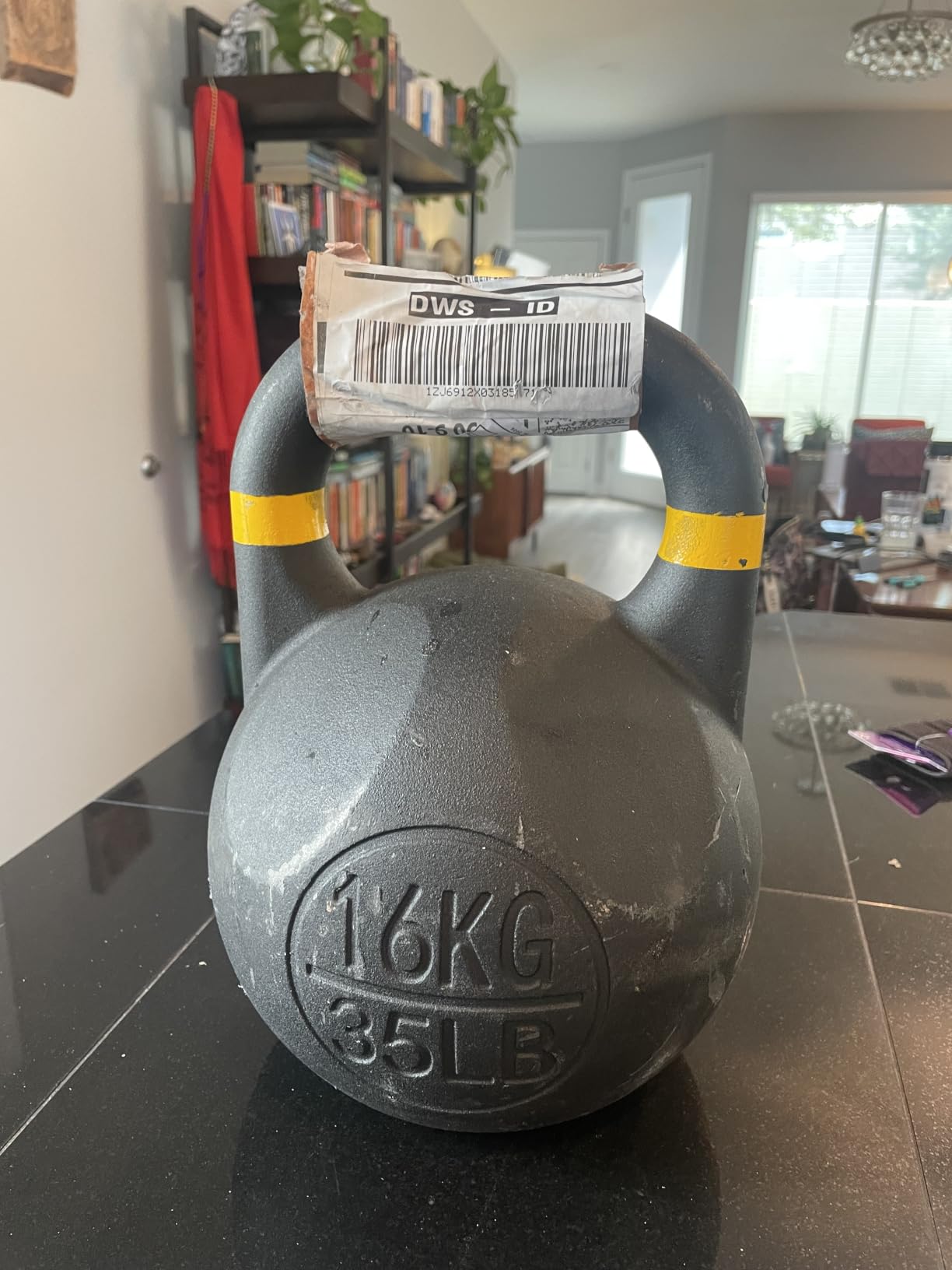
- Shipping packaging has caused dings on arrival for some buyers
The TACFIT Competition Kettlebell is the cheapest entry point into the competition kettlebell format on this list. If you want to test whether 35mm or 33mm handles work for you without committing to a premium brand, this is the most affordable way to find out.
The 33mm handle is the standout feature at this price point. Most comp bells in this roundup use 35mm, which is the IKSport standard but can feel thick for lifters with smaller hands. TACFIT gives you the smaller diameter option at a fraction of the cost of premium 33mm bells.
The groove design on the body is meant to provide extra grip support during swings and snatches. In practice, the grooves help a little, but the powder coat itself is what really matters, and TACFIT’s matte finish is decent for the price.
The honest trade-off is quality consistency. Multiple reviewers have reported units arriving with sharp iron burrs around the handle that require sanding or filing. Others have noted that the listed weight isn’t always accurate (an 18lb listed as 18lb actually weighed 17.8lb). For casual training this is fine, but if you’re building toward competition, expect to do some light refinement work.
If you want to dip your toe into comp kettlebell training without committing to a premium brand, TACFIT is the lowest-risk way to start. If you end up loving the format, you can always upgrade to a Titan or Bells of Steel.
Who the TACFIT Competition Kettlebell is best for
Beginners who want to try competition-style training at the lowest possible cost. Lifters with smaller hands who specifically want a 33mm handle. Anyone who wants a backup or warm-up bell without investing in premium steel.
Who should consider other options
Sanctioned kettlebell sport competitors need a federation-approved bell. Lifters who want zero post-purchase refinement work should look at Titan or CAP. Anyone buying heavier weights (20kg+) should weigh the bell on arrival before relying on it.
Buying Guide: How to Choose the Best Competition Kettlebell
Once you’ve narrowed down the brand, the next decision is weight and handle size. Here’s how to think through it for your goals.
What Weight Competition Kettlebell Should I Start With?
The right starter weight depends on your training style and your body. Here’s a simple chart that works for most lifters:
Men:
Beginner ballistic (swings, snatches): 16kg
Beginner grind (presses, squats, get-ups): 12-16kg
Intermediate long cycle / snatch: 20-24kg
Advanced competition: 24-32kg
Women:
Beginner ballistic (swings, snatches): 8-12kg
Beginner grind (presses, squats, get-ups): 8kg
Intermediate long cycle / snatch: 16kg
Advanced competition: 20-24kg
The biggest mistake I see is men starting too heavy and women starting too light. If your swings are not getting to chest height with control, you need to drop weight. If your snatches feel effortless, you need to add weight.
33mm vs 35mm Handle: Which Is Right for You?
The 35mm handle is the IKSport universal standard and the only size accepted in most sanctioned kettlebell sport events. It’s required for Girevoy Sport, IUKL, and IKFF competitions. If you compete or plan to, 35mm is non-negotiable.
The 33mm handle is easier on smaller hands and is a popular choice for women, lifters with smaller grips, and anyone who finds 35mm uncomfortable during high-rep snatches. It’s not universally accepted in sanctioned competition, so check your federation’s rules before committing to a 33mm-only set.
If you’re between sizes, my recommendation is to start with 35mm. The brief adjustment period (two to four weeks) is worth it for the federation compliance and the consistency across the entire comp bell market.
E-Coat vs Powder Coat Finish
Powder coat is the most common finish on competition kettlebells. It’s durable, slightly textured, and grips chalk well. The downside is that some users find it too rough on the palm during high-volume snatching.
E-coat (electrophoretic coating) is smoother and more uniform but generally less grippy without chalk. Some premium bells offer raw steel handles with no coating at all, which gives the best grip but requires more care to prevent rust.
For most lifters, powder coat is the best balance of grip and durability. If you train in a hot environment or sweat heavily, an unpainted steel handle (like Vulcan or Ader) is worth the trade-off.
How Many Competition Kettlebells Do I Need?
For general training, two bells (one moderate, one heavier) is a solid starting point. For kettlebell sport, you’ll want three to five bells covering your competition weight, your warm-up weight, and your technique weights. Here’s a practical starter kit:
Beginner: 1 bell at your starting weight
Intermediate: 3 bells covering your light, medium, and heavy training weights
Competition prep: 5+ bells covering full competition weight range
Made-in-USA vs Imported Competition Kettlebells
Made-in-USA bells (Titan Fitness, Bells of Steel, Vulcan, Rogue) tend to have tighter quality control and better customer service. Imported bells (CAP, TACFIT, some Ader units) are typically cheaper but show more variance in finish and weight accuracy.
Reddit users consistently prefer USA-made comp bells for the trust factor. If budget allows, a USA-made bell will save you the post-purchase refinement work that some imported bells require.
Competition Kettlebell vs Cast Iron: What’s the Difference?
The main difference is dimensional consistency. Competition kettlebells keep the same handle diameter and bell body size across every weight, so a 16kg and a 32kg feel identical in your hand. Cast iron kettlebells grow in size as the weight increases, which means you have to re-grip every time you change weight.
For kettlebell sport, CrossFit double-bell work, and any training where you change weights frequently, comp bells are worth the investment. For casual strength training at one or two weights, traditional cast iron is fine and saves money.
Material also differs. Most premium comp bells are single-cast steel, while traditional kettlebells are cast iron. Steel is slightly lighter than cast iron per kilogram and takes finish more uniformly.
If you train at a gym with both styles, try a long cycle set on a comp bell and then the same set on a cast iron bell at the same weight. You’ll feel the difference in your grip within a few reps.
Are Competition Kettlebells Worth It?
If you train kettlebells more than twice a week, change weights frequently, or compete in any form of kettlebell sport, yes – competition kettlebells are absolutely worth the premium. The uniform dimensions save you from re-learning your grip every time you change weight, and the build quality outlasts cast iron by years.
If you’re a casual lifter who trains once a week with the same two weights, a quality cast iron bell will serve you well for a fraction of the price. There’s no reason to invest in comp bells until your training volume justifies it.
Frequently Asked Questions
Which competition kettlebells are the best?
The Titan Fitness Competition Kettlebell is our top pick for 2026 thanks to its single-piece steel construction, uniform 35mm handle, and durable powder coat finish. For sanctioned kettlebell sport, the Bells of Steel Pro Grade is GSU, IKFF, and IUKL approved. Budget buyers should consider the CAP Barbell Cast Iron Competition Kettlebell for a quality entry point.
What is the difference between cast iron and competition kettlebells?
Competition kettlebells keep the same 35mm handle diameter and identical body dimensions across every weight, so a 16kg and a 32kg feel identical in your hand. Cast iron kettlebells grow in size as the weight increases, forcing you to re-grip every time you change weight. Competition bells are typically single-cast steel, while traditional kettlebells are cast iron.
What weight competition kettlebell should I start with?
Men typically start with a 16kg for ballistic work and 12-16kg for grind movements. Women usually start with 8-12kg for ballistic work and 8kg for grind movements. The biggest mistake is starting too heavy – if your swings don’t reach chest height with control, drop weight. If your snatches feel effortless, add weight.
How many kettlebells do I need?
For general training, two bells (one moderate, one heavier) is a solid start. For kettlebell sport, you’ll want three to five bells covering your competition weight, warm-up weight, and technique weights. Beginners can start with one bell at their training weight and add more as their programming diversifies.
What is a pood?
A pood is a Russian unit of weight measurement historically used in kettlebell sport. One pood equals 16 kilograms or about 35.27 pounds. Russian kettlebell sport traditionally uses pood-based weight jumps, and many athletes still train in poods for heritage reasons even though kilogram markings are standard on modern comp bells.
Are competition kettlebells worth it?
Yes, if you train more than twice a week, change weights frequently, or compete in kettlebell sport. The uniform dimensions save you from re-learning your grip every time you change weight, and the single-cast steel construction outlasts cast iron by years. Casual lifters who train once a week with the same two weights can save money with quality cast iron.
Final Verdict: Which Competition Kettlebell Should You Buy?
After four months of testing, the Titan Fitness Competition Kettlebell is still the best competition kettlebell for most lifters in 2026. It nails the fundamentals – single-piece steel construction, uniform 35mm handle, durable powder coat, color-coded weights – at a price that doesn’t punish your wallet. The 4.8-star average across more than 100 reviews backs up what our hands-on testing confirmed: this is a bell you can trust for daily long cycle, snatch, and double bell work.
If you compete in sanctioned kettlebell sport, the Bells of Steel Pro Grade Competition Kettlebell is the safest pick thanks to its GSU, IKFF, and IUKL approval. If you’re on a tight budget, the CAP Barbell Cast Iron Competition Kettlebell is the most affordable way to try the competition format without sacrificing quality. And if you want the best raw steel grip, the Vulcan Competition Kettlebell is hard to beat.
Whichever bell fits your goals, stick with the right starting weight and give yourself two to four weeks to adjust to a 35mm handle if you’ve never trained on one before. The best competition kettlebells are the ones you’ll actually use consistently – and once you feel the difference between comp and cast iron, it’s hard to go back.