
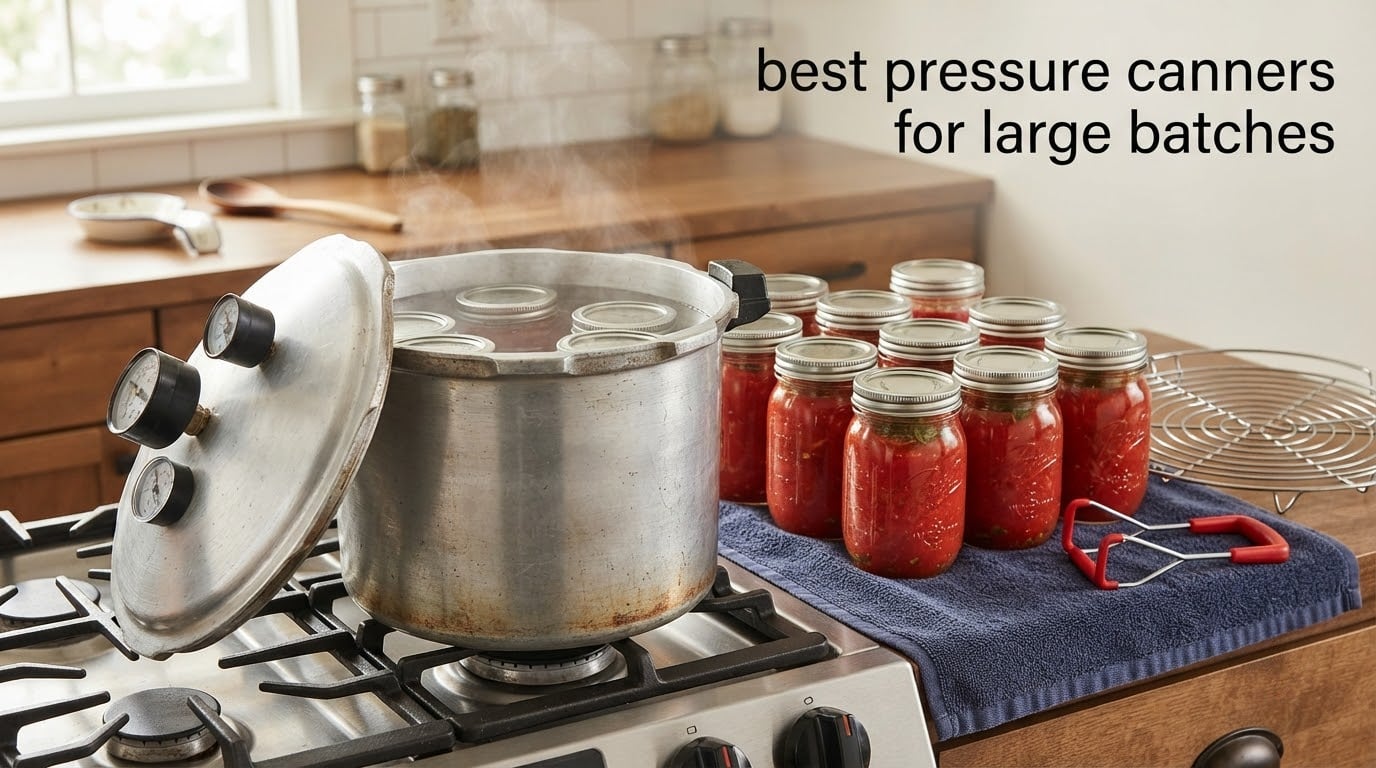
Most people shopping for the best pressure canners for large batches end up comparing pot sizes on a retailer page, and pot sizes are not the number that matters. Jars per load is. A 23-quart canner that holds 7 quart jars and a 30-quart canner that also holds 7 quart jars cost you the same number of stove hours for the same harvest.
So we ranked everything here on throughput first, then on the three things that quietly decide whether a big canner is pleasant to live with: how the lid seals, what your cooktop will accept, and how heavy the thing is when you want to put it away.
We spent weeks comparing spec sheets, owner reviews and manufacturer guidance across ten large-capacity units, from a 41.5-quart cast-aluminum classic to a 23-quart digital model that runs itself. Everything below was last checked in 2026, and every jar count we quote comes from the manufacturer or from what owners report filling the rack.
One safety line first, because it matters more than any ranking here: a pressure canner holds 10 or 15 PSI for the 20 to 90 minute processing times that low-acid foods need to destroy Clostridium botulinum spores. A standard pressure cooker or electric multicooker is not approved for canning by the USDA or the National Center for Home Food Preservation. If you have never canned before, read the pressure washer buying guides we maintain for the same rule we apply to tools: match the machine to the job, not the other way around.
Table of Contents
Top 3 Picks: Best Pressure Canners for Large Batches (October 2026)
These three carry the picks that matter most for anyone processing more than about 30 jars a season: maximum single-batch capacity among the certified canners, the best-reviewed value workhorse, and the best full-size canner for induction cooktops.

All American 941 (41.5 qt)
- About 19 quart jars or 32 pints
- Metal-to-metal seal with no gasket
- Weighted regulator
- 33 lb empty weight

Presto 01781 (23 qt)
- 7 quart jars or 20 pints
- Dial gauge plus 15 lb weighted regulator
- Also a boiling-water canner
- 12-year limited warranty

Presto 01784 (23 qt)
- Stainless-clad induction base
- 7 quart jars or 20 pints or 26 half-pints
- Air vent and cover lock
- 12-year limited warranty
Quick Overview: Every Pressure Canner in the Roundup
Here is the whole list at a glance, with the capacity and the pressure control that actually determines what you can put in a load. Click through to any row for the full review.
| Product | Specifications | Action |
|---|---|---|
| All American 941 (41.5 qt) |
|
Check Latest Price |
 Universal 53-Quart Pressure Cooker Universal 53-Quart Pressure Cooker |
|
Check Latest Price |
| Presto 01781 (23 qt) |
|
Check Latest Price |
| Presto 01784 (23 qt) |
|
Check Latest Price |
 WantJoin 23 Qt Pressure Canner WantJoin 23 Qt Pressure Canner |
|
Check Latest Price |
 Presto 02153 (23 qt Digital) Presto 02153 (23 qt Digital) |
|
Check Latest Price |
 Granite Ware 20-Quart Granite Ware 20-Quart |
|
Check Latest Price |
 MIRRO 22 Qt MIRRO 22 Qt |
|
Check Latest Price |
 Hawkins Bigboy (22 L) Hawkins Bigboy (22 L) |
|
Check Latest Price |
 T-fal 22 Qt T-fal 22 Qt |
|
Check Latest Price |
1. All American 941 (41.5 qt) – the true large-batch leader
All American 1930: 41.5qt Pressure Cooker/Canner (The 941) – Exclusive Metal-to-Metal Sealing System – Easy to Open & Close – Suitable for Gas or Electric Stoves – Made in the USA
41.5 qt capacity
Holds about 19 quart jars
Metal-to-metal seal
33 lb empty weight
Pros
- Metal-to-metal seal means no gasket to replace
- About 19 quart jars or 32 pints in one load
- Shares gauge and knobs with the 21.5 qt model
- Weighted regulator needs no annual calibration
- Made in the USA at Wisconsin Aluminum Foundry
Cons
- 33 lb empty so loading and unloading happen on the stove
- Long heat-up and cool-down versus smaller pots
- Tall 19 inch body needs overhead burner clearance
If you process a real harvest, this is the canner the rest of this list is measured against. Owners consistently describe filling it with roughly 19 quart jars or about 32 pints in a single run, and that is nearly three times a typical 23-quart load.
We chose it as our top pick on the strength of two things that rarely appear together. It carries a 4.9 rating across 9769 reviews, the highest in this roundup, and it uses a precision-machined metal-to-metal sealing system instead of a rubber gasket.
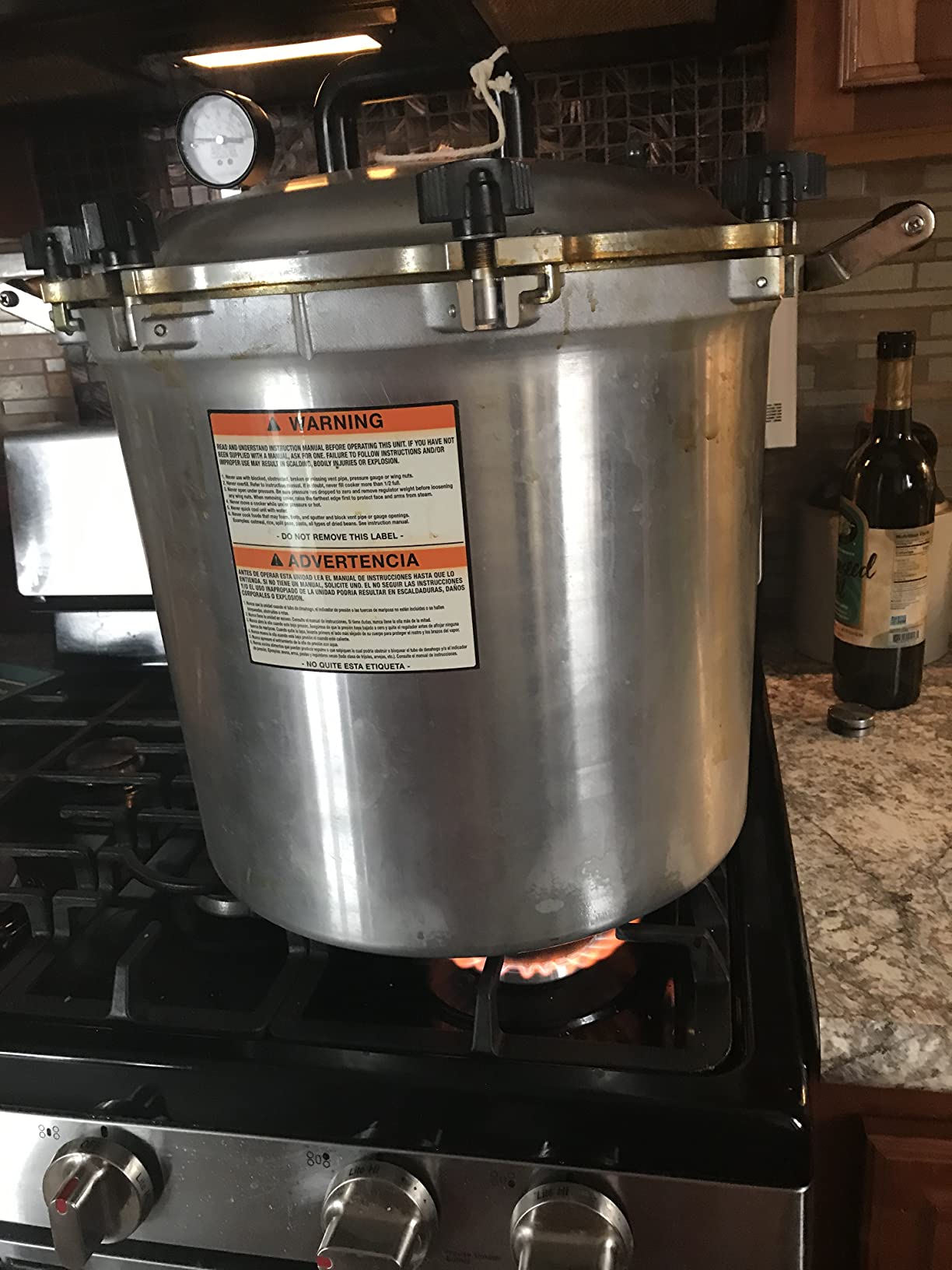
The second point is the one experienced canners bring up first. The recurring line in the forums is that the All American models are the best because they use no seal, which means nothing to replace, sterilize or lose in a storage cabinet. It also means the lid is quieter and more repeatable from season to season.
Owners running serious produce volumes describe the jump from 7-quart batches to a 19-quart batch as the single change that made canning practical. The cost is a slower ramp: the body is 33 pounds empty and measures 15.25 by 15.25 inches with a 19-inch height, so you fill and drain it where it sits.
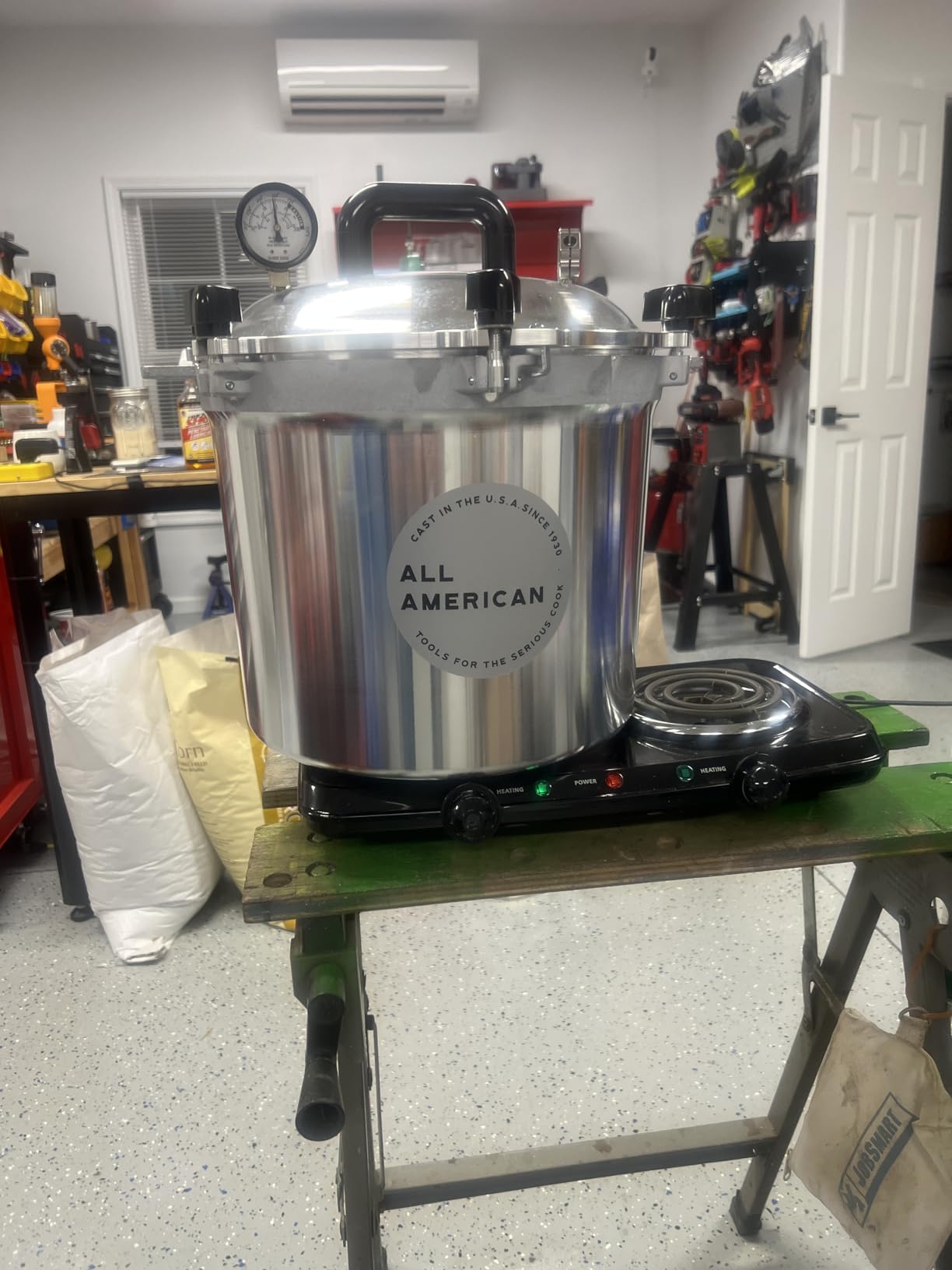
Pressure is controlled by a machined regulator weight that jiggles, and the steam gauge is there for reference rather than control. That is the arrangement a r/Canning commenter described when they noted that 10 PSI is what pressure canning actually requires and that a dial reading is the more reassuring option at altitude.
Because the regulator is weighted rather than dialled, there is no annual calibration appointment. For a household that puts up food every week of the season, that removes one recurring task from the calendar.
Who this canner suits
Anyone who wants the most jars finished per stove hour. Owners who process 50 or more pounds of produce a year, can families that do meat and stock as well as vegetables, and anyone who would rather buy one vessel and stop thinking about it will get the most out of it.
It also rewards the multi-generational buyer. Owners on the forums talk about canners being handed down, and parts, gauges and locking knobs are shared with the smaller All American models.
Who should look elsewhere
Do not buy this if your kitchen cannot give up burner space and overhead clearance, or if lifting 33 pounds of hot pot is not something you can manage. The trade-off versus a 23-quart aluminum canner is real: you trade weight and heat-up time for triple the capacity.
Skip it for acid-heavy cooking as well. The aluminum body reacts with vinegar and tomato-heavy simmering, and this is a canning vessel rather than a general-purpose stockpot.
2. Universal 53-Quart Pressure Cooker – the biggest pot in the group
Universal (Extra Large) 53-Quart Aluminum Pressure Cooker for Professional Use – Commercial-Grade, 2 Safety Valves, Reinforced Handles, Easy-Open Lid, – Ideal for Large Kitchens, and Restaurants
53-quart capacity
2 safety valves and 2 regulators
5.8 PSI working pressure
26.5 lb empty weight
Pros
- Largest capacity in the roundup at 53 quarts
- Dual safety valves and dual regulators for heavy duty
- Reinforced burn-resistant handles and a sturdy lid knob
- Works on gas electric and glass-ceramic cooktops
Cons
- The maker states it is not suited to a typical home kitchen
- Food cooks in direct contact with the pot rather than in jars
- Several owners report the lid closure cracking in early use
Nothing else here is this large. At 53 quarts with a 23.5-inch tall body, this is the pot you would use for a community kitchen, a catering run or a batch of stock for a hundred people rather than a household garden.
We rate it 4.1 across 143 reviews, and the reviews split neatly by use case. Commercial buyers describe steady performance across many cycles, while a cluster of one-star reviews objects that this is a pressure cooker rather than a canning vessel and reports the lid closure breaking.
There is a safety distinction buried in that split, and it is the reason this sits below the others. Food cooks in direct contact with the aluminum pot, not inside mason jars, and the regulator holds a working pressure of 5.8 PSI. USDA pressure canning guidance is built around 10 or 15 PSI with jars on a rack.
At 26.5 pounds empty it is far lighter than the 41.5-quart cast-aluminum canner despite holding more liquid, which is simply a difference in construction. The body is aluminum rather than cast aluminum.
Two safety valves and two regulator valves give a lot of redundancy for high-volume work, and the reinforced handles are genuinely built for repeated heavy lifting. For anyone running a commercial kitchen line that needs capacity more than certified canning accuracy, that redundancy is the selling point.
The working pressure figure is worth pausing on before you commit. It is lower than the range the USDA prescribes for low-acid canning, so this is a bulk cooking vessel in our book rather than a large-batch pressure canner.
Who this cooker suits
Restaurants, community kitchens and large gatherings that need to cook a serious volume of beans, stock or meat in one pot. The capacity-per-pound ratio is the strongest in the roundup, and the redundant valves make sense in a setting with trained staff.
It also suits anyone who wants a very large pot without moving up to a commercial stainless line, provided the burner and the ventilation can handle the footprint.
Who should look elsewhere
Home canners who want to put low-acid vegetables, meat or stock into jars should not treat this as a canner. The 5.8 PSI working pressure, the direct-contact cooking and the manufacturer’s own note that it is not for typical home kitchens all point the same direction.
Owners also report cracking at the closure point in early use, and 15% of its ratings are one star, which is the largest negative share in this roundup. If you want a large-batch pressure canner, buy one of the certified units instead.
3. Presto 01781 (23 qt) – the best value workhorse
Presto 01781 23-Quart Pressure Canner and Cooker
23 qt capacity
7 quarts or 20 pints or 26 half-pints
Dial gauge and 15 lb regulator
12 lb empty
Pros
- Holds 7 quart jars or 20 pints or 26 half-pints
- Dial gauge plus weighted regulator gives reading and signal
- Warp-resistant heavy-gauge aluminum heats evenly
- 12-year limited warranty and a 76-page recipe book
Cons
- Includes a single 15 lb regulator so 5 and 10 lb weights cost extra
- A second canning rack is needed to stack pints and half-pints
- Not induction compatible
With 20113 reviews at 4.8 stars, this is the most established pressure canner in the roundup by a wide margin, and owners repeatedly name a 20-pint load or 7 quarts in one run as the practical sweet spot for large-batch work.
It is also the canner most often recommended to first-time buyers. Forum regulars describe it as great and much less expensive than the metal-seal alternatives, and as a natural teaching canner because the dial gives a number to point at.
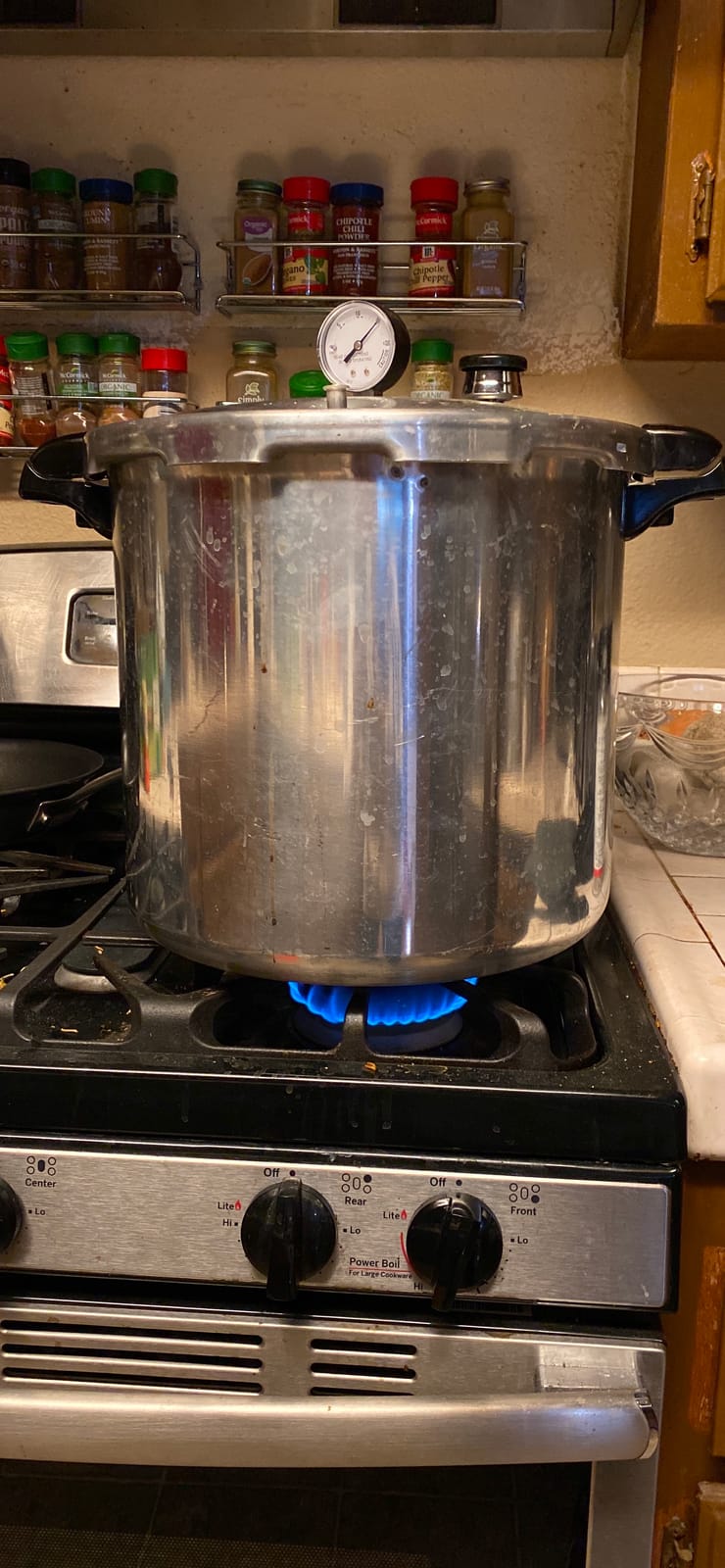
The gauge is a genuine asset above 1,000 feet. Higher elevation means water boils at a lower temperature, and a dial reading gives you a visible confirmation of what the weighted regulator is doing, which matters when you live anywhere with hills.
At 12 pounds empty it is the lightest of the 23-quart units here, and the 12-year limited warranty is longer than almost anything else in the category. The included 76-page manual doubles as a recipe and canning guide.
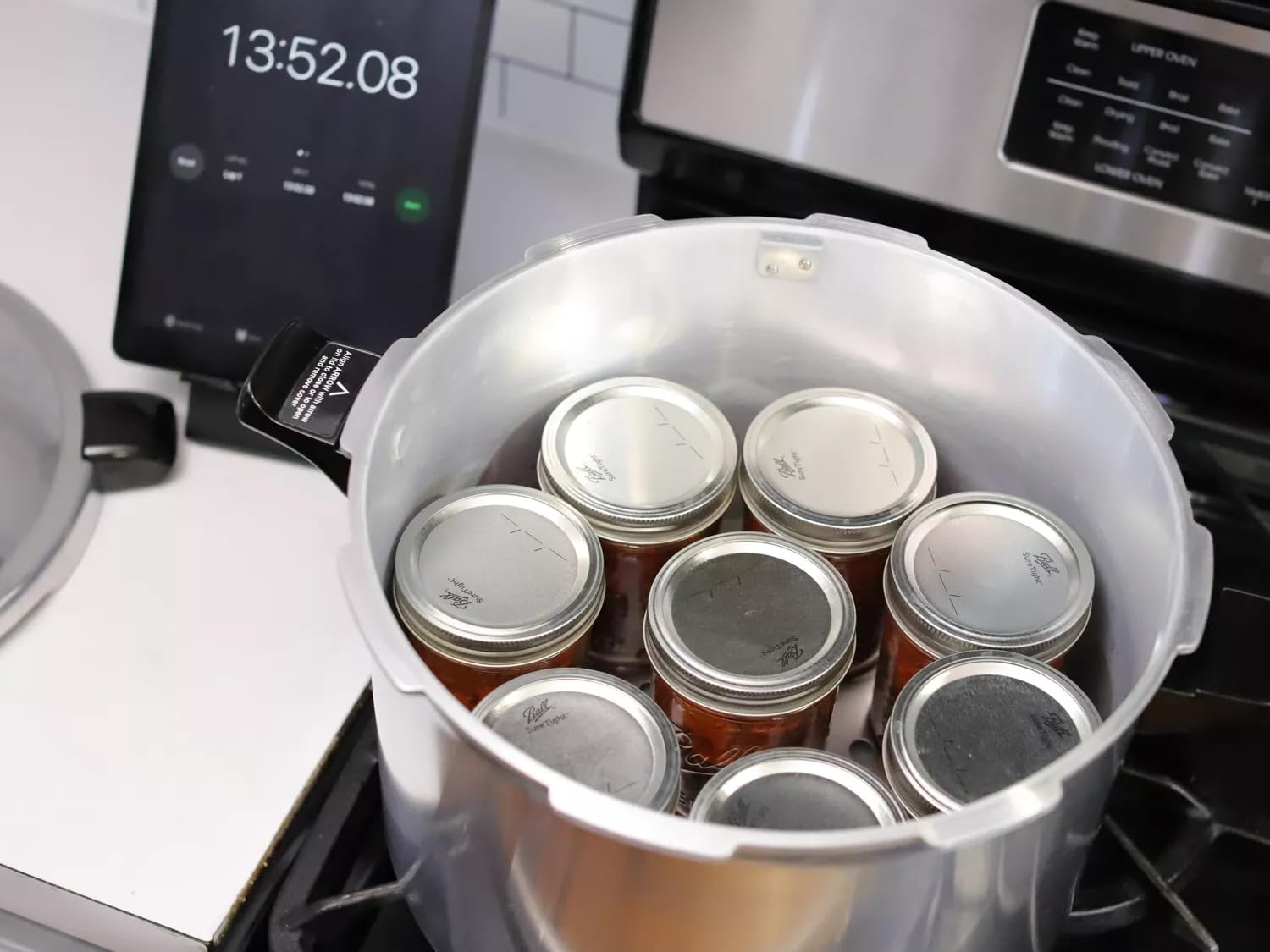
Owners’ most common upgrade note is consistent: add the 5 and 10 pound regulator weights and a second canning rack. Out of the box this holds 7 quart jars on one rack, and the second rack is what unlocks 20 pints or 26 half-pints.
A verified buyer describes the benefit plainly, saying the extra rack lets you double stack your jars and process double the pints and half-pint jars for bigger projects. That single accessory is the difference between a good large-batch canner and a great one.
Who this canner suits
Households putting up 30 to 100 jars a season who want the strongest review base in the category. It handles a full garden harvest, a five-gallon bucket of tomatoes and low-acid vegetables with room for a genuine second layer of small jars.
It also suits anyone who needs one vessel for two jobs, since it doubles as a boiling-water canner for fruits, jams, pickles and salsa as well as a pressure canner and a large pressure cooker.
Who should look elsewhere
Do not buy it on an induction cooktop. The plain heavy-gauge aluminum base will not work, and a bare aluminum bottom is exactly what glass-ceramic owners report scratching. Choose the 01784 instead if your kitchen is induction.
Buyers who want zero gasket maintenance should also weigh the alternative. This pot uses a rubber sealing ring that needs annual inspection and eventual replacement, unlike the metal-seal cast-aluminum units.
4. Presto 01784 (23 qt) – the best induction-compatible full-size canner
Presto 01784 23-Quart Induction Compatible Pressure Canner
23 qt capacity
Stainless steel-clad induction base
Air vent and cover lock
12.5 lb empty weight
Pros
- The full-size consumer canner owners report finding for induction
- Stainless-clad base heats more evenly than plain aluminum
- Matching arrows make the lid lock simple and reliable
- Still handles 7 quarts or 20 pints or 26 half-pints
Cons
- Includes only a 15 lb regulator so 5 and 10 lb settings cost extra
- One rack included which limits stacking of smaller jars
- Aluminum body reacts with acidic foods
Everything that made the 01781 a strong large-batch pick carries over here, with one decisive change: a stainless steel-clad base that works on gas, electric, glass-ceramic and induction cooktops.
Owners who switched to induction describe this as the only full-size canner they were able to find, and several note that the clad base spreads heat more evenly than the plain-aluminum version. That matters at batch sizes of 7 quarts, where hot spots show up as uneven processing.
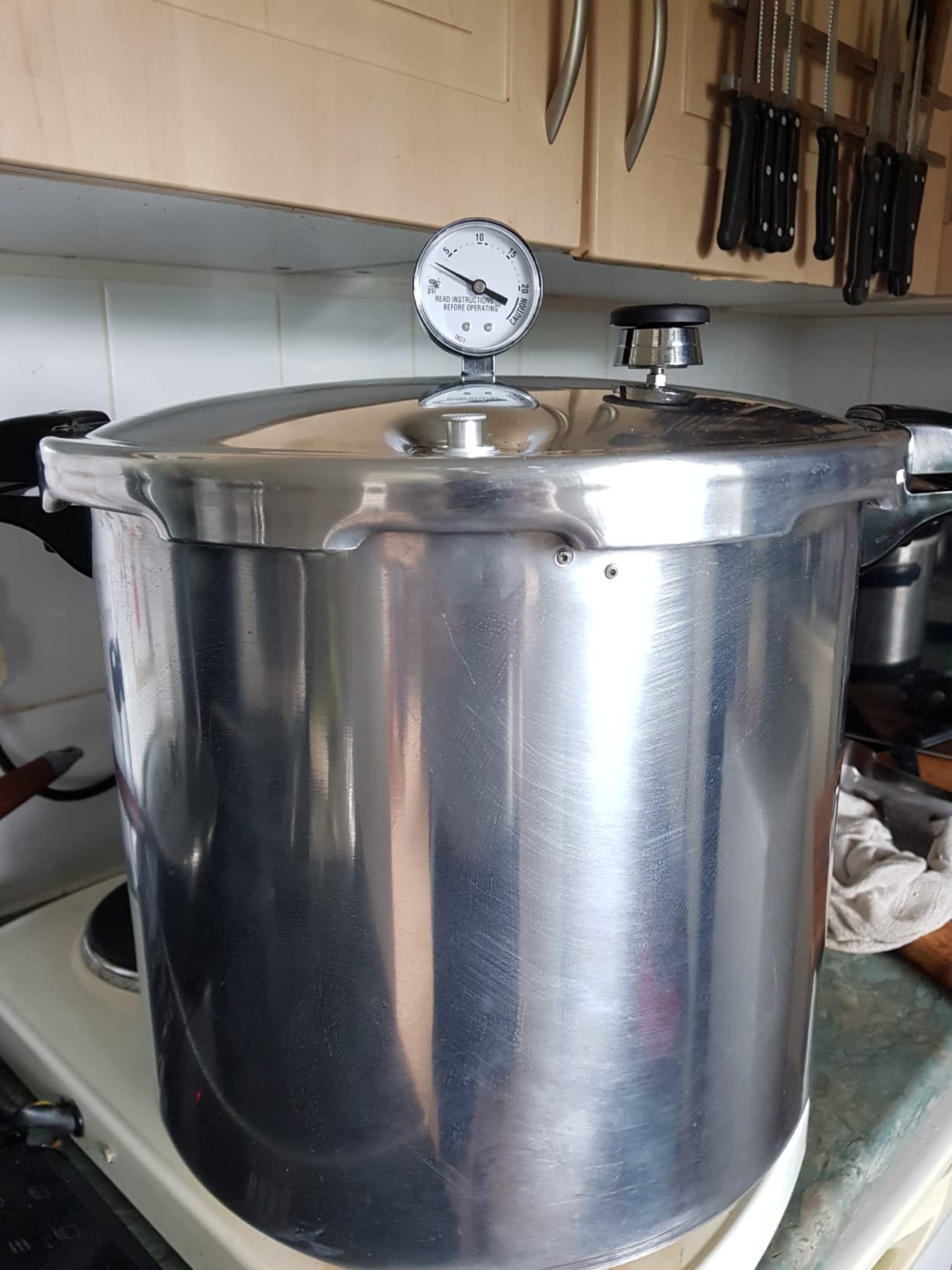
The air vent and cover lock is a safety feature worth understanding. It blocks pressure from building until the lid is correctly aligned, and it will not let the cover open until pressure has dropped, which removes two of the most common beginner mistakes.
Capacity is identical to the 01781 at 7 quart jars, 20 pints or 26 half-pints, so nothing is traded away for the induction base. It weighs 12.5 pounds empty and carries the same 12-year limited warranty.
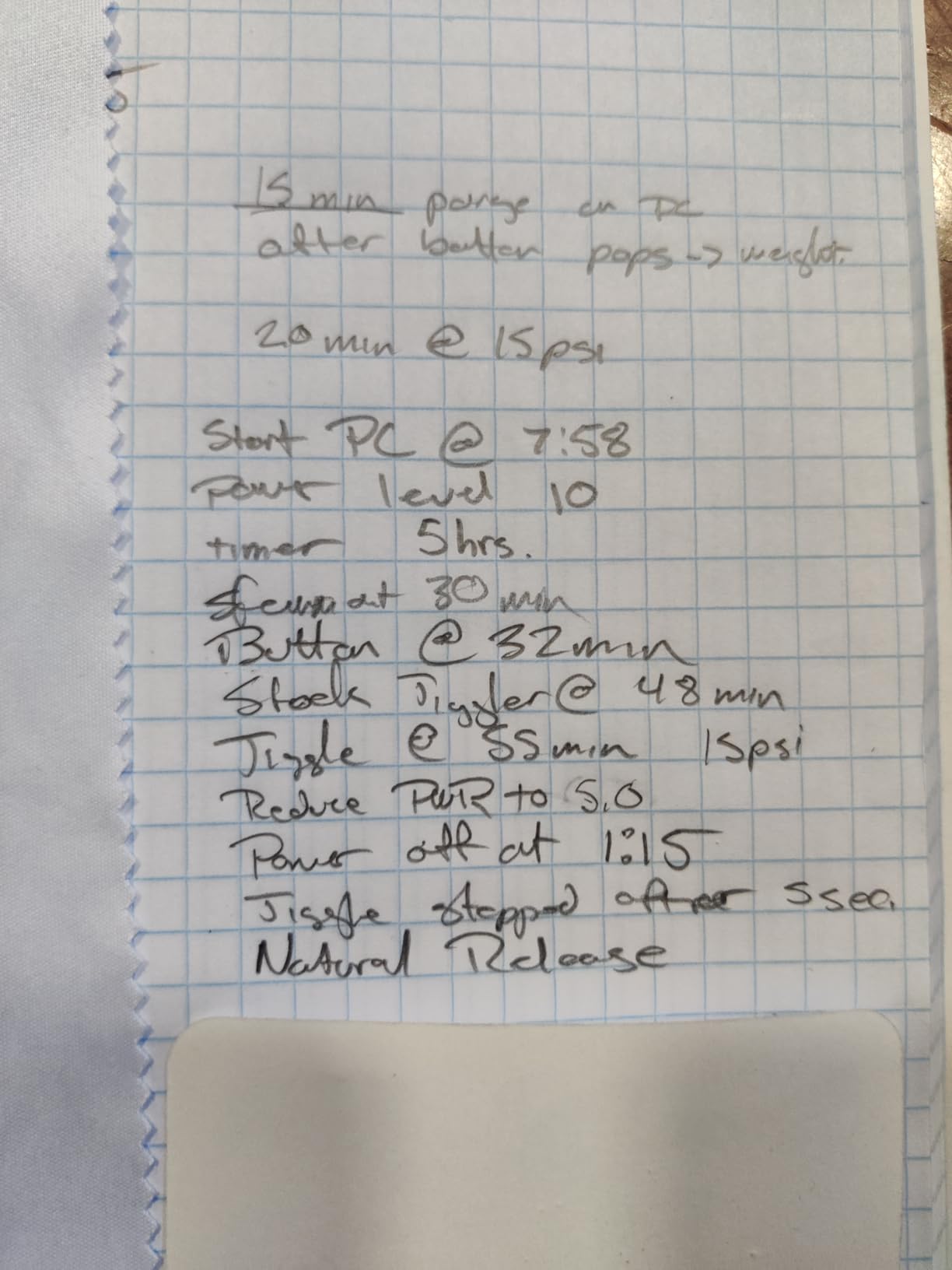
The most repeated caveat in reviews is the accessory list. The unit includes a 15 pound weighted regulator and a precise pressure gauge, but the 5 and 10 pound weights and a second rack are separate purchases, and a lot of buyers buy them at the same time.
One practical note for induction owners: even with a clad base, resting a heavy pot on a glass-ceramic surface is worth doing on a heat diffuser mat if you want to protect the glass over a decade of use.
Who this canner suits
Induction households processing more than about 30 jars a season, and anyone on glass-ceramic who wants a large-batch pressure canner without the scratch risk of a bare aluminum base. The same second-rack math applies, so budget for it on day one.
It also suits people who like having both a dial reference and a weighted regulator in the same pot, which is useful if you move between lowland and high-altitude recipes.
Who should look elsewhere
If gasket-free sealing matters to you, this is still a rubber-gasket pot. The All American units are the ones that remove that maintenance item entirely, at a much higher purchase cost.
Owners also report this specific model is harder to track down than the standard 01781 at the major retailers, and the aluminum body still reacts with acidic foods, so keep it on canning duty rather than vinegar work.
5. WantJoin 23 Qt – the best budget 23-quart unit
Wantjoin Aluminum Pressure Cooker 23Qt Pressure Canner, Pressure Pot with Pressure Control for Home Kitchen or Restraurant, Commercial Pressure Cooker with Gauge
23 qt capacity
Composite base for gas and induction
6 listed safety protections
13.3 lb empty weight
Pros
- 23-quart capacity at the entry cost of this roundup
- Six listed safety protections including an alarm valve
- Thickened composite base works on gas and induction
- Uncoated food-grade aluminum surface resists scratching
Cons
- Marketed as a pressure cooker rather than a canning-focused vessel
- Guidance is thinner than the dedicated canners here
- Aluminum is damaged by vinegar and other acid foods
The appeal here is straightforward arithmetic. This is the most affordable route to a 23-quart body and an induction-capable base in a home kitchen, and at 4.3 stars across 777 reviews it holds up better than the tier would suggest.
Owners point to the induction-capable thickened composite base and the six-protection suite, which includes an automatic lock, check valve, pressure limiting valve, safety valve, alarm valve and an anti-blocking cover. That is an unusually long feature list for the tier.
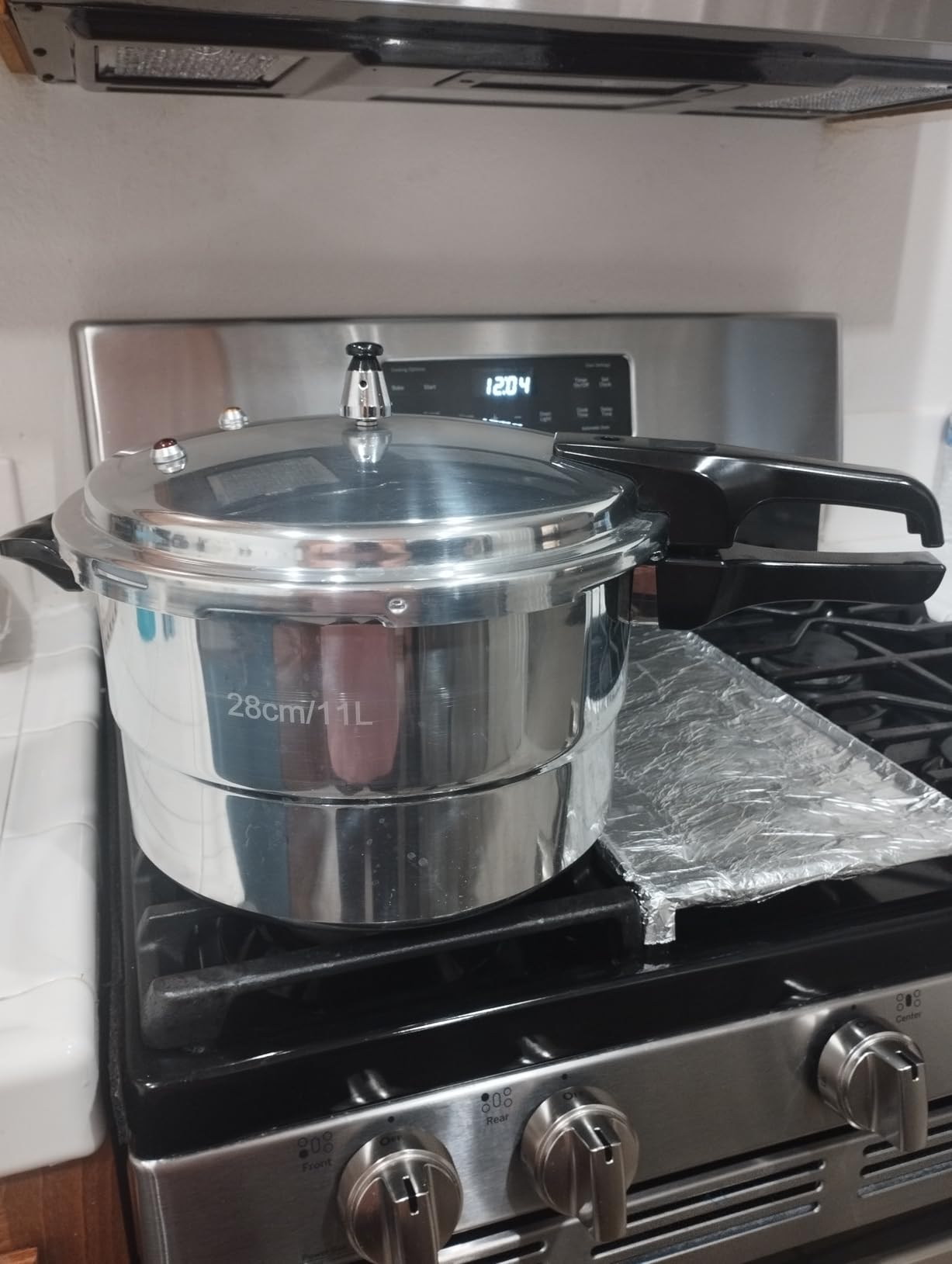
At 13.3 pounds empty it sits between the Presto and the cast-aluminum units, and the 14.1 by 18.9 inch footprint fits most kitchen ranges without dedicated space.
The honest limitation is documentation. Owners report that the guidance included is thin compared with the Presto and All American units, and a storage bag is included rather than a full canning manual. Learning the process means following a separate USDA or NCHFP reference.
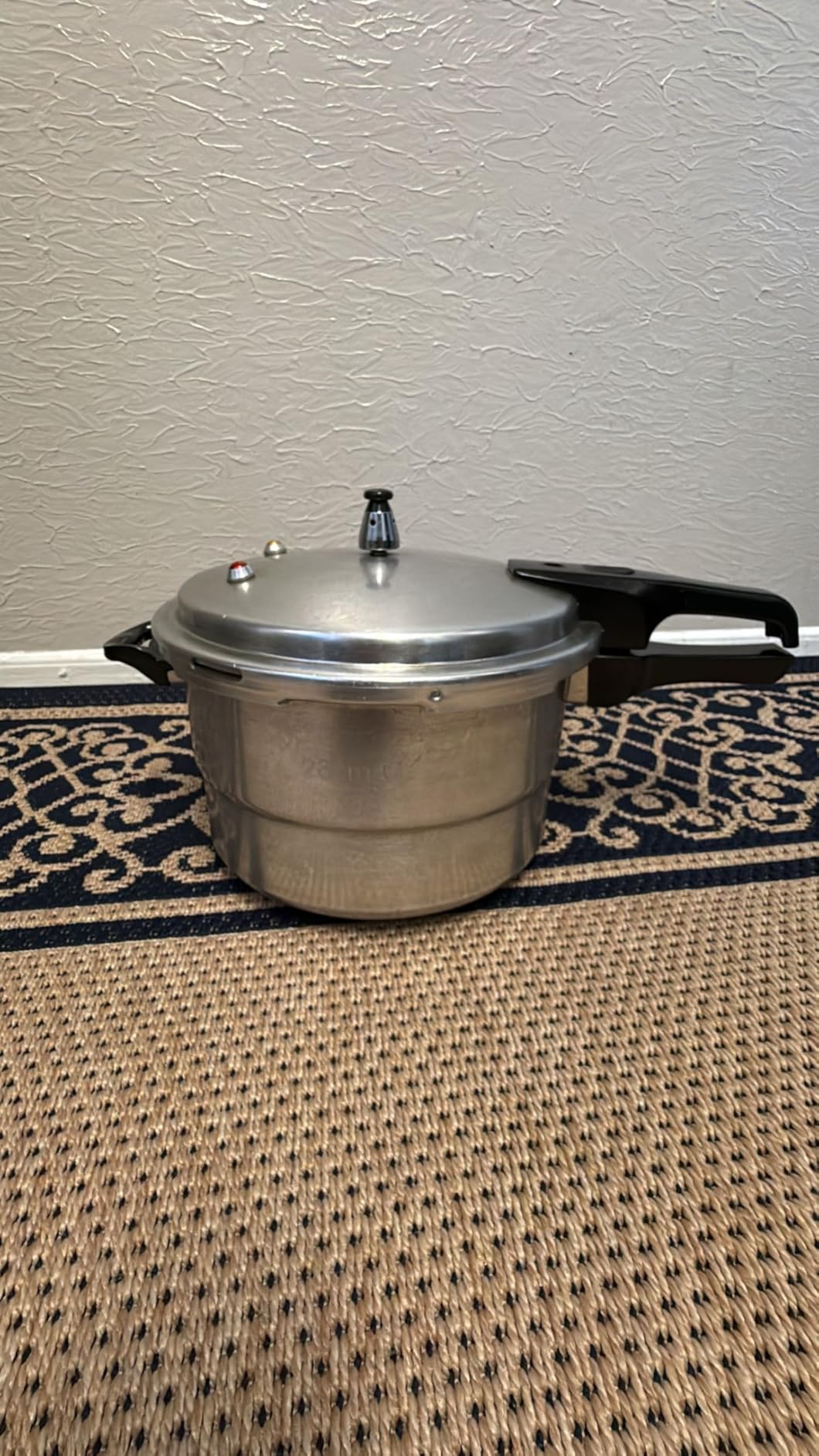
The weaker 9% one-star share reflects two recurring complaints: lid hardware such as the knob and locking parts needing frequent reseating, and the gap between being sold as a canner and being described as a pressure pot. At 71% five-star it sits below the leaders but well inside a normal range.
We would treat this as the right choice for someone who wants capacity first and is already comfortable running a canning process safely. It is a weaker pick for a first-time canner who needs a manual in the box.
Who this cooker suits
Budget-conscious households that want one 23-quart pot for both pressure cooking and canning, and induction households who want a large body without paying for the Presto clad base. The uncoated surface is also scratch resistant, which is friendly to glass tops.
It works well as a secondary pot, since many owners pair a large unit with a smaller one for shoulder-season work rather than putting everything into a single vessel.
Who should look elsewhere
New canners should pick a model with a real canning guide and clear PSI markings in the box. Learning low-acid processing without in-box instructions is a poor trade for what you saved.
If you plan to can every week through a season, the recurring lid-hardware complaints are likely to matter more to you than they do to an occasional user. The cast-aluminum and long-warranty options age better.
6. Presto 02153 (23 qt digital) – the best electric pressure canner
Presto 02153 23-Quart Digital Pressure Canner
23 qt capacity
Up to 7 quart jars
Sensor-driven automatic control
16.1 lb empty weight
Pros
- Automates pressure timing and cool-down so the pot is not babysat
- Audible beeps that carry from another room
- Does pressure canning and boiling-water canning in one appliance
- Automatic altitude adjustment removes manual corrections
Cons
- Only one rack is included so jars cannot be stacked out of the box
- Settings and times cannot be changed once a cycle starts
- Cool-down runs long and jars must not be removed hot
This is the newest unit here, a recent release at 4.5 stars across 276 reviews, and it is the only true electric pressure canner in the group. That distinction matters more than the star average for anyone without a stovetop.
Sensor-driven control holds processing temperature automatically, so there is no burner to babysit and no manual altitude correction. The LED display walks you through each step, and it runs a full automatic cool-down cycle rather than making you guess when to open the lid.
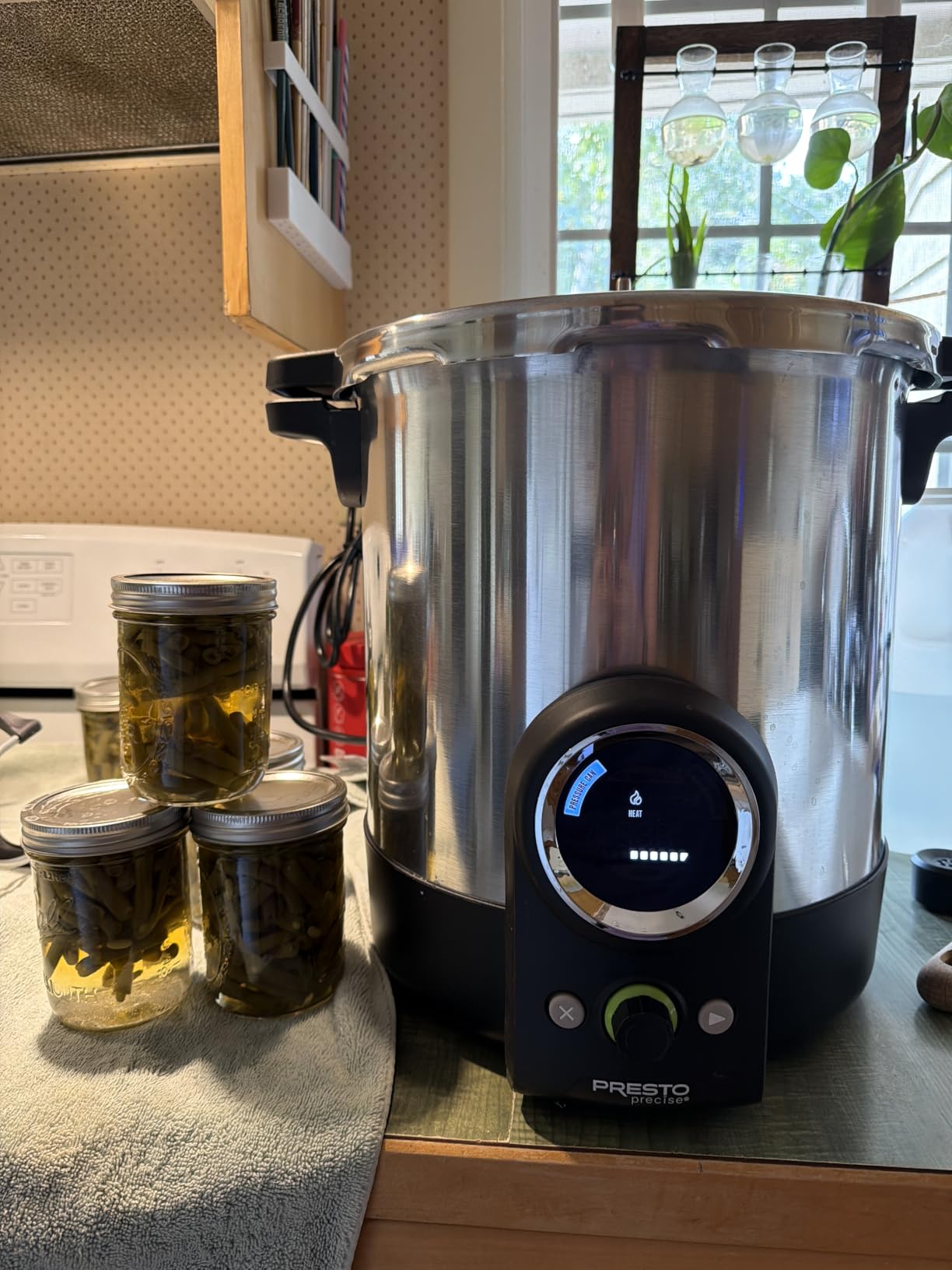
Owners who came from stovetop canning describe the controls as removing the guesswork, and several note that it replaced two manual canners in their setup. It handles up to 7 quart jars, or two stacked layers of pint jars if you buy the second rack.
It also does boiling-water canning, so a household that puts up jam and salsa alongside vegetables and meat gets both methods in one appliance. The metal-to-metal closure is described as very safe by long-time Presto owners.
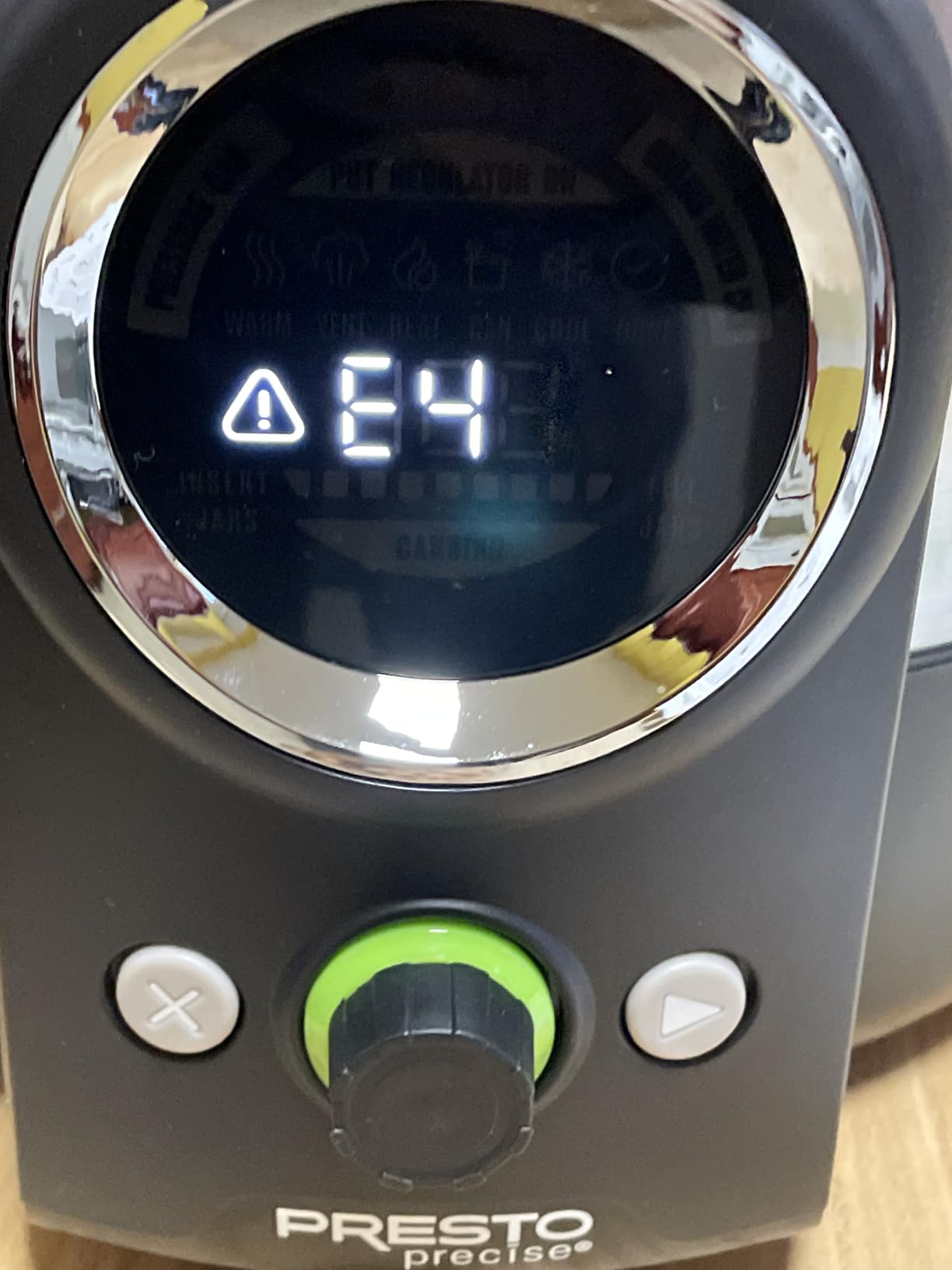
The reported drawbacks are mostly interface friction rather than performance. Settings and times cannot be adjusted once a cycle has started, the jar-warming step is awkward to skip, and cool-down takes a while, with jars needing to stay in place until the process finishes.
One outlier review reports a slow time-to-pressure cycle and a scorched batch. With 276 reviews the sample is still small, so we would treat that as a single data point rather than a pattern.
Who this canner suits
Households without a gas range, older canners, and anyone with mobility limits who should not lift a hot pot off a burner. The hands-free processing and audible alerts make it practical to start a load and step away.
It also suits people living at altitude, since the automatic altitude adjustment removes the correction a weighted or dialled stovetop canner would need.
Who should look elsewhere
Do not expect it to beat a 41.5-quart cast-aluminum canner on throughput. Seven quart jars is the ceiling, so large-batch means more loads rather than bigger loads, and at 16.1 pounds it is not a lightweight machine to move around.
Buyers who like to improvise will also find the non-adjustable cycles frustrating. Recipe timing is set by the program, not by you.
7. Granite Ware 20-Quart – the best lightweight large-batch canner
Granite Ware Pressure Canner/Cooker/Steamer, 20-Quart
20 qt capacity
3 regulators at 5 10 and 15 PSI
Hard anodized aluminum
10.5 lb empty weight
Pros
- Hard anodized surface resists rust and staining over long use
- Three calibrated regulator weights included for different foods
- One pot covers pressure canning water-bath canning cooking and steaming
- Lightest large-batch unit here at 10.5 pounds
Cons
- 20 quarts is the smallest jar load among the large models compared
- Anodized interior darkens with repeated high-heat use
- No dial gauge so pressure is judged by weight and steam
At 10.5 pounds empty this is the lightest canner in the roundup, and for anyone who lifts their pot out of a cabinet rather than filling it where it stands, that is not a minor detail.
It rates 4.6 across 801 reviews, and the recurring praise is for the adjustable three-weight regulator system at 5, 10 and 15 PSI plus a surface that resists staining. All three weights are included, which removes the accessory hunting that adds friction elsewhere in the category.
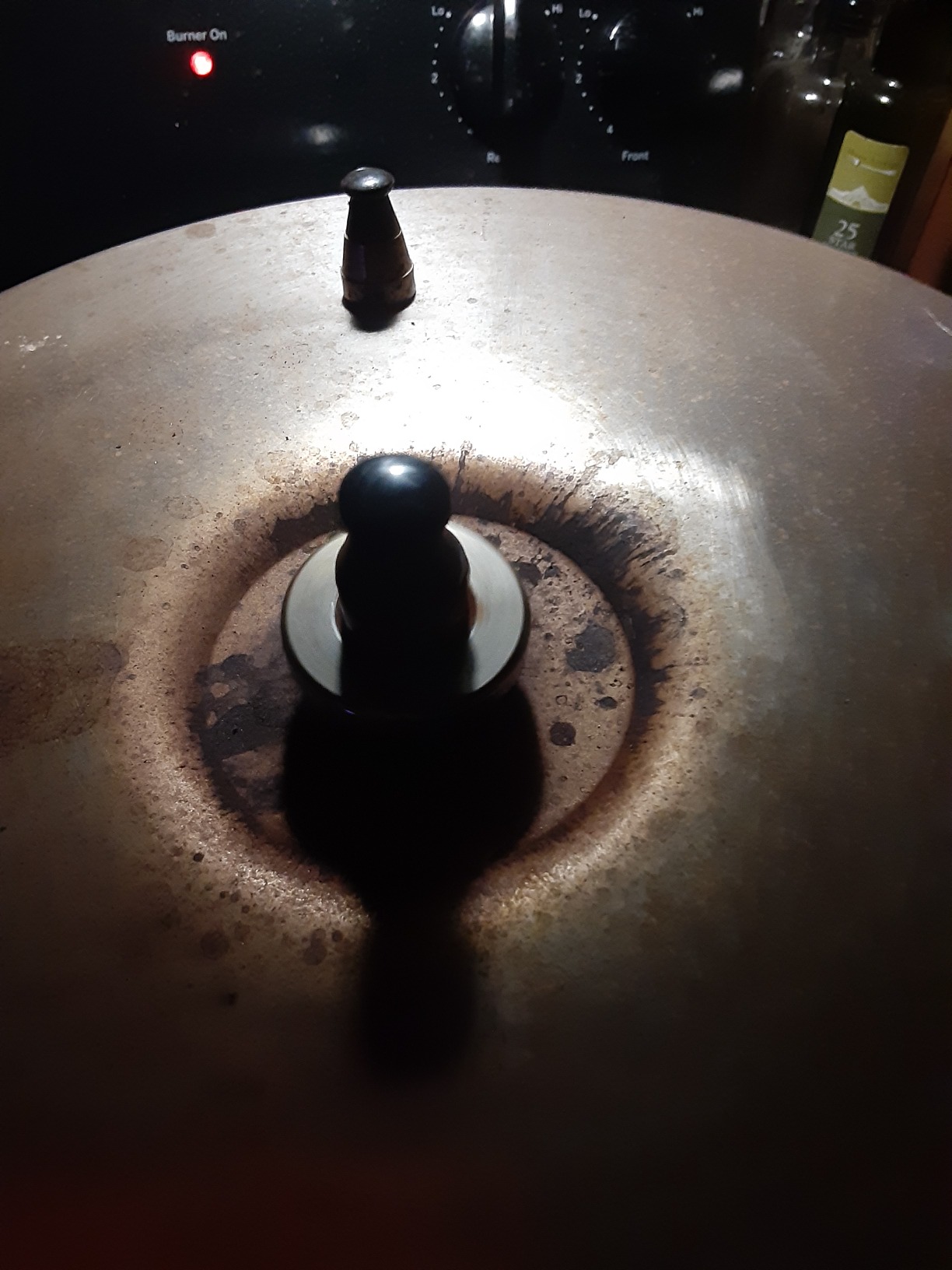
One pot covers a lot of ground. It works as a pressure canner for meats, poultry and low-acid vegetables, as a boiling-water canner for high-acid foods, and as a steamer or large pressure cooker on an ordinary weeknight.
There is no dial gauge, so pressure is judged by the weight and the visible steam behaviour. That is a deliberate trade: fewer parts to maintain and no annual calibration, but no numeric reading when you want one.
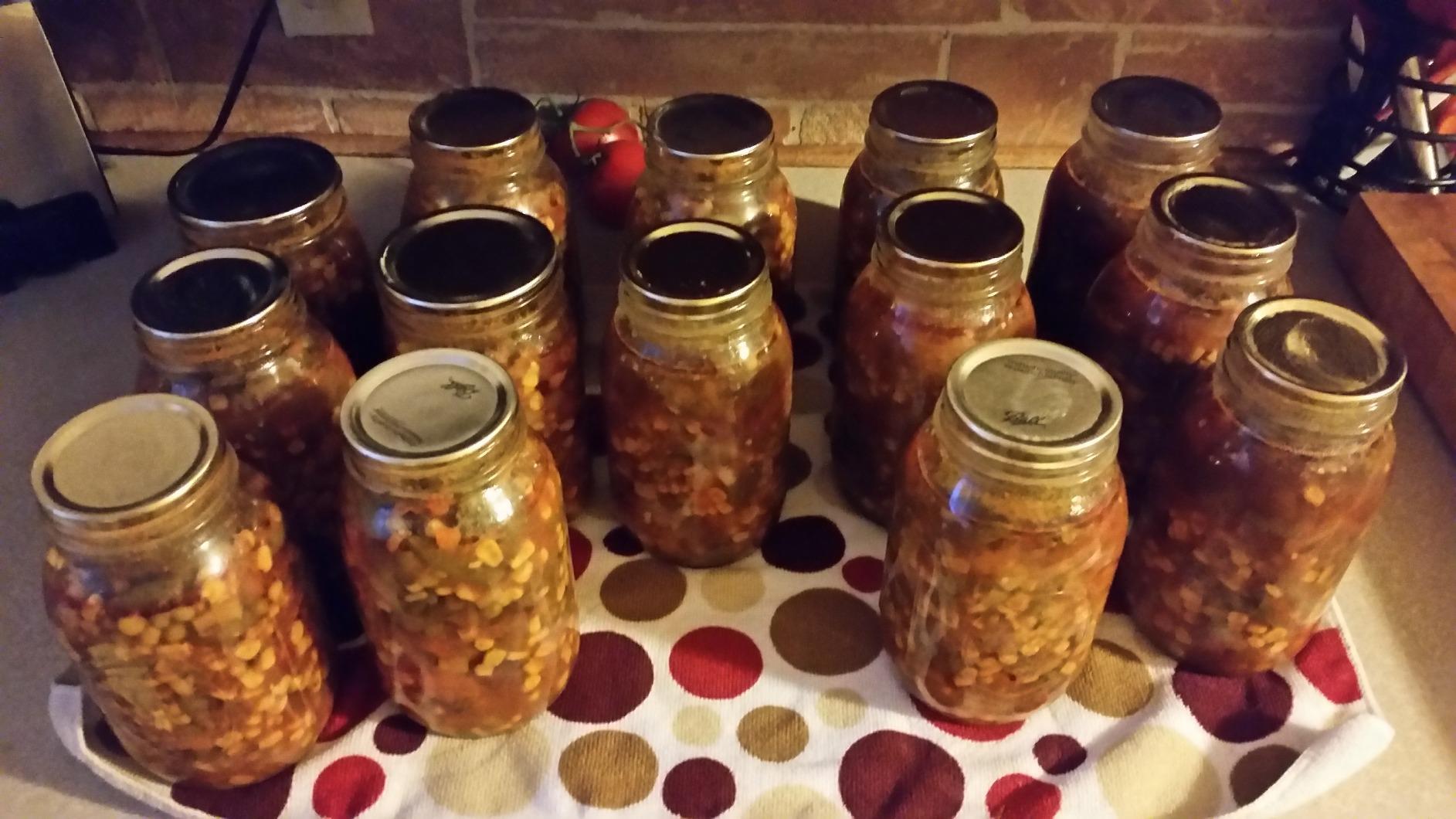
The honest drawback is throughput. Twenty quarts is the smallest jar load among the large-batch units we compared, and buyers who want big batches note it directly. For a 23-quart or 41.5-quart workload, you are running more loads.
The anodized interior will also darken over repeated high-heat use. It does not affect sealing, but it changes the appearance, and some owners read it as damage when it is simply the surface doing its job.
Who this canner suits
Older canners, smaller households and anyone with a back or shoulder who needs a lighter pot. The included 5, 10 and 15 PSI weights mean you can follow any USDA or NCHFP recipe without hunting for parts.
It is also a good second canner. Many owners keep a small unit for weekend batches and a large one for peak harvest, and this fills the shoulder-season role nicely.
Who should look elsewhere
If your harvest genuinely fills more than about six or seven quart jars at a time, capacity will work against you. You will do more heat-up and cool-down cycles for the same total output.
Skip it if you need a pressure reading. Without a dial, there is no way to confirm the gauge reading at altitude, and the aluminum body is not induction compatible either.
8. MIRRO 22 Qt – the best pick for stacking jars
MIRRO 22 Qt Aluminum Pressure Canner with 3 Regulators, 5, 10 & 15 PSI
22 qt capacity
3 regulators at 5 10 and 15 PSI
Two racks included
13.7 lb empty weight
Pros
- Two racks included so pints and half-pints stack immediately
- Three regulators let you match pressure to the food
- Holds heat steadily with little burner adjustment once at pressure
- Good seal results with very little siphoning reported on stocks
Cons
- The regulator must be pushed firmly onto the stem to seat
- The weight leaves a rust-colored stain around the steam vent
- The weight does not visibly dance the way some weighted gauges do
- Not rated for glass cooktops by several owners
The MIRRO is the canner in this roundup that comes with everything needed for a genuine double layer. Two racks come in the box, so pints and half-pints can be stacked from the first day rather than after a second purchase.
It holds a 4.5 rating across 741 reviews and is repeatedly described as the best value among weighted-gauge canners. Canners moving from a dial-gauge Presto tend to appreciate the hands-off jiggle operation, and seal results on stocks and broths are consistently clean with very little siphoning.
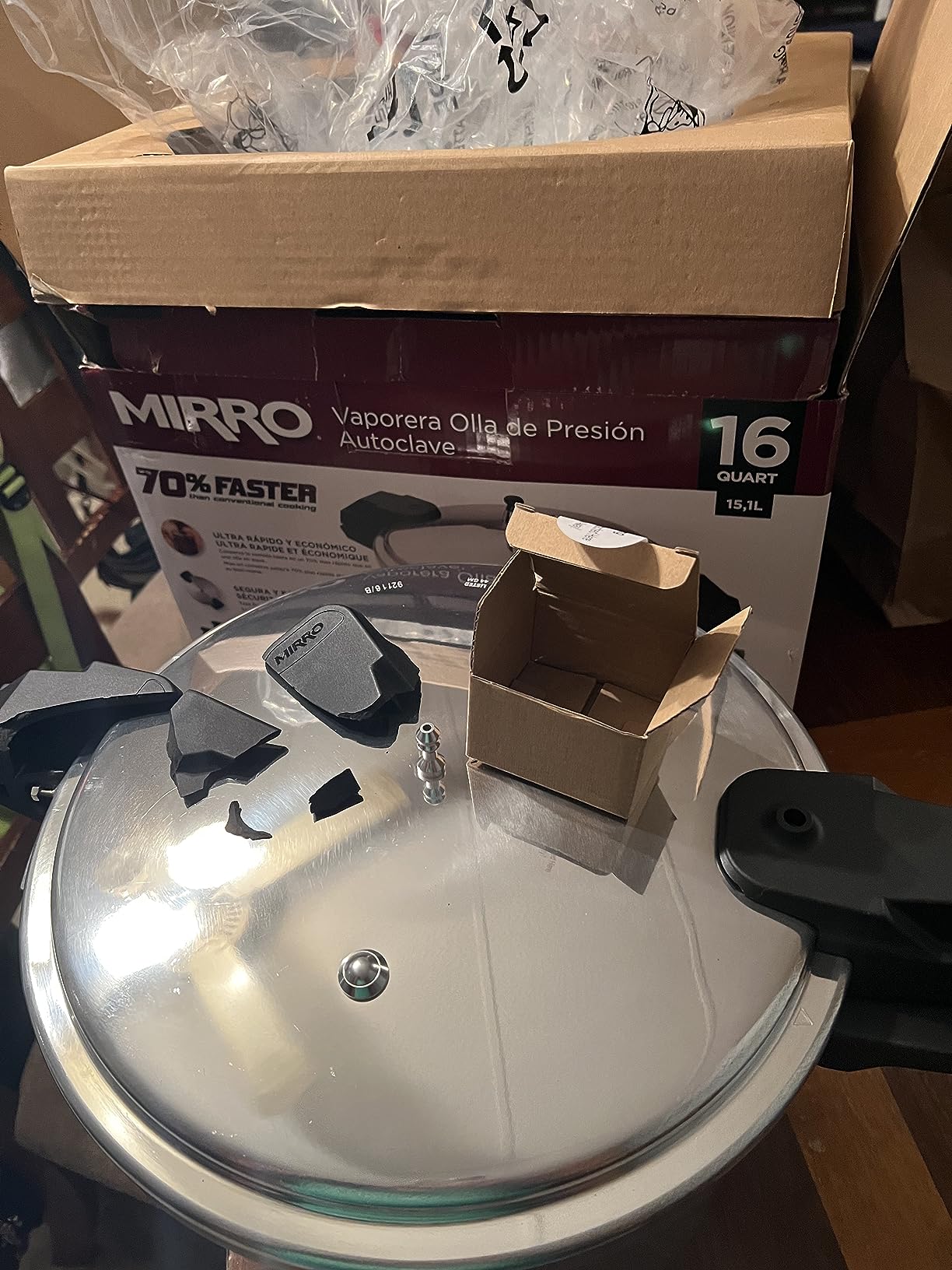
Three regulators covering 5, 10 and 15 PSI let you match pressure to the food rather than running everything at the highest setting. Owners also note it holds heat steadily once it reaches pressure, so burner attention drops sharply after the first ten minutes.
At 13.7 pounds empty it is manageable for a 22-quart aluminum pot, and dual cool-touch handles help when you are moving it on and off the burner.
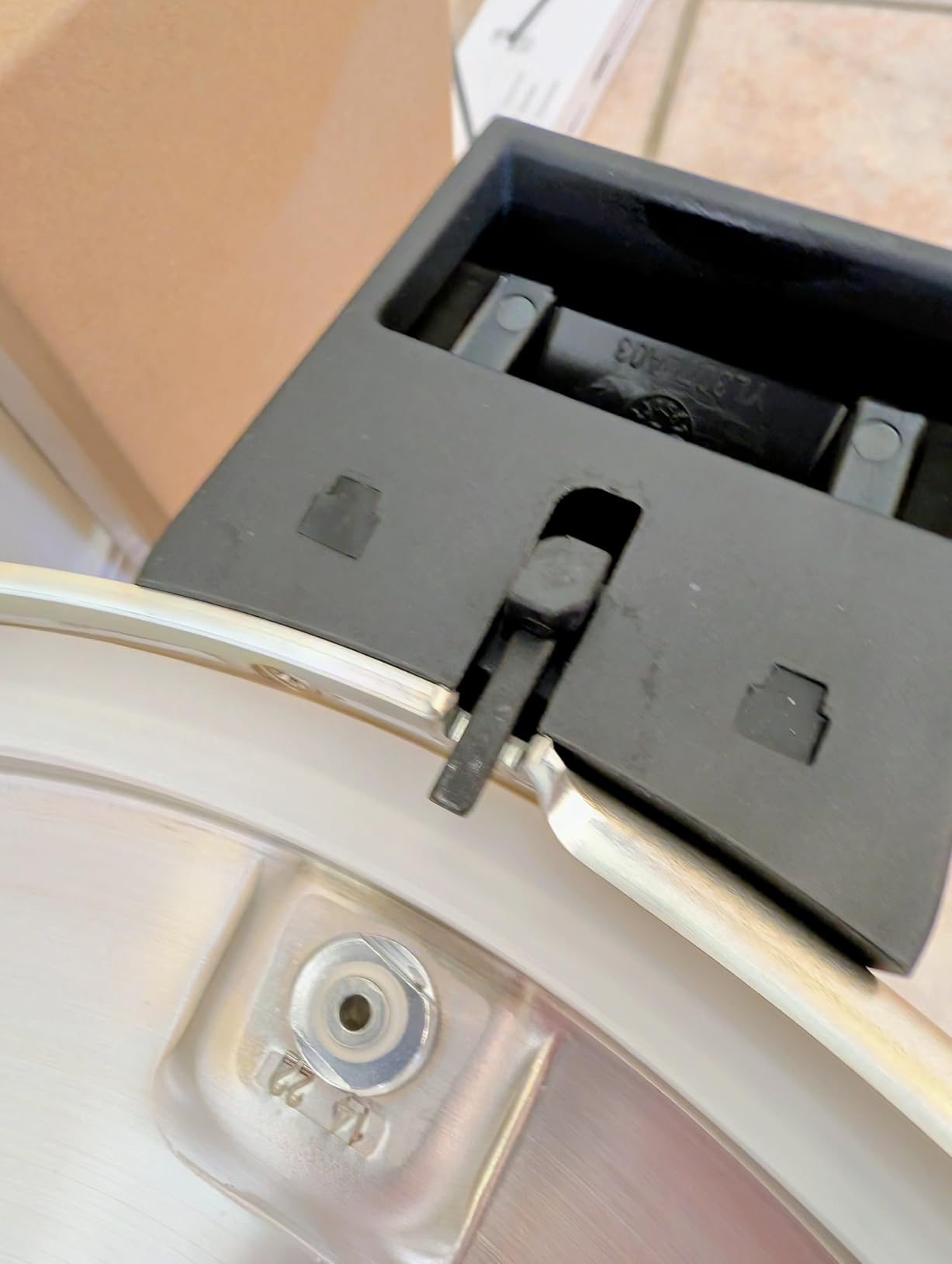
Two recurring nits are worth knowing before you order. The regulator has to be pushed firmly onto the stem until you hear two clicks, and the weight leaves a rust-coloured ring around the steam vent from first use that does not wash off.
Several owners also note that the weight does not visibly dance the way some weighted-gauge canners do. If you learn pressure control by watching the jiggle, that is a real adjustment period. On glass cooktops, owners report it is not rated, so use a heat diffuser or choose another model.
Who this canner suits
Anyone whose harvest produces mostly pints and half-pints rather than quarts, since the included second rack is where the value is. Two layers of small jars in one run is exactly what large-batch season means for a household that does jams, salsas and pickles alongside vegetables.
It also suits buyers who prefer weighted operation with all three pressure settings in the box and no dial to calibrate.
Who should look elsewhere
Buyers on glass-ceramic cooktops should look at the clad-base or hard-anodized options instead. Several MIRRO owners specifically warn against glass tops for this model.
If you want a numeric pressure reading for altitude work, the absence of a dial is a limitation. And if a visible jiggle matters to how you monitor a load, test that expectation early.
9. Hawkins Bigboy (22 L) – the best tall-pot format
Hawkins Bigboy Aluminum Pressure Cooker, 22 Litres
22 litre capacity
Tall cylindrical format holds 4 quart jars
4.06-4.88 mm thick base
21.3 lb empty weight
Pros
- Tall cylindrical shape fits 4 quart jars in a single load
- Reinforced fibreglass handles and a thick base read as built to last
- Inner lid geometry prevents the cover lifting on pressure release
- Marketed for 22 to 30 person servings and catering
Cons
- Hawkins states it does not manufacture a canner
- 1-star reviews make up 11% of the rating
- One reviewer measured the 15 lb weight venting at about 10 PSI
- Some buyers find the listed capacity smaller in practice
The Bigboy is the only unit here shaped like a stockpot rather than a wide canner, and that geometry is the whole story. The tall cylindrical body fits 4 quart jars in a single load, which is the USDA minimum, using vertical space instead of horizontal space.
It carries 4.2 stars across 1343 reviews with a 68% five-star share, and the reviews split by use case. Buyers using it as a large-batch pressure cooker praise the tall format, the 4.06 to 4.88 mm base and the reinforced fibreglass handles, while the critical reviews focus on certification.

That certification point is the one to read carefully. Hawkins states that it does not manufacture a canner, so this is not USDA canning equipment in the way the Presto, MIRRO, T-fal and All American units are. We include it because the large-batch pressure cooking case is real, not because it is a safe substitute for a certified canner.
The elliptical inner lid tucks under the pot lip so it cannot blow off on pressure release, and there is an extra safety valve fitted. The thick base spreads heat evenly across that tall column of liquid.
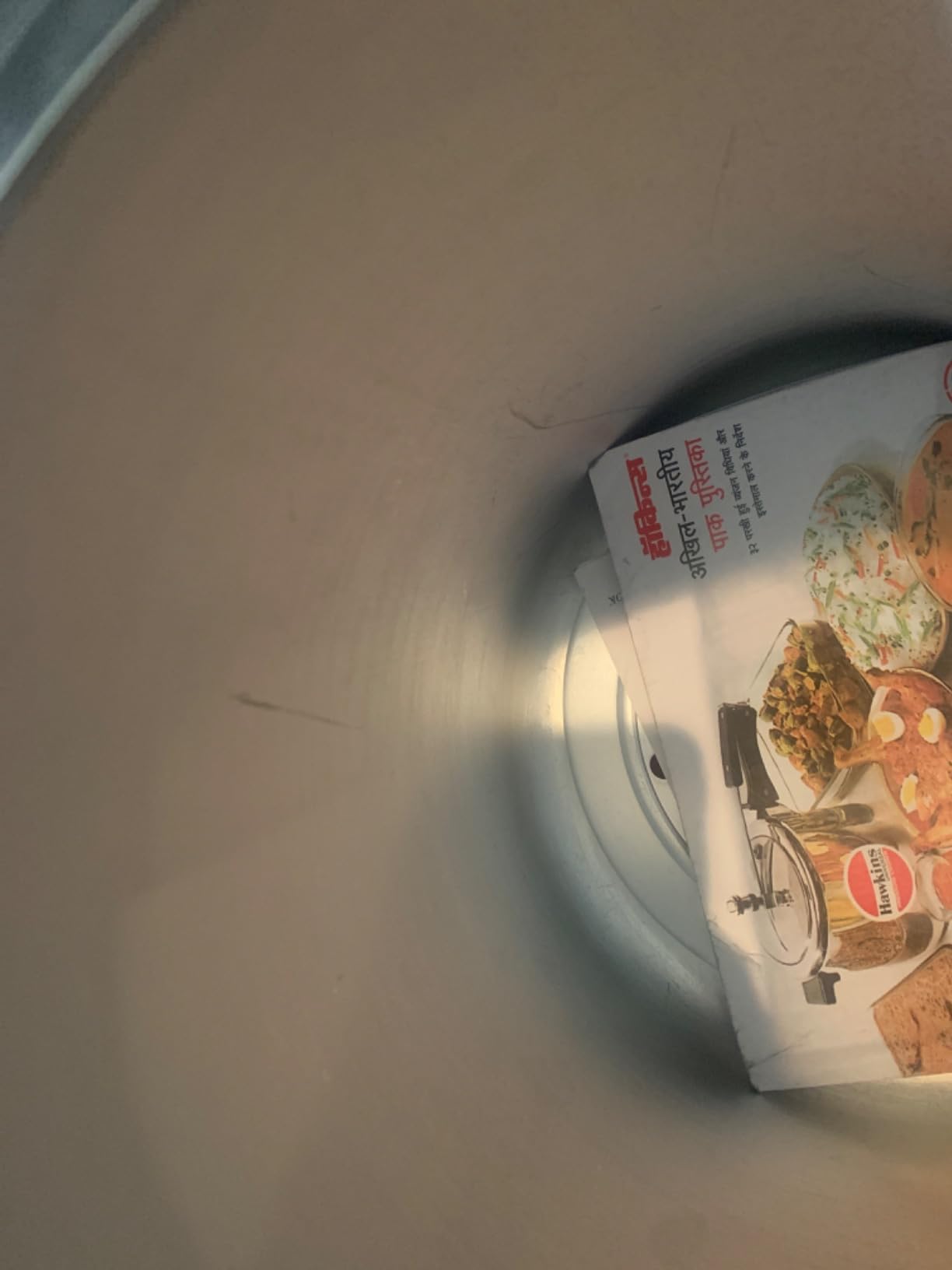
At 21.3 pounds empty it is heavier than most 22-quart pots but still light enough to move when unloaded, and the two lifting handles plus reinforced side handles make that manageable. It is marketed for 22 to 30 person servings, hotels, restaurants and caterers.
One detailed review reports measuring the 15 pound weight popping at roughly 10 PSI and venting heavily, alongside an unresponsive manufacturer. It is an isolated account, but with an 11% one-star share, the second-largest negative share in this roundup, treat the certification gap as the deciding factor rather than an afterthought.
Who this cooker suits
Large households and small food businesses that want to cook a big volume of beans, meat or stock in a single tall pot. The elliptical inner lid geometry and reinforced handles are genuinely well suited to repeated high-volume use.
It is also a good match for anyone whose kitchen has a tall cabinet gap but not a wide burner, since the footprint is narrower than the standard canner shape.
Who should look elsewhere
Anyone whose goal is putting low-acid food into jars should skip it. The manufacturer does not present it as canning equipment, and the pressure-reading criticism adds a second reason to look at a certified canner.
It is also not the choice if you need a dial reading, and at 21.3 pounds it is one of the heavier 22-quart options despite the tall format.
10. T-fal 22 Qt – the best pick for first-time canners
T-fal 22-Quart Aluminum Pressure Canner, 3 PSI Settings, Home Canning, Includes Racks & Canning Guide, Large Capacity, Pressure & Water Bath Canning for Vegetables, Meats, Seafood & Fruits, Silver
22 qt capacity
24 half-pints or 18 pints or 7 quarts
Three PSI settings with a gauge
Two racks included
Pros
- Two racks included so 24 half-pints or two layers stack at once
- Handles pressure canning and boiling-water canning in one pot
- Gauge plus three settings removes guesswork for beginners
- Consistently good seals with no jar failures reported
Cons
- Gasket can leak slightly at the handle and needs cleaning or reseating
- Some units auto-vent before reaching 15 PSI
- Indicator valve and gauge calibration reported inconsistently
- 16.26 inch height needs substantial burner clearance
The T-fal is the canner we would hand to someone on their first season. It holds 24 half-pints, 16 wide-mouth pints, 18 pints or 7 quarts per batch, and two racks are included so the second layer is available immediately.
With 6778 reviews at 4.4 stars and a 74% five-star share, the dominant theme in the reviews is ease. Beginners describe it as simple and safe, and the easy-to-read gauge with three PSI settings removes the guesswork of judging pressure by sound or by steam alone.
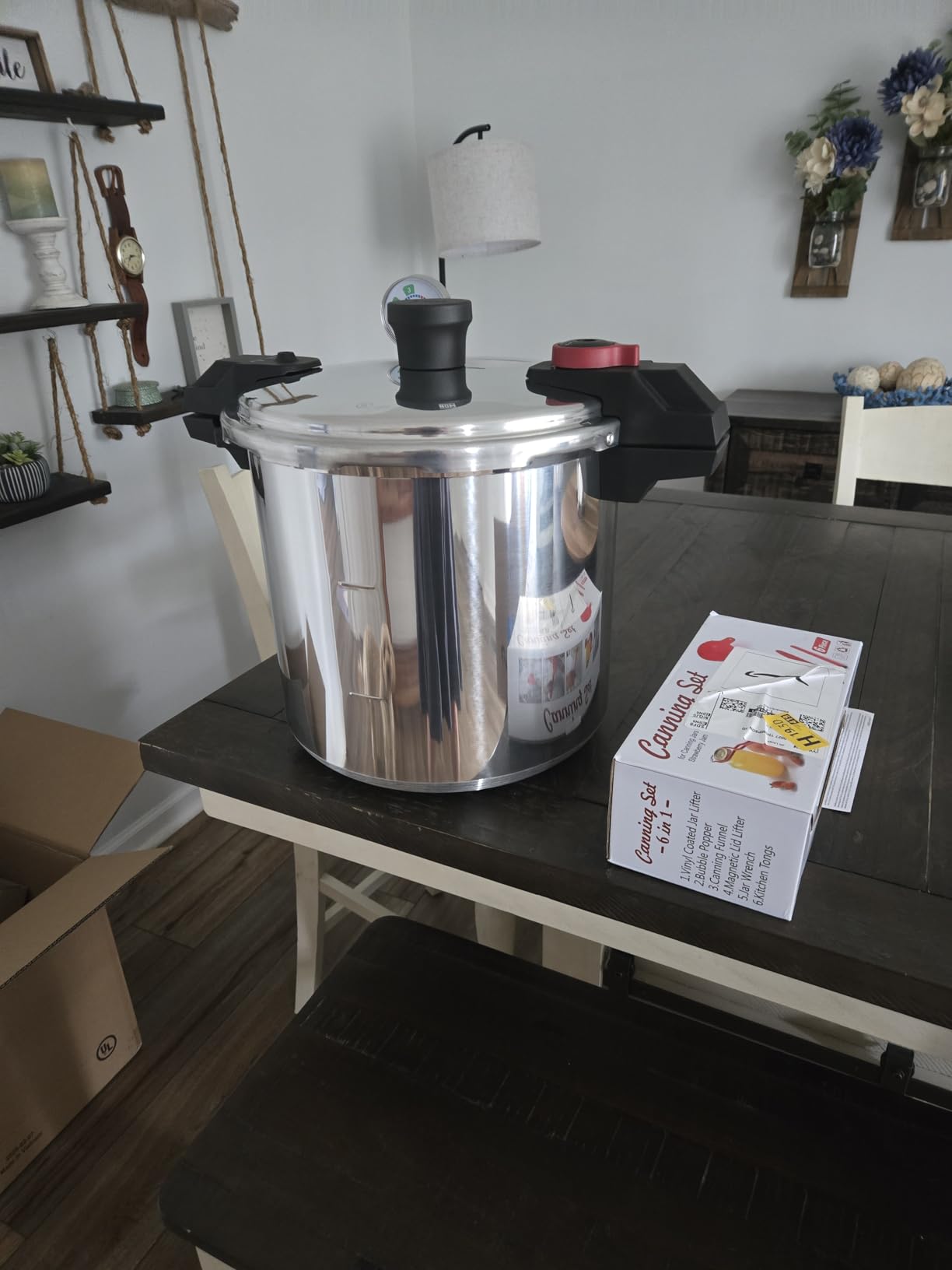
It also arrives with a complete step-by-step canning guide, which matters more than it sounds. New canners need the processing time for their specific food at their specific altitude, and having that in the box removes a common source of error.
Regular users report consistently good seals with no jar failures, and it handles both pressure canning and boiling-water canning in the same pot, so seasonal jams and salsas need no second appliance.
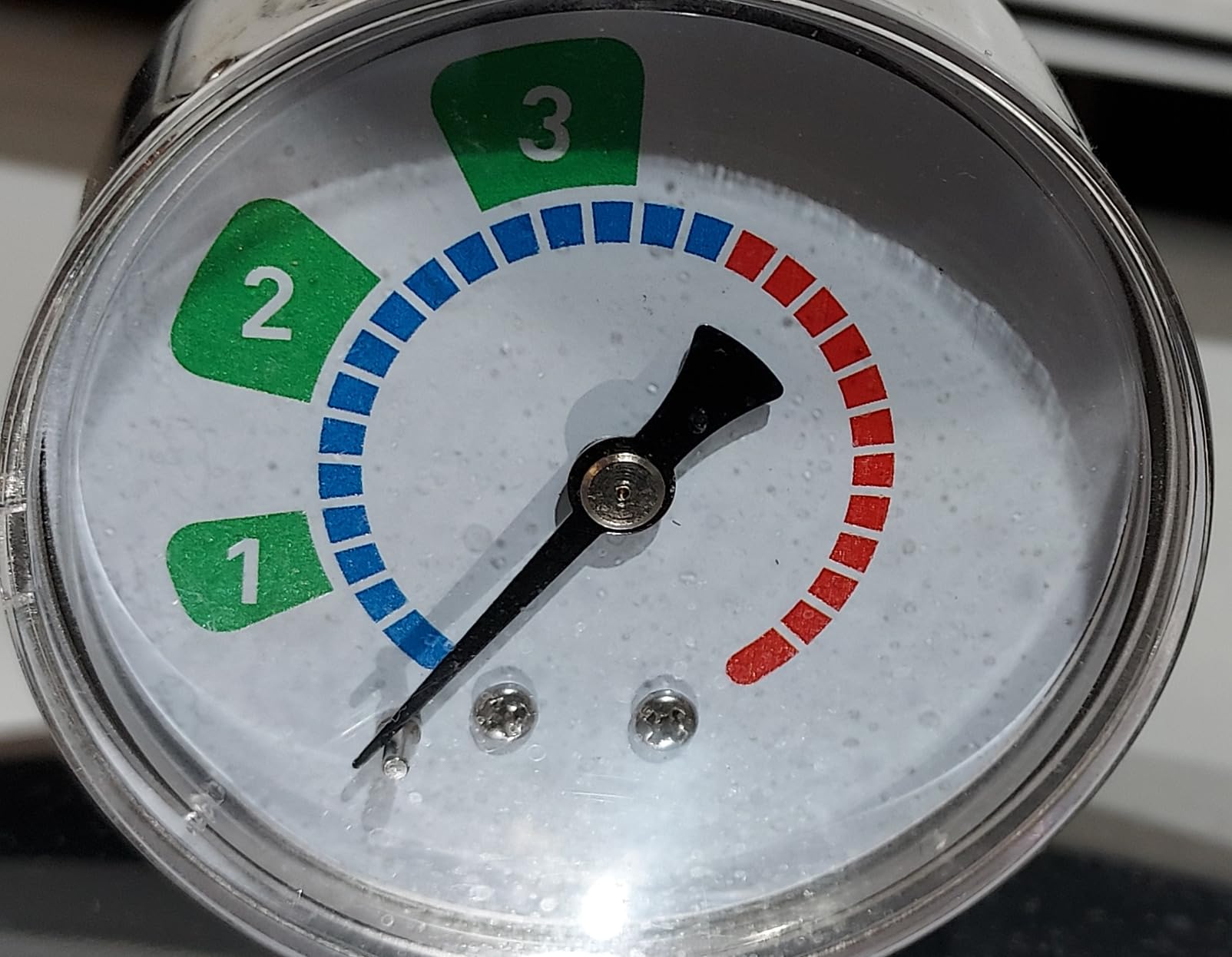
The critiques are worth taking seriously. The gasket can leak slightly at the handle and needs cleaning or occasional reseating, and some units auto-vent before reaching 15 PSI, which forces you to run the burner very high to compensate.
There are also reports of inconsistent gauge calibration and indicator valve behaviour across units, plus a 16.26 inch height that needs real burner clearance. We would check pressure behaviour on a small test batch early in the season rather than finding out at peak harvest.
Who this canner suits
First-time canners working up to roughly 40 to 50 jars a season, and households that want a single pot for pressure canning, water-bath canning and everyday pressure cooking. The included guide and gauge make it the least intimidating entry point here.
It is also a strong choice for a small kitchen, because 22 quarts covers a meaningful load without the 33-pound lifting problem of the 41.5-quart canners.
Who should look elsewhere
If you plan to can every week, the gasket maintenance and the auto-vent reports will wear on you. A weighted-gauge or metal-seal design removes both problems.
Glass-cooktop and induction households should also skip it: the polished aluminum body is not a good match for either, and the warranty is one year, the shortest in this roundup.
How Many Jars Fit in a Large-Batch Load?
Quart capacity and jar capacity are not the same measurement, which is why people get frustrated comparing listings. Pot volume includes the headspace the pot needs to work, so the number of jars that fit is always lower than the quart figure suggests.
4 to 5 quart jars is the USDA minimum, and the Hawkins Bigboy reaches it with a tall cylindrical layout. That is enough for a small household, not for a garden harvest.
6 to 7 quart jars is the practical standard. The Presto 01781, the Presto 01784, the Presto 02153 and the T-fal 22 all reach 7 quarts, which is the baseline most large-batch buyers end up at.
Two layers of smaller jars is the same 23-quart pot doing much more work, and it needs a second canning rack. Both Presto models reach 20 pints or 26 half-pints this way, the T-fal reaches 24 half-pints or 18 pints, and the MIRRO and T-fal include the second rack in the box.
About 19 quart jars or 32 pints is what the All American 941 does, and no other certified canner in this roundup comes close.
So the real large-batch question is how many small jars you can stack. If your harvest is mostly quarts, capacity above 7 quarts is where the returns start. If it is jams and salsas, buy the second rack before you buy the bigger pot.
One more number nobody publishes: a second rack is the cheapest throughput upgrade available. It turns a 7-quart canner into a 20-pint canner for less than the step up to a larger tier.
How to Choose a Pressure Canner for Large Batches
Start with jars per load, not pot size. Count what a real harvest produces. If a good week gives you 7 quarts, a 23-quart canner is finished. If it gives you 20, look at the 41.5-quart class or plan on two loads. The 4-quart USDA minimum is a safety floor, not a target.
Decide stovetop or electric early. Stovetop canners reach higher capacity and last for generations, and the electric Presto 02153 removes the monitoring entirely with sensor-driven control and automatic altitude adjustment. If you have no stovetop, the choice is made for you.
Match the base to your cooktop. Bare aluminum will not work on induction and is what glass-ceramic owners report scratching. A stainless-clad base, as on the Presto 01784, or a hard anodized body, as on the Granite Ware, solves both problems.
Choose a dial, a weighted regulator, or both. A weighted regulator is simple and needs no maintenance, but a dial gives you a number to confirm, which matters above 1,000 feet where water boils cooler. The Presto 01781 and 01784 give you both, and the electric Presto handles altitude automatically.
Factor in the gasket. This is the single most-repeated trust signal in the canning community. All American models use a precision-machined metal-to-metal seal, so there is nothing to replace; Presto, MIRRO, T-fal and the digital Presto all use a rubber sealing ring that should be inspected annually and replaced roughly every one to three years.
Do not forget calibration. Dial gauges need annual verification, usually arranged through a Cooperative Extension office. Weighted gauges do not. If you live somewhere far from an extension office, that tips the decision toward a weighted design.
Budget the accessories up front. Second racks, 5 and 10 pound regulator weights and heat diffuser mats are all sold separately for several models. Buying them on day one avoids the common discovery halfway through a harvest that your 23-quart pot will not stack jars out of the box.
Check clearance and weight last, not first. A 41.5-quart canner is 19 inches tall and 33 pounds empty, so it needs overhead burner space and has to be filled where it sits. A 20-quart canner at 10.5 pounds goes in and out of a cabinet easily. Neither is right for every kitchen, which is the case for a two-canner setup: a small canner for shoulder season and a large one for peak.
Whatever else you buy, wash your gear properly between sessions. Our guide to gas pressure washers for decks covers the kind of wash-down setup that handles jars, racks and canner parts in one pass. If most of your gear lives in the garage rather than the kitchen, our picks for electric pressure washers for cars apply the same cleanup-after-use discipline to a smaller, more portable machine.
Pressure Canner vs Pressure Cooker: Where the Safety Line Sits
A pressure canner is a USDA-approved processing vessel. It holds 10 or 15 PSI at canning pressure for the full processing time a low-acid food requires, typically 20 to 90 minutes, and it is designed to bring jars to a safe internal temperature that destroys botulism spores.
A pressure cooker is built to cook food quickly at high pressure and is not certified for canning. Electric multicookers are not approved for canning either, and no test kitchen recommendation for a pressure cooker changes that. Follow the manufacturer’s canning instructions and the current USDA or NCHFP guidance, and do not improvise a canning process on an appliance that was not built for it.
Jars should also stay off the side walls. They belong on the canning rack with space between them so water and steam circulate, and a canner filled past its capacity can jostle jars when the lid is locked.
Whatever you choose, process low-acid foods only for the time listed in a current USDA or extension service recipe, adjust for altitude as the guidance specifies, and leave finished jars undisturbed for 12 to 24 hours.
Frequently Asked Questions
Is there a pressure canner that doesn’t require a gasket?
Yes. All American models use a precision-machined metal-to-metal sealing system instead of a rubber gasket, so there is nothing to replace or sterilize. Presto, MIRRO, T-fal, Granite Ware and Hawkins all use a rubber sealing ring that should be inspected annually and replaced roughly every one to three years.
Can jars touch the side of a pressure canner?
It is best practice to keep jars off the side walls. Jars should sit on the canning rack with space between them so water and steam circulate evenly. Resting jars against the canner wall can lead to uneven heating, and overfilling the canner can jostle jars when the lid is locked.
Are All American pressure canners worth it?
For heavy or large-batch use, yes. The gasket-free metal seal, cast aluminum construction and US manufacturing make them the most durable option here and remove the recurring gasket cost. The All American 941 also carries the largest certified jar load here at about 19 quart jars. For light or occasional use a Presto 23-quart is the better value.
How many jars fit in a 23 quart pressure canner?
A 23-quart pressure canner holds 7 quart jars on a single rack, or 20 pints and 26 half-pints when you add a second canning rack. The Presto 01781, Presto 01784, Presto 02153 and T-fal 22 all reach 7 quarts. The second rack is usually sold separately.
Which pressure canner has the highest rating?
The All American 941 has the highest rating in this roundup at 4.9 stars across 9769 reviews, and the Presto 01781 leads on review volume at 20113 reviews. In this category review volume and long ownership histories matter as much as the raw star average, because the canners that are still in use are the ones that were built to last.
Final Verdict: The Best Pressure Canners for Large Batches in 2026
The All American 941 is our pick for the best pressure canners for large batches because it finishes the most jars per stove hour, carries a 4.9 rating across 9769 reviews, and never asks you to replace a gasket. The Presto 01781 is the value pick at 7 quart jars with a 12-year warranty, and the Presto 01784 is the answer for induction kitchens.
Whichever you choose, buy the second rack on the same day, match the base to your cooktop, and follow a current USDA or extension recipe for processing times. Volume is what you came for, and safety is what keeps the jars on your shelf.