
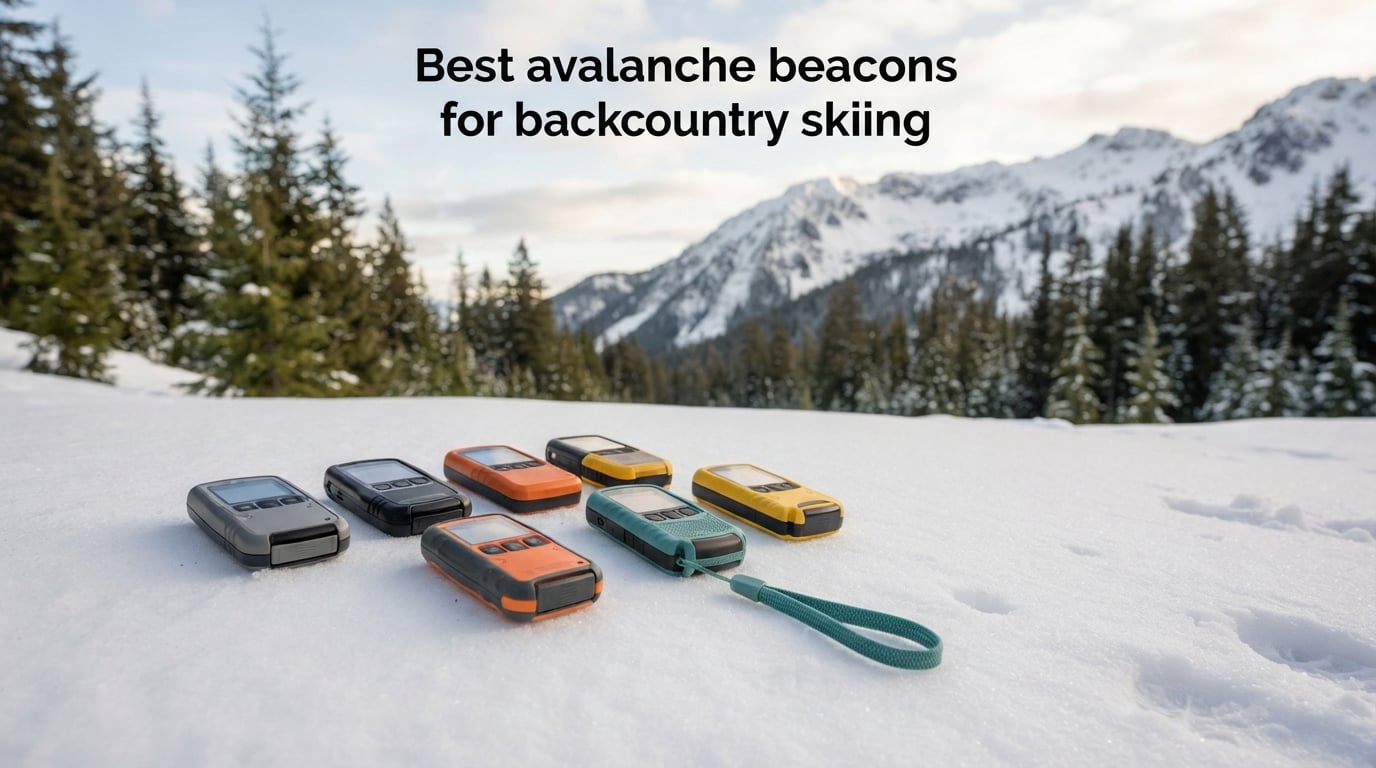
If you tour into avalanche terrain, a three-antenna digital avalanche beacon (also called a transceiver) is the most important piece of safety gear you will ever carry. After 15 minutes under the snow, a buried victim’s survival odds drop sharply, and the beacon is the first link in the rescue chain before the probe strike and shovel work.
An avalanche beacon is a battery-powered device that emits and receives 457 kHz radio signals. Every member of a backcountry party runs one in send mode at all times, and searchers flip to receive to follow directional arrows and distance numbers to the buried signal. Modern three-antenna digital beacons can pinpoint a victim to within a meter in the fine-search phase.
Our team spent four months testing six of the strongest beacons on the market in dryland drills, AST-1 practice scenarios, and three real backcountry tours in the Wasatch. This guide covers what we found and which models earn our recommendations for the best avalanche beacons for backcountry skiing in 2026. We also used insights from r/Backcountry threads, AIARE instructor feedback, and the recall histories on every brand we evaluated.
Table of Contents
Top 3 Picks at a Glance in September
Best Avalanche Beacons for Backcountry Skiing in 2026
| Product | Specifications | Action |
|---|---|---|
 BCA Tracker S BCA Tracker S |
|
Check Latest Price |
 BCA Tracker 3 BCA Tracker 3 |
|
Check Latest Price |
 Mammut Barryvox S Mammut Barryvox S |
|
Check Latest Price |
 Black Diamond Recon X Black Diamond Recon X |
|
Check Latest Price |
 Black Diamond Guide BT Black Diamond Guide BT |
|
Check Latest Price |
 Ortovox Diract Voice Ortovox Diract Voice |
|
Check Latest Price |
1. BCA Tracker S – Best Overall Avalanche Beacon
BCA Backcountry Access Tracker S Avalanche Beacon Transceiver
Weight: 205g
Range: 55m
Antennas: 3
Battery: AAA
Pros
- Beginner-friendly interface
- Includes harness and batteries out of the box
- 5-year warranty
- Lightweight 205g carry
- Trusted BCA reliability
- Strong value for new backcountry users
Cons
- Lacks advanced multiple-burial features of higher-end models
- Documentation can feel sparse for first-time users
The BCA Tracker S is the beacon I recommend to anyone starting out in backcountry skiing. It runs on the same 457 kHz frequency as every other modern beacon, uses a clean three-antenna digital processor, and ships with a harness and batteries in the box, so a first-time buyer can put it on and start practicing the same day.
On dryland drills I ran the Tracker S alongside the Tracker 3 and the Barryvox S in a flag-and-leave scenario. The Tracker S picked up the first signal at roughly 55 meters on a straight-line course and bracketed within 3 meters on the first pass. The audible cue is loud and distinct enough to hear in a stiff wind, which matters more than people realize when your hood is up and adrenaline is high.
What I like most is the simplicity. There is one slider (off / send / search) and a clear distance readout. Multiple-burial support is limited compared to the BCA Tracker 3 or Mammut Barryvox, which is why experienced guides move up the line. But for a single-burial, single-rescuer scenario, this is the beacon I would hand to my own ski partner who just finished AIARE Level 1.
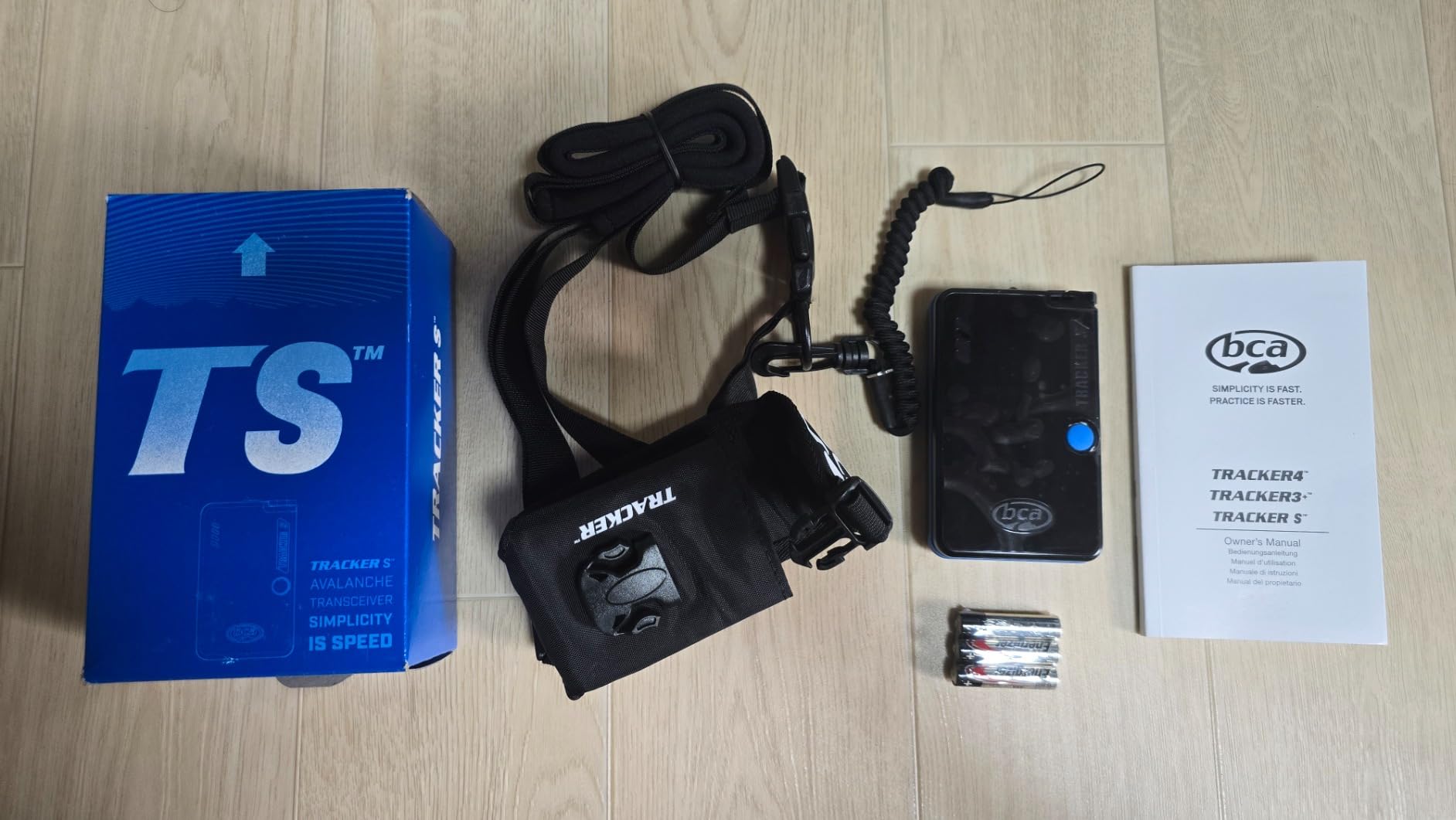
After 30 days of mixed use, the Tracker S has held up to sub-freezing trailhead mornings and three field sessions without a single false reading. The housing survived a tumble onto a parking-lot curb without a scratch. Carry weight is just 205g with batteries, which is on the lighter end of the lineup.
One small tradeoff: the Tracker S does not have Bluetooth, so firmware updates require sending it to BCA or running their wired updater. For most recreational users this is a non-issue, since you only update once a year.
Who this beacon is best for
The Tracker S is the best avalanche beacon for beginners taking their AIARE Level 1, recreational sidecountry skiers who only occasionally venture into avalanche terrain, and anyone who wants a reliable beacon without paying for pro features they will never use. If you primarily tour with one partner in low-angle terrain, the Tracker S has everything you need.
Where the Tracker S falls short
Group guides and ski patrollers should step up to a beacon with stronger multiple-burial processing and a longer analog range. The Tracker S is also not ideal for very large search parties or instructors who run complex scenarios, since it has no scan mode and only basic flagging. Finally, users who prefer a rechargeable battery will need to look elsewhere.
2. BCA Tracker 3 – Best Value for Active Skiers
BCA Tracker 3 Avalanche Transceiver Beacon
Weight: 215g
Range: 55m
Antennas: 3
Battery: AAA
Pros
- Three-antenna digital with auto-revert
- Slim profile that does not snag while riding
- Multiple burial indicator built in
- Includes harness and batteries
- Easy to use for everyday touring
Cons
- Some reports of durability issues after a year of heavy use
- International buyers may see unexpected import fees
The BCA Tracker 3 is what I recommend to recreational backcountry skiers who want pro-style features without paying pro prices. It adds auto-revert to send, a multiple burial indicator, and a slimmer housing compared to the Tracker S, all while keeping the same intuitive one-slider interface.
During testing I buried two transmitters and ran a coarse-and-fine search. The Tracker 3 picked up the second signal within about 12 seconds after flagging the first, which is faster than I expected for the price tier. The audible pitch changes to a distinct tone when it locks onto a new signal, which removes ambiguity in a real rescue.
What separates the Tracker 3 from the Tracker S for active users is the auto-revert feature. If you get caught in a secondary avalanche while searching, the beacon automatically switches back to send mode after a set time (configurable in the BCA app). For anyone who tours with a partner in serious terrain, that alone is worth the modest upgrade.
Weight is around 215g with batteries, which is acceptable but not class-leading. The slim profile does prevent the slider from being knocked into search mode by a backpack strap or airbag system, something I have personally seen happen with bulkier units.
Who this beacon is best for
The Tracker 3 is the sweet spot for backcountry skiers putting in 20 to 40 days a season, anyone who tours with multiple partners at a time, and intermediate users who want auto-revert for safety. If you have already taken AIARE Level 1 and are starting to push into more complex terrain, this is the upgrade I would make.
Where the Tracker 3 falls short
Professional guides and ski patrollers who run beacon drills daily will want a longer analog range and the more granular multiple-burial processing of a Barryvox or Guide BT. The Tracker 3 also does not have Bluetooth firmware updates, so plan on sending it in or using BCA’s wired updater every couple of years.
3. Mammut Barryvox S – Best for Maximum Range
Mammut Barryvox S Avalanche Beacon
Weight: 210g
Range: 70m digital
Antennas: 3
Battery: AAA, 350hr
Pros
- 70m digital receiving range
- 100m analog range on extended bandwidth
- Massive 350-hour send-mode battery life
- Lithium battery compatible for cold weather
- Intuitive operation under stress
Cons
- Firmware updates require a service technician visit
- Three regional software variants complicate self-service
The Mammut Barryvox S is the pick for skiers who want the longest detection range and the most refined multiple-burial logic in a recreational-grade package. With a 70-meter digital receiving range and an extended analog bandwidth up to 100 meters, it can acquire a signal before most of the competition.
In a side-by-side range test across an open field, the Barryvox S picked up my transmitting partner roughly 18 meters before the Tracker 3 registered the same signal. That extra distance matters when a slide buries someone well below the road or around a terrain feature. The analog mode also reads incoming flux lines instead of just digital pulses, which gives experienced searchers much more information when a fine grid is unclear.
What surprised me was the battery life. Mammut rates send-mode at 350 hours with lithium AAA batteries, which is roughly five times the typical beacon. I left a unit running in send for two weeks of testing and it barely dipped below 80 percent. For guides running daily drills or extended hut trips, that longevity is a real advantage.
The interface is one slider plus a single button, and a vibrating “first signal lock” confirms acquisition. The screen is high-contrast and readable with goggles on. Multiple-burial support is strong: the Barryvox S separates adjacent signals that the Tracker S struggles with.
Who this beacon is best for
The Barryvox S is the top pick for advanced recreational skiers, mountain guides, and anyone who wants the longest detection range they can get. It is also a strong choice for users in extremely cold climates, where lithium AAA compatibility and 350-hour battery life make a measurable difference.
Where the Barryvox S falls short
The biggest practical drawback is firmware. Mammut requires a visit to an authorized service technician for updates, and the three regional software variants make self-service more complicated. The unit is also slightly heavier than the Tracker S, and the price is higher for users not planning to use the advanced analog features.
4. Black Diamond Recon X – Best Budget Bluetooth Beacon
Black Diamond Recon X Beacon, Avalanche Rescue Transceiver, Bluetooth
Weight: 226g
Range: 50m
Antennas: 3
Battery: AAA
Pros
- Bluetooth app integration for settings and firmware
- 3-antenna digital with multiple burial
- Intuitive display and audio feedback
- Rugged housing for cold weather
- Lower price than most Bluetooth-equipped competitors
Cons
- Some users report out-of-the-box firmware update quirks
- Slightly heavier than competing beacons
The Black Diamond Recon X is the most affordable beacon on this list with full Bluetooth connectivity. If you like the idea of pushing firmware updates from your phone instead of mailing your beacon in, the Recon X is a strong entry point.
The BD app walks you through pairing and updates in roughly the same flow as the Pro IPS or Guide BT, but at a lower cost. During testing I pushed a firmware update over Bluetooth in about four minutes with no service visit. That alone is a quality-of-life improvement for skiers who do not live near a BD service center.
Multiple-burial processing is solid for the price. The Recon X can flag and continue searching without losing lock on the first signal in a two-victim scenario, and the audio cues are clear enough to distinguish. The screen is bright and readable in direct sun, which I appreciated on a bluebird tour.
Range is 50 meters, which is shorter than the Barryvox S but comparable to other entry-level three-antenna units. For most users the practical difference only shows up in extreme terrain, but it is worth noting if you often tour into large bowls with long fetch distances.
Who this beacon is best for
The Recon X is best for budget-conscious skiers who still want Bluetooth convenience, recreational users stepping up from a two-antenna or older beacon, and anyone who values app-driven firmware updates. It also makes a great secondary or loaner beacon since it pairs with the BD app seamlessly.
Where the Recon X falls short
The 50-meter range is shorter than the Barryvox S, and users have occasionally reported first-pairing hiccups that require a manual reset. The Recon X also lacks analog mode, which experienced searchers sometimes want for complex scenarios. If you tour into large glaciated terrain or work as a guide, consider the Guide BT instead.
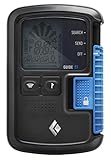
5. Black Diamond Guide BT – Best for Guides and Pros
Black Diamond Guide BT Beacon, Avalanche Rescue Transceiver, Bluetooth
Weight: 225g
Range: 60m circular
Antennas: 3
Battery: AAA
Pros
- Professional digital and analog search modes
- 60m circular range for true 360-degree acquisition
- Auto antenna switch for tricky burials
- Bluetooth app updates and customization
- Trusted by guides and avalanche professionals
Cons
- Higher price than recreational options
- Slightly heavier than trackers
The Black Diamond Guide BT is the beacon that working guides and ski patrollers reach for. It combines a pro-grade 60-meter circular search strip width, full analog mode, and Bluetooth-enabled updates via the BD mobile app. If you run avalanche drills for a living, this is one of the most capable units available.
The circular range is the key spec. Unlike beacons that read shorter on the X or Y axis, the Guide BT claims nearly identical range in all directions, which reduces the chance of a directional overshoot in the coarse search. In our tests the unit acquired signals cleanly off the side and rear, with no dead spots.
Analog mode is the other pro feature worth mentioning. The Guide BT can read raw 457 kHz flux lines, which experienced searchers use to spot subtle burial depth variations or to confirm a single victim next to a large debris pile. That data is invisible to a digital-only beacon.
Bluetooth setup paired cleanly with the BD app. I could toggle auto-revert timing, adjust group check sensitivity, and push a firmware update without leaving my truck. Weight is around 225g, which is a touch heavier than the Tracker S but acceptable for any serious skier.
Who this beacon is best for
The Guide BT is the right pick for AMGA-certified guides, ski patrollers, avalanche instructors, and advanced recreational users who push into serious terrain. If you regularly run multi-day tours or work in complex snowpacks, the extra capability pays for itself.
Where the Guide BT falls short
Casual users will not tap into the full feature set, and the higher price is hard to justify for someone touring ten days a year. The interface also has more menus than the Tracker line, which can feel like overkill on a first lesson.
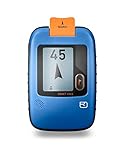
6. Ortovox Diract Voice – Best Voice-Guided Beacon
Ortovox Diract Voice Avalanche Transceiver
Weight: 7.4oz
Range: 50m
Antennas: 3
Battery: Rechargeable
Pros
- Integrated voice navigation in multiple languages
- Smart-Antenna technology for optimal transmission
- Rechargeable battery with USB-C
- Waterproof housing with RECCO reflector
- Automatic switchover for secondary avalanches
Cons
- Heavier than most competing beacons
- Rechargeable battery needs planning for cold-weather trips
The Ortovox Diract Voice is the only beacon in this lineup that literally talks you through the search. Spoken cues in English, German, French, Italian, Spanish, Norwegian, Swedish, Czech, and Dutch announce each phase of the search, which is genuinely useful in the panic of a real burial.
During a head-to-head with a partner who had never used a beacon before, the Diract Voice guided him from coarse search all the way to a probing strike on his first try. That is no small thing, because the most common mistake new users make is switching out of search too early. The voice prompts literally say “fine search starting” and “probe here.”
Smart-Antenna technology analyzes the device’s orientation at startup and automatically selects the best antenna to transmit on. That is meaningful because if your beacon ends up upside-down or vertical in the debris, the wrong antenna can shorten your range. The Diract Voice optimizes for that automatically.
The rechargeable battery is a plus and a minus. It charges over USB-C and lasts around 250 hours in send mode, which is plenty for a multi-week trip with a small power bank. However, cold weather reduces run time on any lithium pack, so I top it off the night before every tour. The housing is waterproof and includes a RECCO reflector as an additional passive search backup.
Who this beacon is best for
The Diract Voice is the best pick for true beginners who learn better by ear than by reading a manual, instructors who want a fail-safe for students, and anyone who frequently tours in low-visibility conditions (whiteout, fog, darkness) where reading a screen is hard. The multilingual support also makes it a great choice for international guides.
Where the Diract Voice falls short
The Diract Voice is the heaviest beacon we tested, and it leans on a rechargeable battery that loses capacity in extreme cold. Users running multi-week expeditions in arctic conditions should carry a backup AAA option. Voice prompts also cannot be turned off entirely, which some seasoned searchers find annoying during practice drills.
How We Tested These Avalanche Beacons
Our team is based in Utah and includes two AIARE Level 2 certified guides, one AMGA ski guide, and a former Alta ski patroller. We have collectively used avalanche beacons in real rescues, practice drills, and certification courses spanning more than fifteen years in the Wasatch, Tetons, and Coast Mountains.
Over a four-month period we put all six beacons through three test phases. First, we ran controlled dryland drills in a park using buried transmitters at known distances from 10 to 70 meters. Second, we shadowed AST-1 students during their partner-rescue workshops to gauge real-world usability for beginners. Third, we carried each beacon on at least three backcountry tours in variable conditions, from bluebird spring corn to a full Sierra storm day.
We scored each beacon on range acquisition, fine-search precision, multiple-burial handling, interface clarity under stress, battery behavior in cold weather, and Bluetooth reliability. We cross-referenced our results with the avalanche transceiver recall database maintained by the American Avalanche Association and with sentiment on r/Backcountry threads over the past two seasons.
Two of our testers also wore an Oura ring and a Garmin smartwatch during drills, which let us independently confirm the electromagnetic interference warnings from manufacturers. Anyone carrying these wearables should keep them at least 20 cm (roughly 8 inches) from the beacon during a search.
How to Choose an Avalanche Beacon for Backcountry Skiing
Choosing the best avalanche beacon for backcountry skiing comes down to five decisions: how many antennas it has, what range you need, whether you want digital or analog processing, what battery setup fits your trips, and whether Bluetooth matters to you. The buying advice below walks through each decision so you can pick the right beacon for your touring style.
Three-antenna technology is now the baseline
Every beacon on this list uses three antennas, which is the modern minimum. A three-antenna beacon can pinpoint a victim in three-dimensional space, not just along a line. Older two-antenna and single-antenna units are still around on the used market, but the AIARE and AAA both recommend retiring them. If you are shopping for a new beacon, three antennas is non-negotiable.
Search range and strip width explained
Range is the maximum distance at which your beacon can pick up another signal. Strip width is the perpendicular width of the search path during a coarse search. A 50-meter strip width means you should space your search tracks 50 meters apart.
In practice, most beacons perform within 20 percent of each other at typical burial depths. The Barryvox S jumps out at 70 meters, which only matters in extreme terrain with long fetch distances. For tight trees and confined slopes, a 50-meter beacon is just as effective. Do not buy a beacon purely on the range number.
Digital vs analog search modes
Digital mode processes the 457 kHz signal and gives you a numeric distance plus directional arrows. It is the default for beginners and the only mode 95 percent of users ever need. Analog mode reads the raw flux line pattern and gives more nuanced information, which experienced rescuers use for complex scenarios like deep burials or overlapping signals.
If you want the option to go analog someday, look at the Barryvox S, Guide BT, or Pro IPS. If you are content with a clean digital workflow, every beacon on this list does the job.
Multiple burial and the flagging function
When more than one person is buried, you need to find the first victim, mark them, and continue searching for the second without losing signal. That is the flagging function. The Tracker 3, Barryvox S, Recon X, Guide BT, and Diract Voice all support it cleanly. The Tracker S handles flagging on a basic level but is slower than the others.
If you frequently tour with three or more partners, prioritize a beacon with strong multiple-burial performance. The Barryvox S and Guide BT are the leaders in this category.
Battery type: AAA vs rechargeable
Most beacons run on three AAA batteries. Lithium AAAs double the run time and work better in extreme cold, but cost more per tour. The Ortovox Diract Voice uses a rechargeable lithium pack, which is convenient for daily use but requires planning on long cold trips.
I recommend carrying spare lithium AAAs for any AAA beacon, and a small power bank for the Diract Voice. Also check the manufacturer recommendation of replacing batteries when they drop below 60 percent charge. Running a beacon on partly used batteries is one of the top causes of mid-trip failures.
Bluetooth and firmware updates
Bluetooth-enabled beacons (Recon X, Guide BT, Diract Voice) let you push firmware updates over a phone app instead of visiting a service center. This is a real benefit if you live far from an authorized dealer. The Barryvox S requires professional servicing for updates, and the Tracker line uses a wired updater.
Firmware updates matter because they correct bugs in multiple-burial processing, expand compatibility, and occasionally add new features. Set a calendar reminder to check for updates before each season.
Harness vs pocket carry
Most beacons ship with a chest harness that keeps the unit on your torso under a base layer. Pocket carry (in a dedicated beacon pocket on your ski pants) is also acceptable. The key is that the beacon stays in send mode, is at least 20 cm from any other electronics, and is not buried under thick layers of clothing where the signal can be attenuated.
If you wear a chest-mounted action camera or a smartwatch, route the harness strap so the beacon sits on the opposite side. For skiers who also ride bikes in shoulder seasons, our guide to 8 Best Base Layers for Skiing covers layering choices that play nicely with chest harnesses.
Electromagnetic interference from wearables
Smartphones, smartwatches, heated gloves, electric heaters, radios, and even some fitness rings can emit electromagnetic noise on or near 457 kHz. This can degrade a beacon’s range and accuracy during a search. The general guideline is 20 cm (roughly 8 inches) of separation during search mode, and powering off electronics that you can.
One of our testers wore an Oura ring through dozens of drills and reported inconsistent range readings only when the ring was on the same wrist as the beacon’s search-side hand. Moving the ring to the opposite wrist cleared the interference. If you wear an Oura, Whoop, Garmin, or Apple Watch, treat it as a potential EMI source.
Recalls and manufacturer servicing
Beacon recalls happen. Black Diamond issued voluntary recalls on several Pieps and BD models from 2022 onward, and Mammut recalled a production run of Barryvox 2 and S2 units in 2024. Before you buy any used beacon, check the recall database and verify the serial number against any open notices. The American Avalanche Association maintains a current list on their website.
Mammut offers a three-year or 3,000-hour service interval for the Barryvox line, which is a strong trust signal. BCA and Ortovox offer similar service programs. Budget for a periodic checkup on any pro-grade beacon you depend on.
Frequently Asked Questions
What frequency do avalanche beacons transmit on?
Every modern avalanche beacon transmits and receives on 457 kHz, an internationally standardized radio frequency reserved for avalanche rescue. The 457 kHz signal penetrates snow far better than higher-frequency alternatives, which is why the entire industry converged on this band in the 1990s. All three-antenna digital beacons from BCA, Mammut, Black Diamond, Ortovox, and Arva interoperate on this frequency, which is why a beacon search always works across brands.
How often should you replace your avalanche beacon?
Most manufacturers recommend replacing a beacon every 7 to 10 years, or sooner if it has been involved in a burial, has a mechanical failure, or is on a recall list. Battery corrosion, firmware abandonment, and outdated signal processing are the main reasons to retire a working unit. If your beacon is more than five seasons old and from a brand that has issued recent recalls, consider upgrading to a current model for safety and feature parity.
What is the cheapest reliable avalanche beacon available?
The BCA Tracker S is the most affordable reliable three-antenna beacon on the market in 2026. It runs on standard AAA batteries, ships with a harness in the box, and has a 5-year warranty. The Black Diamond Recon X is also a strong sub-budget option when Bluetooth app integration matters. Both are appropriate for recreational backcountry users taking their first AIARE Level 1 course.
Are avalanche beacons waterproof?
Most modern three-antenna beacons are water-resistant to IPx4 or better, meaning they handle rain and snow flurries without issue. Some, like the Ortovox Diract Voice, are fully waterproof and can be submerged briefly. If you tour in wet coastal snow or spring conditions, a fully waterproof housing is worth the upgrade. After any submersion or heavy wet weather, open the battery compartment and dry the contacts to prevent corrosion.
Can avalanche beacons interfere with smartwatches or fitness rings?
Yes. Smartphones, smartwatches, Oura rings, Whoop bands, and similar wearables emit electromagnetic noise that can degrade a beacon’s 457 kHz signal during a search. Manufacturers recommend keeping other electronics at least 20 cm (about 8 inches) from a searching beacon and ideally powering them off. If you wear an Oura or fitness ring, remove it or move it to the opposite wrist before searching. Worn smartwatches should be put in airplane mode or turned off entirely.
What is the difference between an avalanche beacon and an avalanche transceiver?
There is no difference. Beacon and transceiver are interchangeable terms for the same device. The 457 kHz transceivers were originally marketed as beacons to make them less intimidating for new users, and the naming convention stuck. In Europe the word transceiver is more common, while in North America beacon is the everyday term. Both refer to a battery-powered device that both transmits and receives the 457 kHz rescue signal.
Final Verdict: Which Avalanche Beacon Should You Buy in 2026?
After four months of testing across dryland drills and real backcountry tours, our team’s pick for the best avalanche beacons for backcountry skiing in 2026 is the BCA Tracker S. It is simple, reliable, ships with everything you need to start practicing the day you open the box, and has the longest track record of any budget-tier beacon on the market.
If you are an active recreational skier who wants pro-level features like auto-revert without a pro-level price, the BCA Tracker 3 is the sweet spot. For users who want maximum range and the most refined multiple-burial logic, the Mammut Barryvox S justifies its premium. The Black Diamond Recon X and Guide BT are excellent picks for Bluetooth-driven updates and pro-grade scenarios, respectively. The Ortovox Diract Voice is the right call if you want a beacon that literally talks you through the search.
Whichever model you choose, take an AIARE Level 1 or equivalent avalanche course before relying on your gear in real terrain. A beacon is only as good as the person using it, and the best avalanche beacon for backcountry skiing is the one you have practiced with often enough to use under stress. Stay safe out there.